
Isaiah 3:14

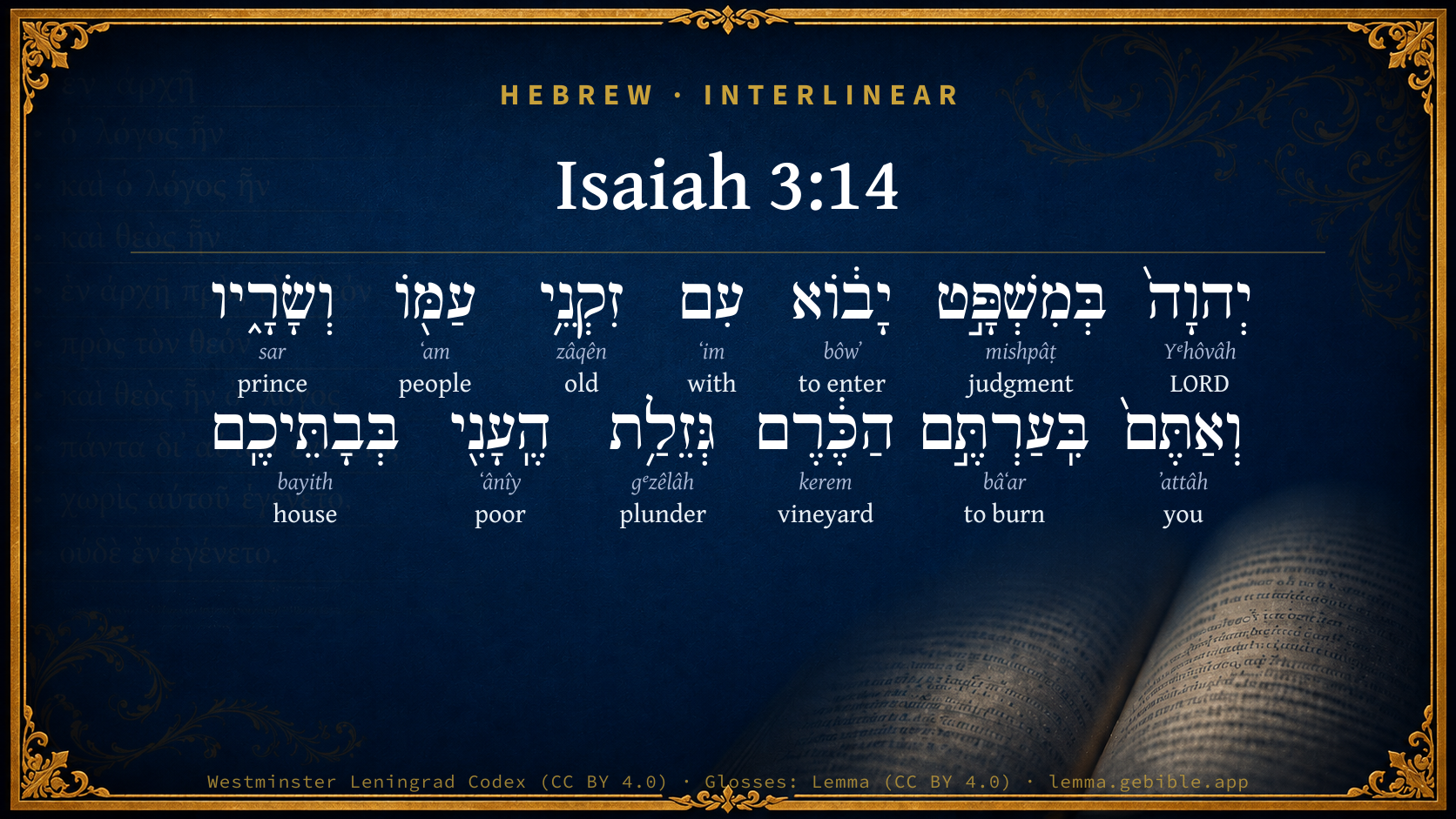
Hebrew (Westminster Leningrad Codex) Isaiah 3:14 appears in the Hebrew Old Testament. The text above is from the Westminster Leningrad Codex. Each word links to its Strong’s number, a concise gloss, and parsing drawn from the Open Scriptures Hebrew Bible morphology. Click any word for its full Brown-Driver-Briggs (BDB) entry.
Download image
Cite this verse

Isaiah 3:14 (World English Bible). Public Domain. Lemma interlinear Bible study tool, https://lemma.gebible.app/v/isaiah/3/14.

Show BibTeX & RIS
BibTeX
RIS
English Translation
Yahweh will enter into judgment with the elders of his people, And their leaders: "It is you who have eaten up the vineyard. The spoil of the poor is in your houses.
World English Bible · Public Domain
Download a study sheet

One document with this verse’s original text, its word-by-word gloss line, the meaning frame, cross-references with their text, attributed commentary, and full source and license credits — printable, and it pastes into notes with its structure intact.

This verse Autodidact and up

Study sheet (.html) Plain text (.txt)

A passage Seminary Student

Up to 50 verses in one chapter. A passage sheet keeps up to 6 commentary sources and 12 cross-references per verse, in the order this page ranks them, and says so on the sheet whenever that leaves anything out. Ask for a single verse and you get the Autodidact verse sheet above.

Everything on this page stays free to read, with no account — the sheet is a download of what is already on screen, not access to it.

Want to remove ads? Support Godless Engineer
Compare translations 3

The same verse in 3 English versions, stacked beneath the original-language interlinear above. Click any original word for its lexicon entry.

Each is an independent rendering of the whole verse — the interlinear is not word-aligned to these translations.

Highlighted words mark where these versions differ — a whole-verse word diff, not a word-by-word alignment.

  • World English Bible Public Domain
    Yahweh will enter into judgment with the elders of his people, And their leaders: "It is you who have eaten up the vineyard. The spoil of the poor is in your houses.
  • King James Version Public Domain
    The LORD will enter into judgment with the ancients of his people, and the princes thereof: for ye have eaten up the vineyard; the spoil of the poor is in your houses.
  • unfoldingWord Literal Text CC BY-SA 4.0
    Yahweh will enter into judgment with the elders of his people and its princes: “And you, you have consumed the vineyard; the plunder of the poor in your houses.

unfoldingWord Literal Text — © unfoldingWord, licensed CC BY-SA 4.0. Word-aligned USFM3 via Door43 (git.door43.org/unfoldingWord/en_ult).

Versions to compare (up to 4)

3 of 4 selected

Show all 18 translations

Every available English version of this verse, each an independent rendering of the whole verse.

  • World English Bible Public Domain
    Yahweh will enter into judgment with the elders of his people, And their leaders: "It is you who have eaten up the vineyard. The spoil of the poor is in your houses.
  • Berean Standard Bible Public Domain
    The LORD brings this charge against the elders and leaders of His people: “You have devoured the vineyard; the plunder of the poor is in your houses.
  • Majority Standard Bible Public Domain
    The LORD brings this charge against the elders and leaders of His people: “You have devoured the vineyard; the plunder of the poor is in your houses.
  • King James Version Public Domain
    The LORD will enter into judgment with the ancients of his people, and the princes thereof: for ye have eaten up the vineyard; the spoil of the poor is in your houses.
  • American Standard Version (1901) Public Domain
    Jehovah will enter into judgment with the elders of his people, and the princes thereof: It is ye that have eaten up the vineyard; the spoil of the poor is in your houses:
  • Revised Version (1885) Public Domain
    The LORD will enter into judgment with the elders of his people, and the princes thereof: It is ye that have eaten up the vineyard; the spoil of the poor is in your houses:
  • Geneva Bible (1599) Public Domain
    The Lord shall enter into iudgement with the Ancients of his people and the princes thereof: for ye haue eaten vp the vineyarde: the spoyle of the poore is in your houses.
  • Douay-Rheims (1899) Public Domain
    The Lord will enter into judgment with the ancients of his people, and its princes: for you have devoured the vineyard, and the spoil of the poor is in your house.
  • Young's Literal Translation Public Domain
    Jehovah into judgment doth enter With elders of His people, and its heads: `And ye, ye have consumed the vineyard, Plunder of the poor `is' in your houses.
  • Literal Standard Version CC BY-SA 4.0
    YHWH enters into judgment || With [the] elderly of His people, and its heads: “And you, you have consumed the vineyard, || Plunder of the poor [is] in your houses.
  • Unlocked Literal Bible CC BY-SA 4.0
    Yahweh will come with judgment against the elders of his people and their leaders: “You have ruined the vineyard; the plunder from the poor is in your houses.
  • unfoldingWord Literal Text CC BY-SA 4.0
    Yahweh will enter into judgment with the elders of his people and its princes: “And you, you have consumed the vineyard; the plunder of the poor in your houses.
  • Darby Bible Public Domain
    Jehovah will enter into judgment with the elders of his people and their princes, [saying:] It is ye that have eaten up the vineyard: the spoil of the poor is in your houses.
  • World Messianic Bible Public Domain
    The LORD will enter into judgment with the elders of his people and their leaders: “It is you who have eaten up the vineyard. The plunder of the poor is in your houses.
  • Webster's Bible Public Domain
    The LORD will enter into judgment with the elders of his people, and with their princes: for ye have eaten up the vineyard; the spoil of the poor is in your houses.
  • Free Bible Version CC BY-SA 4.0
    The Lord comes to give his judgment against the elders and leaders of his people: You are the ones who have destroyed my vineyard; your houses are full with everything you've stolen from the poor.
  • Bible in Basic English Public Domain
    The Lord comes to be the judge of their responsible men and of their rulers: it is you who have made waste the vine-garden, and in your houses is the property of the poor which you have taken by force.
  • JPS Tanakh (1917) Public Domain
    The LORD will enter into judgment with the elders of His people, and the princes thereof: 'It is ye that have eaten up the vineyard; the spoil of the poor is in your houses;

Literal Standard Version (2020), Covenant Press — licensed CC BY-SA 4.0. Text via the HelloAO Bible API (eBible.org). Unlocked Literal Bible (unfoldingWord) — licensed CC BY-SA 4.0. Text via the HelloAO Bible API (eBible.org). unfoldingWord Literal Text — © unfoldingWord, licensed CC BY-SA 4.0. Word-aligned USFM3 via Door43 (git.door43.org/unfoldingWord/en_ult). Free Bible Version, Dr. Jonathan Gallagher — licensed CC BY-SA 4.0. Text via the HelloAO Bible API (eBible.org).

Word by word

More ways to search: Search by grammar → Find every occurrence → Compare this word →

Practice this passage: Drill this verse → Learn its vocabulary →

גְּזֵלַ֥ת
gᵉzêlâh
H1500
“plunder of”
Noun, Common, Feminine, Singular, Construct
Part of Speech
Noun
Type
Common
Gender
Feminine
Number
Singular
State
Construct
Full BDB Definition

Origin: from H1498

TWOT: 337b

plunder, spoil, robbery
  1. יְהוָה֙ Yᵉhôvâh H3068 “LORD” Noun, Proper
  2. בְּמִשְׁפָּ֣ט mishpâṭ H4941 “in/at · judgment” Preposition + Noun, Common, Masculine, Singular, Absolute
  3. יָב֔וֹא bôwʼ H935 “to enter” Verb, Qal, Imperfect, 3rd Person, Masculine, Singular
  4. עִם ʻim H5973 “with” Preposition
  5. זִקְנֵ֥י zâqên H2205 “old of” Adjective, Adjective, Masculine, Plural, Construct
  6. עַמּ֖וֹ ʻam H5971 “people · his” Noun, Common, Masculine, Singular, Construct + Suffix, Personal, 3rd Person, Masculine, Singular
  7. וְשָׂרָ֑יו sar H8269 “and · princes · his” Conjunction + Noun, Common, Masculine, Plural, Construct + Suffix, Personal, 3rd Person, Masculine, Singular
  8. וְאַתֶּם֙ ʼattâh H859 “and · you” Conjunction + Pronoun, Personal, 2nd Person, Masculine, Plural
  9. בִּֽעַרְתֶּ֣ם bâʻar H1197 “to burn” Verb, Piel, Perfect, 2nd Person, Masculine, Plural
  10. הַכֶּ֔רֶם kerem H3754 “the · vineyard” Particle, Definite Article + Noun, Common, Both, Singular, Absolute
  11. הֶֽעָנִ֖י ʻânîy H6041 “the · poor” Particle, Definite Article + Adjective, Adjective, Masculine, Singular, Absolute
  12. בְּבָתֵּיכֶֽם bayith H1004 “in/at · houses · your” Preposition + Noun, Common, Masculine, Plural, Construct + Suffix, Personal, 2nd Person, Masculine, Plural

About this verse

These counts appear in no published source. They are computed here, from the morphology-tagged text and Lemma’s own curated glosses. What Lemma adds →

13
words
13
distinct lemmas
Prophets
section

Notable vocabulary

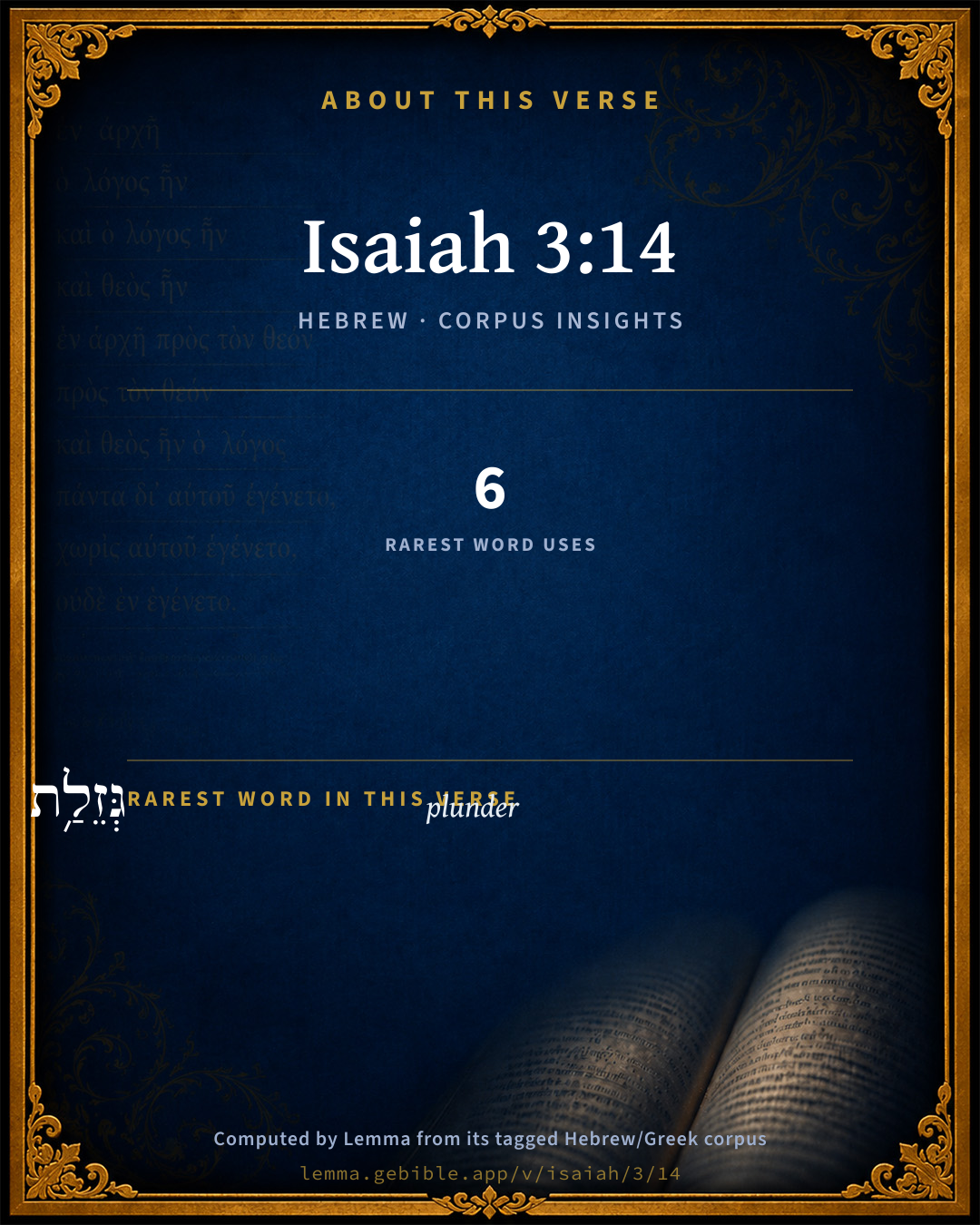
The rarest word here is גְּזֵלַ֥ת plunder H1500 — appearing just 6 times in the whole Hebrew Bible.

Shared distinctive vocabulary

גְּזֵלַ֥ת plunder H1500 occurs in 6 verses of the Hebrew Bible. Also found in:

Grammatical profile

  • 2 verbs
  • 7 nouns
  • 2 adjectives
  • 1 pronoun
  • 1 preposition

Verb forms

  • יָב֔וֹא Qal · Imperfect
  • בִּֽעַרְתֶּ֣ם Piel · Perfect

Hebrew & Septuagint length

In English translation the verse runs 32 words from the Hebrew and 37 from the Septuagint (LXX English) — closely comparable.

A rough comparison of the two English renderings, which tokenize alike — not a word-level alignment.

Word counts can differ between the Hebrew and the Greek without any difference in meaning — e.g. the Hebrew direct-object marker אֵת has no separate Greek word, and Greek often adds the article ὁ.

Cross-references

14

Topical passages linked to Isaiah 3:14 in the Treasury of Scripture Knowledge — connected by theme and wording, ordered by reader-vote popularity; previews shown in the World English Bible.

  • Job 22:4 Is it for your piety that he reproves you, That he enters with you into judgment?
  • Job 24:9 There are those who pluck the fatherless from the breast, And take a pledge of the poor,
  • Psalms 14:4 Have all the workers of iniquity no knowledge, Who eat up my people as they eat bread, And don't call on Yahweh?
  • Psalms 143:2 Don't enter into judgment with your servant, For in your sight no man living is righteous.
  • Isaiah 3:2–3 The mighty man, The man of war, The judge, The prophet, The diviner, The elder,
  • Isaiah 5:7 For the vineyard of Yahweh of Hosts is the house of Israel, And the men of Judah his pleasant plant: And he looked for justice, but, behold, oppression; For righteousness, but, behold, a cry of distress.
  • Jeremiah 5:27 As a cage is full of birds, so are their houses full of deceit: therefore they are become great, and grew rich.
  • Amos 4:1 Listen to this word, you cows of Bashan, who are on the mountain of Samaria, who oppress the poor, who crush the needy, who tell their lords, "Bring, and let us drink."
  • James 2:6 But you have dishonored the poor man. Don't the rich oppress you, and personally drag you before the courts?
  • Job 24:2–7 There are people who remove the landmarks. They violently take away flocks, and feed them.
  • Job 34:23 For he doesn't need to consider a man further, That he should go before God in judgment.
  • Micah 2:2 They covet fields, and seize them; And houses, and take them away: And they oppress a man and his house, Even a man and his heritage.
  • Micah 6:10 Are there yet treasures of wickedness in the house of the wicked, And a short ephah that is accursed?
  • Matthew 21:33 "Hear another parable. There was a man who was a master of a household, who planted a vineyard, set a hedge about it, dug a winepress in it, built a tower, leased it out to farmers, and went into another country.

Cross-references courtesy of OpenBible.info (CC BY 4.0).

Hebrew and Greek witnesses Masoretic Hebrew ↔ Greek Septuagint

The same verse in the two great witnesses to the Old Testament, shown verse-for-verse.

These are two independent witnesses, not word-aligned to each other, and the Septuagint is shown in lemma (dictionary) form.

Hebrew Isaiah 3:14 Masoretic · Westminster Leningrad Codex

יְהוָה֙ בְּמִשְׁפָּ֣ט יָב֔וֹא עִם זִקְנֵ֥י עַמּ֖וֹ וְשָׂרָ֑יו וְאַתֶּם֙ בִּֽעַרְתֶּ֣ם הַכֶּ֔רֶם גְּזֵלַ֥ת הֶֽעָנִ֖י בְּבָתֵּיכֶֽם

Yahweh will enter into judgment with the elders of his people, And their leaders: "It is you who have eaten up the vineyard. The spoil of the poor is in your houses.

World English Bible · Public Domain

Greek LXX Isaiah 3:14 Septuagint · lemma form

αὐτός κύριος εἰς κρίσις ἥκω μετά ὁ πρεσβύτερος ὁ λαός καί μετά ὁ ἄρχων αὐτός σύ δέ τίς ἐνπυρίζω ὁ ἀμπελών ἐγώ καί ὁ ἁρπαγή ὁ πτωχός ἐν ὁ οἶκος σύ

The Lord himself shall enter into judgment with the elders of the people, and with their rulers: but why have you⌃ set my vineyard on fire, and why is the spoil of the poor in your houses?

LXX2012 (modern English Septuagint) · Public Domain

On this verse, Adam Clarke's Commentary discusses the Septuagint’s reading. Read the note in Commentary ↓

Hebrew: Westminster Leningrad Codex (CC BY 4.0). Greek: Septuagint (public domain); English from LXX2012 (modern English Septuagint) (Public Domain). How the Septuagint differs from the Hebrew →

Targum (Aramaic paraphrase)

1

The Targum is the ancient Jewish Aramaic paraphrase of the Hebrew Scriptures — an interpretive translation, not the Hebrew text itself. Onkelos (literal) and Pseudo-Jonathan (expansive) render the Torah, and Jonathan the Prophets. Coverage is partial: where no permissively-licensed English translation exists for a verse, only the Aramaic is shown. This is verse-level text, not a word-by-word alignment to the Hebrew.

  1. Targum Jonathan Prophets (Joshua–Malachi)
    יְיָ בְּדִינָא יֵעוֹל יַת סָבֵי עַמָא וְסַרְכוֹהִי וְאַתּוּן אֲנִסְתּוּן יַת עַמִי חֲטוֹף מַסְכְּנָא בְּבָתֵּיכוֹן:

    The Lord will enter into judgment with the elders of His people, and with their oppressors; because ye have robbed my people, the spoil of the poor is in your houses.

    Targum Jonathan — Aramaic: “Mikraot Gedolot” (public domain). English: “Sefaria Community Translation” (CC0 1.0 (public-domain dedication)); “London "Chaldee Paraphrase," 1871” (public domain). Text via Sefaria.

Commentary

Notes on Isaiah 3:14 from classic Christian and Jewish commentators (each source and its license shown beneath its notes). The classic Christian expositions comment on the surrounding passage and are grouped to its opening verse, so a note may address several verses; the Jewish commentaries on the Tanakh (Rashi and others) are per-verse, so they appear only where the commentator wrote on this verse.

Lemma curates 59 commentaries, every one of them public domain or Creative Commons licensed, each selected and text-cleaned for this edition rather than reprinted as found. About our sources →

Trapp's Complete Commentary

John Trapp

Isa 3:14 The LORD will enter into judgment with the ancients of his people, and the princes thereof: for ye have eaten up the vineyard; the spoil of the poor [is] in your houses.

Ver. 14. The Lord will enter into judgment with the ancients.] With the princes and rulers, each of which shall have cause to cry out,

“ Iudex ante fui, nunc iudicis ante tribunal Sistor. ”

For ye have eaten up the vineyard.] Vos, non caret emphasi, "Ye," even "ye" that should have preserved it, and wrought in it, have depastured and destroyed my vineyard, that is, my Church, {as Isa 5:17} or poor men’s possessions, through your extortions and oppressions.

And the spoil of the poor is in your houses.] You are taken επ αυτοφωρω, {a} in the very act of your theft, as Cacus was, and Verres, &c.

{a} Deprehensi estis in furto. - Oecolamp.

John Trapp, A Commentary or Exposition upon All the Books of the Old and New Testament (1647–1656) — public domain. Text from a community e-Sword module.

The Biblical Illustrator

Joseph S. Exell

Isa_3:14

The Lord will enter into judgment

God, the Friend of the poor

Whoever abandons the sanctuary, the poor should never go away; whoever closes the Bible, the poor man should keep it lying widely open; he should always have a Bible that opens easily, not stiffly, because it is well handled, and is the continual defence of men who cannot defend themselves.

(J. Parker, D. D.)

Isaiahs solemn reproof

Returning into the city he silently hovers in and out of the courts of revelry and feasting that open on to the narrow thoroughfares, watching the judges and honourable men of wealth, who had just come in from their ceremonial worship at the temple, to eat, to drink, to talk lewdly, and to amuse themselves with soothsayers and necromancers, and the haughty women, with stretched forth necks and wanton eyes, and gay and sumptuous dresses, paid for with the money wrung from the impoverished tenantry of their spouses. As he watches and muses, the fire within his bones flames up, and he reminds them as he passes into the darkness, the spoil of the poor is in your houses! (F. Sessions.)

The Biblical Illustrator, edited by Joseph S. Exell (c. 1880s–1900s) — public domain. Text from a community e-Sword module.

Tyndale Open Study Notes

Tyndale Open Resources

3:14 elders and rulers: Wickedness and abuse by ungodly and incompetent leadership thwarts God’s purpose for his people (see also 3:12). Therefore, leaders come under more severe judgment because they bear responsibility for the welfare of those under them. • my vineyard: See the Song of the Vineyard (5:1-7).

Tyndale Open Study Notes — © Tyndale Open Resources, licensed CC BY-SA 4.0. Text via the HelloAO Bible API.

Geneva Bible (1599)

Geneva Bible translators

Meaning, that the rulers and governors had destroyed his Church, and not preserved it, according to their duty.

Geneva Bible (1599) marginal notes — public domain. Text via Bolls.life.

Jamieson, Fausset & Brown

Robert Jamieson, A. R. Fausset & David Brown

ancients--Hence they are spoken of as "taken away" (Isa 3:1-2).

vineyard--the Jewish theocracy (Isa 5:1-7; Psa 80:9-13).

eaten up--"burnt"; namely, by "oppressive exactions" (Isa 3:12). Type of the crowning guilt of the husbandmen in the days of Jesus Christ (Mat 21:34-41).

spoil . . . houses-- (Mat 23:14).

Jamieson, Fausset & Brown — Commentary Critical and Explanatory on the Whole Bible (1871) — public domain (CC PDM 1.0). Text via the HelloAO Bible API.

Adam Clarke's Commentary

Verse 14. The vineyard. - "My vineyard"] כרמי carmi, Septuagint, Chaldee, Jerome.

Adam Clarke's Commentary on the Bible (1810–1826) — public domain. Text from a community e-Sword/MySword module.

The Cambridge Bible for Schools and Colleges

gen. ed. J. J. S. Perowne

14. Those immediately arraigned are the “elders and princes,” the authorities responsible for the national welfare.

for ye have eaten up] Rather, And you—ye have eaten up. The indignant remonstrance of Jehovah commences at this point. The image of the vineyard is fully explained in ch. Isa_5:1-7. The point of the accusation here is that those who should have kept the vineyard from the intrusion of wild beasts have themselves devoured it.

the spoil … houses] the evidence of their sin.

The Cambridge Bible for Schools and Colleges (gen. ed. J. J. S. Perowne; Cambridge University Press, 1878–1918) — public domain. Text from a community e-Sword module.

John Gill's Exposition

The Lord will enter into judgment with the ancients of his people, and the princes thereof,.... Both civil and ecclesiastical; the princes, chief priests, and elders of the people, who set themselves and took counsel together against the Lord and his Christ; would not suffer the people to be gathered to him; sought his life, and at last took it away.

For ye have eaten up the vineyard, or burnt it (p); the house of Israel, and of Judah compared to a vineyard, in a following chapter; and so the Targum,

"ye have oppressed my people;''

these are the husbandmen our Lord speaks of, that beat the servants that were sent for the fruits of the vineyard, and at last killed the heir, Mat 21:34.

The spoil of the poor is in your houses; the Pharisees devoured widows' houses, and filled their own, with the spoil of them, Mat 23:14.

(p) "succendistis", Vatablus, Montanus.

John Gill's Exposition of the Whole Bible (1746–1763) — public domain (CC PDM 1.0). Text via the HelloAO Bible API.

Albert Barnes' Notes on the Bible

With the ancients ... - With the old men, the counselors.

Ye have eaten up the vineyard - Hebrew ‘Ye have burnt up’ - that is, you have oonsumed or destroyed it. By the vineyard is represented the Jewish republic or people; Psa 80:9-13; compare the notes at Isa 5:1-7. The princes and rulers had, by their exactions and oppressions, ruined the people, and destroyed the country.

The spoil of the poor - The “plunder” of the poor; or that which you have taken from the poor by exactions and oppressions. The word “spoil” commonly means the plunder or booty which is obtained in war.

Albert Barnes' Notes on the Bible (1834–1885) — public domain. Text from a community e-Sword/MySword module.

Matthew Poole's English Annotations

The ancients; the princes or rulers, as it is explained in the next clause, who are oft called elders, because such were commonly and fitly chosen out of those who were ripe in years.

Eaten up; destroyed instead of preserving and dressing it, as you should have done.

The vineyard; the church and commonwealth of Israel, which is oft called God’s vineyard, as Psa 80:8,14,15; Isa 5:1; Jer 2:21, &c., and here the vineyard, by way of eminency; or, the vineyard which was committed to your care to keep.

The spoil of the poor; the goods which you have violently taken away from the poor.

Matthew Poole's English Annotations on the Holy Bible (1683–1685) — public domain. Text from a community e-Sword/MySword module.

Whedon's Commentary on the Bible

Daniel D. Whedon

14. The parties are now distinctly named.

The ancients — The elders, heads of houses and tribes, responsible representatives of the people.

Ye have — The address is direct. The charge is against these guides.

Eaten up the vineyard — Destroyed God’s Church by subverting its purity. Ye have “eaten” (literally, burnt) this up. The same in effect as if it stood, “Ye have robbed my people;” and thus it better accords with the word spoil, plunder; the evidence of which is, that it is in your houses.

Daniel D. Whedon (gen. ed.), Commentary on the Old and New Testaments (1874–1909) — public domain. Text from a community e-Sword module.

The Pulpit Commentary

The ancients... the princes. These were the chief oppressors. They delivered the judgments, and it was by them that justice was perverted. Jehovah therefore enters specially into judgment with them. For ye have eaten up; rather, So ye have eaten up. Jehovah is supposed to address the unjust judges. He reproaches them with having "eaten up," or rather "scorched up," his vineyard, i.e. Israel, (comp. Isa_5:1-7) and taxes them with having still their ill-gotten gains in their houses. "So ye," he says, "have thus acted ye whose duty it was to have acted so differently."

The Pulpit Commentary (1880–1919), ed. H.D.M. Spence-Jones & Joseph S. Exell — public domain. Text from a community e-Sword module.

John Wesley's Explanatory Notes

Ancients - The princes or rulers; such were commonly chosen out of those who were in ripe years. Eaten - Destroyed instead of preserving the church and commonwealth of Israel. Spoil - The goods which you have violently taken away from the poor.

John Wesley, Explanatory Notes Upon the Whole Bible (1754–1765) — public domain. Text via the GEBible commentary corpus.

Keil & Delitzsch

C. F. Keil & F. Delitzsch

"Jehovah will proceed to judgment with the elders of His people, and its princes. And ye, ye have eaten up the vineyard; prey of the suffering is in your houses. What mean ye that ye crush my people, and grind the face of the suffering? Thus saith the Lord Jehovah of hosts." The words of God Himself commence with "and ye" (v'attem). The sentence to which this (et vos = at vos) is the antithesis is wanting, just as in Psa 2:6, where the words of God commence with "and I" (va'ani, et ego = ast ego). the tacit clause may easily be supplied, viz., I have set you over my vineyard, but he have consumed the vineyard. The only question is, whether the sentence is to be regarded as suppressed by Jehovah Himself, or by the prophet. Most certainly by Jehovah Himself. The majesty with which He appeared before the rulers of His people as, even without words, a practical and undeniable proof that their majesty was only a shadow of His, and their office His trust. But their office consisted in the fact that Jehovah had committed His people to their care. The vineyard of Jehovah was His people - a self-evident figure, which the prophet dresses up in the form of a parable in chapter 5. Jehovah had appointed them as gardeners and keepers of this vineyard, but they themselves have become the very beasts that they ought to have warded off. בּער is applied to the beasts which completely devour the blades of a corn-field or the grapes of a vineyard (Exo 22:4). This change was perfectly obvious. The possessions stolen from their unhappy countrymen, which were still in their houses, were the tangible proof of their plundering of the vineyard. "The suffering:" ani (depressus, the crushed) is introduced as explanatory of haccerem, the prey, because depression and misery were the ordinary fate of the congregation which God called His vineyard. It was ecclesia pressa, but woe to the oppressors! In the question "what mean ye?" (mallâcem) the madness and wickedness of their deeds are implied. מה and לכם are fused into one word here, as if it were a prefix (as in Exo 4:2; Eze 8:6; Mal 1:13; vid., Ges. 20, 2). The Keri helps to make it clear by resolving the chethibh. The word mallâcem ought, strictly speaking, to be followed by chi: "What is there to you that ye crush my people?" as in Isa 22:1, Isa 22:16; but the words rush forwards (as in Jon 1:6), because they are an explosion of wrath. For this reason the expressions relating to the behaviour of the rulers are the strongest that can possibly be employed. דּכּא (crush) is also to be met with in Pro 22:22; but "grind the face" (tâchan p'ne) is a strong metaphor without a parallel. The former signifies "to pound," the latter "to grind," as the millstone grinds the corn. They grind the faces of those who are already bowed down, thrusting them back with such unmerciful severity, that they stand as it were annihilated, and their faces become as white as flour, or as the Germans would say, cheese-white, chalk-white, as pale as death, from oppression and despair. Thus the language supplied to a certain extent appropriate figures, with which to describe the conduct of the rulers of Israel; but it contained no words that could exhaust the immeasurable wickedness of their conduct: hence the magnitude of their sin is set before them in the form of a question, "What is to you?" i.e., What indescribable wickedness is this which you are committing? The prophet hears this said by Jehovah, the majestic Judge, whom he here describes as Adonai Elohim Zebaoth (according to the Masoretic pointing). This triplex name of God, which we find in the prophetic books, viz., frequently in Amos and also in Jer 2:19, occurs for the first time in the Elohistic Psalm, Psa 69:7. This scene of judgment is indeed depicted throughout in the colours of the Psalms, and more especially recals the (Elohistic) Psalm of Asaph (Psa 82:1-8).

Keil & Delitzsch — Biblical Commentary on the Old Testament (1861–1891) — public domain (CC PDM 1.0). Text via the HelloAO Bible API. (Old Testament only.)

J. A. Alexander on Isaiah

Joseph Addison Alexander

This verse describes the parties more distinctly and begins the accusation. “Jehovah will enter into judgment (engage in litigation, both as a party and a judge) with the elders of His people (the heads of houses, families and tribes) and the chiefs thereof (the hereditary chiefs of Israel, here and elsewhere treated as responsible representatives of the people). And ye (even ye) have consumed the vineyard (of Jehovah, His church or chosen people), the spoil of the poor (that which is taken from him by violence) is in your houses.” Some regard the last clause as the language of the Prophet, giving a reason why God would enter into judgment with them; but it is commonly regarded as the commencement of the judge’s own address, which is continued through the following verse.

Joseph Addison Alexander, The Prophecies of Isaiah (1846–1847; New York: Scribner, 1870–1878) — public domain. Text from a community e-Sword module.

Rashi

Rabbi Shlomo Yitzchaki (Rashi)

The Lord will enter into judgment with the elders of His people For they should have protested (Shabbath 55a), and to the nations He says, And you have ravaged My vineyard. I became slightly incensed [against them,] and you helped to do harm.

the spoils of the poor [of] a poor generation, for they were poor in good deeds. All this is in the Midrash Aggadah, but according to its simple meaning, the entire section deals with Israel, and “stands to judge the peoples,” refers to the tribes.

and you have ravaged the vineyard The elders and the officers ‘ate up’ the rest of the people.

Rashi on the Tanakh — English translations: “The Judaica Press complete Tanach with Rashi, translated by A. J. Rosenberg” (CC BY 4.0); “Pentateuch with Rashi's commentary by M. Rosenbaum and A.M. Silbermann, 1929-1934” (public domain); “The Metsudah Tanach series, Lakewood, N.J” (CC BY 4.0); and “The Book of Joshua, Metsudah Publications, 1997” (CC BY 4.0). Text via Sefaria.

Ibn Ezra

Rabbi Abraham ibn Ezra

Ye have eaten up, etc. How can you be the judges of my people, when you yourselves, etc. בערתם You have eaten up. Comp. Exod. 22:4. The vineyard. That is, Israel.

Ibn Ezra on the Tanakh — English translations: “Sefaria Community Translation” (CC0 1.0 (public-domain dedication)); “Yalkut, Sifsei Chachomim Chumash, Metsudah Publications, 2009” (CC BY 4.0); and “Commentary of Ibn Ezra on Isaiah - trans. by M. Friedlander, 1873” (public domain). Text via Sefaria.

Lesson kit

Teaching starters — assembled from the data on this page, not authored interpretation. Every prompt links to the verse data it draws on. Edit before teaching.

Isaiah, in the Prophets, opens this verse with 13 words (13 distinct Hebrew lemmas). Its most distinctive word is gᵉzêlâh (“plunder”). A historical commentator’s framing appears above. Read the whole chapter for the surrounding context.

Discussion questions

  1. The word gᵉzêlâh carries the sense “plunder.” How does it shape the verse?
  2. How does Leviticus 6:4, which shares the word «plunder», read alongside this verse?
  3. These translations render this verse differently. What is at stake in choosing one wording over another?
  4. «יָב֔וֹא» is a Qal Imperfect verb. How does that grammatical form shape the action described?
  5. Compare how Trapp's Complete Commentary and The Biblical Illustrator read this verse. Where do they agree or differ?

Things to notice

Reading settings

Reading text

Shown beneath each verse's original-language words.

Old Testament
Old Testament edition

Read the OT as the Masoretic Hebrew (MT) or the Greek Septuagint (LXX).

English shown for the Greek Septuagint (in the Hebrew ↔ Greek comparison).

Comparing translations? Open the Compare panel on any verse page to stack up to four side by side.