Leviticus 4:15

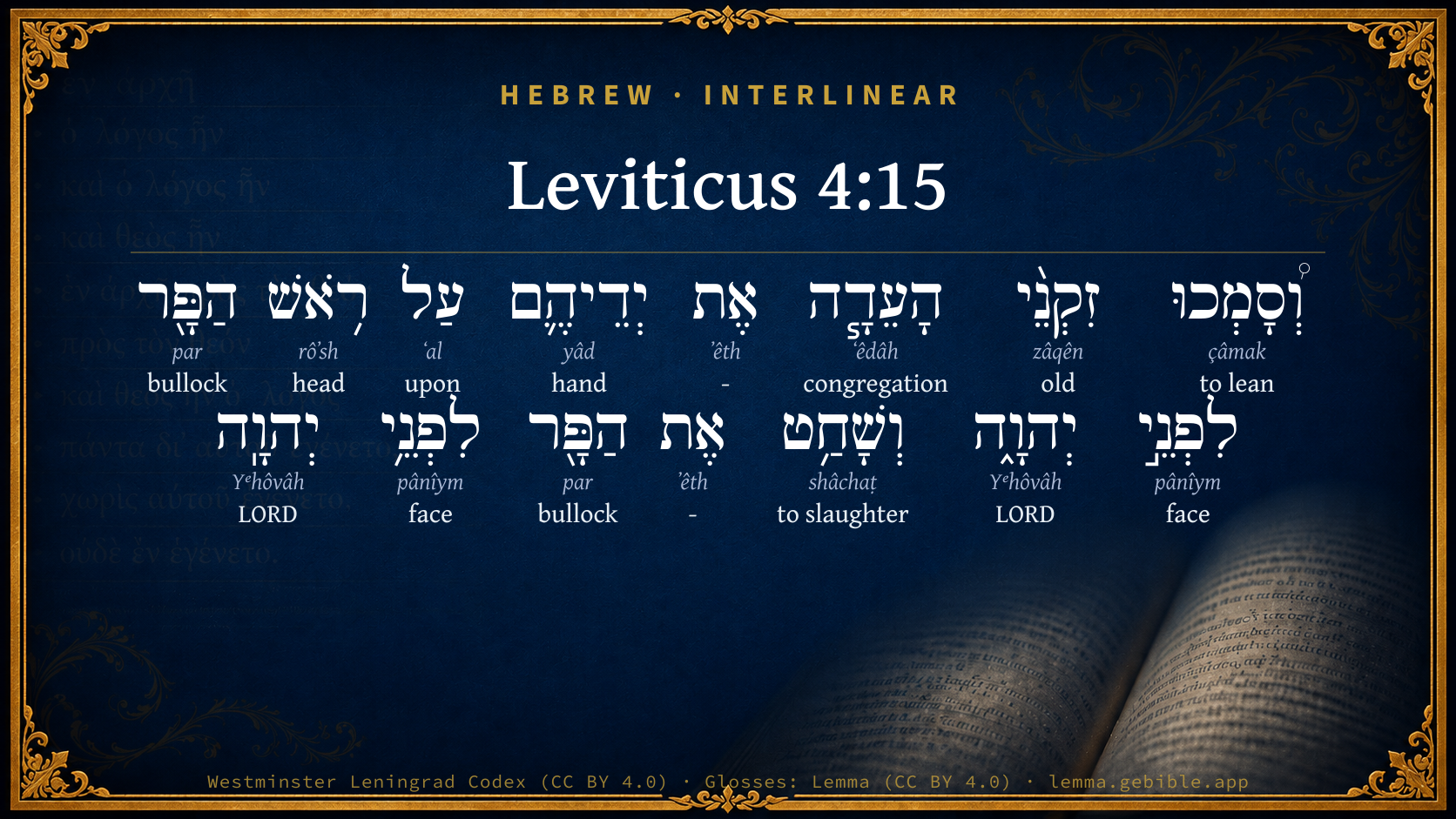
Hebrew (Westminster Leningrad Codex) Leviticus 4:15 appears in the Hebrew Old Testament. The text above is from the Westminster Leningrad Codex. Each word links to its Strong’s number, a concise gloss, and parsing drawn from the Open Scriptures Hebrew Bible morphology. Click any word for its full Brown-Driver-Briggs (BDB) entry.
Download image
Cite this verse

Leviticus 4:15 (World English Bible). Public Domain. Lemma interlinear Bible study tool, https://lemma.gebible.app/v/leviticus/4/15.

Show BibTeX & RIS
BibTeX
RIS
English Translation
The elders of the congregation shall lay their hands on the head of the bull before Yahweh; and the bull shall be killed before Yahweh.
World English Bible · Public Domain
Download a study sheet

One document with this verse’s original text, its word-by-word gloss line, the meaning frame, cross-references with their text, attributed commentary, and full source and license credits — printable, and it pastes into notes with its structure intact.

This verse Autodidact and up

Study sheet (.html) Plain text (.txt)

A passage Seminary Student

Up to 50 verses in one chapter. A passage sheet keeps up to 6 commentary sources and 12 cross-references per verse, in the order this page ranks them, and says so on the sheet whenever that leaves anything out. Ask for a single verse and you get the Autodidact verse sheet above.

Everything on this page stays free to read, with no account — the sheet is a download of what is already on screen, not access to it.

Want to remove ads? Support Godless Engineer
Compare translations 3

The same verse in 3 English versions, stacked beneath the original-language interlinear above. Click any original word for its lexicon entry.

Each is an independent rendering of the whole verse — the interlinear is not word-aligned to these translations.

Highlighted words mark where these versions differ — a whole-verse word diff, not a word-by-word alignment.

  • World English Bible Public Domain
    The elders of the congregation shall lay their hands on the head of the bull before Yahweh; and the bull shall be killed before Yahweh.
  • King James Version Public Domain
    And the elders of the congregation shall lay their hands upon the head of the bullock before the LORD: and the bullock shall be killed before the LORD.
  • unfoldingWord Literal Text CC BY-SA 4.0
    And the elders of the congregation shall lay their hands on the head of the bull to the face of Yahweh. And he shall slaughter the bull to the face of Yahweh.

unfoldingWord Literal Text — © unfoldingWord, licensed CC BY-SA 4.0. Word-aligned USFM3 via Door43 (git.door43.org/unfoldingWord/en_ult).

Versions to compare (up to 4)

3 of 4 selected

Show all 18 translations

Every available English version of this verse, each an independent rendering of the whole verse.

  • World English Bible Public Domain
    The elders of the congregation shall lay their hands on the head of the bull before Yahweh; and the bull shall be killed before Yahweh.
  • Berean Standard Bible Public Domain
    The elders of the congregation are to lay their hands on the bull’s head before the LORD, and it shall be slaughtered before the LORD.
  • Majority Standard Bible Public Domain
    The elders of the congregation are to lay their hands on the bull’s head before the LORD, and it shall be slaughtered before the LORD.
  • King James Version Public Domain
    And the elders of the congregation shall lay their hands upon the head of the bullock before the LORD: and the bullock shall be killed before the LORD.
  • American Standard Version (1901) Public Domain
    And the elders of the congregation shall lay their hands upon the head of the bullock before Jehovah; and the bullock shall be killed before Jehovah.
  • Revised Version (1885) Public Domain
    And the elders of the congregation shall lay their hands upon the head of the bullock before the LORD: and the bullock shall be killed before the LORD.
  • Geneva Bible (1599) Public Domain
    And the Elders of the Congregation shall put their handes vpon the head of the bullocke before the Lord, and he shall kill the bullocke before the Lord.
  • Douay-Rheims (1899) Public Domain
    And the ancients of the people shall put their hands upon the head thereof before the Lord. And the calf being immolated in the sight of the Lord,
  • Young's Literal Translation Public Domain
    and the elders of the company have laid their hands on the head of the bullock, before Jehovah, and `one' hath slaughtered the bullock before Jehovah.
  • Literal Standard Version CC BY-SA 4.0
    and the elderly of the congregation have laid their hands on the head of the bullock, before YHWH, and [one] has slaughtered the bullock before YHWH.
  • Unlocked Literal Bible CC BY-SA 4.0
    The elders of the assembly will lay their hands on the head of the bull before Yahweh, and the bull will be killed before Yahweh.
  • unfoldingWord Literal Text CC BY-SA 4.0
    And the elders of the congregation shall lay their hands on the head of the bull to the face of Yahweh. And he shall slaughter the bull to the face of Yahweh.
  • Darby Bible Public Domain
    and the elders of the assembly shall lay their hands on the head of the bullock before Jehovah; and one shall slaughter the bullock before Jehovah.
  • World Messianic Bible Public Domain
    The elders of the congregation shall lay their hands on the head of the bull before the LORD; and the bull shall be killed before the LORD.
  • Webster's Bible Public Domain
    And the elders of the congregation shall lay their hands upon the head of the bullock before the LORD: and the bullock shall be killed before the LORD.
  • Free Bible Version CC BY-SA 4.0
    The elders of Israel are to put their hands on its head and kill it before the Lord.
  • Bible in Basic English Public Domain
    And let the chiefs of the people put their hands on its head before the Lord, and put the ox to death before the Lord.
  • JPS Tanakh (1917) Public Domain
    And the elders of the congregation shall lay their hands upon the head of the bullock before the LORD; and the bullock shall be killed before the LORD.

Literal Standard Version (2020), Covenant Press — licensed CC BY-SA 4.0. Text via the HelloAO Bible API (eBible.org). Unlocked Literal Bible (unfoldingWord) — licensed CC BY-SA 4.0. Text via the HelloAO Bible API (eBible.org). unfoldingWord Literal Text — © unfoldingWord, licensed CC BY-SA 4.0. Word-aligned USFM3 via Door43 (git.door43.org/unfoldingWord/en_ult). Free Bible Version, Dr. Jonathan Gallagher — licensed CC BY-SA 4.0. Text via the HelloAO Bible API (eBible.org).

Word by word

More ways to search: Search by grammar → Find every occurrence → Compare this word →

Practice this passage: Drill this verse → Learn its vocabulary →

וְ֠סָמְכוּ
çâmak
H5564
“and · to lean”
Conjunction + Verb, Qal, Sequential Perfect, 3rd Person, Common, Plural
Part of Speech
Conjunction + Verb
Stem
Qal
Form
Sequential Perfect
Person
3rd Person
Gender
Common
Number
Plural
Full BDB Definition

Origin: a primitive root

TWOT: 1514

to lean, lay, rest, support, put, uphold, lean upon - (Qal) - to lean or lay upon, rest upon, lean against - to support, uphold, sustain - (Niphal) to support or brace oneself - (Piel) to sustain, refresh, revive
  1. זִקְנֵ֨י zâqên H2205 “old of” Adjective, Adjective, Masculine, Plural, Construct
  2. הָעֵדָ֧ה ʻêdâh H5712 “the · congregation” Particle, Definite Article + Noun, Common, Feminine, Singular, Absolute
  3. אֶת ʼêth H853 “-” Particle, Direct Object
  4. יְדֵיהֶ֛ם yâd H3027 “hands · their” Noun, Common, Both, Dual, Construct + Suffix, Personal, 3rd Person, Masculine, Plural
  5. עַל ʻal H5921 “upon” Preposition
  6. רֹ֥אשׁ rôʼsh H7218 “head of” Noun, Common, Masculine, Singular, Construct
  7. הַפָּ֖ר par H6499 “the · bullock” Particle, Definite Article + Noun, Common, Masculine, Singular, Absolute
  8. לִפְנֵ֣י pânîym H6440 “to/for · face(s) of” Preposition + Noun, Common, Both, Plural, Construct
  9. יְהוָ֑ה Yᵉhôvâh H3068 “LORD” Noun, Proper
  10. וְשָׁחַ֥ט shâchaṭ H7819 “and · to slaughter” Conjunction + Verb, Qal, Sequential Perfect, 3rd Person, Masculine, Singular
  11. אֶת ʼêth H853 “-” Particle, Direct Object
  12. הַפָּ֖ר par H6499 “the · bullock” Particle, Definite Article + Noun, Common, Masculine, Singular, Absolute
  13. לִפְנֵ֥י pânîym H6440 “to/for · face(s) of” Preposition + Noun, Common, Both, Plural, Construct
  14. יְהוָֽה Yᵉhôvâh H3068 “LORD” Noun, Proper

About this verse

These counts appear in no published source. They are computed here, from the morphology-tagged text and Lemma’s own curated glosses. What Lemma adds →

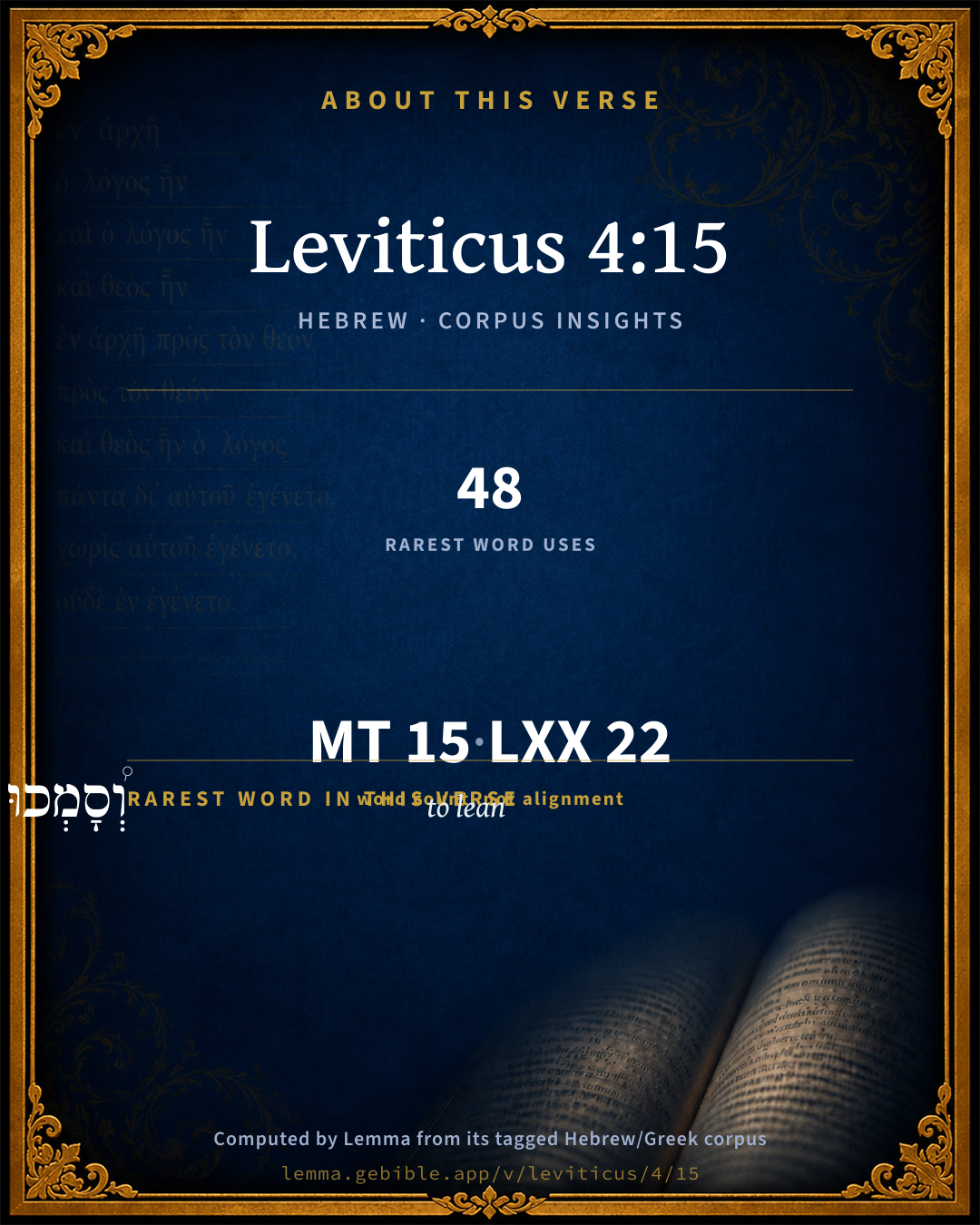
15
words
11
distinct lemmas
Pentateuch
section

Shared distinctive vocabulary

וְ֠סָמְכוּ to lean H5564 occurs in 47 verses of the Hebrew Bible. Also found in:

Grammatical profile

  • 2 verbs
  • 9 nouns
  • 1 adjective
  • 1 preposition
  • 2 particles

Verb forms

  • וְ֠סָמְכוּ Qal · Sequential Perfect
  • וְשָׁחַ֥ט Qal · Sequential Perfect

Repetition

Words recur within this verse — often emphatic in Hebrew:

  • הַפָּ֖ר bullock H6499 ×2
  • לִפְנֵ֣י face H6440 ×2
  • יְהוָ֑ה LORD H3068 ×2

Hebrew & Septuagint length

In English translation the verse runs 25 words from the Hebrew and 28 from the Septuagint (LXX English) — closely comparable.

A rough comparison of the two English renderings, which tokenize alike — not a word-level alignment.

Word counts can differ between the Hebrew and the Greek without any difference in meaning — e.g. the Hebrew direct-object marker אֵת has no separate Greek word, and Greek often adds the article ὁ.

In the original languages it is 15 Hebrew tokens and 22 Greek tokens — but the two are counted differently (Hebrew bundles its prefixes and suffixes into one token; the Greek is in lemma form), so that isn’t a like-for-like length.

Cross-references

11

Topical passages linked to Leviticus 4:15 in the Treasury of Scripture Knowledge — connected by theme and wording, ordered by reader-vote popularity; previews shown in the World English Bible.

  • Leviticus 1:4 He shall lay his hand on the head of the burnt offering, and it shall be accepted for him to make atonement for him.
  • Exodus 24:1 He said to Moses, "Come up to Yahweh, you, and Aaron, Nadab, and Abihu, and seventy of the elders of Israel; and worship from a distance.
  • Exodus 24:9 Then Moses, Aaron, Nadab, Abihu, and seventy of the elders of Israel went up.
  • Leviticus 4:4 He shall bring the bull to the door of the Tent of Meeting before Yahweh; and he shall lay his hand on the head of the bull, and kill the bull before Yahweh.
  • Leviticus 8:14 He brought the bull of the sin offering, and Aaron and his sons laid their hands on the head of the bull of the sin offering.
  • Leviticus 8:22 He presented the other ram, the ram of consecration: and Aaron and his sons laid their hands on the head of the ram.
  • Leviticus 16:21 Aaron shall lay both his hands on the head of the live goat, and confess over him all the iniquities of the children of Israel, and all their transgressions, even all their sins; and he shall put them on the head of the goat, and shall send him away into the wilderness by the hand of a man who is in readiness.
  • Numbers 8:10 You shall present the Levites before Yahweh. The children of Israel shall lay their hands on the Levites,
  • Numbers 11:16 Yahweh said to Moses, Gather to me seventy men of the elders of Israel, whom you know to be the elders of the people, and officers over them; and bring them to the tent of meeting, that they may stand there with you.
  • Numbers 11:25 Yahweh came down in the cloud, and spoke to him, and took of the Spirit that was on him, and put it on the seventy elders: and it happened that when the Spirit rested on them, they prophesied, but they did so no more.
  • Deuteronomy 21:3–9 and it shall be, that the city which is nearest to the slain man, even the elders of that city shall take a heifer of the herd, which hasn't been worked with, and which has not drawn in the yoke;

Cross-references courtesy of OpenBible.info (CC BY 4.0).

Hebrew and Greek witnesses Masoretic Hebrew ↔ Greek Septuagint

The same verse in the two great witnesses to the Old Testament, shown verse-for-verse.

These are two independent witnesses, not word-aligned to each other, and the Septuagint is shown in lemma (dictionary) form.

Hebrew Leviticus 4:15 Masoretic · Westminster Leningrad Codex

וְ֠סָמְכוּ זִקְנֵ֨י הָעֵדָ֧ה אֶת יְדֵיהֶ֛ם עַל רֹ֥אשׁ הַפָּ֖ר לִפְנֵ֣י יְהוָ֑ה וְשָׁחַ֥ט אֶת הַפָּ֖ר לִפְנֵ֥י יְהוָֽה

The elders of the congregation shall lay their hands on the head of the bull before Yahweh; and the bull shall be killed before Yahweh.

World English Bible · Public Domain

Greek LXX Leviticus 4:15 Septuagint · lemma form

καί ἐπιτίθημι ὁ πρεσβύτερος ὁ συναγωγή ὁ χείρ αὐτός ἐπί ὁ κεφαλή ὁ μόσχος ἔναντι κύριος καί σφάζω ὁ μόσχος ἔναντι κύριος

And the elders of the congregation shall lay their hands on the head of the calf before the Lord, and they shall kill the calf before the Lord.

LXX2012 (modern English Septuagint) · Public Domain

Hebrew: Westminster Leningrad Codex (CC BY 4.0). Greek: Septuagint (public domain); English from LXX2012 (modern English Septuagint) (Public Domain). How the Septuagint differs from the Hebrew →

Targum (Aramaic paraphrase)

2

The Targum is the ancient Jewish Aramaic paraphrase of the Hebrew Scriptures — an interpretive translation, not the Hebrew text itself. Onkelos (literal) and Pseudo-Jonathan (expansive) render the Torah, and Jonathan the Prophets. Coverage is partial: where no permissively-licensed English translation exists for a verse, only the Aramaic is shown. This is verse-level text, not a word-by-word alignment to the Hebrew.

  1. Targum Onkelos Torah (Genesis–Deuteronomy)
    וְיִסְמְכוּן סָבֵי כְנִשְׁתָּא יָת יְדֵיהוֹן עַל רֵישׁ תּוֹרָא קֳדָם יְיָ וְיִכּוֹס יָת תּוֹרָא קֳדָם יְיָ

    (no public-domain English translation for this verse)

    Targum Onkelos — Aramaic: “Onkelos Genesis” (public domain); “Onkelos Exodus” (public domain); “Onkelos Leviticus” (public domain); “Onkelos Numbers” (public domain); “Onkelos Deuteronomy” (public domain). English: “Sefaria Community Translation” (CC0 1.0 (public-domain dedication)); “J.W. Etheridge. The Targums of Onkelos and Jonathan Ben Uzziel on the Pentateuch. London: Longmans, Green, 1862” (public domain). Text via Sefaria.

  2. Targum Pseudo-Jonathan Torah (Genesis–Deuteronomy)
    וְיִסְמְכוּן תְּרֵיסַר סָבֵי כְנִישְׁתָּא דְמִתְמַנִין אֲמַרְכוּלִין עַל תְּרֵיסַר שִׁבְטַיָא יַת יְדֵיהוֹן בְּתוּקְפָא עַל רֵישׁ תּוֹרָא וְיִכּוֹס טַבְּחָא יַת תּוֹרָא קֳדָם יְיָ

    And twelve of the elders of the congregation, the counsellors (amarkelin) appointed over the twelve tribes, shall lay their hands firmly upon the head of the bullock, and the slayer shall kill the bullock before the Lord.

    Targum Pseudo-Jonathan — Aramaic: “Targum Jonathan on Genesis” (public domain); “Targum Jonathan on Exodus” (public domain); “Targum Jonathan on Leviticus” (public domain); “Targum Jonathan on Numbers” (public domain); “Targum Jonathan on Deuteronomy” (public domain). English: “The Targum of Jonathan ben Uzziel, trans. J. W. Etheridge, London, 1862” (public domain). Text via Sefaria.

Commentary

Notes on Leviticus 4:15 from classic Christian and Jewish commentators (each source and its license shown beneath its notes). The classic Christian expositions comment on the surrounding passage and are grouped to its opening verse, so a note may address several verses; the Jewish commentaries on the Tanakh (Rashi and others) are per-verse, so they appear only where the commentator wrote on this verse.

Lemma curates 59 commentaries, every one of them public domain or Creative Commons licensed, each selected and text-cleaned for this edition rather than reprinted as found. About our sources →

Trapp's Complete Commentary

John Trapp

Lev 4:15 And the elders of the congregation shall lay their hands upon the head of the bullock before the LORD: and the bullock shall be killed before the LORD.

Ver. 15. And the elders.] These, as the representative congregation, took upon them the guilt of their common errors, as those did in 2Ch 29:23.

John Trapp, A Commentary or Exposition upon All the Books of the Old and New Testament (1647–1656) — public domain. Text from a community e-Sword module.

Joseph Benson's Commentary

Lev 4:15. The elders — Who here acted in the name of all the people, who could not possibly perform this act in their own persons.

Joseph Benson's Commentary on the Old and New Testaments (1811–1818) — public domain. Text from a community e-Sword module.

Tyndale Open Study Notes

Tyndale Open Resources

4:15 The Hebrew term for elders is related to the word for beard. It implies mature but not necessarily elderly individuals. They were leaders of the community—typically, heads of families and tribes (cp. Exod 18:21-26; Deut 22:15-19). For this offering, the elders represented the entire people, as they would later in anointing David as king (2 Sam 5:3).

Tyndale Open Study Notes — © Tyndale Open Resources, licensed CC BY-SA 4.0. Text via the HelloAO Bible API.

Geneva Bible (1599)

Geneva Bible translators

Or, the Priest.

For all the people could not lay on their hands: therefore it was sufficient that the Ancients of the people did it in the name of all the Congregation.

Geneva Bible (1599) marginal notes — public domain. Text via Bolls.life.

Ellicott's Commentary for English Readers

(15) And the elders of the congregation shall lay their hands.—As the whole congregation could not lay their hands on the victim, their representatives had to perform this act. (See Lev_4:4.) But as the elders also were far too many to do it, since they were seventy in number, it was ordained during the second Temple that three of their members should lay their hands upon the sacrifice. Besides this sin offering there was only one other congregational offering upon which there was this laying of hands: i.e., the scape-goat (Lev_16:21).

A Bible Commentary for English Readers, edited by Charles John Ellicott (1878–1897) — public domain. Text from a community e-Sword module.

The Cambridge Bible for Schools and Colleges

gen. ed. J. J. S. Perowne

15. the elders] This expression, common in JE and Deut., occurs in P here and in Lev_9:1, Jos_20:4 only.

The Cambridge Bible for Schools and Colleges (gen. ed. J. J. S. Perowne; Cambridge University Press, 1878–1918) — public domain. Text from a community e-Sword module.

John Gill's Exposition

And the priest that is anointed shall bring of the bullock's blood,.... That is, the chief priest, as the Targums of Onkelos and Jonathan explain it:

to the tabernacle of the congregation; as he brought the blood of his own bullock, Lev 4:5 from hence to the Lev 4:16 an account is given of the same rites to be observed in the sin offering, for the congregation, as for the anointed priest; See Gill on Lev 4:6, Lev 4:7, Lev 4:12.

John Gill's Exposition of the Whole Bible (1746–1763) — public domain (CC PDM 1.0). Text via the HelloAO Bible API.

Albert Barnes' Notes on the Bible

In this case the imposition of hands is performed by the elders in behalf of the nation. But in other respects the rites were performed by the high priest in the same manner as in the sin-offering for himself.

Albert Barnes' Notes on the Bible (1834–1885) — public domain. Text from a community e-Sword/MySword module.

Matthew Poole's English Annotations

The elders of the congregation, i.e. the rulers of the people, of whom see Exo 3:16; 24:1, who here acted in the name of all the people, who could not possibly perform this act in their own persons.

Matthew Poole's English Annotations on the Holy Bible (1683–1685) — public domain. Text from a community e-Sword/MySword module.

John Wesley's Explanatory Notes

The elders - Who here acted in the name of all the people, who could not possibly perform this act in their own persons.

John Wesley, Explanatory Notes Upon the Whole Bible (1754–1765) — public domain. Text via the GEBible commentary corpus.

Lesson kit

Teaching starters — assembled from the data on this page, not authored interpretation. Every prompt links to the verse data it draws on. Edit before teaching.

Leviticus, in the Pentateuch, opens this verse with 15 words (11 distinct Hebrew lemmas). Its most distinctive word is çâmak (“to lean”). A historical commentator’s framing appears above. Read the whole chapter for the surrounding context.

Discussion questions

  1. The word çâmak carries the sense “to lean.” How does it shape the verse?
  2. Genesis 27:37 shares the word «to lean» with this verse. How do the two illuminate each other?
  3. “bullock” occurs 2× in this one verse. What is the effect of the repetition?
  4. These translations render this verse differently; the difference is in the English rendering, not the original. What questions does that raise?
  5. The verb «וְ֠סָמְכוּ» is Qal Sequential Perfect. How does its form color the action?
  6. Reading how Trapp's Complete Commentary and Joseph Benson's Commentary read this verse, where do the two commentators agree and where do they part?

Things to notice

Reading settings

Reading text

Shown beneath each verse's original-language words.

Old Testament
Old Testament edition

Read the OT as the Masoretic Hebrew (MT) or the Greek Septuagint (LXX).

English shown for the Greek Septuagint (in the Hebrew ↔ Greek comparison).

Comparing translations? Open the Compare panel on any verse page to stack up to four side by side.