
Isaiah 47:6

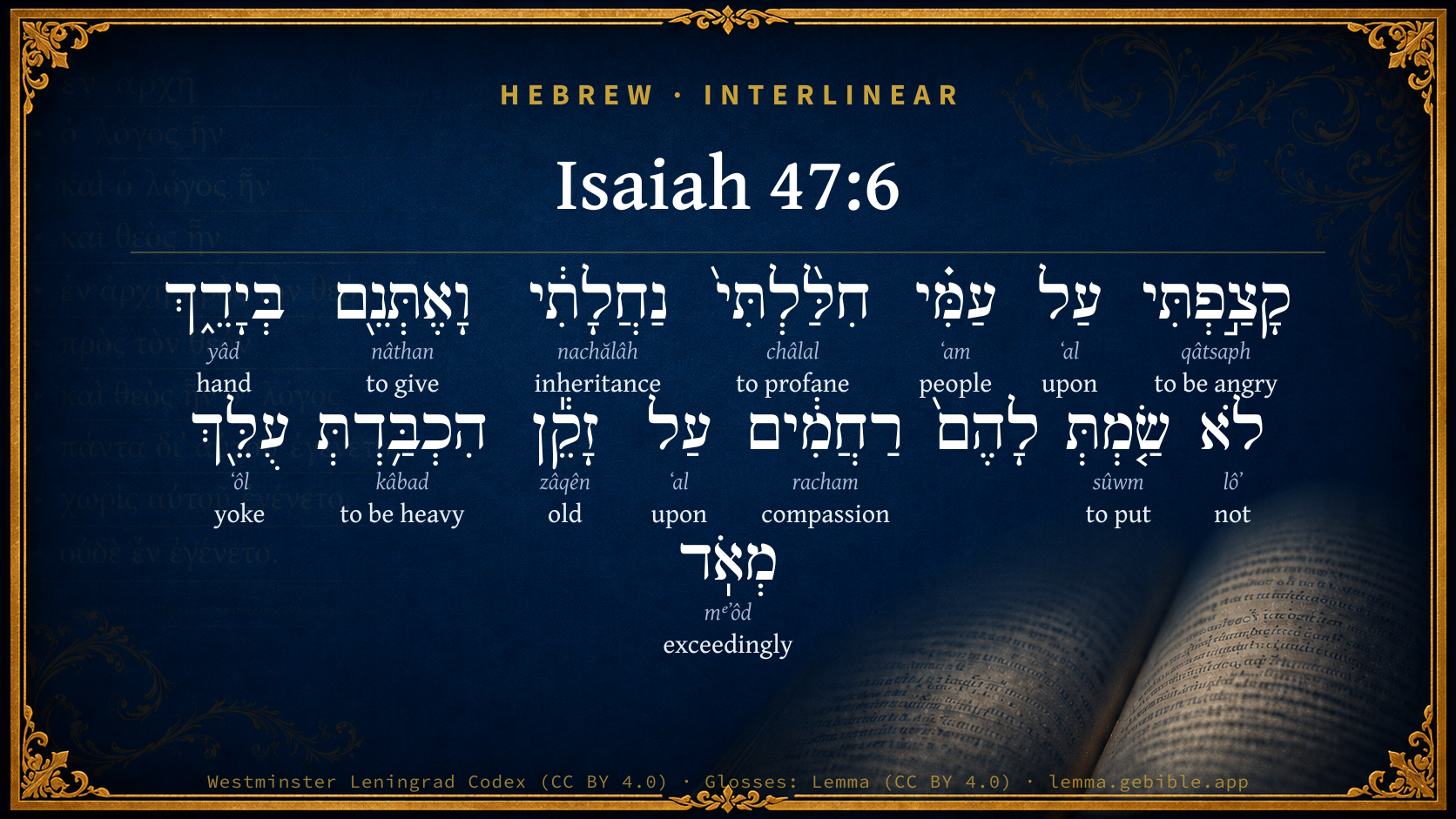
Hebrew (Westminster Leningrad Codex) Isaiah 47:6 appears in the Hebrew Old Testament. The text above is from the Westminster Leningrad Codex. Each word links to its Strong’s number, a concise gloss, and parsing drawn from the Open Scriptures Hebrew Bible morphology. Click any word for its full Brown-Driver-Briggs (BDB) entry.
Download image
Cite this verse

Isaiah 47:6 (World English Bible). Public Domain. Lemma interlinear Bible study tool, https://lemma.gebible.app/v/isaiah/47/6.

Show BibTeX & RIS
BibTeX
RIS
English Translation
I was angry with my people, I profaned my inheritance, and gave them into your hand: you did show them no mercy; on the aged have you very heavily laid your yoke.
World English Bible · Public Domain
Download a study sheet

One document with this verse’s original text, its word-by-word gloss line, the meaning frame, cross-references with their text, attributed commentary, and full source and license credits — printable, and it pastes into notes with its structure intact.

This verse Autodidact and up

Study sheet (.html) Plain text (.txt)

A passage Seminary Student

Up to 50 verses in one chapter. A passage sheet keeps up to 6 commentary sources and 12 cross-references per verse, in the order this page ranks them, and says so on the sheet whenever that leaves anything out. Ask for a single verse and you get the Autodidact verse sheet above.

Everything on this page stays free to read, with no account — the sheet is a download of what is already on screen, not access to it.

Want to remove ads? Support Godless Engineer
Compare translations 3

The same verse in 3 English versions, stacked beneath the original-language interlinear above. Click any original word for its lexicon entry.

Each is an independent rendering of the whole verse — the interlinear is not word-aligned to these translations.

Highlighted words mark where these versions differ — a whole-verse word diff, not a word-by-word alignment.

  • World English Bible Public Domain
    I was angry with my people, I profaned my inheritance, and gave them into your hand: you did show them no mercy; on the aged have you very heavily laid your yoke.
  • King James Version Public Domain
    I was wroth with my people, I have polluted mine inheritance, and given them into thine hand: thou didst shew them no mercy; upon the ancient hast thou very heavily laid thy yoke.
  • unfoldingWord Literal Text CC BY-SA 4.0
    I was angry with my people; I profaned my inheritance, and I gave them into your hand. You set no mercies to them; on the elderly, you made your yoke very heavy.

unfoldingWord Literal Text — © unfoldingWord, licensed CC BY-SA 4.0. Word-aligned USFM3 via Door43 (git.door43.org/unfoldingWord/en_ult).

Versions to compare (up to 4)

3 of 4 selected

Show all 18 translations

Every available English version of this verse, each an independent rendering of the whole verse.

  • World English Bible Public Domain
    I was angry with my people, I profaned my inheritance, and gave them into your hand: you did show them no mercy; on the aged have you very heavily laid your yoke.
  • Berean Standard Bible Public Domain
    I was angry with My people; I profaned My heritage, and I placed them under your control. You showed them no mercy; even on the elderly you laid a most heavy yoke.
  • Majority Standard Bible Public Domain
    I was angry with My people; I profaned My heritage, and I placed them under your control. You showed them no mercy; even on the elderly you laid a most heavy yoke.
  • King James Version Public Domain
    I was wroth with my people, I have polluted mine inheritance, and given them into thine hand: thou didst shew them no mercy; upon the ancient hast thou very heavily laid thy yoke.
  • American Standard Version (1901) Public Domain
    I was wroth with my people, I profaned mine inheritance, and gave them into thy hand: thou didst show them no mercy; upon the aged hast thou very heavily laid thy yoke.
  • Revised Version (1885) Public Domain
    I was wroth with my people, I profaned mine inheritance, and gave them into thine hand: thou didst shew them no mercy; upon the aged hast thou very heavily laid thy yoke.
  • Geneva Bible (1599) Public Domain
    I was wroth with my people: I haue polluted mine inheritance, and giuen them into thine had: thou diddest shew them no mercy, but thou didest lay thy very heauy yoke vpon the ancient.
  • Douay-Rheims (1899) Public Domain
    I was angry with my people, I have polluted my inheritance, and have given them into thy bend: thou hast shewn no mercy to them: upon the ancient thou hast laid thy yoke exceeding heavy.
  • Young's Literal Translation Public Domain
    I have been wroth against My people, I have polluted Mine inheritance And I give them into thy hand, Thou hast not appointed for them mercies, On the aged thou hast made thy yoke very heavy,
  • Literal Standard Version CC BY-SA 4.0
    I have been angry against My people, I have defiled My inheritance || And I give them into your hand, || You have not appointed mercies for them, || You have made your yoke very heavy on the aged,
  • Unlocked Literal Bible CC BY-SA 4.0
    I was angry with my people; I defiled my heritage and gave them over into your hand, but you showed them no mercy; you placed a very heavy yoke on the old people.
  • unfoldingWord Literal Text CC BY-SA 4.0
    I was angry with my people; I profaned my inheritance, and I gave them into your hand. You set no mercies to them; on the elderly, you made your yoke very heavy.
  • Darby Bible Public Domain
    I was wroth with my people, I polluted mine inheritance, and gave them into thy hand: thou didst shew them no mercy; upon the aged didst thou very heavily lay thy yoke;
  • World Messianic Bible Public Domain
    I was angry with my people. I profaned my inheritance and gave them into your hand. You showed them no mercy. You laid a very heavy yoke on the aged.
  • Webster's Bible Public Domain
    I was wroth with my people, I have polluted my inheritance, and given them into thy hand: thou didst show them no mercy; upon the ancient hast thou very heavily laid thy yoke.
  • Free Bible Version CC BY-SA 4.0
    I was angry with my people, and I abandoned those who belonged to me. I handed them over to you. But you didn't show them mercy—you even mistreated old people.
  • Bible in Basic English Public Domain
    I was angry with my people, I put shame on my heritage, and gave them into your hands: you had no mercy on them; you put a cruel yoke on those who were old;
  • JPS Tanakh (1917) Public Domain
    I was wroth with My people, I profaned Mine inheritance, and gave them into thy hand; thou didst show them no mercy; upon the aged hast thou very heavily laid thy yoke.

Literal Standard Version (2020), Covenant Press — licensed CC BY-SA 4.0. Text via the HelloAO Bible API (eBible.org). Unlocked Literal Bible (unfoldingWord) — licensed CC BY-SA 4.0. Text via the HelloAO Bible API (eBible.org). unfoldingWord Literal Text — © unfoldingWord, licensed CC BY-SA 4.0. Word-aligned USFM3 via Door43 (git.door43.org/unfoldingWord/en_ult). Free Bible Version, Dr. Jonathan Gallagher — licensed CC BY-SA 4.0. Text via the HelloAO Bible API (eBible.org).

Word by word

More ways to search: Search by grammar → Find every occurrence → Compare this word →

Practice this passage: Drill this verse → Learn its vocabulary →

קָצַ֣פְתִּי
qâtsaph
H7107
“to be angry”
Verb, Qal, Perfect, 1st Person, Common, Singular
Part of Speech
Verb
Stem
Qal
Form
Perfect
Person
1st Person
Gender
Common
Number
Singular
Full BDB Definition

Origin: a primitive root

TWOT: 2058

to be displeased, be angry, fret oneself, be wroth - (Qal) to be wroth, to be full of wrath, to be furious - (Hiphil) to provoke to wrath or anger - (Hithpael) to put oneself in a rage, anger oneself
  1. עַל ʻal H5921 “upon” Preposition
  2. עַמִּ֗י ʻam H5971 “people · my” Noun, Common, Masculine, Singular, Construct + Suffix, Personal, 1st Person, Common, Singular
  3. חִלַּ֨לְתִּי֙ châlal H2490 “to profane” Verb, Piel, Perfect, 1st Person, Common, Singular
  4. נַחֲלָתִ֔י nachălâh H5159 “inheritance · my” Noun, Common, Feminine, Singular, Construct + Suffix, Personal, 1st Person, Common, Singular
  5. וָאֶתְּנֵ֖ם nâthan H5414 “and · to give · them” Conjunction + Verb, Qal, Sequential Imperfect, 1st Person, Common, Singular + Suffix, Personal, 3rd Person, Masculine, Plural
  6. בְּיָדֵ֑ךְ yâd H3027 “in/at · hand · your” Preposition + Noun, Common, Both, Singular, Construct + Suffix, Personal, 2nd Person, Feminine, Singular
  7. לֹא lôʼ H3808 “not” Particle, Negative
  8. שַׂ֤מְתְּ sûwm H7760 “to put” Verb, Qal, Perfect, 2nd Person, Feminine, Singular
  9. רַחֲמִ֔ים racham H7356 “compassion” Noun, Common, Masculine, Plural, Absolute
  10. עַל ʻal H5921 “upon” Preposition
  11. זָקֵ֕ן zâqên H2205 “old” Adjective, Adjective, Masculine, Singular, Absolute
  12. הִכְבַּ֥דְתְּ kâbad H3513 “to be heavy” Verb, Hiphil, Perfect, 2nd Person, Feminine, Singular
  13. עֻלֵּ֖ךְ ʻôl H5923 “yoke · your” Noun, Common, Masculine, Singular, Construct + Suffix, Personal, 2nd Person, Feminine, Singular
  14. מְאֹֽד mᵉʼôd H3966 “exceedingly” Adverb

About this verse

These counts appear in no published source. They are computed here, from the morphology-tagged text and Lemma’s own curated glosses. What Lemma adds →

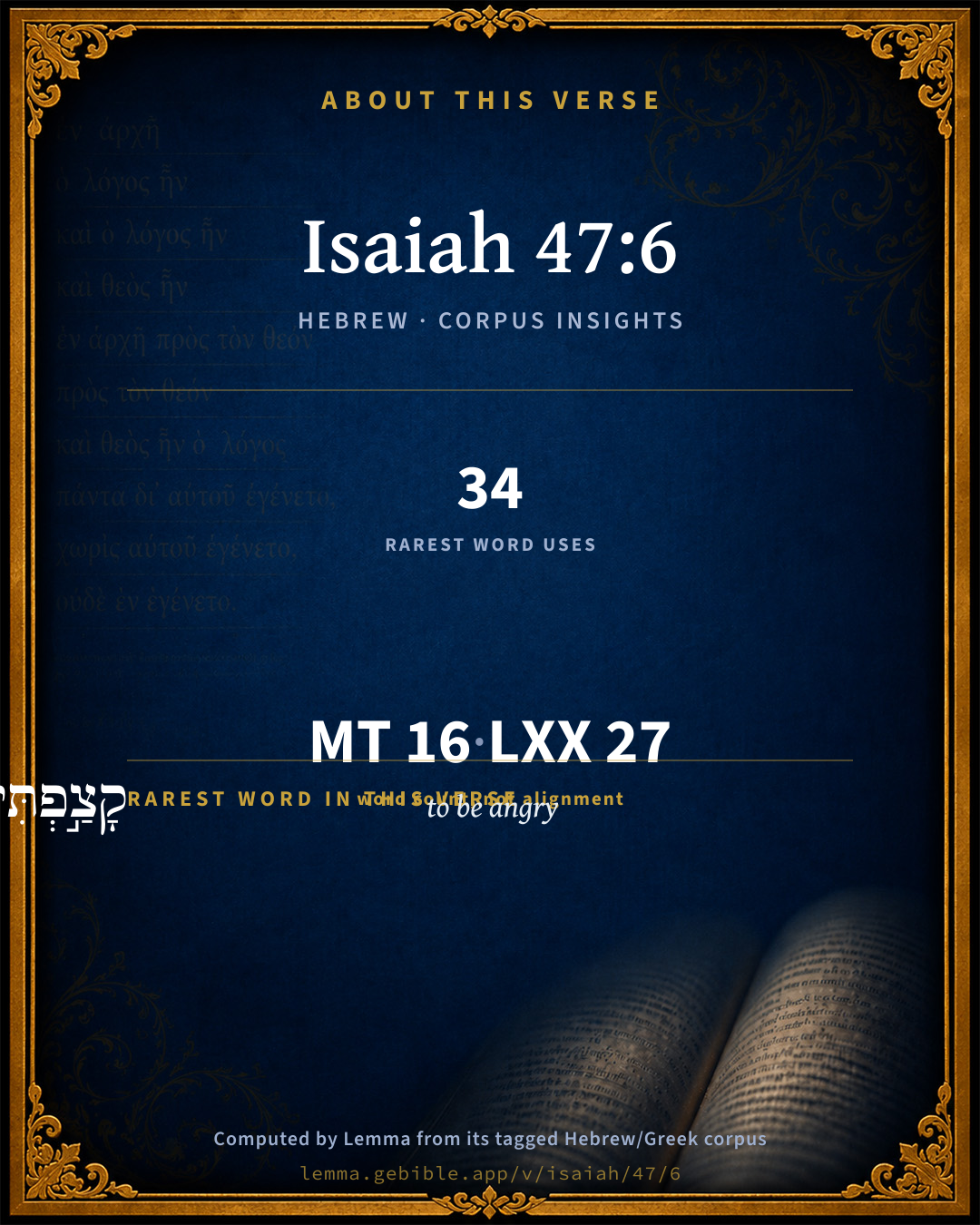
16
words
14
distinct lemmas
Prophets
section

Shared distinctive vocabulary

קָצַ֣פְתִּי to be angry H7107 occurs in 32 verses of the Hebrew Bible. Also found in:

Grammatical profile

  • 5 verbs
  • 5 nouns
  • 1 adjective
  • 3 prepositions
  • 1 adverb
  • 1 particle

Verb forms

  • קָצַ֣פְתִּי Qal · Perfect
  • חִלַּ֨לְתִּי֙ Piel · Perfect
  • וָאֶתְּנֵ֖ם Qal · Sequential Imperfect
  • שַׂ֤מְתְּ Qal · Perfect
  • הִכְבַּ֥דְתְּ Hiphil · Perfect

Repetition

A word recurs within this verse — often emphatic in Hebrew:

Hebrew & Septuagint length

In English translation the verse runs 32 words from the Hebrew and 36 from the Septuagint (LXX English) — closely comparable.

A rough comparison of the two English renderings, which tokenize alike — not a word-level alignment.

Word counts can differ between the Hebrew and the Greek without any difference in meaning — e.g. the Hebrew direct-object marker אֵת has no separate Greek word, and Greek often adds the article ὁ.

In the original languages it is 16 Hebrew tokens and 27 Greek tokens — but the two are counted differently (Hebrew bundles its prefixes and suffixes into one token; the Greek is in lemma form), so that isn’t a like-for-like length.

Cross-references

17

Topical passages linked to Isaiah 47:6 in the Treasury of Scripture Knowledge — connected by theme and wording, ordered by reader-vote popularity; previews shown in the World English Bible.

  • 2 Chronicles 28:9 But a prophet of Yahweh was there, whose name was Oded: and he went out to meet the host that came to Samaria, and said to them, Behold, because Yahweh, the God of your fathers, was angry with Judah, he has delivered them into your hand, and you have slain them in a rage which has reached up to heaven.
  • Zechariah 1:15 I am very angry with the nations that are at ease; for I was but a little displeased, but they added to the calamity."
  • Deuteronomy 28:50 a nation of fierce facial expressions, that shall not regard the person of the old, nor show favor to the young,
  • Obadiah 1:10 For the violence done to your brother Jacob, shame will cover you, and you will be cut off forever.
  • James 2:13 For judgment is without mercy to him who has shown no mercy. Mercy triumphs over judgment.
  • Psalms 69:26 For they persecute him whom you have wounded. They tell of the sorrow of those whom you have hurt.
  • Isaiah 10:6 I will send him against a profane nation, and against the people of my wrath will I give him a charge, to take the spoil, and to take the prey, and to tread them down like the mire of the streets.
  • Isaiah 14:17 who made the world as a wilderness, and overthrew the cities of it; who didn't let loose his prisoners to their home?"
  • Isaiah 42:24–25 Who gave Jacob for a spoil, and Israel to the robbers? Didn't Yahweh? he against whom we have sinned, and in whose ways they would not walk, neither were they obedient to his law.
  • Obadiah 1:16 For as you have drunk on my holy mountain, so will all the nations drink continually. Yes, they will drink, swallow down, and will be as though they had not been.
  • 2 Samuel 24:14 David said to Gad, I am in a great strait: let us fall now into the hand of Yahweh; for his mercies are great; and let me not fall into the hand of man.
  • Isaiah 13:16 Their infants also shall be dashed in pieces before their eyes; their houses shall be rifled, and their wives ravished.
  • Isaiah 43:28 Therefore I will profane the princes of the sanctuary; and I will make Jacob a curse, and Israel a reviling.
  • Lamentations 2:2 The Lord has swallowed up all the habitations of Jacob, and has not pitied: He has thrown down in his wrath the strongholds of the daughter of Judah; He has brought them down to the ground; he has profaned the kingdom and the princes of it.
  • Ezekiel 24:21 Speak to the house of Israel, Thus says the Lord Yahweh: Behold, I will profane my sanctuary, the pride of your power, the desire of your eyes, and that which your soul pities; and your sons and your daughters whom you have left behind shall fall by the sword.
  • Ezekiel 28:16 By the abundance of your traffic they filled the midst of you with violence, and you have sinned: therefore I have cast you as profane out of the mountain of God; and I have destroyed you, covering cherub, from the midst of the stones of fire.
  • Matthew 7:2 For with whatever judgment you judge, you will be judged; and with whatever measure you measure, it will be measured to you.

Cross-references courtesy of OpenBible.info (CC BY 4.0).

Hebrew and Greek witnesses Masoretic Hebrew ↔ Greek Septuagint

The same verse in the two great witnesses to the Old Testament, shown verse-for-verse.

These are two independent witnesses, not word-aligned to each other, and the Septuagint is shown in lemma (dictionary) form.

Hebrew Isaiah 47:6 Masoretic · Westminster Leningrad Codex

קָצַ֣פְתִּי עַל עַמִּ֗י חִלַּ֨לְתִּי֙ נַחֲלָתִ֔י וָאֶתְּנֵ֖ם בְּיָדֵ֑ךְ לֹא שַׂ֤מְתְּ לָהֶם֙ רַחֲמִ֔ים עַל זָקֵ֕ן הִכְבַּ֥דְתְּ עֻלֵּ֖ךְ מְאֹֽד

I was angry with my people, I profaned my inheritance, and gave them into your hand: you did show them no mercy; on the aged have you very heavily laid your yoke.

World English Bible · Public Domain

Greek LXX Isaiah 47:6 Septuagint · lemma form

παραὀξύνω ἐπί ὁ λαός ἐγώ μιαίνω ὁ κληρονομία ἐγώ ἐγώ δίδωμι εἰς ὁ χείρ σύ σύ δέ οὐ δίδωμι αὐτός ἔλεος ὁ πρεσβύτερος βαρύνω ὁ ζυγός σφόδρα

I have been provoked with my people; you have defiled my inheritance: I gave them into your hand, but you did not extend mercy to them: you made the yoke of the aged man very heavy,

LXX2012 (modern English Septuagint) · Public Domain

Hebrew: Westminster Leningrad Codex (CC BY 4.0). Greek: Septuagint (public domain); English from LXX2012 (modern English Septuagint) (Public Domain). How the Septuagint differs from the Hebrew →

Targum (Aramaic paraphrase)

1

The Targum is the ancient Jewish Aramaic paraphrase of the Hebrew Scriptures — an interpretive translation, not the Hebrew text itself. Onkelos (literal) and Pseudo-Jonathan (expansive) render the Torah, and Jonathan the Prophets. Coverage is partial: where no permissively-licensed English translation exists for a verse, only the Aramaic is shown. This is verse-level text, not a word-by-word alignment to the Hebrew.

  1. Targum Jonathan Prophets (Joshua–Malachi)
    רְגֵיזִית עַל עַמִי אַפֵיסִית אַחְסַנְתִּי וּמְסַרְתִּינוּן בִידָךְ לָא אִתְמַלֵית עֲלֵיהוֹן רַחֲמִין עַל סָבָא אַתְקֵיפְתָּא מַרְוָתִיךְ לַחְדָא:

    I was angry with my people, I have polluted mine inheritance, and given them into thine hand: thou hast not had compassion upon them, thou didst make thy dominion over the ancient very cruel.

    Targum Jonathan — Aramaic: “Mikraot Gedolot” (public domain). English: “Sefaria Community Translation” (CC0 1.0 (public-domain dedication)); “London "Chaldee Paraphrase," 1871” (public domain). Text via Sefaria.

Commentary

Notes on Isaiah 47:6 from classic Christian and Jewish commentators (each source and its license shown beneath its notes). The classic Christian expositions comment on the surrounding passage and are grouped to its opening verse, so a note may address several verses; the Jewish commentaries on the Tanakh (Rashi and others) are per-verse, so they appear only where the commentator wrote on this verse.

Lemma curates 59 commentaries, every one of them public domain or Creative Commons licensed, each selected and text-cleaned for this edition rather than reprinted as found. About our sources →

Trapp's Complete Commentary

John Trapp

Isa 47:6 I was wroth with my people, I have polluted mine inheritance, and given them into thine hand: thou didst shew them no mercy; upon the ancient hast thou very heavily laid thy yoke.

Ver. 6. I was wroth.] See on Zec 1:15.

I have polluted mine inheritance.] God is his people’s inheritance, and they are his; but now, for their sins, he had dealt with them as with a profane and unclean thing.

Thou didst show them no mercy.] Heb., Thou didst set them no bowels. Cruelty cries for vengeance. See Jer 50:17; Jer 51:24.

Upon the ancient.] Who should have been borne with for their age and weakness.

John Trapp, A Commentary or Exposition upon All the Books of the Old and New Testament (1647–1656) — public domain. Text from a community e-Sword module.

Tyndale Open Study Notes

Tyndale Open Resources

47:6 The people of Israel had provoked God’s wrath, prompting him to use Babylon to punish them. Now wicked Babylon itself would be punished.

Tyndale Open Study Notes — © Tyndale Open Resources, licensed CC BY-SA 4.0. Text via the HelloAO Bible API.

Geneva Bible (1599)

Geneva Bible translators

They abused God’s judgments, thinking that he punished the Israelites, because he would utterly cast them off, and therefore instead of pitying their misery, thou didst increase it.

Geneva Bible (1599) marginal notes — public domain. Text via Bolls.life.

Jamieson, Fausset & Brown

Robert Jamieson, A. R. Fausset & David Brown

reason for God's vengeance on Babylon: in executing God's will against His people, she had done so with wanton cruelty (Isa 10:5, &c.; Jer 50:17; Jer 51:33; Zac 1:15).

polluted my inheritance-- (Isa 43:28).

the ancient--Even old age was disregarded by the Chaldeans, who treated all alike with cruelty (Lam 4:16; Lam 5:12) [ROSENMULLER]. Or, "the ancient" means Israel, worn out with calamities in the latter period of its history (Isa 46:4), as its earlier stage of history is called its "youth" (Isa 54:6; Eze 16:60).

Jamieson, Fausset & Brown — Commentary Critical and Explanatory on the Whole Bible (1871) — public domain (CC PDM 1.0). Text via the HelloAO Bible API.

Adam Clarke's Commentary

Verse 6. I was wroth with my people] God, in the course of his providence, makes use of great conquerors and tyrants as his instruments to execute his judgments in the earth; he employs one wicked nation to scourge another. The inflicter of the punishment may perhaps be as culpable as the sufferer; and may add to his guilt by indulging his cruelty in executing God's justice. When he has fulfilled the work to which the Divine vengeance has ordained him, he will become himself the object of it; see Isa 10:5-12. God charges the Babylonians, though employed by himself to chastise his people, with cruelty in regard to them. They exceeded the bounds of justice and humanity in oppressing and destroying them; and though they were really executing the righteous decree of God, yet, as far as it regarded themselves, they were only indulging their own ambition and violence. The Prophet Zechariah sets this matter in the same light: "I was but a little angry and they helped forward the affliction;" Zec 1:15. - L.

Adam Clarke's Commentary on the Bible (1810–1826) — public domain. Text from a community e-Sword/MySword module.

Ellicott's Commentary for English Readers

(6) I was wroth with my people . . .—The sin of Babylon was that she had gone beyond her commission as the chastiser of Israel, casting off all reverence for age, and making even the old men do the hard tasks of bond-slaves (Lam_4:16; Lam_5:12). (Comp. Zec_1:15.)

A Bible Commentary for English Readers, edited by Charles John Ellicott (1878–1897) — public domain. Text from a community e-Sword module.

The Cambridge Bible for Schools and Colleges

gen. ed. J. J. S. Perowne

6. Jehovah speaks, charging Babylon with pitiless inhumanity towards His people when they were delivered to her for chastisement (for the thought cf. Zec_1:15).

I was wroth with my people] Cf. Isa_54:9, Isa_57:16 f., Isa_64:5; Isa_64:9.

I have polluted (R.V. I profaned) mine inheritance] Cf. Isa_43:28. “Profane” is the opposite of “holy;” as “holy to Jehovah” Israel was inviolable (Jer_2:3), but when this relation ceased she passed under the power of the heathen.

upon the ancient] Better, as R.V.: upon the aged. Although the word is sing., there can be no doubt that it is used literally of the old men on whom the hardships of captivity fell most heavily (cf. Lam_4:16; Lam_5:12). The idea that Israel as a nation is meant is not to be entertained (see on ch. Isa_46:4). We have little knowledge of the circumstances of the Israelites in exile, but there is nothing improbable in the supposition that some of them were put to forced labour, and that cases of exceptional barbarity may have occurred.

The Cambridge Bible for Schools and Colleges (gen. ed. J. J. S. Perowne; Cambridge University Press, 1878–1918) — public domain. Text from a community e-Sword module.

John Gill's Exposition

I was wroth with my people,.... The people of Israel, for their sins and transgressions, particularly their idolatries. Here begin the reasons and causes of the destruction of Babylon, and the first mentioned is their cruelty to the people of God; for though he was angry with them himself, yet he resented their being ill used by them:

I have polluted mine inheritance; the Jews, who, as they were his people, were his portion and inheritance, as he was theirs: these he is said to pollute, by suffering the Heathen to enter into the land, and defile their city and sanctuary, and carry them captive into an unclean and idolatrous country:

and given them into thine hand; to correct and chastise, but in measure, not to kill and destroy:

whereas thou didst show them no mercy; used them very cruelly, and exceeded the commission given:

upon the ancient hast thou very heavily laid thy yoke; whose age should have commanded reverence and respect, and whose weakness and infirmities called for compassion; but nothing of this kind was shown; they were not spared because of age, but had insupportable burdens laid upon them; and if not they, then much less young men; see Lam 5:12.

John Gill's Exposition of the Whole Bible (1746–1763) — public domain (CC PDM 1.0). Text via the HelloAO Bible API.

Albert Barnes' Notes on the Bible

I was worth with my people - In this verse and the following, a reason is assigned why God would deal so severely with her. One of the reasons was, that in executing the punishment which he had designed on the Jewish people, she had done it with pride, ambition, and severity; so that though God intended they should be punished, yet the feelings of Babylon in doing it, were such also as to deserve his decided rebuke and wrath.

I have polluted mine inheritance - Jerusalem and the land of Judea see the notes at Isa 43:28). He had stripped it of its glory; caused the temple and city to be destroyed; and spread desolation over the land. Though it had been done by the Chaldeans, yet it had been in accordance with his purpose, and under his direction Deu 4:20; Psa 28:9.

Thou didst show them no mercy - Though God had given up his people to be punished for their sins, yet this did not justify the spirit with which the Chaldeans had done it, or make proper the cruelty which they had evinced toward them. It is true that some of the Jewish captives, as, e. g., Daniel, were honored and favored in Babylon. It is not improbable that the circumstances of many of them were comparatively easy while there, and that they acquired possessions and formed attachments there which made them unwilling to leave that land when Cyrus permitted them to return to their own country. But it is also true, that Nebuchadnezzar showed them no compassion when he destroyed the temple and city, that the mass of them were treated with great indignity and cruelty in Babylon. See Psa 137:1-3, where they pathetically and beautifully record their sufferings:

By the rivers of Babylon there we sat down,

Yea, we wept when we remembered Zion.

For there they that carried us away captive required of us a song;

And they that wasted us rcquired of us mirth.

Saying, Sing us one of the songs of Zion.

Thus also Jeremiah Jer 1:17 describes the cruelty of their conquerors: ‘Israel is a scattered sheep - the lions have driven him away; this Nebuchadnezzar hath broken his bones’ (see also 2Ki 25:5, 2Ki 25:6, 2Ki 25:27; Jer 51:34; Lam 4:16; Lam 5:11-14).

Upon the ancient - That is, upon the old man. The idea is, that they had oppressed, and reduced to hard servitude, those who were venerable by years, and by experience. To treat the aged with veneration is everywhere in the Scriptures regarded as an important and sacred duty Lev 19:32; Job 32:4-6; and to disregard age, and pour contempt on hoary hairs, is everywhere spoken of as a crime of an aggravated nature (compare 2Ki 2:23-25; Pro 30:17). That the Chaldeans had thus disregarded age and rank, is a frequent subject of complaint among the sacred writers:

They respected not the persons of the priests,

They favored not the elders.

Lam 4:16

Princes are hanged up by their hand.

The faces of eiders were not honored.

Lam 5:12

Laid the yoke - The yoke in the Bible is an emblem of slavery or bondage Lev 26:13; Deu 28:48; of afflictions and crosses Lam 3:27; of punishment for sin Lam 1:14; of God’s commandments Mat 11:29-30. Here it refers to the bondage and affliction which they experienced in Babylon.

Albert Barnes' Notes on the Bible (1834–1885) — public domain. Text from a community e-Sword/MySword module.

Haydock's Catholic Bible Commentary

Polluted; deemed or declared unclean. But thou hast sought to gratify thy vindictive temper, in punishing my people. (Calmet) --- The sins of both called down vengeance. (Worthington)

George Leo Haydock (1774–1849), Haydock's Catholic Family Bible and Commentary, 1859 edition — public domain. Excludes Psalms (Douay-Rheims chapter numbering differs from Protestant) and Deuterocanonical books (Catholic canon only).

Matthew Poole's English Annotations

I have polluted mine inheritance; I cast them away as an unclean thing; I stained their glory; I removed them from the Holy Land, and from the place of my presence and worship, which alone made them a holy and peculiar people; I banished them into a polluted land, amongst uncircumcised and unclean persons, by whom they were many ways defiled; I rejected them from being my people, and so were in my sight no better than the rest of the heathen nations.

Given them into thine hand, to punish them, and deal with them as thou sawest fit.

Thou didst show them no mercy; thou hast exceeded the bounds of thy commission, and instead of that compassion which humanity teacheth men to show to such as are in misery, thou didst add to their afflictions.

Upon the ancient hast thou very heavily laid the yoke; who besides their common calamity were afflicted with the miseries of old age, and therefore did require both pity and reverence.

Matthew Poole's English Annotations on the Holy Bible (1683–1685) — public domain. Text from a community e-Sword/MySword module.

Whedon's Commentary on the Bible

Daniel D. Whedon

6. I was wroth with my people — Angry with his people, Jehovah suffered them to be treated as polluted. I…

polluted mine inheritance — Allusion is here made to Isa_43:28 : “Therefore I have profaned the princes of the sanctuary, and have given Jacob to the curse.”

And given them into thine hand — Into the hand of the Chaldeans or Babylonians, who showed them no mercy. See 2Ch_36:17.

Upon the ancient — Meaning the aged ones of Israel, a class of persons for whose welfare Jehovah had usually tenderly cared.

Daniel D. Whedon (gen. ed.), Commentary on the Old and New Testaments (1874–1909) — public domain. Text from a community e-Sword module.

The Pulpit Commentary

I was wroth with my people. (comp. 2Ki_24:3, 4 2Ch_36:13-17) I have polluted... and given; rather, I polluted and gave. The reference is to the conquest of Judaea by Nebuchadnezzar. Thou didst show them no mercy. We have very little historical knowledge of the general treatment of the Jewish exiles during the Captivity. A certain small number Daniel and the Three Children were advanced to positions of importance, (Dan_1:19 Dan_2:48, 49 3:30) and, on the whole, well treated. On the other hand, Jehoiachin underwent an imprisonment of thirty-seven years" duration. (2Ki_25:27) Mr. Cheyne says that "the writings of Jeremiah and Ezekiel do not suggest that the bulk of the exiles were great sufferers." This is, no doubt, true; and we may, perhaps, regard Isaiah"s words in this place as sufficiently made good by the "cruelties which disfigured the first days of the Babylonian triumph". (Lam_4:16 Lam_5:12 2Ch_36:17) Still, there may well have been a large amount of suffering among the rank-and-file of the captives, of which no historic record has come down to us. Psalm 138. reveals some of the bitter feelings of the exiles. Upon the ancient; rather, upon the aged. The author of Chronicles notes that Nebuchadnezzar, on taking Jerusalem, "had no compassion on young man or maiden, old man or him that stooped for age" (l.s.c.). There is no reason for giving the words of the present passage an allegorical meaning.

HOMILIES BY W. CLARKSON Ver. 6. What we owe to the aged.

"Upon the ancient hast thou very heavily laid thy yoke." This wrong-doing is selected, out of all others, to point the reproaches of the prophet. If Babylon would do that, it was merciless enough to do anything. Hard, indeed, is the heart that will show no pity for old age, but will lay a heavy yoke on its shoulders. We may let this sentence suggest to us the light in which a Christian man will look at age. What is its due? How shall we exhibit the temper our Master would approve in our bearing towards it?

I THE CONSIDERATENESS WHICH IS DUE TO THE WEAK. Many passages from both Testaments invite our attention to the considerateness of the Divine Father, of the gracious Lord, to the weak, to the burdened, to the defenceless. (see Isa_40:11) To be patient and considerate in our relations with those whose power is reduced, and who are going back to the feebleness out of which they once came, is to be "the children of our Father who is in heaven," is to be "disciples indeed" of the great Exemplar.

II THE RESPECT WHICH IS DUE TO THE EXPERIENCED. There are truths which nothing but experience seems able to teach. What evils might not be shunned, what sorrows escaped, what happiness and what usefulness secured, if we would but let the wisdom of the experienced direct our thoughts and guide our steps! They only who have sounded the waters of life can tell their depth; they only who have drunk of its many cups can tell us where the killing poison or where the curing medicine is to be found. Age, instructed by experience, has a wisdom Which youth and maturity do well to reverence and to master.

III THE GRATITUDE WHICH IS DUE TO THOSE WHO HAVE SERVED US. There are many aged men who have lived selfish lives, and to whom we owe no gratitude at all; but there are others who have toiled and suffered, not perfunctorily or of constraint, but freely and magnanimously, to these far more is due than the pecuniary payment they may have received, and they win go to the grave unrecompensed if those who reap the fruits of their labours and trials do not render them the honour they have earned.

IV THE SERVICE WE SHOULD RENDER TO THOSE WHO WILL SOON BE BEYOND OUR REACH It is an affecting and constraining thought that there remain but a very few times more when we can do anything for one of our neighbours that he will soon be where our band cannot reach to rescue or to enrich him. The aged will soon be gone from amongst us. A few weeks or months will take them where no kindness of ours can make their path smoother, their heart happier, their character more noble. To them, most of all, applies the gracious sentiment "Be kind to each other; The night"s coming on, When friend and when brother, Perchance, will be gone.

1. Unkindness to the aged is peculiarly displeasing to God.

2. Considerateness and succour shown to the aged will draw down the special favour of Christ. They, too, are among the "little ones" whom it is at our peril that we "offend," to render whom the simplest act of love is to win a Saviour"s blessing. C.

Doing God"s work unworthily.

"Thou didst not show them compassion." God had entrusted Babylon with the work of executing his Divine judgments on his people. The work was done, but God could not approve of the way in which it was done. Compare, for illustrative purposes, the cases of King Saul and of John. Saul was made executioner of the Divine judgment on Amalek, but God could not approve of his work: he erred on the side of laxity. Jehu was made executioner of the Divine judgment on the house of Ahab, but God could not approve of his work: he erred on the side of severity. The complaint God makes against Babylon is that it had "shown no mercy," and one specific instance is given there had been no considerateness shown towards the aged among the captives; even "upon the ancient hast thou very heavily laid thy yoke." Even the old people were made to do the tasks of bond-slaves. "They respected not the persons of the priests, they favoured not the elders"; (Lam_4:16) "Princes are hanged up by their hand: the faces of elders were not honoured"; (Lam_5:12) "I am very sore displeased with the heathen that are at ease: for I was but a little displeased, and they helped forward the affliction". (Zec_1:15) "The writings of Jeremiah and Ezekiel do not suggest that the Jewish exiles were great sufferers. Perhaps the prophet may refer to the cruelties which disfigured the first days of the Babylonian triumph; or possibly the conduct of the Babylonians varied, according to the flexibility and submissiveness of the conquered" (Cheyne). The general topic suggested is that God"s work entrusted to us becomes a Divine agency for the searching and testing of our characters. God will be sure to take account, not only of the fact that we have done the work, but also of the spirit and the manner in which we have done it. No parent can be satisfied with obedience that is a mere act. God watches the character of our obedience. It may be shown that we do God"s work unworthily, and come under his reproof, when we

I DO IT TO SERVE SELFISH ENDS. This spoils all obedience. The motive in it is wrong. But how searching it would be to us all to try and read our actions in the light of the motives that prompted them! Babylon served itself, so it can expect no approval or acceptance from God.

II DO IT OTHERWISE THAN AS GOD WISHES. For he who properly takes up a work for God keeps himself open to Divine leadings and teachings as to the way in which it should be carried out. We often err by taking up work, and then severing ourselves from any close and daily dependence on God in the doing of it.

III DO IT WITHOUT DUE CONSIDERATIONS AND QUALIFICATIONS. Here the reproach is that no "mercy" was shown. God"s judgments are always considerate in their applications; they are mercy-tempered; they take due account of "remnants" and "faithful few." In this man almost always tails, and so he does not represent or honour God even in his work for him. R.T.

The Pulpit Commentary (1880–1919), ed. H.D.M. Spence-Jones & Joseph S. Exell — public domain. Text from a community e-Sword module.

John Wesley's Explanatory Notes

Polluted - I cast them away as an unclean thing. Into thine hand - To punish them. No mercy - Thou hast exceeded the bounds of thy commission. The ancient - Who besides their common calamity were afflicted with the miseries of old age, and therefore did require both pity and reverence.

John Wesley, Explanatory Notes Upon the Whole Bible (1754–1765) — public domain. Text via the GEBible commentary corpus.

J. A. Alexander on Isaiah

Joseph Addison Alexander

“I was wroth against my people; I profaned my heritage,” (i.e., I suffered my chosen and consecrated people to be treated as something common and unclean). In the same sense God is said before (Isa 43:28) to have profaned the holy princes. Israel is called Jehovah’s heritage, as being His perpetual possession, continued from one generation to another. This general import of the figure is obvious enough, although there is an essential difference between this case and that of literal inheritance, because in the latter the change and succession affect the proprietor, whereas in the former they affect the thing possessed, and the possessor is unchangeable. “And I gave them into thy hand, as my instruments of chastisement. Thou didst not show them mercy,” literally place (give or appoint) it to them. God’s providential purpose was not even known to His instruments, and could not therefore be the rule of their conduct or the measure of their responsibility. Though unconsciously promoting His designs, their own ends and motives were entirely corrupt. In the precisely analogous case of the Assyrian, it is said, (Isa 10:7), ‘he will not think so, and his heart not so will purpose, because to destroy (is) in his heart and to cut of nations not a few.’ The general charge is strengthened by a specific aggravation. “On the aged thou didst aggravate thy yoke (or make it heavy) exceedingly.” Some understand this of the whole people, whom they suppose to be described as old, (i.e., as having reached the period of national decrepitude). Others prefer the strict sense of the words, viz. that they were cruelly oppressive even to the aged captives, under which they include elders in office and in rank as well as in age. This particular form of inhumanity is charged upon the Babylonians by Jeremiah twice (Lam 4:16; Lam 5:12) and in both cases he connects the word with a parallel term denoting rank or office, viz. priests and princes. The essential meaning of the clause, as a description of inordinate severity to those least capable of retaliation or resistance, still remains the same in either case.

Joseph Addison Alexander, The Prophecies of Isaiah (1846–1847; New York: Scribner, 1870–1878) — public domain. Text from a community e-Sword module.

unfoldingWord translationNotes

Door43 World Missions Community

Connecting Statement:

Yahweh continues to speak to Babylon about her downfall as if she were a queen who is humiliated. (See: Metaphor and Personification)

I was angry

Here "I" refers to Yahweh.

I defiled my heritage

Yahweh speaks of the people of Israel being his special possession as if they were his heritage or inheritance. AT: "I defiled my people, who are my special possession" (See: Metaphor)

gave them over into your hand

Here the word "hand" represents Babylon's power or control. AT: "I put them under your power" (See: Metonymy)

you placed a very heavy yoke on the old people

Yahweh speaks of the Babylonians oppressing the old people as if they had treated the old people like cattle and put heavy yokes on their necks. (See: Metaphor)

I will rule forever as sovereign queen

Babylon speaks of permanently ruling over many nations as if she were a queen who would rule forever. (See: Metaphor)

You did not take these things to heart

Yahweh speaks of thinking carefully about something as if it were placing that thing on one's heart. AT: "You did not consider these things" (See: Metaphor)

translationWords

anger

people of God

defile

hand

mercy

yoke

eternity

queen

heart

unfoldingWord translationNotes — © Distant Shores Media and the Door43 World Missions Community, licensed CC BY-SA 4.0. Source: git.door43.org/Door43/en_tn.

Rashi

Rabbi Shlomo Yitzchaki (Rashi)

on the aged you made your yoke very heavy On the aged, who were unable to bear hard work, you made heavy your yoke.

Rashi on the Tanakh — English translations: “The Judaica Press complete Tanach with Rashi, translated by A. J. Rosenberg” (CC BY 4.0); “Pentateuch with Rashi's commentary by M. Rosenbaum and A.M. Silbermann, 1929-1934” (public domain); “The Metsudah Tanach series, Lakewood, N.J” (CC BY 4.0); and “The Book of Joshua, Metsudah Publications, 1997” (CC BY 4.0). Text via Sefaria.

Ibn Ezra

Rabbi Abraham ibn Ezra

I was wroth, etc. When I was angry with my people, thou didst not show mercy to them, etc.

The ancient is especially mentioned because of the failure of his strength and because of the regard due to him.

Ibn Ezra on the Tanakh — English translations: “Sefaria Community Translation” (CC0 1.0 (public-domain dedication)); “Yalkut, Sifsei Chachomim Chumash, Metsudah Publications, 2009” (CC BY 4.0); and “Commentary of Ibn Ezra on Isaiah - trans. by M. Friedlander, 1873” (public domain). Text via Sefaria.

Lesson kit

Teaching starters — assembled from the data on this page, not authored interpretation. Every prompt links to the verse data it draws on. Edit before teaching.

Isaiah, in the Prophets, opens this verse with 16 words (14 distinct Hebrew lemmas). Its most distinctive word is qâtsaph (“to be angry”). A historical commentator’s framing appears above. Read the whole chapter for the surrounding context.

Discussion questions

  1. What does “to be angry” (qâtsaph) contribute to the verse as a whole?
  2. Genesis 40:2 shares the word «to be angry» with this verse. How do the two illuminate each other?
  3. “upon” occurs 2× in this one verse. What is the effect of the repetition?
  4. These translations render this verse differently; the difference is in the English rendering, not the original. What questions does that raise?
  5. The verb «קָצַ֣פְתִּי» is Qal Perfect. How does its form color the action?
  6. Reading how Trapp's Complete Commentary and Tyndale Open Study Notes read this verse, where do the two commentators agree and where do they part?

Things to notice

Reading settings

Reading text

Shown beneath each verse's original-language words.

Old Testament
Old Testament edition

Read the OT as the Masoretic Hebrew (MT) or the Greek Septuagint (LXX).

English shown for the Greek Septuagint (in the Hebrew ↔ Greek comparison).

Comparing translations? Open the Compare panel on any verse page to stack up to four side by side.