Judges 8:16

Hebrew (Westminster Leningrad Codex) Judges 8:16 appears in the Hebrew Old Testament. The text above is from the Westminster Leningrad Codex. Each word links to its Strong’s number, a concise gloss, and parsing drawn from the Open Scriptures Hebrew Bible morphology. Click any word for its full Brown-Driver-Briggs (BDB) entry.
Download image
Cite this verse

Judges 8:16 (World English Bible). Public Domain. Lemma interlinear Bible study tool, https://lemma.gebible.app/v/judges/8/16.

Show BibTeX & RIS
BibTeX
RIS
English Translation
He took the elders of the city, and thorns of the wilderness and briers, and with them he taught the men of Succoth.
World English Bible · Public Domain
Download a study sheet

One document with this verse’s original text, its word-by-word gloss line, the meaning frame, cross-references with their text, attributed commentary, and full source and license credits — printable, and it pastes into notes with its structure intact.

This verse Autodidact and up

Study sheet (.html) Plain text (.txt)

A passage Seminary Student

Up to 50 verses in one chapter. A passage sheet keeps up to 6 commentary sources and 12 cross-references per verse, in the order this page ranks them, and says so on the sheet whenever that leaves anything out. Ask for a single verse and you get the Autodidact verse sheet above.

Everything on this page stays free to read, with no account — the sheet is a download of what is already on screen, not access to it.

Want to remove ads? Support Godless Engineer
Compare translations 3

The same verse in 3 English versions, stacked beneath the original-language interlinear above. Click any original word for its lexicon entry.

Each is an independent rendering of the whole verse — the interlinear is not word-aligned to these translations.

Highlighted words mark where these versions differ — a whole-verse word diff, not a word-by-word alignment.

  • World English Bible Public Domain
    He took the elders of the city, and thorns of the wilderness and briers, and with them he taught the men of Succoth.
  • King James Version Public Domain
    And he took the elders of the city, and thorns of the wilderness and briers, and with them he taught the men of Succoth.
  • unfoldingWord Literal Text CC BY-SA 4.0
    And took the elders of the city and thorns of the wilderness and briers, and he taught the men of Succoth with them.

unfoldingWord Literal Text — © unfoldingWord, licensed CC BY-SA 4.0. Word-aligned USFM3 via Door43 (git.door43.org/unfoldingWord/en_ult).

Versions to compare (up to 4)

3 of 4 selected

Show all 18 translations

Every available English version of this verse, each an independent rendering of the whole verse.

  • World English Bible Public Domain
    He took the elders of the city, and thorns of the wilderness and briers, and with them he taught the men of Succoth.
  • Berean Standard Bible Public Domain
    Then he took the elders of the city, and using the thorns and briers of the wilderness, he disciplined the men of Succoth.
  • Majority Standard Bible Public Domain
    Then he took the elders of the city, and using the thorns and briers of the wilderness, he disciplined the men of Succoth.
  • King James Version Public Domain
    And he took the elders of the city, and thorns of the wilderness and briers, and with them he taught the men of Succoth.
  • American Standard Version (1901) Public Domain
    And he took the elders of the city, and thorns of the wilderness and briers, and with them he taught the men of Succoth.
  • Revised Version (1885) Public Domain
    And he took the elders of the city, and thorns of the wilderness and briers, and with them he taught the men of Succoth.
  • Geneva Bible (1599) Public Domain
    Then he tooke the Elders of the citie, and thornes of the wildernes and breers, and did teare the men of Succoth with them.
  • Douay-Rheims (1899) Public Domain
    So he took the ancients of the city and thorns and briers of the desert, and tore them with the same, and cut in pieces the men of Soccoth.
  • Young's Literal Translation Public Domain
    And he taketh the elders of the city, and the thorns of the wilderness, and the threshing instruments, and teacheth by them the men of Succoth,
  • Literal Standard Version CC BY-SA 4.0
    And he takes the elderly of the city, and [the] thorns of the wilderness, and the threshing instruments, and teaches the men of Succoth by them,
  • Unlocked Literal Bible CC BY-SA 4.0
    Gideon took the elders of the city, and he punished the men of Succoth with the desert thorns and briers.
  • unfoldingWord Literal Text CC BY-SA 4.0
    And took the elders of the city and thorns of the wilderness and briers, and he taught the men of Succoth with them.
  • Darby Bible Public Domain
    And he took the elders of the city and he took thorns of the wilderness and briers and with them taught the men of Succoth.
  • World Messianic Bible Public Domain
    He took the elders of the city, and thorns of the wilderness and briers, and with them he taught the men of Succoth.
  • Webster's Bible Public Domain
    And he took the elders of the city, and thorns of the wilderness, and briers, and with them he taught the men of Succoth.
  • Free Bible Version CC BY-SA 4.0
    So he took the town elders of Succoth and taught them a lesson using thorns and briers from the desert.
  • Bible in Basic English Public Domain
    Then he took the responsible men of the town and had them crushed on a bed of thorns and sharp stems.
  • JPS Tanakh (1917) Public Domain
    And he took the elders of the city, and thorns of the wilderness and briers, and with them he taught the men of Succoth.

Literal Standard Version (2020), Covenant Press — licensed CC BY-SA 4.0. Text via the HelloAO Bible API (eBible.org). Unlocked Literal Bible (unfoldingWord) — licensed CC BY-SA 4.0. Text via the HelloAO Bible API (eBible.org). unfoldingWord Literal Text — © unfoldingWord, licensed CC BY-SA 4.0. Word-aligned USFM3 via Door43 (git.door43.org/unfoldingWord/en_ult). Free Bible Version, Dr. Jonathan Gallagher — licensed CC BY-SA 4.0. Text via the HelloAO Bible API (eBible.org).

Word by word

More ways to search: Search by grammar → Find every occurrence → Compare this word →

Practice this passage: Drill this verse → Learn its vocabulary →

הַֽבַּרְקֳנִ֑ים
barqân
H1303
“the · briers”
Particle, Definite Article + Noun, Common, Masculine, Plural, Absolute
Part of Speech
Particle + Noun
Type
Common
Gender
Masculine
Number
Plural
State
Absolute
Full BDB Definition

Origin: from H1300

TWOT: 287e

briers, briars
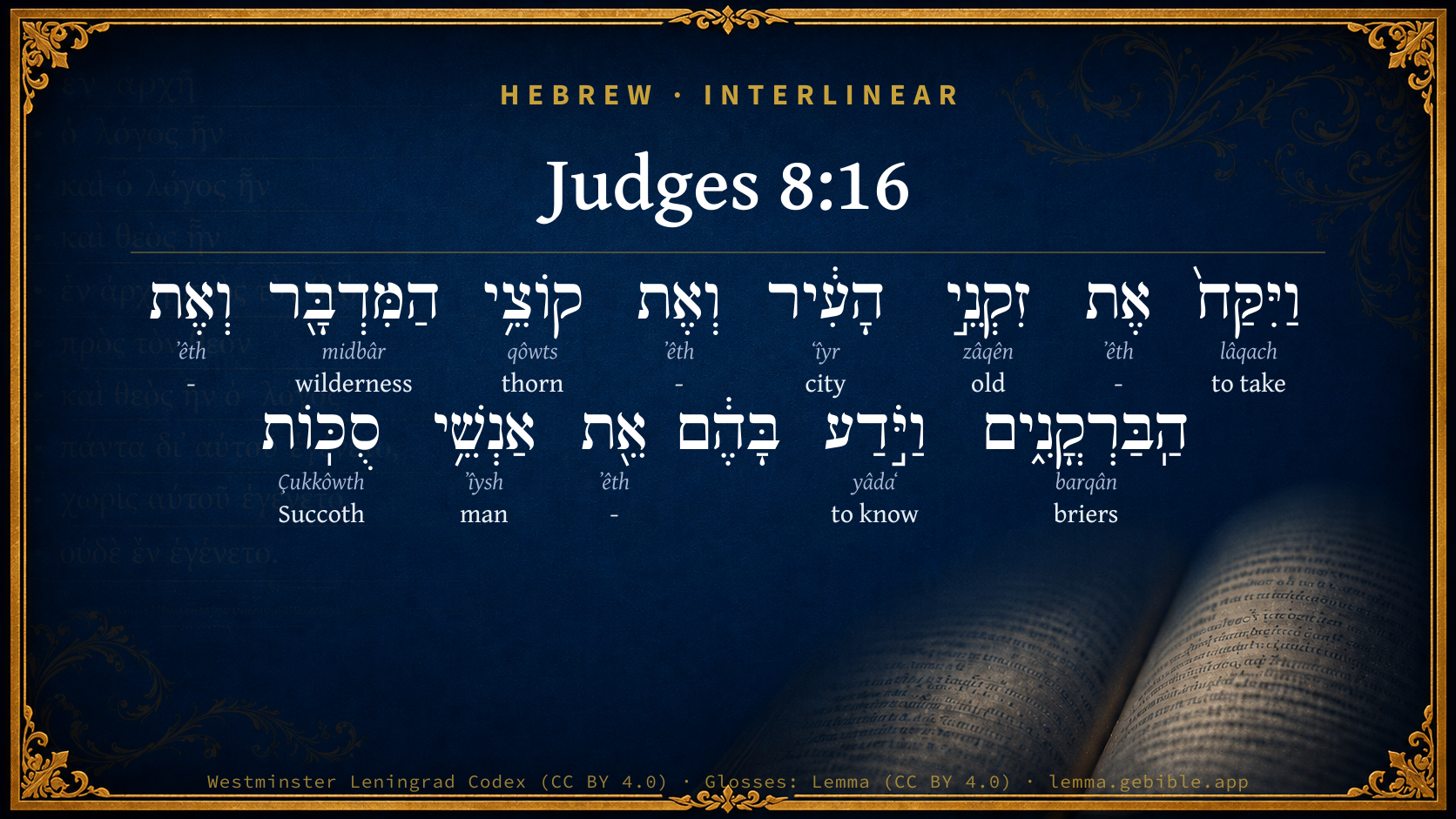
  1. וַיִּקַּח֙ lâqach H3947 “and · to take” Conjunction + Verb, Qal, Sequential Imperfect, 3rd Person, Masculine, Singular
  2. אֶת ʼêth H853 “-” Particle, Direct Object
  3. זִקְנֵ֣י zâqên H2205 “old of” Adjective, Adjective, Masculine, Plural, Construct
  4. הָעִ֔יר ʻîyr H5892 “the · city” Particle, Definite Article + Noun, Common, Feminine, Singular, Absolute
  5. וְאֶת ʼêth H853 “and · -” Conjunction + Particle, Direct Object
  6. קוֹצֵ֥י qôwts H6975 “thorns of” Noun, Common, Masculine, Plural, Construct
  7. הַמִּדְבָּ֖ר midbâr H4057 “the · wilderness” Particle, Definite Article + Noun, Common, Masculine, Singular, Absolute
  8. וְאֶת ʼêth H853 “and · -” Conjunction + Particle, Direct Object
  9. וַיֹּ֣דַע yâdaʻ H3045 “and · to know” Conjunction + Verb, Hiphil, Sequential Imperfect, 3rd Person, Masculine, Singular
  10. אֵ֖ת ʼêth H853 “-” Particle, Direct Object
  11. אַנְשֵׁ֥י ʼîysh H376 “men of” Noun, Common, Masculine, Plural, Construct
  12. סֻכּֽוֹת Çukkôwth H5523 “Succoth” Noun, Proper

About this verse

These counts appear in no published source. They are computed here, from the morphology-tagged text and Lemma’s own curated glosses. What Lemma adds →

14
words
10
distinct lemmas
Historical
section

Notable vocabulary

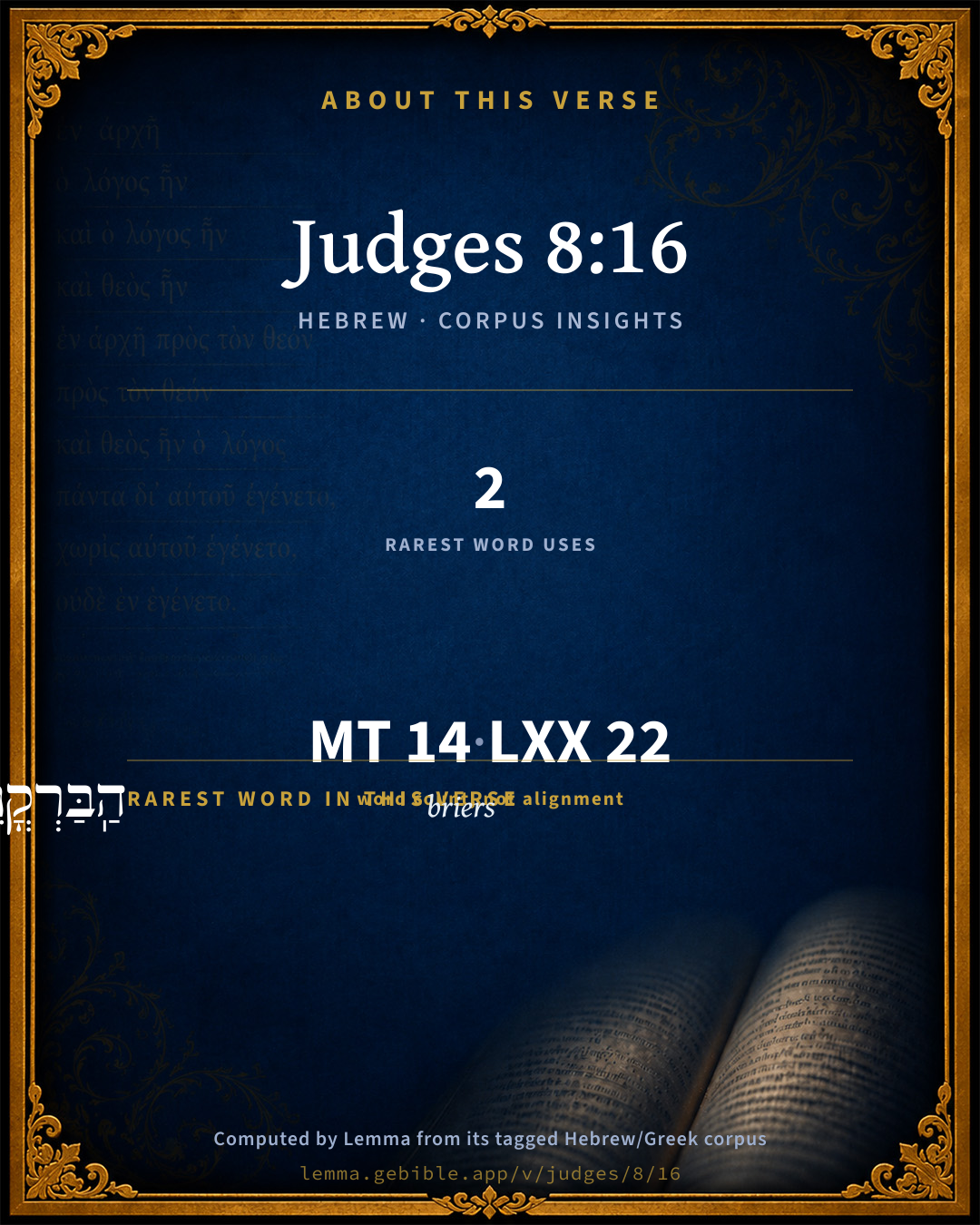
The rarest word here is הַֽבַּרְקֳנִ֑ים briers H1303 — appearing just 2 times in the whole Hebrew Bible.

Shared distinctive vocabulary

הַֽבַּרְקֳנִ֑ים briers H1303 occurs in 2 verses of the Hebrew Bible. Also found in:

Grammatical profile

  • 2 verbs
  • 6 nouns
  • 1 adjective
  • 1 preposition
  • 4 particles

Verb forms

  • וַיִּקַּח֙ Qal · Sequential Imperfect
  • וַיֹּ֣דַע Hiphil · Sequential Imperfect

Hebrew & Septuagint length

In English translation the verse runs 23 words from the Hebrew and 27 from the Septuagint (LXX English) — closely comparable.

A rough comparison of the two English renderings, which tokenize alike — not a word-level alignment.

Word counts can differ between the Hebrew and the Greek without any difference in meaning — e.g. the Hebrew direct-object marker אֵת has no separate Greek word, and Greek often adds the article ὁ.

In the original languages it is 14 Hebrew tokens and 22 Greek tokens — but the two are counted differently (Hebrew bundles its prefixes and suffixes into one token; the Greek is in lemma form), so that isn’t a like-for-like length.

Cross-references

5

Topical passages linked to Judges 8:16 in the Treasury of Scripture Knowledge — connected by theme and wording, ordered by reader-vote popularity; previews shown in the World English Bible.

  • Judges 8:7 Gideon said, Therefore when Yahweh has delivered Zebah and Zalmunna into my hand, then I will tear your flesh with the thorns of the wilderness and with briers.
  • Proverbs 10:13 Wisdom is found on the lips of him who has discernment, But a rod is for the back of him who is void of understanding.
  • Proverbs 19:29 Penalties are prepared for scoffers, And beatings for the backs of fools.
  • Ezra 2:6 The children of Pahath-moab, of the children of Jeshua [and] Joab, two thousand eight hundred twelve.
  • Micah 7:4 The best of them is like a brier. The most upright is worse than a thorn hedge. The day of your watchmen, Even your visitation, has come; Now is the time of their confusion.

Cross-references courtesy of OpenBible.info (CC BY 4.0).

Hebrew and Greek witnesses Masoretic Hebrew ↔ Greek Septuagint

The same verse in the two great witnesses to the Old Testament, shown verse-for-verse.

These are two independent witnesses, not word-aligned to each other, and the Septuagint is shown in lemma (dictionary) form.

Hebrew Judges 8:16 Masoretic · Westminster Leningrad Codex

וַיִּקַּח֙ אֶת זִקְנֵ֣י הָעִ֔יר וְאֶת קוֹצֵ֥י הַמִּדְבָּ֖ר וְאֶת הַֽבַּרְקֳנִ֑ים וַיֹּ֣דַע בָּהֶ֔ם אֵ֖ת אַנְשֵׁ֥י סֻכּֽוֹת

He took the elders of the city, and thorns of the wilderness and briers, and with them he taught the men of Succoth.

World English Bible · Public Domain

Greek LXX Judges 8:16 Septuagint · lemma form

καί λαμβάνω ὁ πρεσβύτερος ὁ πόλις ἐν ὁ ἄκανθα ὁ ἔρημος καί ὁ βαρακηνιμ καί ἀλοάω ἐν αὐτός ὁ ἀνήρ ὁ πόλις

And he took the elders of the city with the thorns of the wilderness and the Barkenim, and with them he tore the men of the city.

LXX2012 (modern English Septuagint) · Public Domain

On this verse, Adam Clarke's Commentary discusses the Septuagint’s reading. Read the note in Commentary ↓

Hebrew: Westminster Leningrad Codex (CC BY 4.0). Greek: Septuagint (public domain); English from LXX2012 (modern English Septuagint) (Public Domain). How the Septuagint differs from the Hebrew →

Targum (Aramaic paraphrase)

1

The Targum is the ancient Jewish Aramaic paraphrase of the Hebrew Scriptures — an interpretive translation, not the Hebrew text itself. Onkelos (literal) and Pseudo-Jonathan (expansive) render the Torah, and Jonathan the Prophets. Coverage is partial: where no permissively-licensed English translation exists for a verse, only the Aramaic is shown. This is verse-level text, not a word-by-word alignment to the Hebrew.

  1. Targum Jonathan Prophets (Joshua–Malachi)
    וּדְבַר יַת סָבֵי קַרְתָּא וְיַת כּוּבֵי מַדְבְּרָא וְיַת בַּרְקָנַיָא וְתַבַּר עֲלֵיהוֹן יַת אֱנָשֵׁי סֻכּוֹת:

    (no public-domain English translation for this verse)

    Targum Jonathan — Aramaic: “Mikraot Gedolot” (public domain). English: “Sefaria Community Translation” (CC0 1.0 (public-domain dedication)); “London "Chaldee Paraphrase," 1871” (public domain). Text via Sefaria.

Commentary

Notes on Judges 8:16 from classic Christian and Jewish commentators (each source and its license shown beneath its notes). The classic Christian expositions comment on the surrounding passage and are grouped to its opening verse, so a note may address several verses; the Jewish commentaries on the Tanakh (Rashi and others) are per-verse, so they appear only where the commentator wrote on this verse.

Lemma curates 59 commentaries, every one of them public domain or Creative Commons licensed, each selected and text-cleaned for this edition rather than reprinted as found. About our sources →

Trapp's Complete Commentary

John Trapp

Jdg 8:16 And he took the elders of the city, and thorns of the wilderness and briers, and with them he taught the men of Succoth.

Ver. 16. And he took the elders of the city, and thorns, &c.] Wherewith he tore them, as well as taught them what it was to be so barbarous, and that he had not threatened them in terrorem only. God also chastiseth his children, and thereby "teacheth them," but after another manner, "out of his law, that he may give them rest from the day of adversity." {Psa 94:12-13} He whippeth them, but it is with sweetbrier. But let scorners of God and his people, deriders and discouragers of the good, look for a Gideon to torture them, with briers and thorns, with scourges and scorpions.

John Trapp, A Commentary or Exposition upon All the Books of the Old and New Testament (1647–1656) — public domain. Text from a community e-Sword module.

Joseph Benson's Commentary

Jdg 8:16-17. With them he taught the men of Succoth — He tore their flesh with these thorns, (as he had threatened, Jdg 8:7.) It is not said that he tormented them till they expired, and therefore he perhaps only put them to torture for some time; but if he put them to death, then the expression, with them he taught the men of Succoth, must mean, that he made their death an example to the rest of the inhabitants, to terrify them from such ungenerous behaviour for the future. “As their crime was the same,” says Dr. Dodd, “as that of the men of Penuel, it seems likely that it was a punishment unto death. However severe, this chastisement was just. In refusing Gideon the succour which he demanded for the troops employed to save the state, they rendered themselves guilty of a species of rebellion; they sinned against the laws of humanity; they joined insult to their cruelty; and their refusal, unworthy a people who had any respect for religion, and any love for their country, merited a more public chastisement; as otherwise their example might have proved contagious, and have defeated all the good effects of Gideon’s government.” He slew the men of the city — Not all of them; probably only those who had affronted him.

Joseph Benson's Commentary on the Old and New Testaments (1811–1818) — public domain. Text from a community e-Sword module.

Geneva Bible (1599)

Geneva Bible translators

Hebrew, break in pieces, as one thresheth corn.

Geneva Bible (1599) marginal notes — public domain. Text via Bolls.life.

Jamieson, Fausset & Brown

Robert Jamieson, A. R. Fausset & David Brown

he took . . . the thorns of the wilderness and briers, and with them he taught the men of Succoth--By refusing his soldiers refreshment, they had committed a public crime, as well as an act of inhumanity, and were subjected to a horrible punishment, which the great abundance and remarkable size of the thorn bushes, together with the thinness of clothing in the East, has probably suggested.

Jamieson, Fausset & Brown — Commentary Critical and Explanatory on the Whole Bible (1871) — public domain (CC PDM 1.0). Text via the HelloAO Bible API.

Adam Clarke's Commentary

Verse 16. He taught the men of Succoth.] Instead of וידע he taught, Houbigant reads וידש he tore; and this is not only agreeable to what Gideon had threatened, Jdg 8:7, but is supported by the Vulgate, Septuagint, Chaldee, Syriac, and Arabic. The Hebrew text might have been easily corrupted in this place by the change of ש shin into ע ain, letters very similar to each other.

Adam Clarke's Commentary on the Bible (1810–1826) — public domain. Text from a community e-Sword/MySword module.

Ellicott's Commentary for English Readers

(16) He taught.—Literally, made to know (Pro_10:9); but דע may be a misreading for ישׂ “he threshed,” as in Jdg_6:7. (Vulg. contrivit atque comminuit.)

The men of Succoth.—i.e., the elders. Gideon would be well aware that in an Oriental city the mass of the people have no voice in any decision. Ewald takes it to mean, “By them (the slain elders) he taught the (rest of the) people of Succoth to be wiser in future.”

A Bible Commentary for English Readers, edited by Charles John Ellicott (1878–1897) — public domain. Text from a community e-Sword module.

The Cambridge Bible for Schools and Colleges

gen. ed. J. J. S. Perowne

16. and with them he taught] Read, changing one letter, threshed as in Jdg_8:7, with LXX. B ἠλόησεν, A κατέξανεν. The Vulgate gives a double rendering: et contrivit cum eis, atque comminuit viros Soccoth. Peshitto and Targ. paraphrase. The meaning seems to be that Gideon dragged thorns and teasels over their prostrate bodies, i.e. carded them; a form of torture well known in antiquity. For ‘threshing’ in this metaphorical sense cf. Amo_1:3, Mic_4:13, Isa_41:15.

The Cambridge Bible for Schools and Colleges (gen. ed. J. J. S. Perowne; Cambridge University Press, 1878–1918) — public domain. Text from a community e-Sword module.

John Gill's Exposition

And he took the elders of the city,.... All of them, especially those of them who had been most guilty, and had them to a proper place, where they might be made public examples of:

and thorns of the wilderness, and briers; which were near at hand, and soon cut up, for which he gave orders to proper persons:

and with them he taught the men of Succoth; either the inhabitants of the place, as distinct from the elders, whose punishment he taught them to be cautious not to follow such examples, or to behave ill to their superiors; or the princes and elders of the city are meant by the men of it, whom Gideon taught or chastised with thorns and briers; and so it is usual with us for a parent or master to say to his child or servant that has offended, I will "teach" you to do so or so, or to do otherwise, when he threatens to chastise: or "with them he made them to know" (z); that is, their sin and the heinousness of it, by the punishment he inflicted on them. Abarbinel thinks the word "know" has the signification of mercy in it, as in Exo 2:25 in that he did not punish in general the men of that city, only the elders of it. The Targum is,"he broke upon them, or by them, the men of Succoth;''so Jarchi and others; that is, he broke the briers and thorns upon them, scourging them with them; or rather broke and tore their flesh by them: whether they died or no is not certain.

(z) "et cognoscere fecit", Montanus; so some in Vatablus; "notificavit", Piscator.

John Gill's Exposition of the Whole Bible (1746–1763) — public domain (CC PDM 1.0). Text via the HelloAO Bible API.

Albert Barnes' Notes on the Bible

He taught - Thought to be a false reading, for “he threshed,” as in Jdg 8:7 margin.

Albert Barnes' Notes on the Bible (1834–1885) — public domain. Text from a community e-Sword/MySword module.

Haydock's Catholic Bible Commentary

Tore. Hebrew seems to be corrupted in this place. "And he shewed (instructed or chastised) with these thorns." The Septuagint and Vulgate read the same word as ver. 7. He crushed the people with such instruments as are used to beat out corn. It is probable that he only treated the magistrates of Soccoth and of Phanuel in this manner. (Calmet)

George Leo Haydock (1774–1849), Haydock's Catholic Family Bible and Commentary, 1859 edition — public domain. Excludes Psalms (Douay-Rheims chapter numbering differs from Protestant) and Deuterocanonical books (Catholic canon only).

Matthew Poole's English Annotations

By that severe punishment (of which Jdg 8:7) he made the men, i.e. the elders of Succoth, to know their sin and folly, though it was too late for their good, but not for the instruction and warning of others.

Matthew Poole's English Annotations on the Holy Bible (1683–1685) — public domain. Text from a community e-Sword/MySword module.

Whedon's Commentary on the Bible

Daniel D. Whedon

16. Taught the men — Made them know his power, and their own guilt, in refusing him supplies. He gave them such a severe scourging, by means of the whips of thorns and briers, that the lesson of respect for God’s chosen conqueror could thenceforth neither be misunderstood nor forgotten.

Daniel D. Whedon (gen. ed.), Commentary on the Old and New Testaments (1874–1909) — public domain. Text from a community e-Sword module.

The Pulpit Commentary

He taught, i.e. corrected, punished. It is, however, very probable that the true leading is Ire threshed or tore (yadash for yadah, the final letters and (being very similar). We have then the fulfilment of Gideon"s threat in ver. 7 recorded in the same words with regard to Succoth, just as the breaking down of the tower of Penuel in ver. 17 is in verbal agreement with ver. 9. The Septuagint and Vulgate both seem to have found he threshed in their copies.

The Pulpit Commentary (1880–1919), ed. H.D.M. Spence-Jones & Joseph S. Exell — public domain. Text from a community e-Sword module.

Rashi

Rabbi Shlomo Yitzchaki (Rashi)

Tore with them. "Broke apart" with them.

Rashi on the Tanakh — English translations: “The Judaica Press complete Tanach with Rashi, translated by A. J. Rosenberg” (CC BY 4.0); “Pentateuch with Rashi's commentary by M. Rosenbaum and A.M. Silbermann, 1929-1934” (public domain); “The Metsudah Tanach series, Lakewood, N.J” (CC BY 4.0); and “The Book of Joshua, Metsudah Publications, 1997” (CC BY 4.0). Text via Sefaria.

Lesson kit

Teaching starters — assembled from the data on this page, not authored interpretation. Every prompt links to the verse data it draws on. Edit before teaching.

Judges, in the Historical, opens this verse with 14 words (10 distinct Hebrew lemmas). Its most distinctive word is barqân (“briers”). A historical commentator’s framing appears above. Read the whole chapter for the surrounding context.

Discussion questions

  1. What does “briers” (barqân) contribute to the verse as a whole?
  2. How does Judges 8:7, which shares the word «briers», read alongside this verse?
  3. «וַיִּקַּח֙» is a Qal Sequential Imperfect verb. How does that grammatical form shape the action described?
  4. Compare how Trapp's Complete Commentary and Joseph Benson's Commentary read this verse. Where do they agree or differ?

Things to notice

Reading settings

Reading text

Shown beneath each verse's original-language words.

Old Testament
Old Testament edition

Read the OT as the Masoretic Hebrew (MT) or the Greek Septuagint (LXX).

English shown for the Greek Septuagint (in the Hebrew ↔ Greek comparison).

Comparing translations? Open the Compare panel on any verse page to stack up to four side by side.