
1 Kings 12:6

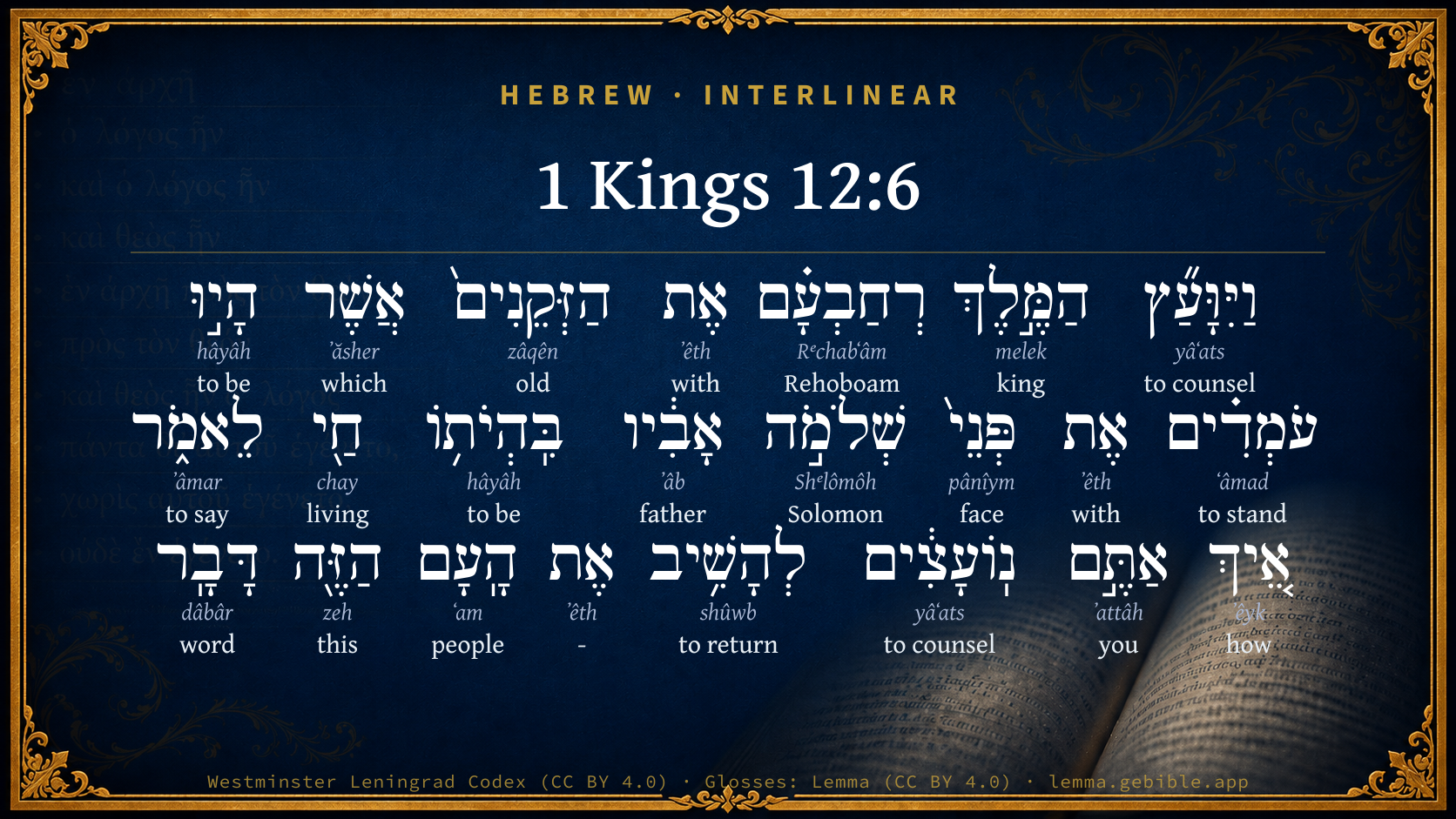
Hebrew (Westminster Leningrad Codex) 1 Kings 12:6 appears in the Hebrew Old Testament. The text above is from the Westminster Leningrad Codex. Each word links to its Strong’s number, a concise gloss, and parsing drawn from the Open Scriptures Hebrew Bible morphology. Click any word for its full Brown-Driver-Briggs (BDB) entry.
Download image
Cite this verse

1 Kings 12:6 (World English Bible). Public Domain. Lemma interlinear Bible study tool, https://lemma.gebible.app/v/1-kings/12/6.

Show BibTeX & RIS
BibTeX
RIS
English Translation
King Rehoboam took counsel with the old men, who had stood before Solomon his father while he yet lived, saying, What counsel give you me to return answer to this people?
World English Bible · Public Domain
Download a study sheet

One document with this verse’s original text, its word-by-word gloss line, the meaning frame, cross-references with their text, attributed commentary, and full source and license credits — printable, and it pastes into notes with its structure intact.

This verse Autodidact and up

Study sheet (.html) Plain text (.txt)

A passage Seminary Student

Up to 50 verses in one chapter. A passage sheet keeps up to 6 commentary sources and 12 cross-references per verse, in the order this page ranks them, and says so on the sheet whenever that leaves anything out. Ask for a single verse and you get the Autodidact verse sheet above.

Everything on this page stays free to read, with no account — the sheet is a download of what is already on screen, not access to it.

Want to remove ads? Support Godless Engineer
Compare translations 3

The same verse in 3 English versions, stacked beneath the original-language interlinear above. Click any original word for its lexicon entry.

Each is an independent rendering of the whole verse — the interlinear is not word-aligned to these translations.

Highlighted words mark where these versions differ — a whole-verse word diff, not a word-by-word alignment.

  • World English Bible Public Domain
    King Rehoboam took counsel with the old men, who had stood before Solomon his father while he yet lived, saying, What counsel give you me to return answer to this people?
  • King James Version Public Domain
    And king Rehoboam consulted with the old men, that stood before Solomon his father while he yet lived, and said, How do ye advise that I may answer this people?
  • unfoldingWord Literal Text CC BY-SA 4.0
    And King Rehoboam consulted with the elders who had been standing to the face of Solomon his father while he was alive, saying, “How are you advising to answer this people a word?”

unfoldingWord Literal Text — © unfoldingWord, licensed CC BY-SA 4.0. Word-aligned USFM3 via Door43 (git.door43.org/unfoldingWord/en_ult).

Versions to compare (up to 4)

3 of 4 selected

Show all 18 translations

Every available English version of this verse, each an independent rendering of the whole verse.

  • World English Bible Public Domain
    King Rehoboam took counsel with the old men, who had stood before Solomon his father while he yet lived, saying, What counsel give you me to return answer to this people?
  • Berean Standard Bible Public Domain
    Then King Rehoboam consulted with the elders who had served his father Solomon during his lifetime. “How do you advise me to respond to these people?” he asked.
  • Majority Standard Bible Public Domain
    Then King Rehoboam consulted with the elders who had served his father Solomon during his lifetime. “How do you advise me to respond to these people?” he asked.
  • King James Version Public Domain
    And king Rehoboam consulted with the old men, that stood before Solomon his father while he yet lived, and said, How do ye advise that I may answer this people?
  • American Standard Version (1901) Public Domain
    And king Rehoboam took counsel with the old men, that had stood before Solomon his father while he yet lived, saying, What counsel give ye me to return answer to this people?
  • Revised Version (1885) Public Domain
    And king Rehoboam took counsel with the old men, that had stood before Solomon his father while he yet lived, saying, What counsel give ye me to return answer to this people?
  • Geneva Bible (1599) Public Domain
    And King Rehoboam tooke counsell with the olde men that had stande before Salomon his father, while he yet liued, and sayde, What counsell giue ye, that I may make an answere to this people?
  • Douay-Rheims (1899) Public Domain
    King Roboam took counsel with the old men, that stood before Solomon his father while he yet lived, and he said: What counsel do you give me, that I may answer this people?
  • Young's Literal Translation Public Domain
    And king Rehoboam consulteth with the elders who have been standing in the presence of Solomon his father, in his being alive, saying, `How are ye counselling to answer this people?'
  • Literal Standard Version CC BY-SA 4.0
    And King Rehoboam consults with the elderly who have been standing in the presence of his father Solomon, in his being alive, saying, “How are you counseling to answer this people?”
  • Unlocked Literal Bible CC BY-SA 4.0
    King Rehoboam consulted with the old men who had stood before Solomon his father while he was alive, and he said, “How do you advise me to answer this people?”
  • unfoldingWord Literal Text CC BY-SA 4.0
    And King Rehoboam consulted with the elders who had been standing to the face of Solomon his father while he was alive, saying, “How are you advising to answer this people a word?”
  • Darby Bible Public Domain
    And king Rehoboam consulted with the old men, who had stood before Solomon his father while he yet lived, saying, How do ye advise to return answer to this people?
  • World Messianic Bible Public Domain
    King Rehoboam took counsel with the old men who had stood before Solomon his father while he yet lived, saying, “What counsel do you give me to answer these people?”
  • Webster's Bible Public Domain
    And king Rehoboam consulted with the old men that stood before Solomon his father while he yet lived, and said, How do ye advise that I may answer this people?
  • Free Bible Version CC BY-SA 4.0
    King Rehoboam asked for advice from the elders who had served his father Solomon when he was alive. “How do you advise me to reply to these people about this?” he asked.
  • Bible in Basic English Public Domain
    Then King Rehoboam took the opinion of the old men who had been with Solomon his father when he was living, and said, In your opinion, what answer am I to give to this people?
  • JPS Tanakh (1917) Public Domain
    And king Rehoboam took counsel with the old men, that had stood before Solomon his father while he yet lived, saying: 'What counsel give ye me to return answer to this people?'

Literal Standard Version (2020), Covenant Press — licensed CC BY-SA 4.0. Text via the HelloAO Bible API (eBible.org). Unlocked Literal Bible (unfoldingWord) — licensed CC BY-SA 4.0. Text via the HelloAO Bible API (eBible.org). unfoldingWord Literal Text — © unfoldingWord, licensed CC BY-SA 4.0. Word-aligned USFM3 via Door43 (git.door43.org/unfoldingWord/en_ult). Free Bible Version, Dr. Jonathan Gallagher — licensed CC BY-SA 4.0. Text via the HelloAO Bible API (eBible.org).

Word by word

More ways to search: Search by grammar → Find every occurrence → Compare this word →

Practice this passage: Drill this verse → Learn its vocabulary →

רְחַבְעָ֗ם
Rᵉchabʻâm
H7346
“Rehoboam”
Noun, Proper
Part of Speech
Noun
Type
Proper
Full BDB Definition

Origin: from H7337 and H5971

TWOT: None

Rehoboam = "a people has enlarged" - son of Solomon and the 1st king of Judah after the split up of the kingdom of Israel
  1. וַיִּוָּעַ֞ץ yâʻats H3289 “and · to counsel” Conjunction + Verb, Niphal, Sequential Imperfect, 3rd Person, Masculine, Singular
  2. הַמֶּ֣לֶךְ melek H4428 “the · king” Particle, Definite Article + Noun, Common, Masculine, Singular, Absolute
  3. אֶת ʼêth H854 “with” Preposition
  4. הַזְּקֵנִים֙ zâqên H2205 “the · old” Particle, Definite Article + Adjective, Adjective, Masculine, Plural, Absolute
  5. אֲשֶׁר ʼăsher H834 “which” Particle, Relative
  6. הָי֣וּ hâyâh H1961 “to be” Verb, Qal, Perfect, 3rd Person, Common, Plural
  7. עֹמְדִ֗ים ʻâmad H5975 “standing” Verb, Qal, Participle Active, Masculine, Plural, Absolute
  8. אֶת ʼêth H854 “with” Preposition
  9. פְּנֵי֙ pânîym H6440 “face(s) of” Noun, Common, Both, Plural, Construct
  10. שְׁלֹמֹ֣ה Shᵉlômôh H8010 “Solomon” Noun, Proper
  11. אָבִ֔יו ʼâb H1 “father · his” Noun, Common, Masculine, Singular, Construct + Suffix, Personal, 3rd Person, Masculine, Singular
  12. בִּֽהְיֹת֥וֹ hâyâh H1961 “in/at · to be · him” Preposition + Verb, Qal, Infinitive Construct + Suffix, Personal, 3rd Person, Masculine, Singular
  13. חַ֖י chay H2416 “living” Adjective, Adjective, Masculine, Singular, Absolute
  14. לֵאמֹ֑ר ʼâmar H559 “to say” Preposition + Verb, Qal, Infinitive Construct
  15. אֵ֚יךְ ʼêyk H349 “how” Particle, Interrogative
  16. אַתֶּ֣ם ʼattâh H859 “you” Pronoun, Personal, 2nd Person, Masculine, Plural
  17. נֽוֹעָצִ֔ים yâʻats H3289 “counseling” Verb, Niphal, Participle Active, Masculine, Plural, Absolute
  18. לְהָשִׁ֥יב shûwb H7725 “to return” Preposition + Verb, Hiphil, Infinitive Construct
  19. אֶת ʼêth H853 “-” Particle, Direct Object
  20. הָֽעָם ʻam H5971 “the · people” Particle, Definite Article + Noun, Common, Masculine, Singular, Absolute
  21. הַזֶּ֖ה zeh H2088 “the · this” Particle, Definite Article + Pronoun, Demonstrative, Masculine, Singular
  22. דָּבָֽר dâbâr H1697 “word” Noun, Common, Masculine, Singular, Absolute

About this verse

These counts appear in no published source. They are computed here, from the morphology-tagged text and Lemma’s own curated glosses. What Lemma adds →

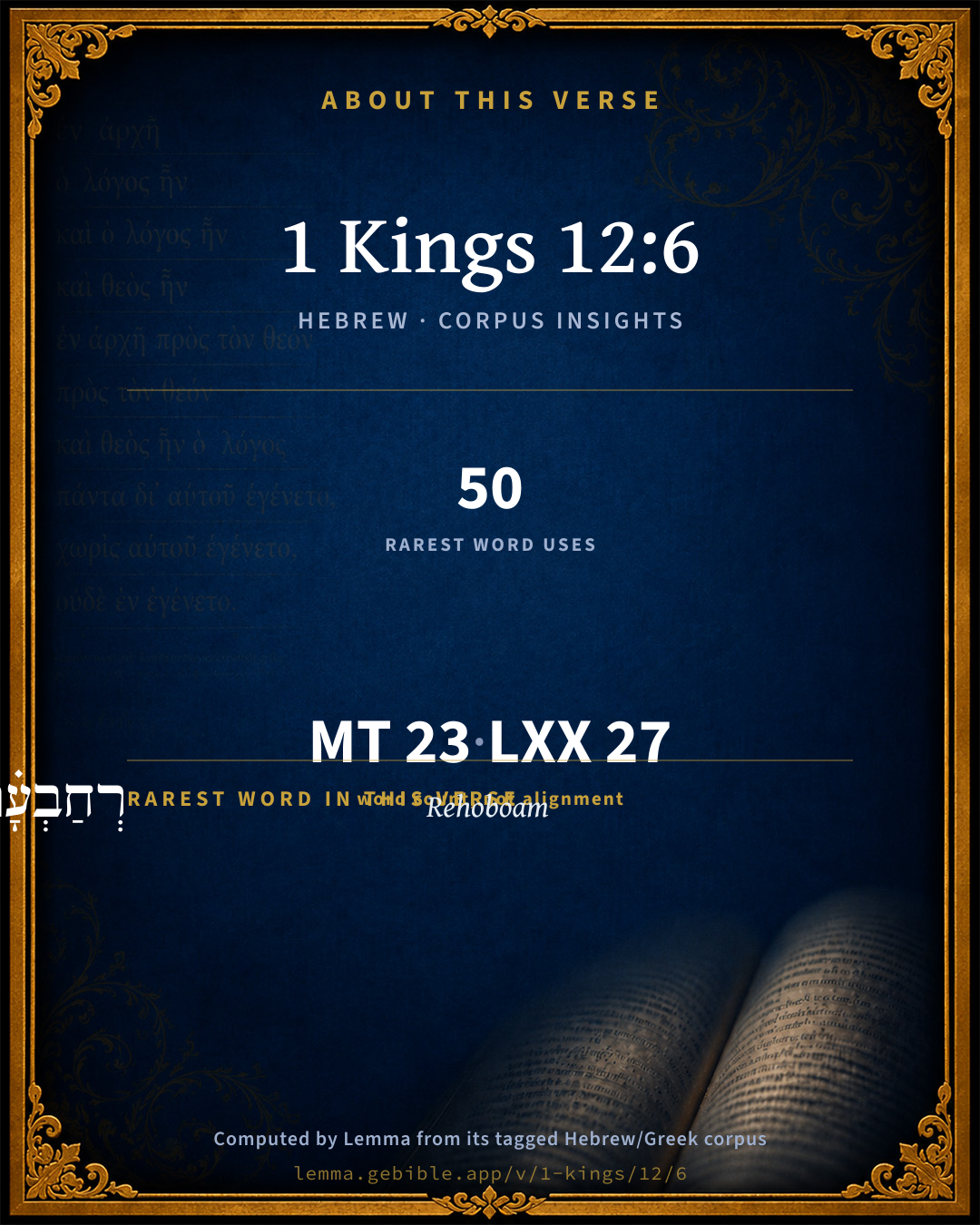
23
words
20
distinct lemmas
Historical
section

Shared distinctive vocabulary

רְחַבְעָ֗ם Rehoboam H7346 occurs in 41 verses of the Hebrew Bible. Also found in:

Grammatical profile

  • 7 verbs
  • 7 nouns
  • 2 adjectives
  • 2 pronouns
  • 2 prepositions
  • 3 particles

Verb forms

  • וַיִּוָּעַ֞ץ Niphal · Sequential Imperfect
  • הָי֣וּ Qal · Perfect
  • עֹמְדִ֗ים Qal · Participle Active
  • בִּֽהְיֹת֥וֹ Qal · Infinitive Construct
  • לֵאמֹ֑ר Qal · Infinitive Construct
  • נֽוֹעָצִ֔ים Niphal · Participle Active
  • לְהָשִׁ֥יב Hiphil · Infinitive Construct

Repetition

Words recur within this verse — often emphatic in Hebrew:

  • וַיִּוָּעַ֞ץ to counsel H3289 ×2
  • הָי֣וּ to be H1961 ×2
  • אֶת with H854 ×2

Hebrew & Septuagint length

In English translation the verse runs 31 words from the Hebrew and 31 from the Septuagint (LXX English) — the same length.

A rough comparison of the two English renderings, which tokenize alike — not a word-level alignment.

Word counts can differ between the Hebrew and the Greek without any difference in meaning — e.g. the Hebrew direct-object marker אֵת has no separate Greek word, and Greek often adds the article ὁ.

In the original languages it is 23 Hebrew tokens and 27 Greek tokens — but the two are counted differently (Hebrew bundles its prefixes and suffixes into one token; the Greek is in lemma form), so that isn’t a like-for-like length.

Cross-references

8

Topical passages linked to 1 Kings 12:6 in the Treasury of Scripture Knowledge — connected by theme and wording, ordered by reader-vote popularity; previews shown in the World English Bible.

  • Job 12:12 With aged men is wisdom, In length of days understanding.
  • Job 32:7 I said, 'Days should speak, And multitude of years should teach wisdom.'
  • 2 Samuel 16:20 Then said Absalom to Ahithophel, Give your counsel what we shall do.
  • 2 Samuel 17:5 Then said Absalom, Call now Hushai the Archite also, and let us hear likewise what he says.
  • 1 Kings 4:2 These were the princes whom he had: Azariah the son of Zadok, the priest;
  • Proverbs 27:10 Don't forsake your friend and your father's friend. Don't go to your brother's house in the day of your disaster: Better is a neighbor who is near than a distant brother.
  • Jeremiah 42:2–5 and said to Jeremiah the prophet, Let, we pray you, our supplication be presented before you, and pray for us to Yahweh your God, even for all this remnant; for we are left but a few of many, as your eyes do see us:
  • Jeremiah 43:2 then spoke Azariah the son of Hoshaiah, and Johanan the son of Kareah, and all the proud men, saying to Jeremiah, You speak falsely: Yahweh our God has not sent you to say, You shall not go into Egypt to sojourn there;

Cross-references courtesy of OpenBible.info (CC BY 4.0).

Hebrew and Greek witnesses Masoretic Hebrew ↔ Greek Septuagint

The same verse in the two great witnesses to the Old Testament, shown verse-for-verse.

These are two independent witnesses, not word-aligned to each other, and the Septuagint is shown in lemma (dictionary) form.

Hebrew 1 Kings 12:6 Masoretic · Westminster Leningrad Codex

וַיִּוָּעַ֞ץ הַמֶּ֣לֶךְ רְחַבְעָ֗ם אֶת הַזְּקֵנִים֙ אֲשֶׁר הָי֣וּ עֹמְדִ֗ים אֶת פְּנֵי֙ שְׁלֹמֹ֣ה אָבִ֔יו בִּֽהְיֹת֥וֹ חַ֖י לֵאמֹ֑ר אֵ֚יךְ אַתֶּ֣ם נֽוֹעָצִ֔ים לְהָשִׁ֥יב אֶת הָֽעָם הַזֶּ֖ה דָּבָֽר

King Rehoboam took counsel with the old men, who had stood before Solomon his father while he yet lived, saying, What counsel give you me to return answer to this people?

World English Bible · Public Domain

Greek LXX 1 Kings 12:6 Septuagint · lemma form

καί παραἀγγέλλω ὁ βασιλεύς ὁ πρεσβύτερος ὅς εἰμί παραἵστημι ἐνώπιον σαλωμών ὁ πατήρ αὐτός ἔτι ζάω αὐτός λέγω πῶς σύ βουλεύω καί ἀποκρίνω ὁ λαός οὗτος λόγος

And the king referred the matter to the elders, who stood before Solomon his father while he was yet living, saying, How do you⌃ advise that I should answer this people?

LXX2012 (modern English Septuagint) · Public Domain

Hebrew: Westminster Leningrad Codex (CC BY 4.0). Greek: Septuagint (public domain); English from LXX2012 (modern English Septuagint) (Public Domain). How the Septuagint differs from the Hebrew →

Targum (Aramaic paraphrase)

1

The Targum is the ancient Jewish Aramaic paraphrase of the Hebrew Scriptures — an interpretive translation, not the Hebrew text itself. Onkelos (literal) and Pseudo-Jonathan (expansive) render the Torah, and Jonathan the Prophets. Coverage is partial: where no permissively-licensed English translation exists for a verse, only the Aramaic is shown. This is verse-level text, not a word-by-word alignment to the Hebrew.

  1. Targum Jonathan Prophets (Joshua–Malachi)
    וְאִתְמְלִיךְ מַלְכָּא רְחַבְעָם בְּסָבַיָא דַהֲווֹ מְשַׁמְשִׁין קֳדָם שְׁלֹמֹה אֲבוּהִי כַּד הֲוָה קַיָם לְמֵימָר אֵיכְדֵין אַתּוּן מִתְמַלְכִין לַאֲתָבָא יַת עַמָא הָדֵין פִּתְגָמָא:

    (no public-domain English translation for this verse)

    Targum Jonathan — Aramaic: “Mikraot Gedolot” (public domain). English: “Sefaria Community Translation” (CC0 1.0 (public-domain dedication)); “London "Chaldee Paraphrase," 1871” (public domain). Text via Sefaria.

Commentary

Notes on 1 Kings 12:6 from classic Christian and Jewish commentators (each source and its license shown beneath its notes). The classic Christian expositions comment on the surrounding passage and are grouped to its opening verse, so a note may address several verses; the Jewish commentaries on the Tanakh (Rashi and others) are per-verse, so they appear only where the commentator wrote on this verse.

Lemma curates 59 commentaries, every one of them public domain or Creative Commons licensed, each selected and text-cleaned for this edition rather than reprinted as found. About our sources →

Trapp's Complete Commentary

John Trapp

1Ki 12:6 And king Rehoboam consulted with the old men, that stood before Solomon his father while he yet lived, and said, How do ye advise that I may answer this people?

Ver. 6. And king Rehoboam consulted with the old men.] This was right; for "with the ancient is wisdom, and in length of days is understanding," {Job 12:12} Cautius dimicant veterani milites.

“ Vulneribus didicit miles habere rectum. ”

Those who have bought their wit, will walk more warily, and advise more solidly.

John Trapp, A Commentary or Exposition upon All the Books of the Old and New Testament (1647–1656) — public domain. Text from a community e-Sword module.

Joseph Benson's Commentary

1Ki 12:6-7. Consulted with the old men that stood before — his father — Solomon, in his best days, though so wise, yet would not depend solely on his own wisdom, but had other wise men about him, with whom he advised, as his counsellors in all matters of moment. If thou wilt be a servant unto this people this day, &c. — By complying with their desires, and condescending to them for a time, till thou art better established in thy throne. They say, This day, that is, now, for a short season, foreseeing that some would dissuade him from this course, as below the majesty of a prince; and answer them, and speak good words — The service is not hard: it is only to give a few good words, which it is as easy to give as bad ones. This was most wise advice, and if Rehoboam had pursued this method, by his mild behaviour and kind speeches he would have won their hearts, and made them submit cheerfully to him, so that he would soon have had the same power over them which his father had.

Joseph Benson's Commentary on the Old and New Testaments (1811–1818) — public domain. Text from a community e-Sword module.

The Expositor's Bible

THE DISRUPTION

1Ki_12:6-20

"It was of the Lord." It is no small proof of the insight and courageous faithfulness of the historian that he accepts without question the verdict of ancient prophecy that the disruption was Gods doing; for everything which happened in the four subsequent centuries, alike in Judah and in Israel, seemed to belie this pious conviction. We, in the light of later history, are now able to see that the disseverance of Israels unity worked out results of eternal advantage to mankind; but in the sixth century before Christ no event could have seemed to be so absolutely disastrous. It must have worn the aspect of an extinction of the glory of the House of Jacob. It involved the obliteration of the great majority of the descendants of the patriarchs, and the reduction of the rest to national insignificance and apparently hopeless servitude. Throughout those centuries of troubled history, in the struggle for existence which was the lot of both kingdoms alike, it was difficult to say whether their antagonism or their friendship, their open wars or their matrimonial alliances, were productive of the greater ruin. Each section of the nation fatally hampered and counterpoised the other with a perpetual rivalry and menace. Ephraim envied Judah, and Judah vexed Ephraim. In extreme cases the south was ready to purchase the intervention of Syria, or even of Assyria, to check and overwhelm its northern rival, while the north could raise up Egypt or Edom to harass the southern kingdom with intolerable raids.

To us the Southern Kingdom, the kingdom of Judah, seems the more important and the more interesting division of the people. It became the heir of all the promises, the nurse of the Messianic hope, the mother of the four greater prophets, the continuer of all the subsequent history after the glory of Israel had been stamped out by Assyria forever.

1. But such was not the aspect presented by the kingdom of Judah, to contemporary observers. On the contrary, Judah seemed to be a paltry and accidental fragment-one tribe, dissevered from the magnificent unity of Israel. Nothing redeemed it from impotence and obliteration but the splendid possessions of Jerusalem and the Temple, which guaranteed the often threatened perpetuity of the House of David. The future seemed to be wholly with Israel when men compared the relative size and population of the disunited tribes. Judah comprised little more than the environs of Jerusalem. Except Jerusalem, Mizpeh, Gibeon, and Hebron, it had no famous shrines and centers of national traditions. It could not even claim the southern town of Beersheba as a secure possession. The tribe of Simeon had melted away into a shadow, if not into non-existence, amid the surrounding populations, and its territory was under the kings of Judah; but they did not even possess the whole of Benjamin, and if that little tribe was nominally reckoned with them, it was only because part of their capital city was in Benjamite territory, to which belonged the valley of Hinnom. To Israel, on the other hand, pertained all the old local sanctuaries and scenes of great events. On the east of Jordan they held Mahanaim; on the west Jericho, near as it was to Jerusalem, and Bethel with its sacred stone of Jacob, and Gilgal with its memorial of the conquest, and Shechem the national place of assembly, and Accho and Joppa on the sea shore. Israel, too, inherited all the predominance over Moab and Ammon, and the Philistines, which had been secured by conquest in the reign of David. {1Ki_16:34; 2Ki_2:4}

2. Then, again, the greatest heroes of tradition had been sons of the northern tribes. The fame of Joshua was theirs, of Deborah and Barak, of fierce Jephthah, of kingly Gideon, and of bold Abimelech. Holy Samuel, the leader of the prophets, and heroic Saul, the first of the kings, had been of their kith and kin. Judah could only claim the bright personality of David, and the already tarnished glories of Solomon, which men did not yet see through the mirage of legend but in the prosaic light of every day.

3. Again, the Northern Kingdom was unhampered by the bad example and erroneous development of the preceding royalty. Jeroboam had not stained his career with crimes like David; nor had he sunk, as Solomon had done, into polygamy and idolatry. It seemed unlikely that he, with so fatal an example before his eyes, could be tempted into oppressive tyranny, futile commerce, or luxurious ostentation. He could found a new dynasty, free from the trammels of a bad commencement, and as fully built on Divine command as that of the House of Jesse.

4. Nor was it a small advantage that the new kingdom had an immense superiority over its southern compeer in richness of soil and beauty of scenery. To it belonged the fertile plain of Jezreel, rolling with harvests of golden grain. Its command of Accho gave it access to the treasures of the shore and of the sea. To it belonged the purple heights of Carmel, of which the very name meant "a garden of God"; and the silver Lake of Galilee, with its inexhaustible swarms of fish; and the fields of Gennesareth, which were a wonder of the world for their tropical luxuriance. Theirs also were the lilied waters and paper-reeds of Merom, and the soft, green, park-like scenery of Gerizim, and the roses of Sharon, and the cedars of Lebanon, and the vines and fig trees and ancient terebinths of all the land of Ephraim, and the forest glades of Zebulon and Naphtali, and the wild uplands beyond the Jordan-which were all far different from the "awful barrenness" of Judah, with its monotony of rounded hills.

3. Under these favorable conditions three great advantages were exceptionally developed in the Northern Kingdom.

(1) It evidently enjoyed a larger freedom as well as a greater prosperity. How gay and bright, how festive and musical, how worldly and luxurious, was the life of the wealthy and the noble in the ivory palaces and on the gorgeous divans of Samaria and Jezreel, as we read of it in the pages of the contemporary prophets! {Amo_5:11; Amo_6:4-6} Naboth and Shemer show themselves as independent of tyranny as any sturdy dalesman or feudal noble, and "the great lady of Shunem, on the slopes of Esdraelon, in her well-known home, is a sample of Israelite life in the north as true as that of the reaper Boaz in the south. She leaves her home under the pressure of famine, and goes down to the plains of Philistia. When she returns and finds a stranger in her corn-fields, she insists on restitution, even at the hand of the king himself."

(2) The Ten Tribes also developed a more brilliant literature. Some of the most glowing psalms are probably of northern origin, as well as the Song of Deborah, and the work of the writer who is now generally recognized by critics under the name of the Deuteronomist. The loveliest poem produced by Jewish literature-the Song of Songs-bears on every page the impress of the beautiful and imaginative north. The fair girl of Shunem loves her leopard-haunted hills, and the vernal freshness of her northern home, more than the perfumed chambers of Solomons seraglio; and her poet is more charmed with the luster and loveliness of Tirzah than with the palaces and Temple of Jerusalem. The Book of Job may have originated in the Northern Kingdom, from which also sprang the best historians of the Jewish race.

(3) But the main endowment of the new kingdom consisted in the magnificent development and independence of the prophets.

It was not till after the overthrow of the Ten Tribes that the glory of prophecy migrated southwards and Jerusalem produced the mighty triad of Isaiah, Jeremiah, and Ezekiel. For the two and a half centuries that the Northern Kingdom lasted scarcely one prophet is heard of in Judah except the scarcely known Hanani, the Eliezer, the son of Mareshah, {2Ch_20:37} who is little more than a nominis umbra. To the north belongs the great herald-prophet of the Old Dispensation, the mighty Elijah; the softer spirit of the statesman-prophet Elisha; the undaunted Micaiah, son of Imlah; the picturesque Micah; the historic Jonah; the plaintive Hosea; and that bold and burning patriot, a fragment of whose prophecy now forms part of the Book of Zechariah. Amos, indeed, belonged by birth to Tekoa, which was in Judah, but his prophetic activity was confined to Bethel and Jezreel. The Schools of the Prophets at Ramah, Bethel, Jericho, and Gilgal were all in Israel. The passages in the third section of the Book of Zechariah are alone sufficient to show how vast was the influence in the affairs of the nation of the prophets of the north, and how fearless their intervention. Even when they were most fiercely persecuted, they were not afraid to beard the most powerful kings-an Ahab and a Jeroboam II-in all their pride. {Zec_11:4-17; Zec_13:7-9} Samaria and Galilee were rich in prophetic lives; and they, too were the destined scene of the life of Him of whom all the prophets prophesied, and from whose inspiration they drew their heavenly fire.

Against these advantages, however, must be set two serious and ultimately fatal drawbacks-germs of disease which lay in the very constitution of the kingdom, and from the first doomed it to death.

One of these was the image-worship, of which I shall speak in a later section; the other was the lack of one predominant and continuous dynasty. The royalty of the north did not spring up through long years of gradual ascendency, and could not originally appeal to splendid services and heroic memories. Jeroboam was a man of humble, and, if tradition says truly, of tainted origin. He was not a usurper, for he was called to the throne by the voice of prophecy and the free spontaneous choice of his people; but in Solomons days he had been a potential if not an actual rebel. He set the example of successful revolt, and it was eagerly followed by many a soldier and general of similar antecedents. In the short space of two hundred and forty-five years there were no less than nine changes of dynasty, of which those of Jeroboam, Baasha, Kobolam, Menahem, consisted only of a father and son. There were at least four isolated or partial kings: Zimri, Tibni, Pekah, and Hosea. Only two dynasties, those of Omri and Jehu, succeeded in maintaining themselves for even four or five generations, and they, like the others, were at last quenched in blood. The close of the kingdom in its usurpations, massacres, and catastrophes reminds us of nothing so much as the disastrous later days of the Roman Empire, when the purple was so often rent by the dagger-thrust, and it was rare for emperors to die a natural death. The kingdom which had risen from a sea of blood set in the same red waves.

On the other hand, whatever may have been the drawback of the small and hampered Southern Kingdom, it had several conspicuous advantages. It had a settled and incomparable capital, which could be rendered impregnable against all ordinary assaults; while the capital of the Northern Kingdom shifted from Shechem to Penuel and Tirzah, and from Tirzah to Samaria and Jezreel. It had the blessing of a loyal people, and of the all-but-unbroken continuity of one loved and cherished dynasty for nearly four centuries. It had the yet greater blessing of producing not a few kings who more or less fully attained to the purity of the theocratic ideal. Asa, Jehoshaphat, Hezekiah, Josiah, were good and high-minded kings, and the two latter were religious reformers. Whatever may have been the sins and shortcomings of Judah-and they were often very heinous-still the prophets bear witness that her transgressions were less incurable than those of her sister Samaria. All good men began to look to Jerusalem as the nursing mother of the Promised Deliverer. "Out of Judah," said the later Zechariah, "shall come forth the corner stone, out of him the nail, out of him the battle bow, out of him every governor together." Amos was horn in Judah; Hosea took refuge there; the later Zechariah labored (9, 11, Zec_13:7-9) for the fusion of the two kingdoms. From the unknown, or little known, seers who endeavored to watch over the infant destinies of Judah, to the mighty prophets who inspired her early resistance to Assyria, or menaced her apostasy with ruin at the hands of Babylon, she rarely lacked for any long period the inspired guidance of moral teachers. Judah was for many years behind-hand in power, in civilization, in literature, even in the splendor of prophetic inspiration, she still managed on the whole to uplift to the nations the standard of righteousness. That standard was often fiercely assaulted, but the standard-bearers did not faint. The torn remnants of the old ideal were still upheld by faithful hands. Neither the heathen tendencies of princes nor the vapid ceremonialism of priests were allowed unchallenged to usurp the place of religion pure and undefiled. The later Judaean prophets, and especially the greatest of them, rose to a spirituality which had never yet been attained, and was never again equaled till the rise of the Sun of Righteousness with healing in His wings.

How clearly, then, do we see the truth of the prophetic announcement that thy disruption of the kingdom was of the Lord out of apparent catastrophe was evolved infinite reparation. The abandonment of the Davidic dynasty of the Ten Tribes looked like earthly ruin. It did indeed hasten the final overthrow of all national autonomy; but that would have come in any case, humanly speaking, from Assyria, or Babylonia, or Persia, or the Seleucids, or the Ptolemies, or Rome. On the other hand, it fostered a religious power and concentration which were of more value to the world than any other blessings. "On all the past greatness and glory of Israel," says Ewald, "Judah cast its free and cheerful gaze. Before its kings floated the vision of great ancestors; before its prophets examples like those of Nathan and Gad; before the whole people the memory of its lofty days. And so it affords us no unworthy example of the honorable part which may be played for many centuries in the history of the world, and the rich blessings which may be imparted, even by a little kingdom, provided it adheres faithfully to the eternal truth. The gain to the higher life of humanity acquired under the earthly protection of this petty monarchy far outweighs all that has been attempted or accomplished for the permanent good of man by many much larger states." "The people of Israel goes under," Says Stade, "but the religion of Israel triumphs over the powers of the world, while it changes its character from the religion of a people into a religion of the world." This development of religion, as he proceeds to point out, was mainly due to the long, slow enfeeblement of the people through many centuries, until at last it had acquired a force which enabled it to survive the political annihilation of the nationality from which it sprang.

In reality both kingdoms gained under the appearance of total loss. "Every people called to high destinies," says Renan, "ought to be a small complete world, enclosing opposed poles within its bosom. Greece had at a few leagues from each other, Sparta and Athens, two antipodes to a superficial observer, but in reality rival sisters, necessary the one to the other. It was the same in Palestine."

The high merit of the historian of the two kingdoms appears in this, that, without entangling himself in details, and while he contents himself with sweeping and summary judgments, he established a moral view of history which has been ratified by the experience of the world. He shows us how the tottering and insignificant kingdom of Judah, secured by Gods promise, and rising through many backslidings into higher spirituality and faithfulness, not only out-lasted for a century the overthrow of its far more powerful rival, but kept alive the torch of faith, and handed it on to the nations of many centuries across the dust and, darkness of intervening generations. And in drawing this picture he helped to secure the fulfillment of his own ideal, for he inspired into many a patriot and many a reformer the indomitable faith in God which has enabled men, in age after age, to defy obloquy and opposition, to face the prison and the sword, secure in the ultimate victory of Gods truth and Gods righteousness amidst the most seemingly absolute failure, and against the most apparently overwhelming odds.

William Robertson Nicoll, ed., The Expositor's Bible (London: Hodder & Stoughton, 1887–1910) — public domain. 65 of 66 books (1 Corinthians is not separately keyed, as that volume carries no machine-parseable verse references); section-level commentary keyed to the opening verse. Introductory and overview sections not keyed to a specific passage are excluded.

Tyndale Open Study Notes

Tyndale Open Resources

12:6-7 older men: Those who had served under Solomon advised moderation.

Tyndale Open Study Notes — © Tyndale Open Resources, licensed CC BY-SA 4.0. Text via the HelloAO Bible API.

Geneva Bible (1599)

Geneva Bible translators

Or, had been of his ancient counselors.

Geneva Bible (1599) marginal notes — public domain. Text via Bolls.life.

The Cambridge Bible for Schools and Colleges

gen. ed. J. J. S. Perowne

6. And king Rehoboam consulted] That the close similarity between the narrative here and 2 Chron. may be as apparent as possible to the English reader, the R.V. reads here as there, took counsel, and similarly in 1Ki_12:8 ‘and took counsel with the young men.’ The change is of no importance to the sense, but where two passages are identical in the original they are with advantage represented so in the translation.

the old men] These persons must have been advanced in years, and perhaps were not in public office under Rehoboam. The age of Rehoboam on his accession was 41 years (1Ki_14:21). (See, however, the note at the end of this chapter.) So though he and his favoured advisers are spoken of as ‘young,’ they were not so, except in comparison with Solomon’s counsellors.

How do you advise that I may answer] Here again in R.V. the translation is harmonized with 2 Chron. What counsel give ye me to return answer. Though this is certainly not so idiomatic as the English of Kings.

The Cambridge Bible for Schools and Colleges (gen. ed. J. J. S. Perowne; Cambridge University Press, 1878–1918) — public domain. Text from a community e-Sword module.

John Gill's Exposition

And King Rehoboam consulted with the old men that stood before Solomon his father, while he yet lived,.... Which was very prudently done; for as these were men in years, and had been his father's counsellors, from whom, do doubt, they had learnt much wisdom, being often in cabinet council with him, they were capable of giving him the best advice:

and said, how do you advise, that I may answer this people? what answer would you advise me to give to them, and in what manner?

John Gill's Exposition of the Whole Bible (1746–1763) — public domain (CC PDM 1.0). Text via the HelloAO Bible API.

Albert Barnes' Notes on the Bible

The old men, that stood before Solomon his father - Perhaps “the princes” of 1Ki 4:2. Solomon placed great value upon good advisers Pro 11:14; Pro 15:22; Pro 24:6.

Albert Barnes' Notes on the Bible (1834–1885) — public domain. Text from a community e-Sword/MySword module.

Haydock's Catholic Bible Commentary

Old man. Banaias and Jahiel. (St. Jerome, Trad.)

George Leo Haydock (1774–1849), Haydock's Catholic Family Bible and Commentary, 1859 edition — public domain. Excludes Psalms (Douay-Rheims chapter numbering differs from Protestant) and Deuterocanonical books (Catholic canon only).

Matthew Poole's English Annotations

With the old men that stood before Solomon; with Solomon’s old counsellors, whom age, and experience of men and things, and converse with such a king, had made wise.

Matthew Poole's English Annotations on the Holy Bible (1683–1685) — public domain. Text from a community e-Sword/MySword module.

The Pulpit Commentary

And king Rehoboam consulted with the old men According to Bahr," the are not old people, but the elders." No doubt the word is constantly used, as in the expressions, "elders of Israel," "elders of the city," etc. (cf. presbuteroi, senatores (from senex), aldermen=elder men), without any reference to age; but this is not the case here, as the strong contrast with "young men" (vers. 8, 13, 14) proves that stood before (see on 1Ki_1:2) Solomon his father among them, perhaps, were some of the "princes" of 1Ki_4:2 sqq. while he yet lived, and said, How do ye advise that I may answer this people?

Ver. 6-11.

Israel"s Magna Charta.

The question submitted to Rehoboam at Shechem concerned the constitution of the monarchy. Hitherto there had been no constitution defining the rights of the people and limiting the power of the crown. Rehoboam took three days to deliberate upon the people"s Bill of Rights, and in that interval took counsel. The old men who stood before Solomon advised concession, while the young ones, who had grown up with him, recommended resistance. Wisdom was with the ancients.

I LIMITED MONARCHY IS BEST FOR THE PEOPLE.

1. Because it recognises their rights.

(1) The people do not exist for the king. They may be governed as republic without a king.

(2) But the king exists for the people. Where no people are there can be no king.

(3) For a king, therefore, to use the people simply for his own aggrandisement and ignore their rights is preposterous. (Jer_2:14)

2. respects their happiness.

(1) Since the people collectively are of more importance than an individual monarch, the haughty bearing of a monarch is out of place. So the sages counselled Rehoboam to "serve" the people and "speak good words to them.

(2) The interests of a good king will be bound up with the happiness of his subjects, and he cannot reasonably object to a constitution that will recognise this community of interests.

II IT IS BEST ALSO FOR THE PRINCE.

1. It encourages his virtues.

(1) It does this by limiting his extravagance. Solomon would have been far happier had his people been saved the charge of building palaces for, and sustaining in state, seven hundred princesses and three hundred concubines.

(2) For what would be necessary to sustain his rank a constitutional king might trust the good sense of his people. At Shechem they did not seek exemption from taxation, but relief from its excesses. They knew that it would not be to the credit of a great people to pauperise their prince.

2. It gives stability to his throne.

(1) "They will be thy servants forever." Such was the manner in which this was expressed by the sages. It will be their interest to be so. Gratitude also will bind them. The loyalty of love is stronger and more enduring than that of fear. This is the loyalty which the gospel claims, and the constancy of the subjects of the kingdom of Christ is witnessed in s million martyrdoms.

(2) Who rules over a loving people may be tranquil. He need not fear the poniard of the assassin. (This is the paradise of tyrants!) He will have the joy of ruling over a happy nation. The typical constitutional monarch is the father of his people.

III ADVOCATES OF TYRANNY SCORN TO REASON.

1. The young counsellors give no reasons.

(1) This method they leave to the ancients. For reasons they substitute smart speech. "Thus shalt thou say unto them, My little finger shall be thicker than my father"s loins." Pertness too often has displaced reason.

(2) Why should reasons be given by one who claims a Divine right to act as he pleases?

2. But may there not be a benevolant autocracy?

(1) Certainly. And if this can be guaranteed, together with competent wisdom, then there is no better government. For is not this the very idea of the government of God?

(2) But who can guarantee this in human kingdoms? The people certainly are as likely to know what is for their welfare as the majority of their kings.

(3) What if the autocrat should prove a fool? What if he should prove a devil? Would not a kingdom in this case be a hell upon earth?

(4) Rehoboam seems to have combined the satanic and the foolish. Lost the greater part of his kingdom; reigned over the remnant wickedly. Christians should pray for their rulers. They should bless God for their liberties. M.

The Pulpit Commentary (1880–1919), ed. H.D.M. Spence-Jones & Joseph S. Exell — public domain. Text from a community e-Sword module.

unfoldingWord translationNotes

Door43 World Missions Community

the old men who had stood before Solomon

To "stand before" is an idiom for serving the king in his presence. AT: "the old men who counseled Solomon" or "the old men who attended to Solomon" (See: Idiom)

translationWords

servant

word

unfoldingWord translationNotes — © Distant Shores Media and the Door43 World Missions Community, licensed CC BY-SA 4.0. Source: git.door43.org/Door43/en_tn.

Lesson kit

Teaching starters — assembled from the data on this page, not authored interpretation. Every prompt links to the verse data it draws on. Edit before teaching.

1 Kings, in the Historical, opens this verse with 23 words (20 distinct Hebrew lemmas). Its most distinctive word is Rᵉchabʻâm (“Rehoboam”). A historical commentator’s framing appears above. Read the whole chapter for the surrounding context.

Discussion questions

  1. The word Rᵉchabʻâm carries the sense “Rehoboam.” How does it shape the verse?
  2. 1 Kings 11:43 shares the word «Rehoboam» with this verse. How do the two illuminate each other?
  3. “to counsel” occurs 2× in this one verse. What is the effect of the repetition?
  4. These translations render this verse differently; the difference is in the English rendering, not the original. What questions does that raise?
  5. The verb «וַיִּוָּעַ֞ץ» is Niphal Sequential Imperfect. How does its form color the action?
  6. Reading how Trapp's Complete Commentary and Joseph Benson's Commentary read this verse, where do the two commentators agree and where do they part?

Things to notice

Reading settings

Reading text

Shown beneath each verse's original-language words.

Old Testament
Old Testament edition

Read the OT as the Masoretic Hebrew (MT) or the Greek Septuagint (LXX).

English shown for the Greek Septuagint (in the Hebrew ↔ Greek comparison).

Comparing translations? Open the Compare panel on any verse page to stack up to four side by side.