Judges 21:16

Hebrew (Westminster Leningrad Codex) Judges 21:16 appears in the Hebrew Old Testament. The text above is from the Westminster Leningrad Codex. Each word links to its Strong’s number, a concise gloss, and parsing drawn from the Open Scriptures Hebrew Bible morphology. Click any word for its full Brown-Driver-Briggs (BDB) entry.
Download image
Cite this verse

Judges 21:16 (World English Bible). Public Domain. Lemma interlinear Bible study tool, https://lemma.gebible.app/v/judges/21/16.

Show BibTeX & RIS
BibTeX
RIS
English Translation
Then the elders of the congregation said, How shall we do for wives for those who remain, seeing the women are destroyed out of Benjamin?
World English Bible · Public Domain
Download a study sheet

One document with this verse’s original text, its word-by-word gloss line, the meaning frame, cross-references with their text, attributed commentary, and full source and license credits — printable, and it pastes into notes with its structure intact.

This verse Autodidact and up

Study sheet (.html) Plain text (.txt)

A passage Seminary Student

Up to 50 verses in one chapter. A passage sheet keeps up to 6 commentary sources and 12 cross-references per verse, in the order this page ranks them, and says so on the sheet whenever that leaves anything out. Ask for a single verse and you get the Autodidact verse sheet above.

Everything on this page stays free to read, with no account — the sheet is a download of what is already on screen, not access to it.

Want to remove ads? Support Godless Engineer
Compare translations 3

The same verse in 3 English versions, stacked beneath the original-language interlinear above. Click any original word for its lexicon entry.

Each is an independent rendering of the whole verse — the interlinear is not word-aligned to these translations.

Highlighted words mark where these versions differ — a whole-verse word diff, not a word-by-word alignment.

  • World English Bible Public Domain
    Then the elders of the congregation said, How shall we do for wives for those who remain, seeing the women are destroyed out of Benjamin?
  • King James Version Public Domain
    Then the elders of the congregation said, How shall we do for wives for them that remain, seeing the women are destroyed out of Benjamin?
  • unfoldingWord Literal Text CC BY-SA 4.0
    So the elders of the congregation said, “What shall we do for wives for the remaining ones, since a woman has been destroyed from Benjamin?”

unfoldingWord Literal Text — © unfoldingWord, licensed CC BY-SA 4.0. Word-aligned USFM3 via Door43 (git.door43.org/unfoldingWord/en_ult).

Versions to compare (up to 4)

3 of 4 selected

Show all 18 translations

Every available English version of this verse, each an independent rendering of the whole verse.

  • World English Bible Public Domain
    Then the elders of the congregation said, How shall we do for wives for those who remain, seeing the women are destroyed out of Benjamin?
  • Berean Standard Bible Public Domain
    Then the elders of the congregation said, “What should we do about wives for those who remain, since the women of Benjamin have been destroyed?”
  • Majority Standard Bible Public Domain
    Then the elders of the congregation said, “What should we do about wives for those who remain, since the women of Benjamin have been destroyed?”
  • King James Version Public Domain
    Then the elders of the congregation said, How shall we do for wives for them that remain, seeing the women are destroyed out of Benjamin?
  • American Standard Version (1901) Public Domain
    Then the elders of the congregation said, How shall we do for wives for them that remain, seeing the women are destroyed out of Benjamin?
  • Revised Version (1885) Public Domain
    Then the elders of the congregation said, How shall we do for wives for them that remain, seeing the women are destroyed out of Benjamin?
  • Geneva Bible (1599) Public Domain
    Therefore the Elders of the Congregation said, How shall we doe for wiues to the remnant? for the women of Beniamin are destroyed.
  • Douay-Rheims (1899) Public Domain
    And the ancients said: What shall we do with the rest, that have not received wives? for all the women in Benjamin are dead.
  • Young's Literal Translation Public Domain
    And the elders of the company say, `What do we do to the remnant for wives -- for the women have been destroyed out of Benjamin?'
  • Literal Standard Version CC BY-SA 4.0
    And [the] elderly of the congregation say, “What do we do to the remnant for wives—for the women have been destroyed out of Benjamin?”
  • Unlocked Literal Bible CC BY-SA 4.0
    Then the leaders of the assembly said, “How will we arrange wives for the Benjamites who are left, since the women of Benjamin have been killed?”
  • unfoldingWord Literal Text CC BY-SA 4.0
    So the elders of the congregation said, “What shall we do for wives for the remaining ones, since a woman has been destroyed from Benjamin?”
  • Darby Bible Public Domain
    Then the elders of the congregation said, "What shall we do for wives for those who are left, since the women are destroyed out of Benjamin?"
  • World Messianic Bible Public Domain
    Then the elders of the congregation said, “How shall we provide wives for those who remain, since the women are destroyed out of Benjamin?”
  • Webster's Bible Public Domain
    Then the elders of the congregation said, How shall we do for wives for them that remain, seeing the women are destroyed out of Benjamin?
  • Free Bible Version CC BY-SA 4.0
    The elders of the assembly asked, “What shall we do to supply the remaining wives because all the women of Benjamin have been destroyed?”
  • Bible in Basic English Public Domain
    Then the responsible men of the meeting said, What are we to do about wives for the rest of them, seeing that the women of Benjamin are dead?
  • JPS Tanakh (1917) Public Domain
    Then the elders of the congregation said: 'How shall we do for wives for them that remain, seeing the women are destroyed out of Benjamin?'

Literal Standard Version (2020), Covenant Press — licensed CC BY-SA 4.0. Text via the HelloAO Bible API (eBible.org). Unlocked Literal Bible (unfoldingWord) — licensed CC BY-SA 4.0. Text via the HelloAO Bible API (eBible.org). unfoldingWord Literal Text — © unfoldingWord, licensed CC BY-SA 4.0. Word-aligned USFM3 via Door43 (git.door43.org/unfoldingWord/en_ult). Free Bible Version, Dr. Jonathan Gallagher — licensed CC BY-SA 4.0. Text via the HelloAO Bible API (eBible.org).

Word by word

More ways to search: Search by grammar → Find every occurrence → Compare this word →

Practice this passage: Drill this verse → Learn its vocabulary →

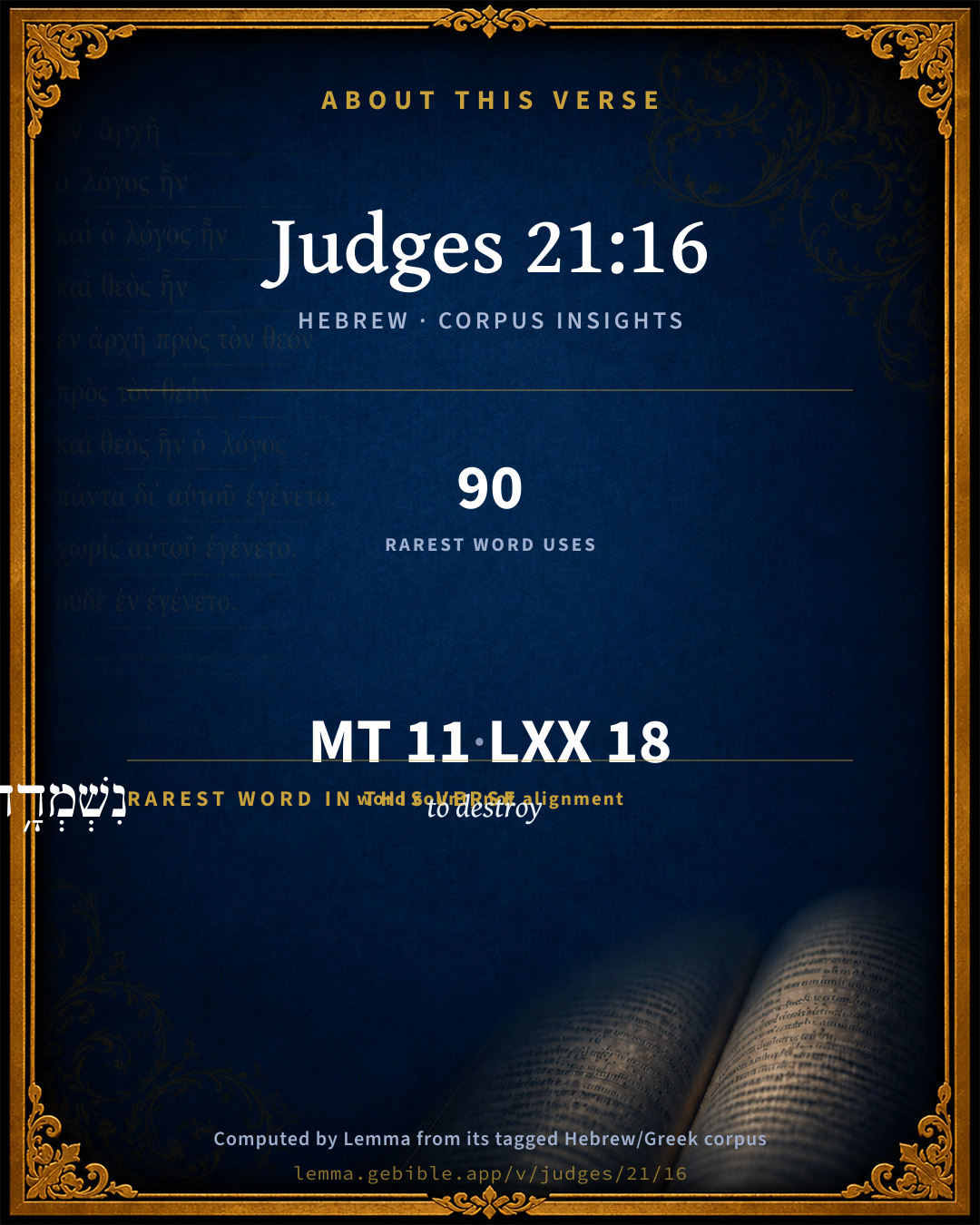
נִשְׁמְדָ֥ה
shâmad
H8045
“to destroy”
Verb, Niphal, Perfect, 3rd Person, Feminine, Singular
Part of Speech
Verb
Stem
Niphal
Form
Perfect
Person
3rd Person
Gender
Feminine
Number
Singular
Full BDB Definition

Origin: a primitive root

TWOT: 2406

to destroy, exterminate, be destroyed, be exterminated - (Niphal) - to be annihilated, be exterminated - to be destroyed, be devastated - (Hiphil) - to annihilate, exterminate - to destroy
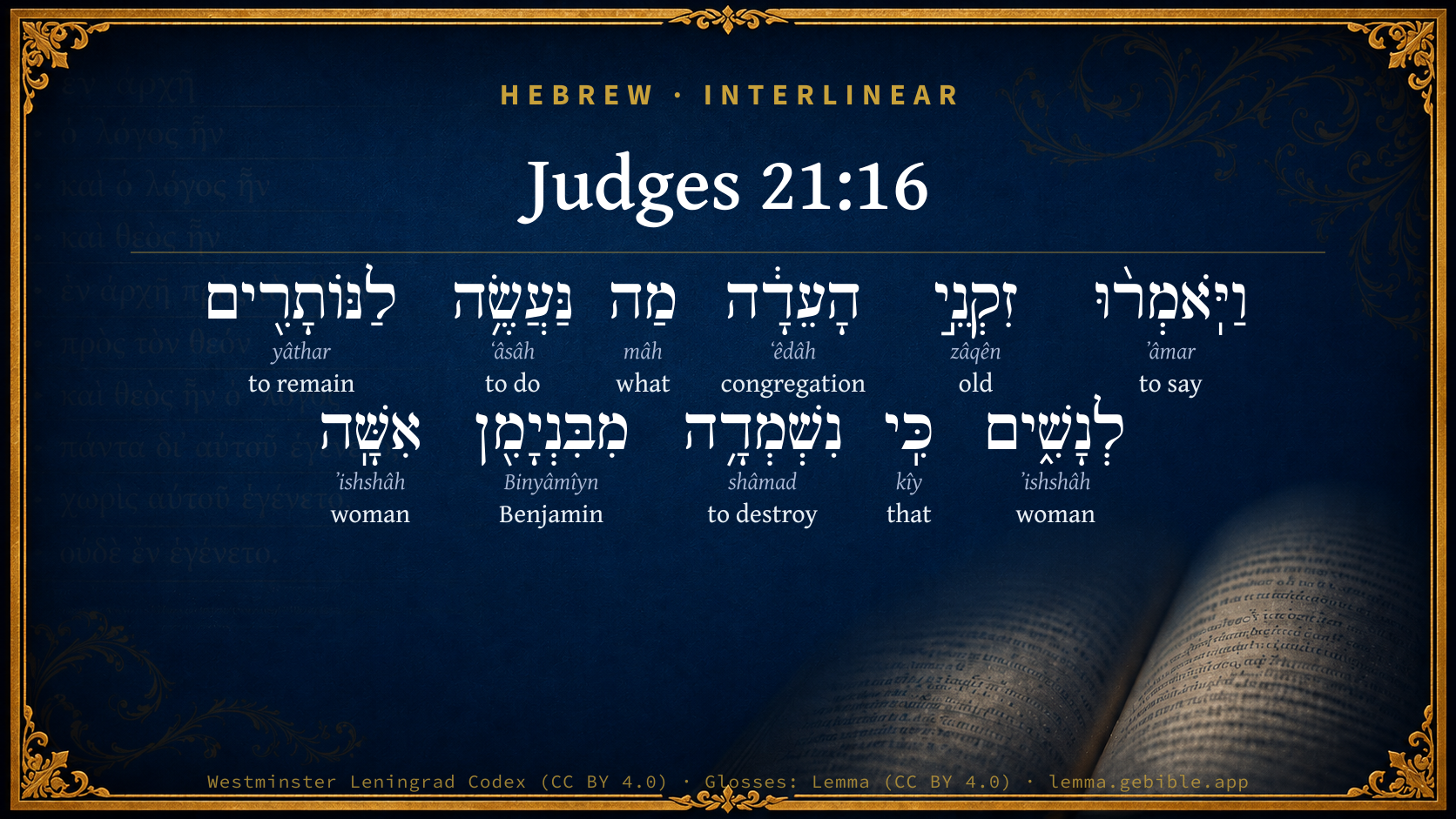
  1. וַיֹּֽאמְר֨וּ ʼâmar H559 “and · to say” Conjunction + Verb, Qal, Sequential Imperfect, 3rd Person, Masculine, Plural
  2. זִקְנֵ֣י zâqên H2205 “old of” Adjective, Adjective, Masculine, Plural, Construct
  3. הָעֵדָ֔ה ʻêdâh H5712 “the · congregation” Particle, Definite Article + Noun, Common, Feminine, Singular, Absolute
  4. מַה mâh H4100 “what” Particle, Interrogative
  5. נַּעֲשֶׂ֥ה ʻâsâh H6213 “to do” Verb, Qal, Imperfect, 1st Person, Common, Plural
  6. לַנּוֹתָרִ֖ים yâthar H3498 “to/for the · remained” Preposition, Determined + Verb, Niphal, Participle Passive, Masculine, Plural, Absolute
  7. לְנָשִׁ֑ים ʼishshâh H802 “to/for · women” Preposition + Noun, Common, Feminine, Plural, Absolute
  8. כִּֽי kîy H3588 “that” Conjunction
  9. מִבִּנְיָמִ֖ן Binyâmîyn H1144 “from · Benjamin” Preposition + Noun, Proper
  10. אִשָּֽׁה ʼishshâh H802 “woman” Noun, Common, Feminine, Singular, Absolute

About this verse

These counts appear in no published source. They are computed here, from the morphology-tagged text and Lemma’s own curated glosses. What Lemma adds →

11
words
10
distinct lemmas
Historical
section

Grammatical profile

  • 4 verbs
  • 4 nouns
  • 1 adjective
  • 1 conjunction
  • 1 particle

Verb forms

  • וַיֹּֽאמְר֨וּ Qal · Sequential Imperfect
  • נַּעֲשֶׂ֥ה Qal · Imperfect
  • לַנּוֹתָרִ֖ים Niphal · Participle Passive
  • נִשְׁמְדָ֥ה Niphal · Perfect

Repetition

A word recurs within this verse — often emphatic in Hebrew:

  • לְנָשִׁ֑ים woman H802 ×2

Hebrew & Septuagint length

In English translation the verse runs 25 words from the Hebrew and 26 from the Septuagint (LXX English) — closely comparable.

A rough comparison of the two English renderings, which tokenize alike — not a word-level alignment.

Word counts can differ between the Hebrew and the Greek without any difference in meaning — e.g. the Hebrew direct-object marker אֵת has no separate Greek word, and Greek often adds the article ὁ.

In the original languages it is 11 Hebrew tokens and 18 Greek tokens — but the two are counted differently (Hebrew bundles its prefixes and suffixes into one token; the Greek is in lemma form), so that isn’t a like-for-like length.

Hebrew and Greek witnesses Masoretic Hebrew ↔ Greek Septuagint

The same verse in the two great witnesses to the Old Testament, shown verse-for-verse.

These are two independent witnesses, not word-aligned to each other, and the Septuagint is shown in lemma (dictionary) form.

Hebrew Judges 21:16 Masoretic · Westminster Leningrad Codex

וַיֹּֽאמְר֨וּ זִקְנֵ֣י הָעֵדָ֔ה מַה נַּעֲשֶׂ֥ה לַנּוֹתָרִ֖ים לְנָשִׁ֑ים כִּֽי נִשְׁמְדָ֥ה מִבִּנְיָמִ֖ן אִשָּֽׁה

Then the elders of the congregation said, How shall we do for wives for those who remain, seeing the women are destroyed out of Benjamin?

World English Bible · Public Domain

Greek LXX Judges 21:16 Septuagint · lemma form

καί εἶπον ὁ πρεσβύτερος ὁ συναγωγή τίς ποιέω ὁ περισσός εἰς γυνή ὅτι ἀπο ἀναἵζω ἀπό βενιαμίν γυνή

And the elders of the congregation said, What shall we do for wives for them that remain? for the women have been destroyed out of Benjamin.

LXX2012 (modern English Septuagint) · Public Domain

Hebrew: Westminster Leningrad Codex (CC BY 4.0). Greek: Septuagint (public domain); English from LXX2012 (modern English Septuagint) (Public Domain). How the Septuagint differs from the Hebrew →

Targum (Aramaic paraphrase)

1

The Targum is the ancient Jewish Aramaic paraphrase of the Hebrew Scriptures — an interpretive translation, not the Hebrew text itself. Onkelos (literal) and Pseudo-Jonathan (expansive) render the Torah, and Jonathan the Prophets. Coverage is partial: where no permissively-licensed English translation exists for a verse, only the Aramaic is shown. This is verse-level text, not a word-by-word alignment to the Hebrew.

  1. Targum Jonathan Prophets (Joshua–Malachi)
    וַאֲמַרוּ סָבֵי כְנִשְׁתָּא מַה נַעְבֵּד לִדְאִשְׁתַּאֲרוּ לִנְשִׁין אֲרֵי פְסָקַת מִדְבֵית בִּנְיָמִן אִתְּתָא:

    (no public-domain English translation for this verse)

    Targum Jonathan — Aramaic: “Mikraot Gedolot” (public domain). English: “Sefaria Community Translation” (CC0 1.0 (public-domain dedication)); “London "Chaldee Paraphrase," 1871” (public domain). Text via Sefaria.

Commentary

Notes on Judges 21:16 from classic Christian and Jewish commentators (each source and its license shown beneath its notes). The classic Christian expositions comment on the surrounding passage and are grouped to its opening verse, so a note may address several verses; the Jewish commentaries on the Tanakh (Rashi and others) are per-verse, so they appear only where the commentator wrote on this verse.

Lemma curates 59 commentaries, every one of them public domain or Creative Commons licensed, each selected and text-cleaned for this edition rather than reprinted as found. About our sources →

Jamieson, Fausset & Brown

Robert Jamieson, A. R. Fausset & David Brown

THE ELDERS CONSULT HOW TO FIND WIVES FOR THOSE THAT WERE LEFT. (Jdg 21:16-21)

the elders of the congregation said, How shall we do for wives for them that remain--Though the young women of Jabesh-gilead had been carefully spared, the supply was found inadequate, and some other expedient must be resorted to.

Jamieson, Fausset & Brown — Commentary Critical and Explanatory on the Whole Bible (1871) — public domain (CC PDM 1.0). Text via the HelloAO Bible API.

The Cambridge Bible for Schools and Colleges

gen. ed. J. J. S. Perowne

16. the elders of the congregation] See on Jdg_20:1, and cf. Lev_4:15. That this half of the verse does not belong to the old story is further shewn by the reference to wives for the Benjamites who had not secured any of the 400 virgins from Jabesh; like the last words of Jdg_21:14; Jdg_21:16 a is a harmonizing addition. 16b may well continue Jdg_21:15 and belong to A.

The Cambridge Bible for Schools and Colleges (gen. ed. J. J. S. Perowne; Cambridge University Press, 1878–1918) — public domain. Text from a community e-Sword module.

Trapp's Complete Commentary

John Trapp

Jdg 21:16 Then the elders of the congregation said, How shall we do for wives for them that remain, seeing the women are destroyed out of Benjamin?

Ver. 16. How shall we do for wives? &c.] Now all their care was for a recruit for Benjamin. A public person should be public spirited; and as Cato did, Toti genitum se credere genti. Selfish people are like those envious Athenians, who sacrificed for none but themselves and their neighbours of Chios.

John Trapp, A Commentary or Exposition upon All the Books of the Old and New Testament (1647–1656) — public domain. Text from a community e-Sword module.

Matthew Henry's Commentary

We have here the method that was taken to provide the 200 Benjamites that remained with wives. And, though the tribe was reduced to a small number, they were only in care to provide each man with one wife, not with more under pretence of multiplying them the faster. They may not bestow their daughters upon them, but to save their oath, and yet marry some of their daughters to them, they put them into a way of taking them by surprise, and marrying them, which should be ratified by their parents' consent, ex post facto - afterwards. The less consideration is used before the making of a vow, the more, commonly, there is need of afterwards for the keeping of it.

I. That which gave an opportunity for the doing of this was a public ball at Shiloh, in the fields, at which all the young ladies of that city and the parts adjacent that were so disposed met to dance, in honour of a feast of the Lord then observed, probably the feast of tabernacles (Jdg 21:19), for that feast (bishop Patrick says) was the only season wherein the Jewish virgins were allowed to dance, and that not so much for their own recreation as to express their holy joy, as David when he danced before the ark, otherwise the present melancholy posture of public affairs would have made dancing unseasonable, as Isa 22:12, Isa 22:13. The dancing was very modest and chaste. It was not mixed dancing; no men danced with these daughters of Shiloh, nor did any married women so far forget their gravity as to join with them. However their dancing thus in public made them an easy prey to those that had a design upon them, whence bishop Hall observes that the ambushes of evil spirits carry away many souls from dancing to a fearful desolation.

II. The elders of Israel gave authority to the Benjamites to do this, to lie in wait in the vineyards which surrounded the green they used to dance on, and, when they were in the midst of their sport, to come upon them, and catch every man a wife for himself, and carry them straight away to their own country, Jdg 21:20, Jdg 21:21. They knew that none of their own daughters would be there, so that the parents of these virgins could not be said to give them, for they knew nothing of the matter. A sorry salvo is better than none, to save the breaking of an oath: it were much better to be cautious in making vows, that there be not occasion afterwards, as there was here, to say before the angel that it was an error. Here was a very preposterous way of match-making, when both the mutual affection of the young people and the consent of the parents must be presumed to come after; the case was extraordinary, and may by no means be drawn into a precedent. Over hasty marriages often occasion a leisurely repentance; and what comfort can be expected from a match made either by force or fraud? The virgins of Jabesh-Gilead were taken out of the midst of blood and slaughter, but these of Shiloh out of the midst of mirth and joy; the former had reason to be thankful that they had their lives for a prey, and the latter, it is to be hoped, had no cause to complain, after a while, when they found themselves matched, not to men of broken and desperate fortunes, as they seemed to be, who were lately fetched out of a cave, but to men of the best and largest estates in the nation, as they must needs be when the lot of the whole tribe of Benjamin, which consisted of 45,600 men (Num 26:41), came to be divided again among 600, who had all by survivorship.

III. They undertook to pacify the fathers of these young women. As to the infringement of their paternal authority, they would easily forgive it when they considered to what fair estates their daughters were matched and what mothers in Israel they were likely to be; but the oath they were bound by, not to give their daughters to Benjamites, might perhaps stick with some of them, whose consciences were tender, yet, as to that, this might satisfy them: - 1. That the necessity was urgent (Jdg 21:22): We reserved not to each man his wife, owning now that they did ill to destroy all the women, and desiring to atone for their too rigorous construction of their vow to destroy them by the most favourable construction of their vow not to match with them. "And therefore for our sakes, who were too severe, let them keep what they have got." For, 2. In strictness it was not a breach of their vow; they had sworn not to give them their daughters, but they had not sworn to fetch them back if they were forcibly taken, so that if there was any fault the elders must be responsible, not the parents. And Quod fieri non debuit, factum valet - That which ought not to have been done is yet valid when it is done. The thing was done, and is ratified only by connivance, according to the law, Num 30:4.

Lastly, In the close of all we have, 1. The settling of the tribe of Benjamin again. The few that remained returned to the inheritance of that tribe, Jdg 21:23. And soon after from among them sprang Ehud, who was famous in his generation, the second judge of Israel, Jdg 3:15. 2. The disbanding and dispersing of the army of Israel, Jdg 21:24. They did not set up for a standing army, nor pretend to make any alterations or establishments in the government; but when the affair was over for which they were called together, they quietly departed in God's peace, every man to his family. Public services must not make us think ourselves above our own private affairs and the duty of providing for our own house. 3. A repetition of the cause of these confusions, Jdg 21:25. Though God was their King, every man would be his own master, as if there was no king. Blessed be God for magistracy.

Matthew Henry's Commentary on the Whole Bible (1708–1710) — public domain (CC PDM 1.0). Text via the HelloAO Bible API.

Ellicott's Commentary for English Readers

(16) How shall we do . . .?—They want to keep their vow in the letter, while they break it in the spirit. The sense of the binding nature of the “ban” was intensely strong (Exo_20:7; Eze_17:18-19), but, as is so often the case among rude and ignorant people, they fancied that it was sufficient to keep it literally, while in effect they violated it. Similarly in Herodotus (iv. 154), Themison having sworn to throw Phronima into the sea—the intention having been that she should be drowned—feels himself bound to throw her into the sea, but has her drawn out of it again. Their want of moral enlightenment revealed itself in this way, and still more in having ever taken this horrible oath, which involved the butchery of innocent men, and of still more innocent women and children. In point of fact, the cherem often broke down under the strain which it placed on men’s best feelings (1Sa_14:45) as well as on their lower temptations. The guilt of breaking a guilty vow is only the original guilt of ever having made it. What the Israelites should have done was not to bathe their hands in more rivers of fraternal blood, but to pray to God to forgive the brutal vehemence which disgraced a cause originally righteous, and to have allowed the remnant of the Benjamites to intermarry with them once more. As it was, they were led by ignorance and rashness into several vows which could not be fulfilled without horrible cruelty and bloodshed, and the fulfilment of which they after all casuistically evaded, and that at the cost of still more bloodshed. As all these events took place under the guidance of Phinehas, they give us a high estimate indeed of the zeal which was his noblest characteristic (Psa_106:30), yet a very low estimate of his state of spiritual insight; and clearly to such a man the fulfilment of Jephthah’s cherem by sacrificing his daughter (see Note on Jdg_11:39) would have seemed as nothing compared to the extermination of tribes and of cities, involving the shedding of rivers of innocent blood. But why should we suppose that the grandson of Aaron, in such times as these—when all was anarchy, idolatry, and restlessness, against which he either did not strive or strove most ineffectually—should stand on so much higher a level than his schismatical and semi-idolatrous cousin, the wandering grandson of Moses?

A Bible Commentary for English Readers, edited by Charles John Ellicott (1878–1897) — public domain. Text from a community e-Sword module.

John Gill's Exposition

Then the elders of the congregation said.... This being the case, that there were not wives enough for them, they were obliged to consult again, and consider of another expedient to provide for them; and this motion came from the elders of the people, not only in years, but in office:

how shall we do for wives for them that remain: the other two hundred, who had none:

seeing the women are destroyed out of Benjamin? and so no wives to be had there; and as for the Israelites which came to Mizpeh, who were of all the tribes of Israel, they had solemnly sworn that they would not give any of their daughters to them, and therefore it was a very difficult thing to provide wives for them.

John Gill's Exposition of the Whole Bible (1746–1763) — public domain (CC PDM 1.0). Text via the HelloAO Bible API.

Matthew Poole's English Annotations

For them that remain; for the two hundred who are yet unprovided of wives.

Matthew Poole's English Annotations on the Holy Bible (1683–1685) — public domain. Text from a community e-Sword/MySword module.

Whedon's Commentary on the Bible

Daniel D. Whedon

16. Wives for them that remain — Two hundred were yet destitute of wives, for the virgins of Jabesh numbered but four hundred, and the remnant of Benjamin were six hundred.

Daniel D. Whedon (gen. ed.), Commentary on the Old and New Testaments (1874–1909) — public domain. Text from a community e-Sword module.

The Pulpit Commentary

Seeing the women. It is rather more in accordance with the Hebrew style to take the words as the narrator"s explanation of the question, What shall we do? They said this because all the women of Benjamin had been destroyed.

The Pulpit Commentary (1880–1919), ed. H.D.M. Spence-Jones & Joseph S. Exell — public domain. Text from a community e-Sword module.

unfoldingWord translationNotes

Door43 World Missions Community

Benjamites

This refers to the descendants of Benjamin. See how you translated this in Judges 3:15.

the women of Benjamin have been killed

This can be stated in active form. AT: "we killed all the Benjamite women" (See: Active or Passive)

There must be an inheritance ... is not destroyed from Israel

The Israelites are exaggerating. They had already given wives to four hundred of the Benjamites, so the tribe would not be completely destroyed. (See: Hyperbole and Generalization)

translationWords

assembly

Benjamin

inherit

tribe

Israel

unfoldingWord translationNotes — © Distant Shores Media and the Door43 World Missions Community, licensed CC BY-SA 4.0. Source: git.door43.org/Door43/en_tn.

Lesson kit

Teaching starters — assembled from the data on this page, not authored interpretation. Every prompt links to the verse data it draws on. Edit before teaching.

Judges, in the Historical, opens this verse with 11 words (10 distinct Hebrew lemmas). Its most distinctive word is shâmad (“to destroy”). A historical commentator’s framing appears above. Read the whole chapter for the surrounding context.

Discussion questions

  1. The word shâmad carries the sense “to destroy.” How does it shape the verse?
  2. “woman” occurs 2× in this one verse. What is the effect of the repetition?
  3. The translations on this page render this verse differently — a whole-verse word diff, not a word-by-word alignment. What might account for the different wordings?
  4. The verb «וַיֹּֽאמְר֨וּ» is Qal Sequential Imperfect. How does its form color the action?
  5. Reading how Jamieson, Fausset & Brown and The Cambridge Bible for Schools and Colleges read this verse, where do the two commentators agree and where do they part?

Things to notice

Reading settings

Reading text

Shown beneath each verse's original-language words.

Old Testament
Old Testament edition

Read the OT as the Masoretic Hebrew (MT) or the Greek Septuagint (LXX).

English shown for the Greek Septuagint (in the Hebrew ↔ Greek comparison).

Comparing translations? Open the Compare panel on any verse page to stack up to four side by side.