
Ruth 4:9

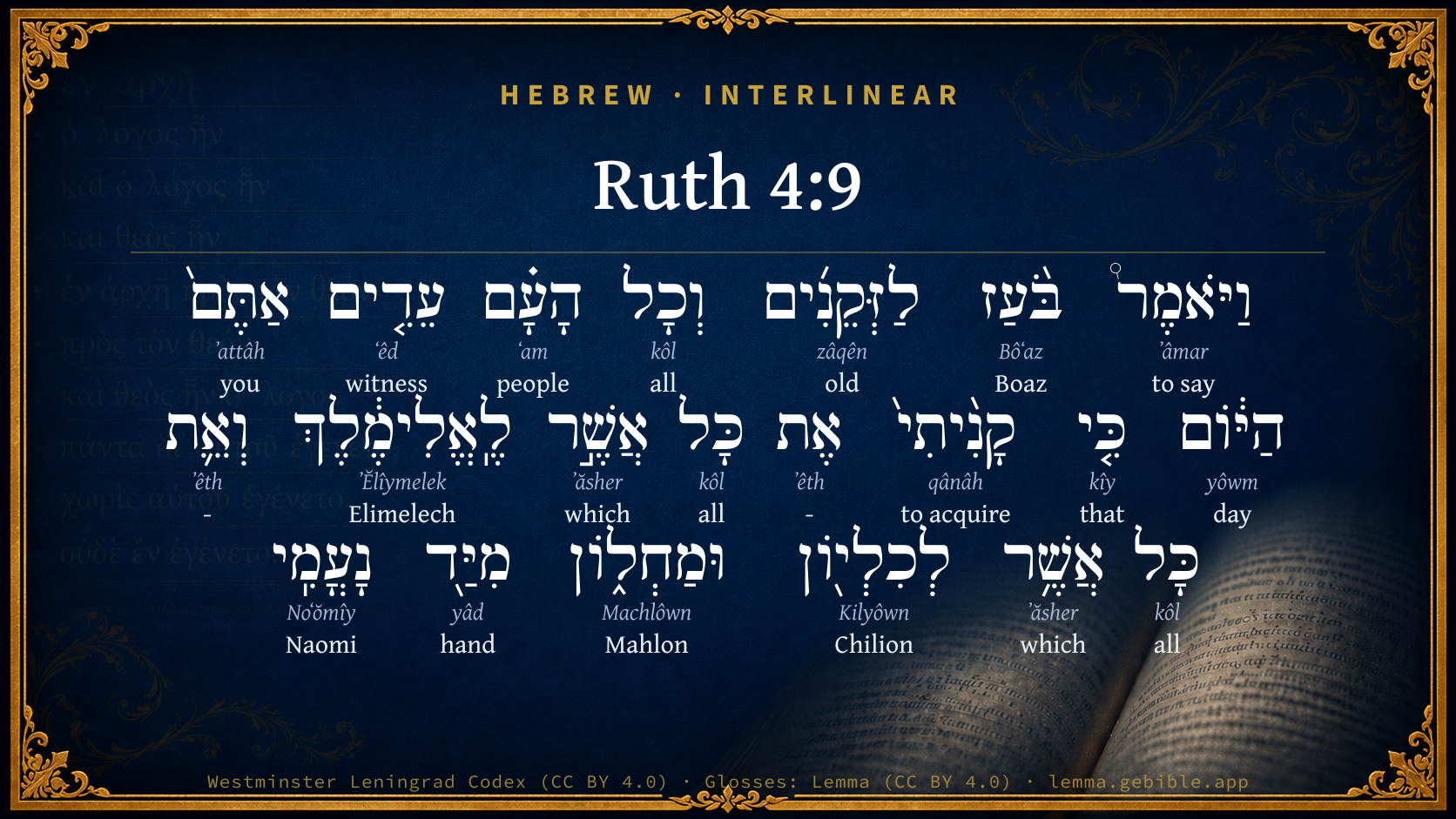
Hebrew (Westminster Leningrad Codex) Ruth 4:9 appears in the Hebrew Old Testament. The text above is from the Westminster Leningrad Codex. Each word links to its Strong’s number, a concise gloss, and parsing drawn from the Open Scriptures Hebrew Bible morphology. Click any word for its full Brown-Driver-Briggs (BDB) entry.
Download image
Cite this verse

Ruth 4:9 (World English Bible). Public Domain. Lemma interlinear Bible study tool, https://lemma.gebible.app/v/ruth/4/9.

Show BibTeX & RIS
BibTeX
RIS
English Translation
Boaz said to the elders, and to all the people, You are witnesses this day, that I have bought all that was Elimelech's, and all that was Chilion's and Mahlon's, of the hand of Naomi.
World English Bible · Public Domain
Download a study sheet

One document with this verse’s original text, its word-by-word gloss line, the meaning frame, cross-references with their text, attributed commentary, and full source and license credits — printable, and it pastes into notes with its structure intact.

This verse Autodidact and up

Study sheet (.html) Plain text (.txt)

A passage Seminary Student

Up to 50 verses in one chapter. A passage sheet keeps up to 6 commentary sources and 12 cross-references per verse, in the order this page ranks them, and says so on the sheet whenever that leaves anything out. Ask for a single verse and you get the Autodidact verse sheet above.

Everything on this page stays free to read, with no account — the sheet is a download of what is already on screen, not access to it.

Want to remove ads? Support Godless Engineer
Compare translations 3

The same verse in 3 English versions, stacked beneath the original-language interlinear above. Click any original word for its lexicon entry.

Each is an independent rendering of the whole verse — the interlinear is not word-aligned to these translations.

Highlighted words mark where these versions differ — a whole-verse word diff, not a word-by-word alignment.

  • World English Bible Public Domain
    Boaz said to the elders, and to all the people, You are witnesses this day, that I have bought all that was Elimelech's, and all that was Chilion's and Mahlon's, of the hand of Naomi.
  • King James Version Public Domain
    And Boaz said unto the elders, and unto all the people, Ye are witnesses this day, that I have bought all that was Elimelech's, and all that was Chilion's and Mahlon's, of the hand of Naomi.
  • unfoldingWord Literal Text CC BY-SA 4.0
    Then Boaz said to the elders and to all the people, “You are witnesses today that I am buying from the hand of Naomi everything that belonged to Elimelek and everything that belonged to Kilion and Mahlon.

unfoldingWord Literal Text — © unfoldingWord, licensed CC BY-SA 4.0. Word-aligned USFM3 via Door43 (git.door43.org/unfoldingWord/en_ult).

Versions to compare (up to 4)

3 of 4 selected

Show all 18 translations

Every available English version of this verse, each an independent rendering of the whole verse.

  • World English Bible Public Domain
    Boaz said to the elders, and to all the people, You are witnesses this day, that I have bought all that was Elimelech's, and all that was Chilion's and Mahlon's, of the hand of Naomi.
  • Berean Standard Bible Public Domain
    At this, Boaz said to the elders and all the people, “You are witnesses today that I am buying from Naomi all that belonged to Elimelech, Chilion, and Mahlon.
  • Majority Standard Bible Public Domain
    At this, Boaz said to the elders and all the people, “You are witnesses today that I am buying from Naomi all that belonged to Elimelech, Chilion, and Mahlon.
  • King James Version Public Domain
    And Boaz said unto the elders, and unto all the people, Ye are witnesses this day, that I have bought all that was Elimelech's, and all that was Chilion's and Mahlon's, of the hand of Naomi.
  • American Standard Version (1901) Public Domain
    And Boaz said unto the elders, and unto all the people, Ye are witnesses this day, that I have bought all that was Elimelech's, and all that was Chilion's and Mahlon's, of the hand of Naomi.
  • Revised Version (1885) Public Domain
    And Boaz said unto the elders, and unto all the people, Ye are witnesses this day, that I have bought all that was Elimelech’s, and all that was Chilion’s and Mahlon’s, of the hand of Naomi.
  • Geneva Bible (1599) Public Domain
    And Boaz sayd vnto the Elders and vnto all the people, Ye are witnesses this day, that I haue bought all that was Elimelechs, and all that was Chilions and Mahlons, of the hand of Naomi.
  • Douay-Rheims (1899) Public Domain
    And he said to the ancients and to all the people: You are witnesses this day, that I have bought all that was Elimelech's, and Chelion's, and Mahalon's, of the hand of Noemi:
  • Young's Literal Translation Public Domain
    And Boaz saith to the elders, and `to' all the people, `Witnesses `are' ye to-day that I have bought all that `is' to Elimelech, and all that `is' to Chilion and Mahlon, from the hand of Naomi;
  • Literal Standard Version CC BY-SA 4.0
    And Boaz says to the elderly, and [to] all the people, “You [are] witnesses today that I have bought all that [belonged] to Elimelech, and all that [belonged] to Chilion and Mahlon, from the hand of Naomi;
  • Unlocked Literal Bible CC BY-SA 4.0
    Then Boaz said to the elders and to all the people, “You are witnesses today that I have bought all that was Elimelek's and all that was Kilion's and Mahlon's from the hand of Naomi.
  • unfoldingWord Literal Text CC BY-SA 4.0
    Then Boaz said to the elders and to all the people, “You are witnesses today that I am buying from the hand of Naomi everything that belonged to Elimelek and everything that belonged to Kilion and Mahlon.
  • Darby Bible Public Domain
    And Boaz said to the elders and all the people, Ye are witnesses this day, that I have bought all that was Elimelech's, and all that was Chilion's and Mahlon's, of the hand of Naomi;
  • World Messianic Bible Public Domain
    Boaz said to the elders and to all the people, “You are witnesses today, that I have bought all that was Elimelech’s, and all that was Chilion’s and Mahlon’s, from the hand of Naomi.
  • Webster's Bible Public Domain
    And Boaz said to the elders, and to all the people, Ye are witnesses this day, that I have bought all that was Elimelech's, and all that was Chilion's and Mahlon's, of the hand of Naomi.
  • Free Bible Version CC BY-SA 4.0
    Then Boaz said to the elders and all the people present, “You are witnesses that today I have bought from Naomi all that belonged to Elimelech, Mahlon, and Chilion.
  • Bible in Basic English Public Domain
    Then Boaz said to the responsible men and to all the people, You are witnesses today that I have taken at a price from Naomi all the property which was Elimelech's, and everything which was Chilion's and Mahlon's.
  • JPS Tanakh (1917) Public Domain
    And Boaz said unto the elders, and unto all the people: 'Ye are witnesses this day, that I have bought all that was Elimelech's, and all that was Chilion's and Mahlon's, of the hand of Naomi.

Literal Standard Version (2020), Covenant Press — licensed CC BY-SA 4.0. Text via the HelloAO Bible API (eBible.org). Unlocked Literal Bible (unfoldingWord) — licensed CC BY-SA 4.0. Text via the HelloAO Bible API (eBible.org). unfoldingWord Literal Text — © unfoldingWord, licensed CC BY-SA 4.0. Word-aligned USFM3 via Door43 (git.door43.org/unfoldingWord/en_ult). Free Bible Version, Dr. Jonathan Gallagher — licensed CC BY-SA 4.0. Text via the HelloAO Bible API (eBible.org).

Word by word

More ways to search: Search by grammar → Find every occurrence → Compare this word →

Practice this passage: Drill this verse → Learn its vocabulary →

לְכִלְי֖וֹן
Kilyôwn
H3630
“to/for · Chilion”
Preposition + Noun, Proper
Part of Speech
Preposition + Noun
Type
Proper
Full BDB Definition

Origin: a form of H3631

TWOT: None

Chilion = "pining" - an Ephraimite and son of Elimelech by Naomi and the deceased husband of Ruth (or maybe deceased husband of Orpah)
  1. וַיֹּאמֶר֩ ʼâmar H559 “and · to say” Conjunction + Verb, Qal, Sequential Imperfect, 3rd Person, Masculine, Singular
  2. בֹּ֨עַז Bôʻaz H1162 “Boaz” Noun, Proper
  3. לַזְּקֵנִ֜ים zâqên H2205 “to/for the · old” Preposition, Determined + Adjective, Adjective, Masculine, Plural, Absolute
  4. וְכָל kôl H3605 “and · all of” Conjunction + Noun, Common, Masculine, Singular, Construct
  5. הָעָ֗ם ʻam H5971 “the · people” Particle, Definite Article + Noun, Common, Masculine, Singular, Absolute
  6. עֵדִ֤ים ʻêd H5707 “witnesses” Noun, Common, Masculine, Plural, Absolute
  7. אַתֶּם֙ ʼattâh H859 “you” Pronoun, Personal, 2nd Person, Masculine, Plural
  8. הַיּ֔וֹם yôwm H3117 “the · day” Particle, Definite Article + Noun, Common, Masculine, Singular, Absolute
  9. כִּ֤י kîy H3588 “that” Conjunction
  10. קָנִ֨יתִי֙ qânâh H7069 “to acquire” Verb, Qal, Perfect, 1st Person, Common, Singular
  11. אֶת ʼêth H853 “-” Particle, Direct Object
  12. כָּל kôl H3605 “all of” Noun, Common, Masculine, Singular, Construct
  13. אֲשֶׁ֣ר ʼăsher H834 “which” Particle, Relative
  14. לֶֽאֱלִימֶ֔לֶךְ ʼĔlîymelek H458 “to/for · Elimelech” Preposition + Noun, Proper
  15. וְאֵ֛ת ʼêth H853 “and · -” Conjunction + Particle, Direct Object
  16. כָּל kôl H3605 “all of” Noun, Common, Masculine, Singular, Construct
  17. אֲשֶׁ֥ר ʼăsher H834 “which” Particle, Relative
  18. וּמַחְל֑וֹן Machlôwn H4248 “and · Mahlon” Conjunction + Noun, Proper
  19. מִיַּ֖ד yâd H3027 “from · hand of” Preposition + Noun, Common, Both, Singular, Construct
  20. נָעֳמִֽי Noʻŏmîy H5281 “Naomi” Noun, Proper

About this verse

These counts appear in no published source. They are computed here, from the morphology-tagged text and Lemma’s own curated glosses. What Lemma adds →

21
words
17
distinct lemmas
Historical
section

Notable vocabulary

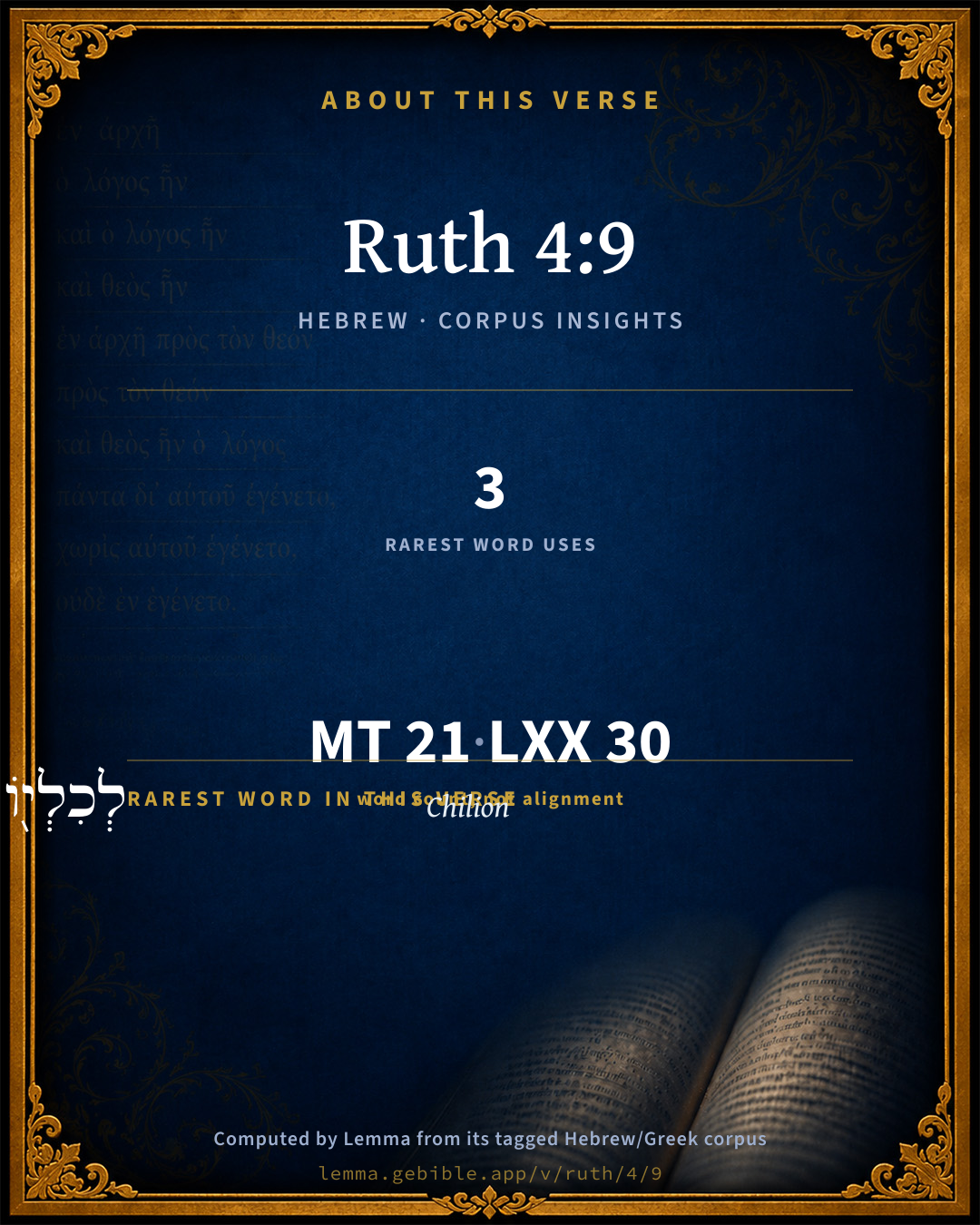
The rarest word here is לְכִלְי֖וֹן Chilion H3630 — appearing just 3 times in the whole Hebrew Bible.

Shared distinctive vocabulary

לְכִלְי֖וֹן Chilion H3630 occurs in 3 verses of the Hebrew Bible. Also found in:

Grammatical profile

  • 2 verbs
  • 12 nouns
  • 1 adjective
  • 1 pronoun
  • 1 conjunction
  • 4 particles

Verb forms

  • וַיֹּאמֶר֩ Qal · Sequential Imperfect
  • קָנִ֨יתִי֙ Qal · Perfect

Repetition

Words recur within this verse — often emphatic in Hebrew:

  • וְכָל all H3605 ×3
  • אֲשֶׁ֣ר which H834 ×2

Hebrew & Septuagint length

In English translation the verse runs 35 words from the Hebrew and 37 from the Septuagint (LXX English) — closely comparable.

A rough comparison of the two English renderings, which tokenize alike — not a word-level alignment.

Word counts can differ between the Hebrew and the Greek without any difference in meaning — e.g. the Hebrew direct-object marker אֵת has no separate Greek word, and Greek often adds the article ὁ.

In the original languages it is 21 Hebrew tokens and 30 Greek tokens — but the two are counted differently (Hebrew bundles its prefixes and suffixes into one token; the Greek is in lemma form), so that isn’t a like-for-like length.

Cross-references

2

Topical passages linked to Ruth 4:9 in the Treasury of Scripture Knowledge — connected by theme and wording, ordered by reader-vote popularity; previews shown in the World English Bible.

  • Genesis 23:16–18 Abraham listened to Ephron. Abraham weighed to Ephron the silver which he had named in the audience of the children of Heth, four hundred shekels of silver, according to the current merchants' standard.
  • Jeremiah 32:10–12 I subscribed the deed, and sealed it, and called witnesses, and weighed him the money in the balances.

Cross-references courtesy of OpenBible.info (CC BY 4.0).

Hebrew and Greek witnesses Masoretic Hebrew ↔ Greek Septuagint

The same verse in the two great witnesses to the Old Testament, shown verse-for-verse.

These are two independent witnesses, not word-aligned to each other, and the Septuagint is shown in lemma (dictionary) form.

Hebrew Ruth 4:9 Masoretic · Westminster Leningrad Codex

וַיֹּאמֶר֩ בֹּ֨עַז לַזְּקֵנִ֜ים וְכָל הָעָ֗ם עֵדִ֤ים אַתֶּם֙ הַיּ֔וֹם כִּ֤י קָנִ֨יתִי֙ אֶת כָּל אֲשֶׁ֣ר לֶֽאֱלִימֶ֔לֶךְ וְאֵ֛ת כָּל אֲשֶׁ֥ר לְכִלְי֖וֹן וּמַחְל֑וֹן מִיַּ֖ד נָעֳמִֽי

Boaz said to the elders, and to all the people, You are witnesses this day, that I have bought all that was Elimelech's, and all that was Chilion's and Mahlon's, of the hand of Naomi.

World English Bible · Public Domain

Greek LXX Ruth 4:9 Septuagint · lemma form

καί εἶπον βοος ὁ πρεσβύτερος καί πᾶς ὁ λαός μάρτυς σύ σήμερον ὅτι κτάομαι πᾶς ὁ ὁ αβιμελεχ καί πᾶς ὅσος ὑποἄρχω ὁ χελαιων καί ὁ μααλων ἐκ χείρ νωεμιν

And Booz said to the elders and to all the people, You⌃ are this day witnesses, that I have bought all that was Elimelech's, and all that belonged to Chelaion and Maalon, of the hand of Noemin.

LXX2012 (modern English Septuagint) · Public Domain

Hebrew: Westminster Leningrad Codex (CC BY 4.0). Greek: Septuagint (public domain); English from LXX2012 (modern English Septuagint) (Public Domain). How the Septuagint differs from the Hebrew →

Commentary

Notes on Ruth 4:9 from classic Christian and Jewish commentators (each source and its license shown beneath its notes). The classic Christian expositions comment on the surrounding passage and are grouped to its opening verse, so a note may address several verses; the Jewish commentaries on the Tanakh (Rashi and others) are per-verse, so they appear only where the commentator wrote on this verse.

Lemma curates 59 commentaries, every one of them public domain or Creative Commons licensed, each selected and text-cleaned for this edition rather than reprinted as found. About our sources →

Matthew Henry's Commentary

Boaz now sees his way clear, and therefore delays not to perform his promise made to Ruth that he would do the kinsman's part, but in the gate of the city, before the elders and all the people, publishes a marriage-contract between himself and Ruth the Moabitess, and therewith the purchase of all the estate that belonged to the family of Elimelech. If he had not been (Rut 2:1) a mighty man of wealth, he could not have compassed this redemption, nor done this service to his kinsman's family. What is a great estate good for, but that it enables a man to do so much the more good in his generation, and especially to those of his own household, if he have but a heart to use it so! Now concerning this marriage it appears,

I. That it was solemnized, or at least published, before many witnesses, Rut 4:9, Rut 4:10. "You are witnesses," 1. "That I have bought the estate. Whoever has it, or any part of it, mortgaged to him, let him come to me and he shall have his money, according to the value of the land," which was computed by the number of years to the year of jubilee (Lev 25:15), when it would have returned of course to Elimelech's family. The more public the sales of estates are the better they are guarded against frauds. 2. "That I have purchased the widow to be my wife." He had no portion with her; what jointure she had was encumbered, and he could not have it without giving as much for it as it was worth, and therefore he might well say he purchased her; and yet, being a virtuous woman, he reckoned he had a good bargain. House and riches are the inheritance of fathers, but a prudent wife is more valuable, is from the Lord as a special gift. He designed, in marrying her, to preserve the memory of the dead, that the name of Mahlon, though he left no son to bear it up, might not be cut off from the gate of his place, but by this means might be preserved, that it should be inserted in the public register that Boaz married Ruth the widow of Mahlon, the son of Elimelech, which posterity, whenever they had occasion to consult the register, would take particular notice of. And this history, being preserved for the sake of that marriage and the issue of it, proved an effectual means to perpetuate the name of Mahlon, even beyond the thought or intention of Boaz, to the world's end. And observe that because Boaz did this honour to the dead, as well as this kindness to the living, God did him the honour to bring him into the genealogy of the Messiah, by which his family was dignified above all the families of Israel; while the other kinsman, that was so much afraid of diminishing himself, and marring his inheritance, by marrying the widow, has his name, family, and inheritance, buried in oblivion and disgrace. A tender and generous concern for the honour of the dead and the comfort of poor widows and strangers, neither of which can return the kindness (Luk 14:14), is sure what God will be well pleased with and will surely recompense. Our Lord Jesus is our Goel, our Redeemer, our everlasting Redeemer. He looked, like Boaz, with compassion on the deplorable state of fallen mankind. At a vast expense he redeemed the heavenly inheritance for us, which by sin was mortgaged, and forfeited into the hands of divine justice, and which we should never have been able to redeem. He likewise purchased a peculiar people, whom he would espouse to himself, though strangers and foreigners, like Ruth, poor and despised, that the name of that dead and buried race might not be cut off for ever. He ventured the marring of his own inheritance, to do this, for, though he was rich, yet for our sakes he became poor; but he was abundantly recompensed for it by his Father, who, because he thus humbled himself, hath highly exalted him, and given him a name above every name. Let us own our obligations to him, make sure our contract with him, and study all our days how to do him honour. Boaz, by making a public declaration of this marriage and purchase, not only secured his title against all pretenders, as it were by a fine with proclamations, but put honour upon Ruth, showed that he was not ashamed of her, and her parentage and poverty, and left a testimony against clandestine marriages. It is only that which is evil that hates the light and comes not to it. Boaz called witnesses to what he did, for it was what he could justify, and would never disown; and such regard was then had, even to the contemned crowd, that not only the elders, but all the people that were in the gate, passing and re-passing, were appealed to (Rut 4:9), and hearkened to (Rut 4:11) when they said, We are witnesses.

II. That it was attended with many prayers. The elders and all the people, when they witnessed to it, wished well to it, and blessed it, Rut 4:11, Rut 4:12. Ruth, it should seem, was now sent for; for they speak of her (Rut 4:12) as present: This young woman; and, he having taken her to wife, they look upon her as already come into his house. And very heartily they pray for the new-married couple.

1. The senior elder, it is likely, made this prayer, and the rest of the elders, with the people, joined in it, and therefore it is spoken of as made by them all; for in public prayers, though but one speaks, we must all pray. Observe, (1.) Marriages ought to be blessed, and accompanied with prayer, because every creature and every condition are that to us, and no more, that God makes them to be. It is civil and friendly to wish all happiness to those who enter into that condition; and what good we desire we should pray for from the fountain of all good. The minister who gives himself to the word and prayer, as he is the fittest person to exhort, so he is the fittest to bless and pray for those that enter into this relation. (2.) We ought to desire and pray for the welfare and prosperity one of another, so far from envying or grieving at it.

2. Now here, (1.) They prayed for Ruth: The Lord make the woman that has come into thy house like Rachel and Leah, that is, "God make her a good wife and a fruitful mother." Ruth was a virtuous woman, and yet needed the prayers of her friends, that by the grace of God she might be made a blessing to the family she had come into. They prayed that she might be like Rachel and Leah, rather than like Sarah and Rebekah, for Sarah had but one son, and Rebekah but one that was in covenant, the other was Esau, who was rejected; but Rachel and Leah did build up the house of Israel: all their children were in the church, and their offspring was numerous. "May she be a flourishing, fruitful, faithful vine by thy house side." (2.) They prayed for Boaz, that he might continue to do worthily in the city to which he was an ornament, and might there be more and more famous. They desired that the wife might be a blessing in the private affairs of the house, and the husband a blessing in the public business of the town, that she in her place, and he in his, might be wise, virtuous, and successful. Observe, The way to be famous is to do worthily. Great reputation must be obtained by great merits. It is not enough not to do unworthily, to be harmless and inoffensive, but we must do worthily, be useful and serviceable to our generation. Those that would be truly illustrious must in their places shine as lights. (3.) They prayed for the family: "Let thy house be like the house of Pharez," that is, "let it be very numerous, let it greatly increase and multiply, as the house of Pharez did." The Bethlehemites were of the house of Pharez, and knew very well how numerous it was; in the distribution of the tribes, that grandson of Jacob had the honour which none of the rest had but Manasseh and Ephraim, that his posterity was subdivided into two distinct families, Hezron and Hamul, Num 26:21. Now they prayed that the family of Boaz, which was one branch of that stock, might in process of time become as numerous and great as the whole stock now was.

Matthew Henry's Commentary on the Whole Bible (1708–1710) — public domain (CC PDM 1.0). Text via the HelloAO Bible API.

Jamieson, Fausset & Brown

Robert Jamieson, A. R. Fausset & David Brown

HE MARRIES RUTH. (Rut 4:9-12)

Boaz said unto the elders, Ye are witnesses this day, that I have bought all that was . . . Chilion's and Mahlon's, of the hand of Naomi--Although the widow of Chilion was still living, no regard was paid to her in the disposal of her husband's property. From her remaining in Moab, she was considered to have either been married again, or to have renounced all right to an inheritance with the family of Elimelech.

Jamieson, Fausset & Brown — Commentary Critical and Explanatory on the Whole Bible (1871) — public domain (CC PDM 1.0). Text via the HelloAO Bible API.

Trapp's Complete Commentary

John Trapp

Rth 4:9 And Boaz said unto the elders, and [unto] all the people, Ye [are] witnesses this day, that I have bought all that [was] Elimelech’s, and all that [was] Chilion’s and Mahlon’s, of the hand of Naomi.

Ver. 9. Ye are witnesses this day.] Fit witnesses ye are, because eyewitnesses: and faithful I hope ye will be, if I need your testimony. Boaz’s care was to make all sure in his new purchase: so it was Abraham’s. {Gen 23:13-18 Jer 32:10-11; Jer 32:25}

John Trapp, A Commentary or Exposition upon All the Books of the Old and New Testament (1647–1656) — public domain. Text from a community e-Sword module.

The Biblical Illustrator

Joseph S. Exell

Rth_4:9

I have bought all that was Elimelechs.

Redemption accomplished

This passage brings to our view the great subject of the gospel revelation--redemption accomplished in the death and resurrection of our Lord Jesus Christ in human flesh for guilty man. Boaz took his kinsmans shoes as a simple but solemn token of the agreement which he had now assumed. He called all the inhabitants and elders of his city to witness that he acknowledged all this responsibility, and was pledged to accomplish the redemption which was thus described and undertaken. The actual accomplishment of the work now depended upon the ability and the faithfulness of Boaz. Everything now rested upon his power and his truth. Was it not just so with the hope of man from the day of his fail to the day of the Saviours manifestation and victory? He had undertaken to be mans Redeemer. Could He, and would He fulfil the wonderful promises which He had given, and upon which He had caused His people to place their trust? The history of the New Testament answers this all-important question. These sacred Scriptures reveal the facts of redemption accomplished; the work undertaken completely finished; the fidelity of the Kinsman Redeemer gloriously established; and His almighty power triumphantly made known. This is now the great message of the gospel to guilty man. It proclaims this accomplished work, and it begs man to accept and enjoy the blessings which are offered in it freely and without price. Like Boaz, Jesus bought back the whole inheritance for man. All that was lost in the first Adam is restored by the second. The Redeemer Himself now owns the inheritance which He has purchased. That which was Elimelechs is now the property of Boaz. That which was mans, and to be in the reward of mans obedience, is now Christs, and only to be had in the freeness and fulness of His gift. It is His own inheritance, and He bestows it upon His people according to His will; according to the measure of the gift of Christ. We have everything in Him. Without Him we have nothing. He has bought back man also for Himself. His chosen flock are His purchased possession, and are to be to the praise of His glory for ever. But the people of Bethlehem were not merely the witnesses of this covenant of Boaz; they were partakers of his joy. They united in their supplications for abundant blessings upon the noble and exalted plan which Boaz had proclaimed. So angels, the witnesses of the covenant of our Redeemer, were more than silent witnesses also. When the foundation of this wonderful work was laid in the Divine covenant these morning stars sang together, and all the sons of God shouted for joy. When the Saviour appeared as babe in Bethlehem they filled the heavens with their songs of praise and prayer: Glory to God in the highest, peace on earth, goodwill to men. When He was travelling in the greatness of His strength, beneath His load of sorrow on the earth, they ministered unto Him and strengthened Him for His work. (S. H. Tyng, D. D.)

The Biblical Illustrator, edited by Joseph S. Exell (c. 1880s–1900s) — public domain. Text from a community e-Sword module.

The Cambridge Bible for Schools and Colleges

gen. ed. J. J. S. Perowne

9. Ye are witnesses] Cf. Rth_4:11. With this appeal for confirmation cf. Jos_24:22, 1Sa_12:5.

I have bought … of the hand of Naomi] More idiomatically the Hebr. perf. should be rendered in English I buy, i.e. I stipulate to buy; cf. the perf. in Rth_4:3 selleth. The purchase-money was to go to Naomi; she had inherited all the family property; even Mahlon’s and Chilion’s land had passed to their mother, not to their widows, probably because the latter were foreigners. The right of a widow to any share in her husband’s estate is not recognized in the Pentateuch2[6]; but later practice allowed provision to be made (Jdt_8:7), and permitted the husband to insert a clause in the marriage settlement giving his widow the right to dwell in his house after him, and to be nourished from his wealth all the days of her widowhood; Talm. Kethuboth iv. 8.

[6] Contrast the provision of the ancient Babylonian Code: the widow is entitled to her marriage-portion and the settlement which her husband had secured to her in writing, and is allowed to live in his dwelling place, §§ 171 and 150. In this, as in other respects, the Code of H̬ammurabi represents a more developed civilization than the Pentateuchal law.

The Cambridge Bible for Schools and Colleges (gen. ed. J. J. S. Perowne; Cambridge University Press, 1878–1918) — public domain. Text from a community e-Sword module.

John Gill's Exposition

And Boaz said unto the elders, and unto all the people,.... Who were present at the gate of the city, or in court:

ye are witnesses this day that I have bought all that was Elimelech's; all the land which belonged to him, who was the husband of Naomi, and the father of Ruth's husband, whose estate Boaz now bought, paying the value for it to Naomi:

and all that was Chilion's and Mahlon's; the two sons of Elimelech, who, had they been living, would have enjoyed their father's estate; but they being dead, it devolved on the mother, and after her on the widows, who must therefore agree to the sale of the estate, as Ruth did, see Rut 4:5. Of Orpah no notice is taken, because she returned to her own land; and besides Mahlon, the husband of Ruth, was the elder brother, and therefore had the first right to the inheritance; but as it was in the hands of Naomi now, the purchase was made of her principally, and therefore Boaz is said to purchase it

of the hand of Naomi; to whom the money was paid, and who delivered the estate to him.

John Gill's Exposition of the Whole Bible (1746–1763) — public domain (CC PDM 1.0). Text via the HelloAO Bible API.

Haydock's Catholic Bible Commentary

Chelion. As Orpha, his widow, took no care to comply with the law, all his possessions devolved on his brother’s posterity. (Menochius) --- It was presumed that she would marry some Moabite. (Calmet)

George Leo Haydock (1774–1849), Haydock's Catholic Family Bible and Commentary, 1859 edition — public domain. Excludes Psalms (Douay-Rheims chapter numbering differs from Protestant) and Deuterocanonical books (Catholic canon only).

The Pulpit Commentary

And Boaz said to the eiders and all the people, Ye are witnesses this day that I have acquired the whole estate of Elimelech, and the whole estate of Chillon and Machlon, from the hand of Naomi. It is absolutely necessary that, at this part of the narrative, as well as in several other portions, we read "between the verses." Naomi, either personally or by representative, must have appeared on the scene, to surrender her territorial rights and receive the value of the estate that had belonged to her husband. But the writer merges in his account these coincidences, and hastens on to the consummation of his story. In the twofold expression, "the whole estate of Elimelech, and the whole estate of Chillon and Machlon," there is a kind of legal particularity. There was of course but one estate, but there was a succession in the proprietorship.

HOMILIES BY J.R. THOMSON Vers. 9-11. Honorable conduct honorably witnessed.

By the "shoe" in the context is meant, no doubt, the sandal, which in the East was, and is, the ordinary covering of the foot, fastened by means of a thong of leather. Although in a house, or in a temple, the sandal was dispensed with, it was always used in walking and upon a journey. It was taken off at meals, in every sacred place, and in the presence of every sacred person, and on occasion of mourning. The context brings before us a symbolical use of the sandal. In early times for even when this book was written the custom was obsolete it was the usage of the men of Israel, in taking possession of any landed property, to pluck off the shoe. This was the survival of a still older custom the planting the foot upon the newly-acquired soil, outwardly and visibly to express the taking possession of it, and asserting a right to it as one"s own. Having, by the permission and at the suggestion of the unnamed kinsman, performed this simple symbolical act, Boaz proceeded to address the assembled elders of the city, calling them to witness two facts; his purchase of the field of Elimelech, and his resolve to take Ruth, the widow of Elimelech"s son, as his own wife. The eiders, in presence of one another, formally and solemnly declared, We are witnesses.

I A RELIGIOUS MAN SHOULD RE SCRUPULOUSLY HONOURABLE IN THE TRANSACTIONS OF LIFE.

II IN NOTHING IS THIS RULE MORE IMPORTANT THAN IN QUESTIONS AFFECTING PROPERTY AND IN MARRIAGE.

III PUBLICITY, THE PRESENCE OF COMPETENT AND VERACIOUS, HONORABLE WITNESSES, MAY BE REGARDED AS OF THE HIGHEST IMPORTANCE. Secret marriages and underhand proceedings with regard to property are to be avoided.

IV A PUBLIC PROFESSION OF CHRISTIANITY IN THE PRESENCE OF WITNESSES IS WISE, RIGHT, AND EXPEDIENT. T.

The Pulpit Commentary (1880–1919), ed. H.D.M. Spence-Jones & Joseph S. Exell — public domain. Text from a community e-Sword module.

Kretzmann's Popular Commentary

Paul E. Kretzmann

The Happy Marriage of Boaz and Ruth

v. 9. And Boaz said unto the elders and unto all the people, those present at the transaction. Ye are witnesses this day that I have bought all that was Elimelech’s, and all that was Chilion’s and Mahlon’s, of the hand of Naomi. He made a formal declaration that he would fulfill the condition, that he acquired the property in question, that he was willing to marry the Moabitess.

v. 10. Moreover, Ruth the Moabitess, the wife of Mahlon, have I purchased to be my wife, acquired by taking over the obligation connected with the land, to raise up the name of the dead upon his inheritance, that the name of the dead be not out off from among his brethren and from the gate of his place, like a withered branch which is cut off a tree; ye are witnesses this day.

v. 11. And all the people that were in the gate, and the elders, responding to this frank appeal and declaration, said, We are witnesses, their testimony giving legal standing to the transaction. The Lord make the woman that is come into thine house, literally, that is about to come, like Rachel and like Leah, which two did build the house of Israel, as the mothers of the twelve tribes; and do thou worthily in Ephratah, in raising up sons who would be heroes of strength, and be famous in Bethlehem, through the honor brought upon him by the same excellent sons;

v. 12. and let thy house be like the house of Pharez, whom Tamar, the special ancestress of their own tribe, bare unto Judah, of the seed which the Lord shall give thee of this young woman. It speaks well of the love and respect in which Ruth was held that the people were so unanimous in bestowing this blessing, with its prayer for such great and wonderful earthly advantages.

v. 13. So Boaz took Ruth, and she was his wife, the marriage took place without delay; and when he went in unto her, the Lord gave her conception, for children are Jehovah’s gift, Psa 127:3, and she bare a son.

v. 14. And the women said unto Naomi, for she no longer was lonely and wanting in women interested in her as at first, when she returned from the land of Moab, poor and bereaved. Blessed be the Lord, which hath not left thee this day without a kinsman, to redeem her from the disgrace of childlessness, of having her family cut off in Israel, that his name may be famous in Israel, being on the lips of many people with words of praise.

v. 15. And he shall be unto thee a restorer of thy life, to refresh and cheer up her soul, and a nourisher of thine old age, by taking care of her in her declining years; for thy daughter-in-law, which loveth thee, which is better to thee than seven sons, hath born him, surely a very high praise for Ruth, showing the regard in which she was held by all the women of the city and neighborhood.

v. 16. And Naomi took the child, and laid it in her bosom, like an actual grandmother, and became nurse unto it, a foster-mother instructing the boy in Israelitish life and customs, an instructress in the Law of God.

v. 17. And the women, her neighbors, gave it a name, saying, There is a son born to Naomi; and they called his name Obed (servant), with reference to the fact that the boy would take care of her, as they had pictured it in their effusive congratulations; he is the father of Jesse, the father of David, and thus one of the ancestors of Christ, Mat 1:5-6.

v. 18. Now, these are the generations of Pharez, the list being appended to the book for quick reference; Pharez begat Hezron, 1Ch 2:4,

v. 19. and Hezron begat Barn, and Barn begat Amminadab,

v. 20. and Amminadab begat Nahshon, Num 1:7, and Nahshon begat Salmon (or, Salmah),

v. 21. and Salmon begat Boaz, and Boaz begat Obed,

v. 22. and Obed begat Jesse, and Jesse begat David. Note: To this day the Lord measures out joy as well as sorrow to His children. He may send affliction and tribulation for many years, but He will often grant a peaceful old age. Our trust in Him must never waver, for His compassion fails not, and His merciful promises will not fall to the ground.

Paul E. Kretzmann, Popular Commentary of the Bible (1921–1924) — public domain. Text from a community e-Sword module.

unfoldingWord translationNotes

Door43 World Missions Community

to the elders and to all the people

This refers to all the people who were present at the meeting place, not to everyone in the town.

all that was Elimelek's and all that was Kilion's and Mahlon's

This refers to all the land and possessions of Naomi's dead husband and sons.

from the hand of Naomi

The hand of Naomi represents Naomi. She was responsible for the money exchange. AT: "from Naomi" (See: Synecdoche)

in order that I might raise up the name of the dead man on his inheritance

The first son that Ruth bore would be legally considered Mahlon's son and would inherit the land that Boaz bought from Naomi. AT: "so that I might give her a son who will inherit the dead man's property"

so that his name will not be cut off from among his brothers and from the gate of his place

Being forgotten is spoken of as if one's name were being cut off from a list of people who had lived earlier. AT: "so that he will not be forgotten by his brothers' descendants and the people of this town" (See: Metaphor)

the gate of his place

The gate of the town is where important legal decisions were made, such as decisions about who owns a piece of land.

translationWords

Boaz

elder

testimony

Ruth

Moab

name

inherit

brother

unfoldingWord translationNotes — © Distant Shores Media and the Door43 World Missions Community, licensed CC BY-SA 4.0. Source: git.door43.org/Door43/en_tn.

Lesson kit

Teaching starters — assembled from the data on this page, not authored interpretation. Every prompt links to the verse data it draws on. Edit before teaching.

Ruth, in the Historical, opens this verse with 21 words (17 distinct Hebrew lemmas). Its most distinctive word is Kilyôwn (“Chilion”). A historical commentator’s framing appears above. Read the whole chapter for the surrounding context.

Discussion questions

  1. What does “Chilion” (Kilyôwn) contribute to the verse as a whole?
  2. Ruth 1:2 shares the word «Chilion» with this verse. How do the two illuminate each other?
  3. “all” occurs 3× in this one verse. What is the effect of the repetition?
  4. The translations on this page render this verse differently — a whole-verse word diff, not a word-by-word alignment. What might account for the different wordings?
  5. The verb «וַיֹּאמֶר֩» is Qal Sequential Imperfect. How does its form color the action?
  6. Reading how Matthew Henry's Commentary and Jamieson, Fausset & Brown read this verse, where do the two commentators agree and where do they part?

Things to notice

Reading settings

Reading text

Shown beneath each verse's original-language words.

Old Testament
Old Testament edition

Read the OT as the Masoretic Hebrew (MT) or the Greek Septuagint (LXX).

English shown for the Greek Septuagint (in the Hebrew ↔ Greek comparison).

Comparing translations? Open the Compare panel on any verse page to stack up to four side by side.