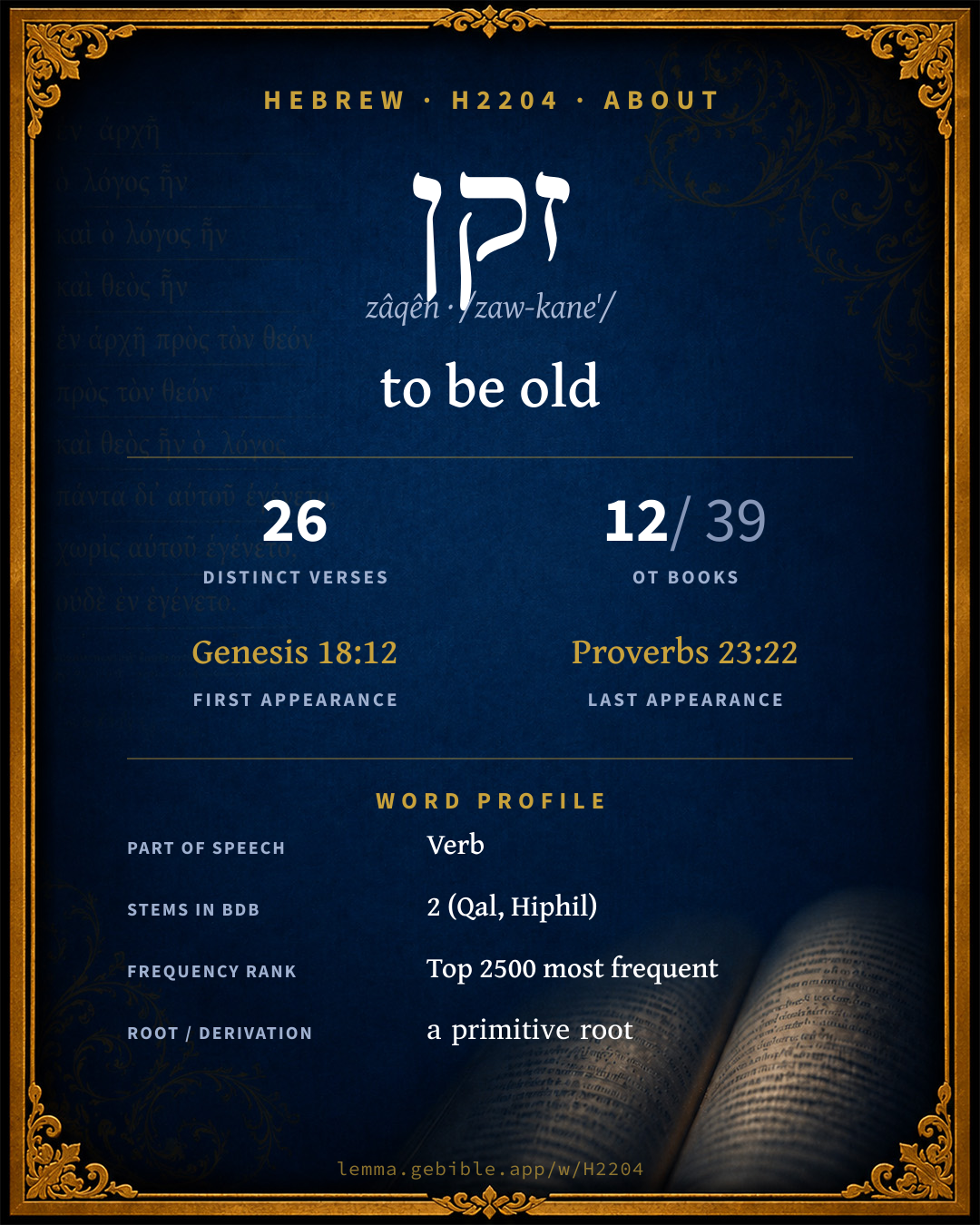
זָקֵן
to be old
‘to be old’ is one of 3 main senses fuller range ↓
Full lexicon entry — Brown-Driver-Briggs (BDB)
From Brown-Driver-Briggs (BDB)
Where this word appears
See every Qal verb in the Hebrew Bible →
Grammar key — what these labels mean
Part of speech
- Verb
- An action or state-of-being word.
Stem
- Qal
- The basic, simple active stem — the plain form of the verb (“he wrote”).
- Hiphil
- The causative active stem (“he caused / brought about”). Here: ‘only Impf. 3 ms.’
Form
- Perfect
- A completed action or state — Hebrew marks aspect (completeness) more than strict tense (“he wrote”).
- Imperfect
- An incomplete, ongoing, or future action (“he will / would write”).
- Sequential Imperfect
- An imperfect with prefixed waw — the standard past-narrative form (waw-consecutive imperfect).
Person
- 3rd Person
- The one spoken about (“he / she / it / they”).
- 1st Person
- The speaker (“I / we”).
- 2nd Person
- The one addressed (“you”).
Gender
- Masculine
- Grammatically masculine.
- Common
- Either gender — not distinguished for this form.
- Feminine
- Grammatically feminine.
Number
- Singular
- One.
Grammatical forms
- Verb, Qal, Perfect, 3rd Person, Masculine, Singular 15 times (56%)
- Verb, Qal, Perfect, 1st Person, Common, Singular 6 times (22%)
- Verb, Hiphil, Imperfect, 3rd Person, Masculine, Singular 2 times (7%)
- Verb, Qal, Perfect, 2nd Person, Masculine, Singular 2 times (7%)
- Verb, Qal, Sequential Imperfect, 3rd Person, Masculine, Singular 1 time (4%)
- Verb, Qal, Perfect, 3rd Person, Feminine, Singular 1 time (4%)
Parsed forms decoded from the imported morphology (morphhb / Westminster Leningrad Codex — WLC text public domain, morphhb tagging CC BY 4.0), counted across 27 parsed occurrences — not distinct verses.
Every verse where H2204 appears — 26 distinct verses across 12 books. Click any verse to open its interlinear word-by-word view. Verse text shown in the World English Bible for context — . Each verse’s Hebrew form is shown with its reference; the English is not keyword-highlighted, since the data carries no word-level English alignment. Use “Compare translations” on any verse to read it across multiple English versions. This concordance covers the Hebrew Bible; Septuagint (Greek Old Testament) occurrences are not indexed here.
Genesis 6 verses
- Genesis 18:12 זָקֵֽן Qal pf 3ms Sarah laughed within herself, saying, "After I have grown old will I have pleasure, my lord being old also?"
- Genesis 18:13 זָקַֽנְתִּי Qal pf 1cs Yahweh said to Abraham, "Why did Sarah laugh, saying, 'Will I really bear a child, yet I am old?'
- Genesis 19:31 זָקֵ֑ן Qal pf 3ms The firstborn said to the younger, "Our father is old, and there is not a man in the earth to come in to us after the manner of all the earth.
- Genesis 24:1 זָקֵ֔ן Qal pf 3ms Abraham was old, and well stricken in age. Yahweh had blessed Abraham in all things.
- Genesis 27:1 זָקֵ֣ן Qal pf 3ms It happened, that when Isaac was old, and his eyes were dim, so that he could not see, he called Esau his elder son, and said to him, "My son?" He said to him, "Here I am."
- Genesis 27:2 זָקַ֑נְתִּי Qal pf 1cs He said, "See now, I am old. I don't know the day of my death.
Joshua 3 verses
- Joshua 13:1 זָקֵ֔ן זָקַ֨נְתָּה֙ Qal pf 3ms Qal pf 2ms Now Joshua was old and well stricken in years; and Yahweh said to him, You are old and well stricken in years, and there remains yet very much land to be possessed.
- Joshua 23:1 זָקֵ֔ן Qal pf 3ms It happened after many days, when Yahweh had given rest to Israel from all their enemies round about, and Joshua was old and well stricken in years;
- Joshua 23:2 זָקַ֔נְתִּי Qal pf 1cs that Joshua called for all Israel, for their elders and for their heads, and for their judges and for their officers, and said to them, I am old and well stricken in years:
Ruth 1 verse
1 Samuel 6 verses
- 1 Samuel 2:22 זָקֵ֣ן Qal pf 3ms Now Eli was very old; and he heard all that his sons did to all Israel, and how that they lay with the women who served at the door of the tent of meeting.
- 1 Samuel 4:18 זָקֵ֥ן Qal pf 3ms It happened, when he made mention of the ark of God, that [Eli] fell from off his seat backward by the side of the gate; and his neck broke, and he died: for he was an old man, and heavy. He had judged Israel forty years.
- 1 Samuel 8:1 זָקֵ֖ן Qal pf 3ms It happened, when Samuel was old, that he made his sons judges over Israel.
- 1 Samuel 8:5 זָקַ֔נְתָּ Qal pf 2ms and they said to him, Behold, you are old, and your sons don't walk in your ways: now make us a king to judge us like all the nations.
- 1 Samuel 12:2 זָקַ֣נְתִּי Qal pf 1cs Now, behold, the king walks before you; and I am old and gray-headed; and, behold, my sons are with you: and I have walked before you from my youth to this day.
- 1 Samuel 17:12 זָקֵ֖ן Qal pf 3ms Now David was the son of that Ephrathite of Bethlehem Judah, whose name was Jesse; and he had eight sons: and the man was an old man in the days of Saul, stricken [in years] among men.
2 Samuel 1 verse
1 Kings 2 verses
2 Kings 1 verse
1 Chronicles 1 verse
2 Chronicles 1 verse
Job 1 verse
Psalms 1 verse
Proverbs 2 verses
About this entry
At a glance — auto-summarized from this page’s data, not written by a person. Every figure links to its source below. This summary describes the numbers; it doesn’t interpret them.
זקן — transliterated zâqên — is a Hebrew verb carrying the sense “to be old.” The King James Version usually renders it “was old,” while modern versions prefer “old” (Berean Standard Bible) and “had aged” (unfoldingWord Literal Text) — see the renderings breakdown. Spanning 26 verses in 12 books, it ranks among the moderately common words of the Hebrew Bible. Debuting at Genesis 18:12, it then recurs through the corpus. The verb spans 2 stems, from Qal to Hiphil. See the sense tree, 26-verse concordance, and the renderings breakdown below.
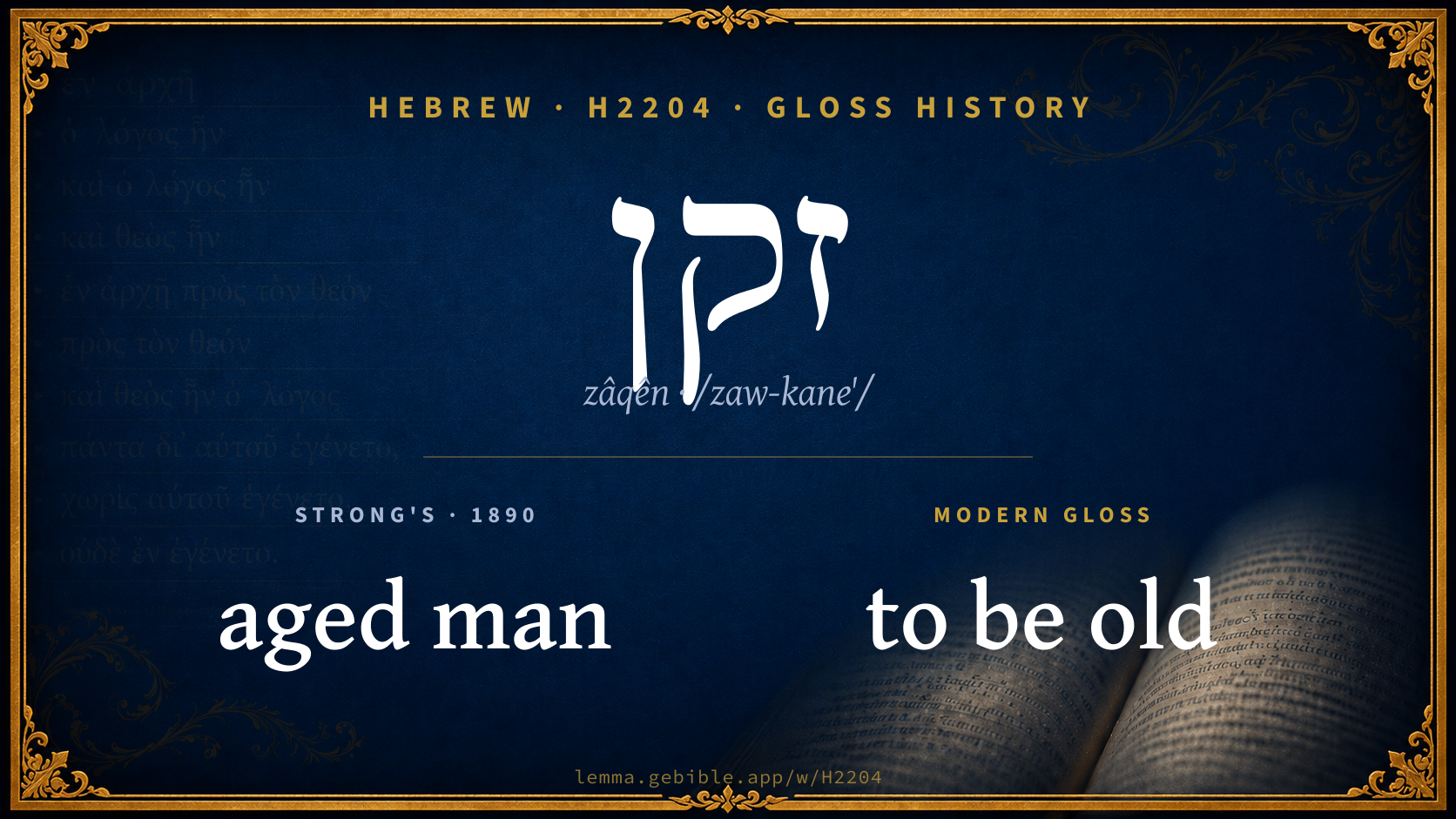
Gloss history
Strong's 1890 vs modern scholarship
About this word
Strong's H2204 catalogs a Hebrew word from the Hebrew Old Testament.
These counts are not copied from any lexicon or concordance. They are computed here, from the morphology-tagged Hebrew Old Testament. What Lemma adds →
- 26
- distinct verses
- The word appears in 26 distinct verses.
- 12 / 39
- OT books
- The word appears in 12 of 39 Old Testament books.
- #1,226
- by frequency
- Top 2500 most frequent Hebrew words (rank 1,226 of 8,640 Hebrew words by occurrence).
View all 26 occurrences in the concordance →
By section of the Old Testament
By traditional corpus
Conventional, traditional groupings — biblical authorship is debated, so this is a traditional corpus grouping, not an authorship claim. Each share is this word’s portion of its verses in that division of the Hebrew canon. Each figure is a share of the word’s 26 distinct verses.
- Prophets (Nevi'im) 13 verses · 50%
- Writings (Ketuvim) 7 verses · 27%
- Torah (Pentateuch) 6 verses · 23%
How translations render this word
Counts come from each version’s own published word-to-Strong’s tagging or interlinear alignment — an approximate guide to how each version renders this word, not a word-level alignment the data otherwise carries. Because each total is that version’s own tagged count, the per-version totals vary from one another and need not match the appearance or distinct-verse counts above. These counts may also differ from a printed concordance because Lemma counts each distinctly tagged rendering and does not collapse phrase taggings into a single head-word total. This is a fixed set of word-tagged versions (KJV, ASV, BSB, ULT) and does not change with the reading translation you choose elsewhere. Each version’s license is shown beside its name below (and on Sources).
BDB lists this Strong’s number as 2 distinct words (homographs). Each count above pools all of them and is not split by sense — see the Senses section below. A low-frequency rendering may belong to a different one of those words, not the primary meaning.
- King James Version†: Was old 6×, Is old 2×, Old 2×
- American Standard Version†: Was old 6×, Him 2×, Is old 2×
- Berean Standard Bible†: Old 7×, Was old 6×, Am old 3×
- unfoldingWord Literal Text†: Had aged 7×, Have aged 4×, Is old 4×
King James Version Public Domain
Renders H2204 across 27† tagged occurrences — most commonly:
Plus 15 renderings that appear only once — usually multi-word phrases or single function words the recovered tagging swept in, not distinct renderings.
American Standard Version Public Domain
Renders H2204 across 27† tagged occurrences — most commonly:
Plus 15 renderings that appear only once — usually multi-word phrases or single function words the recovered tagging swept in, not distinct renderings.
Berean Standard Bible Public Domain
Renders H2204 across 27† tagged occurrences — most commonly:
Plus 6 renderings that appear only once — usually multi-word phrases or single function words the recovered tagging swept in, not distinct renderings.
unfoldingWord Literal Text CC BY-SA 4.0
Renders H2204 across 32† tagged occurrences — most commonly:
Plus 11 renderings that appear only once — usually multi-word phrases or single function words the recovered tagging swept in, not distinct renderings.
Senses in the full BDB
Hebrew verbs can shift meaning by stem (binyan): Qal is the basic action, Niphal is often passive or reflexive, Piel often intensifies or makes it factitive, and Hiphil is typically causative. The senses below are grouped under the stem BDB assigns to each.
What do BDB’s symbols mean?
BDB uses these scholarly abbreviations:
| Symbol | Meaning |
|---|---|
| 𝔊 | the Septuagint (the ancient Greek translation, LXX) |
| 𝔙 | the Vulgate (the Latin translation) |
| 𝔖 | the Syriac version (the Peshitta) |
| 𝔗 | the Targum (the Aramaic translation) |
| ψ | the Psalms |
| √ | root (the underlying root or stem) |
| ‖ | parallel passage (a synonymous or contrasted parallel) |
| † | the dagger: every passage where the word occurs is cited |
The 6 senses and sub-senses the full Brown-Driver-Briggs lexicon distinguishes for this word, in lexicon order (not ranked by frequency), with BDB’s own verbatim wording and sub-sense lettering. Shown in Hebrew script with BDB’s own scholarly abbreviations. The condensed entry is in the Lexicon Entry tab. See also the Forms in the corpus table below.
זקן I be or become old (cf., according to Thes, Arabic ذَقُونٌa she-camal that lets her lower lip hang down, 3, v. Lane 968
Qal
- Pf. 3 ms. זָקֵן Gn 18:12 + 14 times (often hard to disting. from pred. adj. זָקֵן q.v.); 3 fs. זָֽקְנָה Pr 23:22; 2 ms. זָקַנְתָּ 1 S 8:5; זָקַ֫נְתָּה Jos 13:1; 1 s. זָקַנְתִּי Jos 23:2 + 3 times; זָקַ֑נְתִּי Gn 18:13; 27:2; Impf. וַיִּזְקַן 2 Ch 24:15;—be (or become) old Gn 18:12, 13; 19:31; 27:1, 2 (all J), 1 S 2:22; 4:18; 8:1, 5; 12:2; 17:12 2 S 19:33 1 K 1:1, 15 2 K 4:14; also Gn 24:1 (‖ בא בימים), so Jos 13:1(×2); 23:1, 2 (‖ here בָּאתִי בימים), 1 Ch 23:1 (‖ שָׂבַע ימים), 2 Ch 24:15 (‖ id.); Pr 23:22 ψ 37:25 (opp. היה נער); note especially זָקַנְתִּי מִהְיוֹת לאישׁ Ru 1:12 I am too old to belong to a man (husband). e.g. Genesis 18:12
Hiphil
- only Impf. 3 ms. יַזְקִין inchoat. shew age, grow old = senescere Ew.§ 122c, cf. Di; of youth Pr 22:6; of tree-root Jb 14:8. e.g. Proverbs 22:6
זקן II old, abs. ז׳ Gn 19
- 1. old, of human beings, as adj. pred. Gn 18:11 (J), Jb 32:4 (ז׳ מִמֶּנּוּ לְיָמִים, in compar.), or attrib. אָב זָקֵן Gn 44:20 (J), אִישׁ ז׳ Ju 19:16, 17, 20, 22, נָבִיא ז׳ 1 K 13:11, 25, 29, מֶלֶךְ ז׳ Ec 4:13; prob. also ז׳ וּשְׂבַע ימים Gn 35:29 (P), Jb 42:17 and Gn 25:8 (P) according to 𝔊 Sam Di; cf. also Ezr 3:12. e.g. Genesis 18:11
- 2. usually as subst.: a. old man (or woman), b. elder;
- a. old man Gn 43:27 (J), Lv 19:32 (H), Dt 28:50; 32:7 (‖ אָב), 1 S 2:31, 32; 28:14 Is 47:6 Jb 12:20; 32:9 Pr 17:6; 20:29 ψ 119:100 Jo 1:2; old men and old women Zc 8:4(×2); cf. זְקַן בֵּיתוֹ Gn 24:2 (J), זִקְנֵי בֵיתוֹ 2 S 12:17; especially opp. נַעַר Ex 10:9 (E), Is 3:5; 20:4 Je 51:22 La 2:21 ψ 148:12, and in phr. מִנַּעַר וְעַד זָקֵן Gn 19:4 (J), Jos 6:21 (JE), Est 3:13; opp. ילדים 1 K 12:6, 8, 13 = 2 Ch 10:6, 8, 13; opp. בַּחוּרִים Je 31:13 Ez 9:6 Jo 3:1, cf. 2 Ch 36:17 (+ יָשֵׁשׁ) and Je 6:11 (+ מְלֵא ימים); opp. עוּל ימים Is 65:20; opp. יונקי שׁדים and עוללים Jo 2:16. e.g. Genesis 43:27
- b. usually pl. elders, as having authority, term techn. (100 times +); elders of a people, especially Israel Ex 3:16, 18; 12:21 (all J), 17:5, 6; 18:12; 19:7; 24:1, 9, 14 Jos 24:1 (all E), Nu 11:16(×2) (שֹׁטְרָיו), v 24, 25, 30; 16:25 Jos 7:6; 8:10; 9:11 (all JE), Dt 5:20 (‖ רָאשֵׁי שִׁבְטֵיכֶם), 27:1; 29:9 (‖ ראשׁי שׁבטיכם, שֹׁטְרֵיכֶם), 31:9, 28 Jos 8:33 (‖ שֹׁטְרִים וְשֹׁפְטָיו), 23:2 (‖ רָאשׁיו, שֹׁפְטָיו, שֹׁטְרָיו); cf. also prob. Jos 24:31 = Ju 2:7 (all D); Lv 9:1, cf. זִקְנֵי הָעֵדָה Lv 4:15 (†both P), Ju 21:16; see also 1 S 4:3; 8:4; 15:30 2 S 3:17; 5:3 = 1 Ch 11:3, 2 S 17:4, 15 1 K 8:1, 3 = 2 Ch 5:2, 4, also 1 Ch 15:25; 21:16; cf. Is 3:2 (גִּבּוֹר וְאִישׁ מִלְחָמָ֑ה שׁוֹפֵט וְנָבִיא וְקֹסֵם וְז׳), 9:14 (‖ נְשׂוּא־פָנִים, but v. prob. gloss, cf. Ew Che Di Du al.); elders of one tribe (Judah) 1 S 30:26 2 S 19:12, so of Gilead Ju 11:5, 7, 8, 9, 10, 11; after the division of the kingdoms, of N. Isr. זקני הארץ 1 K 20:7 cf. v 8, also 2 K 6:32(×2), 10:1 (‖ שָׂרִים etc.) cf. v 5; under Josiah זקני יְהוּדָה 2 K 23:1 = 2 Ch 34:29; see also ז׳ הארץ Je 26:17, cf. זקני ארץ Pr 31:23, cf. La 1:19; 2:10; 4:16; 5:12, 14 (‖ שׂרים; + שַׁעַר); often in Ezek.: Ez 7:26 (‖ כהן), of Judah 8:1, of Isr. 8:11, 12; 14:1; 20:1, 3, also 9:6 (but del. Co). Exil. ז׳ הַגּוֹלָה Je 29:1 (‖ הכהנים, הנביאים); post-exile Ezr 10:8 (‖ שׂרים), poss. also Jo 1:14; elders of י׳ Is 24:23 (cf. Ex 24:1, 9), זִקְנֵי הַכֹּהֲנִים 2 K 19:2 = Is 37:2, so Je 19:1 (‖ זקני העם); of other peoples, Midian Nu 22:4, 7, Moab v 7 (all E), Egypt ψ 105:22 (‖ שׂרים); of Gebal Ez 27:9; elders of a city, especially as sitting in the gate to judge Dt 19:12; 21:2 (+ שֹׁפְטֶיךָ) v 3, 4, 6, 19 (+ שַׁעַר־מְקֹמוֹ), v 20; 22:15 (+ הַשָּׁ֑עְרָה), v 16, 17, 18; 25:7 (+ הַשַּׁ֫עֲרָה), v 8, 9 (all in Dt. code, and only so therein), Ru 4:2, 4, 9, 11 (cf. שַׁעַר v 1, 11), מוֹשַׁב זְקֵנִים ψ 107:32 (‖ קְהַל־עָ֑ם); Ju 8:14 (‖ שׂרים), v 16 1 S 11:3; 16:4 1 K 21:8, 11 Ezr 10:14. e.g. Exodus 3:16
Senses from the full Brown-Driver-Briggs lexicon (Brown, Driver, Briggs; Oxford 1906 — public domain), digitized via Sefaria, supplemented by the OpenScriptures HebrewLexicon (CC BY 4.0). Full attribution on Sources.
Word origin
I. vb. be or become old (cf., according to Thes, Arabic ذَقُونٌa she-camal that lets her lower lip hang down, 3, v. Lane 968; ذِقْنٌ decrepit man)—
II. adj. old, abs. ז׳ Gn 19:4 + 30 times (on distinct. from vb. v. supr.); cstr. זְקַן Gn 24:2; pl. זְקֵנִים Gn 18:11 + 44 times; זְקֵנוֹת Zc 8:4; cstr. זִקְנֵי Gn 50:7 + 85 times; sf. זְקֵנַי La 1:19, זְקֵנֶיךָ Dt 21:2; 32:7, זְקֵנָיו Jos 8:33 + 3 times, זְקֵנֶיהָ Ju 8:14, זְקֵנֵינוּ Ex 10:9 Jos 9:11, זִקְנֵיכֶם Dt 5:20 + 2 times;—
— Brown-Driver-Briggs (Oxford 1906, public domain), digitized via Sefaria, supplemented by the OpenScriptures HebrewLexicon (CC BY 4.0). See Sources.
Origin: a primitive root
Jastrow Dictionary
A second Hebrew/Aramaic lexicon for comparison, covering Aramaic and post-biblical (Talmudic, Targumic, Midrashic) usage that the biblical-Hebrew BDB does not. Matched by lemma rather than by Strong’s number, so a lemma may carry more than one Jastrow headword (shown separately below), and the entries cover usage well beyond the Bible.
זָקֵן I
- (b. h.) [to be thin, shrunk, hard,] to be old. Gen. R. s. 48 (ref. to Gen. XVIII, 13) ואני זָקַנְתִּי מלעשות וכ׳ am I (the Lord) too old to do wonders? e.g. Genesis 18:13
- 1. to grow old. Snh. 100ᵇ הִזְקִינָה שמא וכ׳ when she arrives at old age, he is afraid lest &c. Erub. 56ᵃ מַזְקִינִים בחצי וכ׳ they age in the middle of their days (prematurely). Sabb. 152ᵃ כל זמן שמַזְקִינִין the older they grow; a. fr.
- 2. to make old, consider old (feeble). Gen. R. s. 48 אתם … ומזקינים חביריכם you consider each himself young, and each his partner old (Yalk. ib. 82 ומז׳ אדניכם and believe your Lord too old [to do wonders]); v. supra.
- 1. to become old, weak, frail. Y. Ber. IX, end 14ᶜ (ref. to prov. XXIII, 22) אם נִזְדַּקְּנָה אומתך וכ׳ if thy nation is decaying (in faith), stand up and fence her in (prevent her being trodden upon); Yalk. Prov. 960.—2) (cmp. דקדק) to be maturely considered, be clear (beyond doubt);
- 3. (cmp. קשיש) to be hard, difficult. Tosef. Snh. VII, 7 (the presiding judge declares) (נִיזְקַן) נִזְקַן הדין ed. Zuck. (Var. נזדקן, נזדקק); discussed in Snh. 42ᵃ מאי נזד׳ הדין what does nizdakken mean? Does it mean קש דינא the case is hard (difficult, so as to demand a reconsideration)?… It means חכם דינא the case is clear; Y. Snh. V, end, 23ᵃ
זָקֵן II
- preced.)
- 1. old man. Gen. R. s. 39, opp. בחור. Y. Bicc. III, 65ᶜ bot. עמידת ז׳ (Yalk. Lev. 670 מצות ז׳) the duty of standing up before an old man. Ḥag. 14ᵃ; a. fr.
- 2. elder, judge, scholar. Ib. (ref. to Is. III, 2) ז׳ זה שראוי וכ׳ zaken means one fit to sit in college sessions. Ber. 8ᵇ ז׳ ששכח וכ׳ a scholar who forgot what he had learned, &c., v. אוֹנֶס. Kidd. 32ᵇ אין ז׳ אלא חכם under zaken (Lev. XIX, 32) a scholar is meant; Sifra K’dosh. Par. 3, ch. VII אין ז̇ק̇ן̇ אלא ז̇ה שק̇נ̇ה חכמה a zaken is he who has acquired wisdom (through study).—ז׳ אשמאי, v. אַשְׁמַאי. Yoma 28ᵇ ז׳ ויושב בישיבה a scholar and member of college. Y. M Kat. III, beg. 81ᶜ איני מכירך ז׳ I shall not recognize thee as (give thee the diploma of) a zaken; a. fr.—Pl. זְקֵנִים. Snh. I, 3, v. סְמִיכָה. Num. R. s. 14 מצות הז׳ rabbinical law. Ber. 11ᵃ זִקְנֵי ב"ש the graduates of the Shammai school; a. v. fr. e.g. Isaiah 3:2
- 3. grandfather, ancestor. Ex. R. s. 1 מעשה זְקֵנָן the conduct of their ancestor (Abraham). Pesik. Zakh., p. 27ᵇ; a. fr.—Fem. זְקֵנָה, זְקֵינָה. 1) old woman. Gen. R. s. 39.—Nidd. 9ᵃ ז׳ one who is past the change of life. Ib. 9ᵇ; a. fr.—2) grandmother, ancestress. Kidd. 31ᵇ הוה ליה ההיא אמא זקי׳ had a grandmother. Gen. R. s. 93 זְקֵינָתוֹ של זה this man’s (my) ancestress (Sarah); a. e.—3) (sub. נְטִיעָה) old plantation. Tosef. Shebi. I, 2; a. e., opp. נטיעה young plantation.—Pl. זְקֵינוֹת. Y. ib. I, 33ᵇ bot.; a. e.
זָקָן
- beard, hair-covered spot. Ber. 11ᵃ זְקָנְךָ וכ׳ thy beard is &c., v. גָּדַל. Snh. VIII, 1 (68ᵇ) עד שיקיף ז׳ התחתון וכ׳ until he grows a beard, by which is meant the hair of the genitals &c.; a. fr.—Pl. זְקָנִים. Lev. R. s. 3.
A Dictionary of the Targumim, the Talmud Babli and Yerushalmi, and the Midrashic Literature (Marcus Jastrow; London, Luzac, 1903) — Public Domain. Digitized via Sefaria. Digitized via Sefaria. Full attribution on Sources.
Forms in the corpus
The 18 distinct written forms H2204 takes in the Hebrew Bible, most frequent first — each parse links to that stem’s occurrences in the concordance. Hebrew forms include their vowel points and cantillation, so a single lemma takes many written forms.
Same root — word family
Other BDB entries built from the same root as H2204, grouped by Strong’s listed origin. These share a root / origin per the lexicon — not necessarily a shared meaning. Each links to that word’s own entry.
Derived from this word
Compare all same-root words → Showing 4 of 5 — not the complete family. They share a root, not necessarily a meaning.
Septuagint verse parallels
This word appears in 24 verses that also exist in the Greek Old Testament (Septuagint), out of the 26 Hebrew verses it occurs in. You can read those verses in Greek by switching the Old Testament edition to the Septuagint.
Read these verses in the Septuagint
- Genesis 18:12
- Joshua 13:1
- Ruth 1:12
- 1 Samuel 2:22
- 2 Samuel 19:32
- 1 Kings 1:1
- 2 Kings 4:14
- 1 Chronicles 23:1
- 2 Chronicles 24:15
- Job 14:8
- Proverbs 23:22
This is a verse-level parallel only — the same verses exist in both the Hebrew and Greek Old Testaments. No word-level Hebrew↔Greek correspondence is claimed: the data carries no such alignment, so no Greek word is shown as this Hebrew word’s translation. Coverage is not total — the Septuagint omits the deuterocanon and renumbers the Psalms, so some Hebrew verses have no direct Greek parallel.