
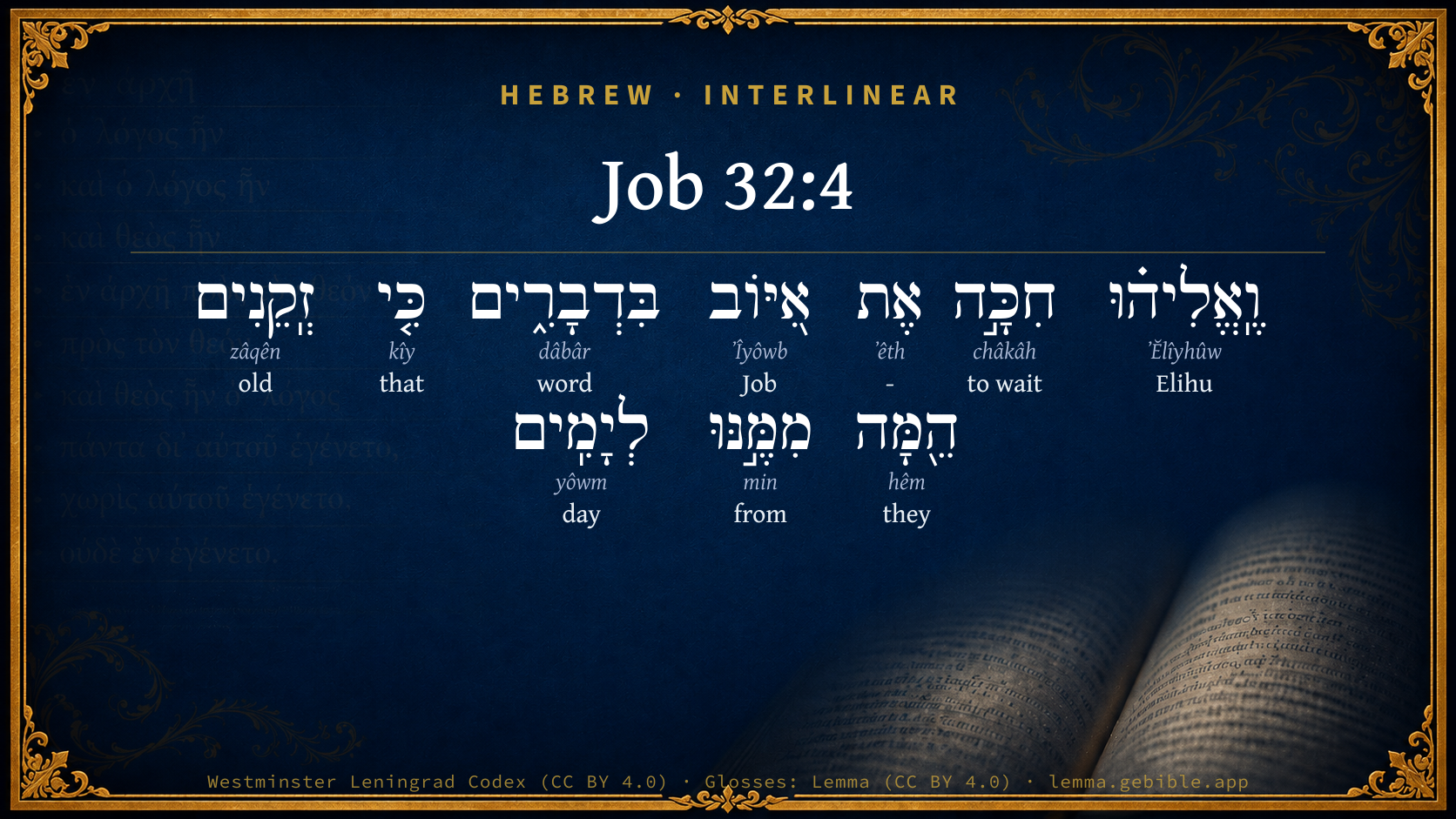
Job 32:4

Hebrew (Westminster Leningrad Codex) Job 32:4 appears in the Hebrew Old Testament. The text above is from the Westminster Leningrad Codex. Each word links to its Strong’s number, a concise gloss, and parsing drawn from the Open Scriptures Hebrew Bible morphology. Click any word for its full Brown-Driver-Briggs (BDB) entry.
Download image
Cite this verse

Job 32:4 (World English Bible). Public Domain. Lemma interlinear Bible study tool, https://lemma.gebible.app/v/job/32/4.

Show BibTeX & RIS
BibTeX
RIS
English Translation
Now Elihu had waited to speak to Job, because they were elder than he.
World English Bible · Public Domain
Download a study sheet

One document with this verse’s original text, its word-by-word gloss line, the meaning frame, cross-references with their text, attributed commentary, and full source and license credits — printable, and it pastes into notes with its structure intact.

This verse Autodidact and up

Study sheet (.html) Plain text (.txt)

A passage Seminary Student

Up to 50 verses in one chapter. A passage sheet keeps up to 6 commentary sources and 12 cross-references per verse, in the order this page ranks them, and says so on the sheet whenever that leaves anything out. Ask for a single verse and you get the Autodidact verse sheet above.

Everything on this page stays free to read, with no account — the sheet is a download of what is already on screen, not access to it.

Want to remove ads? Support Godless Engineer
Compare translations 3

The same verse in 3 English versions, stacked beneath the original-language interlinear above. Click any original word for its lexicon entry.

Each is an independent rendering of the whole verse — the interlinear is not word-aligned to these translations.

Highlighted words mark where these versions differ — a whole-verse word diff, not a word-by-word alignment.

  • World English Bible Public Domain
    Now Elihu had waited to speak to Job, because they were elder than he.
  • King James Version Public Domain
    Now Elihu had waited till Job had spoken, because they were elder than he.
  • unfoldingWord Literal Text CC BY-SA 4.0
    Now Elihu had awaited Job with words, because they older in days than he.

unfoldingWord Literal Text — © unfoldingWord, licensed CC BY-SA 4.0. Word-aligned USFM3 via Door43 (git.door43.org/unfoldingWord/en_ult).

Versions to compare (up to 4)

3 of 4 selected

Show all 18 translations

Every available English version of this verse, each an independent rendering of the whole verse.

  • World English Bible Public Domain
    Now Elihu had waited to speak to Job, because they were elder than he.
  • Berean Standard Bible Public Domain
    Now Elihu had waited to speak to Job because the others were older than he.
  • Majority Standard Bible Public Domain
    Now Elihu had waited to speak to Job because the others were older than he.
  • King James Version Public Domain
    Now Elihu had waited till Job had spoken, because they were elder than he.
  • American Standard Version (1901) Public Domain
    Now Elihu had waited to speak unto Job, because they were elder than he.
  • Revised Version (1885) Public Domain
    Now Elihu had waited to speak unto Job, because they were elder than he.
  • Geneva Bible (1599) Public Domain
    (Now Elihu had wayted til Iob had spoken: for they were more ancient in yeeres then he)
  • Douay-Rheims (1899) Public Domain
    So Eliu waited while Job was speaking, because they were his elders that were speaking.
  • Young's Literal Translation Public Domain
    And Elihu hath waited earnestly beside Job with words, for they are older than he in days.
  • Literal Standard Version CC BY-SA 4.0
    And Elihu has waited earnestly beside Job with words, for they are older than he in days.
  • Unlocked Literal Bible CC BY-SA 4.0
    Now Elihu had waited to speak to Job because the other men were older than he.
  • unfoldingWord Literal Text CC BY-SA 4.0
    Now Elihu had awaited Job with words, because they older in days than he.
  • Darby Bible Public Domain
    But Elihu had waited till Job had finished speaking, because they were older than he.
  • World Messianic Bible Public Domain
    Now Elihu had waited to speak to Job, because they were older than he.
  • Webster's Bible Public Domain
    Now Elihu had waited till Job had spoken because they were older than he.
  • Free Bible Version CC BY-SA 4.0
    Elihu had waited for the other three to speak with Job since they were older than he was.
  • Bible in Basic English Public Domain
    Now Elihu had kept quiet while Job was talking, because they were older than he;
  • JPS Tanakh (1917) Public Domain
    Now Elihu had waited to speak unto Job, because they were older than he.

Literal Standard Version (2020), Covenant Press — licensed CC BY-SA 4.0. Text via the HelloAO Bible API (eBible.org). Unlocked Literal Bible (unfoldingWord) — licensed CC BY-SA 4.0. Text via the HelloAO Bible API (eBible.org). unfoldingWord Literal Text — © unfoldingWord, licensed CC BY-SA 4.0. Word-aligned USFM3 via Door43 (git.door43.org/unfoldingWord/en_ult). Free Bible Version, Dr. Jonathan Gallagher — licensed CC BY-SA 4.0. Text via the HelloAO Bible API (eBible.org).

Word by word

More ways to search: Search by grammar → Find every occurrence → Compare this word →

Practice this passage: Drill this verse → Learn its vocabulary →

וֶֽאֱלִיה֗וּ
ʼĔlîyhûw
H453
“and · Elihu”
Conjunction + Noun, Proper
Part of Speech
Conjunction + Noun
Type
Proper
Full BDB Definition

Origin: from H410 and H1931

TWOT: None

Elihu = "He is my God" - the younger man who rebuked Job and his three friends - an Ephraimite, Samuel's great grandfather - a Manassite warrior chief for David - son of Shemaiah and Korhite gatekeeper - David's brother
  1. חִכָּ֣ה châkâh H2442 “to wait” Verb, Piel, Perfect, 3rd Person, Masculine, Singular
  2. אֶת ʼêth H853 “-” Particle, Direct Object
  3. אִ֭יּוֹב ʼÎyôwb H347 “Job” Noun, Proper
  4. בִּדְבָרִ֑ים dâbâr H1697 “in/at · words” Preposition + Noun, Common, Masculine, Plural, Absolute
  5. כִּ֤י kîy H3588 “that” Conjunction
  6. זְֽקֵנִים zâqên H2205 “old” Adjective, Adjective, Masculine, Plural, Absolute
  7. הֵ֖מָּה hêm H1992 “they” Pronoun, Personal, 3rd Person, Masculine, Plural
  8. מִמֶּ֣נּוּ min H4480 “from · us” Preposition + Suffix, Personal, 1st Person, Common, Plural
  9. לְיָמִֽים yôwm H3117 “to/for · days” Preposition + Noun, Common, Masculine, Plural, Absolute

About this verse

These counts appear in no published source. They are computed here, from the morphology-tagged text and Lemma’s own curated glosses. What Lemma adds →

10
words
10
distinct lemmas
Wisdom
section

Notable vocabulary

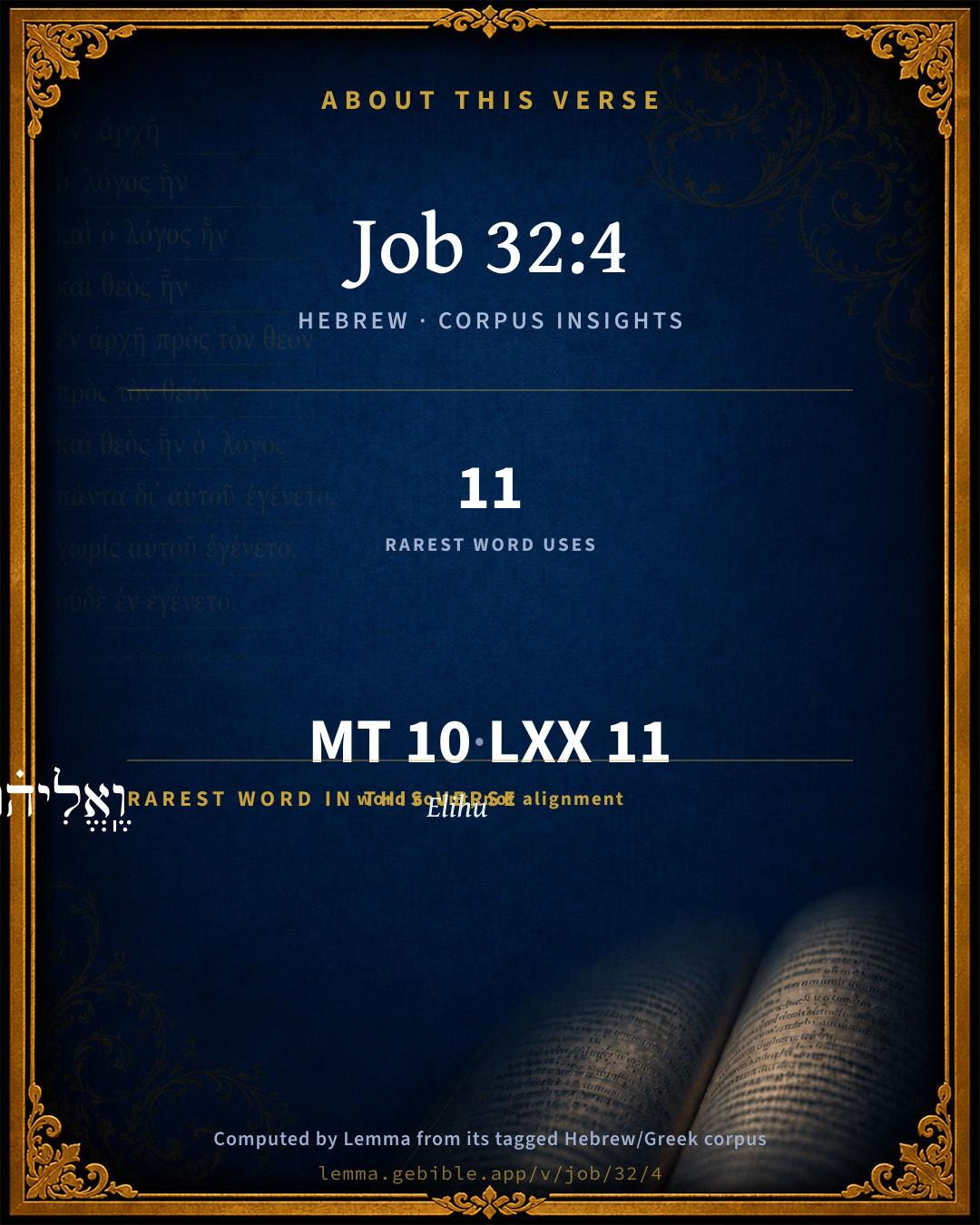
The rarest word here is וֶֽאֱלִיה֗וּ Elihu H453 — appearing just 11 times in the whole Hebrew Bible.

Shared distinctive vocabulary

וֶֽאֱלִיה֗וּ Elihu H453 occurs in 11 verses of the Hebrew Bible. Also found in:

Grammatical profile

  • 1 verb
  • 4 nouns
  • 1 adjective
  • 1 pronoun
  • 1 preposition
  • 1 conjunction
  • 1 particle

Verb forms

  • חִכָּ֣ה Piel · Perfect

Hebrew & Septuagint length

In English translation the verse runs 14 words from the Hebrew and 16 from the Septuagint (LXX English) — closely comparable.

A rough comparison of the two English renderings, which tokenize alike — not a word-level alignment.

Word counts can differ between the Hebrew and the Greek without any difference in meaning — e.g. the Hebrew direct-object marker אֵת has no separate Greek word, and Greek often adds the article ὁ.

In the original languages it is 10 Hebrew tokens and 11 Greek tokens — but the two are counted differently (Hebrew bundles its prefixes and suffixes into one token; the Greek is in lemma form), so that isn’t a like-for-like length.

Cross-references

2

Topical passages linked to Job 32:4 in the Treasury of Scripture Knowledge — connected by theme and wording, ordered by reader-vote popularity; previews shown in the World English Bible.

  • Job 32:11–12 "Behold, I waited for your words, And I listened for your reasoning, While you searched out what to say.
  • Proverbs 18:13 He who gives answer before he hears, That is folly and shame to him.

Cross-references courtesy of OpenBible.info (CC BY 4.0).

Hebrew and Greek witnesses Masoretic Hebrew ↔ Greek Septuagint

The same verse in the two great witnesses to the Old Testament, shown verse-for-verse.

These are two independent witnesses, not word-aligned to each other, and the Septuagint is shown in lemma (dictionary) form.

Hebrew Job 32:4 Masoretic · Westminster Leningrad Codex

וֶֽאֱלִיה֗וּ חִכָּ֣ה אֶת אִ֭יּוֹב בִּדְבָרִ֑ים כִּ֤י זְֽקֵנִים הֵ֖מָּה מִמֶּ֣נּוּ לְיָמִֽים

Now Elihu had waited to speak to Job, because they were elder than he.

World English Bible · Public Domain

Greek LXX Job 32:4 Septuagint · lemma form

ελιους δέ ὑπομένω δίδωμι ἀπόκρισις ιωβ ὅτι πρεσβύτερος αὐτός εἰμί ἡμέρα

But Elius had forborne to give an answer to Job, because they were older than he.

LXX2012 (modern English Septuagint) · Public Domain

Hebrew: Westminster Leningrad Codex (CC BY 4.0). Greek: Septuagint (public domain); English from LXX2012 (modern English Septuagint) (Public Domain). How the Septuagint differs from the Hebrew →

Commentary

Notes on Job 32:4 from classic Christian and Jewish commentators (each source and its license shown beneath its notes). The classic Christian expositions comment on the surrounding passage and are grouped to its opening verse, so a note may address several verses; the Jewish commentaries on the Tanakh (Rashi and others) are per-verse, so they appear only where the commentator wrote on this verse.

Lemma curates 59 commentaries, every one of them public domain or Creative Commons licensed, each selected and text-cleaned for this edition rather than reprinted as found. About our sources →

Trapp's Complete Commentary

John Trapp

Job 32:4 Now Elihu had waited till Job had spoken, because they [were] elder than he.

Ver. 4. Now Elihu had waited till Job had spoken] Yea, though his speech was very long, yet he heard him out, though himself were with child to speak. Broughton rendereth it, waited to speak with Job; he would not thrust in till they had all done their discourses. This was his modesty, though a man of singular abilities. Raram facit virtus cum scientia mixturam. To blame then surely was Gregory, for thinking so ill and writing so harshly of this good young man, as if he had been proud and arrogant; descanting to that purpose upon his name, country, and kindred.

Because they were elder than he] And therefore ought of right to have the precedence of speech; though it appeareth, by all that followeth, that in this controversy he saw further into it, judged righter, and rebuked Job with more gravity and wisdom, than any of them; so that Job was fully convinced, and made no reply at all; no more than Jonah did when God set him down, Job 4:11 : so forcible are right words.

John Trapp, A Commentary or Exposition upon All the Books of the Old and New Testament (1647–1656) — public domain. Text from a community e-Sword module.

Tyndale Open Study Notes

Tyndale Open Resources

32:4-7 Elihu’s deference to elders followed a well-known principle (see also 12:12; 15:10; Lev 19:32; 1 Tim 5:1; 1 Pet 5:5).

Tyndale Open Study Notes — © Tyndale Open Resources, licensed CC BY-SA 4.0. Text via the HelloAO Bible API.

Geneva Bible (1599)

Geneva Bible translators

That is, the three mentioned before.

Geneva Bible (1599) marginal notes — public domain. Text via Bolls.life.

Jamieson, Fausset & Brown

Robert Jamieson, A. R. Fausset & David Brown

had spoken--Hebrew, "in words," referring rather to his own "words" of reply, which he had long ago ready, but kept back in deference to the seniority of the friends who spoke.

Jamieson, Fausset & Brown — Commentary Critical and Explanatory on the Whole Bible (1871) — public domain (CC PDM 1.0). Text via the HelloAO Bible API.

Ellicott's Commentary for English Readers

(4) Now Elihu had waited till Job had spoken.—Literally, Had waited in words for or regarding Job; that is, as some understand it, had waited to speak unto Job, or, more probably, had waited till the argument was closed to declare his opinion with reference to Job. The line taken by Elihu is an intermediate one, and is neither that of Job nor his friends. He admits the integrity of Job—or, at least, he does not deny it—although he uses very strong expressions as to the course which Job has adopted (Job_34:7-9; Job_34:35-37); but he considers that the Divine afflictions have a disciplinary object, and that they may be sent because God has discerned the seeds of unfaithfulness and defection in the sufferer; and this may serve to explain their purpose in the case of Job. He has very lofty ideas of the righteousness of God (Job_34:10, &c.), and of His power and majesty (Job_37:22). He holds that with regard to the Almighty we cannot find Him out, but that we may safely trust His mercy and His justice. This is the position to which he leads Job when the Lord answers him out of the whirlwind.

A Bible Commentary for English Readers, edited by Charles John Ellicott (1878–1897) — public domain. Text from a community e-Sword module.

The Cambridge Bible for Schools and Colleges

gen. ed. J. J. S. Perowne

4. waited till Job had spoken] Rather, waited to speak unto Job, lit. waited for Job with words. Elihu had waited (till the friends spoke) prepared to address Job, as he now does.

The Cambridge Bible for Schools and Colleges (gen. ed. J. J. S. Perowne; Cambridge University Press, 1878–1918) — public domain. Text from a community e-Sword module.

John Gill's Exposition

Now Elihu had waited till Job had spoken,.... Made an end of speaking, until he had thus expressed himself, "the words of Job are ended", Job 31:40, and waited likewise until his three friends had said all they had to say, and which is here supposed and implied, as appears by what follows:

because they were elder than he; it may be added, from the original text, "in", or "as two days" (l); they had lived longer in the world than he, and therefore did not take upon him to speak till they had done; he, as became a young man, was swift to hear, and slow to speak; that they were old men, appears from what Eliphaz says, Job 15:10.

(l) "diebus", Beza, Montanus, Mercerus; "quod ad dies", Schultens.

John Gill's Exposition of the Whole Bible (1746–1763) — public domain (CC PDM 1.0). Text via the HelloAO Bible API.

Albert Barnes' Notes on the Bible

Now Elihu had waited - Margin, as in Hebrew, expected Job in words. The meaning is plain, that he had waited until all who were older than himself had spoken.

Because they were elder than he - Margin, as in Hebrew, older for days. It appears that they were all older than he was. We have no means of determining their respective ages, though it would seem probable that Eliphaz was the oldest of the three friends, as he uniformly spoke first.

Albert Barnes' Notes on the Bible (1834–1885) — public domain. Text from a community e-Sword/MySword module.

Matthew Poole's English Annotations

Elihu had waited with patience, as the word notes.

Till Job; add, and his three friends, as appears from the following words. It is a synecdoche, whereof instances have been given before.

They were elder than he; and therefore he expected more satisfaction from them, and gave them the precedency in the discourse; wherein he showed his prudence and modesty.

Matthew Poole's English Annotations on the Holy Bible (1683–1685) — public domain. Text from a community e-Sword/MySword module.

Whedon's Commentary on the Bible

Daniel D. Whedon

4. Waited till Job had spoken — Elihu had modestly stood in the background and “awaited Job with words.” Kitto (Pictorial Bible) tells us, that “at the present time, in Arabia, every one that pleases attends whenever a discussion is in progress. It is not courteous for any one to interpose until the original parties in the dispute have exhausted themselves: then any have a right to declare their views of the subject.” This custom may account for the fact that no other notice is taken of Elihu either before or after his speeches.

Daniel D. Whedon (gen. ed.), Commentary on the Old and New Testaments (1874–1909) — public domain. Text from a community e-Sword module.

The Pulpit Commentary

Now Elihu had waited till Job had spoken; rather, to speak to Job (see the Revised Version) He had waited impatiently until the three special "friends" had said their say, and be might come forward without manifest presumption. Because they were elder than he. (On the respect paid to age at this time in the land wherein Job lived, see the comment on Job_29:8)

The Pulpit Commentary (1880–1919), ed. H.D.M. Spence-Jones & Joseph S. Exell — public domain. Text from a community e-Sword module.

John Wesley's Explanatory Notes

'Till Job - And his three friends.

John Wesley, Explanatory Notes Upon the Whole Bible (1754–1765) — public domain. Text via the GEBible commentary corpus.

Keil & Delitzsch

C. F. Keil & F. Delitzsch

4-6 And Elihu had waited for Job with words, for they were older than he in days. And Elihu saw that there was no answer in the mouth of the three men, then his wrath was kindled. And Elihu the son of Barachel the Buzite began, and said.

He had waited (perf. in the sense of the plusquamperf., Ew. 135, a) for Job with words (בּדברים as elsewhere בּמלּים, בּמלּין), i.e., until Job should have spoken his last word in the controversial dialogue. Thus he considered it becoming on his part, for they (המּה, illi, whereas אלּה according to the usage of the language is hi) were older (seniores) than he in days (לימים as Job 32:6, less harsh here, instead of the acc. of closer definition, Job 15:10, comp. Job 11:9). As it now became manifest that the friends made no reply to Job's last speeches for want of the right solution of problem, and therefore also Job had nothing further to say, he believes that he may venture, without any seeming want of courtesy, to give utterance to his long-restrained indignation; and Elihu (with Mahpach) the son of Barach'el (Mercha) the Buzite (with Rebia parvum) began and spoke (ויּאמר not with Silluk, but Mercha mahpach., and in fact with Mercha on the accented penult., as Job 3:2, and further).

Keil & Delitzsch — Biblical Commentary on the Old Testament (1861–1891) — public domain (CC PDM 1.0). Text via the HelloAO Bible API. (Old Testament only.)

Rashi

Rabbi Shlomo Yitzchaki (Rashi)

because they were older than he in days [i.e.,] the others [were older than he]. Therefore, he refrained until they were still.

Rashi on the Tanakh — English translations: “The Judaica Press complete Tanach with Rashi, translated by A. J. Rosenberg” (CC BY 4.0); “Pentateuch with Rashi's commentary by M. Rosenbaum and A.M. Silbermann, 1929-1934” (public domain); “The Metsudah Tanach series, Lakewood, N.J” (CC BY 4.0); and “The Book of Joshua, Metsudah Publications, 1997” (CC BY 4.0). Text via Sefaria.

Lesson kit

Teaching starters — assembled from the data on this page, not authored interpretation. Every prompt links to the verse data it draws on. Edit before teaching.

Job, in the Wisdom, opens this verse with 10 words (10 distinct Hebrew lemmas). Its most distinctive word is ʼĔlîyhûw (“Elihu”). A historical commentator’s framing appears above. Read the whole chapter for the surrounding context.

Discussion questions

  1. What does “Elihu” (ʼĔlîyhûw) contribute to the verse as a whole?
  2. 1 Samuel 1:1 shares the word «Elihu» with this verse. How do the two illuminate each other?
  3. The translations on this page render this verse differently — a whole-verse word diff, not a word-by-word alignment. What might account for the different wordings?
  4. The verb «חִכָּ֣ה» is Piel Perfect. How does its form color the action?
  5. Reading how Trapp's Complete Commentary and Tyndale Open Study Notes read this verse, where do the two commentators agree and where do they part?

Things to notice

Reading settings

Reading text

Shown beneath each verse's original-language words.

Old Testament
Old Testament edition

Read the OT as the Masoretic Hebrew (MT) or the Greek Septuagint (LXX).

English shown for the Greek Septuagint (in the Hebrew ↔ Greek comparison).

Comparing translations? Open the Compare panel on any verse page to stack up to four side by side.