1 Samuel 2:32

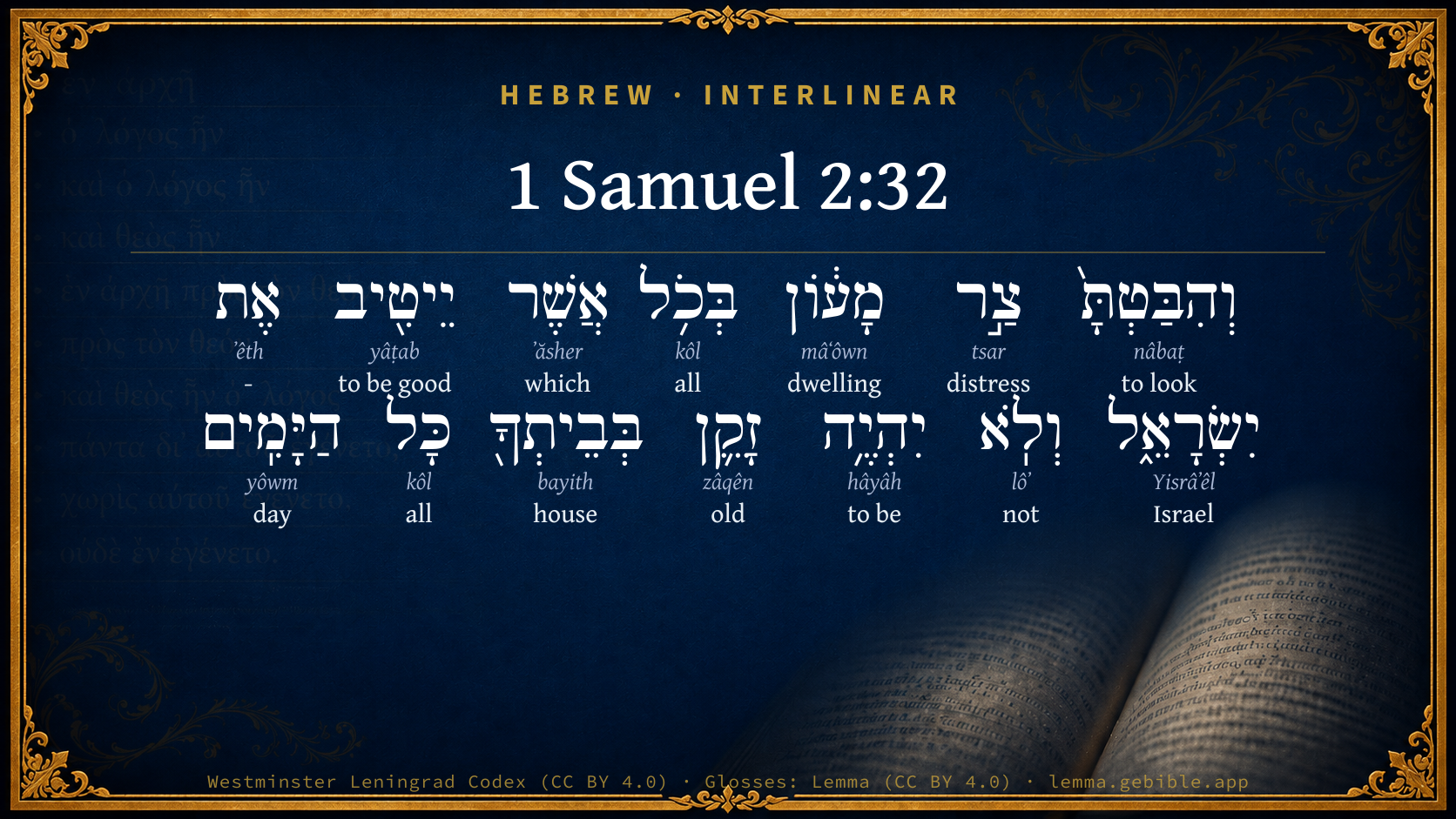
Hebrew (Westminster Leningrad Codex) 1 Samuel 2:32 appears in the Hebrew Old Testament. The text above is from the Westminster Leningrad Codex. Each word links to its Strong’s number, a concise gloss, and parsing drawn from the Open Scriptures Hebrew Bible morphology. Click any word for its full Brown-Driver-Briggs (BDB) entry.
Download image
Cite this verse

1 Samuel 2:32 (World English Bible). Public Domain. Lemma interlinear Bible study tool, https://lemma.gebible.app/v/1-samuel/2/32.

Show BibTeX & RIS
BibTeX
RIS
English Translation
You shall see the affliction of [my] habitation, in all the wealth which [God] shall give Israel; and there shall not be an old man in your house forever.
World English Bible · Public Domain
Download a study sheet

One document with this verse’s original text, its word-by-word gloss line, the meaning frame, cross-references with their text, attributed commentary, and full source and license credits — printable, and it pastes into notes with its structure intact.

This verse Autodidact and up

Study sheet (.html) Plain text (.txt)

A passage Seminary Student

Up to 50 verses in one chapter. A passage sheet keeps up to 6 commentary sources and 12 cross-references per verse, in the order this page ranks them, and says so on the sheet whenever that leaves anything out. Ask for a single verse and you get the Autodidact verse sheet above.

Everything on this page stays free to read, with no account — the sheet is a download of what is already on screen, not access to it.

Want to remove ads? Support Godless Engineer
Compare translations 3

The same verse in 3 English versions, stacked beneath the original-language interlinear above. Click any original word for its lexicon entry.

Each is an independent rendering of the whole verse — the interlinear is not word-aligned to these translations.

Highlighted words mark where these versions differ — a whole-verse word diff, not a word-by-word alignment.

  • World English Bible Public Domain
    You shall see the affliction of [my] habitation, in all the wealth which [God] shall give Israel; and there shall not be an old man in your house forever.
  • King James Version Public Domain
    And thou shalt see an enemy in my habitation, in all the wealth which God shall give Israel: and there shall not be an old man in thine house for ever.
  • unfoldingWord Literal Text CC BY-SA 4.0
    And you will see the distress of the Dwelling, in all that he will do good with Israel. And an old man will not be in your house all of the days.

unfoldingWord Literal Text — © unfoldingWord, licensed CC BY-SA 4.0. Word-aligned USFM3 via Door43 (git.door43.org/unfoldingWord/en_ult).

Versions to compare (up to 4)

3 of 4 selected

Show all 18 translations

Every available English version of this verse, each an independent rendering of the whole verse.

  • World English Bible Public Domain
    You shall see the affliction of [my] habitation, in all the wealth which [God] shall give Israel; and there shall not be an old man in your house forever.
  • Berean Standard Bible Public Domain
    You will see distress in My dwelling place. Despite all that is good in Israel, no one in your house will ever again reach old age.
  • Majority Standard Bible Public Domain
    You will see distress in My dwelling place. Despite all that is good in Israel, no one in your house will ever again reach old age.
  • King James Version Public Domain
    And thou shalt see an enemy in my habitation, in all the wealth which God shall give Israel: and there shall not be an old man in thine house for ever.
  • American Standard Version (1901) Public Domain
    And thou shalt behold the affliction of `my' habitation, in all the wealth which `God' shall give Israel; and there shall not be an old man in thy house for ever.
  • Revised Version (1885) Public Domain
    And thou shalt behold the affliction of my habitation, in all the wealth which God shall give Israel: and there shall not be an old man in thine house for ever.
  • Geneva Bible (1599) Public Domain
    And thou shalt see thine enemie in the habitation of the Lord in all thinges wherewith God shall blesse Israel, and there shall not be an olde man in thine house for euer.
  • Douay-Rheims (1899) Public Domain
    And thou shalt see thy rival in the temple, in all the prosperity of Israel, and there shall not be an old man in thy house for ever.
  • Young's Literal Translation Public Domain
    and thou hast beheld an adversary `in My' habitation, in all that He doth good with Israel, and there is not an old man in thy house all the days.
  • Literal Standard Version CC BY-SA 4.0
    and you have beheld an adversary [in My] habitation, in all that He does good with Israel, and there is not an old man in your house all the days.
  • Unlocked Literal Bible CC BY-SA 4.0
    You will see distress in the place where I live. Although good will be given to Israel, there will no longer be any old man in your house.
  • unfoldingWord Literal Text CC BY-SA 4.0
    And you will see the distress of the Dwelling, in all that he will do good with Israel. And an old man will not be in your house all of the days.
  • Darby Bible Public Domain
    And thou shalt see an oppressor [in my] habitation, amidst all the good that shall be done to Israel; and there shall not be an old man in thy house for ever.
  • World Messianic Bible Public Domain
    You will see the affliction of my habitation, in all the wealth which I will give Israel. There shall not be an old man in your house forever.
  • Webster's Bible Public Domain
    And thou shalt see an enemy in my habitation, in all the wealth which God shall give Israel: and there shall not be an old man in thy house for ever.
  • Free Bible Version CC BY-SA 4.0
    You will see tragedy in the place of worship. While Israel will prosper, no one in your family will ever again reach old age.
  • Bible in Basic English Public Domain
    And never again will there be an old man in your family.
  • JPS Tanakh (1917) Public Domain
    And thou shalt behold a rival in My habitation, in all the good which shall be done to Israel; and there shall not be an old man in thy house for ever.

Literal Standard Version (2020), Covenant Press — licensed CC BY-SA 4.0. Text via the HelloAO Bible API (eBible.org). Unlocked Literal Bible (unfoldingWord) — licensed CC BY-SA 4.0. Text via the HelloAO Bible API (eBible.org). unfoldingWord Literal Text — © unfoldingWord, licensed CC BY-SA 4.0. Word-aligned USFM3 via Door43 (git.door43.org/unfoldingWord/en_ult). Free Bible Version, Dr. Jonathan Gallagher — licensed CC BY-SA 4.0. Text via the HelloAO Bible API (eBible.org).

Word by word

More ways to search: Search by grammar → Find every occurrence → Compare this word →

Practice this passage: Drill this verse → Learn its vocabulary →

מָע֔וֹן
mâʻôwn
H4583
“dwelling”
Noun, Common, Both, Singular, Absolute
Part of Speech
Noun
Type
Common
Gender
Both
Number
Singular
State
Absolute
Full BDB Definition

Origin: from the same as H5772

TWOT: 1581a

dwelling, habitation, refuge - lair, refuge (of jackals) - dwelling
  1. וְהִבַּטְתָּ֙ nâbaṭ H5027 “and · to look” Conjunction + Verb, Hiphil, Sequential Perfect, 2nd Person, Masculine, Singular
  2. צַ֣ר tsar H6862 “distress of” Adjective, Adjective, Masculine, Singular, Construct
  3. בְּכֹ֥ל kôl H3605 “in/at · all” Preposition + Noun, Common, Masculine, Singular, Absolute
  4. אֲשֶׁר ʼăsher H834 “which” Particle, Relative
  5. יֵיטִ֖יב yâṭab H3190 “to be good” Verb, Hiphil, Imperfect, 3rd Person, Masculine, Singular
  6. אֶת ʼêth H853 “-” Particle, Direct Object
  7. יִשְׂרָאֵ֑ל Yisrâʼêl H3478 “Israel” Noun, Proper
  8. וְלֹֽא lôʼ H3808 “and · not” Conjunction + Particle, Negative
  9. יִהְיֶ֥ה hâyâh H1961 “to be” Verb, Qal, Imperfect, 3rd Person, Masculine, Singular
  10. זָקֵ֛ן zâqên H2205 “old” Adjective, Adjective, Masculine, Singular, Absolute
  11. בְּבֵיתְךָ֖ bayith H1004 “in/at · house · your” Preposition + Noun, Common, Masculine, Singular, Construct + Suffix, Personal, 2nd Person, Masculine, Singular
  12. כָּל kôl H3605 “all of” Noun, Common, Masculine, Singular, Construct
  13. הַיָּמִֽים yôwm H3117 “the · days” Particle, Definite Article + Noun, Common, Masculine, Plural, Absolute

About this verse

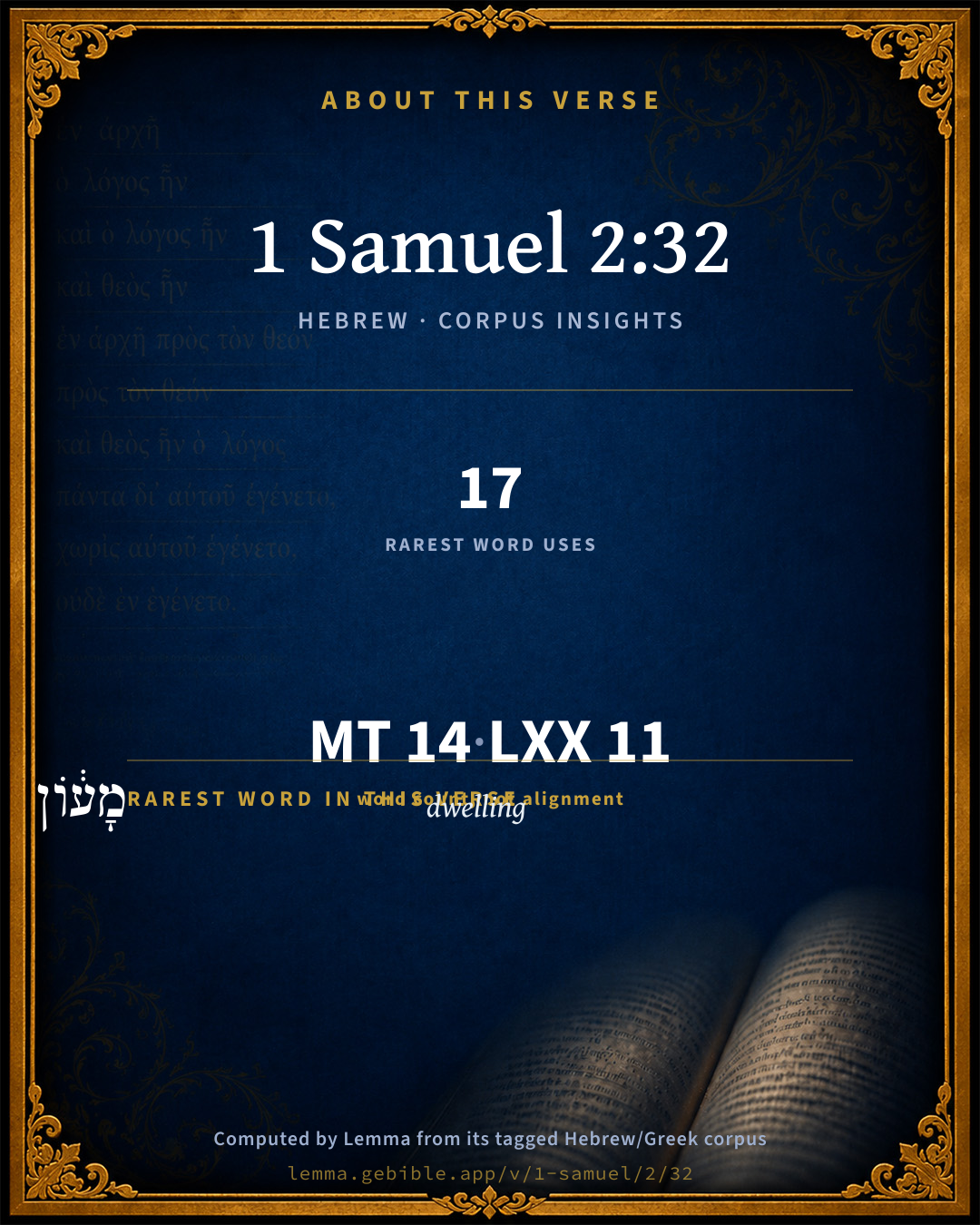
These counts appear in no published source. They are computed here, from the morphology-tagged text and Lemma’s own curated glosses. What Lemma adds →

14
words
13
distinct lemmas
Historical
section

Notable vocabulary

The rarest word here is מָע֔וֹן dwelling H4583 — appearing just 17 times in the whole Hebrew Bible.

Shared distinctive vocabulary

מָע֔וֹן dwelling H4583 occurs in 17 verses of the Hebrew Bible. Also found in:

Grammatical profile

  • 3 verbs
  • 6 nouns
  • 2 adjectives
  • 3 particles

Verb forms

  • וְהִבַּטְתָּ֙ Hiphil · Sequential Perfect
  • יֵיטִ֖יב Hiphil · Imperfect
  • יִהְיֶ֥ה Qal · Imperfect

Repetition

A word recurs within this verse — often emphatic in Hebrew:

  • בְּכֹ֥ל all H3605 ×2

Hebrew & Septuagint length

In English translation the verse runs 29 words from the Hebrew and 13 from the Septuagint (LXX English) — the Septuagint runs noticeably shorter here. See the side-by-side →

A rough comparison of the two English renderings, which tokenize alike — not a word-level alignment.

Word counts can differ between the Hebrew and the Greek without any difference in meaning — e.g. the Hebrew direct-object marker אֵת has no separate Greek word, and Greek often adds the article ὁ.

In the original languages it is 14 Hebrew tokens and 11 Greek tokens — but the two are counted differently (Hebrew bundles its prefixes and suffixes into one token; the Greek is in lemma form), so that isn’t a like-for-like length.

Cross-references

6

Topical passages linked to 1 Samuel 2:32 in the Treasury of Scripture Knowledge — connected by theme and wording, ordered by reader-vote popularity; previews shown in the World English Bible.

  • Zechariah 8:4 Thus says Yahweh of Hosts: "Old men and old women will again dwell in the streets of Jerusalem, every man with his staff in his hand for very age.
  • 1 Samuel 4:11 The ark of God was taken; and the two sons of Eli, Hophni and Phinehas, were slain.
  • Psalms 78:59–64 When God heard this, he was angry, And greatly abhorred Israel;
  • 1 Samuel 4:4 So the people sent to Shiloh; and they brought from there the ark of the covenant of Yahweh of Hosts, who sits [above] the cherubim: and the two sons of Eli, Hophni and Phinehas, were there with the ark of the covenant of God.
  • 1 Samuel 4:22 She said, The glory is departed from Israel; for the ark of God is taken.
  • 1 Kings 2:26–27 To Abiathar the priest said the king, Get you to Anathoth, to your own fields; for you are worthy of death: but I will not at this time put you to death, because you bear the ark of the Lord Yahweh before David my father, and because you were afflicted in all in which my father was afflicted.

Cross-references courtesy of OpenBible.info (CC BY 4.0).

Hebrew and Greek witnesses Masoretic Hebrew ↔ Greek Septuagint

The same verse in the two great witnesses to the Old Testament, shown verse-for-verse.

Here the Septuagint runs noticeably shorter than the Hebrew — LXX2012 (modern English Septuagint) 13 words vs World English Bible 29. A rough length comparison of the two English translations, not a word-level alignment — read both below.

These are two independent witnesses, not word-aligned to each other, and the Septuagint is shown in lemma (dictionary) form.

Hebrew 1 Samuel 2:32 Masoretic · Westminster Leningrad Codex

וְהִבַּטְתָּ֙ צַ֣ר מָע֔וֹן בְּכֹ֥ל אֲשֶׁר יֵיטִ֖יב אֶת יִשְׂרָאֵ֑ל וְלֹֽא יִהְיֶ֥ה זָקֵ֛ן בְּבֵיתְךָ֖ כָּל הַיָּמִֽים

You shall see the affliction of [my] habitation, in all the wealth which [God] shall give Israel; and there shall not be an old man in your house forever.

World English Bible · Public Domain

Greek LXX 1 Samuel 2:32 Septuagint · lemma form

καί οὐ εἰμί σύ πρεσβύτης ἐν οἶκος ἐγώ πᾶς ὁ ἡμέρα

And you shall not have an old man in my house for ever.

LXX2012 (modern English Septuagint) · Public Domain

Hebrew: Westminster Leningrad Codex (CC BY 4.0). Greek: Septuagint (public domain); English from LXX2012 (modern English Septuagint) (Public Domain). How the Septuagint differs from the Hebrew →

Targum (Aramaic paraphrase)

1

The Targum is the ancient Jewish Aramaic paraphrase of the Hebrew Scriptures — an interpretive translation, not the Hebrew text itself. Onkelos (literal) and Pseudo-Jonathan (expansive) render the Torah, and Jonathan the Prophets. Coverage is partial: where no permissively-licensed English translation exists for a verse, only the Aramaic is shown. This is verse-level text, not a word-by-word alignment to the Hebrew.

  1. Targum Jonathan Prophets (Joshua–Malachi)
    וּתְהֵי מִתְתַּכֵּל וּתְהֵי חָזֵי בְעַקְתָא דְתֵיתֵי עַל אֱנַשׁ בֵּיתֵךְ בְּחוֹבִין דְחַבְתּוּן קֳדָמַי בְּבֵית מַקְדְשִׁי וּבָתַר כֵּן אַיְיתִי טַבְתָא עַל יִשְׂרָאֵל וְלָא יְהֵי סִיב בְּבֵיתָךְ כָּל יוֹמַיָא:

    (no public-domain English translation for this verse)

    Targum Jonathan — Aramaic: “Mikraot Gedolot” (public domain). English: “Sefaria Community Translation” (CC0 1.0 (public-domain dedication)); “London "Chaldee Paraphrase," 1871” (public domain). Text via Sefaria.

Commentary

Notes on 1 Samuel 2:32 from classic Christian and Jewish commentators (each source and its license shown beneath its notes). The classic Christian expositions comment on the surrounding passage and are grouped to its opening verse, so a note may address several verses; the Jewish commentaries on the Tanakh (Rashi and others) are per-verse, so they appear only where the commentator wrote on this verse.

Lemma curates 59 commentaries, every one of them public domain or Creative Commons licensed, each selected and text-cleaned for this edition rather than reprinted as found. About our sources →

The Cambridge Bible for Schools and Colleges

gen. ed. J. J. S. Perowne

32. thou shalt see an enemy in my habitation] Or, a rival, the same word as that rendered “adversary” in 1Sa_1:6. The best explanation of this difficult passage appears to be this: ‘Thou, in the person of thy descendants, wilt see another take thy place as priest in my habitation (cp. 1Sa_2:29), at the time when the nation shall be most prosperous and the office most honourable;’ the reference being to Abiathar’s deposition by Solomon (1Ki_2:27). The words might also be translated “Thou shalt behold the distress of my habitation” (cp. E. V. margin), and would then refer to the neglect which the tabernacle suffered owing to the loss of the Ark, even while the nation was prospering under Samuel and Saul. Such neglect would be a punishment on the house of Eli, because the High-priest for the time would lose his position and influence.

The Sept. however omits 1Sa_2:32, and there are other grounds for suspecting that the present Heb. text of this verse as well as of 1Sa_2:29 is corrupt.

wealth] Here in the sense of “weal,” “well-being,” as in the Litany ‘In all time of our wealth.’

The Cambridge Bible for Schools and Colleges (gen. ed. J. J. S. Perowne; Cambridge University Press, 1878–1918) — public domain. Text from a community e-Sword module.

Trapp's Complete Commentary

John Trapp

1Sa 2:32 And thou shalt see an enemy [in my] habitation, in all [the wealth] which [God] shall give Israel: and there shall not be an old man in thine house for ever.

Ver. 32. And thou shalt see an enemy,] i.e., A rival, another high priest, viz., Zadok, set up by Solomon. {1Ki 1:26-27} "Thou shalt see it"; i.e., thy posterity shall, to their grief and regret:

In all the wealth.] In the time of Solomon’s most flourishing reign, the most gallant of that kingdom.

John Trapp, A Commentary or Exposition upon All the Books of the Old and New Testament (1647–1656) — public domain. Text from a community e-Sword module.

Joseph Benson's Commentary

1Sa 2:32. Thou shalt see an enemy, &c. — The words may be rendered, as in the margin, and seem evidently to mean, Thou shalt see, in thy own person, the affliction or calamity of my habitation; that is, either of the land of Israel, wherein I dwell; or of the sanctuary, called God’s habitation by way of eminence, whose greatest glory the ark was, (1Sa 4:21-22,) and consequently whose greatest calamity the loss of the ark was; for, or instead of, all that good wherewith God could have blessed Israel, having raised up a young prophet, Samuel, and thereby given good grounds of hope that he intended to bless Israel, if thou and thy sons had not hindered it by your sins. So this clause of threatening concerns Eli’s person, as the following concerns his posterity. And this best agrees with the most proper signification of that phrase, Thou shalt see.

Joseph Benson's Commentary on the Old and New Testaments (1811–1818) — public domain. Text from a community e-Sword module.

Tyndale Open Study Notes

Tyndale Open Resources

2:32-33 live out their days: In the Old Testament, a short life often expresses God’s disfavor, while long life represents God’s blessing (cp. Gen 15:15; 1 Kgs 3:14; Ps 91:16).

Tyndale Open Study Notes — © Tyndale Open Resources, licensed CC BY-SA 4.0. Text via the HelloAO Bible API.

Geneva Bible (1599)

Geneva Bible translators

Thy posterity shall see the glory of the chief Priest translated to another, whom they shall envy, 1 Kings 2:27.

Geneva Bible (1599) marginal notes — public domain. Text via Bolls.life.

Jamieson, Fausset & Brown

Robert Jamieson, A. R. Fausset & David Brown

thou shalt see an enemy in my habitation--A successful rival for the office of high priest shall rise out of another family (Sa2 15:35; Ch1 24:3; Ch1 29:22). But the marginal reading, "thou shalt see the affliction of the tabernacle," seems to be a preferable translation.

Next: 1 Samuel Chapter 3

Jamieson, Fausset & Brown — Commentary Critical and Explanatory on the Whole Bible (1871) — public domain (CC PDM 1.0). Text via the HelloAO Bible API.

Adam Clarke's Commentary

Verse 32. Thou shalt see an enemy in my habitation] Every version and almost every commentator understands this clause differently. The word tsar, which we translate an enemy, and the Vulgate aemulum, a rival, signifies calamity; and this is the best sense to understand it in here. The calamity which he saw was the defeat of the Israelites, the capture of the ark, the death of his wicked sons, and the triumph of the Philistines. All this he saw, that is, knew to have taken place, before he met with his own tragical death.

In all the wealth which God shall give Israel] This also is dark. The meaning may be this: God has spoken good concerning Israel; he will, in the end, make the triumph of the Philistines their own confusion; and the capture of the ark shall be the desolation of their gods; but the Israelites shall first be sorely pressed with calamity. See the margin.

There shall not be an old man] This is repeated from the preceding verse, all the family shall die in the flower of their years, as is said in the following verse.

Adam Clarke's Commentary on the Bible (1810–1826) — public domain. Text from a community e-Sword/MySword module.

Ellicott's Commentary for English Readers

(32) And thou shalt see an enemy.—Some—e.g., the Vulgate—understand by enemy a “rival”: thou shalt see thy rival in the Temple. The words, however, point to something which Eli would live to see with grief and horror. The reference is no doubt to the capture of the Ark by the Philistines in the battle where his sons were slain. The earthly habitation of the Eternal was there robbed of its glory and pride, for the ark of the covenant was the heart of the sanctuary.

In all the wealth which God shall give Israel.—“The affliction of God’s house from the loss of the ark remained while under the lead of Samuel there came blessing to the people.”—Erdmann.

There is another explanation which refers the fulfilment of this part of the prophecy to the period of Solomon’s reign, when Abiathar, of the house of Eli, was deposed from the High Priestly dignity to make room for Zadok, but the reference to the capture of the ark is by far more probable.

A Bible Commentary for English Readers, edited by Charles John Ellicott (1878–1897) — public domain. Text from a community e-Sword module.

John Gill's Exposition

And the man of thine,..... Of his family, which should spring from him: whom I shall not cut off from mine altar: from serving there: who though he shall not be an high priest, but a common priest, as all the descendants of Aaron were:

shall be to consume thine eyes, and to grieve thine heart; that is, the eyes and heart of his posterity; who though they should see of their family ministering in the priest's office, yet should make so poor a figure on account of their outward meanness and poverty, or because of their want of wisdom, and intellectual endowments, or because of their scandalous lives, that it would fill their hearts with grief and sorrow, and their eyes with tears, so that their eyes would fail, and be consumed, and their hearts be broken:

and all the increase of thine house shall die in the flower of their age; or "die men" (k); grown men, not children, when it would not be so great an affliction to part with them; but when at man's estate, in the prime of their days, perhaps about thirty years of age, the time when the priests entered upon their office to do all the work of it; the Targum is,"shall be killed young men:''it is more than once said in the Talmud (l), that there was a family in Jerusalem, the men of which died at eighteen years of age; they came and informed Juchanan ben Zaccai of it; he said to them, perhaps of the family of Eli are ye, as it is said, Sa1 2:33.

(k) "morientur viri", Montanus, Tigurine version; "morientur virile aetate", Junius & Tremellius, Piscator; so V. L. (l) T. Bab. Roshhashanah, fol. 18. 1. & Yebamot, fol. 105. 1.

John Gill's Exposition of the Whole Bible (1746–1763) — public domain (CC PDM 1.0). Text via the HelloAO Bible API.

Albert Barnes' Notes on the Bible

The original text is rather obscure and difficult of construction, but the King James Version probably gives the sense of it. The margin gives another meaning.

In all the wealth ... - The allusion is particularly to Solomon’s reign, when Zadok was made priest instead of Abiathar, 1Ki 2:26-27. (See 1Ki 4:20 ff) The enormous number of sacrifices then offered must have been a great source of wealth to the priests 1Ki 8:63-66.

Albert Barnes' Notes on the Bible (1834–1885) — public domain. Text from a community e-Sword/MySword module.

Haydock's Catholic Bible Commentary

Thy rival. A priest of another race. This was partly filled when Abiathar, of the race of Heli, was removed from the priesthood, and Sadoc, who was of another line, was substituted in his place. But it was more fully accomplished in the New Testament, when the priesthood of Aaron gave place to that of Christ. (Challoner) --- Some suppose that this rival was Samuel, in whom this prediction was partly fulfilled, though more completely in Christ. (Ven. Bede, q.) (Menochius) --- Heli saw not in person the exaltation of Eleazar’s family. Hebrew and other version are very much embarrassed here. (Calmet) --- Protestants, "and thou shalt see an enemy in my habitation, in all the wealth which God shall give Israel." (Haydock)

George Leo Haydock (1774–1849), Haydock's Catholic Family Bible and Commentary, 1859 edition — public domain. Excludes Psalms (Douay-Rheims chapter numbering differs from Protestant) and Deuterocanonical books (Catholic canon only).

Matthew Poole's English Annotations

So the sense is,

Thou shalt see, not in thy person, but in thy posterity, (it being most frequent in Scripture to attribute that to parents which properly belongs to their posterity only; as Gen 17:8; Gen 27:29,40)

an enemy, i.e. thy competitor, or him who shall possess that place of high trust and honour which now thou enjoyest, (such persons being through man’s corrupt nature esteemed as a man’s worst enemy,) in my habitation, i.e. in the sanctuary. And then he adds by way of aggravation, that this sad accident should happen in all the wealth when God shall give Israel, i.e. in a time when God should eminently bless Israel, and make good all his promises to them, which was in Solomon’s days, when Abiathar of Eli’s race was put out of the high priesthood, and Zadok was put in his place, 1Ki 2:27,35, when the priesthood was most glorious, and most profitable, and comfortable, and therefore the loss of it more deplorable. But the words may be otherwise rendered, as is noted in the margin of our English Bibles: Thou shalt see, to wit, in thy own person, the affliction, or oppression, or calamity of my habitation, i.e. either of the land of Israel, wherein I dwell; or of the sanctuary, called the habitation by way of eminency, whose greatest glory the ark was, 1Sa 4:21,22, and consequently, whose greatest calamity the loss of the ark was; for, or instead of all that good wherewith God would have blessed Israel, or was about to bless Israel; having raised up a young prophet, Samuel, and thereby given good grounds of hope that he intended to bless Israel, if thou and thy sons had not hindered it by your sins, which God was resolved severely to punish. So this clause of the threatening concerns Eli’s person, as the following concerns his posterity. And this best agrees with the most proper and usual signification of that phrase, Thou shalt see. For ever, i.e. as long as the priesthood continues in thy family, or as long as the Levitical priesthood lasts.

Matthew Poole's English Annotations on the Holy Bible (1683–1685) — public domain. Text from a community e-Sword/MySword module.

Whedon's Commentary on the Bible

Daniel D. Whedon

32. Thou shalt see an enemy — There can be given no satisfactory exposition of this verse as it stands in the authorized version, or by understanding either Samuel or Zadok to be the enemy referred to. The marginal reading gives a far better sense to the first part of the verse — Thou shall see the affliction of the tabernacle; but what follows — for all the wealth which God would have given Israel — makes no sense, and has no sufficient warrant in the Hebrew text. The word ישׂב, which is rendered give both in the text and margin, means to be good, cheerful, glad; and, in the Hiphil form, to cause to be good, cheerful, etc. Thus in Pro_15:13, our translators have rendered it maketh cheerful — “A merry heart maketh a cheerful countenance.” We would therefore translate the passage thus: Thou shall see an affliction of the habitation (tabernacle, as in 1Sa_2:29) in all which made Israel glad. That which above all things else made Israel glad and joyous was the possession of the ark of the covenant. Witness the joyful shout of the army when it was brought into their camp at Eben-ezer, (1Sa_4:5,) and the joys of Israel when David brought it to Jerusalem. 2 Samuel 6. The greatest calamity that could befall the tabernacle was the loss of the ark, the symbol of the Divine presence; and Eli lived to see that bitter affliction, (1Sa_4:11; 1Sa_4:18,) which was emphatically an affliction of the tabernacle in respect to (ב) all that was wont to make Israel glad. His sudden death, when he heard that the ark was captured, was as much as to say, If the ark is lost ALL is lost. So bitter an affliction was this to the nation that it was chronicled as “the captivity of the land.” See note, Jdg_18:30.

Daniel D. Whedon (gen. ed.), Commentary on the Old and New Testaments (1874–1909) — public domain. Text from a community e-Sword module.

The Pulpit Commentary

Thou shalt see an enemy. The translation of ver. 32 is very difficult, but is probably as follows: "And thou shalt behold, i.e. see with wonder and astonishment, narrowness of habitation in all the wealth which shall be given unto Israel." The word translated narrowness often means an "enemy," but as that for habitation is the most general term in the Hebrews language for a dwelling, being used even of the dens of wild beasts (Jer_9:10; Nah_2:12) the rendering an "enemy of dwelling" gives no sense. Hence the violent insertion of the pronoun my, for which no valid excuse can be given. But narrowness of dwelling, means distress, especially in a man"s domestic relations, and this is the sense required. In the growing public and national prosperity which was to be Israel"s lot under Samuel, Saul, David, and Solomon, Eli was to see, not in person, but prophetically, calamity attaching itself to his own family. His house was to decay in the midst of the progress of all the rest. Upon this denunciation of private distress naturally follows the repetition of the threat that the house of Ithamar should be left without an old man to guide its course onward to renewed prosperity.

The Pulpit Commentary (1880–1919), ed. H.D.M. Spence-Jones & Joseph S. Exell — public domain. Text from a community e-Sword module.

John Wesley's Explanatory Notes

Shalt see,&c. - The words may be rendered; thou shalt see, in thy own person, the affliction, or calamity of my habitation; that is, either of the land of Israel, wherein I dwell; or of the sanctuary, called the habitation by way of eminency, whose greatest glory the ark was, chap. iv, 21, 22, and consequently, whose greatest calamity the loss of the ark was; for, or instead of all that good wherewith God would have blessed Israel, having raised up a young prophet Samuel, and thereby given good grounds of hope that he intended to bless Israel, if thou and thy sons had not hindered it by your sins. So this clause of the threatning concerns Eli's person, as the following concerns his posterity. And this best agrees with the most proper signification of that phrase, Thou shalt see.

John Wesley, Explanatory Notes Upon the Whole Bible (1754–1765) — public domain. Text via the GEBible commentary corpus.

Rashi

Rabbi Shlomo Yitzchaki (Rashi)

And you will see a rival [in My] Sanctuary. And you will see your rival at your side in My Sanctuary just as a woman who sees her rival with her in the house.

Throughout all the good that He will bring upon Yisroel. When the Temple will be built in the days of Shlomo, and the goodness promised to Yisroel will be complete, as it is said there, "Not one word has gone unfulfilled from His entire gracious promise. Yehudah and Yisroel were numerous, like the sand that is by the sea. And Yehudah and Yisroel dwelt in security, each man under his grapevine and under his fig tree… all the days of Shlomo."

But there will be no elder in your family. This is an appropriate punishment. You ate sacrifices before the [permitted] time, before they burnt the fat, so too, you will die before your time.

Rashi on the Tanakh — English translations: “The Judaica Press complete Tanach with Rashi, translated by A. J. Rosenberg” (CC BY 4.0); “Pentateuch with Rashi's commentary by M. Rosenbaum and A.M. Silbermann, 1929-1934” (public domain); “The Metsudah Tanach series, Lakewood, N.J” (CC BY 4.0); and “The Book of Joshua, Metsudah Publications, 1997” (CC BY 4.0). Text via Sefaria.

Lesson kit

Teaching starters — assembled from the data on this page, not authored interpretation. Every prompt links to the verse data it draws on. Edit before teaching.

1 Samuel, in the Historical, opens this verse with 14 words (13 distinct Hebrew lemmas). Its most distinctive word is mâʻôwn (“dwelling”). The Greek Septuagint runs shorter here. A historical commentator’s framing appears above. Read the whole chapter for the surrounding context.

Discussion questions

  1. How does “dwelling” (mâʻôwn) shape what this verse is saying?
  2. How does Deuteronomy 26:15, which shares the word «dwelling», read alongside this verse?
  3. What does the repetition of “all” (2× in this one verse) do in this verse?
  4. The Septuagint runs shorter here than the Hebrew. What might account for the difference?
  5. These translations render this verse differently. What is at stake in choosing one wording over another?
  6. «וְהִבַּטְתָּ֙» is a Hiphil Sequential Perfect verb. How does that grammatical form shape the action described?
  7. Compare how The Cambridge Bible for Schools and Colleges and Trapp's Complete Commentary read this verse. Where do they agree or differ?

Things to notice

Reading settings

Reading text

Shown beneath each verse's original-language words.

Old Testament
Old Testament edition

Read the OT as the Masoretic Hebrew (MT) or the Greek Septuagint (LXX).

English shown for the Greek Septuagint (in the Hebrew ↔ Greek comparison).

Comparing translations? Open the Compare panel on any verse page to stack up to four side by side.