Deuteronomy 22:16

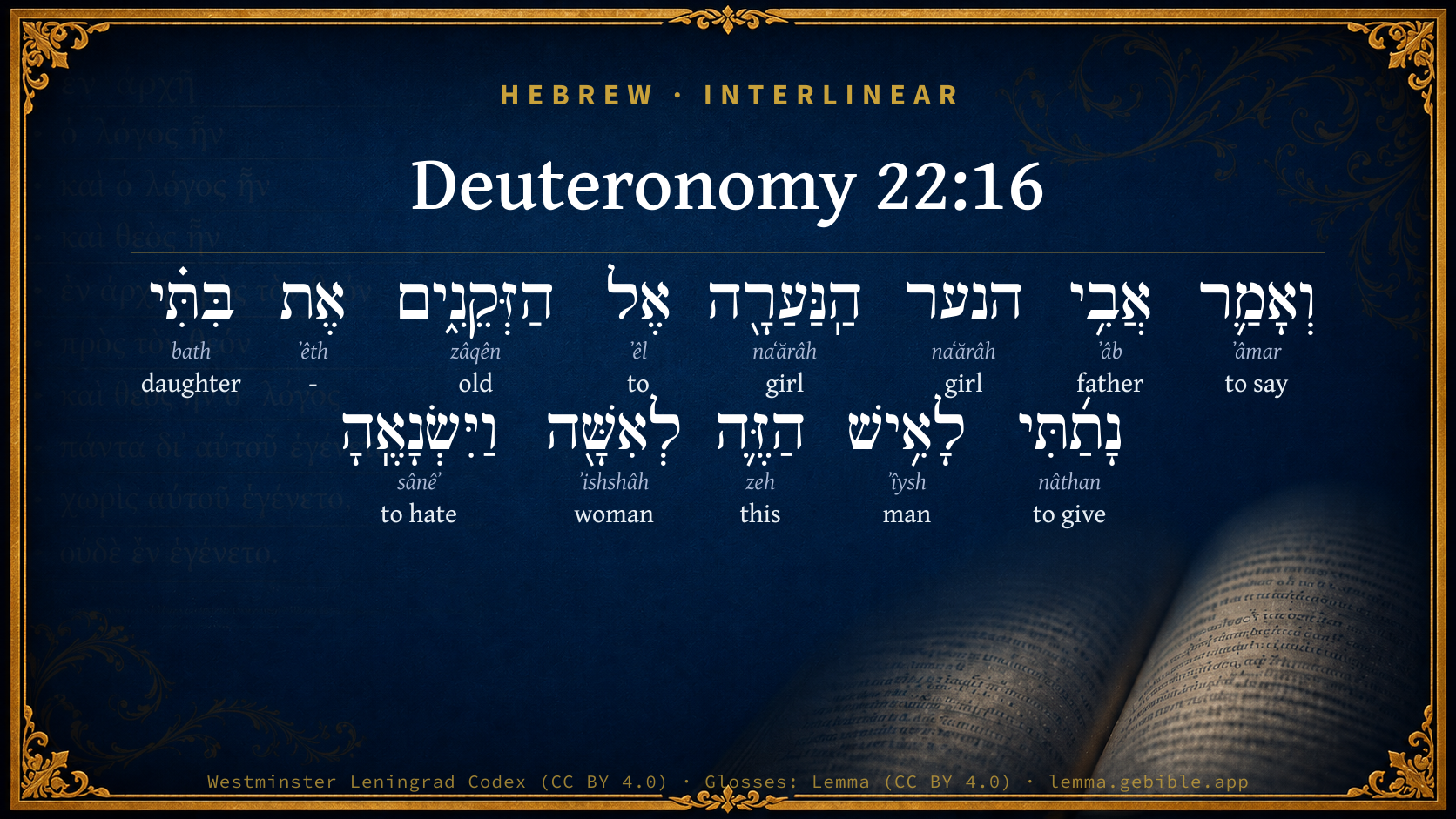
Hebrew (Westminster Leningrad Codex) Deuteronomy 22:16 appears in the Hebrew Old Testament. The text above is from the Westminster Leningrad Codex. Each word links to its Strong’s number, a concise gloss, and parsing drawn from the Open Scriptures Hebrew Bible morphology. Click any word for its full Brown-Driver-Briggs (BDB) entry.
Download image
Cite this verse

Deuteronomy 22:16 (World English Bible). Public Domain. Lemma interlinear Bible study tool, https://lemma.gebible.app/v/deuteronomy/22/16.

Show BibTeX & RIS
BibTeX
RIS
English Translation
and the young lady's father shall tell the elders, I gave my daughter to this man to wife, and he hates her;
World English Bible · Public Domain
Download a study sheet

One document with this verse’s original text, its word-by-word gloss line, the meaning frame, cross-references with their text, attributed commentary, and full source and license credits — printable, and it pastes into notes with its structure intact.

This verse Autodidact and up

Study sheet (.html) Plain text (.txt)

A passage Seminary Student

Up to 50 verses in one chapter. A passage sheet keeps up to 6 commentary sources and 12 cross-references per verse, in the order this page ranks them, and says so on the sheet whenever that leaves anything out. Ask for a single verse and you get the Autodidact verse sheet above.

Everything on this page stays free to read, with no account — the sheet is a download of what is already on screen, not access to it.

Want to remove ads? Support Godless Engineer
Compare translations 3

The same verse in 3 English versions, stacked beneath the original-language interlinear above. Click any original word for its lexicon entry.

Each is an independent rendering of the whole verse — the interlinear is not word-aligned to these translations.

Highlighted words mark where these versions differ — a whole-verse word diff, not a word-by-word alignment.

  • World English Bible Public Domain
    and the young lady's father shall tell the elders, I gave my daughter to this man to wife, and he hates her;
  • King James Version Public Domain
    And the damsel's father shall say unto the elders, I gave my daughter unto this man to wife, and he hateth her;
  • unfoldingWord Literal Text CC BY-SA 4.0
    And the father of the girl shall say to the elders, ‘I gave my daughter to this man as a wife, and he hates her.

unfoldingWord Literal Text — © unfoldingWord, licensed CC BY-SA 4.0. Word-aligned USFM3 via Door43 (git.door43.org/unfoldingWord/en_ult).

Versions to compare (up to 4)

3 of 4 selected

Show all 18 translations

Every available English version of this verse, each an independent rendering of the whole verse.

  • World English Bible Public Domain
    and the young lady's father shall tell the elders, I gave my daughter to this man to wife, and he hates her;
  • Berean Standard Bible Public Domain
    and say to the elders, “I gave my daughter in marriage to this man, but he has come to hate her.
  • Majority Standard Bible Public Domain
    and say to the elders, “I gave my daughter in marriage to this man, but he has come to hate her.
  • King James Version Public Domain
    And the damsel's father shall say unto the elders, I gave my daughter unto this man to wife, and he hateth her;
  • American Standard Version (1901) Public Domain
    and the damsel's father shall say unto the elders, I gave my daughter unto this man to wife, and he hateth her;
  • Revised Version (1885) Public Domain
    and the damsel’s father shall say unto the elders, I gave my daughter unto this man to wife, and he hateth her;
  • Geneva Bible (1599) Public Domain
    And the maydes father shall say vnto the Elders, I gaue my daughter vnto this man to wife, and he hateth her:
  • Douay-Rheims (1899) Public Domain
    And the father shall say: I gave my daughter unto this man to wife: and because he hateth her,
  • Young's Literal Translation Public Domain
    and the father of the damsel hath said unto the elders, My daughter I have given to this man for a wife, and he doth hate her;
  • Literal Standard Version CC BY-SA 4.0
    and the father of the girl has said to the elderly, I have given my daughter to this man for a wife, and he hates her;
  • Unlocked Literal Bible CC BY-SA 4.0
    The girl's father must say to the elders, 'I gave my daughter to this man as a wife, and he hates her.
  • unfoldingWord Literal Text CC BY-SA 4.0
    And the father of the girl shall say to the elders, ‘I gave my daughter to this man as a wife, and he hates her.
  • Darby Bible Public Domain
    and the damsel's father shall say unto the elders, I gave my daughter unto this man as wife, and he hates her;
  • World Messianic Bible Public Domain
    The young lady’s father shall tell the elders, “I gave my daughter to this man as his wife, and he hates her.
  • Webster's Bible Public Domain
    And the damsel's father shall say to the elders, I gave my daughter to this man for a wife, and he hateth her,
  • Free Bible Version CC BY-SA 4.0
    and the father will explain to them, “I gave my daughter in marriage to this man, but he has ended up hating her.
  • Bible in Basic English Public Domain
    And let the girl's father say to the responsible men, I gave my daughter to this man for his wife, but he has no love for her;
  • JPS Tanakh (1917) Public Domain
    And the damsel's father shall say unto the elders: 'I gave my daughter unto this man to wife, and he hateth her;

Literal Standard Version (2020), Covenant Press — licensed CC BY-SA 4.0. Text via the HelloAO Bible API (eBible.org). Unlocked Literal Bible (unfoldingWord) — licensed CC BY-SA 4.0. Text via the HelloAO Bible API (eBible.org). unfoldingWord Literal Text — © unfoldingWord, licensed CC BY-SA 4.0. Word-aligned USFM3 via Door43 (git.door43.org/unfoldingWord/en_ult). Free Bible Version, Dr. Jonathan Gallagher — licensed CC BY-SA 4.0. Text via the HelloAO Bible API (eBible.org).

Word by word

More ways to search: Search by grammar → Find every occurrence → Compare this word →

Practice this passage: Drill this verse → Learn its vocabulary →

הנער
naʻărâh
H5291
“the · girl”
Particle, Definite Article + Noun, Common, Feminine, Singular, Absolute
Part of Speech
Particle + Noun
Type
Common
Gender
Feminine
Number
Singular
State
Absolute
Full BDB Definition

Origin: from H5288

TWOT: 1389c

girl, damsel, female servant - girl, damsel, little girl - of young woman, marriageable young woman, concubine, prostitute - maid, female attendant, female servant
  1. וְאָמַ֛ר ʼâmar H559 “and · to say” Conjunction + Verb, Qal, Sequential Perfect, 3rd Person, Masculine, Singular
  2. אֲבִ֥י ʼâb H1 “father of” Noun, Common, Masculine, Singular, Construct
  3. הַֽנַּעַרָ֖ה naʻărâh H5291 “the · girl” Particle, Definite Article + Noun, Common, Feminine, Singular, Absolute
  4. אֶל ʼêl H413 “to” Preposition
  5. הַזְּקֵנִ֑ים zâqên H2205 “the · old” Particle, Definite Article + Adjective, Adjective, Masculine, Plural, Absolute
  6. אֶת ʼêth H853 “-” Particle, Direct Object
  7. בִּתִּ֗י bath H1323 “daughter · my” Noun, Common, Feminine, Singular, Construct + Suffix, Personal, 1st Person, Common, Singular
  8. נָתַ֜תִּי nâthan H5414 “to give” Verb, Qal, Perfect, 1st Person, Common, Singular
  9. לָאִ֥ישׁ ʼîysh H376 “to/for the · man” Preposition, Determined + Noun, Common, Masculine, Singular, Absolute
  10. הַזֶּ֛ה zeh H2088 “the · this” Particle, Definite Article + Pronoun, Demonstrative, Masculine, Singular
  11. לְאִשָּׁ֖ה ʼishshâh H802 “to/for · woman” Preposition + Noun, Common, Feminine, Singular, Absolute
  12. וַיִּשְׂנָאֶֽהָ sânêʼ H8130 “and · to hate · her” Conjunction + Verb, Qal, Sequential Imperfect, 3rd Person, Masculine, Singular + Suffix, Personal, 3rd Person, Feminine, Singular

About this verse

These counts appear in no published source. They are computed here, from the morphology-tagged text and Lemma’s own curated glosses. What Lemma adds →

13
words
12
distinct lemmas
Pentateuch
section

Grammatical profile

  • 3 verbs
  • 6 nouns
  • 1 adjective
  • 1 pronoun
  • 1 preposition
  • 1 particle

Verb forms

  • וְאָמַ֛ר Qal · Sequential Perfect
  • נָתַ֜תִּי Qal · Perfect
  • וַיִּשְׂנָאֶֽהָ Qal · Sequential Imperfect

Repetition

A word recurs within this verse — often emphatic in Hebrew:

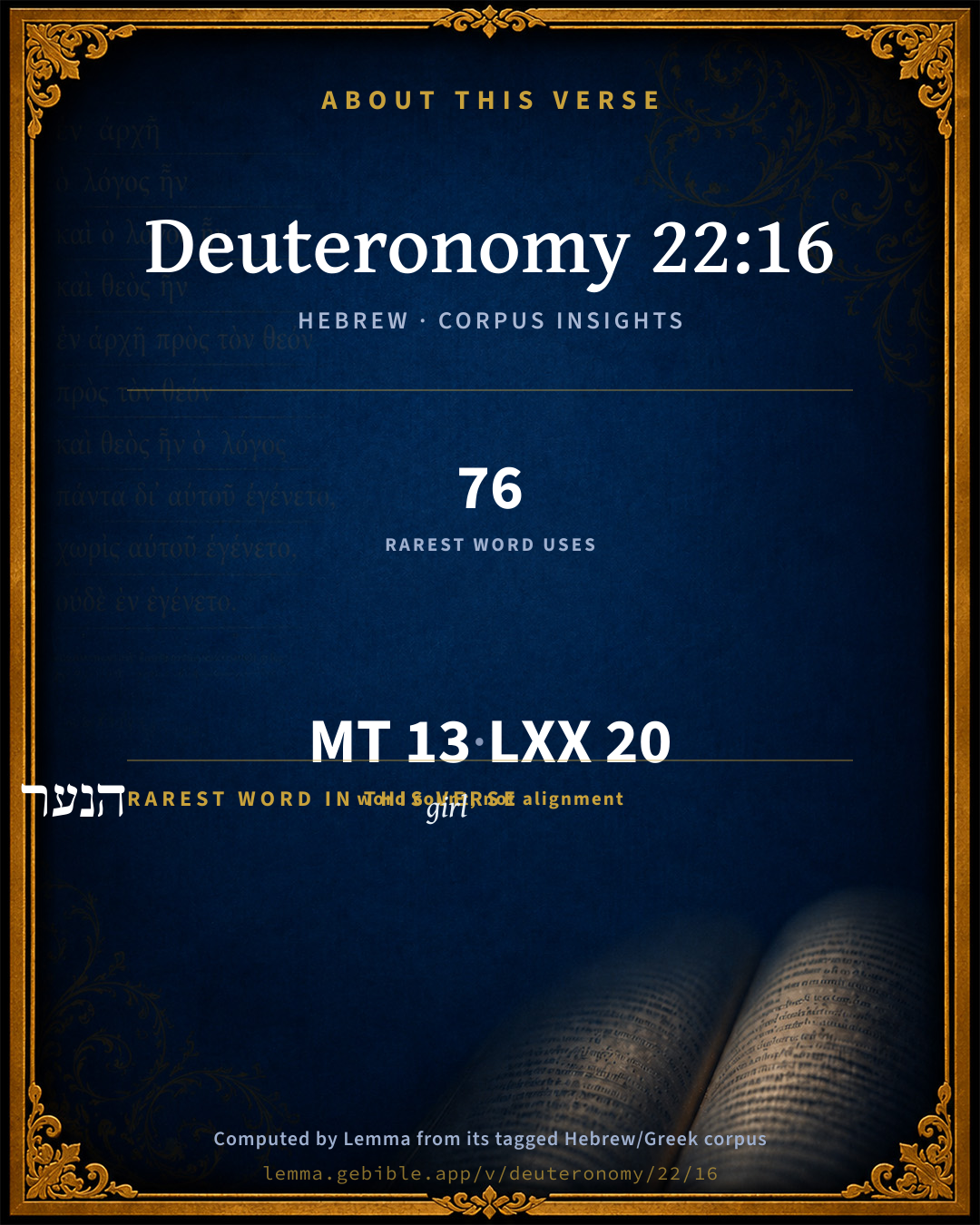
  • הנער girl H5291 ×2

Hebrew & Septuagint length

In English translation the verse runs 22 words from the Hebrew and 22 from the Septuagint (LXX English) — the same length.

A rough comparison of the two English renderings, which tokenize alike — not a word-level alignment.

Word counts can differ between the Hebrew and the Greek without any difference in meaning — e.g. the Hebrew direct-object marker אֵת has no separate Greek word, and Greek often adds the article ὁ.

In the original languages it is 13 Hebrew tokens and 20 Greek tokens — but the two are counted differently (Hebrew bundles its prefixes and suffixes into one token; the Greek is in lemma form), so that isn’t a like-for-like length.

Hebrew and Greek witnesses Masoretic Hebrew ↔ Greek Septuagint

The same verse in the two great witnesses to the Old Testament, shown verse-for-verse.

These are two independent witnesses, not word-aligned to each other, and the Septuagint is shown in lemma (dictionary) form.

Hebrew Deuteronomy 22:16 Masoretic · Westminster Leningrad Codex

וְאָמַ֛ר אֲבִ֥י הנער הַֽנַּעַרָ֖ה אֶל הַזְּקֵנִ֑ים אֶת בִּתִּ֗י נָתַ֜תִּי לָאִ֥ישׁ הַזֶּ֛ה לְאִשָּׁ֖ה וַיִּשְׂנָאֶֽהָ

and the young lady's father shall tell the elders, I gave my daughter to this man to wife, and he hates her;

World English Bible · Public Domain

Greek LXX Deuteronomy 22:16 Septuagint · lemma form

καί εἶπον ὁ πατήρ ὁ παῖς ὁ γερουσία ὁ θυγάτηρ ἐγώ οὗτος δίδωμι ὁ ἄνθρωπος οὗτος γυνή καί μισέω αὐτός

And the father of the damsel shall say to the elders, I gave this my daughter to this man for a wife;

LXX2012 (modern English Septuagint) · Public Domain

Hebrew: Westminster Leningrad Codex (CC BY 4.0). Greek: Septuagint (public domain); English from LXX2012 (modern English Septuagint) (Public Domain). How the Septuagint differs from the Hebrew →

Targum (Aramaic paraphrase)

2

The Targum is the ancient Jewish Aramaic paraphrase of the Hebrew Scriptures — an interpretive translation, not the Hebrew text itself. Onkelos (literal) and Pseudo-Jonathan (expansive) render the Torah, and Jonathan the Prophets. Coverage is partial: where no permissively-licensed English translation exists for a verse, only the Aramaic is shown. This is verse-level text, not a word-by-word alignment to the Hebrew.

  1. Targum Onkelos Torah (Genesis–Deuteronomy)
    וְיֵימַר אֲבוּהָא דְעוּלֶמְתָּא לְסָבַיָא יָת בְּרַתִּי יְהָבִית לְגַבְרָא הָדֵין לְאִנְתּוּ וּסְנִנַהּ

    (no public-domain English translation for this verse)

    Targum Onkelos — Aramaic: “Onkelos Genesis” (public domain); “Onkelos Exodus” (public domain); “Onkelos Leviticus” (public domain); “Onkelos Numbers” (public domain); “Onkelos Deuteronomy” (public domain). English: “Sefaria Community Translation” (CC0 1.0 (public-domain dedication)); “J.W. Etheridge. The Targums of Onkelos and Jonathan Ben Uzziel on the Pentateuch. London: Longmans, Green, 1862” (public domain). Text via Sefaria.

  2. Targum Pseudo-Jonathan Torah (Genesis–Deuteronomy)
    וְיֵימַר אֲבוּהָא דְעוּלֵימְתָּא לְחַכִּימַיָא יַת בְּרַתִּי קַדֵּישִׁית לְגַבְרָא הָדֵין לְאִנְתּוּ וּמִן בָּתַר דְּשַׁמֵּשׁ עִמָּהּ סַנָא לָהּ

    And the father of the damsel shall say to the sages, I wedded my daughter to this man to be his wife; but after lying with her he hath hated her;

    Targum Pseudo-Jonathan — Aramaic: “Targum Jonathan on Genesis” (public domain); “Targum Jonathan on Exodus” (public domain); “Targum Jonathan on Leviticus” (public domain); “Targum Jonathan on Numbers” (public domain); “Targum Jonathan on Deuteronomy” (public domain). English: “The Targum of Jonathan ben Uzziel, trans. J. W. Etheridge, London, 1862” (public domain). Text via Sefaria.

Commentary

Notes on Deuteronomy 22:16 from classic Christian and Jewish commentators (each source and its license shown beneath its notes). The classic Christian expositions comment on the surrounding passage and are grouped to its opening verse, so a note may address several verses; the Jewish commentaries on the Tanakh (Rashi and others) are per-verse, so they appear only where the commentator wrote on this verse.

Lemma curates 59 commentaries, every one of them public domain or Creative Commons licensed, each selected and text-cleaned for this edition rather than reprinted as found. About our sources →

Trapp's Complete Commentary

John Trapp

Deu 22:16 And the damsel’s father shall say unto the elders, I gave my daughter unto this man to wife, and he hateth her;

Ver. 16. And he hateth her.] Which is a monster in nature. {Eph 5:28-29}

John Trapp, A Commentary or Exposition upon All the Books of the Old and New Testament (1647–1656) — public domain. Text from a community e-Sword module.

John Gill's Exposition

And, lo, he hath given occasion of speech against her,.... In the neighbourhood where they dwell; has been the cause of persons speaking reproachfully of her, as one of ill fame:

saying, l found not thy daughter a maid; so that it seems he said this not only to his neighbours, and before a court of judicature, but to the parents of the damsel:

and yet these are the tokens of my daughter's virginity; which were brought with him, and produced in open court:

and they shall spread the cloth before the elders of the city; that they might have ocular proof and evidence of the truth of what he said, by having spread before them the sheet stained with the blood of her virginity upon her husband's first congress with her. It seems that the mother, as well as the father, were present and concerned in this action: for it is said, "they shall spread"; and though the mother might not speak, she was the proper person to bring this cloth and spread it; and indeed it was particularly in her care and keeping; for we are told (t), that two persons, called "the friends" of the bride and bridegroom, went first into their bedchamber, and thoroughly examined the bed, whether there was anything relating to the sign of virginity, by which one might impose upon another; and they stood all night keeping watch with great joy and cheerfulness, as if they had been the guards of a king and queen; (to which is thought the allusion is in Joh 3:29) their business was, when the bridegroom and bride came out, to rush in immediately, and examine all things again; and knowing and owning the former linen sheets in which they had lain, took them and delivered them to the mother. Nor need spreading such a cloth before the court be thought unlikely because of the indecency of it, when it is observed that persons and things much more filthy came under the cognizance and examination of the priests, as leprous, menstruous, and profluvious persons, and their respective disorders; nor is it at all improbable that there should be such evident tokens as are said to be given, when it is observed, especially of the Jewish women, at what a tender age they were marriageable, and were frequently married, namely, when twelve years and one day old. And the Africans, as we are told (u), have a custom with them similar to this at a wedding;"a feast is prepared, and a certain woman waits without, until the bride is lain with; and then a linen cloth, stained with blood, is reached out to her, which she carries in her hands, and shows to the guests, crying out with a loud voice that this was a virgin hitherto not corrupt; then she, with other women, are splendidly received, first by the parents of the bridegroom, and then of the bride; but if she does not appear to be a virgin, she is returned to her parents under the disgrace of all, and the marriage made null and void.''Indeed there are some Jewish writers, that interpret this cloth in a parabolical and allegorical sense, and understand by it witnesses that; would make the case as clear and plain as the spreading out a cloth or garment. They suppose that before the damsel was lain with she was examined by several matrons, who declaring her to be a virgin, gave it under their hands in writing to her parents, which they were capable of producing in court when there was occasion for it; so Jarchi says, this is a parable; the meaning is, they made things as clear and as plain as a new cloth; with which agrees the Talmud (w) he seems to have taken it from, where on these words, and they shall spread the cloth, this remark is made; but the literal sense seems best.

(t) Nachman. apud Fagium in loc. Schindler. Lex: Pentaglott. col. 260, 261. (u) Joan. Leon. Descript. Africae, l. 3. p. 325. (w) T. Bab. Cetubot, fol. 46. 1.

John Gill's Exposition of the Whole Bible (1746–1763) — public domain (CC PDM 1.0). Text via the HelloAO Bible API.

unfoldingWord translationNotes

Door43 World Missions Community

General Information:

Moses is still speaking to the people of Israel.

he has accused her of shameful things

The full meaning of this statement can be made explicit. AT: "he has accused her of having slept with someone before he married her" (See: Assumed Knowledge and Implicit Information)

I did not find in your daughter the proof of virginity

The abstract nouns "proof" and "virginity" can be translated as verb phrases. AT: "Your daughter could not prove that she has never had sexual relations" (See: Abstract Nouns)

But here is the proof of my daughter's virginity

The abstract nouns "proof" and "virginity" can be translated as verb phrases. AT: "But this proves that my daughter has never had sexual relations" (See: Abstract Nouns)

Then they will spread the garment out before the elders of the city

The full meaning of this statement can be made explicit. AT: "And then the mother and father will show the clothing with the bloodstain to the elders as proof that she was a virgin" (See: Assumed Knowledge and Implicit Information)

translationWords

elder

accuse

shame

virgin

unfoldingWord translationNotes — © Distant Shores Media and the Door43 World Missions Community, licensed CC BY-SA 4.0. Source: git.door43.org/Door43/en_tn.

Rashi

Rabbi Shlomo Yitzchaki (Rashi)

ואמר אבי הנערה AND THE DAMSEL’S FATHER SHALL SAY [UNTO THE ELDERS] — although both parents appear before them, yet the father alone shall speak — this teaches that a woman is not allowed to speak in the presence of her husband (if he, too, is concerned in the matter) (Sifrei Devarim 235:10).

Rashi on the Tanakh — English translations: “The Judaica Press complete Tanach with Rashi, translated by A. J. Rosenberg” (CC BY 4.0); “Pentateuch with Rashi's commentary by M. Rosenbaum and A.M. Silbermann, 1929-1934” (public domain); “The Metsudah Tanach series, Lakewood, N.J” (CC BY 4.0); and “The Book of Joshua, Metsudah Publications, 1997” (CC BY 4.0). Text via Sefaria.

Lesson kit

Teaching starters — assembled from the data on this page, not authored interpretation. Every prompt links to the verse data it draws on. Edit before teaching.

Deuteronomy, in the Pentateuch, opens this verse with 13 words (12 distinct Hebrew lemmas). Its most distinctive word is naʻărâh (“girl”). A historical commentator’s framing appears above. Read the whole chapter for the surrounding context.

Discussion questions

  1. What does “girl” (naʻărâh) contribute to the verse as a whole?
  2. “girl” occurs 2× in this one verse. What is the effect of the repetition?
  3. The translations on this page render this verse differently — a whole-verse word diff, not a word-by-word alignment. What might account for the different wordings?
  4. The verb «וְאָמַ֛ר» is Qal Sequential Perfect. How does its form color the action?
  5. Reading how Trapp's Complete Commentary and John Gill's Exposition read this verse, where do the two commentators agree and where do they part?

Things to notice

Reading settings

Reading text

Shown beneath each verse's original-language words.

Old Testament
Old Testament edition

Read the OT as the Masoretic Hebrew (MT) or the Greek Septuagint (LXX).

English shown for the Greek Septuagint (in the Hebrew ↔ Greek comparison).

Comparing translations? Open the Compare panel on any verse page to stack up to four side by side.