Judges 19:17

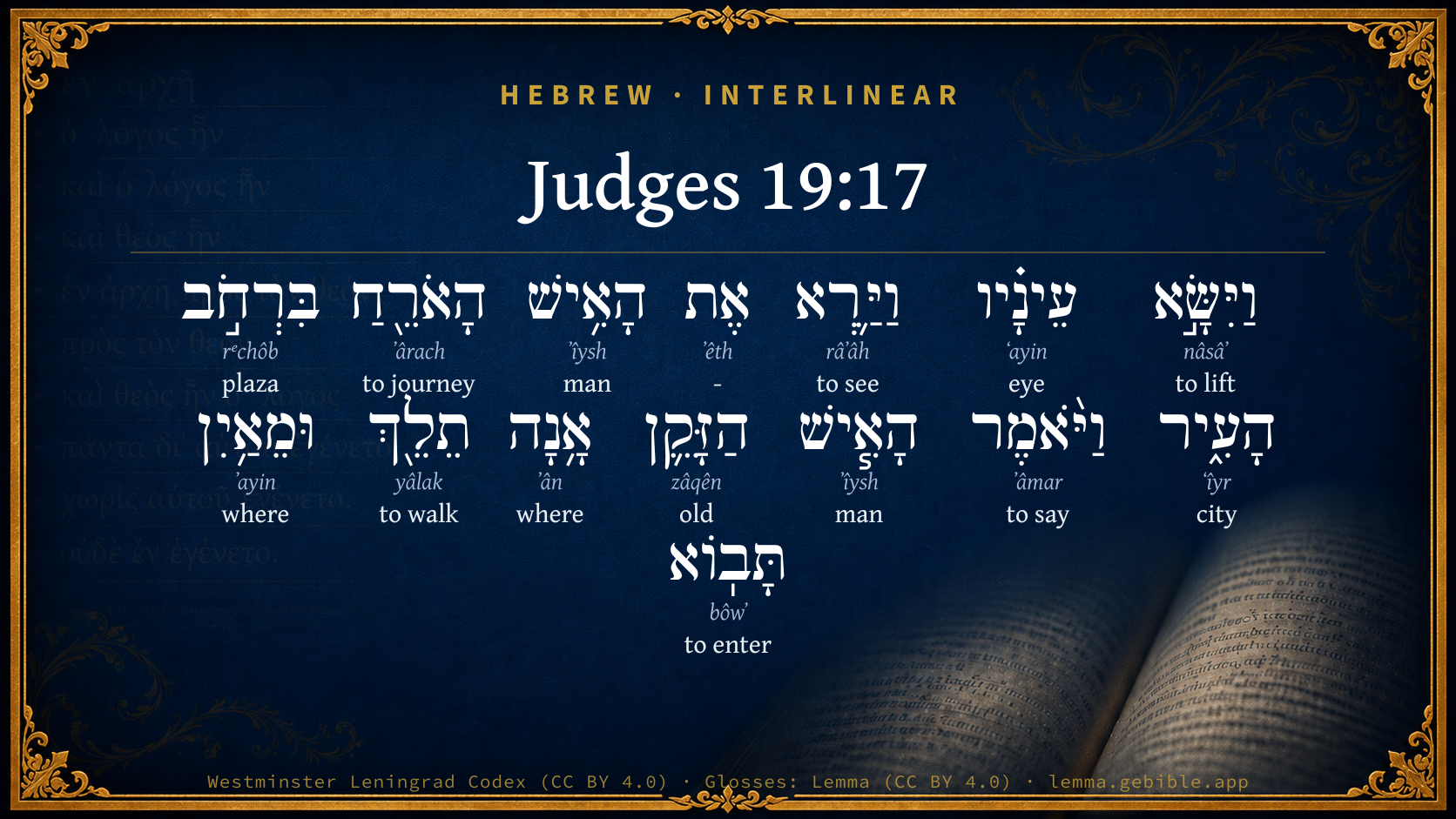
Hebrew (Westminster Leningrad Codex) Judges 19:17 appears in the Hebrew Old Testament. The text above is from the Westminster Leningrad Codex. Each word links to its Strong’s number, a concise gloss, and parsing drawn from the Open Scriptures Hebrew Bible morphology. Click any word for its full Brown-Driver-Briggs (BDB) entry.
Download image
Cite this verse

Judges 19:17 (World English Bible). Public Domain. Lemma interlinear Bible study tool, https://lemma.gebible.app/v/judges/19/17.

Show BibTeX & RIS
BibTeX
RIS
English Translation
He lifted up his eyes, and saw the wayfaring man in the street of the city; and the old man said, Where go you? and whence come you?
World English Bible · Public Domain
Highlights
  • 1 first appearance in the Hebrew Bible
Full analysis ↓
Download a study sheet

One document with this verse’s original text, its word-by-word gloss line, the meaning frame, cross-references with their text, attributed commentary, and full source and license credits — printable, and it pastes into notes with its structure intact.

This verse Autodidact and up

Study sheet (.html) Plain text (.txt)

A passage Seminary Student

Up to 50 verses in one chapter. A passage sheet keeps up to 6 commentary sources and 12 cross-references per verse, in the order this page ranks them, and says so on the sheet whenever that leaves anything out. Ask for a single verse and you get the Autodidact verse sheet above.

Everything on this page stays free to read, with no account — the sheet is a download of what is already on screen, not access to it.

Want to remove ads? Support Godless Engineer
Compare translations 3

The same verse in 3 English versions, stacked beneath the original-language interlinear above. Click any original word for its lexicon entry.

Each is an independent rendering of the whole verse — the interlinear is not word-aligned to these translations.

Highlighted words mark where these versions differ — a whole-verse word diff, not a word-by-word alignment.

  • World English Bible Public Domain
    He lifted up his eyes, and saw the wayfaring man in the street of the city; and the old man said, Where go you? and whence come you?
  • King James Version Public Domain
    And when he had lifted up his eyes, he saw a wayfaring man in the street of the city: and the old man said, Whither goest thou? and whence comest thou?
  • unfoldingWord Literal Text CC BY-SA 4.0
    And he lifted his eyes, and he saw the traveling man in the open area of the city. And the old man said, “Where are you going and from where are you coming?”

unfoldingWord Literal Text — © unfoldingWord, licensed CC BY-SA 4.0. Word-aligned USFM3 via Door43 (git.door43.org/unfoldingWord/en_ult).

Versions to compare (up to 4)

3 of 4 selected

Show all 18 translations

Every available English version of this verse, each an independent rendering of the whole verse.

  • World English Bible Public Domain
    He lifted up his eyes, and saw the wayfaring man in the street of the city; and the old man said, Where go you? and whence come you?
  • Berean Standard Bible Public Domain
    When he looked up and saw the traveler in the city square, the old man asked, “Where are you going, and where have you come from?”
  • Majority Standard Bible Public Domain
    When he looked up and saw the traveler in the city square, the old man asked, “Where are you going, and where have you come from?”
  • King James Version Public Domain
    And when he had lifted up his eyes, he saw a wayfaring man in the street of the city: and the old man said, Whither goest thou? and whence comest thou?
  • American Standard Version (1901) Public Domain
    And he lifted up his eyes, and saw the wayfaring man in the street of the city; and the old man said, Whither goest thou? and whence comest thou?
  • Revised Version (1885) Public Domain
    And he lifted up his eyes, and saw the wayfaring man in the street of the city; and the old man said, Whither goest thou? and whence comest thou?
  • Geneva Bible (1599) Public Domain
    And when he had lift vp his eyes, he sawe a wayfairing man in the streetes of the citie: then this olde man sayde, Whither goest thou, and whence camest thou?
  • Douay-Rheims (1899) Public Domain
    And the old man lifting up his eyes, saw the man sitting with his bundles in the street of the city, and said to him: Whence comest thou? and whither goest thou?
  • Young's Literal Translation Public Domain
    And he lifteth up his eyes, and seeth the man, the traveller, in a broad place of the city, and the aged man saith, `Whither goest thou? and whence comest thou?'
  • Literal Standard Version CC BY-SA 4.0
    And he lifts up his eyes, and sees the man, the traveler, in a broad place of the city, and the old man says, “To where do you go? And where do you come from?”
  • Unlocked Literal Bible CC BY-SA 4.0
    He raised his eyes and saw the traveler in the city square. The old man said, “Where are you going? Where are you coming from?”
  • unfoldingWord Literal Text CC BY-SA 4.0
    And he lifted his eyes, and he saw the traveling man in the open area of the city. And the old man said, “Where are you going and from where are you coming?”
  • Darby Bible Public Domain
    And he lifted up his eyes, and saw the wayfarer in the open square of the city; and the old man said, "Where are you going? and whence do you come?"
  • World Messianic Bible Public Domain
    He lifted up his eyes, and saw the wayfaring man in the street of the city; and the old man said, “Where are you going? Where did you come from?”
  • Webster's Bible Public Domain
    And when he had lifted up his eyes, he saw a way-faring man in the street of the city: and the old man said, Whither goest thou? and whence comest thou?
  • Free Bible Version CC BY-SA 4.0
    He looked over and noticed the traveler in the square and asked, “Where are you going and where have you come from?”
  • Bible in Basic English Public Domain
    And when he saw the traveller in the street of the town, the old man said, Where are you going? and where do you come from?
  • JPS Tanakh (1917) Public Domain
    And he lifted up his eyes, and saw the wayfaring man in the broad place of the city; and the old man said: 'Whither goest thou? and whence comest thou?'

Literal Standard Version (2020), Covenant Press — licensed CC BY-SA 4.0. Text via the HelloAO Bible API (eBible.org). Unlocked Literal Bible (unfoldingWord) — licensed CC BY-SA 4.0. Text via the HelloAO Bible API (eBible.org). unfoldingWord Literal Text — © unfoldingWord, licensed CC BY-SA 4.0. Word-aligned USFM3 via Door43 (git.door43.org/unfoldingWord/en_ult). Free Bible Version, Dr. Jonathan Gallagher — licensed CC BY-SA 4.0. Text via the HelloAO Bible API (eBible.org).

Word by word

More ways to search: Search by grammar → Find every occurrence → Compare this word →

Practice this passage: Drill this verse → Learn its vocabulary →

הָאֹרֵ֖חַ
ʼârach
H732
“the · journeying”
Particle, Definite Article + Verb, Qal, Participle Active, Masculine, Singular, Absolute
Part of Speech
Particle + Verb
Stem
Qal
Form
Participle Active
Gender
Masculine
Number
Singular
State
Absolute
Full BDB Definition

Origin: a primitive root

TWOT: 161

to wander, journey, go, keep company with - (Qal) - to journey, go - (participle) - wandering, wayfarer, journeying - (substantive) - wanderer, wayfarer, traveller
  1. וַיִּשָּׂ֣א nâsâʼ H5375 “and · to lift” Conjunction + Verb, Qal, Sequential Imperfect, 3rd Person, Masculine, Singular
  2. עֵינָ֗יו ʻayin H5869 “eyes · his” Noun, Common, Both, Dual, Construct + Suffix, Personal, 3rd Person, Masculine, Singular
  3. וַיַּ֛רְא râʼâh H7200 “and · to see” Conjunction + Verb, Qal, Sequential Imperfect, 3rd Person, Masculine, Singular
  4. אֶת ʼêth H853 “-” Particle, Direct Object
  5. הָאִ֥ישׁ ʼîysh H376 “the · man” Particle, Definite Article + Noun, Common, Masculine, Singular, Absolute
  6. בִּרְחֹ֣ב rᵉchôb H7339 “in/at · plaza of” Preposition + Noun, Common, Feminine, Singular, Construct
  7. הָעִ֑יר ʻîyr H5892 “the · city” Particle, Definite Article + Noun, Common, Feminine, Singular, Absolute
  8. וַיֹּ֨אמֶר ʼâmar H559 “and · to say” Conjunction + Verb, Qal, Sequential Imperfect, 3rd Person, Masculine, Singular
  9. הָאִ֧ישׁ ʼîysh H376 “the · man” Particle, Definite Article + Noun, Common, Masculine, Singular, Absolute
  10. הַזָּקֵ֛ן zâqên H2205 “the · old” Particle, Definite Article + Adjective, Adjective, Masculine, Singular, Absolute
  11. אָ֥נָה ʼân H575 “where” Adverb
  12. תֵלֵ֖ךְ yâlak H3212 “to walk” Verb, Qal, Imperfect, 2nd Person, Masculine, Singular
  13. וּמֵאַ֥יִן ʼayin H370 “and · from · where” Conjunction + Preposition + Particle, Interrogative
  14. תָּבֽוֹא bôwʼ H935 “to enter” Verb, Qal, Imperfect, 2nd Person, Masculine, Singular

About this verse

These counts appear in no published source. They are computed here, from the morphology-tagged text and Lemma’s own curated glosses. What Lemma adds →

15
words
14
distinct lemmas
Historical
section

Notable vocabulary

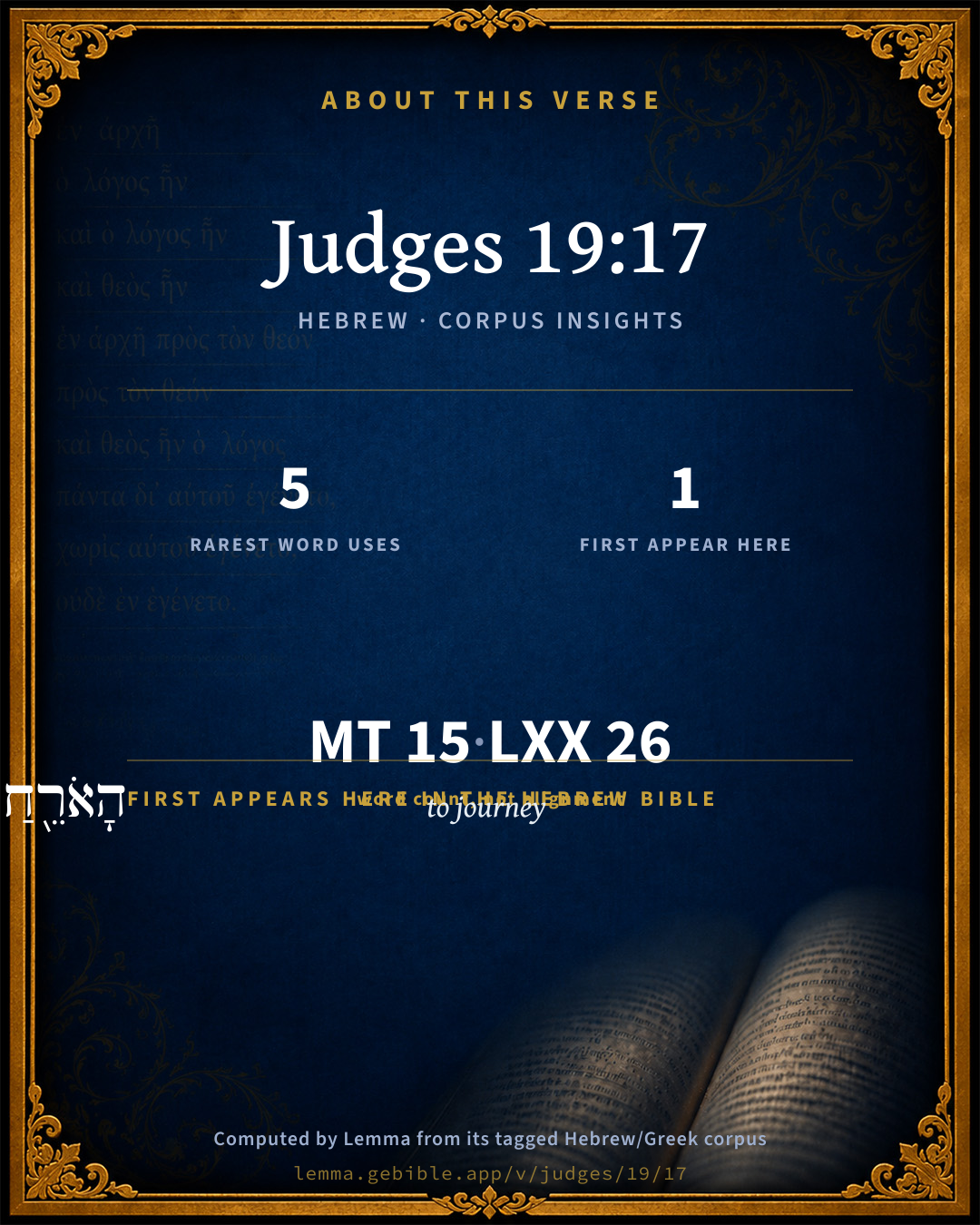
The rarest word here is הָאֹרֵ֖חַ to journey H732 — appearing just 5 times in the whole Hebrew Bible.

First appearance in Scripture

This word makes its first canonical appearance in the Hebrew Bible here:

  • הָאֹרֵ֖חַ to journey H732

Shared distinctive vocabulary

הָאֹרֵ֖חַ to journey H732 occurs in 5 verses of the Hebrew Bible. Also found in:

Grammatical profile

  • 6 verbs
  • 5 nouns
  • 1 adjective
  • 1 adverb
  • 2 particles

Verb forms

  • וַיִּשָּׂ֣א Qal · Sequential Imperfect
  • וַיַּ֛רְא Qal · Sequential Imperfect
  • הָאֹרֵ֖חַ Qal · Participle Active
  • וַיֹּ֨אמֶר Qal · Sequential Imperfect
  • תֵלֵ֖ךְ Qal · Imperfect
  • תָּבֽוֹא Qal · Imperfect

Repetition

A word recurs within this verse — often emphatic in Hebrew:

  • הָאִ֥ישׁ man H376 ×2

Hebrew & Septuagint length

In English translation the verse runs 28 words from the Hebrew and 30 from the Septuagint (LXX English) — closely comparable.

A rough comparison of the two English renderings, which tokenize alike — not a word-level alignment.

Word counts can differ between the Hebrew and the Greek without any difference in meaning — e.g. the Hebrew direct-object marker אֵת has no separate Greek word, and Greek often adds the article ὁ.

In the original languages it is 15 Hebrew tokens and 26 Greek tokens — but the two are counted differently (Hebrew bundles its prefixes and suffixes into one token; the Greek is in lemma form), so that isn’t a like-for-like length.

Cross-references

2

Topical passages linked to Judges 19:17 in the Treasury of Scripture Knowledge — connected by theme and wording, ordered by reader-vote popularity; previews shown in the World English Bible.

  • Genesis 16:8 He said, "Hagar, Sarai's handmaid, where did you come from? Where are you going?" She said, "I am fleeing from the face of my mistress Sarai."
  • Genesis 32:17 He commanded the foremost, saying, "When Esau, my brother, meets you, and asks you, saying, 'Whose are you? Where are you going? Whose are these before you?'

Cross-references courtesy of OpenBible.info (CC BY 4.0).

Hebrew and Greek witnesses Masoretic Hebrew ↔ Greek Septuagint

The same verse in the two great witnesses to the Old Testament, shown verse-for-verse.

These are two independent witnesses, not word-aligned to each other, and the Septuagint is shown in lemma (dictionary) form.

Hebrew Judges 19:17 Masoretic · Westminster Leningrad Codex

וַיִּשָּׂ֣א עֵינָ֗יו וַיַּ֛רְא אֶת הָאִ֥ישׁ הָאֹרֵ֖חַ בִּרְחֹ֣ב הָעִ֑יר וַיֹּ֨אמֶר הָאִ֧ישׁ הַזָּקֵ֛ן אָ֥נָה תֵלֵ֖ךְ וּמֵאַ֥יִן תָּבֽוֹא

He lifted up his eyes, and saw the wayfaring man in the street of the city; and the old man said, Where go you? and whence come you?

World English Bible · Public Domain

Greek LXX Judges 19:17 Septuagint · lemma form

καί αἴρω ὁ ὀφθαλμός αὐτός καί ὁράω ὁ ὁδοιπόρος ἀνήρ ἐν ὁ πλατύς ὁ πόλις καί εἶπον ὁ ἀνήρ ὁ πρεσβύτης ποῦ πορεύομαι καί πόθεν ἔρχομαι

And he lifted up his eyes, and saw a traveller in the street of the city; and the old man said to him, Whither go you, and whence come you?

LXX2012 (modern English Septuagint) · Public Domain

Hebrew: Westminster Leningrad Codex (CC BY 4.0). Greek: Septuagint (public domain); English from LXX2012 (modern English Septuagint) (Public Domain). How the Septuagint differs from the Hebrew →

Targum (Aramaic paraphrase)

1

The Targum is the ancient Jewish Aramaic paraphrase of the Hebrew Scriptures — an interpretive translation, not the Hebrew text itself. Onkelos (literal) and Pseudo-Jonathan (expansive) render the Torah, and Jonathan the Prophets. Coverage is partial: where no permissively-licensed English translation exists for a verse, only the Aramaic is shown. This is verse-level text, not a word-by-word alignment to the Hebrew.

  1. Targum Jonathan Prophets (Joshua–Malachi)
    וּזְקֵיף עֵינוֹהִי וַחֲזָא יַת גַבְרָא דַאֲרַח בִּרְחוֹב קַרְתָּא וַאֲמַר גַבְרָא סָבָא לְאָן אַתְּ אָזִיל וּמְנָן אַתְּ אָתֵי:

    (no public-domain English translation for this verse)

    Targum Jonathan — Aramaic: “Mikraot Gedolot” (public domain). English: “Sefaria Community Translation” (CC0 1.0 (public-domain dedication)); “London "Chaldee Paraphrase," 1871” (public domain). Text via Sefaria.

Commentary

Notes on Judges 19:17 from classic Christian and Jewish commentators (each source and its license shown beneath its notes). The classic Christian expositions comment on the surrounding passage and are grouped to its opening verse, so a note may address several verses; the Jewish commentaries on the Tanakh (Rashi and others) are per-verse, so they appear only where the commentator wrote on this verse.

Lemma curates 59 commentaries, every one of them public domain or Creative Commons licensed, each selected and text-cleaned for this edition rather than reprinted as found. About our sources →

Trapp's Complete Commentary

John Trapp

Jdg 19:17 And when he had lifted up his eyes, he saw a wayfaring man in the street of the city: and the old man said, Whither goest thou? and whence comest thou?

Ver. 17. Whither goest thou? and whence comest thou?] Necessary questions to be asked of such as shall be entertained by us, lest we take a snake into our bosoms. Abundans cautela non nocet. It is good to be hospitable, but with it to be cautious.

John Trapp, A Commentary or Exposition upon All the Books of the Old and New Testament (1647–1656) — public domain. Text from a community e-Sword module.

Geneva Bible (1599)

Geneva Bible translators

Or, a man walking.

Geneva Bible (1599) marginal notes — public domain. Text via Bolls.life.

John Gill's Exposition

And when he had lifted up his eyes,.... For it may be, as he came out of the field, he was musing and meditating with his eyes downwards directed, but coming into the city looked up:

he saw a wayfaring man in the street of the city; whom he supposed to be a traveller and a stranger by his dress, and other circumstances, having never seen him before, and knowing pretty well the inhabitants of the place:

and the old man said, whither goest thou? and whence comest thou? the meaning of the questions is, what place he was travelling to, and from whence he came last.

John Gill's Exposition of the Whole Bible (1746–1763) — public domain (CC PDM 1.0). Text via the HelloAO Bible API.

Haydock's Catholic Bible Commentary

Bundles. Hebrew, "saw a traveller in," &c.

George Leo Haydock (1774–1849), Haydock's Catholic Family Bible and Commentary, 1859 edition — public domain. Excludes Psalms (Douay-Rheims chapter numbering differs from Protestant) and Deuterocanonical books (Catholic canon only).

Lesson kit

Teaching starters — assembled from the data on this page, not authored interpretation. Every prompt links to the verse data it draws on. Edit before teaching.

Judges, in the Historical, opens this verse with 15 words (14 distinct Hebrew lemmas). Its most distinctive word is ʼârach (“to journey”). A historical commentator’s framing appears above. Read the whole chapter for the surrounding context.

Discussion questions

  1. The word ʼârach carries the sense “to journey.” How does it shape the verse?
  2. The word “to journey” first appears here in Scripture. What is being introduced at this debut?
  3. 2 Samuel 12:4 shares the word «to journey» with this verse. How do the two illuminate each other?
  4. “man” occurs 2× in this one verse. What is the effect of the repetition?
  5. The translations on this page render this verse differently — a whole-verse word diff, not a word-by-word alignment. What might account for the different wordings?
  6. The verb «וַיִּשָּׂ֣א» is Qal Sequential Imperfect. How does its form color the action?
  7. Reading how Trapp's Complete Commentary and Geneva Bible (1599) read this verse, where do the two commentators agree and where do they part?

Things to notice

Reading settings

Reading text

Shown beneath each verse's original-language words.

Old Testament
Old Testament edition

Read the OT as the Masoretic Hebrew (MT) or the Greek Septuagint (LXX).

English shown for the Greek Septuagint (in the Hebrew ↔ Greek comparison).

Comparing translations? Open the Compare panel on any verse page to stack up to four side by side.