
Psalms 119:100

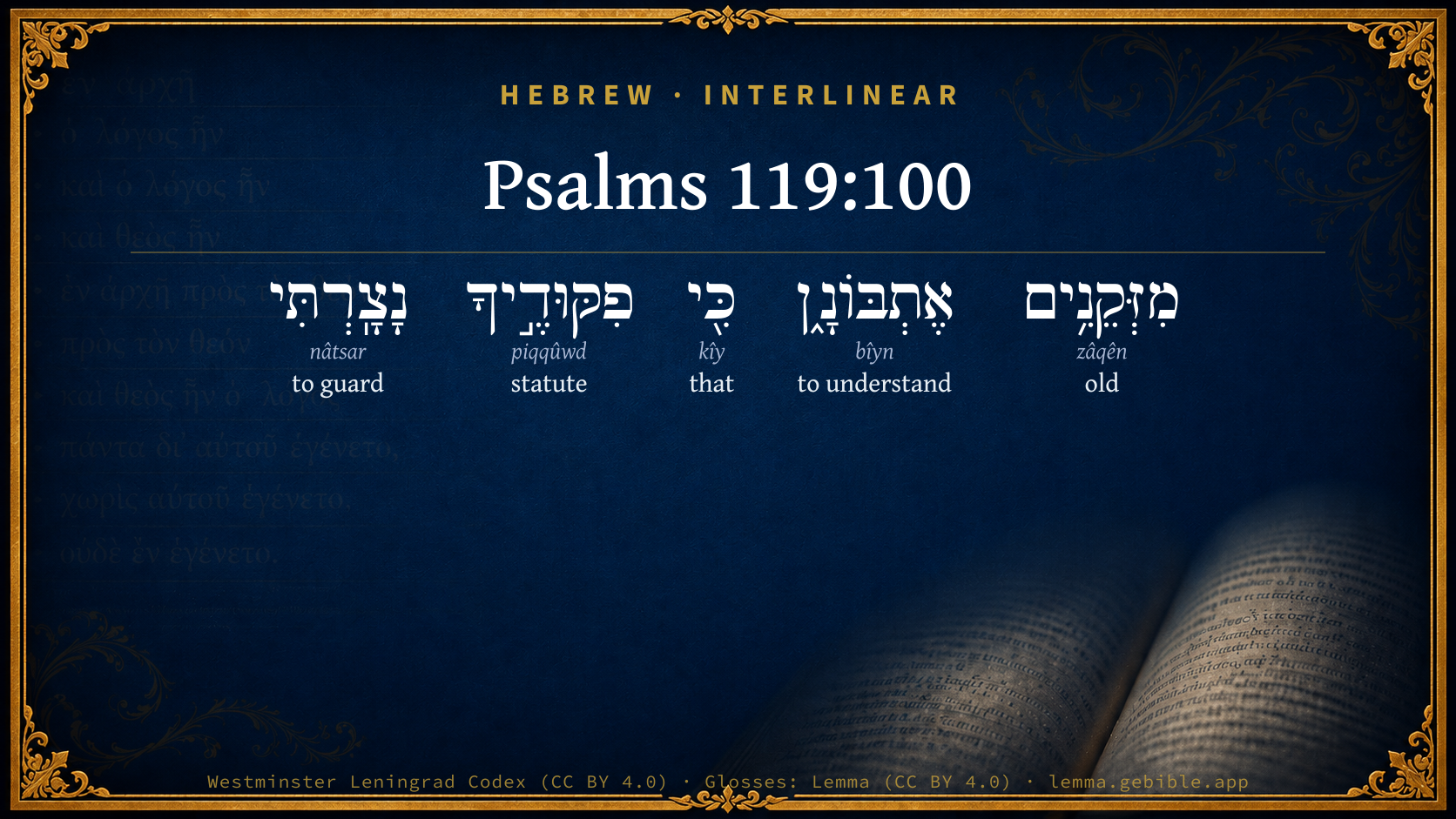
Hebrew (Westminster Leningrad Codex) Psalms 119:100 appears in the Hebrew Old Testament. The text above is from the Westminster Leningrad Codex. Each word links to its Strong’s number, a concise gloss, and parsing drawn from the Open Scriptures Hebrew Bible morphology. Click any word for its full Brown-Driver-Briggs (BDB) entry.
Download image
Cite this verse

Psalms 119:100 (World English Bible). Public Domain. Lemma interlinear Bible study tool, https://lemma.gebible.app/v/psalms/119/100.

Show BibTeX & RIS
BibTeX
RIS
English Translation
I understand more than the aged, Because I have kept your precepts.
World English Bible · Public Domain
Download a study sheet

One document with this verse’s original text, its word-by-word gloss line, the meaning frame, cross-references with their text, attributed commentary, and full source and license credits — printable, and it pastes into notes with its structure intact.

This verse Autodidact and up

Study sheet (.html) Plain text (.txt)

A passage Seminary Student

Up to 50 verses in one chapter. A passage sheet keeps up to 6 commentary sources and 12 cross-references per verse, in the order this page ranks them, and says so on the sheet whenever that leaves anything out. Ask for a single verse and you get the Autodidact verse sheet above.

Everything on this page stays free to read, with no account — the sheet is a download of what is already on screen, not access to it.

Want to remove ads? Support Godless Engineer
Compare translations 3

The same verse in 3 English versions, stacked beneath the original-language interlinear above. Click any original word for its lexicon entry.

Each is an independent rendering of the whole verse — the interlinear is not word-aligned to these translations.

Highlighted words mark where these versions differ — a whole-verse word diff, not a word-by-word alignment.

  • World English Bible Public Domain
    I understand more than the aged, Because I have kept your precepts.
  • King James Version Public Domain
    I understand more than the ancients, because I keep thy precepts.
  • unfoldingWord Literal Text CC BY-SA 4.0
    I understand more than the elders, for I have kept your precepts.

unfoldingWord Literal Text — © unfoldingWord, licensed CC BY-SA 4.0. Word-aligned USFM3 via Door43 (git.door43.org/unfoldingWord/en_ult).

Versions to compare (up to 4)

3 of 4 selected

Show all 17 translations

Every available English version of this verse, each an independent rendering of the whole verse.

  • World English Bible Public Domain
    I understand more than the aged, Because I have kept your precepts.
  • Berean Standard Bible Public Domain
    I discern more than the elders, for I obey Your precepts.
  • Majority Standard Bible Public Domain
    I discern more than the elders, for I obey Your precepts.
  • King James Version Public Domain
    I understand more than the ancients, because I keep thy precepts.
  • American Standard Version (1901) Public Domain
    I understand more than the aged, Because I have kept thy precepts.
  • Revised Version (1885) Public Domain
    I understand more than the aged, because I have kept thy precepts.
  • Geneva Bible (1599) Public Domain
    I vnderstoode more then the ancient, because I kept thy precepts.
  • Young's Literal Translation Public Domain
    Above elders I understand more, For Thy precepts I have kept.
  • Literal Standard Version CC BY-SA 4.0
    Above elderly—I understand more, || For I have kept Your precepts.
  • Unlocked Literal Bible CC BY-SA 4.0
    I understand more than those older than I am; this is because I have kept your instructions.
  • unfoldingWord Literal Text CC BY-SA 4.0
    I understand more than the elders, for I have kept your precepts.
  • Darby Bible Public Domain
    I understand more than the aged, because I have observed thy precepts.
  • World Messianic Bible Public Domain
    I understand more than the aged, because I have kept your precepts.
  • Webster's Bible Public Domain
    I understand more than the ancients, because I keep thy precepts.
  • Free Bible Version CC BY-SA 4.0
    I even understand more than the elders because I follow your directions.
  • Bible in Basic English Public Domain
    I have more wisdom than the old, because I have kept your orders.
  • JPS Tanakh (1917) Public Domain
    I understand more than mine elders, because I have keep Thy precepts.

Literal Standard Version (2020), Covenant Press — licensed CC BY-SA 4.0. Text via the HelloAO Bible API (eBible.org). Unlocked Literal Bible (unfoldingWord) — licensed CC BY-SA 4.0. Text via the HelloAO Bible API (eBible.org). unfoldingWord Literal Text — © unfoldingWord, licensed CC BY-SA 4.0. Word-aligned USFM3 via Door43 (git.door43.org/unfoldingWord/en_ult). Free Bible Version, Dr. Jonathan Gallagher — licensed CC BY-SA 4.0. Text via the HelloAO Bible API (eBible.org).

Word by word

More ways to search: Search by grammar → Find every occurrence → Compare this word →

Practice this passage: Drill this verse → Learn its vocabulary →

About this verse

These counts appear in no published source. They are computed here, from the morphology-tagged text and Lemma’s own curated glosses. What Lemma adds →

5
words
5
distinct lemmas
Wisdom
section

Notable vocabulary

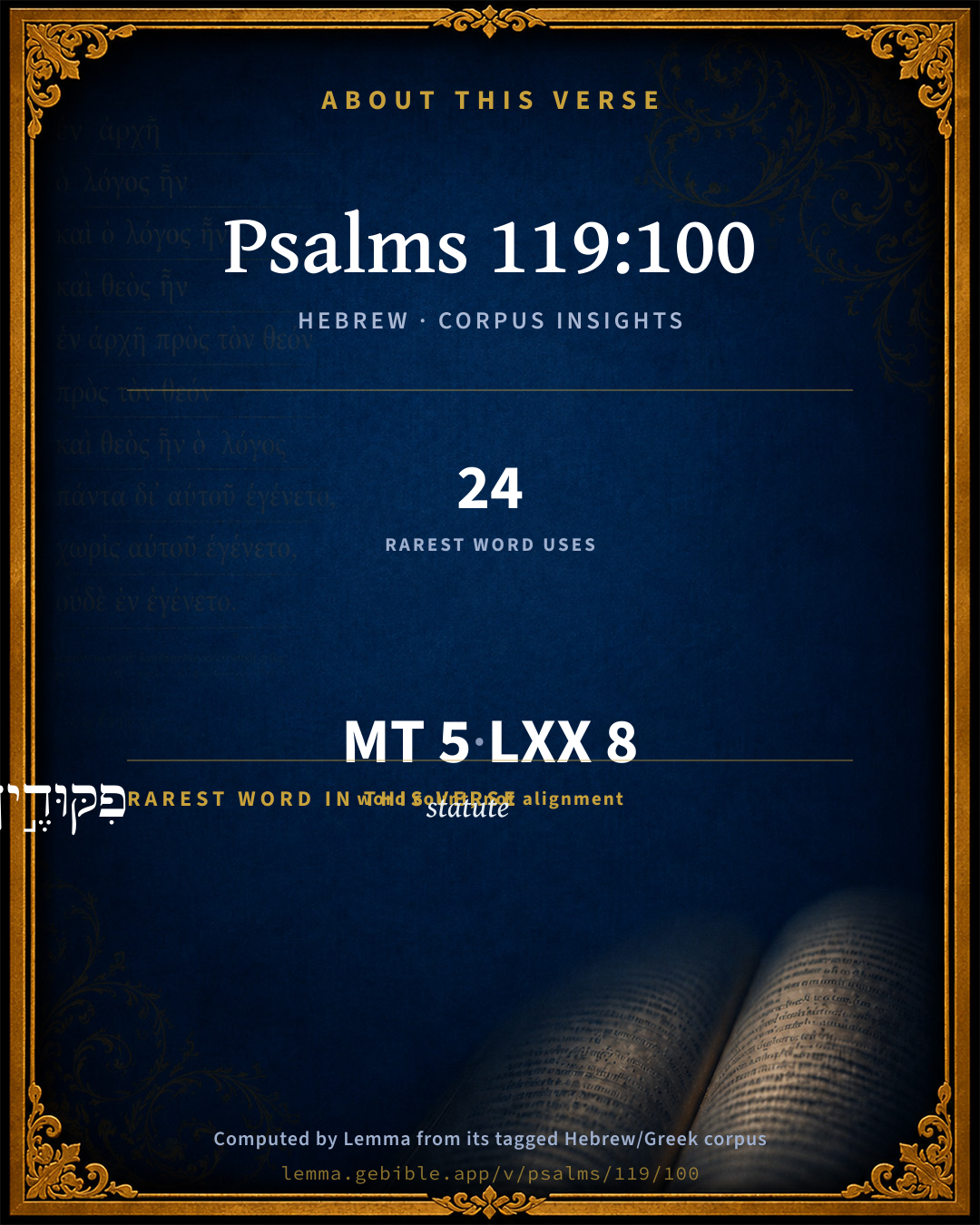
The rarest word here is פִקּוּדֶ֣יךָ statute H6490 — appearing just 24 times in the whole Hebrew Bible.

Shared distinctive vocabulary

פִקּוּדֶ֣יךָ statute H6490 occurs in 24 verses of the Hebrew Bible. Also found in:

Grammatical profile

  • 2 verbs
  • 1 noun
  • 1 adjective
  • 1 conjunction

Verb forms

  • אֶתְבּוֹנָ֑ן Hithpolel · Imperfect
  • נָצָֽרְתִּי Qal · Perfect

Hebrew & Septuagint length

In English translation the verse runs 12 words from the Hebrew and 13 from the Septuagint (LXX English) — closely comparable.

A rough comparison of the two English renderings, which tokenize alike — not a word-level alignment.

Word counts can differ between the Hebrew and the Greek without any difference in meaning — e.g. the Hebrew direct-object marker אֵת has no separate Greek word, and Greek often adds the article ὁ.

In the original languages it is 5 Hebrew tokens and 8 Greek tokens — but the two are counted differently (Hebrew bundles its prefixes and suffixes into one token; the Greek is in lemma form), so that isn’t a like-for-like length.

Cross-references

10

Topical passages linked to Psalms 119:100 in the Treasury of Scripture Knowledge — connected by theme and wording, ordered by reader-vote popularity; previews shown in the World English Bible.

  • Psalms 111:10 The fear of Yahweh is the beginning of wisdom. All those who do his work have a good understanding. His praise endures forever!
  • James 3:13 Who is wise and understanding among you? Let him show by his good conduct that his deeds are done in gentleness of wisdom.
  • Job 12:12 With aged men is wisdom, In length of days understanding.
  • Job 15:9–10 What do you know, that we don't know? What do you understand, which is not in us?
  • Job 28:28 To man he said, 'Behold, the fear of the Lord, that is wisdom. To depart from evil is understanding.'"
  • Jeremiah 8:8–9 How do you say, We are wise, and the law of Yahweh is with us? But, behold, the false pen of the scribes has worked falsely.
  • 1 Kings 12:6–15 King Rehoboam took counsel with the old men, who had stood before Solomon his father while he yet lived, saying, What counsel give you me to return answer to this people?
  • Job 32:4 Now Elihu had waited to speak to Job, because they were elder than he.
  • Matthew 7:24 "Everyone therefore who hears these words of mine, and does them, I will liken him to a wise man, who built his house on a rock.
  • Job 32:7–10 I said, 'Days should speak, And multitude of years should teach wisdom.'

Cross-references courtesy of OpenBible.info (CC BY 4.0).

Hebrew and Greek witnesses Masoretic Hebrew ↔ Greek Septuagint

The same verse in the two great witnesses to the Old Testament, shown verse-for-verse.

You’re reading Greek Psalm 118 (Hebrew Psalm 119). The Septuagint counts the superscription, so verse numbers can differ from the Hebrew — chapter-level alignment, not verse-by-verse. Numbering follows Rahlfs.

These are two independent witnesses, not word-aligned to each other, and the Septuagint is shown in lemma (dictionary) form.

Hebrew Psalms 119:100 Masoretic · Westminster Leningrad Codex

מִזְּקֵנִ֥ים אֶתְבּוֹנָ֑ן כִּ֖י פִקּוּדֶ֣יךָ נָצָֽרְתִּי

I understand more than the aged, Because I have kept your precepts.

World English Bible · Public Domain

Greek LXX Greek Psalm 118:100 Septuagint · lemma form

ὑπέρ πρεσβύτερος συνἵημι ὅτι ὁ ἐντολή σύ ἐκζητέω

I understand more that the aged; because I have sought out your commandments.

LXX2012 (modern English Septuagint) · Public Domain

On this verse, Ellicott's Commentary for English Readers discusses the Septuagint’s reading. Read the note in Commentary ↓

Hebrew: Westminster Leningrad Codex (CC BY 4.0). Greek: Septuagint (public domain); English from LXX2012 (modern English Septuagint) (Public Domain). How the Septuagint differs from the Hebrew →

Commentary

Notes on Psalms 119:100 from classic Christian and Jewish commentators (each source and its license shown beneath its notes). The classic Christian expositions comment on the surrounding passage and are grouped to its opening verse, so a note may address several verses; the Jewish commentaries on the Tanakh (Rashi and others) are per-verse, so they appear only where the commentator wrote on this verse.

Lemma curates 59 commentaries, every one of them public domain or Creative Commons licensed, each selected and text-cleaned for this edition rather than reprinted as found. About our sources →

Trapp's Complete Commentary

John Trapp

Psa 119:100 I understand more than the ancients, because I keep thy precepts.

Ver. 100. I understand more than the ancients] Whom yet age, use, and experience have taught much; but by the practical study of the word I outgo them all; with reference to those hoary heads, the seniors of the Synedrion, be it spoken, Non prolixa facit sapientem barba.

John Trapp, A Commentary or Exposition upon All the Books of the Old and New Testament (1647–1656) — public domain. Text from a community e-Sword module.

J. A. Alexander on Psalms

Joseph Addison Alexander

100. (Psa 119:100) (More) than old men I understand, because thy precepts I have kept. The first verb is the same, and has the same sense as in Psa 119:95. The ambiguous Hebrew words here cannot be expressed by any one in modern English, as it may mean either old men in the proper sense, whose greater experience entitled them to be considered wiser than their juniors; or the ancients, those of former generations, who are popularly looked upon as wiser than their children and successors. One of these senses suits the personal, the other the national design and application of the psalm. In either case, there is really no boast of superior intelligence, as a distinguishing endowment, but merely an assertion, in a striking form, that the highest wisdom is to do the will of God. See above, on Psa 111:10.

Joseph Addison Alexander, The Psalms Translated and Explained (1850) — public domain. Text from a community e-Sword module.

Adam Clarke's Commentary

Verse 100. I understand more than the ancients] God had revealed to him more of that hidden wisdom which was in his law than he had done to any of his predecessors. And this was most literally true of David, who spoke more fully about Christ than any who had gone before him; or, indeed, followed after him. His compositions are, I had almost said, a sublime Gospel.

Adam Clarke's Commentary on the Bible (1810–1826) — public domain. Text from a community e-Sword/MySword module.

Ellicott's Commentary for English Readers

(100) Ancients.—Or, more probably, as the LXX. and Vulg., and the old versions generally took it, old men.

A Bible Commentary for English Readers, edited by Charles John Ellicott (1878–1897) — public domain. Text from a community e-Sword module.

The Cambridge Bible for Schools and Colleges

gen. ed. J. J. S. Perowne

100. I have more discernment than the aged] It is not official ‘elders’ who are meant, but those whose long life has given them opportunity to learn by experience.

The Cambridge Bible for Schools and Colleges (gen. ed. J. J. S. Perowne; Cambridge University Press, 1878–1918) — public domain. Text from a community e-Sword module.

John Gill's Exposition

Through thy precepts I get understanding,.... Of the will of God; of his worship, the nature and manner of it; of his ordinances, their use and importance; and of his doctrines, and the excellency of them;

therefore I hate every false way; of worship; all superstition and will worship, the commandments and inventions of men, and every false doctrine; all lies in hypocrisy, for no lie is of the truth; every thing that is contrary to the word of God, and is not according to truth and godliness. The Targum is,

"I hate every lying man.''

John Gill's Exposition of the Whole Bible (1746–1763) — public domain (CC PDM 1.0). Text via the HelloAO Bible API.

Albert Barnes' Notes on the Bible

I understand more than the ancients - Hebrew, The old men. It does not refer, as the word “ancients” does with us, to the people of former times, but to aged men. They have treasured up wisdom. They have had the advantage of experience, of study, and of observation. They, therefore, like teachers, become a standard by which we measure our own attainments, as the boy hardly hopes to gain that amount of knowledge which he observes in people who are venerable in years, and who are remarkable for their acquirements. Compare Job 12:12 : “With the ancient is wisdom, and in length of days understanding.” Job 32:7 : “I said, Days should speak, and multitude of years should teach wisdom.” Compare 1Ki 4:30-31. Yet the psalmist says that he “had” reached this point, and had even gone beyond what he had once thought he could never attain.

Because I keep thy precepts - It is all the result of an honest endeavor to do right; to observe law; to keep the commands of God. Obedience to the law of God will do more than any mere human teaching to make a man truly wise.

Albert Barnes' Notes on the Bible (1834–1885) — public domain. Text from a community e-Sword/MySword module.

Matthew Poole's English Annotations

By which reason he intimates that the practice of religion is the best way to understand it, and that men’s vicious hearts and lives are the greatest hinderances of all true and solid knowledge of it.

Matthew Poole's English Annotations on the Holy Bible (1683–1685) — public domain. Text from a community e-Sword/MySword module.

The Treasury of David

Charles H. Spurgeon

Ver. 100. I understand more than the ancients, because I keep thy precepts. The men of old age, and the men of old time, were outdone by the holier and more youthful learner. He had been taught to observe in heart and life the precepts of the Lord, and this was more than the most venerable sinner had ever learned, more than the philosopher of antiquity had so much as aspired to know. He had the word with him, and so outstripped his foes; lie meditated on it, and so outran his friends; he practised it, and so outshone his elders. The instruction derived from Holy Scripture is useful in many directions, superior from many points of view, unrivalled everywhere and in every way. As our soul may make her boast in the Lord, so may we boast in his word. "There is none like it: give it me, "said David as to Goliath's sword, and we may say the same as to the word of the Lord. If men prize antiquity they have it here. The ancients are had in high repute, but what did they all know compared with that which we perceive in the divine precepts? "The old is better" says one: but the oldest of all is the best of all, and what is that but the word of the Ancient of days

Ver. 100. I understand...because l keep. Would we know the Lord? Let us keep his commandments. "By thy precepts, "saith David, that is, by the observance of thy precepts, "I get understanding." "If any man do my will" (saith our blessed Saviour, Joh 7:17), "he shall know my doctrine." boulei yeololov lenesyai? tav entolav fulasse, saith Nazienzen: Wouldst thou be a divine? do the commandments; for action is (as it were) the basis of contemplation. It is St. Gregory's observation concerning the two disciples who, whilst Christ talked with them, knew him not; but in performing an act of hospitality towards him, to wit, breaking bread with him, they knew him, that they were enlightened, not by hearing him, but by doing divine precepts, Quisquis ergo vult audita intelligere; festinet ea quae jam audire potuit, opere implere, Whosoever therefore will understand, let him first make haste to do what he heareth. Nathanael Hardy, 1618-1670.

Ver. 100. I understand more than the ancients. The ordinary answer of ignorant people is, "What! must we be wiser than our forefathers?" And yet those same people would be richer than their forefathers were. The maximum quod sic of a Christian is this, he must grow in grace, till his head reach up to heaven, till grace is perfected in glory. Christopher Love, 1618-1651.

Ver. 100. More than the ancients. Understanding gotten by the precepts of the word is better than understanding gotten by long experience. It is better in four regards. First, It is more exact. Our experience reacheth but to a few things; but the word of God reacheth to all cases that concern true happiness. The word is the result of God's wisdom, who is the Ancient of days; therefore exceeds the wisdom of the ancients, or experience of any men, or all men. Secondly, as it is more exact, so a more sure way of learning wisdom, whereas experience is more uncertain. Many have much experience, yet have not a heart to see and to gather wisdom from what they feel: De 29:2-4. Thirdly, it is a safer and cheaper way of learning, to learn by rule, than to come home by weeping cross, and to learn wisdom by our own smart. Experience is too expensive a way; and, if we had nothing else to guide us, into how many thousand miseries should we run! Fourthly, it is shorter. The way by age and experience is a long way; and so, for a long time, all a man's younger age must needs be miserable and foolish. Now, here you may come betimes to be wise by studying the word of God. It concerns a man, not only to be wise at length, but to be wise betimes. The foolish virgins were wise too late: but never were any wise too soon. Condensed from Thomas Manton.

Ver. 100. If this way the Word of God were thus perfect in David's time, what is it by the addition of so many parcels of Scripture since? If it then gave wisdom to the simple (Ps 14:7); if it made David, being brought up but as a shepherd, wiser than his enemies, than his ancients, than his teachers; as an angel of God in discerning right from wrong (1Sa 14:17); able to guide the people by the skilfulness of his hands (Ps 78:72); what kind of wisdom is there, which we may not now gather from thence? What depth of natural philosophy have we in Genesis and Job! What flowers of rhetoric in the prophets! What force of logic in Saint Paul's epistles! what art of poetry in the psalms! What excellent moral precepts, not only for private life, but for the regulation of families and commonwealth in the Proverbs and Ecclesiastes! To which may be added in a second rank as very useful, though apocryphal, the Book of Wisdom and Ecclesiasticus. What reasonable and just laws have we in Leviticus and Deuteronomy, which moved the great Ptolemy to hire the Septuagints to translate them into Greek: what unmatchable antiquity, variety, and wonderful events, and certainty of story, in the books of Moses, Joshua, the Judges, Samuel, the Kings, and Chronicles, together with Ruth and Esther, Ezra and Nehemiah, and, since Christ, in the sacred Gospels and Acts of the Apostles. And, lastly, what profound mysteries have we in the prophecies of Ezekiel and Daniel, and the Revelation of Saint John. But in this it infinitely exceeds the wisdom of all human writings, that it is alone "able to make a man wise unto salvation" (2Ti 3:15). Upon these considerations, Charles the Fifth of France, surnamed The Wise, not only caused the Bible to be translated into French, but was himself very studious in the Holy Scriptures. And Alphonsus, King of Arragon, is said to have read over the whole Bible fourteen several times, with Lyra's notes upon it; though he were otherwise excellently well learned, yet was the law of God his delight, "more desired of him than gold, yea, than much fine gold, sweeter also than honey and the honeycomb." George Hakewell, 1579-1649.

Ver. 100. Antiquity no security for truth as contrasted with revelation: old age no proof of wisdom as contrasted with holy living: open confession no evidence of boasting as contrasted with sullen pride.

Ver. 100. Obedience the high road to understanding. W.B.H.

Ver. 100. Obedience the key of knowledge. Joh 7:17.

Psalms 119:101*

Charles H. Spurgeon's The Treasury of David (1869–1885) — public domain. Psalms only. Text from a community e-Sword/MySword module.

The Pulpit Commentary

I understand more than the ancients; or, "the aged." Advanced age does not necessarily give wisdom. (see Job_32:7-9) "Antiquity is no help against stupidity" (Luther). Because I keep thy precepts . (comp. ver. 104 and Joh_7:17)

Human teachers and the Bible itself.

"I understand more than the aged, because I have kept thy precepts." This is no mere boasting, no invidious comparison. It is the recognition of the fact that the man who is taught of God knows what no human teacher can teach. The human teacher has a limited range; the Divine Teacher transcends it. But the Word of God, the Scriptures of the Divine revelations, are the agencies God uses for imparting the higher knowledge. It is necessary to say that what God teaches is not a mere advance on what man teaches. It is other than man teaches. Man deals with the surface of things; God deals with the inmost of things. Man keeps within the agency of limited human language; God can teach through spiritual sensibilities. It is true that he uses the written Word; but it is not true that he confines himself to the formality of the Word. He teaches through the spiritual feeling which the Word excites. There is much made of a comprehensive, all-round education, but it is not enough insisted on that this must include the Divine teaching.

I THE NECESSARY LIMITS OF HUMAN TEACHINGS.

1. They are limited by the mental capacity of those who teach and those who are taught.

2. They are limited by the imperfection of the vehicle by which human knowledge is conveyed. No human word has the same connotation for every one who uses it, and few words keep the same connotation for one man through a long life.

3. They are limited by the variableness of the material at their command. New facts are continually displacing old ones, and new theories condemning old ones. In science, a book ten years old is comparatively useless.

4. They are limited by the range over which they extend, which is compelled to keep away from all knowledge of God and the things of God. "Who by searching can find out God?" And yet it is in that higher range of knowledge alone that man"s true nature can be unfolded. The queen of sciences is theology.

II THE DIVINE TEACHINGS BEYOND THE HUMAN LIMITS. Is man only a mind? Many seem to think of him as having no more than a mental organization. A man is a spiritual being, kin to God, having for his present agency and use a body and a mind. The Divine range is the soul, which is the man himself. R.T.

The Pulpit Commentary (1880–1919), ed. H.D.M. Spence-Jones & Joseph S. Exell — public domain. Text from a community e-Sword module.

John Wesley's Explanatory Notes

Because - The practice of religion is the best way to understand it.

John Wesley, Explanatory Notes Upon the Whole Bible (1754–1765) — public domain. Text via the GEBible commentary corpus.

Lesson kit

Teaching starters — assembled from the data on this page, not authored interpretation. Every prompt links to the verse data it draws on. Edit before teaching.

Psalms, in the Wisdom, opens this verse with 5 words (5 distinct Hebrew lemmas). Its most distinctive word is piqqûwd (“statute”). A historical commentator’s framing appears above. Read the whole chapter for the surrounding context.

Discussion questions

  1. How does “statute” (piqqûwd) shape what this verse is saying?
  2. Psalms 19:8 shares the word «statute» with this verse. How do the two illuminate each other?
  3. These translations render this verse differently. What is at stake in choosing one wording over another?
  4. The verb «אֶתְבּוֹנָ֑ן» is Hithpolel Imperfect. How does its form color the action?
  5. Reading how Trapp's Complete Commentary and J. A. Alexander on Psalms read this verse, where do the two commentators agree and where do they part?

Things to notice

Reading settings

Reading text

Shown beneath each verse's original-language words.

Old Testament
Old Testament edition

Read the OT as the Masoretic Hebrew (MT) or the Greek Septuagint (LXX).

English shown for the Greek Septuagint (in the Hebrew ↔ Greek comparison).

Comparing translations? Open the Compare panel on any verse page to stack up to four side by side.