Deuteronomy 25:8

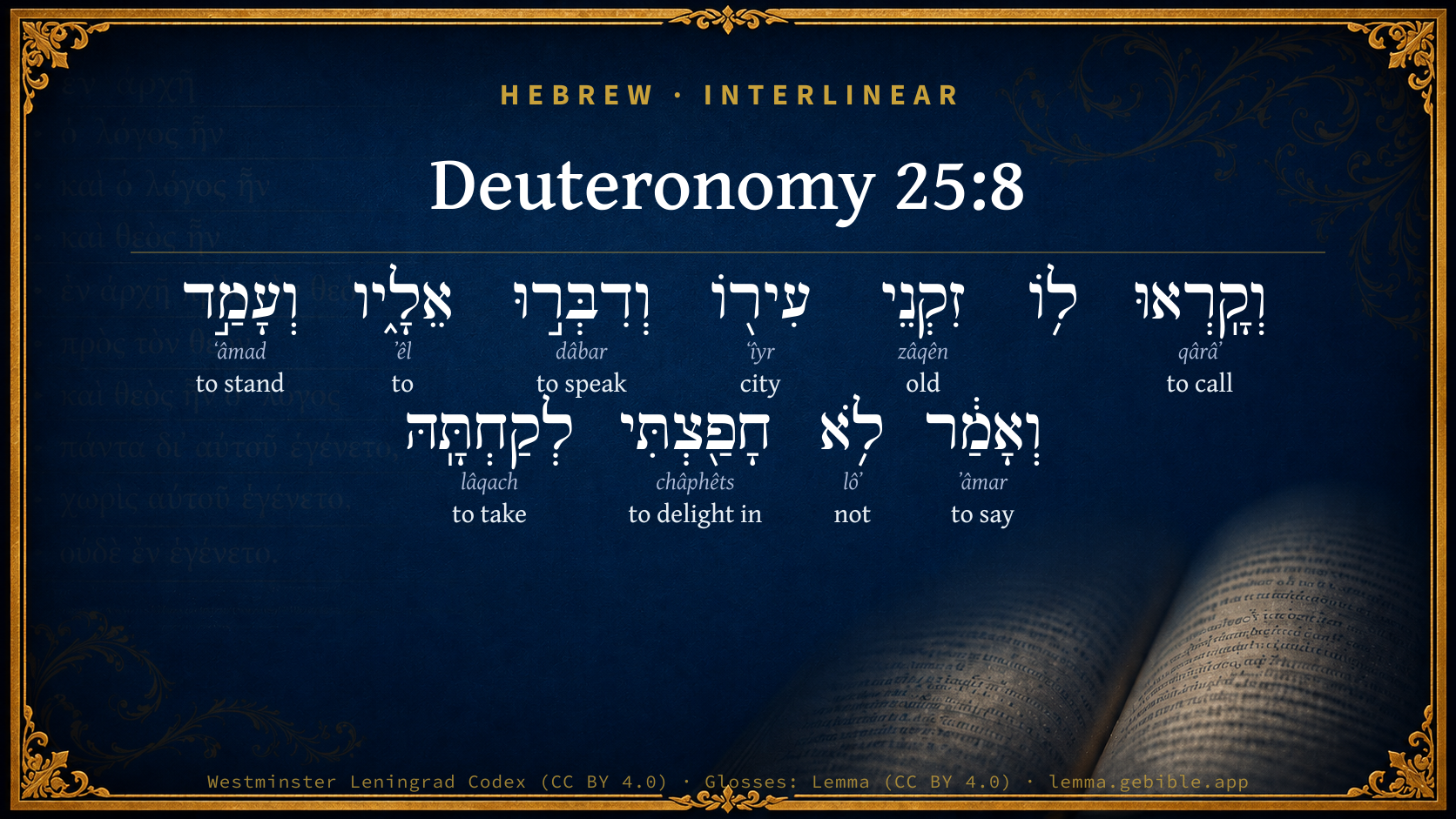
Hebrew (Westminster Leningrad Codex) Deuteronomy 25:8 appears in the Hebrew Old Testament. The text above is from the Westminster Leningrad Codex. Each word links to its Strong’s number, a concise gloss, and parsing drawn from the Open Scriptures Hebrew Bible morphology. Click any word for its full Brown-Driver-Briggs (BDB) entry.
Download image
Cite this verse

Deuteronomy 25:8 (World English Bible). Public Domain. Lemma interlinear Bible study tool, https://lemma.gebible.app/v/deuteronomy/25/8.

Show BibTeX & RIS
BibTeX
RIS
English Translation
Then the elders of his city shall call him, and speak to him: and if he stand, and say, I don't want to take her;
World English Bible · Public Domain
Download a study sheet

One document with this verse’s original text, its word-by-word gloss line, the meaning frame, cross-references with their text, attributed commentary, and full source and license credits — printable, and it pastes into notes with its structure intact.

This verse Autodidact and up

Study sheet (.html) Plain text (.txt)

A passage Seminary Student

Up to 50 verses in one chapter. A passage sheet keeps up to 6 commentary sources and 12 cross-references per verse, in the order this page ranks them, and says so on the sheet whenever that leaves anything out. Ask for a single verse and you get the Autodidact verse sheet above.

Everything on this page stays free to read, with no account — the sheet is a download of what is already on screen, not access to it.

Want to remove ads? Support Godless Engineer
Compare translations 3

The same verse in 3 English versions, stacked beneath the original-language interlinear above. Click any original word for its lexicon entry.

Each is an independent rendering of the whole verse — the interlinear is not word-aligned to these translations.

Highlighted words mark where these versions differ — a whole-verse word diff, not a word-by-word alignment.

  • World English Bible Public Domain
    Then the elders of his city shall call him, and speak to him: and if he stand, and say, I don't want to take her;
  • King James Version Public Domain
    Then the elders of his city shall call him, and speak unto him: and if he stand to it, and say, I like not to take her;
  • unfoldingWord Literal Text CC BY-SA 4.0
    And the elders of his city shall call him and speak to him. If he stands and says, ‘I do not delight in taking her.’

unfoldingWord Literal Text — © unfoldingWord, licensed CC BY-SA 4.0. Word-aligned USFM3 via Door43 (git.door43.org/unfoldingWord/en_ult).

Versions to compare (up to 4)

3 of 4 selected

Show all 18 translations

Every available English version of this verse, each an independent rendering of the whole verse.

  • World English Bible Public Domain
    Then the elders of his city shall call him, and speak to him: and if he stand, and say, I don't want to take her;
  • Berean Standard Bible Public Domain
    Then the elders of his city shall summon him and speak with him. If he persists and says, “I do not want to marry her,”
  • Majority Standard Bible Public Domain
    Then the elders of his city shall summon him and speak with him. If he persists and says, “I do not want to marry her,”
  • King James Version Public Domain
    Then the elders of his city shall call him, and speak unto him: and if he stand to it, and say, I like not to take her;
  • American Standard Version (1901) Public Domain
    Then the elders of his city shall call him, and speak unto him: and if he stand, and say, I like not to take her;
  • Revised Version (1885) Public Domain
    Then the elders of his city shall call him, and speak unto him: and if he stand, and say, I like not to take her;
  • Geneva Bible (1599) Public Domain
    Then the Elders of his citie shall call him, and commune with him: if he stand and say, I wil not take her,
  • Douay-Rheims (1899) Public Domain
    And they shall cause him to be sent for forthwith, and shall ask him. If he answer: I will not take her to wife:
  • Young's Literal Translation Public Domain
    and the elders of his city have called for him, and spoken unto him, and he hath stood and said, I have no desire to take her;
  • Literal Standard Version CC BY-SA 4.0
    and [the] elderly of his city have called for him, and spoken to him, and he has stood and said, I have no desire to take her.
  • Unlocked Literal Bible CC BY-SA 4.0
    Then the elders of his city must call him and speak to him. But suppose that he insists and says, 'I do not wish to take her.'
  • unfoldingWord Literal Text CC BY-SA 4.0
    And the elders of his city shall call him and speak to him. If he stands and says, ‘I do not delight in taking her.’
  • Darby Bible Public Domain
    Then the elders of his city shall call him and speak unto him; and if he stand to it and say, I like not to take her;
  • World Messianic Bible Public Domain
    Then the elders of his city shall call him, and speak to him. If he stands and says, “I don’t want to take her,”
  • Webster's Bible Public Domain
    Then the elders of his city shall call him, and speak to him: and if he shall stand to it, and say, I like not to take her,
  • Free Bible Version CC BY-SA 4.0
    The town elders are to summon him and talk with him. If he continues to refuse and says, “I don't want to marry her,”
  • Bible in Basic English Public Domain
    Then the responsible men of the town will send for the man, and have talk with him: and if he still says, I will not take her;
  • JPS Tanakh (1917) Public Domain
    Then the elders of his city shall call him, and speak unto him; and if he stand, and say: 'I like not to take her';

Literal Standard Version (2020), Covenant Press — licensed CC BY-SA 4.0. Text via the HelloAO Bible API (eBible.org). Unlocked Literal Bible (unfoldingWord) — licensed CC BY-SA 4.0. Text via the HelloAO Bible API (eBible.org). unfoldingWord Literal Text — © unfoldingWord, licensed CC BY-SA 4.0. Word-aligned USFM3 via Door43 (git.door43.org/unfoldingWord/en_ult). Free Bible Version, Dr. Jonathan Gallagher — licensed CC BY-SA 4.0. Text via the HelloAO Bible API (eBible.org).

Word by word

More ways to search: Search by grammar → Find every occurrence → Compare this word →

Practice this passage: Drill this verse → Learn its vocabulary →

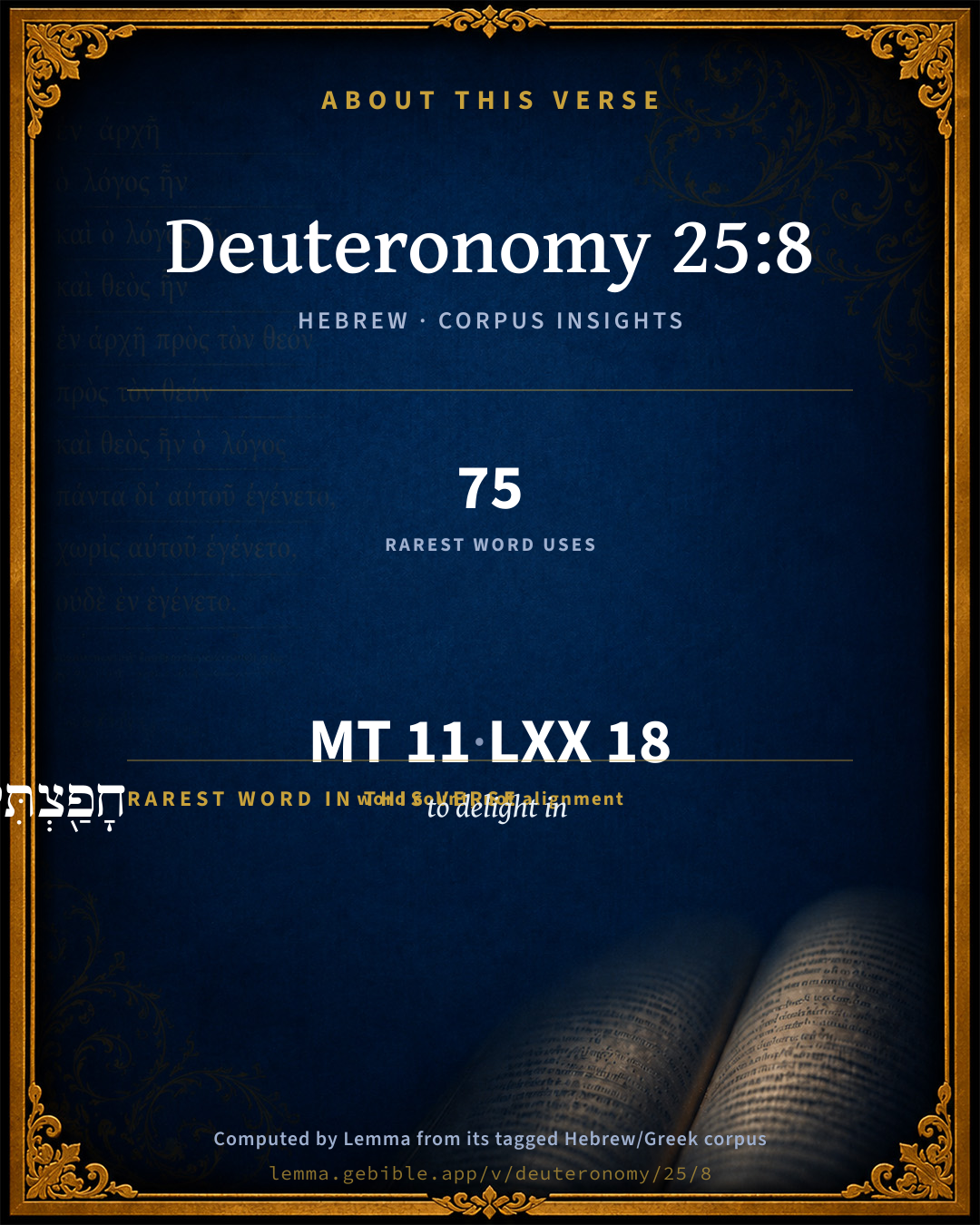
חָפַ֖צְתִּי
châphêts
H2654
“to delight in”
Verb, Qal, Perfect, 1st Person, Common, Singular
Part of Speech
Verb
Stem
Qal
Form
Perfect
Person
1st Person
Gender
Common
Number
Singular
Full BDB Definition

Origin: a primitive root

TWOT: 712 , 713

to delight in, take pleasure in, desire, be pleased with - (Qal) - of men - to take pleasure in, delight in - to delight, desire, be pleased to do - of God - to delight in, have pleasure in - to be pleased to do - to move, bend down - (Qal) to bend down
  1. וְקָֽרְאוּ qârâʼ H7121 “and · to call” Conjunction + Verb, Qal, Sequential Perfect, 3rd Person, Common, Plural
  2. זִקְנֵי zâqên H2205 “old of” Adjective, Adjective, Masculine, Plural, Construct
  3. עִיר֖וֹ ʻîyr H5892 “city · his” Noun, Common, Feminine, Singular, Construct + Suffix, Personal, 3rd Person, Masculine, Singular
  4. וְדִבְּר֣וּ dâbar H1696 “and · to speak” Conjunction + Verb, Piel, Sequential Perfect, 3rd Person, Common, Plural
  5. אֵלָ֑יו ʼêl H413 “to · him” Preposition + Suffix, Personal, 3rd Person, Masculine, Singular
  6. וְעָמַ֣ד ʻâmad H5975 “and · to stand” Conjunction + Verb, Qal, Sequential Perfect, 3rd Person, Masculine, Singular
  7. וְאָמַ֔ר ʼâmar H559 “and · to say” Conjunction + Verb, Qal, Sequential Perfect, 3rd Person, Masculine, Singular
  8. לֹ֥א lôʼ H3808 “not” Particle, Negative
  9. לְקַחְתָּֽהּ lâqach H3947 “to take · her” Preposition + Verb, Qal, Infinitive Construct + Suffix, Personal, 3rd Person, Feminine, Singular

About this verse

These counts appear in no published source. They are computed here, from the morphology-tagged text and Lemma’s own curated glosses. What Lemma adds →

11
words
10
distinct lemmas
Pentateuch
section

Grammatical profile

  • 6 verbs
  • 1 noun
  • 1 adjective
  • 2 prepositions
  • 1 particle

Verb forms

  • וְקָֽרְאוּ Qal · Sequential Perfect
  • וְדִבְּר֣וּ Piel · Sequential Perfect
  • וְעָמַ֣ד Qal · Sequential Perfect
  • וְאָמַ֔ר Qal · Sequential Perfect
  • חָפַ֖צְתִּי Qal · Perfect
  • לְקַחְתָּֽהּ Qal · Infinitive Construct

Hebrew & Septuagint length

In English translation the verse runs 25 words from the Hebrew and 24 from the Septuagint (LXX English) — closely comparable.

A rough comparison of the two English renderings, which tokenize alike — not a word-level alignment.

Word counts can differ between the Hebrew and the Greek without any difference in meaning — e.g. the Hebrew direct-object marker אֵת has no separate Greek word, and Greek often adds the article ὁ.

In the original languages it is 11 Hebrew tokens and 18 Greek tokens — but the two are counted differently (Hebrew bundles its prefixes and suffixes into one token; the Greek is in lemma form), so that isn’t a like-for-like length.

Cross-references

1

Topical passages linked to Deuteronomy 25:8 in the Treasury of Scripture Knowledge — connected by theme and wording, ordered by reader-vote popularity; previews shown in the World English Bible.

  • Ruth 4:6 The near kinsman said, I can't redeem it for myself, lest I mar my own inheritance: take my right of redemption on you; for I can't redeem it.

Cross-references courtesy of OpenBible.info (CC BY 4.0).

Hebrew and Greek witnesses Masoretic Hebrew ↔ Greek Septuagint

The same verse in the two great witnesses to the Old Testament, shown verse-for-verse.

These are two independent witnesses, not word-aligned to each other, and the Septuagint is shown in lemma (dictionary) form.

Hebrew Deuteronomy 25:8 Masoretic · Westminster Leningrad Codex

וְקָֽרְאוּ ל֥וֹ זִקְנֵי עִיר֖וֹ וְדִבְּר֣וּ אֵלָ֑יו וְעָמַ֣ד וְאָמַ֔ר לֹ֥א חָפַ֖צְתִּי לְקַחְתָּֽהּ

Then the elders of his city shall call him, and speak to him: and if he stand, and say, I don't want to take her;

World English Bible · Public Domain

Greek LXX Deuteronomy 25:8 Septuagint · lemma form

καί καλέω αὐτός ὁ γερουσία ὁ πόλις αὐτός καί εἶπον αὐτός καί ἵστημι εἶπον οὐ βούλομαι λαμβάνω αὐτός

And the elders of his city shall call him, and speak to him; and if he stand and say, I will not take her:

LXX2012 (modern English Septuagint) · Public Domain

Hebrew: Westminster Leningrad Codex (CC BY 4.0). Greek: Septuagint (public domain); English from LXX2012 (modern English Septuagint) (Public Domain). How the Septuagint differs from the Hebrew →

Targum (Aramaic paraphrase)

2

The Targum is the ancient Jewish Aramaic paraphrase of the Hebrew Scriptures — an interpretive translation, not the Hebrew text itself. Onkelos (literal) and Pseudo-Jonathan (expansive) render the Torah, and Jonathan the Prophets. Coverage is partial: where no permissively-licensed English translation exists for a verse, only the Aramaic is shown. This is verse-level text, not a word-by-word alignment to the Hebrew.

  1. Targum Onkelos Torah (Genesis–Deuteronomy)
    וִיקְרוּן לֵהּ סָבֵי קַרְתֵּהּ וִימַלְלוּן עִמֵהּ וִיקוּם וְיֵימַר לָא רְעֵנָא לְמִסְבַהּ

    (no public-domain English translation for this verse)

    Targum Onkelos — Aramaic: “Onkelos Genesis” (public domain); “Onkelos Exodus” (public domain); “Onkelos Leviticus” (public domain); “Onkelos Numbers” (public domain); “Onkelos Deuteronomy” (public domain). English: “Sefaria Community Translation” (CC0 1.0 (public-domain dedication)); “J.W. Etheridge. The Targums of Onkelos and Jonathan Ben Uzziel on the Pentateuch. London: Longmans, Green, 1862” (public domain). Text via Sefaria.

  2. Targum Pseudo-Jonathan Torah (Genesis–Deuteronomy)
    וְיִקְרוֹן לֵיהּ חַכִּימֵי קַרְתֵּיהּ וִימַלְלוּן עִמֵּיהּ מִילְכָּא קְשִׁיטָא וִיקוּם בְּבֵי דִינָא וְיֵימַר בְּלִישָׁן בֵּית קוּדְשָׁא לָא רָעֵינָא לְמִיסְבָּהּ

    And the elders of his city shall call him and speak with him, with true counsel; and he may rise up in the house of justice, and say in the holy tongue, I am not willing to take her.

    Targum Pseudo-Jonathan — Aramaic: “Targum Jonathan on Genesis” (public domain); “Targum Jonathan on Exodus” (public domain); “Targum Jonathan on Leviticus” (public domain); “Targum Jonathan on Numbers” (public domain); “Targum Jonathan on Deuteronomy” (public domain). English: “The Targum of Jonathan ben Uzziel, trans. J. W. Etheridge, London, 1862” (public domain). Text via Sefaria.

Commentary

Notes on Deuteronomy 25:8 from classic Christian and Jewish commentators (each source and its license shown beneath its notes). The classic Christian expositions comment on the surrounding passage and are grouped to its opening verse, so a note may address several verses; the Jewish commentaries on the Tanakh (Rashi and others) are per-verse, so they appear only where the commentator wrote on this verse.

Lemma curates 59 commentaries, every one of them public domain or Creative Commons licensed, each selected and text-cleaned for this edition rather than reprinted as found. About our sources →

The Cambridge Bible for Schools and Colleges

gen. ed. J. J. S. Perowne

8. This v. really continues the protasis of the cond. sentence which starts in Deu_25:7; the apodosis begins with Deu_25:9.

The Cambridge Bible for Schools and Colleges (gen. ed. J. J. S. Perowne; Cambridge University Press, 1878–1918) — public domain. Text from a community e-Sword module.

John Gill's Exposition

Then the elders of his city shall call him,.... Require him to come, before them, and declare his resolution, and the reasons for it; recite this law to him, and explain the nature of it, and exhort him to comply with it, or show reason why he does not, at least to have his final resolution upon it:

and speak unto him; talk with him upon this subject, and give him their best advice; and what that was Maimonides (o) more particularly informs us; if it is good and advisable to marry, they advise him to marry; but if it is better advice to pluck off the shoe, they give it; as when she is young and he is old, or she is old and he young, they advise him to allow the shoe to be plucked off:

and if he stand to it: and say, I like not to take her; if, after all the conversation, debate, and counsel between them, he is resolute, and abides by his first determination, that he will not marry her, then the following method was to be taken.

(o) Yebum Vechalitzab, c. 4. sect. 1.

John Gill's Exposition of the Whole Bible (1746–1763) — public domain (CC PDM 1.0). Text via the HelloAO Bible API.

Matthew Poole's English Annotations

Speak unto him, to convince him of the duty, and persuade him to it.

If he stand to it; if he obstinately refuse it.

Matthew Poole's English Annotations on the Holy Bible (1683–1685) — public domain. Text from a community e-Sword/MySword module.

Rashi

Rabbi Shlomo Yitzchaki (Rashi)

ועמד AND HE SHALL STAND [AND SAY] — He must say this standing (Sifrei Devarim 290:3).

יאמר AND HE SHALL SAY — in the Holy Language. She, too, has to make her statements in the Holy Language (Yevamot 106b; cf. Sifrei Devarim 291:6).

Rashi on the Tanakh — English translations: “The Judaica Press complete Tanach with Rashi, translated by A. J. Rosenberg” (CC BY 4.0); “Pentateuch with Rashi's commentary by M. Rosenbaum and A.M. Silbermann, 1929-1934” (public domain); “The Metsudah Tanach series, Lakewood, N.J” (CC BY 4.0); and “The Book of Joshua, Metsudah Publications, 1997” (CC BY 4.0). Text via Sefaria.

Lesson kit

Teaching starters — assembled from the data on this page, not authored interpretation. Every prompt links to the verse data it draws on. Edit before teaching.

Deuteronomy, in the Pentateuch, opens this verse with 11 words (10 distinct Hebrew lemmas). Its most distinctive word is châphêts (“to delight in”). A historical commentator’s framing appears above. Read the whole chapter for the surrounding context.

Discussion questions

  1. What does “to delight in” (châphêts) contribute to the verse as a whole?
  2. Ruth 4:6 shares this passage’s theme. How do the two illuminate each other?
  3. The translations on this page render this verse differently — a whole-verse word diff, not a word-by-word alignment. What might account for the different wordings?
  4. The verb «וְקָֽרְאוּ» is Qal Sequential Perfect. How does its form color the action?
  5. Reading how The Cambridge Bible for Schools and Colleges and John Gill's Exposition read this verse, where do the two commentators agree and where do they part?

Things to notice

Reading settings

Reading text

Shown beneath each verse's original-language words.

Old Testament
Old Testament edition

Read the OT as the Masoretic Hebrew (MT) or the Greek Septuagint (LXX).

English shown for the Greek Septuagint (in the Hebrew ↔ Greek comparison).

Comparing translations? Open the Compare panel on any verse page to stack up to four side by side.