
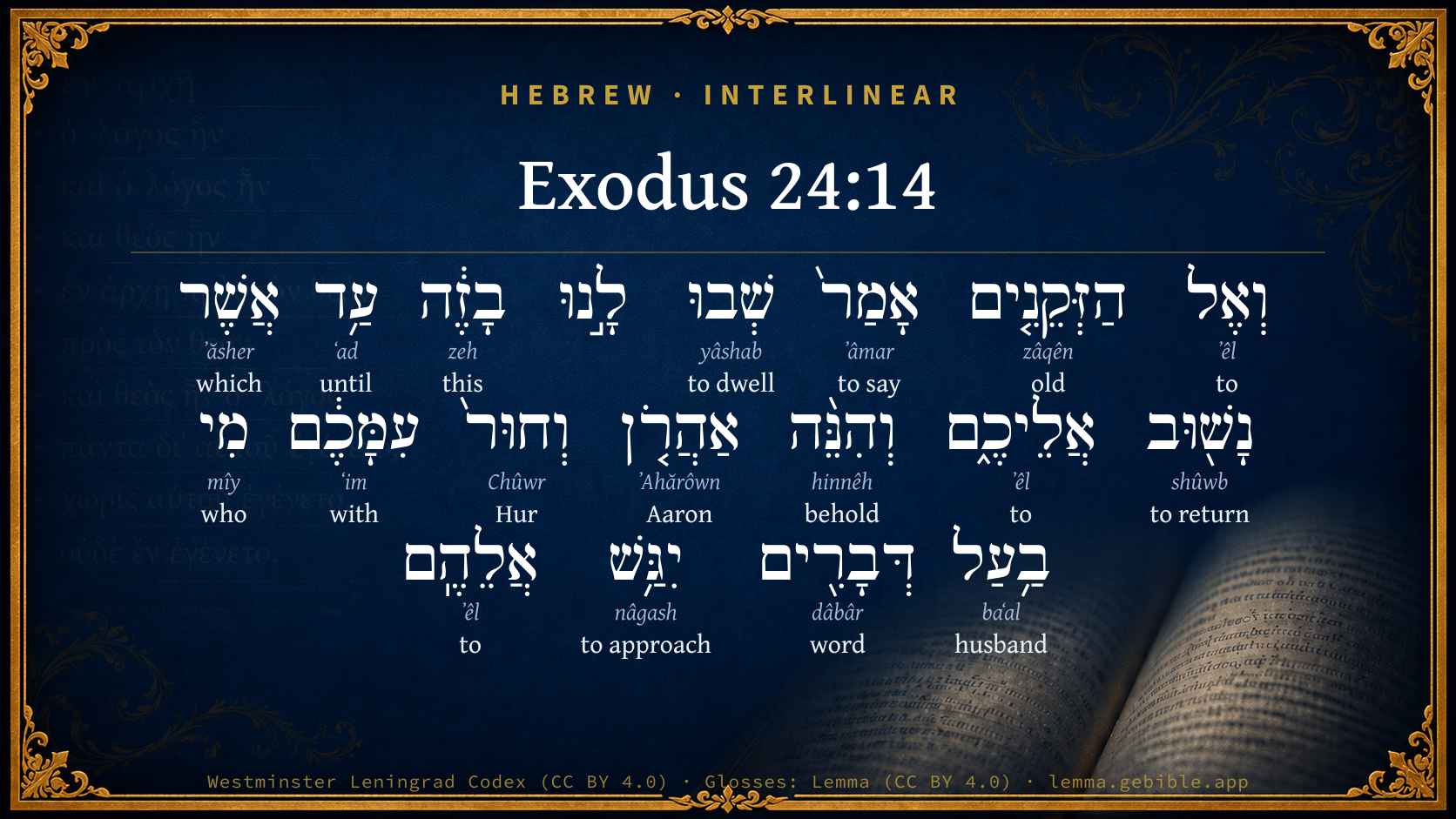
Exodus 24:14

Hebrew (Westminster Leningrad Codex) Exodus 24:14 appears in the Hebrew Old Testament. The text above is from the Westminster Leningrad Codex. Each word links to its Strong’s number, a concise gloss, and parsing drawn from the Open Scriptures Hebrew Bible morphology. Click any word for its full Brown-Driver-Briggs (BDB) entry.
Download image
Cite this verse

Exodus 24:14 (World English Bible). Public Domain. Lemma interlinear Bible study tool, https://lemma.gebible.app/v/exodus/24/14.

Show BibTeX & RIS
BibTeX
RIS
English Translation
He said to the elders, "Wait here for us, until we come again to you. Behold, Aaron and Hur are with you. Whoever is involved in a dispute can go to them."
World English Bible · Public Domain
Download a study sheet

One document with this verse’s original text, its word-by-word gloss line, the meaning frame, cross-references with their text, attributed commentary, and full source and license credits — printable, and it pastes into notes with its structure intact.

This verse Autodidact and up

Study sheet (.html) Plain text (.txt)

A passage Seminary Student

Up to 50 verses in one chapter. A passage sheet keeps up to 6 commentary sources and 12 cross-references per verse, in the order this page ranks them, and says so on the sheet whenever that leaves anything out. Ask for a single verse and you get the Autodidact verse sheet above.

Everything on this page stays free to read, with no account — the sheet is a download of what is already on screen, not access to it.

Want to remove ads? Support Godless Engineer
Compare translations 3

The same verse in 3 English versions, stacked beneath the original-language interlinear above. Click any original word for its lexicon entry.

Each is an independent rendering of the whole verse — the interlinear is not word-aligned to these translations.

Highlighted words mark where these versions differ — a whole-verse word diff, not a word-by-word alignment.

  • World English Bible Public Domain
    He said to the elders, "Wait here for us, until we come again to you. Behold, Aaron and Hur are with you. Whoever is involved in a dispute can go to them."
  • King James Version Public Domain
    And he said unto the elders, Tarry ye here for us, until we come again unto you: and, behold, Aaron and Hur are with you: if any man have any matters to do, let him come unto them.
  • unfoldingWord Literal Text CC BY-SA 4.0
    And he had said to the elders, “Wait for us in this place until we return to you. And behold! Aaron and Hur are with you; Whoever is a master of words may come near to them.”

unfoldingWord Literal Text — © unfoldingWord, licensed CC BY-SA 4.0. Word-aligned USFM3 via Door43 (git.door43.org/unfoldingWord/en_ult).

Versions to compare (up to 4)

3 of 4 selected

Show all 18 translations

Every available English version of this verse, each an independent rendering of the whole verse.

  • World English Bible Public Domain
    He said to the elders, "Wait here for us, until we come again to you. Behold, Aaron and Hur are with you. Whoever is involved in a dispute can go to them."
  • Berean Standard Bible Public Domain
    And he said to the elders, “Wait here for us until we return to you. Aaron and Hur are here with you. Whoever has a dispute can go to them.”
  • Majority Standard Bible Public Domain
    And he said to the elders, “Wait here for us until we return to you. Aaron and Hur are here with you. Whoever has a dispute can go to them.”
  • King James Version Public Domain
    And he said unto the elders, Tarry ye here for us, until we come again unto you: and, behold, Aaron and Hur are with you: if any man have any matters to do, let him come unto them.
  • American Standard Version (1901) Public Domain
    And he said unto the elders, Tarry ye here for us, until we come again unto you: and, behold, Aaron and Hur are with you: whosoever hath a cause, let him come near unto them.
  • Revised Version (1885) Public Domain
    And he said unto the elders, Tarry ye here for us, until we come again unto you: and, behold, Aaron and Hur are with you: whosoever hath a cause, let him come near unto them.
  • Geneva Bible (1599) Public Domain
    And said vnto the Elders, Tary vs here, vntill we come againe vnto you: and beholde, Aaron, and Hur are with you: whosoeuer hath any matters, let him come to them.
  • Douay-Rheims (1899) Public Domain
    Said to the ancients: Wait ye here till we return to you. You have Aaron and Hur with you: if any question shall arise, you shall refer it to them.
  • Young's Literal Translation Public Domain
    and unto the elders he hath said, `Abide ye for us in this `place', until that we turn back unto you, and lo, Aaron and Hur `are' with you -- he who hath matters doth come nigh unto them.'
  • Literal Standard Version CC BY-SA 4.0
    and he has said to the elderly, “Abide for us in this [place] until we return to you, and behold, Aaron and Hur [are] with you—he who has matters comes near to them.”
  • Unlocked Literal Bible CC BY-SA 4.0
    Moses had said to the elders, “Stay here and wait for us until we come to you. Aaron and Hur are with you. If anyone has a dispute, let him go to them.”
  • unfoldingWord Literal Text CC BY-SA 4.0
    And he had said to the elders, “Wait for us in this place until we return to you. And behold! Aaron and Hur are with you; Whoever is a master of words may come near to them.”
  • Darby Bible Public Domain
    And he said to the elders, Wait here for us, until we return to you; and behold, Aaron and Hur are with you: if any man have any matter, let him come before them.
  • World Messianic Bible Public Domain
    He said to the elders, “Wait here for us, until we come again to you. Behold, Aaron and Hur are with you. Whoever is involved in a dispute can go to them.”
  • Webster's Bible Public Domain
    And he said to the elders, Tarry ye here for us, until we come again to you: and behold, Aaron and Hur are with you: if any man hath any matters to do, let him come to them.
  • Free Bible Version CC BY-SA 4.0
    He told the elders, “Stay here and wait for us to return. Aaron and Hur are with you. If anyone has a problem, they can talk with them.”
  • Bible in Basic English Public Domain
    And he said to the chiefs, Keep your places here till we come back to you: Aaron and Hur are with you; if anyone has any cause let him go to them.
  • JPS Tanakh (1917) Public Domain
    And unto the elders he said: 'Tarry ye here for us, until we come back unto you; and, behold, Aaron and Hur are with you; whosoever hath a cause, let him come near unto them.'

Literal Standard Version (2020), Covenant Press — licensed CC BY-SA 4.0. Text via the HelloAO Bible API (eBible.org). Unlocked Literal Bible (unfoldingWord) — licensed CC BY-SA 4.0. Text via the HelloAO Bible API (eBible.org). unfoldingWord Literal Text — © unfoldingWord, licensed CC BY-SA 4.0. Word-aligned USFM3 via Door43 (git.door43.org/unfoldingWord/en_ult). Free Bible Version, Dr. Jonathan Gallagher — licensed CC BY-SA 4.0. Text via the HelloAO Bible API (eBible.org).

Word by word

More ways to search: Search by grammar → Find every occurrence → Compare this word →

Practice this passage: Drill this verse → Learn its vocabulary →

וְחוּר֙
Chûwr
H2354
“and · Hur”
Conjunction + Noun, Proper
Part of Speech
Conjunction + Noun
Type
Proper
Full BDB Definition

Origin: the same as H2353 or H2352

TWOT: None

Hur = "hole" - a chief assistant to Moses and Aaron - grandfather of Bezaleel, the chief artificer of the tabernacle; possibly the same as 1 above - the 4th of the 5 kings of Midian who were slain with Balaam after Peor - father of Rephaiah in the time of Nehemiah - father of Ben-Hur who was commissariat officer for Solomon in Mount Ephraim
  1. וְאֶל ʼêl H413 “and · to” Conjunction + Preposition
  2. הַזְּקֵנִ֤ים zâqên H2205 “the · old” Particle, Definite Article + Adjective, Adjective, Masculine, Plural, Absolute
  3. אָמַר֙ ʼâmar H559 “to say” Verb, Qal, Perfect, 3rd Person, Masculine, Singular
  4. שְׁבוּ yâshab H3427 “dwell” Verb, Qal, Imperative, 2nd Person, Masculine, Plural
  5. בָזֶ֔ה zeh H2088 “in/at · this” Preposition + Pronoun, Demonstrative, Masculine, Singular
  6. עַ֥ד ʻad H5704 “until” Preposition
  7. אֲשֶׁר ʼăsher H834 “which” Particle, Relative
  8. נָשׁ֖וּב shûwb H7725 “to return” Verb, Qal, Imperfect, 1st Person, Common, Plural
  9. אֲלֵיכֶ֑ם ʼêl H413 “to · you” Preposition + Suffix, Personal, 2nd Person, Masculine, Plural
  10. וְהִנֵּ֨ה hinnêh H2009 “and · behold” Conjunction + Particle, Demonstrative
  11. אַהֲרֹ֤ן ʼAhărôwn H175 “Aaron” Noun, Proper
  12. עִמָּכֶ֔ם ʻim H5973 “with · you” Preposition + Suffix, Personal, 2nd Person, Masculine, Plural
  13. מִי mîy H4310 “who” Particle, Interrogative
  14. בַ֥עַל baʻal H1167 “husband of” Noun, Common, Masculine, Singular, Construct
  15. דְּבָרִ֖ים dâbâr H1697 “words” Noun, Common, Masculine, Plural, Absolute
  16. יִגַּ֥שׁ nâgash H5066 “to approach” Verb, Qal, Imperfect, 3rd Person, Masculine, Singular
  17. אֲלֵהֶֽם ʼêl H413 “to · them” Preposition + Suffix, Personal, 3rd Person, Masculine, Plural

About this verse

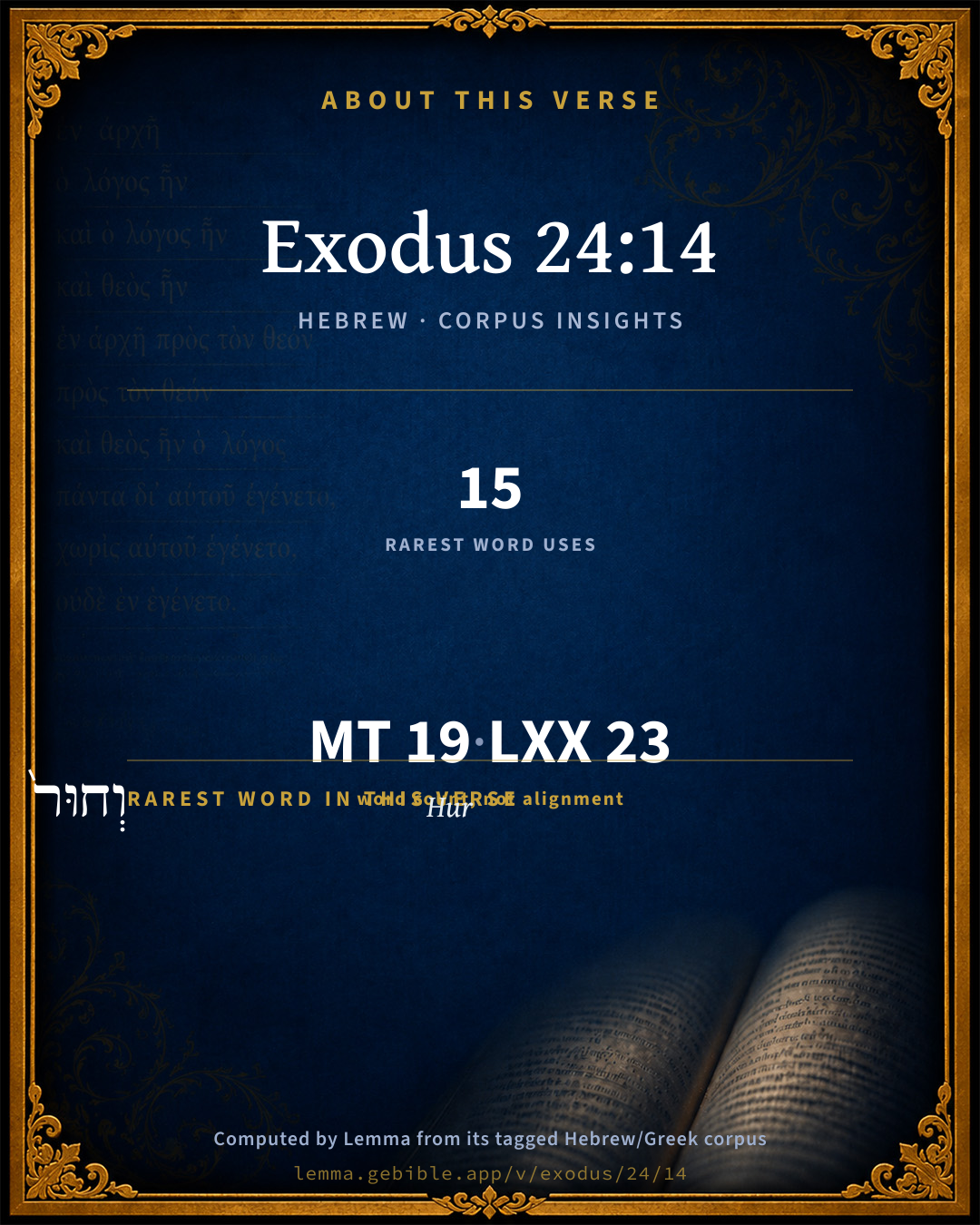
These counts appear in no published source. They are computed here, from the morphology-tagged text and Lemma’s own curated glosses. What Lemma adds →

19
words
16
distinct lemmas
Pentateuch
section

Notable vocabulary

The rarest word here is וְחוּר֙ Hur H2354 — appearing just 15 times in the whole Hebrew Bible.

Shared distinctive vocabulary

וְחוּר֙ Hur H2354 occurs in 15 verses of the Hebrew Bible. Also found in:

Grammatical profile

  • 4 verbs
  • 4 nouns
  • 1 adjective
  • 1 pronoun
  • 6 prepositions
  • 3 particles

Verb forms

  • אָמַר֙ Qal · Perfect
  • שְׁבוּ Qal · Imperative
  • נָשׁ֖וּב Qal · Imperfect
  • יִגַּ֥שׁ Qal · Imperfect

Repetition

A word recurs within this verse — often emphatic in Hebrew:

  • וְאֶל to H413 ×3

Hebrew & Septuagint length

In English translation the verse runs 32 words from the Hebrew and 35 from the Septuagint (LXX English) — closely comparable.

A rough comparison of the two English renderings, which tokenize alike — not a word-level alignment.

Word counts can differ between the Hebrew and the Greek without any difference in meaning — e.g. the Hebrew direct-object marker אֵת has no separate Greek word, and Greek often adds the article ὁ.

In the original languages it is 19 Hebrew tokens and 23 Greek tokens — but the two are counted differently (Hebrew bundles its prefixes and suffixes into one token; the Greek is in lemma form), so that isn’t a like-for-like length.

Cross-references

7

Topical passages linked to Exodus 24:14 in the Treasury of Scripture Knowledge — connected by theme and wording, ordered by reader-vote popularity; previews shown in the World English Bible.

  • Exodus 17:12 But Moses' hands were heavy; and they took a stone, and put it under him, and he sat on it. Aaron and Hur held up his hands, the one on the one side, and the other on the other side. His hands were steady until sunset.
  • Exodus 17:10 So Joshua did as Moses had told him, and fought with Amalek; and Moses, Aaron, and Hur went up to the top of the hill.
  • Genesis 22:5 Abraham said to his young men, "Stay here with the donkey. The boy and I will go yonder. We will worship, and come back to you.
  • Exodus 18:25–26 Moses chose able men out of all Israel, and made them heads over the people, rulers of thousands, rulers of hundreds, rulers of fifties, and rulers of tens.
  • Exodus 32:1 When the people saw that Moses delayed to come down from the mountain, the people gathered themselves together to Aaron, and said to him, "Come, make us gods, which shall go before us; for as for this Moses, the man who brought us up out of the land of Egypt, we don't know what has become of him."
  • 1 Samuel 10:8 You shall go down before me to Gilgal; and, behold, I will come down to you, to offer burnt offerings, and to sacrifice sacrifices of peace-offerings: seven days shall you wait, until I come to you, and show you what you shall do.
  • 1 Samuel 13:8–13 He stayed seven days, according to the set time that Samuel [had appointed]: but Samuel didn't come to Gilgal; and the people were scattered from him.

Cross-references courtesy of OpenBible.info (CC BY 4.0).

Hebrew and Greek witnesses Masoretic Hebrew ↔ Greek Septuagint

The same verse in the two great witnesses to the Old Testament, shown verse-for-verse.

These are two independent witnesses, not word-aligned to each other, and the Septuagint is shown in lemma (dictionary) form.

Hebrew Exodus 24:14 Masoretic · Westminster Leningrad Codex

וְאֶל הַזְּקֵנִ֤ים אָמַר֙ שְׁבוּ לָ֣נוּ בָזֶ֔ה עַ֥ד אֲשֶׁר נָשׁ֖וּב אֲלֵיכֶ֑ם וְהִנֵּ֨ה אַהֲרֹ֤ן וְחוּר֙ עִמָּכֶ֔ם מִי בַ֥עַל דְּבָרִ֖ים יִגַּ֥שׁ אֲלֵהֶֽם

He said to the elders, "Wait here for us, until we come again to you. Behold, Aaron and Hur are with you. Whoever is involved in a dispute can go to them."

World English Bible · Public Domain

Greek LXX Exodus 24:14 Septuagint · lemma form

καί ὁ πρεσβύτερος εἶπον ἡσυχάζω αὐτοῦ ἕως ἀναστρέφω πρός σύ καί ἰδού ααρων καί ωρ μετά σύ ἐάν τις συνβαίνω κρίσις προςπορεύομαι αὐτός

And to the elders they said, Rest there till we return to you; and behold, Aaron and Or are with you: if any man have a cause to be tried, let them go to them.

LXX2012 (modern English Septuagint) · Public Domain

Hebrew: Westminster Leningrad Codex (CC BY 4.0). Greek: Septuagint (public domain); English from LXX2012 (modern English Septuagint) (Public Domain). How the Septuagint differs from the Hebrew →

Targum (Aramaic paraphrase)

2

The Targum is the ancient Jewish Aramaic paraphrase of the Hebrew Scriptures — an interpretive translation, not the Hebrew text itself. Onkelos (literal) and Pseudo-Jonathan (expansive) render the Torah, and Jonathan the Prophets. Coverage is partial: where no permissively-licensed English translation exists for a verse, only the Aramaic is shown. This is verse-level text, not a word-by-word alignment to the Hebrew.

  1. Targum Onkelos Torah (Genesis–Deuteronomy)
    וּלְסָבַיָא אֲמַר אוֹרִיכוּ לָנָא הָכָא עַד דִנְתוּב לְוָתְכוֹן וְהָא אַהֲרֹן וְחוּר עִמְכוֹן מָן דְאִית לֵהּ דִינָא יִתְקְרֵב לִקֳדָמֵיהוֹן:

    (no public-domain English translation for this verse)

    Targum Onkelos — Aramaic: “Onkelos Genesis” (public domain); “Onkelos Exodus” (public domain); “Onkelos Leviticus” (public domain); “Onkelos Numbers” (public domain); “Onkelos Deuteronomy” (public domain). English: “Sefaria Community Translation” (CC0 1.0 (public-domain dedication)); “J.W. Etheridge. The Targums of Onkelos and Jonathan Ben Uzziel on the Pentateuch. London: Longmans, Green, 1862” (public domain). Text via Sefaria.

  2. Targum Pseudo-Jonathan Torah (Genesis–Deuteronomy)
    וּלְחַכִּימַיָא אָמַר אַמְתִּינוּן לָנָא הָכָא עַד זְמַן דִּנְתוֹב לְוַותְכוֹן וְהָא אַהֲרן וְחוּר עִמְכוֹן מַאן דְּאִית לֵיהּ עֵיסַק דִּינָא יִתְקְרֵב לְוַותְהוֹן

    And to the sages he had said, Expect us here, at the time of our return to you; and, behold, Aharon and Hur are with you; if there be any matter of judgment, bring it to them.

    Targum Pseudo-Jonathan — Aramaic: “Targum Jonathan on Genesis” (public domain); “Targum Jonathan on Exodus” (public domain); “Targum Jonathan on Leviticus” (public domain); “Targum Jonathan on Numbers” (public domain); “Targum Jonathan on Deuteronomy” (public domain). English: “The Targum of Jonathan ben Uzziel, trans. J. W. Etheridge, London, 1862” (public domain). Text via Sefaria.

Commentary

Notes on Exodus 24:14 from classic Christian and Jewish commentators (each source and its license shown beneath its notes). The classic Christian expositions comment on the surrounding passage and are grouped to its opening verse, so a note may address several verses; the Jewish commentaries on the Tanakh (Rashi and others) are per-verse, so they appear only where the commentator wrote on this verse.

Lemma curates 59 commentaries, every one of them public domain or Creative Commons licensed, each selected and text-cleaned for this edition rather than reprinted as found. About our sources →

Trapp's Complete Commentary

John Trapp

Exo 24:14 And he said unto the elders, Tarry ye here for us, until we come again unto you: and, behold, Aaron and Hur [are] with you: if any man have any matters to do, let him come unto them.

Ver. 14. And Hur.] {See Trapp on "Exo 17:10"}

John Trapp, A Commentary or Exposition upon All the Books of the Old and New Testament (1647–1656) — public domain. Text from a community e-Sword module.

Jamieson, Fausset & Brown

Robert Jamieson, A. R. Fausset & David Brown

he said unto the elders, Tarry ye here for us--There is a circular valley or hollow a good way up on the brow of Jebel Musa, which was their halting place, while he alone was privileged to ascend the highest peak. The people stood below, as in the "outer court," the elders in the "holy place," Moses, as a type of Christ, in "the holy of holies."

Jamieson, Fausset & Brown — Commentary Critical and Explanatory on the Whole Bible (1871) — public domain (CC PDM 1.0). Text via the HelloAO Bible API.

Adam Clarke's Commentary

Verse 14. Tarry ye here for us] Probably Moses did not know that he was to continue so long on the mount, nor is it likely that the elders tarried the whole forty days where they were: they doubtless, after waiting some considerable time, returned to the camp; and their return is supposed to have been the grand cause why the Israelites made the golden calf, as they probably reported that Moses was lost.

Aaron and Hur are with you] Not knowing how long he might be detained on the mount, and knowing that many cases might occur which would require the interference of the chief magistrate, Moses constituted them regents of the people during the time he should be absent.

Adam Clarke's Commentary on the Bible (1810–1826) — public domain. Text from a community e-Sword/MySword module.

Ellicott's Commentary for English Readers

(14) He said unto the elders.—Moses understood that his stay in the mount was about to be a prolonged one (see Exo_24:12). He therefore prudently determined to make arrangements for the government and direction of the people during his absence. Aaron his brother, and Hur, the father of Bezaleel, perhaps his brother- in-law, seemed to him the fittest persons to exercise authority over the people during his absence; and accordingly he named them as the persons to whom application was to be made under any circumstances of difficulty.

Here.—In the plain below the mountain. The injunction was that the camp should not be moved until Moses came down, however long he might be detained by the Divine colloquy.

A Bible Commentary for English Readers, edited by Charles John Ellicott (1878–1897) — public domain. Text from a community e-Sword module.

The Cambridge Bible for Schools and Colleges

gen. ed. J. J. S. Perowne

14. And unto the elders he said] viz. before going up into the mount (v. 13). The elders are not the seventy mentioned by J in vv. 1, 9 (among whom Hur is not named, and who are not likely to have had forensic differences while waiting for Moses’ return), but the elders in the camp, who would naturally take the lead during Moses’ absence, and who are bidden here not to move (with the camp) from where they are, till he and Joshua return. Perhaps (Nöld., We., Bä.) elders is even a harmonistic correction for people, suggested by vv. 1, 9.

whosoever hath a cause, &c.] if during Moses’ absence any differences arise among the people, requiring for their settlement the intervention of a judge, they must be referred to Aaron and Hur (Exo_17:10; Exo_17:12), as his representatives. The judicial organization established in ch. 18 does not seem to be presupposed; the verse thus supports the conclusion (p. 162) that ch. 18 once stood after ch. 24.

a cause] lit. words: see on Exo_23:8; cf. (for the Heb.) Isa_50:8.

The Cambridge Bible for Schools and Colleges (gen. ed. J. J. S. Perowne; Cambridge University Press, 1878–1918) — public domain. Text from a community e-Sword module.

John Gill's Exposition

And he said unto the elders,.... The seventy elders which were selected out of the several tribes of Israel, and now about to return to the camp:

tarry ye here for us; meaning himself and Joshua, who was going with him:

until we come again unto you; perhaps Moses might not know how long his stay would be at the top of the mount, but supposed it would be some time by the provision he makes for hearing and adjusting cases in his absence:

and behold, Aaron and Hur are with you; Hur is not mentioned before, as being with Moses and the rest; but doubtless he was, at least it is highly probable he was one of the seventy elders of him; see Gill on Exo 17:10.

if any man have any matters to do: any cases to be considered, any cause to be tried in difference between him and another man, and which cannot be determined by the inferior judges, is too difficult for them to take in hand:

let him come unto them; bring his case before them, and have their advice and opinion, and be determined by them.

John Gill's Exposition of the Whole Bible (1746–1763) — public domain (CC PDM 1.0). Text via the HelloAO Bible API.

Haydock's Catholic Bible Commentary

Wait ye. They returned soon to the camp; and the people not perceiving Moses with them, and supposing he was dead, made the golden calf.

George Leo Haydock (1774–1849), Haydock's Catholic Family Bible and Commentary, 1859 edition — public domain. Excludes Psalms (Douay-Rheims chapter numbering differs from Protestant) and Deuterocanonical books (Catholic canon only).

Matthew Poole's English Annotations

For us, i.e. for me and Joshua, and here, i.e. in the camp, where he was when he spake these words; for it was where not only Aaron and Hur, but the people might come, as it here follows, and therefore not upon the mount. Moses had made

Aaron and Hur joint-commissioners, to determine hard causes which were brought to them from the elders, according to the order, Exo 18:22. Some make Aaron the ecclesiastical head, and Hur the civil head; but Aaron was not authorized for ecclesiastical matters till Exo 28.

Matthew Poole's English Annotations on the Holy Bible (1683–1685) — public domain. Text from a community e-Sword/MySword module.

Whedon's Commentary on the Bible

Daniel D. Whedon

14. Tarry ye — Moses appeared to know that he would be absent from the camp some time, and hence the instructions here given to the elders.

Aaron and Hur — Comp. Exo_17:10; Exo_17:12, notes. It would seem that Moses and Joshua parted from the elders on the spot where they ate and drank together, (Exo_24:11;) in which case it is of course to be understood that the elders would return to the camp and abide in their tents as usual until Moses returned. Possibly, however, as Keil supposes, Moses and the elders went down again to the camp together after the covenant meal.

Daniel D. Whedon (gen. ed.), Commentary on the Old and New Testaments (1874–1909) — public domain. Text from a community e-Sword module.

The Pulpit Commentary

And he said unto the elders. Before taking his departure for the long sojourn implied in God"s address to him, "Come up to me into the mount, and be there" (ver. 12), Moses thought it necessary to give certain directions to the elders as to what they should do in his absence

1. They were to remain where they werei.e. , in the plain at the foot of Sinai, until his return, however long it should be delayed.

2. They were to regard Aaron and Hur as their leaders, and his (Moses") representatives. In case of any difficulty arising, they were to refer the matter to them. On Hur see the comment upon Exo_17:12.

The Pulpit Commentary (1880–1919), ed. H.D.M. Spence-Jones & Joseph S. Exell — public domain. Text from a community e-Sword module.

unfoldingWord translationNotes

Door43 World Missions Community

wait for us

"wait for Joshua and me"

Hur

Hur was a man who was a friend of Moses and Aaron. See how you translated this name in Exodus 17:10. (See: How to Translate Names)

translationWords

Moses

elder

unfoldingWord translationNotes — © Distant Shores Media and the Door43 World Missions Community, licensed CC BY-SA 4.0. Source: git.door43.org/Door43/en_tn.

Rashi

Rabbi Shlomo Yitzchaki (Rashi)

ואל הזקנים אמר BUT UNTO THE ELDERS HE SAID when he left the camp (אמר in the sequence of verbs which we find here denotes the pluperfect; the translation therefore is: and to the elders he had said).

שבו לנו בזה ABIDE YE HERE FOR US and stay ye with all the other people in the camp so as to be ready to decide his dispute for each man.

חור [AND] HUR — He was the son of Miriam and his father was Caleb the son of Jephunneh, as it is said, (1 Chr. 2:9) “Caleb took unto him Ephrath, who bare him Hur”; and Ephrath is identical with Miriam, as it is stated in Treatise Sotah 11b.

מי בעל דברים HE WHO HAS ANY MATTER TO DO — i. e. he who has any law-suit.

Rashi on the Tanakh — English translations: “The Judaica Press complete Tanach with Rashi, translated by A. J. Rosenberg” (CC BY 4.0); “Pentateuch with Rashi's commentary by M. Rosenbaum and A.M. Silbermann, 1929-1934” (public domain); “The Metsudah Tanach series, Lakewood, N.J” (CC BY 4.0); and “The Book of Joshua, Metsudah Publications, 1997” (CC BY 4.0). Text via Sefaria.

Ramban (Nachmanides)

Rabbi Moshe ben Nachman (Ramban / Nachmanides)

AND UNTO THE ELDERS HE SAID: ‘TARRY YE HERE FOR US.’ The meaning of this is that when Moses parted from them with his minister, he commanded them that they should tarry there. It does not mean that they were to stay there day and night until their return, for he said, and behold, Aaron and Hur are with you; whosoever hath a cause, let him come near unto them, and it is in the camp that parties to a dispute would be found, since that was where the seat of justice was, and he had already told everybody, Return ye to your tents. But the meaning of tarry ye here is that they should stay at that place, and should not break through to come up to them, even to the place where Joshua was, until he [Moses] would come back to them.In my opinion it is possible that the explanation of the verse is as follows: “Sit [translated as “tarry”] in its literal meaning: “sit” — sit in court in our place and act as a substitute for us. in our place and serve as a substitute for us in the camp; Aaron and Hur are with you, and whosoever hath a cause — one of those hard causes that they would bring to me — let him come near unto them in my place.” He said unto them as a special recognition to Aaron and Hur, for they were to come before all the elders and they would all be assembled at one place, just as he said Aaron and Hur are with you. Thus Moses commanded that the elders together with Aaron and Hur should sit as a court, just as he himself did, over the officers of thousands and hundreds, until he returns, since he knew that he would tarry in the mountain. He said: for us [tarry ye here ‘for us’] as a mark of honor to his disciple, just as he said to Joshua, Choose us out men. This is a correct interpretation. But Rashi wrote: “And unto the elders he said — when he left the camp, Tarry ye here for us — stay you with the rest of the people so as to be ready to judge each man’s dispute.” But this is impossible, for they were not at that moment in the camp, and what sense would there be for him to tell them so when they were in the camp and had already been appointed as judges!Terumah

Ramban (Nachmanides) on the Tanakh — English translation: “Commentary on the Torah by Ramban (Nachmanides). Translated and annotated by Charles B. Chavel. New York, Shilo Pub. House, 1971-1976” (CC BY 4.0). Text via Sefaria.

Lesson kit

Teaching starters — assembled from the data on this page, not authored interpretation. Every prompt links to the verse data it draws on. Edit before teaching.

Exodus, in the Pentateuch, opens this verse with 19 words (16 distinct Hebrew lemmas). Its most distinctive word is Chûwr (“Hur”). A historical commentator’s framing appears above. Read the whole chapter for the surrounding context.

Discussion questions

  1. How does “Hur” (Chûwr) shape what this verse is saying?
  2. How does Exodus 17:10, which shares the word «Hur», read alongside this verse?
  3. What does the repetition of “to” (3× in this one verse) do in this verse?
  4. These translations render this verse differently; the difference is in the English rendering, not the original. What questions does that raise?
  5. «אָמַר֙» is a Qal Perfect verb. How does that grammatical form shape the action described?
  6. Compare how Trapp's Complete Commentary and Jamieson, Fausset & Brown read this verse. Where do they agree or differ?

Things to notice

Reading settings

Reading text

Shown beneath each verse's original-language words.

Old Testament
Old Testament edition

Read the OT as the Masoretic Hebrew (MT) or the Greek Septuagint (LXX).

English shown for the Greek Septuagint (in the Hebrew ↔ Greek comparison).

Comparing translations? Open the Compare panel on any verse page to stack up to four side by side.