Jeremiah 19:1

Hebrew (Westminster Leningrad Codex) Jeremiah 19:1 appears in the Hebrew Old Testament. The text above is from the Westminster Leningrad Codex. Each word links to its Strong’s number, a concise gloss, and parsing drawn from the Open Scriptures Hebrew Bible morphology. Click any word for its full Brown-Driver-Briggs (BDB) entry.
Download image
Cite this verse

Jeremiah 19:1 (World English Bible). Public Domain. Lemma interlinear Bible study tool, https://lemma.gebible.app/v/jeremiah/19/1.

Show BibTeX & RIS
BibTeX
RIS
English Translation
Thus said Yahweh, Go, and buy a potter's earthen bottle, and [take] of the elders of the people, and of the elders of the priests;
World English Bible · Public Domain
Download a study sheet

One document with this verse’s original text, its word-by-word gloss line, the meaning frame, cross-references with their text, attributed commentary, and full source and license credits — printable, and it pastes into notes with its structure intact.

This verse Autodidact and up

Study sheet (.html) Plain text (.txt)

A passage Seminary Student

Up to 50 verses in one chapter. A passage sheet keeps up to 6 commentary sources and 12 cross-references per verse, in the order this page ranks them, and says so on the sheet whenever that leaves anything out. Ask for a single verse and you get the Autodidact verse sheet above.

Everything on this page stays free to read, with no account — the sheet is a download of what is already on screen, not access to it.

Want to remove ads? Support Godless Engineer
Compare translations 3

The same verse in 3 English versions, stacked beneath the original-language interlinear above. Click any original word for its lexicon entry.

Each is an independent rendering of the whole verse — the interlinear is not word-aligned to these translations.

Highlighted words mark where these versions differ — a whole-verse word diff, not a word-by-word alignment.

  • World English Bible Public Domain
    Thus said Yahweh, Go, and buy a potter's earthen bottle, and [take] of the elders of the people, and of the elders of the priests;
  • King James Version Public Domain
    Thus saith the LORD, Go and get a potter's earthen bottle, and take of the ancients of the people, and of the ancients of the priests;
  • unfoldingWord Literal Text CC BY-SA 4.0
    Thus says Yahweh: “Go and buy a potter’s earthenware jar, and from of the elders of the people and of from of the elders of the priests.

unfoldingWord Literal Text — © unfoldingWord, licensed CC BY-SA 4.0. Word-aligned USFM3 via Door43 (git.door43.org/unfoldingWord/en_ult).

Versions to compare (up to 4)

3 of 4 selected

Show all 18 translations

Every available English version of this verse, each an independent rendering of the whole verse.

  • World English Bible Public Domain
    Thus said Yahweh, Go, and buy a potter's earthen bottle, and [take] of the elders of the people, and of the elders of the priests;
  • Berean Standard Bible Public Domain
    This is what the LORD says: “Go and buy a clay jar from a potter. Take some of the elders of the people and leaders of the priests,
  • Majority Standard Bible Public Domain
    This is what the LORD says: “Go and buy a clay jar from a potter. Take some of the elders of the people and leaders of the priests,
  • King James Version Public Domain
    Thus saith the LORD, Go and get a potter's earthen bottle, and take of the ancients of the people, and of the ancients of the priests;
  • American Standard Version (1901) Public Domain
    Thus said Jehovah, Go, and buy a potter's earthen bottle, and `take' of the elders of the people, and of the elders of the priests;
  • Revised Version (1885) Public Domain
    Thus said the LORD, Go, and buy a potter’s earthen bottle, and take of the elders of the people, and of the elders of the priests;
  • Geneva Bible (1599) Public Domain
    Thus sayth the Lord, Goe, and buy an earthen bottel of a potter, and take of the ancients of the people, and of the ancients of the Priests,
  • Douay-Rheims (1899) Public Domain
    Thus saith the Lord: Go, and take a potter's earthen bottle, and take of the ancients of the people, and of the ancients of the priests:
  • Young's Literal Translation Public Domain
    Thus said Jehovah, `Go, and thou hast got a potter's earthen vessel, and of the elders of the people, and of the elders of the priests,
  • Literal Standard Version CC BY-SA 4.0
    Thus said YHWH: “Go, and you have acquired a potter’s earthen vessel, and from [the] elderly of the people, and from [the] elderly of the priests,
  • Unlocked Literal Bible CC BY-SA 4.0
    Yahweh said this, “Go and purchase a potter's clay flask while you are with the elders of the people and the priests.
  • unfoldingWord Literal Text CC BY-SA 4.0
    Thus says Yahweh: “Go and buy a potter’s earthenware jar, and from of the elders of the people and of from of the elders of the priests.
  • Darby Bible Public Domain
    Thus saith Jehovah: Go and buy a potter's earthen flagon, and [take] of the elders of the people, and of the elders of the priests;
  • World Messianic Bible Public Domain
    Thus said the LORD, “Go, and buy a potter’s earthen container, and take some of the elders of the people and of the elders of the priests;
  • Webster's Bible Public Domain
    Thus saith the LORD, Go and get a potter's earthen bottle, and take of the ancients of the people, and of the ancients of the priests;
  • Free Bible Version CC BY-SA 4.0
    This is what the Lord says: Go and buy a clay jar from a potter. Take some of the elders of the people and leaders of the priests with you,
  • Bible in Basic English Public Domain
    This is what the Lord has said: Go and get for money a potter's bottle made of earth, and take with you some of the responsible men of the people and of the priests;
  • JPS Tanakh (1917) Public Domain
    Thus said the LORD: Go, and get a potter's earthen bottle, and take of the elders of the people, and of the elders of the priests;

Literal Standard Version (2020), Covenant Press — licensed CC BY-SA 4.0. Text via the HelloAO Bible API (eBible.org). Unlocked Literal Bible (unfoldingWord) — licensed CC BY-SA 4.0. Text via the HelloAO Bible API (eBible.org). unfoldingWord Literal Text — © unfoldingWord, licensed CC BY-SA 4.0. Word-aligned USFM3 via Door43 (git.door43.org/unfoldingWord/en_ult). Free Bible Version, Dr. Jonathan Gallagher — licensed CC BY-SA 4.0. Text via the HelloAO Bible API (eBible.org).

Word by word

More ways to search: Search by grammar → Find every occurrence → Compare this word →

Practice this passage: Drill this verse → Learn its vocabulary →

בַקְבֻּ֖ק
baqbuq
H1228
“bottle of”
Noun, Common, Masculine, Singular, Construct
Part of Speech
Noun
Type
Common
Gender
Masculine
Number
Singular
State
Construct
Full BDB Definition

Origin: from H1238

TWOT: 273a

flask, bottle
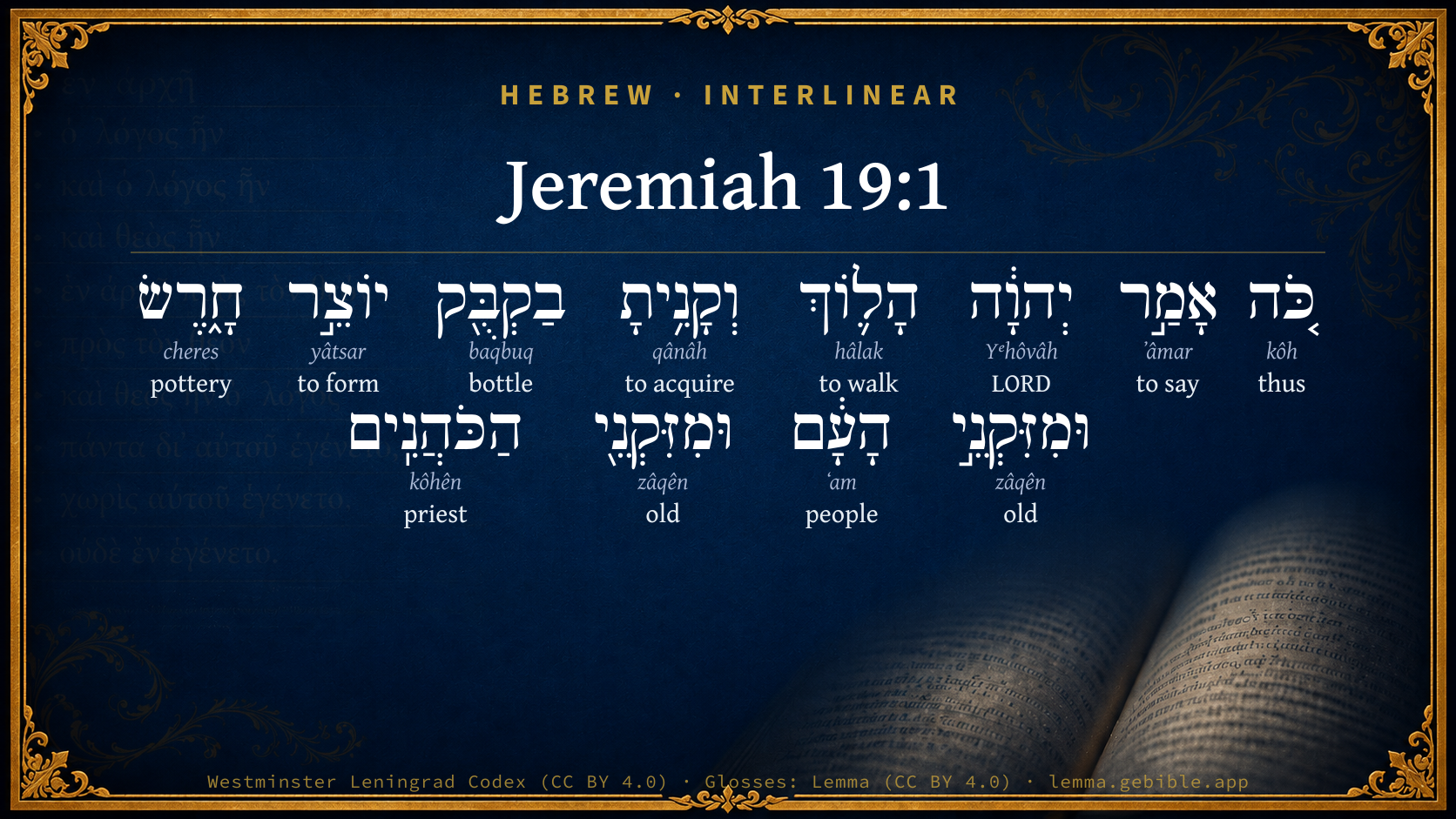
  1. כֹּ֚ה kôh H3541 “thus” Adverb
  2. אָמַ֣ר ʼâmar H559 “to say” Verb, Qal, Perfect, 3rd Person, Masculine, Singular
  3. יְהוָ֔ה Yᵉhôvâh H3068 “LORD” Noun, Proper
  4. הָל֛וֹךְ hâlak H1980 “to walk” Verb, Qal, Infinitive Absolute
  5. וְקָנִ֥יתָ qânâh H7069 “and · to acquire” Conjunction + Verb, Qal, Sequential Perfect, 2nd Person, Masculine, Singular
  6. יוֹצֵ֣ר yâtsar H3335 “forming” Verb, Qal, Participle Active, Masculine, Singular, Construct
  7. חָ֑רֶשׂ cheres H2789 “pottery” Noun, Common, Masculine, Singular, Absolute
  8. וּמִזִּקְנֵ֣י zâqên H2205 “and · from · old of” Conjunction + Preposition + Adjective, Adjective, Masculine, Plural, Construct
  9. הָעָ֔ם ʻam H5971 “the · people” Particle, Definite Article + Noun, Common, Masculine, Singular, Absolute
  10. וּמִזִּקְנֵ֖י zâqên H2205 “and · from · old of” Conjunction + Preposition + Adjective, Adjective, Masculine, Plural, Construct
  11. הַכֹּהֲנִֽים kôhên H3548 “the · priests” Particle, Definite Article + Noun, Common, Masculine, Plural, Absolute

About this verse

These counts appear in no published source. They are computed here, from the morphology-tagged text and Lemma’s own curated glosses. What Lemma adds →

12
words
11
distinct lemmas
Prophets
section

Notable vocabulary

The rarest word here is בַקְבֻּ֖ק bottle H1228 — appearing just 3 times in the whole Hebrew Bible.

Shared distinctive vocabulary

בַקְבֻּ֖ק bottle H1228 occurs in 3 verses of the Hebrew Bible. Also found in:

Grammatical profile

  • 4 verbs
  • 5 nouns
  • 2 adjectives
  • 1 adverb

Verb forms

  • אָמַ֣ר Qal · Perfect
  • הָל֛וֹךְ Qal · Infinitive Absolute
  • וְקָנִ֥יתָ Qal · Sequential Perfect
  • יוֹצֵ֣ר Qal · Participle Active

Repetition

A word recurs within this verse — often emphatic in Hebrew:

  • וּמִזִּקְנֵ֣י old H2205 ×2

Cross-references

16

Topical passages linked to Jeremiah 19:1 in the Treasury of Scripture Knowledge — connected by theme and wording, ordered by reader-vote popularity; previews shown in the World English Bible.

  • Ezekiel 8:11–12 There stood before them seventy men of the elders of the house of Israel; and in the midst of them stood Jaazaniah the son of Shaphan, every man with his censer in his hand; and the odor of the cloud of incense went up.
  • Numbers 11:16 Yahweh said to Moses, Gather to me seventy men of the elders of Israel, whom you know to be the elders of the people, and officers over them; and bring them to the tent of meeting, that they may stand there with you.
  • Isaiah 30:14 He shall break it as a potter's vessel is broken, breaking it in pieces without sparing; so that there shall not be found among the pieces of it a broken piece with which to take fire from the hearth, or to dip up water out of the cistern."
  • Jeremiah 18:2–4 Arise, and go down to the potter's house, and there I will cause you to hear my words.
  • Lamentations 4:2 The precious sons of Zion, comparable to fine gold, How are they esteemed as earthen pitchers, the work of the hands of the potter!
  • 2 Kings 19:2 He sent Eliakim, who was over the household, and Shebna the scribe, and the elders of the priests, covered with sackcloth, to Isaiah the prophet the son of Amoz.
  • 1 Chronicles 24:4–6 There were more chief men found of the sons of Eleazar than of the sons of Ithamar; and [thus] were they divided: of the sons of Eleazar there were sixteen, heads of fathers' houses; and of the sons of Ithamar, according to their fathers' houses, eight.
  • Jeremiah 19:10–11 Then shall you break the bottle in the sight of the men who go with you,
  • 2 Corinthians 4:7 But we have this treasure in clay vessels, that the exceeding greatness of the power may be of God, and not from ourselves.
  • Jeremiah 26:17 Then rose up certain of the elders of the land, and spoke to all the assembly of the people, saying,
  • Jeremiah 32:14 Thus says Yahweh of Hosts, the God of Israel: Take these deeds, this deed of the purchase which is sealed, and this deed which is open, and put them in an earthen vessel; that they may continue many days.
  • Ezekiel 9:6 kill utterly the old man, the young man and the virgin, and little children and women; but don't come near any man on whom is the mark: and begin at my sanctuary. Then they began at the old men that were before the house.
  • Matthew 26:3 Then the chief priests, the scribes, and the elders of the people were gathered together in the court of the high priest, who was called Caiaphas.
  • Matthew 27:1 Now when morning had come, all the chief priests and the elders of the people took counsel against Jesus to put him to death:
  • Matthew 27:41–42 Likewise the chief priests also mocking, with the scribes, the Pharisees, and the elders, said,
  • Acts 4:5–6 It happened in the morning, that their rulers, elders, and scribes were gathered together in Jerusalem.

Cross-references courtesy of OpenBible.info (CC BY 4.0).

Hebrew and Greek witnesses Masoretic Hebrew ↔ Greek Septuagint

The same verse in the two great witnesses to the Old Testament, shown verse-for-verse.

These are two independent witnesses, not word-aligned to each other, and the Septuagint is shown in lemma (dictionary) form.

Hebrew Jeremiah 19:1 Masoretic · Westminster Leningrad Codex

כֹּ֚ה אָמַ֣ר יְהוָ֔ה הָל֛וֹךְ וְקָנִ֥יתָ בַקְבֻּ֖ק יוֹצֵ֣ר חָ֑רֶשׂ וּמִזִּקְנֵ֣י הָעָ֔ם וּמִזִּקְנֵ֖י הַכֹּהֲנִֽים

Thus said Yahweh, Go, and buy a potter's earthen bottle, and [take] of the elders of the people, and of the elders of the priests;

World English Bible · Public Domain

Greek LXX Structure differs

In the Septuagint, Jeremiah is about an eighth shorter than the Hebrew and arranges its material differently — the Oracles Against the Nations (Hebrew chapters 46–51) appear in the middle of the Greek book, after 25:13. Because the chapter and verse boundaries do not line up, a verse-for-verse comparison with the Hebrew is not shown.

A verse-for-verse comparison isn’t shown here because the chapters and verses don’t line up. Switch to the LXX edition with the MT / LXX toggle above to read the Greek directly.

On this verse, Whedon's Commentary on the Bible discusses the Septuagint’s reading. Read the note in Commentary ↓

Hebrew: Westminster Leningrad Codex (CC BY 4.0). Greek: Septuagint (public domain); English from a public-domain English Septuagint. How the Septuagint differs from the Hebrew →

Targum (Aramaic paraphrase)

1

The Targum is the ancient Jewish Aramaic paraphrase of the Hebrew Scriptures — an interpretive translation, not the Hebrew text itself. Onkelos (literal) and Pseudo-Jonathan (expansive) render the Torah, and Jonathan the Prophets. Coverage is partial: where no permissively-licensed English translation exists for a verse, only the Aramaic is shown. This is verse-level text, not a word-by-word alignment to the Hebrew.

  1. Targum Jonathan Prophets (Joshua–Malachi)
    כִּדְנַן אֲמַר יְיָ לִי אֱזֵיל וְתִזְבּוֹן זְלוּעַ דַחֲסַף פֶּחָר וְתִדְבַּר עִמָךְ מִסָבֵי עַמָא וּמִסָבֵי כַּהֲנַיָא:

    (no public-domain English translation for this verse)

    Targum Jonathan — Aramaic: “Mikraot Gedolot” (public domain). English: “Sefaria Community Translation” (CC0 1.0 (public-domain dedication)); “London "Chaldee Paraphrase," 1871” (public domain). Text via Sefaria.

Commentary

Notes on Jeremiah 19:1 from classic Christian and Jewish commentators (each source and its license shown beneath its notes). The classic Christian expositions comment on the surrounding passage and are grouped to its opening verse, so a note may address several verses; the Jewish commentaries on the Tanakh (Rashi and others) are per-verse, so they appear only where the commentator wrote on this verse.

Lemma curates 59 commentaries, every one of them public domain or Creative Commons licensed, each selected and text-cleaned for this edition rather than reprinted as found. About our sources →

Trapp's Complete Commentary

John Trapp

Jer 19:1 Thus saith the LORD, Go and get a potter’s earthen bottle, and [take] of the ancients of the people, and of the ancients of the priests;

Ver. 1. Thus saith the Lord.] By the former type of a potter and his vessel, God had showed the Jews what he could do to them - viz., break them at his pleasure, and remake them upon their repentance. Here, by a like prophetic paradigm, is set forth what the Lord now will do to them - viz., break them so for their obstinace, as that they should never be repaired, and restored to their ancient lustre and flourish. And this the prophet Jeremiah ( fortissimus ille Dei athleta, as one calleth him) that valiant champion of the Lord, telleth them freely, though he kissed the stocks and was well beaten for his boldness. {Jer 20:2} Where it is worthy our observation, that as the prophet’s task was more and more increased, so was his strength and courage. Deus gratiam multiplicat onere ingravescente. So it was with Athanasius, Luther, Latimer, Calvin, &c.

Go and get a potter’s earthen bottle.] Called in Hebrew Bakbuk, {a} either from the emptiness and hollowness of it, or else from the guggling sound that it made when it was either filled or emptied. By a like figure it is said of the vulturine eagle, {Job 39:30} that they do glutglut blood. {b}

And take of the ancients.] Of both sorts for witnesses.

{a} Onomatopoeia.

{b} Jegnalegnudam.

John Trapp, A Commentary or Exposition upon All the Books of the Old and New Testament (1647–1656) — public domain. Text from a community e-Sword module.

Joseph Benson's Commentary

Jer 19:1-2. Go and get a potter’s earthen bottle — The meaning of this emblem is fully explained in the subsequent verses; and indeed the whole chapter requires little more comment than a reference to the passages in the margin. And take of the ancients of the people — Or, take with thee some of the ancients, &c. By these, men of reputation and eminence are meant, probably such as were members of the Sanhedrim. And of the ancients of the priests — The heads of the four and twenty courses: see 1Ch 24:4. Such were the most proper to be witnesses of those things which the prophet was about to say and do. And go unto the valley of the son of Hinnom — A most noted valley, to the east of Jerusalem; which is by the entry of the east gate — By which men entered into the temple; from whence they had a prospect of the valley of Hinnom, which lay south- east of the temple, Jos 15:8. The Hebrew is שׁער החרסית, the gate Harsith, which some interpret, the dung gate, mentioned Neh 2:13; others, the potters’ gate; the potters’ field being near the temple: see Zec 11:13.

Joseph Benson's Commentary on the Old and New Testaments (1811–1818) — public domain. Text from a community e-Sword module.

Whedon's Commentary on the Bible

Daniel D. Whedon

THE BROKEN PITCHER AND ITS LESSON, Jer_19:1-13.

1. Potter — Literally, shaper of earthenware.

Bottle — A jar with a narrow neck, whose Hebrew name — bakkuk — comes from the noise made by liquids in flowing out.

Get — Literally, buy. By a bold construction, not unusual in Hebrew, the word is carried over upon the incongruous nouns people and priests. The Septuagint and Syriac versions, as well as our own, insert the verb take.

Ancients — Rather, elders, representing the commonwealth in both its civil and ecclesiastical aspects, and, as it would seem, those most ready to hear the word of God.

Daniel D. Whedon (gen. ed.), Commentary on the Old and New Testaments (1874–1909) — public domain. Text from a community e-Sword module.

The Preacher's Complete Homiletical Commentary

Joseph S. Exell (gen. ed.)

CRITICAL AND EXEGETICAL NOTES.—See notes to preceding chapter for Chronology, &c. Vide also Introductory Notes to chap. 20.

Geographical References.—Jer_19:2. “Valley of the Son of Hinnom,” cf. note on chap. Jer_2:31. “The East gate,” margin the Sun gate. But the word is not definite; שַׁעַר הַחַרְסוּת. Jerome, Keil, and Henderson suggest the Pottery gate as the true rendering from חָרַס. The word Harsuth occurs nowhere else, and probably is derived from the fact that the refuse from neighbouring pottery works lay about there. The Targum and Kimchi render it dung gate. But the word Harsith occurs in the Talmud for potter’s clay. The situation of the Pottery gate cannot be determined, but plainly it opened into the Valley of Hinnom (Jos_15:8). “The potters there formed vessels for the use of the Temple, which was close by (cf. Jer_19:10-14; chap. Jer_18:2; Zec_11:13”).—Jamieson. Jer_19:5. “High places of Baal:” cf. chap. Jer_7:31. Jer_19:11. “Bury them in Tophet:” cf. Notes, Geographical and Personal, on chap. Jer_7:31.

Personal Allusions.—Jer_19:1. “Ancients of the people and ancients of the priests.” The Sanhedrim was composed of seventy-two elders, taken partly from the priests (2Ki_19:2) and partly from the other tribes (Num_11:16; Jos_7:6; 1Ki_8:1), and thus represented the nation. This great council presided over the ecclesiastical and civic affairs of the whole people.

Manners and Customs.—Jer_19:5. “Burn their sons with fire:” cf. chap. Jer_7:31. Jer_19:13. “Houses upon whose roofs they have burned incense.” On the flat roofs of Oriental houses festivals were held (Jdg_16:27), booths were erected at feasts (Neh_8:16), sacrifices were offered to the sun and planets (2Ki_23:11-12; Jer_32:29; Zep_1:5).

Literary Criticisms.—Jer_19:1. “A potter’s earthen bottle.” The bottle was a flask with a long narrow neck, and called בַּקְבֻּק from the gurgling sound made when being emptied. Jer_19:7. “I will make void.” The word בַּקּוֹתִי, is used playing upon the symbol-word בַּקְבֻּק; the root of both words being בָּקַק, to pour out. Jer_19:8.—“Desolate”—an astonishment. “Plagues thereof:” lit. blows: plague being here used because regarded as a “blow” direct from God’s hand. Jer_19:11. “And they shall bury them in Tophet,” &c.—these words, and to the end of verse, are omitted in the Septuagint and by Hitzig, as interpolated from Jer_7:32. Jer_19:13. “Defiled as the place, of Tophet:” lit. shall be the defiled. The better rendering is (as Targum and Speaker’s Com.) shall be as the defiled Tophet: or lit., shall be as the place Tophet, the defiled.

HOMILETIC OUTLINE ON THE ENTIRE CHAPTER 19

Jer_19:1-15.—A SYMBOLIC PROPHECY OF DOOM

God bids His prophet attempt to impress this obdurate and heedless people with another enacted symbol, which was derived again from the potter’s craft. This time the symbol assumes a more alarming form.

1. The potter’s work is here completed; the vessel is in this instance formed; in chap. 18 it was a vessel in the process of being moulded.

2. The destructive work is here irremediable. In the former symbol the clay was worked again and again till perfected; here the vessel, being completed and baked, is incapable of being reshaped, and is hopelessly shattered, destroyed, and abandoned.

What are the different meanings of these two pottery symbols?

1. The patient working upon the clay, crushing the ill-formed vessel, and skilfully remoulding it till a perfect vessel was obtained, symbolised the Divine process of formation by which God was moulding a people whom He would not abandon till His design in them was realised.

2. The absolute shattering of the potter’s bottle now symbolises the complete destruction of that generation of the Jewish people, as useless for God’s purposes and contrary to His mind. This vessel, having been baked, could not be formed anew, was beyond reformation, and so must be destroyed.

This prophetic enactment arranges itself into three stages—

I. The solemn exhibition of the doomed vessel.

1. The appropriate spectators. “Ancients of the people and ancients of the priests.” They represented the entire tribes, and so did the potter’s bottle: it was a symbol of that existing generation. The vessel which was typically used was not an unfinished piece of clay, but a bottle completed and duly hardened; and these “ancients” represented a nation whose usages and temperament were fixed and determined.

2. The scene of its exhibition. “The pottery gate” (see Geog. References, supra). The place where refuse was cast. That gate, opening into the valley of Ben-Hinnom, looked out upon the scene where this people had broken every law of God. Loathsome memorials of the nation’s vile criminality lay before these “ancients.” It thus justified the doom about to be pronounced, God would break them in pieces. Around their feet, moreover, as they stood “at the entry of the gate,” lay shattered fragments of pottery; suggestive of the “evil” (Jer_19:3) God would “bring upon this place” and people; and the degradation also which impended.

3. The explanatory message of woe. (a) All classes were included in the coming woe (Jer_19:3); (b) the doom would excite general amazement—“Ears tingle,” (Jer_19:3; Jer_19:8); (c) yet the justice thereof was manifest (Jer_19:4-5); (d) and the ruin would be absolutely desolating and complete (Jer_19:6-10).

II. The irremediable shattering of the vessel.

1. The violent method of its destruction. (a.) Not by accident but by design it was broken. God intended it; man performed it; and it was accomplished with violence. (b.) It was completely shattered. So shall Jerusalem—people and city, the entire generation—be broken to pieces; none, nothing spared. (c.) The destruction was easily and irresistibly effected. They would be powerless to avert the ruin. All “the counsel of Judah and Jerusalem” (Jer_19:7) would have no utility in striving to thwart God’s purpose on this “vessel of wrath fitted to destruction.” (d.) No ingenuity could repair the ruin: “cannot be made whole again.” How dreadful is God’s work when He destroys! “None can stay His hand, nor say unto Him, What doest Thou?”

2. The suggestive scene of its destruction. Josiah had swept all the impurities of the nation into the valley of Ben-Hinnom. It was a scene of desecration and doom. The two things were connected—desecration and doom. And this people had become a desecrated people; therefore should they fall in execrable scenes. Loathsome as Tophet was, it would become more horrible still as “the valley of slaughter” (Jer_19:6). The bearing of the case is this, sin explains man’s destruction: Tophet testified against the nation’s violation of God’s claims: Tophet would witness violence upon the offenders: “they shall bury them in Tophet till there be no place to bury them” (Jer_19:11).

III. The reiteration of doom in the temple court.

1. Proclaim to a larger audience. “All the people” (Jer_19:14). In this assembled the greatest crowd (2Ch_20:5). Thus would the solemn predictions, founded upon the symbolic action in Tophet, gain currency over the entire country. None could therefore plead ignorance as an excuse. Nor can we. The doom of iniquity is known—“there is no speech nor language where the voice is not heard.”

2. Uttered within the very house of God. Where messages of grace had often been delivered. But “judgment must begin at the house of God.” Men must not think to escape the denunciation of sin in God’s house.

3. Pronounced upon all transgressors. It was not Jerusalem, “this city,” which alone had sinned, but “all her towns.” Sinners would gladly pass over on to others the crimes God denounces: but here all are included. For in every instance there had been wilful rejection of God’s Word: “they have hardened their necks that they might not hear My words.” What need have we to pray to be kept from like “hardness of heart and contempt for God’s Word and commandments!”

HOMILIES AND COMMENTS ON VERSES OF CHAPTER 19

Jer_19:1. The “earthen bottle” was a humiliating symbol of

i. Their mean origin (Gen_3:19; Isa_51:1).

ii. Their frail existence (Deu_26:5; see Homilies on chap. Jer_18:4, &c.).

Comments—

Jer_19:3. “O kings of Judah.” Spoken in the plural, because the message (Jer_19:3-9) related not specially to the reigning king, but to the whole royal house. No king of David’s line was henceforth to sit upon the throne till He came whose is the true kingdom (Joh_18:37).—Speaker’s Com.

Jer_19:4. See Homily on chap. Jer_18:15.

Jer_19:6; Jer_19:6. These verses repeat chap. Jer_7:31-32. Vide Notes and Homilies.

Jer_19:7. “I will make void,” i.e., “I will pour out” (see Lit. Crit. on verse). Neumann suggests that Jeremiah carried to Tophet the bottle full of water, the Oriental symbol of life (Isa_35:6; Isa_41:18), and at these words emptied it in the presence of the ancients.

Jer_19:8. See chap. Jer_18:16.

Jer_19:9. A description of the siege, (comp. Jer_18:21). For the fulfilment see Lam_2:20; Lam_4:10.

Jer_19:10-14. Theme: THE POTTER’S VESSEL BROKEN IN TOPHET.

The scene of the people’s sin will also be the scene of their punishment. In the time of the good king Hezekiah, Tophet was the place in which the army of Sennacherib perished, when Jerusalem was delivered in consequence of the prayers and the faith of the king. (See Isa_30:33; Isa_33:4; Isa_37:36).

This place, signalised by the merciful intervention of God in favour of Jerusalem, was afterwards polluted by idolatry. (See chap, Jer_7:31-32; 2Ki_23:10.)

I. The earthen vessel broken in Tophet. That vessel was typical of Jerusalem, which should thus be destroyed.

Its destruction in Tophet was accompanied by the declaration that the place of their idolatry should be the scene of their slaughter. The inhabitants of Jerusalem would be slain by the Chaldeans, and the scene of their idolatrous worship be defiled by their carcases, for there would be no sufficient place to bury them. Comp. Jer_7:32.

II. Judas Iscariot perished in the potter’s field That traitor was typical of the Jewish nation; symbolising its rejection of Christ; and the Psalmist in his prophecies concerning Judas extends them to the Jewish nation, typified by him. (See Psa_55:7-22; Psa_109:8-31.)

The analogy between Judas and the Jews was made more awful by the very place in which he came to his miserable end—the potter’s field! (Comp. Act_1:18-19 with Mat_27:7 and Zec_11:12.) There is reason for thinking that it was near Tophet, or the Valley of Hinnom, which the prophet connects with the potter’s house and the potter’s gate (Jer_19:2). Both Judas and the potter’s earthen vessel, equally types of the Jews, were dashed to pieces [the vessel by God’s command] in that place.

Here is subject for devout reflection and solemn meditation.—Wordsworth.

Jer_19:14-15. “Then came Jeremiah from Tophet,” &c.

Here commences the record of an incident which runs on connectedly with chap. 21, and should have formed part of the chapter. For general explanations of the facts see Introductory Notes to chap. 21.

The Preacher's Complete Homiletical Commentary (gen. ed. Joseph S. Exell; Funk & Wagnalls, c. 1892) — public domain (pre-1929). A full-Bible homiletical/sermon-outline anthology covering 65 of 66 books (2 John is absent from the source module). Text from a community e-Sword module.

Keil & Delitzsch

C. F. Keil & F. Delitzsch

The Broken Pitcher. - Jer 19:1. "Thus said Jahveh: Go and buy a potter's vessel, and take of the elders of the people and of the elders of the priests, Jer 19:2. And go forth into the valley of Benhinnom, which is before the gate Harsuth, and proclaim there the words which I shall speak unto thee, Jer 19:3. And say: Hear the word of Jahveh, ye kings of Judah and inhabitants of Jerusalem: Thus hath said Jahveh of hosts, the God of Israel: Behold, I bring evil upon this place, the which whosoever heareth his ears shall tingle. Jer 19:4. Because they have forsaken me, and disowned this place, and burnt incense in it to other gods whom they knew not, they, and their fathers, and the kings of Judah, and have filled this place with the blood of innocents, Jer 19:5. And have built high places for Baal, to burn their sons in the fire as burnt-offerings to Baal, which I have neither commanded nor spoken, nor came it into my heart. Jer 19:6. Therefore, behold, days come, saith Jahve, that this place shall no longer be called Tophet and Valley of Benhinnom, but Valley of Slaughter. Jer 19:7. And I make void the counsel of Judah and Jerusalem in this place, and cause them to fall by the sword before their enemies and by the hand of them that seek their lives, and give their carcases to be food for the fowls of the heaven and the beast of the earth. Jer 19:8. And make this city a dismay and a scoffing; every one that passeth thereby shall be dismayed and hiss because of all her strokes; Jer 19:9. And make them eat the flesh of their sons and the flesh of their daughters, and each shall eat his neighbour's flesh in the siege and straitness wherewith their enemies and they that seek after their lives shall straiten them. - Jer 19:10. And break the pitcher before the eyes of the men that go with thee, Jer 19:11. And say to them: Thus hath Jahve of hosts said: Even so will I break this people and this city as one breaketh this potter's vessel, that it cannot be made whole again; and in Tophet shall they bury them, because there is no room to bury. Jer 19:12. Thus will I do unto this place, saith Jahveh, and its inhabitants, to make this city as Tophet. Jer 19:13. And the houses of Jerusalem and the houses of the kings of Judah shall become, as the place Tophet, unclean, all the houses upon whose roofs they have burnt incense to the whole host of heaven and poured out drink-offerings to other gods."

The purpose for which Jeremiah was to buy the earthen jar is told in Jer 19:10, and the meaning of breaking it in the valley of Benhinnom is shown in Jer 19:11-13. בּקבּק, from בּקק, to pour out, is a jar with a narrow neck, so called from the sound heard when liquid is poured out of it, although the vessel was used for storing honey, Kg1 14:3. The appellation יוצר, former of earthen vessels, i.e., potter, is given to denote the jar as one which, on being broken, would shiver into many fragments. Before "of the elders of the people" a verb seems to be awanting, for which cause many supply ולקחתּ (according to Jer 41:12; Jer 43:10, etc.), rightly so far as sense is concerned; but we are hardly entitled to assume a lacuna in the text. That assumption is opposed by the ו before מזּקני; for we cannot straightway presume that this ו was put in after the verb had dropped out of the text. In that case the whole word would have been restored. We have here rather, as Schnur. saw, a bold constructio praegnans, the verb "buy" being also joined in zeugma with "of the elders:" buy a jar and (take) certain of the elders; cf. similar, only less bold, zeugmatic constr. in Job 4:10; Job 10:12; Isa 58:5. "Elders of the priests," as in Kg2 19:2, probably identical with the "princes (שׂרי) of the priests," Ch2 36:14, are doubtless virtually the same as the "heads (ראשׁי) of the priests," Neh 12:7, the priests highest in esteem, not merely for their age, but also in virtue of their rank; just as the "elders of the people" were a permanent representation of the people, consisting of the heads of tribes, houses or septs, and families; cf. Kg1 8:1-3, and my Bibl. Archol. ii. S. 218. Jeremiah was to take elders of the people and of the priesthood, because it was most readily to be expected of them that the word of God to be proclaimed would find a hearing amongst them. As to the valley of Benhinnom, see on Jer 7:31. שׁער החרסוּת, not Sun-gate (after חרס, Job 9:7; Jdg 8:13), but Pottery or Sherd-gate, from חרס = חרשׂ, in rabbin. חרסית, potter's clay. The Chet. חרסוּת is the ancient form, not the modern (Hitz.), for the Keri is adapted to the rabbinical form. The clause, "which is before the Harsuth-gate," is not meant to describe more particularly the locality, sufficiently well known in Jerusalem, but has reference to the act to be performed there. The name, gate of חרסוּת, which nowhere else occurs, points no doubt to the breaking to shivers of the jar. Hence we are rather to translate Sherd-gate than Pottery-gate, the name having probably arisen amongst the people from the broken fragments which lay about this gate. Comm. are not at one as to which of the known city gates is meant. Hitz. and Kimchi are wrong in thinking of a gate of the court of the temple - the southern one. The context demands one of the city gates, two of which led into the Benhinnom valley: the Spring-or Fountain-gate at the south-east corner, and the Dung-gate on the south-west side of Zion; see on Neh 3:13-15. One of these two must be meant, but which of them it cannot be decided. there Jeremiah is to cry aloud the words which follow, Jer 19:3-8, and which bear on the kings of Judah and the inhabitants of Jerusalem. "Kings" in the plural, as in Jer 13:13, because the matter concerned not the reigning king only, but his successors too, who had been guilty of the sins to be punished.

Jer 19:3-5

In Jer 19:3-5 the threatening is summarily set forth. Horrible evil will the Lord bring on this place, i.e., Jerusalem. The ears of every one that hears it will tingle, so utterly stunning will the news of it turn out to be; cf. Kg2 21:12 and Sa1 3:11, where we find תּצלּינה; cf. Ew. 197, a. This they have brought on themselves by their dreadful sins. They have forsaken Jahveh, disowned this place; נכּר , prop. find strange, Deu 32:27, then treat as strange, deny, Job 21:29. In substance: they have not treated Jerusalem as the city of the sanctuary of their God, but, as it mentioned after, they have burnt incense in it to other (strange) gods. The words: they and their fathers, and the kings of Judah, are not the subject to "knew not," as is "they and their," etc., in Jer 9:15; Jer 16:13, but to the preceding verb of the principal clause. "And have filled the city with the blood of innocents." This Grot. and others understand by the blood of the children slain for Moloch; and for this, appeal is made to Psa 106:37., where the pouring out of innocent blood is explained to be that of sons and daughters offered to idols. But this passage cannot be the standard for the present one, neither can the statement that here we have to deal with idolatry alone. This latter is petitio principii. If shedding the blood of innocents had been said of offerings to Moloch, then Jer 19:5 must be taken as epexegesis. But in opposition to this we have not only the parallelism of the clauses, but also and especially the circumstance, that not till Jer 19:5 is mention made of altars on which to offer children of Moloch. We therefore understand the filling of Jerusalem with the blood of innocents, according to Jer 7:6, cf. Jer 2:34 and Jer 22:3, Jer 22:17, of judicial murder or of bloody persecution of the godly; and on two grounds: 1. because alongside of idolatry we always find mentioned as the chief sin the perversion of justice to the shedding of innocent blood (cf. the passages cited), so that this sin would not likely be omitted here, as one cause of the dreadful judgment about to pass on Jerusalem; 2. because our passage recalls the very wording of Kg2 21:16, where, after mentioning his idolatry, it is said of Manasseh: Also innocent blood hath he shed, until he made Jerusalem full (מלּא) to the brink.

The climax in the enumeration of sins in these verses is accordingly this: 1. The disowning of the holiness of Jerusalem as the abode of the Lord by the public practice of idolatry; 2. the shedding of innocent blood as extremity of injustice and godless judicial practices; 3. as worst of all abominations, the building of altars for burning their own children to Moloch. That the Moloch-sacrifices are mentioned last, as being worst of all, is shown by the three relative clauses: which I have not commanded, etc., which by an impassioned gradation of phrases mark God's abomination of these horrors. On this subject cf. Jer 7:31 and Jer 32:35.

Jer 19:6-13

In Jer 19:6-13 the threatened punishment is given again at large, and that in two strophes or series of ideas, which explain the emblematical act with the pitcher. The first series, Jer 19:6-9, is introduced by בּקּותי, which intimates the meaning of the pitcher; and the other, Jer 19:10-13, is bound up with the breaking of the pitcher. But both series are, Jer 19:6, opened by the mention of the locality of the act. As Jer 19:5 was but an expansion of Jer 7:31, so Jer 19:6 is a literal repetition of Jer 7:32. The valley of Benhinnom, with its places for abominable sacrifices (תּפת, see on Jer 7:32), shall in the future be called Valley of Slaughter; i.e., at the judgment on Jerusalem it will be the place where the inhabitants of Jerusalem and Judah will be slain by the enemy. There God will make void (בּקּותי, playing on בּקבּק), i.e., bring to nothing; for what is poured out comes to nothing; cf. Isa 19:3. There they shall fall by the sword in such numbers that their corpses shall be food for the beasts of prey (cf. Jer 7:33), and the city of Jerusalem shall be frightfully ravaged (Jer 19:8, cf. Jer 18:16; Jer 25:9, etc.). מכּתה (plural form of suffix without Jod; cf. Ew. 258, a), the wounds she has received. - In Jer 19:9 is added yet another item to complete the awful picture, the terrible famine during the siege, partly taken from the words of Deu 28:53. and Lev 26:29. That this appalling misery did actually come about during the last siege by the Chaldeans, we learn from Lam 4:10. - The second series, Jer 19:10-13, is introduced by the act of breaking the pitcher. This happens before the eyes of the elders who have accompanied Jeremiah thither: to them the explanatory word of the Lord is addressed. As the earthen pitcher, so shall Jerusalem - people and city - be broken to pieces; and that irremediably. This is implied in: as one breaks a potter's vessel, etc. (הרפה for הרפא). The next clause: and in Tophet they shall bury, etc., is omitted by the lxx as a repetition from Jer 7:32, and is object to by Ew., Hitz., and Graf, as not being in keeping with its context. Ew. proposes to insert it before "as one breaketh;" but this transposition only obscures the meaning of the clause. It connects very suitably with the idea of the incurable breaking in sunder. Because the breaking up of Jerusalem and its inhabitants shall be incurable, shall be like the breaking of a pitcher dashed into countless fragments, therefore there will be lack of room in Jerusalem to bury the dead, and the unclean places of Tophet will need to be used for that purpose. With this the further thought of Jer 19:12 and Jer 19:13 connects simply and suitably. Thus (as had been said at Jer 19:11) will I do unto this place and its inhabitants, ולתת, and that to make the city as Tophet, i.e., not "a mass of sherds and rubbish, as Tophet now is" (Graf); for neither was Tophet then a rubbish-heap, nor did it so become by the breaking of the pitcher. But Josiah had turned all the place of Tophet in the valley of Benhinnom into an unclean region (Kg2 23:10). All Jerusalem shall become an unclean place like Tophet. This is put in so many words in Jer 19:13 : The houses of Jerusalem shall become unclean like the place Tophet, namely, all houses on whose roofs idolatry has been practised. The construction of הטּמאים causes some difficulty. The position of the word at the end disfavours our connecting it with the subject בּתּי, and so does the article, which does not countenance its being taken as predicate. To get rid of the article, J. D. Mich. and Ew. sought to change the reading into תּפתּה טמאים, after Isa 30:33. But תּפתּה means a Tophet-like place, not Tophet itself, and so gives no meaning to the purpose. No other course is open than to join the word with "the place Tophet:" like the place Tophet, which is unclean. The plural would then be explained less from the collective force of מקום than from regard to the plural subject. "All the houses" opens a supplementary definition of the subject: as concerning all houses; cf. Ew. 310, a. On the worship of the stars by sacrifice on the housetops, transplanted by Manasseh to Jerusalem, see the expos. of Zep 1:5 and Kg2 21:3. 'והסּך, coinciding literally with Jer 7:18; the inf. absol. being attached to the verb. finit. of the former clause (Ew. 351, c.). - Thus far the word of the Lord to Jeremiah, which he was to proclaim in the valley of Benhinnom. - The execution of the divine commission is, as being a matter of course, not expressly recounted, but is implied in Jer 19:14 as having taken place.

Keil & Delitzsch — Biblical Commentary on the Old Testament (1861–1891) — public domain (CC PDM 1.0). Text via the HelloAO Bible API. (Old Testament only.)

Lange's Commentary on the Holy Scriptures

Second Symbol:—The Broken Vessel

Jeremiah 19, 20

1. The symbolic action and its interpretation

Jer_19:1-13

1Thus saith the Lord [Jehovah], Go and get [buy] a potter’s earthen bottle [vessel],1 and take [some] of the ancients [elders]2 of the people, and of the ancients 2[elders] of the priests; And go forth into the valley of the Son of Hinnom [valley of Ben-Hinnom], which is by the entry of the east [Potters’] gate,3 and 3proclaim there the words that I shall tell thee, And say, Hear ye the word of the Lord [Jehovah], O kings of Judah, and inhabitants of Jerusalem: Thus saith the Lord of hosts [Jehovah Zebaoth] the God of Israel, Behold, I will bring evil upon 4this place, the which whosoever heareth,4 his ears shall tingle. Because they have forsaken me, and have estranged5 this place, and have burned incense in it to other gods, whom neither they nor their fathers have known, nor the kings of Judah, and 5have filled this place with the blood of innocents; They have built also the high places of Baal, to burn their sons [children] with fire for burnt offerings unto Baal, which I commanded not, nor spake it, neither came it into my mind.

6Therefore, behold, the days come, saith the Lord [Jehovah], that this place shall no more be called Tophet, nor The Valley of the Son of Hinnom [valley of 7Ben-Hinnom] but The Valley of Slaughter. And I will make void [pour out] the counsel of Judah and Jerusalem in this place; and I will cause them to fall by the sword before their enemies and by the hands of them that seek their lives; and their carcases will I give to be meat for the fowls of the heaven, and for the 8beasts of the earth [land]. And I will make this city desolate, and an hissing [a horror of desolation and a derision]; every one that passes thereby [through] shall be astonished and hiss[deride] because of all the plagues thereof.6 And I will 9cause them to eat the flesh of their sons, and the flesh of their daughters, and they shall eat every one the flesh of his friend in the siege and straitness, wherewith their enemies and they that seek their lives, shall straiten them.7

10Then shalt thou break the bottle [pitcher] in the sight of the men that go with thee. 11And shalt say unto them, Thus saith the Lord of Hosts [Jehovah Zebaoth], Even so will I break this people and this city, as one breaketh a potter’s vessel, that cannot be made whole again; and they shall bury them in Tophet, till [because] there be 12[is] no place [room] to bury [elsewhere]. Thus will I do unto this place, saith the Lord [Jehovah], and to the inhabitants thereof, and even make this city as Tophet: 13and the houses of Jerusalem, and the houses of the kings of Judah, shall be denied as the place of Tophet, [because of]8 all the houses upon whose roofs they have burned incense unto all the host of heaven, and have poured out9 drink-offerings unto other gods.

EXEGETICAL AND CRITICAL

The prophet receives the command to buy another pitcher from the potter, and in company with the elders of the people and priests to betake himself to the valley of Ben-Hinnom, near a gate, which appears here under the name of the Potter’s gate (Jer_19:1-2). There he is to proclaim the words which we read in Jer_19:3-13. In these words a severe divine judgment is first proclaimed in general (Jer_19:3). Then the crimes are narrated in detail, which the people and the kings of Judah have committed in this place. Then the divine punishments are mentioned, of which the witness and theatre will be the valley of Ben-Hinnom or Tophet: 1. This will be called the Valley of Slaughter, (Jer_19:6), in consequence of the slaughter, which after the failure of the plans determined on by the people (here the prophet must have made the gesture of pouring out of the pitcher), both the enemy will make among the people, and the people among themselves (Jer_19:8-9). 2. The people and city shall be broken in pieces, which the prophet indicates by the breaking of the pitcher; Tophet for lack of room shall become a place of interment, and the city, with all the houses on whose roofs offerings have been made to Baal, shall become a place like the desolate and unclean Tophet (Jer_19:10-13).

Jer_19:1-2. Thus saith … I shall tell thee. This opening is like that in Jer_17:19—bottle, Heb. bakbuk, is an earthen pitcher with a long neck. The sound of the word seems to imitate the noise of water being poured out.—Comp. the Greek βόμβυλος, βομβύλη, and the German Kutterkrug.—Elders of the priests are mentioned besides only in Isa_37:2 (2Ki_19:2). Whether they are identical with the princes or chief of the priests (2Ch_26:14; Neh_12:7) or only in general the most respectable of the priests is doubtful. Comp. Oehler, in Herzog, R.-Enc., XII. S. 183.—Valley of Ben-Hinnom. Comp. Comm. on Jer_7:31 coll. Jer_2:23.—By the entry (פתח), comp. Gen_18:1; Jdg_9:35, etc.Naegelsb. Gr., § 70, c.—Potter’s gate. 1. concerning the form, comp. Textual Notes. 2. As to the meaning, (a) some of the older Rabbins, cited by Kimchi, who however does not agree with them, are of opinion that the word is to be derived from חֶרֶם sun, and that by the sun-gate is to be understood the eastern gate of the temple, since there was no gate in the city-wall to the South. So also Teemellius, Piscator, J. D. Michaelis and Hitzig, but they would have the southern gate of the outer court (a solis æstu sic dictam) understood to be the nearest way to Tophet. (b) The other commentators agree in deriving חַרִסִית from הֶרֶם, testa. But opinions greatly differ whether the gate was so called because the potsherds were thrown out there [the Chaldee paraphrast renders: the dung-gate], or because the potters lived in its vicinity, or because the clay-pits were just outside the gate. The last is the view of Hofmann (Weiss, u. Erf. II., S. 124, etc. Vid. Comm. on 7. 31). Apart from the etymological signification of the word Tophet, which Hofmann gives, it is in favor of this interpretation that this same place is called in Mat_27:7ἀγρὸς τοῦ κεραμέως (observe the generic article). This name decidedly favors the supposition that the place stood in closer relation to pottery than that of a mere depository of potsherds. White clay, a kind of pipe-clay, is also still dug there. Comp. Herzog, R.-Enc, 5. S. 475; Raumer, Pal. S. 306. Finally the choice of an earthen pitcher for the prophetic symbol must have been occasioned by the inner relation which the pitcher bore to the place of the action. If it was merely intended to indicate that death and destruction would come upon Jerusalem even so as to fill Tophet with corpses, the breaking and throwing away of any other object would have answered as well. But Jeremiah is to take an earthen pitcher because Tophet was the place where such vessels were produced, consequently nothing was more natural than to choose for this place of breaking an object to be broken which originated there, in connection with which it is not to be denied that other reasons, as the comparatively easy frangibility, and the climax in relation to Jeremiah 18. (there transformation, here destruction) may have co-operated. And by all this also it. is not disputed that the potters may have lived in the vicinity of the clay-pits, and that the same place may have served at the same time for the deposit of potsherds and other refuse. 3. To what gate otherwise known does the pottery-gate correspond? The name occurs here only. The remark on 17. 19 is here confirmed that the names of the gates of Jerusalem have been often changed. Many commentators proceed, as we have remarked, on the hypothesis that the city wall had no gates to the South. That this is an error will now scarcely be doubted by anyone. Comp. Raumer, Pal., S. 291. On the southern side of the city were the well-gate [Zion-gate?—S. R. A.] and the dung-gate. Both opened on the Tyropæum, both therefore conducted to Tophet, the former being nearer to this place. But the latter corresponds better to the character of Tophet as an unclean spot, receiving the impurities of the city. Here also the cloaca Betzo disembogued. “The site of this gate,” says Raumer, S. 352, “is the lowest point of the city, to which all the filth of the city and the ravine of Siloah descends.”—[Comp. Thomson, The Land and the Book, II. 497]. A definite conclusion is however not to be reached with respect to things concerning which so much uncertainty still prevails.

Jer_19:3-5. And say … into my mind. Here it is not recorded, as in Jer_18:3, that the prophet performed the command received in Jer_19:1-2, and thereupon in the valley of Hinnom received the revelation contained in Jer_19:3 sqq. For there (Jeremiah 18.) the revelation to be received was occasioned by the observations made at the potter’s (18. 3, 4). There is no similar occasion here, so that Jer_19:3 proceeds at once to communicate the revelation.—And say, reads as though the previous discourse were continued, which cannot be the case on account of I shall tell. We shall not err if we attribute the mode of expression here chosen to the written representation.—Kings of Judah. Here, as in Jer_19:4 coll. 13. 13; 17. 20 the prophet has in view not only the person of the present, king, but the kingdom of Judah generally.—This place is here, in accordance with what follows. Tophet.—They, etc. Comp. Jer_9:15; Jer_16:13; Jer_44:3; Jer_44:2—Have filled. On the verbal form comp. Comm. on 18. 4.—Blood of innocents. According to the connection and Psa_106:37-38 we must understand this of the blood of the children offered in sacrifice.

Jer_19:5 is almost verbatim the same as Jer_7:31; Jer_32:35. Comp. the remarks on the first of these passages.

Jer_19:6-9. Therefore behold … shall straiten them. After, in Jer_19:4-5, the abominations practised in Tophet have been enumerated, the announcement is now made of the corresponding punishments. This announcement, which appears to be a specification of the summary denunciation in Jer_19:3 b, is made in two stages, of which the first (Jer_19:6-9) is accompanied by the gesture of pouring out (Jer_19:7), and the second by the act of breaking (Jer_19:10).—The days come, etc., Jer_19:6. Comp. Comm. on Jer_7:32.—Pour out. Isa_24:1; Nah_2:3. What is poured out falls to the ground, which is frequently used as a figurative expression for coming to naught. Comp. 1Sa_3:19; 2Ki_10:10.—In this place. Is this the term, in quo, or in quern? I believe the latter. In Tophet all the counsel of Judah and Jerusalem is to find its tragical end, as this is indeed expressed by the name Valley of Slaughter, and by burying in Tophet (Jer_19:11) and by becoming like Tophet (Jer_19:12).—I will give, etc. Comp. 7. 30; 16. 4.—A hissing, Jer_19:8. Comp. 18. 16; 25. 9, 18; 51. 37.—Every one, etc. Comp. 1Ki_9:8; Jer_18:16; Jer_49:17; Jer_1:13.

Jer_19:9 is taken entire from Deu_28:53-55 (Lev_26:29). Comp. Lam_2:20; Lam_4:10. As historical analogies, comp. 2Ki_6:28-29. Joseph, Bell. Jud., 4. 3, 3–5.

Jer_19:10-13. Then shalt thou break … unto other gods. The second stage of the symbolic action. The progress consists in this, that by the breaking of the pitcher the total ruin of the city and people (therefore not merely of individuals) and by the casting into Tophet its desolation and defilement, or in other words its becoming itself Tophet, is symbolized.’—As one breaketh (Jer_19:11). Comp. Comm. on 5. 26; 6. 29; 8. 4; 10. 3; 12. 11; Naegelsb. Gr., § 101, 2, b.—Cannot be made whole again. Though uttered concerning another object, we find the same words verbatim in Deu_28:27; Deu_28:35.—And they shall bury, etc. Comp. Jer_7:32. These words being wanting in the LXX., have been suspected. But they stand in a good connection, and correspond to the casting out, by which the pitcher was not merely broken but buried in Tophet. Consequently by this act Tophet is as it were dedicated to the purposes of a cemetery. Jeremiah says interments will be made in Tophet for want of room. This prophecy may have been fulfilled after the destruction of the city by Nebuchadnezzar (comp. Jer_32:29) though we have no positive statements to this effect. But Tophet. having once become a place of burial, must have accomplished this destination afterwards in a significant manner. It is the ἀγρὸς τοῦ κεραμέως which was bought with the price of blood for the burial-place of pilgrims (Mat_27:3 sqq.; Act_1:18-19). And still at the present day Aceldama is the burial-place of pilgrims dying in Jerusalem; indeed the whole of the valley surrounding Zion on the West and South, on its right side, contains numerous rock sepulchres, a true “Necropolis,” says Raumer. Comp. his Pal., S. 306.

Jer_19:12. Thus will I do, etc. The Lord will do to the city as is indicated by the breaking of the pitcher. Thus will Jerusalem become a heap of ruins, and unclean, for the want of room presupposes that even the city itself will be full of corpses. Therefore we find וְ before לָתֵת = and indeed. Comp. rems. on Jer_17:10.—Shall be defiled, (הטמאים). [Henderson renders: which are polluted, shall be as this place; Hitzig, Umbreit, Naegelsbach: shall be as the place of Tophet, the unclean, or unclean.—S. R. A.]. Since the Hebrew in a much higher degree than our modern languages is capable of the constructio ad sensum, since especially an ideal plural is often contained in singular words (comp. 1Ki_5:17; 2Sa_15:23. Naegelsb. Gr., § 105, 2f.) so the connection of the singular Tophet with הטמאים presents in itself no difficulty. Only it is not clear what are the several elements included in the unity of Tophet. Hofmann and others suppose them to be graves, a referred above, on Jer_7:31, to altars. This word is certainly elsewhere used as feminine. But in respect also to gender, the same ideal construction prevails in the Hebrew. (Comp. Naegelsb. Gr., § 60, 4). It appears to me therefore that the prophet had here the places of worship in view. These he calls unclean both en account of the abominations practised there, and the defilements caused by Josiah, 2Ki_23:10. The other renderings (defiled as the predicate, or as in apposition to houses or to place or another division of the words: תֹּבְּתֵּה טְמֵאִֹים) are opposed by such strong grammatical objections, that the remaining uncertainty of our explanation is scarce worth consideration in comparison with them. The houses of Jerusalem will however in this sense be like Tophet, that the place where they now stand, will in the future become as desolate and unclean as it.—Upon the roofs. Comp. Zep_1:5; 2Ki_23:12. J. D. Michaelis quotes Strabo (16. p. 1131): Ναβαταῖοι (comp. 1Ma_5:25; 1Ma_9:35) ἥλιον τιμῶσιν ἐπὶ τοῦ δώματος ίδρυσάμενοι βωμὸν, σπένδοντες ἐν αὐτῷκαθ ἡμέραν καὶ λιβανίζοντες.

Footnotes:

[1]Jer_19:1.—בקבק is found as an appellative in 1Ki_14:3, and as a proper name in Ezr_2:51; Neh_7:53, coll. בַּקְסֻּקְיָה, Neh_11:17; Neh_12:9; Neh_12:25. Gesenius (Thes., I., p. 232 [Lax. s, v.]) derives it from בקק, evacuavit (comp. Jer_19:7), according to the analogy of חַרְחֻר ,בַּרְבֻדִים, etc. So also Olsh. § 190, e. [Hitzig renders: a bottle,—Naegelsb.: a pitcher,—from the maker of earthenware.—S. R. A.]—יוצר חרשׂ. There is also יֹצְרֵי פֶסֶל, Isa_44:9 coll. Isa_54:16-17. חרשׂ synonymous with חֶרֶם, is that which has become dry and rough by heat. (Comp. חֶרֶם, scabies a scabiendo, as Krätze from kratzen in German), Deu_28:27, and חֶרֶם, sun, in Jdg_8:13; Job_9:7; then especially the burnt earthenware: בְּלִי ח׳, Lev_6:21, etc. נִבְלֵי ח׳, Lam_4:2.

[2]Jer_19:1.—ומזקני ו׳. LXX., καὶ ἂξεις ἀπὸ τῶν πρεσβντέρων, etc. They certainly did not read וְלָקַחְתָּ, but correctly supplied it from וְקָנִיתָ, for the prophet was not merely to buy the pitcher, but to take it with him. It is a species of very bold construction peægnins, the verb to be supplied governing not the preposition present in the sentence, but the preposition of a second sentence, connected by וְ, to which it forms a predicate, comp. Naegelsb. Gr., § 112, 7.

[3]Jer_19:2.—שַׁעַר חַחַרְסִית. The form חַרְסוּת is not the later, as Hitzig supposes, but חַרְסִית is the only form used by the Rabbins, and from this both the Keri and the Χαρσείθ (LXX.) or Ἁρσίθ (Aqu., Symm., Theod.), of the Greek translators is to be explained. The Syriac text in the London Polyglot strangely has Chadsit.

[4]Jer_19:3—Comp. 1Sa_3:11; 2Ki_21:12. As to the construction 1. בָּל־שֹׁמְעָה Partic. absolutum to be resolved into a hypothetical sentence. (Comp. Exo_12:15; Num_21:3 : Naegelsb. Gr., § 97, 2 b); 2. אֲשֶׁר is accusative, attracted by שׁמְעָתּ; 3. The apodosis on account of the brevity of the sentence is without the connecting Vau. (Comp. Gen_4:15; Rth_1:16-17). תִּצַלְנָה for תְּצִלֶּינָה (so in 1Sa_3:11) according to the Aramaic formation. Comp. Ewald, § 197, a; Olsh., § 243, b, d.

[5]Jer_19:4.—וינכרו ו׳ LXX. ἀπηλλοτρίωσαν; Vulg., alienum fecerunt. This rendering accords both with the connection and the etymology of the word. The latter occurs in Piel besides only in Deu_32:7; 1Sa_23:7; Job_21:29; Job_34:19. With the exception of the passages in Job, in which the Piel evidently has the meaning of the Hiphil, the meaning is everywhere appropriate, “to estrange one’s self or another.”

[6]Jer_19:8.—On the suffix form in מַכֹּתֵהָ comp. Naegelsb. Gr., § 44, 4 Anm. coll. Olsh., § 131, 1.

[7]Jer_19:9.—אשר יציקו להם wherewith they procure them distress (Deu_28:53; Deu_28:55; Deu_28:57). אשׁר is the Acc. instrumentalis (comp. Naegelsb. Gr., § 70, i.); הֵצִיק, is that Hiphil, which has the substantive idea contained in the verb with respect to the nearer object (comp. Naegelsb. Gr., § 69, 1 Anm. 2; Jdg_16:16; Isa_29:2; Isa_29:7).

[8]Jer_19:13.—לְ .לכל is distributive. Comp. Eze_44:9. Naegelsb. Gr., § 112, 5 b.

[9]Jer_19:13.—והסד. Comp. rems. on Jer_7:18; Jer_44:17 sqq. coll. Jer_32:29. With respect to the construction, comp. Naegelsb. Gr., § 92, 2 a.

Lange's Commentary on the Holy Scriptures (Critical, Doctrinal, and Homiletical), ed. John Peter Lange, English translation edited by Philip Schaff (1864–1880) — public domain. Text from a community e-Sword module.

The Annotated Bible

Arno C. Gaebelein

CHAPTER 19

The Broken Bottle

1. The broken bottle and the message (Jer 19:1-13)

2. The fate announced in the court of the Lord’s house (Jer 19:14-15)

Jer 19:1-13. He was to get a potter’s earthen bottle accompanied by elders and priests, and go to the valley of the son of Hinnom. There he should proclaim the words Jehovah would breathe into him. The message is another judgment message and needs no further comment. In Tophet, the valley of Hinnom, they had worked their abominations, burnt their sons with fire. Now it should become the valley of slaughter, so that their carcasses should be eaten by the fowls and wild beasts. He would cause them to eat the flesh of their loved ones. It was fulfilled during the siege of Jerusalem Lam 4:10. Then he broke the bottle as a sign that thus the people and the city should be broken.

Jer 19:14-15. When the prophet returned from the valley of Hinnom he took his place in the court of the LORD’s house and declared the fate of the city.

Arno C. Gaebelein, The Annotated Bible (1913–1922) — public domain. Text from a community e-Sword module.

The Expositor's Bible

CHAPTER XII

THE BROKEN VESSEL - A SYMBOL OF JUDGMENT

Jeremiah 19

THE result of his former address, founded upon the procedure of the potter, had only been to bring out into clearer distinctness the appalling extent of the national corruption. It was evident that Judah was incorrigible, and the Potters vessel must be broken in pieces by its Maker.

"Thus said Iahvah: Go and buy a bottle" (baqbuq, as if "a pour pour"; the meaning is alluded to in the first word of Jer_19:7 : ubaqqothi, " and I will pour out") "of a moulder of pottery" so the accents; but perhaps the Vulgate is right: "lagunculam figuli testeam," "a potters earthen vessel," A.V.; lit. a potters bottle, viz., earthenware), "and" (take: LXX rightly adds) "some of the elders of the people and of the elders of the priests, and go out into the valley of ben Hinnom at the entry of the Pottery Gate" (a postern, where broken earthenware and rubbish were shot forth into the valley: the term is connected with that for "pottery," Jer_19:1, which is the same as that in Job_2:8), "and cry there the words that I shall speak unto thee,"-Jeremiah does not pause here, to relate how he followed the Divine impulse, but goes on at once to communicate the tenor of the Divine "words"; a circumstance which points to the fact that this narrative was only written some time after the symbolical action which it records; "and say thou, Hear ye Iahvahs word, O kings of Judah and inhabitants of Jerusalem! Thus said Iahvah Sabaoth, the God of Israel: Lo, I am about to bring an evil upon this place, such that, whoever heareth it, his ears shall tingle!" If we suppose, as seems likely, that this series of oracles (Jeremiah 18-20) belongs to the reign of Jehoiachin, the expression "kings of Judah" may denote that king and the queen mother. Another view is that the kings of Judah in general are addressed "as an indefinite class of persons," here and elsewhere, {Jer_17:20; Jer_22:4} because the prophet did not write the main portion of his book until after the siege of Jerusalem (Ewald). The announcement of this verse is quoted by the compiler of Kings in relation to the crimes of king Manasseh. {2Ki_21:12}

"Because that they forsook Me, and made this place strange"-alienated it from Iahvah by consecrating it to "strange gods"; or, as the Targum and Syriac, "polluted" it-"and burnt incense therein to other gods, whom neither they nor their fathers knew"; {Jer_16:13} "and the kings of Judah did fill this place with blood of innocents" (so the LXX "Nor the kings of Judah" gives a poor sense; they are included in the preceding phrase), "and built the bamoth Baal" (High places of Baal; a proper name), {Jos_13:17} "to burn their sons in the fire," ("as burnt offerings to the Baal"; LXX omits, and it is wanting, Jer_7:31, Jer_32:35. It may be a gloss, but is probably genuine, as there are slight variations in each passage), "which I commanded not" ("nor spake": LXX omits), "neither came it into My mind: therefore, behold days are coming, saith Iahvah, when this place will no more be called the Tophet and valley of ben Hinnom but the Valley of Slaughter!" ("and in Tophet shall they bury, so that there be"-remain-"no room to bury!" This clause, preserved at the end of Jer_19:11, but omitted there by the LXX, probably belongs here). "And I will pour out" {Isa_19:3} "the counsel of Judah and Jerusalem in this place"-that is, I will empty the land of all wisdom and resourcefulness, as one empties a bottle of its water, so that the heads of the state shall be powerless to devise any effectual scheme of defence in the face of calamity {cf. Jer_13:13} -"and I will cause them to fall by the sword before their enemies", {Deu_28:25} "and by the hand of them that seek their life; and I will make their carcases food unto the birds of the air and the beasts of the earth" (Deu_28:26; Jer_7:33, Jer_16:4). "And I will set this city for an astonishment" {Deu_28:37} "and a hissing"; {Deu_18:16} "every one that passeth by her shall be astonished and hiss at all her strokes" {Jer_49:17; Jer_1:13} or "plagues." {Deu_28:59} "And I will cause them to eat the flesh of their sons and the flesh of their daughters, and each the flesh of his fellow shall they eat-in the stress and the straitness wherewith their enemies and they that seek their life shall straiten them." It will be seen from the references that the Deuteronomic colouring of these closing threats (Jer_19:7-9) is very strong, the last verse being practically a quotation. {Deu_28:53} The effect of the whole oracle would thus be to suggest that the terrible sanctions of the sacred Law would not remain inoperative; but that the shameless violation of the solemn covenant under Josiah, by which the nation undertook to observe the code of Deuteronomy, would soon be visited with the retributive calamities so vividly foreshadowed in that book.

"And break thou the bottle, to the eyes of the men that go with thee, and say unto them: Thus said Iahvah Sabaoth; So will I break this people and this cry, as one breaketh the potters vessel so that it cannot be mended again! Thus will I do to this place, saith Iahvah, and to the inhabitants thereof, and make" (infin. constr), as in Jer_17:10, continuing the mood and person of the preceding verb; which is properly a function of the infin, absol., as in Jer_19:13) "this city like a Tophet"-make it one huge altar of human sacrifice, a burning place for thousands of human victims. "And the houses of Jerusalem, and the houses of the kings of Judah"-the palace of David and Solomon, in which king after king had reigned, and "done the evil in Iahvahs eyes,"-"shall become like the place of the Tophet, the defiled ones! even all the houses upon the roofs of which they burnt incense unto all the host of heaven, and poured outpourings" (libations of wine and honey) "unto other gods." (So the Hebrews punctuation, which seems to give a very good sense. The principal houses those of the kings and grandees, are called "the defiled," because their roofs especially have been polluted with idolatrous rites. The last clause of the verse explains the epithet, which might have been referred to "the kings of Judah," had it preceded "like the place of the Tophet." The houses were not to become "defiled"; they were already so, past all cleansing; they were to be destroyed with fire, and in their destruction to become the Tophet or sacrificial pyre of their inhabitants. We need not, therefore, read "Tophteh," after Isa_30:33, as I at first thought of doing, to find afterwards that Ewald had already suggested it. The term rendered "even all," is lit. "unto all," that is, "including all." {cf. Eze_44:9}

The command "and break thou the bottle and say unto them" compared with that of Jer_19:2, "and cry there the words that I shall speak unto thee!" seems to indicate the proper point of view from which the whole piece is to be regarded. Jeremiah is recalling and describing a particular episode in his past ministry; and he includes the whole of it, with the attendant circumstances and all that he said, first to the elders in the vale of ben Hinnom, and then to the people assembled in the temple, under the comprehensive "Thus said Iahvah!" with which he begins his narrative. In other words, he affirms that he was throughout the entire occurrence guided by the impulses of the Spirit of God. It is very possible that the longer first address (Jer_19:2-9) really gives the substance of what he said to the people in the temple on his return from the valley, which is merely summarised in Jer_19:15.

"And Jeremiah came in"-into the temple "from the Tophet, whither Iahvah had sent him to prophesy, and took his stand in the court of Iahvahs House; and said unto all the people: Thus said Iahvah Sabaoth Israels God; Lo, I am about to bring upon" (Jer_19:3) "this city and upon all her cities" ("and upon her villages": LXX adds) "all the evil that I have spoken concerning her; because they stiffened their neck," {Jer_7:26} "not to hear My words!" In this apparent epitome of His discourse to the people in the temple, the prophet seems to sum up all his past labours, in view of an impending crisis. "All the evil" spoken hitherto concerning Jerusalem is upon the point of being accomplished. {cf. Jer_25:3}

In reviewing the entire oracle, we may note as in former instances, the care with which all the circumstances of the symbolical action are chosen, in order to enhance the effect of it upon the minds of the witnesses. The Oriental mind delights in everything that partakes of the nature of an enigma; it loves to be called upon to unravel the meaning of dark sentences, and to disentangle the wisdom wrapped up in riddling words and significant actions. It would have found eloquence in Tarquins unspoken answer to his sons messenger. "Rex velut deliberabundus in hortum aedium transit, sequente nuncio filii: ibi inambulans tacitus summa papaverum capita dicitur baculo decussisse" (Liv. 1:54). No doubt Jeremiahs companions would watch his every step, and would not miss the fact that he carried his earthenware vessel out of the city by the "Sherd Gate." Here was a vessel yet whole, treated as though it were already a shattered heap of fragments! They would be prepared for the oracle in the valley.

It is worth while, by the way, to notice who those companions were. They were certain of "the elders of the people" and of "the elders of the priests." Jeremiah, it seems, was no wild revolutionary dreamer and schemer, whose hand and voice were against all established authority in Church and State. This was not the character of the Hebrew prophets in general, though some writers have conceived thus of them. There is no evidence that Jeremiah ever sought to divest himself of the duties and privileges of his hereditary priesthood; or that he looked upon the monarchy and the priestly guilds and the entire social organisation of Israel, as other than institutions divinely originated and divinely preserved through all the ages of the national history. He did not believe that man created these institutions, though experience taught him that man might abuse and pervert them from their lawful uses. His aim was always to reform, to restore, to lead the people back to "the old paths" of primitive simplicity and rectitude; not to abolish hereditary institutions, and substitute for the order which had become an integral part of the national life, some brand new constitution which had never been tried, and would be no more likely to fit the body corporate than the armour of Saul fitted the free limbs of the young shepherd who was to slay Goliath.

The prophets never called for the abolition of those laws and customs, civil and ecclesiastical, which were the very framework of the state, and the pillars of the social edifice. They did not cry, "Down with kings and priests!" but to both kings and priests they cried, "Hear ye Iahvahs word!" And all experience proves that they were right. Paper constitutions have never yet redeemed a nation from its vices, nor delivered a community from the impotence and the decay which are the inevitable fruits of moral corruption. Arbitrary legislative changes will not alter the inward condition of a people; covetousness and hypocrisy, pride and selfishness, intemperance and uncleanness and cruelty, may be as rampant in a commonwealth as in a kingdom.

The contents of the oracle are much what we have had many times already. The chief difference lies in a calm definiteness of assurance, a tone of distinct certitude, as though the end were so near at hand as to leave no room for doubt or hesitation. And this difference is fittingly and impressively suggested by the particular symbol chosen-the shattering of an earthenware vessel, beyond the possibility of repair. The direct mention of the king of Babylon and the Babylonian captivity, in the sequel (chapter 20), points to the presence of a Babylonian invasion, probably that which ended with the exile of Jeconiah and the chief citizens of Jerusalem.

The fatal sin, from which the oracle starts and to which it returns, is forsaking Iahvah, and making the city of His choice "strange" to Him, that is, hateful and unclean, by contact with foreign and bloody superstitions, which were even falsely declared by their promoters to be pleasing to Iahvah, the Avenger of innocent blood! {Jer_7:31} The punishment corresponds to the offence. The sacrifices of blood will be requited with blood, shed in torrents on the very spot which had been so foully polluted; they who had not scrupled to slay their children for the sacrifice, were to slay them again for food under the stress of siege and famine; the city and its houses, defiled with the foreign worships, will become one vast Molech fire, {Jer_32:35} in which all will perish together.

It may strike a modern reader that there is something repulsive and cold blooded in this detailed enumeration of appalling horrors. But not only is it the case that Jeremiah is quoting from the Book of the Law, at a time when, to an unprejudiced eye, there was every likelihood that the course of events would verify his dark forebodings; in the dreadful experience of those times such incidents as those mentioned (Jer_19:9) were familiar occurrences in the obstinate defence and protracted sufferings of beleaguered cities. The prophet, therefore, simply affirms that obstinate persistence in following their own counsels and rejecting the higher guidance will bring upon the nation its irretrievable ruin. We know that in the last siege he did his utmost to prevent the occurrence of these unnatural horrors by urging surrender; but then, as always, the people "stiffened their neck, not to hear Iahvahs words."

Jeremiah knew his countrymen well. No phrase could have better described the resolute obstinacy of the national character. How were the headstrong, self-will, the inveterate sensuality, the blind tenacity of fanatical and non-moral conceptions which characterised this people, to be purified and made serviceable in the interests of true religion, except by means of the fiery ordeal which all the prophets foresaw and foretold? As we have seen, polytheism exercised upon the popular mind a spell which we can hardly comprehend from our modern point of view; a polytheism foul and murderous, which violated the tenderest affections of our nature by demanding of the father the sacrifice of his child, and violated the very instinct of natural purity by the shameless indulgence of its worship. It was a consecration of lust and cruelty, -that worship of Molech, those rites of the Baals and Asheras. Meagre and monotonous as the sacred records may on these heads appear to be, their witness is supplemented by other sources, by the monuments of Babylon and Phoenicia.

It is hard to see how the religious instinct of men in this peculiar stage of belief and practice was to be enlightened and purified in any other way than the actual course of Providence. What arguments can be imagined that would have appealed to minds which found a fatal fascination, nay, we must suppose an intense satisfaction, in rites so hideous that one durst not even describe them; minds to which the lofty monotheism of Amos, the splendid eloquence of an Isaiah, the plaintive lyrical strain of a Jeremiah, appealed in vain? Appeals to the order of the world, to the wonders of organic life, were lost upon minds which made gods of the most obvious subjects of that order, the sun, moon, and stars; which even personified and adored the physical principle whereby the succession of life after life is perpetuated.

Nothing short of the perception "that the word of the prophets had come to pass," the recognition, therefore, that the prophetic idea of God was the true idea, could have succeeded in keeping the remnant of Judah safe from the contagion of surrounding heathenism in the land of their exile, and in radically transforming once for all the religious tendencies of the Jewish race.

In Jeremiahs view, the heinousness of Judahs idolatry is heightened by the consideration that the gods of their choice are gods "whom neither they nor their fathers knew" (Jer_19:4). The kings Ahaz, Manasseh, Amon, had introduced novel rites, and departed from "the old paths" more decidedly than any of their predecessors. In this connection, we may remember that, while modern Romish controversialists do not scruple to accuse the Church of this country with having unlawfully innovated at the Reformation, the Anglican appeal has always been to Scripture and primitive antiquity. Such, too, was the appeal of the prophets. {Hos_6:1; Hos_6:7; Hos_11:1; Jer_2:2; Jer_6:16; Jer_11:3} It is the glory of our Church, aglory of which neither the lies of Jesuits nor the envy of the sectaries can rob her, that she returned to "the old paths," boldly overleaping the dark ages of mediaeval ignorance, imposture, and corruption, and planting her foot firmly on the rock of apostolic practice and the consent of the undivided Church.

Disunion among Christians is a sore evil, but union in the maintenance and propaganda of falsehood is a worse; and the guilt of disunion lies at the door of that system which abused its authority to crush out legitimate freedom of thought, to retard the advancement of learning, and to establish those monstrous innovations in doctrine and worship, which subtle dialecticians may prove to their own satisfaction to be innocent and non-idolatrous in essence and intention, though all the world can see that in practice they are grossly idolatrous. God preserve England from that toleration of serious error, which is so easy to sceptical indifference! God preserve her from lending an ear to the siren voices that would seduce her to yield her hard won independence, her noble freedom, her manly rational piety, to the unhistorical and unscriptural claims of the Papacy!

If we reverence those Scriptures of the Old Testament to which our Lord and His Apostles made their constant appeal, we shall keep steadily before our minds the fact that, in the estimation of a prophet like Jeremiah, the sin of sins, the sin that involved the ruin of Israel and Judah, was the sin of associating other objects of worship with the One Only God. The temptation is peculiarly strong to some natures. The continual relapse of ancient Israel is not so great a wonder to those of us who have any knowledge of mankind, and who can observe what is passing around them at the present day. It is the severe demand of Gods holy law, which makes men cast about for some plausible compromise-it is that demand which also makes them yearn after some intermediary power, whose compassion will be less subject to considerations of justice, whom prayers and entreaties and presents may overcome, and induce to wink at unrepented sin. In an age of unsettlement, the more daring spirits will be prone to silence their inconvenient scruples by rushing into atheism, while the more timid may take refuge in Popery. "For to disown a Moral Governour, or to admit that any observances of superstition can release men from the duty of obeying Him, equally serves the purpose of those, who resolve to be as wicked as they dare, or as little virtuous as they can" (Bp. Hurd).

Then too there is the glory of the saints and angels of God. How can frail man refuse to bow before the vision of their power and splendour, as they stand, the royal children of the King of kings, around the heavenly throne, deathless, radiant with love and joy and purity, exalted far above all human weakness and human sorrows? If the holy angels are "ministering spirits," why not the entire community of the Blessed? And what is to hinder us from casting ourselves at the feet of saint or angel, ones own appointed guardian, or chosen helper? Let good George Herbert answer for us all.

Oh glorious spirits, who after all your bands

See the smooth face of God, without a frown,

Or strict commands

Where every one is king, and hath his crown,

If not upon his head, yet in his hands:

Not out of envy or maliciousness

Do I forbear to crave your special aid.

I would address

My vows to thee most gladly, blessed Maid,

And Mother of my God, in my distress:

But now, (alas!) I dare not; for our King,

Whom we do all jointly adore and praise,

Bids no such thing:

And where His pleasure no injunction lays,

(Tis your own case) ye never move a wing.

"All worship is prerogative, and a flower

Of His rich crown, from whom lies no appeal

At the last hour:

Therefore we dare not from His garland steal,

To make a posy for inferior power."

In this sense also, as in many others, the warning of St. John applies:

LITTLE CHILDREN, KEEP YOURSELVES FROM IDOLS!

William Robertson Nicoll, ed., The Expositor's Bible (London: Hodder & Stoughton, 1887–1910) — public domain. 65 of 66 books (1 Corinthians is not separately keyed, as that volume carries no machine-parseable verse references); section-level commentary keyed to the opening verse. Introductory and overview sections not keyed to a specific passage are excluded.

Tyndale Open Study Notes

Tyndale Open Resources

19:1-15 Jeremiah acted out another parable (see 13:1-14) that demonstrated to the leaders of Judah that the Lord would utterly destroy their idolatrous and murderous nation.

Tyndale Open Study Notes — © Tyndale Open Resources, licensed CC BY-SA 4.0. Text via the HelloAO Bible API.

Matthew Henry's Commentary

The corruption of man having made it necessary that precept should be upon precept, and line upon line (so unapt are we to receive, and so very apt to let slip, the things of God), the grace of God has provided that there shall be, accordingly, precept upon precept, and line upon line, that those who are irreclaimable may be inexcusable. For this reason the prophet is here sent with a message to the same purport with what he had often delivered, but with some circumstances that might make it the more taken notice of, a thing which ministers should study, for a little circumstance may sometimes be a great advantage, and those that would win souls must be wise.

I. He must take of the elders and chief men, both in church and state, to be his auditors and witnesses to what he said - the ancients of the people and the ancients of the priests, the most eminent men both in the magistracy and in the ministry, that they might be faithful witnesses to record, as those Isa 8:2. It is strange that these great men should be at the beck of a poor prophet, and obey his summons to attend him out of the city, they know not whither and they knew not why. But, though the generality of the elders were disaffected to him, yet it is likely that there were some few among them who looked upon him as a prophet of the Lord, and would pay this respect to the heavenly vision. Note, Persons of rank and figure have an opportunity of honouring God, by a diligent attendance on the ministry of the word and other divine institutions; and they ought to think it an honour, and no disparagement to themselves, yea, though the circumstances be mean and despicable. It is certain that the greatest of men is less than the least of the ordinances of God.

II. He must go to the valley of the son of Hinnom, and deliver this message there; for the word of the Lord is not bound to any one place; as good a sermon may be preached in the valley of Tophet as in the gate of the temple. Christ preached on a mountain and out of a ship. This valley lay partly on the south side of Jerusalem, but the prophet's way to it was by the entry on the east gate - the sun gate (Jer 19:2), so some render it, and suppose it to look not towards the sun-rising, but the noon sun - the potter's gate, so some. This sermon must be preached in that place, in the valley of the son of Hinnom, 1. Because there they had been guilty of the vilest of their idolatries, the sacrificing of their children to Moloch, a horrid piece of impiety, which the sight of the place might serve to remind them of and upbraid them with. 2. Because there they should feel the sorest of their calamities; there the greatest slaughter should be made among them; and, it being the common sink of the city, let them look upon it and see what a miserable spectacle this magnificent city would be when it should be all like the valley of Tophet. God bids him go thither, and proclaim there the words that I shall tell thee, when thou comest thither; whereby it appears (as Mr. Gataker well observed) that God's messages were frequently not revealed to the prophets before the very instant of time wherein they were to deliver them.

III. He must give general notice of a general ruin now shortly coming upon Judah and Jerusalem, Jer 19:3. He must, as those that make proclamation, begin with an Oyes: Hear you the word of the Lord, though it be a terrible word, for you may thank yourselves if it be so. Both rulers and ruled must attend to it, at their peril; the kings of Judah, the king and his sons, the king and his princes and privy-counsellors, must hear the word of the King of kings, for, high as they are, he is above them. The inhabitants of Jerusalem also must hear what God has to say to them. Both princes and people have contributed to the national guilt and must concur in the national repentance, or they will both share in the national ruin. Let them all know that the Lord of hosts, who is therefore able to do what he threatens, though he is the God of Israel, nay, because he is so, will therefore punish them in the first place for their iniquities (Amo 3:2): He will bring evil upon this place (upon Judah and Jerusalem) so surprising, and so dreadful, that whosoever hears it, his ears shall tingle; whosoever hears the prediction of it, hears the report and representation of it, it shall make such an impression of terror upon him that he shall still think he hears it sounding in his ears and shall not be able to get it out of his mind. The ruin of Eli's house is thus described (Sa1 3:11), and of Jerusalem, Kg2 21:12.

IV. He must plainly tell them what their sins were for which God had this controversy with them, Jer 19:4, Jer 19:5. They are charged with apostasy from God (They have forsaken me) and abuse of the privileges of the visible church, and which they had been dignified - They have estranged this place. Jerusalem (the holy city), the temple (the holy house), which was designed for the honour of God and the support of his kingdom among men, they had alienated from those purposes, and (as some render the word) they had strangely abused. They had so polluted both with their wickedness that God had disowned both, and abandoned them to ruin. He charges them with an affection for and the adoration of false gods, such as neither they nor their fathers have known, such as never had recommended themselves to their belief and esteem by any acts of power or goodness done for them or their ancestors, as that God had abundantly done whom they forsook; yet they took them at a venture for their gods; nay, being fond of change and novelty, they liked them the better for their being upstarts, and new fashions in religion were as grateful to their fancies as in other things. They also stand charged with murder, wilful murder, from malice prepense: They have filled this place with the blood of innocents. It was Manasseh's sin (Kg2 24:4), which the Lord would not pardon. Nay, as if idolatry and murder, committed separately, were not bad enough and affront enough to God and man, they have put them together, have consolidated them into one complicated crime, that of burning their children in the fire to Baal (Jer 19:5), which was the most insolent defiance to all the laws both of natural and revealed religion that ever mankind was guilty of; and by it they openly declared that they loved their new gods better than ever they loved the true God, though they were such cruel task-masters that they required human sacrifices (inhuman I should call them), which the Lord Jehovah, whose all lives and souls are, never demanded from his worshippers; he never spoke of such a thing, nor came it into his mind. See Jer 7:31.

V. He must endeavour to affect them with the greatness of the desolation that was coming upon them. He must tell them (as he had done before, Jer 7:32) that this valley of the son of Hinnom shall acquire a new name, the valley of slaughter (Jer 19:6), for (Jer 19:7) multitudes shall fall there by the sword, when either they sally out upon the besiegers and are repulsed or attempt to make their escape and are seized: They shall fall before their enemies, who not only endeavour to make themselves masters of their houses and estates, but have such an implacable enmity to them that they seek their lives; they thirst after their blood, and, when they are dead, will not allow a cartel for the burying of the slain, but their carcases shall be meat for the fowls of the heaven and beasts of the earth. What a dismal place will the valley of Tophet be then! And as for those that remain within the city, and will not capitulate with the besiegers, they shall perish for want of food, when first they have eaten the flesh of their sons and daughters, and dearest friends, through the straitness wherewith their enemies shall straiten them, Jer 19:9. This was threatened in the law as an instance of the extremity to which the judgments of God should reduce them (Lev 26:29, Deu 28:53) and was accomplished, Lam 4:10. And, lastly, the whole city shall be desolate, the houses laid in ashes, the inhabitants slain or taken prisoners; there shall be no resort to it, nor any thing in it but what looks rueful and horrid; so that every one that passes by shall be astonished (Jer 19:8), as he had said before, Jer 18:16. That place which holiness had made the joy of the whole earth sin had made the reproach and shame of the whole earth.

VI. He must assure them that all their attempts to prevent and avoid this ruin, so long as they continued impenitent and unreformed, would be fruitless and vain (Jer 19:7): I will make void the counsel of Judah and Jerusalem (of the princes and senators of Judah and Jerusalem) in this place, in the royal palace, which lay on the south side of the city, not far from the place where the prophet now stood. Note, There is no fleeing from God's justice but by fleeing to his mercy. Those that will not make good God's counsel, by humbling themselves under his mighty hand, shall find that God will make void their counsel and blast their projects, which they think ever so well concerted for their own preservation. There is no counsel or strength against the Lord.

Matthew Henry's Commentary on the Whole Bible (1708–1710) — public domain (CC PDM 1.0). Text via the HelloAO Bible API.

Adam Clarke's Commentary

CHAPTER XIX

By the significant type of breaking a potter's vessel, Jeremiah

is directed to predict the utter desolation of Judah and

Jerusalem, 1-15.

The prophets taught frequently by symbolic actions as well as

by words.

NOTES ON CHAP. XIX

Verse 1. Go and get a potter's earthen bottle] This discourse was also delivered some time in the reign of Jehoiakim. Under the type of breaking a potter's earthen bottle or jug, Jeremiah shows his enemies that the word of the Lord should stand, that Jerusalem should be taken and sacked, and they all carried into captivity.

Ancients of the priests] The chiefs of the twenty-four classes which David had established. See 1Ch 24:4.

Adam Clarke's Commentary on the Bible (1810–1826) — public domain. Text from a community e-Sword/MySword module.

John Calvin's Commentaries

We see that the Prophet was sent by God to shew the people that there was no firmness in that state of which hypocrites boasted; for God, who had favored the people of Israel with singular benefits, did no less retain them in his own possession than the potter. The Prophet had before shewn to the Jews that the potter formed his vessels as he pleased, and also, that when he had taken the clay and the vessel did not please him, he formed another. This prophecy has a similar import, yet it is different, as we shall presently see. The Prophet is here bidden to buy an earthen vessel of the potter, and at the meeting of the people to break it, that all might understand that they were like earthen vessels, and that being thus admonished of their fragility, they might no longer be proud, as though they possessed a firm and perpetual state of happiness.

The main object of the two visions is, however, the same: for the Jews thought that they were not subject to the common lot of men, because they had been chosen as a peculiar people; nor would they have gloried in vain with regard to that inestimable privilege, had there been a mutual agreement between God and them; but as they were covenant-breakers, their glorying was vain and foolish, in thinking that God was bound to them. For what right had they to claim this privilege? God indeed had adopted the whole race of Abraham, but there was a condition introduced,

“Walk before me and be perfect.” (Genesis 17:2)

When they all had become apostates, the covenant, as to them, was abolished. Then God could not have been called, as it were, to an account, as though he had violated his covenant with them, for he owed them nothing. They had become aliens; for through their wickedness and perfidy they had departed from him. God then designed to show how vain and how false was their confidence, when they said, “We are a holy race, we are God’s heritage;” because they had wholly departed from the covenant which God had made with their fathers.

But in the form adopted, as I have said, there is some difference. The Prophet had before introduced the potter to shew that there was no less power in God than in a mortal man, because we are before him as the clay, so that he can form and destroy his vessels as he pleases: but here the Prophet shews, that though the Jews had been formed for a time, and so formed as to have been like an excellent and a beautiful vessel, yet it was not a perpetual condition. And it is probable that when they had heard that God could, like the potter, form and re-form them, they had devised an evasion, according to what men usually do who deal sophistically with God, — “O, be it so, the potter can from the same clay form both a precious and a worthless vessel; but we are the precious vessel, and God has given us that form; for when he made a covenant with Abraham, he adorned him with this singular distinction: he afterwards brought our fathers out of Egypt, and then there was a better form added; and since at length he raised a kingdom among us with this promise, that the throne of David would be perpetual, it cannot possibly be otherwise than that we are to continue in our state.” Hence the Prophet expresses here more than in the former prophecy, that not only God had the power of a potter in forming his vessels, but that when the vessel is already formed and possesses great splendor, it can again be broken: he stated this lest the Jews should object by saying, that the state in which they were under David and his posterity would be perpetual. He says, “This is nothing: for the earthen vessel, though splendid and elegant in its form, can yet be broken in the third or fourth year no less than at the time when it is formed, and can be broken for ever,” according to what is afterwards implied by the similitude.

We shall proceed now to the words: he says, Go and get for thee an earthen vessel. The Rabbins think the name given to the vessel to be factitious, as the grammarians say, that is, made from its sound; for it appears to have been a flagon or a bottle; and as the bottle has a narrow mouth, it makes this sound, בקבק bakbuk, when we drink from it; and hence they think the name is derived. There is, however, no ambiguity as to the thing itself, that the word means a bottle, not only made of earth, but also either of glass or of wood. By adding the word חרש cheresh, he specifies what but בקבק, bekbek, is a general word. He then adds what is literally, From the elders, and interpreters think that the words “bring with thee” are to be understood; and as to the sense I agree with them, for we shall hereafter see, that in the presence of those who went with him he broke the vessel: it then follows that the elders here spoken of were taken by Jeremiah as his companions; but as מ mem, sometimes means “with,” as in the fifty-seventh chapter of Isaiah, (Isaiah 57:8)

“and made thee a covenant with them, מהם”

I take it to be of the same meaning here; and this is doubtless suitable here, for he was to go with the elders of the people and with the elders of the priests

John Calvin's Commentaries (1540-1563) — public domain. Text from the Calvin Translation Society English edition (1840s-50s) via the Christian Classics Ethereal Library (ccel.org). Calvin's coverage is partial (roughly two-thirds of the Bible); uncommented books and verses are honest gaps, never fabricated. The 19th-century editor's footnotes and remarks are omitted so the notes are faithfully Calvin's own voice.

Ellicott's Commentary for English Readers

XIX.

(1) And get a potter’s earthen bottle.—The word for “get” involves buying as the process. The similitude—one might better call it, the parable dramatised—represents the darker side of the imagery of Jer_18:3-4. There the vessel was still on the potter’s wheel, capable of being re-shaped. Now we have the vessel which has been baked and hardened. No change is possible. If it is unfit for the uses for which it was designed, there is nothing left but to break it. As such it became now the fit symbol of the obdurate people of Israel. Their polity, their nationality, their religious system, had to be broken up. The word for “vessel” indicates a large earthen jar with a narrow neck, the “cruse” used for honey in 1Ki_14:3. Its form, bakbuk, clearly intended to represent the gurgling sound of the water as it was poured out, is interesting as an example of onomatopœia in the history of language.

Take of the ancients of the people, and of the ancients of the priests.—The elders. and therefore the representatives of the civil and ecclesiastical rulers, were to be the witnesses of this acted prophecy of the destruction of all that they held most precious. The word “take” is not in the Hebrew, but either some such verb has to be supplied. or the verb “go” has to be carried on, “Let the ancients . . . go with thee.”

A Bible Commentary for English Readers, edited by Charles John Ellicott (1878–1897) — public domain. Text from a community e-Sword module.

The Cambridge Bible for Schools and Colleges

gen. ed. J. J. S. Perowne

1. buy a potter’s earthen bottle] The point in ch. 18 (the potter’s clay) was the power of God to alter the destinies of a people at any moment, just as the potter’s work (Jer_19:4) was made “again another vessel.” The special lesson here is that there may come a time in the history of a nation when its persistent obduracy shall demand that the only alteration in its destiny shall take the form of breaking, destruction.

take] The word (supplied in LXX) has fallen accidentally out of the Hebrew text.

the elders of the priests] The expression occurs 2Ki_19:2. They are called “the chiefs of the priests” in 2Ch_36:14.

The Cambridge Bible for Schools and Colleges (gen. ed. J. J. S. Perowne; Cambridge University Press, 1878–1918) — public domain. Text from a community e-Sword module.

John Gill's Exposition

Thus saith the Lord, go and get a potter's earthen bottle,.... From the potter's house, where he had lately been; and where he had been shown, in an emblematic way, what God would do in a short time with the Jews; and which is here further illustrated by this emblem: or, "go and get", or "buy, a bottle of the potter, an earthen one" (k); so Kimchi; called in Hebrew "bakbuk", from the gurgling of the liquor poured into it, or out of it, or drank out of it, which makes a sound like this word (l):

and take of the ancients of the people, and of the ancients of the priests; the word "take" is rightly supplied by our translators, as it is by the Targum, the Septuagint, Syriac, and Arabic versions; for these words are not to be connected with the former, as in the Vulgate Latin version; as if the prophet was to get or buy the earthen bottle of the elders of the people, and of the priests; but those who were the greatest and principal men of the city, and of which the Jewish sanhedrim consisted, were to be taken by the prophet to be witnesses of what were said and done, to see the bottle broke, and hear what Jeremiah from the Lord had to say; who, from their years, it might be reasonably thought, would seriously attend to those things, and would report them to the people to great advantage; and the Lord, who sent the prophet to them, no doubt inclined their hearts to go along with him; who, otherwise, in all probability, would have refused; and perhaps would have charged him with impertinence and boldness, and would have rejected his motion with contempt, as foolish or mad.

(k) "emas, vel emito oenophorum a figulo testaceum", Munster, Tigurine version. So Kimchi and Ben Melech. (l) Vid. Stockium, p. 150.

John Gill's Exposition of the Whole Bible (1746–1763) — public domain (CC PDM 1.0). Text via the HelloAO Bible API.

Albert Barnes' Notes on the Bible

Get (i. e., purchase) a potter’s earthen bottle - The “bottle” was a flask with a long neck, and took its name from the noise made by liquids in running out.

The ancients - These “elders” were the regularly constituted representatives of the people (see Jer 29:1; Num 11:16), and the organization lasted down to our Saviour’s time Mat 26:47. Similarly the priests had also their representatives 2Ki 19:2. Accompanied thus by the representatives of Church and State, the prophet was to carry the earthen bottle, the symbol of their mean origin and frail existence, outside the walls of Jerusalem.

Albert Barnes' Notes on the Bible (1834–1885) — public domain. Text from a community e-Sword/MySword module.

Haydock's Catholic Bible Commentary

Priests. They were to furnish the vessel, and accompany the prophets, ver. 10. Septuagint, "and thou shalt take some of," &c. (Haydock) --- Words and actions together instruct most powerfully. (St. Jerome) (Worthington)

George Leo Haydock (1774–1849), Haydock's Catholic Family Bible and Commentary, 1859 edition — public domain. Excludes Psalms (Douay-Rheims chapter numbering differs from Protestant) and Deuterocanonical books (Catholic canon only).

Matthew Poole's English Annotations

Critics dispute the figure and fashion of this

bottle; ( see the English Annotations, and Mr. Pool’s Latin Synopsis;) but that is not much material, for God’s design was only to show the fragility of this people, how easily he could break them, and how certainly he would break them in pieces. For the more public notice of this typical action, Jeremiah is commanded to take for witnesses some of the gravest of the people and of the priests; whether they were members of the Sanhedrim (which was made up of these two sorts) or not, the Scripture saith not.

Matthew Poole's English Annotations on the Holy Bible (1683–1685) — public domain. Text from a community e-Sword/MySword module.

Dummelow's Commentary on the Holy Bible

J. R. Dummelow

In Jeremiah 18 the special lesson was the power of God to alter at any moment the destinies of a people. Here, on the other hand, it is taught that the time may come when the only alteration must take the form of a breaking or overthrow.

1-13. Figure of the broken vessel.

1. Ancients] RV 'elders.'

2. Valley of the son of Hinnom] see on Jer_7:31. East gate] Hebrew is obscure. RM 'gate of potsherds,' perhaps because refuse of this sort was thrown there.

3. Kings] the whole dynasty with their accumulated transgressions.

4. Estranged this place] i.e. alienated it from the worship of God.

6. Tophet] see on Jer_7:31.

8. An hissing] see on Jer_18:16.

9. This was fulfilled in the Chaldean siege of Jerusalem: see Lam_2:20; Lam_4:10.

11. Till there be no place to bury] see on Jer_7:32.

13. The flat roofs were easily used as gathering places: see e.g. Jdg_16:27; Neh_8:16; Zep_1:5.

14. This v. as introducing another address should commence a new paragraph ending with Jer_20:6.

J. R. Dummelow, A Commentary on the Holy Bible (Macmillan, 1909) — public domain. Text from a community e-Sword module.

The Pulpit Commentary

With this chapter, vers. 1-6 of the next ought undoubtedly to be connected to complete the narrative. Jeremiah here comes before us performing another symbolical action. By breaking a potter"s vessel he foreshows the ruin impending over Jerusalem for the idolatry practiced in the valley of Hinnom. Not (remarks Graf) as if the worship of Moloch had been restored after the death of Josiah; ver. 13, in fact, sufficiently shows that the Tophet had, ever since Josiah"s time, continued to be an unclean place, and the sins which are here rebuked are the unexpiated abominations of Manasseh"s reign. (described in Jer_15:4, as the immediate causes of the Captivity) Jeremiah"s prophecy on the Tophet is followed by one on the fate of a certain Pas but, a high officer in the temple. The principal prophecy presents striking points of contact with Jer 7, (comp. vers. 4-6 with Jer_7:30-32; and ver. 13 with Jer_7:18 Jer_8:2) and we may presume that the events here related belong to the time to which we have already referred Jeremiah 7, viz. the early part of the reign of Jehoiakim. The same date is confirmed for the narrative of Pashur by the office which is therein given him; for according to Jer_29:25, Jer_29:26, the office was not held by him, but by Zephaniah.

A potter"s earthen bottle. Dr. Thomson speaks of the extreme cheapness and brittleness of the common pottery of Palestine. (comp. Isa_30:14) The ancients of the people. The natural popular representatives. (comp. Exo_3:16 2Sa_19:11 1Ki_8:1 1Ki_20:7) It was an announcement concerning the whole people that Jeremiah was about to make. The ancients of the priests. (comp. 2Ki_19:2)

Vers. 1-13. The broken bottle.

That was a strange scene the royal family, the nobles, the chief priests, together with the populace of Jerusalem, gathered, at the summons of a prophet whose power could not be ignored though his teaching was opposed, in the valley of Hinnom, now reeking with the odors of foul crime; and the prophet facing them, alone and fearless, with a common potter"s vessel in his hand, while he draws a most awful picture of impending calamity, and sternly charges his audience with the terrible wickedness which is bringing it upon their heads, and brings his discourse to a dramatic climax by breaking the vessel to pieces.

I CONSIDER THE CIRCUMSTANCES OF THE DISCOURSE.

1. It was addressed especially to the leaders of the people (ver. 1). To the poor the gospel is preached," but to the great sterner messages must often be declared. Nothing in the history of the prophets is more exemplary than the directness of their accusations of guilt in high places. They were no flattering court preachers. Yet they were court preachers. They did not reserve their harsh words for the poorest and lowest of the people, as modern popular preachers are too apt to do. The leaders were first in crime; they should be first in responsibility.

2. It was spoken on the site of the greatest wickedness. The guilty people had the memorials of their crimes before their eyes while judgment was being pronounced for them. Men naturally shun these valleys of Hinnom, these scenes of old sins, the sight of which stings the conscience. But they must revisit them. It is sometimes the duty of the preacher to take his hearers back in memory to the circumstances of the past which they would gladly forget.

3. It was dearly and boldly expressed. The language was precise, detailed, and graphic, the description of the approaching ruin vivid and appalling. Jeremiah used no euphemisms. His words are enough to make our blood curdle as we read them, more than a score of centuries after they were spoken. How must they have sounded in the ears of the criminals who heard them as the sentence of their own doom? Lurid pictures of future punishment frequently strike one as unreal, as though only drawn for effect; they rouse unbelief in some, despair in others, or a hardening in sin. Yet a clear and uncompromising statement of the scriptural revelation of the horrors of the future is not to be set aside for more pleasing doctrines, especially in preaching to the great and the self-satisfied.

4. It was accompanied by a significant action. Jeremiah broke the bottle in the presence of his audience. This would strike the eye and impress the imagination. It is not enough that we convince the reason of a truth; we must rouse the imagination to realize it before it will be effectual. The Eastern imagery of the Bible is useful to us in this way. The preacher finds the value of illustrations in making truth vivid and interesting. Ideas may be received through the eye as well as through the ear.

II CONSIDER THE SUBJECT OF THE DISCOURSE.

1. It accused of sin,

(1) in forsaking God and

(2) in practicing vice and cruelty.

We must feel the intensity of guilt to realize the justice of punishment.

1. It denounced a most terrible doom. This was to correspond to the crimes committed. The Tophet of sin was to be the Tophet of punishment. They who had sacrificed children to Moloch would eat the flesh of their sons, etc.

2. It exposed the rottenness of false confidence. "I will pour out the counsel of Judah." People imagine that somehow, without repentance, by ingenuity or by daring, they may escape the consequences of their sins. They will find that all such devices must end in ignominious failure.

3. It was accompanied by a symbol of hopeless destruction. The bottle was broken.

(1) This potter"s vessel was a comparatively worthless thing: wickedness robs men"s lives of all value.

(2) It was very brittle: nothing is so unstable as the security of the wicked before their sins have wrought out their natural consequences.

(3) It was broken to pieces: the punishment of sin is destruction the destruction of a nation for national sin as seen in the breaking up of the Jewish people, the destruction of a soul in the killing out of it of spiritual activities and all the higher capacities of its being.

HOMILIES BY A.F. MUIR Vers. 1, 2, 10, 11. The breaking of the potter"s vessel.

Another symbolic action, but in this case the revelation to the mind of the prophet was not dependent upon its being performed. It is because of the public significance of it he is enjoined to perform it. The "elders of the priests" and the "elders of the people" are invited to the scene.

I THE SYMBOL. This was a "potter"s earthen bottle or "vessel"," and thus had to be carefully distinguished from the "clay" spoken of in Jeremiah 18. The latter is soft and unshaped, and may be molded as the potter wishes; but the vessel is already formed and hardened into a certain definite shape, which it is impossible materially to alter. As that represented the stuff or material of which nations and institutions could be made, this must stand for the Jewish nation, with its character historically matured and fixed. Jehovah had already given it the form he intended it to assume, and placed it in certain relations with himself as a theocracy. The historic institutions and nations of the world are the creation of God. He has raised them up and controlled the forces that molded and determined their specific character and work. "The powers that be are ordained of God." The position, character, and life of individual men are also his work. No man is "self-made" in any fundamental sense of the word. A gracious providence has nurtured and cared for him; and, it may be, saving grace has redeemed and sanctified him. He "is the noblest work of God.

II THE ACTION. This was threefold, viz:

1. The vessel was bought. "Get;" literally, "buy." Jehovah had redeemed Israel to be a people for himself. The outlays of Divine love and mercy are suggested. The providence and grace of God are now being expended. The blood of Christ was shed for all nations, "the Jew first, and afterwards the Gentile;" and for every man born into the world. "Ye are not your own: ye are bought with a price. A deeper, obligation is thereby incurred to him, and a grander authority on his part justified. We are all made and saved, or, as it may be expressed, made and remade by him.

2. It was probably poured out. Ver. 7, "I will make void literally, "pour out." This action would be natural under the circumstances, and highly impressive. And if it be objected that the vessel was empty, that very fact might still render the action the more emphatically significant. Their counsels were also vain and empty. God suffers wicked nations and men to devise evil, but only as it works out his own ends is it allowed to be executed. He will bring to naught the counsel of the ungodly. That which is devised without his blessing will come to no successful issue.

3. It was broken. (Ver. 10). This was intended to depict the extreme and final character of the impending, judgment one breaketh a potter"s vessel, that cannot be made whole again" (ver. 11). The nationality of the Jews was to be destroyed. The Babylonion captivity, although only obscurely predicted, is apparently alluded to; but some hold that, as this was but an incomplete fulfillment, the Roman conquest must have been meant. All nations and individuals are on their trial, and may be subjected to this extreme penalty. God holds the sovereign power in his own hand. There is no remedy; the past is irrevocable. And there is no appeal from his sentence, when the limit of his forbearance has been Fussed.

4. It was disgraced by being cast into Tophet. A double purpose was thereby expressed. The scene of idolatrous rites was to be disgraced by being made the burial-place of the slaughtered thousands of Jerusalem, as, on the other hand, such a burial and the necessity for it would be humiliating to the metropolis of the faith.

III THE ATTENDANT CIRCUMSTANCES.

1. It was done in presence of the representatives of the nation. "Take of the ancients eiders of the people, and of the ancients of the priests." They were probably responsible for the national guilt, and by their personal and artificial influence might be able to avert the catastrophe. Those who influence a nation"s life kings, princes, statesmen, ministers of religion, authors, etc. should be specially appealed to in cases of national sin. So the parent for the child. It is both respectful and just that such persons should be addressed in the first instance. But every man is responsible for his own sin. His intelligence and moral nature must, therefore, be addressed.

2. The language used was such as to recall the general penalties to be incurred by breaking the Law. (De 28) The fact was thus suggested that the judgment was willfully and knowingly incurred. There is nothing new about the evils that come upon transgressing nations and individuals, or about their history. It is not for man to judge. God knows the reasons for his procedure, and the sinner himself is not ignorant.

3. The meaning of the breaking of the vessel is fully explained beforehand. This is ever the Divine order. There is space for repentance" given even to the worst sinners. No man will go wholly unwarned into perdition. Nay, even the historic and so-called secular character of nations, institutions, and individuals is precious in God"s eyes, and effort is constantly made to convert it into an influence of blessing. The sinner is offered the "means of grace" that he may become a saint and a servant of the Most High. And it is only as he obstinately continues in his sin that the irrevocable judgment falls. M.

HOMILIES BY S. CONWAY Vers. 1-15. Denunciations of doom.

This chapter is filled with these awful warnings of the prophet. And they are made the more awful by the reflection that, fitted as they were to rouse the most careless and hardened, yet they failed with those to whom they were addressed. And so this sad chapter teaches us such lessons as these:

1. The earnest purpose of God to save man from his sin. Hence these warnings.

2. The awfully hardening power of the sin which could despise them.

3. What wise methods are to be employed in the endeavor to arouse and alarm the ungodly. On this we will dwell awhile. This chapter shows

I THAT THOSE MOST LIKELY TO INFLUENCE THEM SHOULD BE SPECIALLY APPEALED TO. Cf. ver. 1, "Take of the ancients," etc. No doubt this was because of their influence over the people generally. If they could be won the rest would follow.

II WE SHOULD AVAIL OURSELVES OF ANY LOCALITIES LIKELY TO LEND FORCE TO WHAT IS SAID. The prophet led forth his audience to "the valley of the son of Hinnom." It was the Tophet, the Gehenna, the place haunted with memories of Divine wrath against idolatry, and whose ever-burning fire and gnawing worm symbolized the quenchless anger of God against it. With what added power, then, would the prophet"s message come when spoken in such a place!

III SUCH MODES OF ADDRESS SHOULD BE ADOPTED AS WOULD BE MOST LIKELY TO IMPRESS. The prophet was bidden take an earthen bottle, and, after he had solemnly denounced the doom of God against the idolatrous city, he was to dash the bottle on the ground and shatter it utterly, past all possibility of mending. By this dramatic action he was to declare the coming destruction of Judah and Jerusalem. Thus vividly and powerfully to the minds of such as witnessed him would the awful truth he had to tell be impressed on their minds. But also in clear words and in full copious detail he set forth what was to come. Now, such symbolic action as that of the prophet might be of very little service to such as we speak to, however impressive to the Oriental mind, but it teaches us that whatever is likely to deepen the effect of our words upon men"s minds we are to use, and fearlessly, as did the prophet, set forth the coming judgments of God. And most of all

IV OUR MESSAGE MUST BE GOD"S MESSAGE. God put into the prophet"s mouth the words he was to speak and taught him how to speak them, and he obeyed. Here is the great essential. If denunciations of judgment be spoken simply as part of an orthodox sermon, or for any other reason than that God has borne in upon our souls the conviction that we must speak such words, we are likely to do but little good indeed, harm rather than good. And let such servant of God who speaks as God bids him remember that, even when speaking thus, his words may fail in the effect designed and desired. "Lord, who hath believed our report," etc.? They did so here. But they will never entirely fail. God"s promise is against that. Some will receive them. Some did even in Jeremiah"s day. There was a faithful remnant. And the preacher will have delivered his own soul, and God"s righteousness in the doom of the impenitent will be vindicated before all. May we be delivered from the necessity of declaring such doom as that which Jeremiah had to speak of; but if we have to, may we be taught of God, as he was, and have better success. C.

HOMILIES BY D. YOUNG Vers. 1-13. The breaking of the potter"s vessel.

I THE PRELIMINARIES OF THE BREAKING. Spectators of the proper sort needed to be deliberately gathered together in the proper place. We may suppose that the elders of the people and of the priests were peculiarly responsible for all that concerned the safety of the city. This symbolic action was best performed before the select responsible few. As they went forth with the prophet they had time to ask themselves what the meaning of this unusual summons might be. It is, perhaps, a little to be wondered at that they should have gone with the prophet at all. And yet, although none might have quite the right motive for going, each would have his own motive, and so an acquiescent assembly be formed. God knows how to subdue and blend the motives of men for his own purposes. In some minds there would be a superstitions regard for the prophetic office; in others, curiosity would operate; and in a few there might be somewhat of the hearing ear and understanding mind. We are, then, to imagine this company going forth; and they do not go forth at random. It is not for mere seclusion they go out of the city. They are led to the very place which, because of the abominations practiced in it, is to be one of the principal causes of future woe. Thus we see how carefully God arranges the circumstances in which his truth is to be proclaimed.

II THIS BREAKING HAD A REASON. The thing was not clone in mere wantonness and thoughtlessness, nor in passion, nor in carelessness. The prophet did not draw his lesson from a jar which some one else had happened to break. He got the vessel with the deliberate purpose, divinely put into his mind, of breaking it. This was far enough away from the purpose with which it was made, and the vessel, once shattered, could be of no further use for this first purpose; but in its destruction it served a far nobler end than if it had been carefully kept to carry water for many long years. Rightly considered, indeed, the vessel was not destroyed, but only its service divinely and wisely changed. So, looking from the symbol to the reality behind it, we must bear in mind that the capture of Jerusalem and the conquest of the land of Israel served certain purposes of God. He did not separate this people and give them this laud that at last they might be scattered, even beyond the usual scattering of a conquered people. But when the scattering did come, he sought to make it evident that it was from his hand. It was not a mere chance of war, but something prepared for and prophesied something to teach and warn the thoughtful among all nations.

III THE REASONS WHY THIS VESSEL WAS THUS SHATTERED BEFORE THESE SPECTATORS.

1. To show the ease with which God can shatter any construction of man. One lesson had already been drawn from the potter"s vessel. (Jer_18:1-10) That lesson was drawn from the plasticity of the raw material. Now another lesson has to be drawn from the fragility of the finished article. This fragility was part of the nature of the article. The potter could not be blamed because the result of his work was so fragile. Fragility, indeed, is a relative quality. An insect could no more have broken this vessel than men by a single blow could level a forest tree. Men talk of their power to do and their power to resist; but this is only in ignorance of the immense, exhaustless power which God in mercy hides from the eyes of man. A potter"s vessel may be preserved for millenniums if it is sufficiently guarded; but it has no strength in itself. These people of Jerusalem were reckoning on the natural position and artificial securities of their city. Yet these very things would only heighten their calamities and miseries. For they would persist in defense, ever hoping against hope, until, in their extremity, they were forced to devour their very children. We need to bear in mind that, however great our natural advantages, our prudence and foresight, we, as far as our natural life is concerned, are but as this fragile vessel in the prophet"s hand.

2. To show the impossibility of man retrieving the disaster. "That cannot be made whole again" (ver. 11). This vessel was not merely cracked. It was more than simply broken. It not only fell, but was dashed to the ground with special force and determination. These people of Israel, once scattered, could not gather themselves together again. God could do it, but only God. And God would not do it; because that would only have been to reconstitute, the fragile. The breaking" of this vessel is only one of many lessons by which God would teach man his natural weakness. He destroys the old and the fragile, that he may put in its place the new and the indestructible. Our wisdom is not to waste time in trying to strengthen what is inherently weak; but to accept with glad thankfulness that real mercy of God which, in destroying the old Jerusalem, makes way for the new and heavenly Jerusalem, that city of God based on the truly everlasting hills. Y.

The Pulpit Commentary (1880–1919), ed. H.D.M. Spence-Jones & Joseph S. Exell — public domain. Text from a community e-Sword module.

John Wesley's Explanatory Notes

Under the type of breaking a potter's vessel is foreshewn the desolation of the Jews for their sins committed in the valley of Hinnom, and elsewhere, ver. 1-15.

John Wesley, Explanatory Notes Upon the Whole Bible (1754–1765) — public domain. Text via the GEBible commentary corpus.

Kretzmann's Popular Commentary

Paul E. Kretzmann

The Parabolic Action and its Explanation

v. 1. Thus saith the Lord, Go and get a potter’s earthen bottle, a pitcher with a long neck, and take of the ancients of the people, the elders of their chief council, and of the ancients of the priests, Cf Isa 36:2,

v. 2. and go forth unto the Valley of the Son of Hinnom, or the Valley of Ben-hinnom, south and southwest of the city, which is by the entry of the East Gate, or the Potsherd Gate, probably identical with the Dung Gate, Neh 3:13-15, near which were the clay-pits or the dumping-grounds of the potters, and proclaim there the words that I shall tell thee, the fact of verbal inspiration being brought out again,

v. 3. and say, Hear ye the word of the Lord, O kings of Judah and inhabitants of Jerusalem, both of whom had become guilty together of idolatrous customs such as were practiced in this valley, sacrifices to Moloch, the abomination of the Mo-abitee, Thus saith the Lord of hosts, the God of Israel, the only one entitled to worship on the part of the people bearing the name of Israel: Behold, I will bring evil upon this place, the which whosoever heareth, his ears shall tingle, ringing as after a peal of thunder with the unequaled horror of the news.

v. 4. Because they have forsaken Me and have estranged this place, devoting it to the worship of strange gods, and have burned incense in it unto other gods, whom neither they nor their fathers have known, nor the kings of Judah, idols which should have been utterly foreign to the mind of the nation, and have filled this place with the blood of innocents, namely, in the unnatural sacrifice of children offered to Moloch;

v. 5. they have built also the high places of Baal, the chief idol of the Canaanites, to burn their sons with fire for burnt offerings unto Baal, which I commanded not nor spake it, neither came it into my mind, the heaping of synonymous expressions indicating that the very idea of such offerings was utterly loathsome to Him:

v. 6. therefore, behold, the days come, saith the Lord, that this place shall no more be called Tophet, a name thought by some commentators to have been given to the place because drums (Hebrew, toph) were beaten to drown out the cries of the children that were being sacrificed, nor The Valley of the Son of Hinnom, but The Valley of Slaughter, where the enemies would descend upon the men of Judah to cut them down unmercifully.

v. 7. And J. will make void the counsel of Judah and Jerusalem in this place, frustrating their plans for the defense of their city, and I will cause them to fall by the sword before their enemies and by the hands of them that seek their lives, in a general slaughter, and their carcasses will I give to be meat for the fowls of the heaven and for the beasts of the earth, the birds and beasts of prey making a welcome meal of their unburied corpses.

v. 8. And I will make this city desolate and an hissing, so that people would make noises of surprise and sneering at its downfall, Jer 18:16; every one that passeth thereby shall be astonished and hiss because of all the plagues thereof, because it was so severely smitten by Jehovah.

v. 9. And I will cause them to eat the flesh of their sons and the flesh of their daughters, in a form of the most abhorrent cannibalism, as threatened in the special curses of the Law, Lev 26:29; Deu 28:53, and they shall eat every one the flesh of his friend in the siege and straitness, in the severity of the famine, wherewith their enemies and they that seek their lives shall straiten them, all demands and considerations of friendship and kinship being forgotten. All this was literally fulfilled, as we read in Lam 4:10. All this was said in explanation of the clay pitcher which Jeremiah carried.

v. 10. Then shall thou break the bottle in the sight of the men that go with thee, thereby calling their attention to the symbolism of his action,

v. 11. and shall say unto them, Thus saith the Lord of hosts, the great Commander of the heavenly armies, the Ruler of the universe, Even so will I break this people and this city as one breaketh a potter’s vessel, whose fragile nature is so obvious, that cannot be made whole again, though the same material may be used once more in making another vessel; and they shall bury them in Tophet, in an unclean place, the regular burial-places being insufficient to hold them all, till there be no place to bury. It is significant that Aceldama, the Field of Blood, Mat 27:3 ff. ; Act 1:18-19, was located in this neighborhood.

v. 12. Thus will I do unto this place, saith the Lord, and to the Inhabitants thereof, as He had now described in detail, and even make this city as Tophet, as an unclean place, full of rubbish and carcasses,

v. 13. and the houses of Jerusalem and the houses of the kings of Judah, the various buildings comprising their palaces, shall be defiled as the place of Tophet, polluted with dead bodies, because of all the houses upon whose roofs they have burned incense unto all the host of heaven, offering sacrifices to the sun and to the planets, this form of idolatry having been established or fostered by Manasseh, 2Ki 21:3, and have poured out drink-offerings unto other gods, the Lord’s complaint with regard to these transgressions being repeated time and again. In our days the gross idolatry of ancient days has been replaced by a finer form of false worship, but its guilt is just as bad as in those days.

Jer 19:14-15

Various Experiences of Jeremiah.

Pashur Opposes Jeremiah.

v. 14. Then came Jeremiah from Tophet, where his last parable had been proclaimed, whither the Lord had sent him to prophesy; and he stood in the court of the Lord’s house, the outside court, where the people assembled in the largest numbers, and said to all the people, probably after repeating the prophecy pronounced in the Valley of Ben-hinnom,

v. 15. Thus saith the Lord of hosts, the God of Israel, whose majesty and supreme authority is here purposely emphasized, Behold, I will bring upon this city and upon all her towns, all the suburban villages, all the evil that I have pronounced against it, threatening destruction to the capital and death and captivity to its inhabitants, because they have hardened their necks, like a rebellious beast of burden, that they might not hear My words. Cf. Jer 16:12; Jer 18:10.

Paul E. Kretzmann, Popular Commentary of the Bible (1921–1924) — public domain. Text from a community e-Sword module.

unfoldingWord translationNotes

Door43 World Missions Community

Valley of Ben Hinnom

This is the name of a valley south of the city of Jerusalem, where people sacrificed to false gods. See how you translated this in Jeremiah 7:31.

Yahweh of hosts ... says this

Jeremiah often uses these words to introduce an important message from Yahweh. See how you translated this in Jeremiah 6:6.

See

"Look" or "Listen" or "Pay attention to what I am about to tell you"

the ears of everyone who hears of it will tingle

Here "ears ... will tingle" is an idiom that means everyone will be shocked by what they hear. AT: "it will shock everyone who hears of it" (See: Idiom)

will tingle

Possible meanings are 1) "will ring" or 2) "will quiver."

translationWords

Yahweh

elder

people group

priest

gate

preach

word

king

kingdom of Judah

Jerusalem

Yahweh of hosts

God

Israel

unfoldingWord translationNotes — © Distant Shores Media and the Door43 World Missions Community, licensed CC BY-SA 4.0. Source: git.door43.org/Door43/en_tn.

Rashi

Rabbi Shlomo Yitzchaki (Rashi)

a jug Heb. בַּקְבֻּק.

potter’s earthen That is to say, of a potter, which is of earthenware.

and some of the elders of the people take along with you. “And of the elders of the people” refers back to ‘Go,’ and some of the elders of the people with you.

Rashi on the Tanakh — English translations: “The Judaica Press complete Tanach with Rashi, translated by A. J. Rosenberg” (CC BY 4.0); “Pentateuch with Rashi's commentary by M. Rosenbaum and A.M. Silbermann, 1929-1934” (public domain); “The Metsudah Tanach series, Lakewood, N.J” (CC BY 4.0); and “The Book of Joshua, Metsudah Publications, 1997” (CC BY 4.0). Text via Sefaria.

Lesson kit

Teaching starters — assembled from the data on this page, not authored interpretation. Every prompt links to the verse data it draws on. Edit before teaching.

Jeremiah, in the Prophets, opens this verse with 12 words (11 distinct Hebrew lemmas). Its most distinctive word is baqbuq (“bottle”). A historical commentator’s framing appears above. Read the whole chapter for the surrounding context.

Discussion questions

  1. How does “bottle” (baqbuq) shape what this verse is saying?
  2. 1 Kings 14:3 shares the word «bottle» with this verse. How do the two illuminate each other?
  3. “old” occurs 2× in this one verse. What is the effect of the repetition?
  4. The translations on this page render this verse differently — a whole-verse word diff, not a word-by-word alignment. What might account for the different wordings?
  5. The verb «אָמַ֣ר» is Qal Perfect. How does its form color the action?
  6. Reading how Trapp's Complete Commentary and Joseph Benson's Commentary read this verse, where do the two commentators agree and where do they part?

Things to notice

Reading settings

Reading text

Shown beneath each verse's original-language words.

Old Testament
Old Testament edition

Read the OT as the Masoretic Hebrew (MT) or the Greek Septuagint (LXX).

English shown for the Greek Septuagint (in the Hebrew ↔ Greek comparison).

Comparing translations? Open the Compare panel on any verse page to stack up to four side by side.