
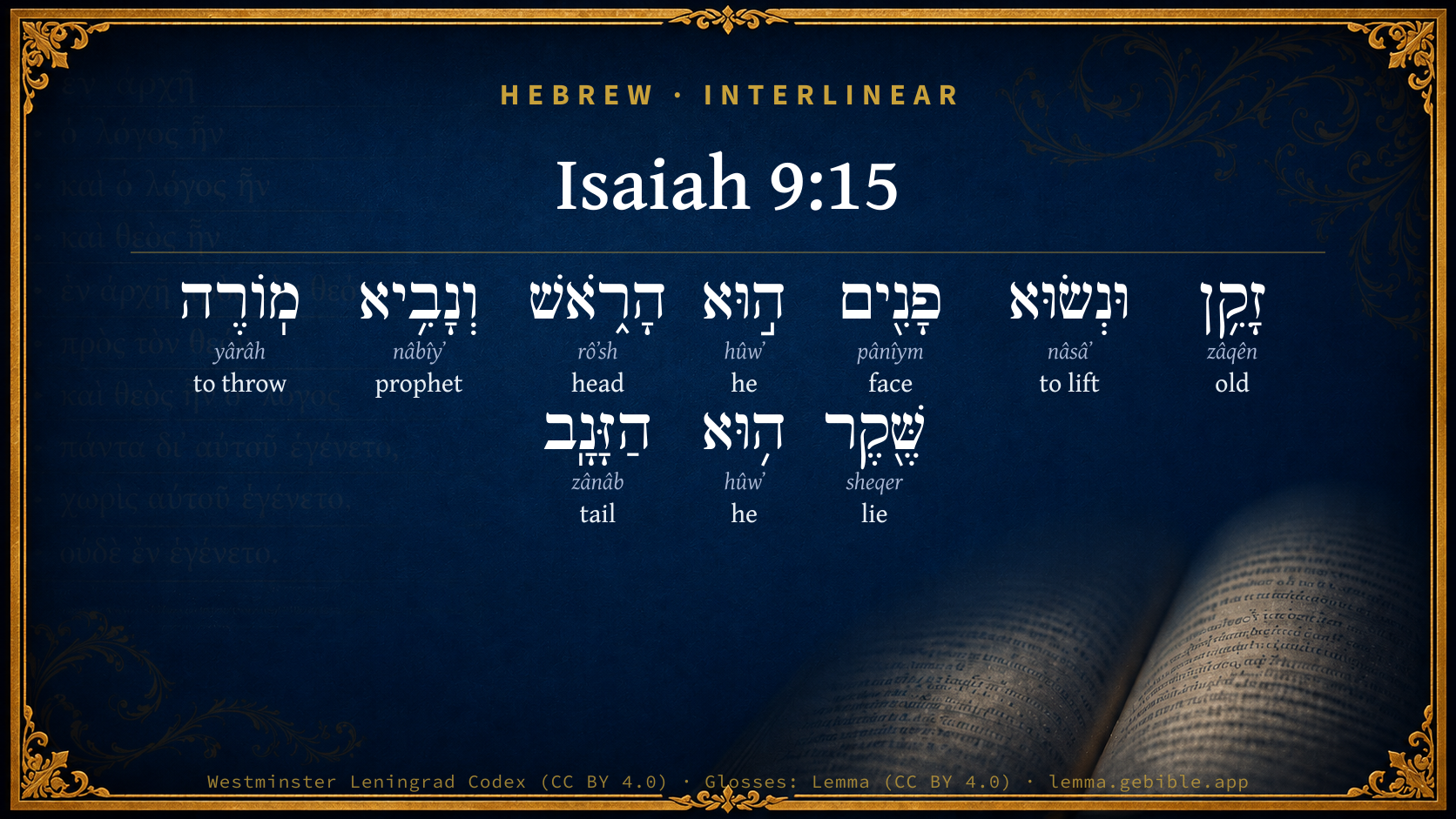
Isaiah 9:15

Hebrew (Westminster Leningrad Codex) Isaiah 9:15 appears in the Hebrew Old Testament. The text above is from the Westminster Leningrad Codex. Each word links to its Strong’s number, a concise gloss, and parsing drawn from the Open Scriptures Hebrew Bible morphology. Click any word for its full Brown-Driver-Briggs (BDB) entry.
Download image
Cite this verse

Isaiah 9:15 (World English Bible). Public Domain. Lemma interlinear Bible study tool, https://lemma.gebible.app/v/isaiah/9/15.

Show BibTeX & RIS
BibTeX
RIS
English Translation
The elder and the honorable man, he is the head; and the prophet who teaches lies, he is the tail.
World English Bible · Public Domain
Download a study sheet

One document with this verse’s original text, its word-by-word gloss line, the meaning frame, cross-references with their text, attributed commentary, and full source and license credits — printable, and it pastes into notes with its structure intact.

This verse Autodidact and up

Study sheet (.html) Plain text (.txt)

A passage Seminary Student

Up to 50 verses in one chapter. A passage sheet keeps up to 6 commentary sources and 12 cross-references per verse, in the order this page ranks them, and says so on the sheet whenever that leaves anything out. Ask for a single verse and you get the Autodidact verse sheet above.

Everything on this page stays free to read, with no account — the sheet is a download of what is already on screen, not access to it.

Want to remove ads? Support Godless Engineer
Compare translations 3

The same verse in 3 English versions, stacked beneath the original-language interlinear above. Click any original word for its lexicon entry.

Each is an independent rendering of the whole verse — the interlinear is not word-aligned to these translations.

Highlighted words mark where these versions differ — a whole-verse word diff, not a word-by-word alignment.

  • World English Bible Public Domain
    The elder and the honorable man, he is the head; and the prophet who teaches lies, he is the tail.
  • King James Version Public Domain
    The ancient and honourable, he is the head; and the prophet that teacheth lies, he is the tail.
  • unfoldingWord Literal Text CC BY-SA 4.0
    The elder and the lifted of face, he the head, and the prophet teaching falsehood, he the tail.

unfoldingWord Literal Text — © unfoldingWord, licensed CC BY-SA 4.0. Word-aligned USFM3 via Door43 (git.door43.org/unfoldingWord/en_ult).

Versions to compare (up to 4)

3 of 4 selected

Show all 18 translations

Every available English version of this verse, each an independent rendering of the whole verse.

  • World English Bible Public Domain
    The elder and the honorable man, he is the head; and the prophet who teaches lies, he is the tail.
  • Berean Standard Bible Public Domain
    The head is the elder and honorable man, and the tail is the prophet who teaches lies.
  • Majority Standard Bible Public Domain
    The head is the elder and honorable man, and the tail is the prophet who teaches lies.
  • King James Version Public Domain
    The ancient and honourable, he is the head; and the prophet that teacheth lies, he is the tail.
  • American Standard Version (1901) Public Domain
    The elder and the honorable man, he is the head; and the prophet that teacheth lies, he is the tail.
  • Revised Version (1885) Public Domain
    The ancient and the honourable man, he is the head; and the prophet that teacheth lies, he is the tail.
  • Geneva Bible (1599) Public Domain
    The ancient and the honorable man, he is the head: and the prophet that teacheth lies, he is the taile.
  • Douay-Rheims (1899) Public Domain
    The aged and honourable, he is the head: and the prophet that teacheth lies, he is the tail.
  • Young's Literal Translation Public Domain
    Elder, and accepted of face, he `is' the head, Prophet, teacher of falsehood, he `is' the tail.
  • Literal Standard Version CC BY-SA 4.0
    Elderly and accepted of faces—he [is] the head, || And prophet teaching falsehood—he [is] the tail.
  • Unlocked Literal Bible CC BY-SA 4.0
    The leader and the noble man are the head; and the prophet that teaches lies is the tail.
  • unfoldingWord Literal Text CC BY-SA 4.0
    The elder and the lifted of face, he the head, and the prophet teaching falsehood, he the tail.
  • Darby Bible Public Domain
    the ancient and honourable, he is the head; and the prophet that teacheth lies, he is the tail.
  • World Messianic Bible Public Domain
    The elder and the honorable man is the head, and the prophet who teaches lies is the tail.
  • Webster's Bible Public Domain
    The ancient and honorable, he is the head; and the prophet that teacheth lies, he is the tail.
  • Free Bible Version CC BY-SA 4.0
    Elders and honorable people are the head, and prophets who teach lies are the tail.
  • Bible in Basic English Public Domain
    The man who is honoured and responsible is the head, and the prophet who gives false teaching is the tail.
  • JPS Tanakh (1917) Public Domain
    (9-14) The elder and the man of rank, he is the head; and the prophet that teacheth lies, he is the tail.

Literal Standard Version (2020), Covenant Press — licensed CC BY-SA 4.0. Text via the HelloAO Bible API (eBible.org). Unlocked Literal Bible (unfoldingWord) — licensed CC BY-SA 4.0. Text via the HelloAO Bible API (eBible.org). unfoldingWord Literal Text — © unfoldingWord, licensed CC BY-SA 4.0. Word-aligned USFM3 via Door43 (git.door43.org/unfoldingWord/en_ult). Free Bible Version, Dr. Jonathan Gallagher — licensed CC BY-SA 4.0. Text via the HelloAO Bible API (eBible.org).

Word by word

More ways to search: Search by grammar → Find every occurrence → Compare this word →

Practice this passage: Drill this verse → Learn its vocabulary →

הַזָּנָֽב
zânâb
H2180
“the · tail”
Particle, Definite Article + Noun, Common, Masculine, Singular, Absolute
Part of Speech
Particle + Noun
Type
Common
Gender
Masculine
Number
Singular
State
Absolute
Full BDB Definition

Origin: from H2179 (in the original sense of flapping)

TWOT: 562a

tail, end, stump
  1. זָקֵ֥ן zâqên H2205 “old” Adjective, Adjective, Masculine, Singular, Absolute
  2. וּנְשׂוּא nâsâʼ H5375 “and · lifted” Conjunction + Verb, Qal, Participle Passive, Masculine, Singular, Construct
  3. פָנִ֖ים pânîym H6440 “face(s)” Noun, Common, Both, Plural, Absolute
  4. ה֣וּא hûwʼ H1931 “he” Pronoun, Personal, 3rd Person, Masculine, Singular
  5. הָרֹ֑אשׁ rôʼsh H7218 “the · head” Particle, Definite Article + Noun, Common, Masculine, Singular, Absolute
  6. וְנָבִ֥יא nâbîyʼ H5030 “and · prophet” Conjunction + Noun, Common, Masculine, Singular, Absolute
  7. מֽוֹרֶה yârâh H3384 “throwing” Verb, Hiphil, Participle Active, Masculine, Singular, Absolute
  8. שֶּׁ֖קֶר sheqer H8267 “lie” Noun, Common, Masculine, Singular, Absolute
  9. ה֥וּא hûwʼ H1931 “he” Pronoun, Personal, 3rd Person, Masculine, Singular

About this verse

These counts appear in no published source. They are computed here, from the morphology-tagged text and Lemma’s own curated glosses. What Lemma adds →

10
words
9
distinct lemmas
Prophets
section

Notable vocabulary

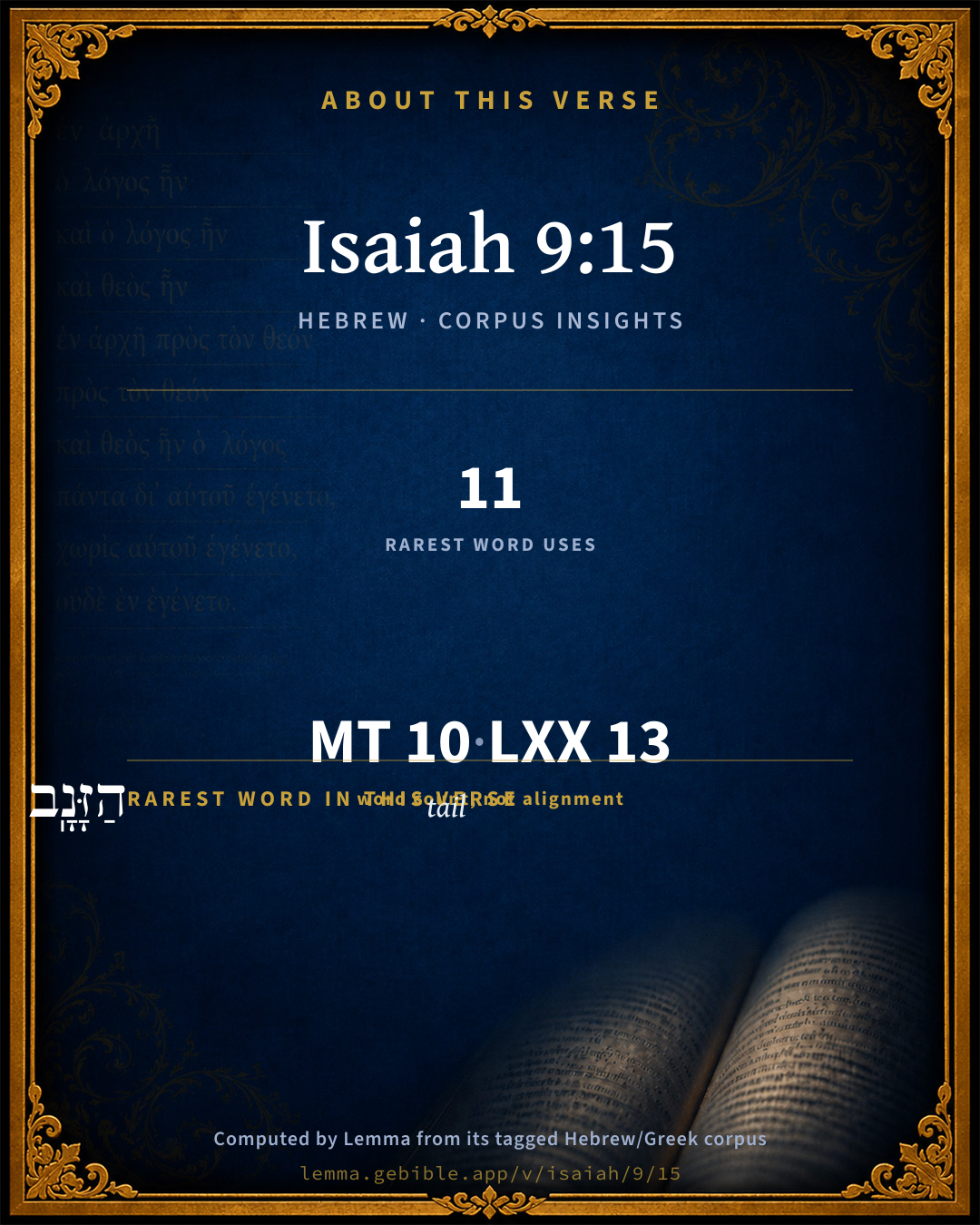
The rarest word here is הַזָּנָֽב tail H2180 — appearing just 11 times in the whole Hebrew Bible.

Shared distinctive vocabulary

הַזָּנָֽב tail H2180 occurs in 9 verses of the Hebrew Bible. Also found in:

Grammatical profile

  • 2 verbs
  • 5 nouns
  • 1 adjective
  • 2 pronouns

Verb forms

  • וּנְשׂוּא Qal · Participle Passive
  • מֽוֹרֶה Hiphil · Participle Active

Repetition

A word recurs within this verse — often emphatic in Hebrew:

  • ה֣וּא he H1931 ×2

Hebrew & Septuagint length

In English translation the verse runs 20 words from the Hebrew and 22 from the Septuagint (LXX English) — closely comparable.

A rough comparison of the two English renderings, which tokenize alike — not a word-level alignment.

Word counts can differ between the Hebrew and the Greek without any difference in meaning — e.g. the Hebrew direct-object marker אֵת has no separate Greek word, and Greek often adds the article ὁ.

In the original languages it is 10 Hebrew tokens and 13 Greek tokens — but the two are counted differently (Hebrew bundles its prefixes and suffixes into one token; the Greek is in lemma form), so that isn’t a like-for-like length.

Cross-references

31

Topical passages linked to Isaiah 9:15 in the Treasury of Scripture Knowledge — connected by theme and wording, ordered by reader-vote popularity; previews shown in the World English Bible.

  • Isaiah 29:10 For Yahweh has poured out on you the spirit of deep sleep, and has closed your eyes, the prophets; and your heads, the seers, has he covered.
  • Matthew 24:24 For there will arise false christs, and false prophets, and they will show great signs and wonders, so as to lead astray, if possible, even the chosen ones.
  • 1 Samuel 9:6 He said to him, See now, there is in this city a man of God, and he is a man who is held in honor; all that he says comes surely to pass: now let us go there; peradventure he can tell us concerning our journey whereon we go.
  • Isaiah 3:2–3 The mighty man, The man of war, The judge, The prophet, The diviner, The elder,
  • Jeremiah 29:21–22 Thus says Yahweh of Hosts, the God of Israel, concerning Ahab the son of Kolaiah, and concerning Zedekiah the son of Maaseiah, who prophesy a lie to you in my name: Behold, I will deliver them into the hand of Nebuchadrezzar king of Babylon; and he shall kill them before your eyes;
  • Ezekiel 13:19 You have profaned me among my people for handfuls of barley and for pieces of bread, to kill the souls who should not die, and to save the souls alive who should not live, by your lying to my people who listen to lies.
  • 2 Timothy 4:2–3 preach the word; be urgent in season and out of season; reprove, rebuke, and exhort, with all patience and teaching.
  • 1 Kings 13:18 He said to him, I also am a prophet as you are; and an angel spoke to me by the word of Yahweh, saying, Bring him back with you into your house, that he may eat bread and drink water. [But] he lied to him.
  • 1 Kings 22:22–24 Yahweh said to him, 'How?' He said, 'I will go forth, and will be a lying spirit in the mouth of all his prophets.' He said, 'You shall entice him, and shall prevail also: go forth, and do so.'
  • Isaiah 3:5 The people will be oppressed, Everyone by another, And everyone by his neighbor. The child will behave himself proudly against the old man, And the base against the honorable.
  • Isaiah 5:13 Therefore my people go into captivity for lack of knowledge; Their honorable men are famished, And their multitudes are parched with thirst.
  • Isaiah 28:17 I will make justice the line, and righteousness the plummet; and the hail shall sweep away the refuge of lies, and the waters shall overflow the hiding-place.
  • Jeremiah 5:31 the prophets prophesy falsely, and the priests bear rule by their means; and my people love to have it so: and what will you do in the end of it?
  • Jeremiah 14:14–15 Then Yahweh said to me, The prophets prophesy lies in my name; I didn't send them, neither have I commanded them, neither spoke I to them: they prophesy to you a lying vision, and divination, and a thing of nothing, and the deceit of their own heart.
  • Jeremiah 23:9 Concerning the prophets. My heart within me is broken, all my bones shake; I am like a drunken man, and like a man whom wine has overcome, because of Yahweh, and because of his holy words.
  • Jeremiah 23:14–15 In the prophets of Jerusalem also I have seen a horrible thing: they commit adultery, and walk in lies; and they strengthen the hands of evil-doers, so that none does return from his wickedness: they are all of them become to me as Sodom, and the inhabitants of it as Gomorrah.
  • Jeremiah 23:25–27 I have heard what the prophets have said, who prophesy lies in my name, saying, I have dreamed, I have dreamed.
  • Jeremiah 27:9–10 But as for you, don't you listen to your prophets, nor to your diviners, nor to your dreams, nor to your soothsayers, nor to your sorcerers, who speak to you, saying, You shall not serve the king of Babylon:
  • Jeremiah 27:14–15 Don't listen to the words of the prophets who speak to you, saying, You shall not serve the king of Babylon; for they prophesy a lie to you.
  • Jeremiah 28:15–16 Then said the prophet Jeremiah to Hananiah the prophet, Hear now, Hananiah: Yahweh has not sent you; but you make this people to trust in a lie.
  • Ezekiel 13:1–16 The word of Yahweh came to me, saying,
  • Ezekiel 13:22 Because with lies you have grieved the heart of the righteous, whom I have not made sad; and strengthened the hands of the wicked, that he should not return from his wicked way, and be saved alive:
  • Hosea 9:8 A prophet watches over Ephraim with my God. A fowler's snare is on all of his paths, And hostility in the house of his God.
  • Malachi 2:9 "Therefore I have also made you contemptible and base before all the people, according to the way you have not kept my ways, but have had respect for persons in the law.
  • Matthew 7:15 "Beware of false prophets, who come to you in sheep's clothing, but inwardly are ravening wolves.
  • 2 Corinthians 11:13–15 For such men are false apostles, deceitful workers, masquerading as Christ's apostles.
  • Galatians 1:8–9 But even though we, or an angel from heaven, should preach to you any gospel other than that which we preached to you, let him be cursed.
  • 2 Thessalonians 2:9–12 even he whose coming is according to the working of Satan with all power and signs and lying wonders,
  • 2 Peter 2:1–3 But there also arose false prophets among the people, as among you also there will be false teachers, who will secretly bring in destructive heresies, denying even the Master who bought them, bringing on themselves swift destruction.
  • 1 John 4:1 Beloved, don't believe every spirit, but test the spirits, whether they are of God, because many false prophets have gone out into the world.
  • Revelation 19:20 The beast was taken, and with him the false prophet who worked the signs in his sight, with which he deceived those who had received the mark of the beast and those who worshiped his image. These two were thrown alive into the lake of fire that burns with sulfur.

Cross-references courtesy of OpenBible.info (CC BY 4.0).

Hebrew and Greek witnesses Masoretic Hebrew ↔ Greek Septuagint

The same verse in the two great witnesses to the Old Testament, shown verse-for-verse.

These are two independent witnesses, not word-aligned to each other, and the Septuagint is shown in lemma (dictionary) form.

Hebrew Isaiah 9:15 Masoretic · Westminster Leningrad Codex

זָקֵ֥ן וּנְשׂוּא פָנִ֖ים ה֣וּא הָרֹ֑אשׁ וְנָבִ֥יא מֽוֹרֶה שֶּׁ֖קֶר ה֥וּא הַזָּנָֽב

The elder and the honorable man, he is the head; and the prophet who teaches lies, he is the tail.

World English Bible · Public Domain

Greek LXX Isaiah 9:15 Septuagint · lemma form

καί εἰμί ὁ μακαρίζω ὁ λαός οὗτος πλανάω καί πλανάω ὅπως καταπίνω αὐτός

the old man, and them that respect persons, this is the head; and the prophet teaching unlawful things, he is the tail.

LXX2012 (modern English Septuagint) · Public Domain

On this verse, John Gill's Exposition discusses the Septuagint’s reading. Read the note in Commentary ↓

Hebrew: Westminster Leningrad Codex (CC BY 4.0). Greek: Septuagint (public domain); English from LXX2012 (modern English Septuagint) (Public Domain). How the Septuagint differs from the Hebrew →

Targum (Aramaic paraphrase)

1

The Targum is the ancient Jewish Aramaic paraphrase of the Hebrew Scriptures — an interpretive translation, not the Hebrew text itself. Onkelos (literal) and Pseudo-Jonathan (expansive) render the Torah, and Jonathan the Prophets. Coverage is partial: where no permissively-licensed English translation exists for a verse, only the Aramaic is shown. This is verse-level text, not a word-by-word alignment to the Hebrew.

  1. Targum Jonathan Prophets (Joshua–Malachi)
    וַהֲווֹ מְשַׁבְּחֵי עַמָא הָדֵין מַטְעָן וְרַבְרְבָנוֹהִי מְסַלְעֲמִין:

    And those that praise this people cause them to err, and their princes swallow them up.

    Targum Jonathan — Aramaic: “Mikraot Gedolot” (public domain). English: “Sefaria Community Translation” (CC0 1.0 (public-domain dedication)); “London "Chaldee Paraphrase," 1871” (public domain). Text via Sefaria.

Commentary

Notes on Isaiah 9:15 from classic Christian and Jewish commentators (each source and its license shown beneath its notes). The classic Christian expositions comment on the surrounding passage and are grouped to its opening verse, so a note may address several verses; the Jewish commentaries on the Tanakh (Rashi and others) are per-verse, so they appear only where the commentator wrote on this verse.

Lemma curates 59 commentaries, every one of them public domain or Creative Commons licensed, each selected and text-cleaned for this edition rather than reprinted as found. About our sources →

Trapp's Complete Commentary

John Trapp

Isa 9:15 The ancient and honourable, he [is] the head; and the prophet that teacheth lies, he [is] the tail.

Ver. 15. The ancient and honourable is the head.] Thus the Scripture frequently expoundeth itself. In a general calamity all fare alike, lords and losels.

And the prophet that teacheth lies, he is the tail.] Such, like dogs, do cauda adblandiri, soothe and smooth men up in their sins, and are the vilest of men. Quid enim contemptius et abiectius animo fingi potest quam assentari divitibus, linguamque venalim habere? Such also, as serpents, glide smoothly over the body, but sting with their tails.

John Trapp, A Commentary or Exposition upon All the Books of the Old and New Testament (1647–1656) — public domain. Text from a community e-Sword module.

Jamieson, Fausset & Brown

Robert Jamieson, A. R. Fausset & David Brown

ancient--the older.

honourable--the man of rank.

prophet . . . lies, . . . tail--There were many such in Samaria (Kg1 22:6, Kg1 22:22-23; compare as to "tail," Rev 9:19).

Jamieson, Fausset & Brown — Commentary Critical and Explanatory on the Whole Bible (1871) — public domain (CC PDM 1.0). Text via the HelloAO Bible API.

Ellicott's Commentary for English Readers

(15) The ancient and honourable . . .—Comp. Isa_3:2-3, for the meaning of the words. These, the prophet seems to say, were the true leaders of the people. The ideal work of the prophet was, indeed, that of a teacher who was to lead even them, but corruptio optimi pessima; and to Isaiah, as to Jeremiah, there was no class so contemptible and base as that of spiritual guides whose policy was that of a time-serving selfishness. The verse is rejected by some critics as a marginal note that has found its way into the text; but the prophet may well have given his own interpretation of this formula. (Comp. Isa_28:7; Isa_29:10; Jer_14:14; Jer_23:9-40.)

A Bible Commentary for English Readers, edited by Charles John Ellicott (1878–1897) — public domain. Text from a community e-Sword module.

John Gill's Exposition

The ancient and honourable, he is the head,.... The elder in office, not in age; and who, on account of his office, dignity, and riches, is honoured by men, is of a venerable countenance himself, and is reverenced when seen and looked upon by others, and received by persons with pleasure and cheerfulness; as the phrase used signifies. The Septuagint and Arabic versions render it, "who admire", or "have" men's "persons in admiration"; which is the character Jude gives of false teachers, Jde 1:16 who are next described:

and the prophet that teacheth lies, he is the tail; so called from their low extract, being often of a mean original and descent; or rather from the meanness of their spirits, their flattery of princes and great men, to whom they tell lies, and prophesy smooth and false things, for the sake of a little sordid gain, in allusion to dogs that wag their tails at their masters; or from the poison of their doctrines, some creatures having poison in their tails, and do much mischief with them. See Rev 9:19.

John Gill's Exposition of the Whole Bible (1746–1763) — public domain (CC PDM 1.0). Text via the HelloAO Bible API.

Albert Barnes' Notes on the Bible

The ancient - The elder; the old man.

And honorable - Hebrew, ‘The man of elevated countenance.’ The man of rank and office.

The prophet that teacheth lies - The false prophet. Of those there were many; and probably at this time many in Samaria.

Albert Barnes' Notes on the Bible (1834–1885) — public domain. Text from a community e-Sword/MySword module.

Matthew Poole's English Annotations

He is, i.e. signifies, as that word is commonly used in the Hebrew tongue, as Gen 41:26,27, and every where.

The prophet that teacheth lies; whose destruction he mentions, not as if it were a punishment to them to be deprived of such persons, but partly to show the extent of the calamity, that it should reach all sorts of persons; and partly to beat down their vain presumptions of peace and prosperity, by showing that those false prophets, which had fed their vain hopes, should perish, and all their false prophecies of peace with them.

He is the tail; these I mean by the tail, as being in’ truth the basest part of the whole body of the people.

Matthew Poole's English Annotations on the Holy Bible (1683–1685) — public domain. Text from a community e-Sword/MySword module.

The Pulpit Commentary

Some suppose this verse to be a gloss, or marginal note, which has crept into the text; but it is too pointed and sarcastic for a mere gloss. There is no reason to doubt its being Isaiah"s. Having spoken of "the tail," he takes the opportunity of lashing the false prophet, who claimed to be among the "honorable," but was really the lowest of the low, worse than his dupes, the true "tail". (comp. Isa_28:7 Isa_29:10 Isa_30:10)

The Pulpit Commentary (1880–1919), ed. H.D.M. Spence-Jones & Joseph S. Exell — public domain. Text from a community e-Sword module.

John Wesley's Explanatory Notes

The prophet - Whose destruction he mentions, not as if it were a punishment to them to be deprived of such persons, but partly to shew the extent of the calamity, that it should reach all sorts of persons; and partly to beat down their vain presumptions of peace and prosperity, by shewing that those false prophets, which had fed their vain hopes, should perish, and their false prophecies with them. Tail - The basest part of the whole people.

John Wesley, Explanatory Notes Upon the Whole Bible (1754–1765) — public domain. Text via the GEBible commentary corpus.

J. A. Alexander on Isaiah

Joseph Addison Alexander

To the descriptive figures of the preceding verse, the Prophet now adds a specific application of the first. Jehovah had cut off from Israel, not only in a general sense the upper and lower classes of society, but in a more restricted sense the wicked rulers, who were the corrupt head of the body politic, and the false prophets who, as their abject adherents, and on account of their hypocrisy and false pretensions to divine authority, must be regarded as its tail, because contemptible and odious, even in comparison with other wicked men, who laid no claim to a religious character. “The elder and the favorite (or honorable person), he (is) the head, and the prophet teaching falsehood, he (is) the tail.” The teaching of falsehood means teaching in the name of God what he has not revealed. The false prophets are called the tail, because the false prophets were morally the basest of the people, and because they were the servile adherents and supporters of the wicked rulers. With respect both to the head which they followed, and the body of which they were the vilest part, they might be justly called the tail.

Joseph Addison Alexander, The Prophecies of Isaiah (1846–1847; New York: Scribner, 1870–1878) — public domain. Text from a community e-Sword module.

Rashi

Rabbi Shlomo Yitzchaki (Rashi)

the leaders Heb. מְאַשְׁרֵי, leaders. Comp. (Job 23:11) “On His steps (בַּאֲשֻׁרוֹ), my foot has held fast.”

and those led by them (lit. him) those who learned the ways of the false leaders. [Others read:] Those led in the way of the misleaders who lead them in these ways, confusing and perplexing ways, from which there is no way to emerge. The expression of מְבֻלָּעִים, misled or corrupt, applies to “ways,” in the manner it is stated elsewhere (supra 3:12): “O my people! Your leaders lead you astray, and the way of your paths they have corrupted.”

Rashi on the Tanakh — English translations: “The Judaica Press complete Tanach with Rashi, translated by A. J. Rosenberg” (CC BY 4.0); “Pentateuch with Rashi's commentary by M. Rosenbaum and A.M. Silbermann, 1929-1934” (public domain); “The Metsudah Tanach series, Lakewood, N.J” (CC BY 4.0); and “The Book of Joshua, Metsudah Publications, 1997” (CC BY 4.0). Text via Sefaria.

Ibn Ezra

Rabbi Abraham ibn Ezra

מאשרי The leaders of. Here we have א instead of י. This process of substituting א for י is reversed in תתימרו You boast yourselves (61:6). In ומאשריו And they that are led, is the א again in the place of.י

Ibn Ezra on the Tanakh — English translations: “Sefaria Community Translation” (CC0 1.0 (public-domain dedication)); “Yalkut, Sifsei Chachomim Chumash, Metsudah Publications, 2009” (CC BY 4.0); and “Commentary of Ibn Ezra on Isaiah - trans. by M. Friedlander, 1873” (public domain). Text via Sefaria.

Lesson kit

Teaching starters — assembled from the data on this page, not authored interpretation. Every prompt links to the verse data it draws on. Edit before teaching.

Isaiah, in the Prophets, opens this verse with 10 words (9 distinct Hebrew lemmas). Its most distinctive word is zânâb (“tail”). A historical commentator’s framing appears above. Read the whole chapter for the surrounding context.

Discussion questions

  1. How does “tail” (zânâb) shape what this verse is saying?
  2. Exodus 4:4 shares the word «tail» with this verse. How do the two illuminate each other?
  3. “he” occurs 2× in this one verse. What is the effect of the repetition?
  4. These translations render this verse differently. What is at stake in choosing one wording over another?
  5. The verb «וּנְשׂוּא» is Qal Participle Passive. How does its form color the action?
  6. Reading how Trapp's Complete Commentary and Jamieson, Fausset & Brown read this verse, where do the two commentators agree and where do they part?

Things to notice

Reading settings

Reading text

Shown beneath each verse's original-language words.

Old Testament
Old Testament edition

Read the OT as the Masoretic Hebrew (MT) or the Greek Septuagint (LXX).

English shown for the Greek Septuagint (in the Hebrew ↔ Greek comparison).

Comparing translations? Open the Compare panel on any verse page to stack up to four side by side.