Judges 11:5

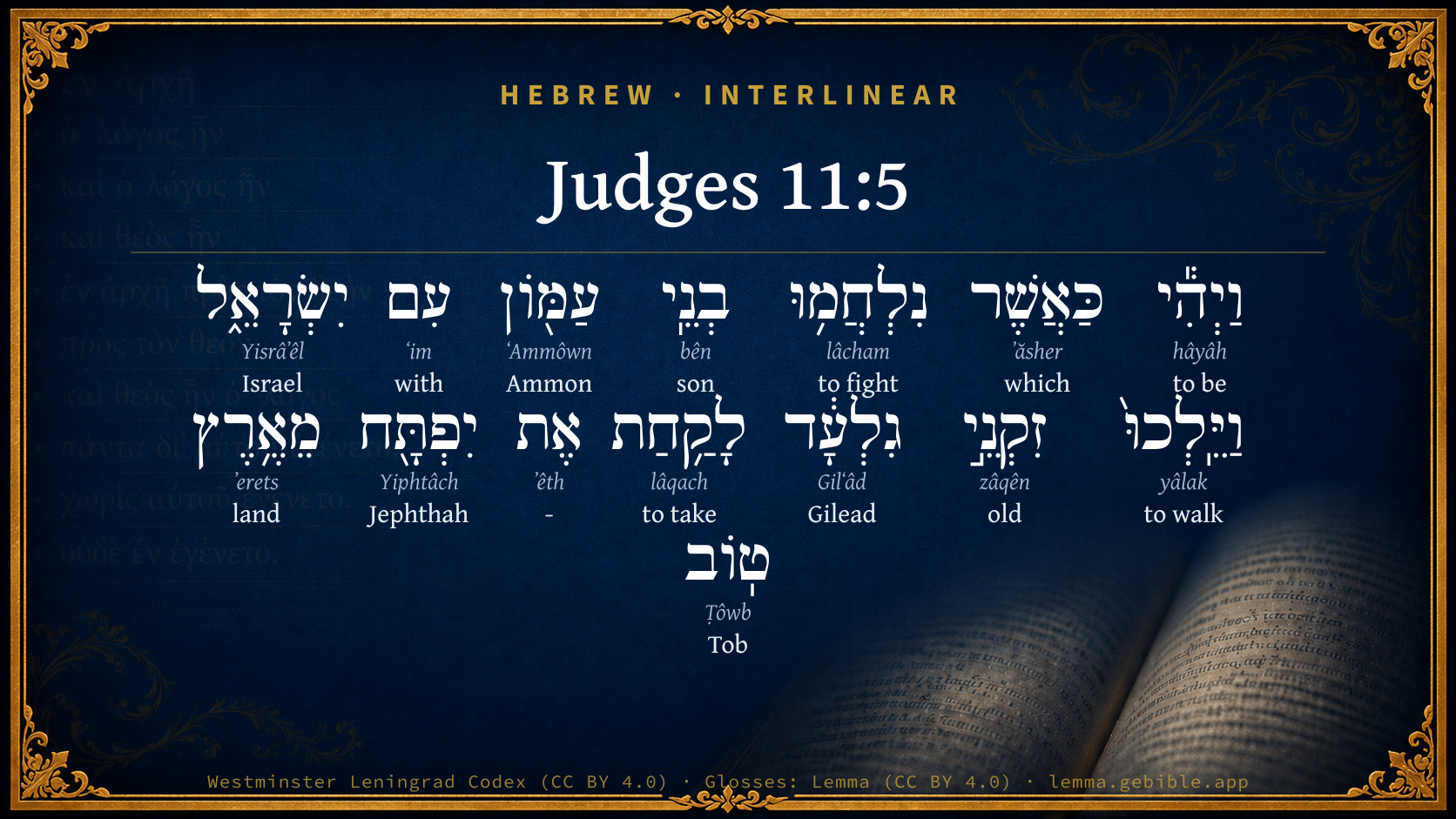
Hebrew (Westminster Leningrad Codex) Judges 11:5 appears in the Hebrew Old Testament. The text above is from the Westminster Leningrad Codex. Each word links to its Strong’s number, a concise gloss, and parsing drawn from the Open Scriptures Hebrew Bible morphology. Click any word for its full Brown-Driver-Briggs (BDB) entry.
Download image
Cite this verse

Judges 11:5 (World English Bible). Public Domain. Lemma interlinear Bible study tool, https://lemma.gebible.app/v/judges/11/5.

Show BibTeX & RIS
BibTeX
RIS
English Translation
It was so, that when the children of Ammon made war against Israel, the elders of Gilead went to get Jephthah out of the land of Tob;
World English Bible · Public Domain
Download a study sheet

One document with this verse’s original text, its word-by-word gloss line, the meaning frame, cross-references with their text, attributed commentary, and full source and license credits — printable, and it pastes into notes with its structure intact.

This verse Autodidact and up

Study sheet (.html) Plain text (.txt)

A passage Seminary Student

Up to 50 verses in one chapter. A passage sheet keeps up to 6 commentary sources and 12 cross-references per verse, in the order this page ranks them, and says so on the sheet whenever that leaves anything out. Ask for a single verse and you get the Autodidact verse sheet above.

Everything on this page stays free to read, with no account — the sheet is a download of what is already on screen, not access to it.

Want to remove ads? Support Godless Engineer
Compare translations 3

The same verse in 3 English versions, stacked beneath the original-language interlinear above. Click any original word for its lexicon entry.

Each is an independent rendering of the whole verse — the interlinear is not word-aligned to these translations.

Highlighted words mark where these versions differ — a whole-verse word diff, not a word-by-word alignment.

  • World English Bible Public Domain
    It was so, that when the children of Ammon made war against Israel, the elders of Gilead went to get Jephthah out of the land of Tob;
  • King James Version Public Domain
    And it was so, that when the children of Ammon made war against Israel, the elders of Gilead went to fetch Jephthah out of the land of Tob:
  • unfoldingWord Literal Text CC BY-SA 4.0
    And it happened, when the sons of Ammon fought with Israel, that the elders of Gilead went to get Jephthah from the land of Tob.

unfoldingWord Literal Text — © unfoldingWord, licensed CC BY-SA 4.0. Word-aligned USFM3 via Door43 (git.door43.org/unfoldingWord/en_ult).

Versions to compare (up to 4)

3 of 4 selected

Show all 18 translations

Every available English version of this verse, each an independent rendering of the whole verse.

  • World English Bible Public Domain
    It was so, that when the children of Ammon made war against Israel, the elders of Gilead went to get Jephthah out of the land of Tob;
  • Berean Standard Bible Public Domain
    and made war with them, the elders of Gilead went to get Jephthah from the land of Tob.
  • Majority Standard Bible Public Domain
    and made war with them, the elders of Gilead went to get Jephthah from the land of Tob.
  • King James Version Public Domain
    And it was so, that when the children of Ammon made war against Israel, the elders of Gilead went to fetch Jephthah out of the land of Tob:
  • American Standard Version (1901) Public Domain
    And it was so, that, when the children of Ammon made war against Israel, the elders of Gilead went to fetch Jephthah out of the land of Tob;
  • Revised Version (1885) Public Domain
    And it was so, that when the children of Ammon made war against Israel, the elders of Gilead went to fetch Jephthah out of the land of Tob:
  • Geneva Bible (1599) Public Domain
    And when the children of Ammon fought with Israel, the Elders of Gilead went to fet Iphtah out of the land of Tob.
  • Douay-Rheims (1899) Public Domain
    And as they pressed hard upon them, the ancients of Galaad went to fetch Jephte out of the land of Tob to help them:
  • Young's Literal Translation Public Domain
    and it cometh to pass, when the Bene-Ammon have fought with Israel, that the elders of Gilead go to take Jephthah from the land of Tob;
  • Literal Standard Version CC BY-SA 4.0
    and it comes to pass, when the sons of Ammon have fought with Israel, that [the] elderly of Gilead go to take Jephthah from the land of Tob;
  • Unlocked Literal Bible CC BY-SA 4.0
    When the people of Ammon made war against Israel, the elders of Gilead went to bring Jephthah back from the land of Tob.
  • unfoldingWord Literal Text CC BY-SA 4.0
    And it happened, when the sons of Ammon fought with Israel, that the elders of Gilead went to get Jephthah from the land of Tob.
  • Darby Bible Public Domain
    And when the Ammonites made war against Israel, the elders of Gilead went to bring Jephthah from the land of Tob;
  • World Messianic Bible Public Domain
    When the children of Ammon made war against Israel, the elders of Gilead went to get Jephthah out of the land of Tob.
  • Webster's Bible Public Domain
    And it was so, that when the children of Ammon made war against Israel, the elders of Gilead went to bring Jephthah out of the land of Tob:
  • Free Bible Version CC BY-SA 4.0
    As the Ammonites were attacking Israel, the elders of Gilead came to get Jephthah from the land of Tob.
  • Bible in Basic English Public Domain
    And when the children of Ammon made war against Israel, the responsible men of Gilead went to get Jephthah back from the land of Tob;
  • JPS Tanakh (1917) Public Domain
    And it was so, that when the children of Ammon made war against Israel, the elders of Gilead went to fetch Jephthah out of the land of Tob.

Literal Standard Version (2020), Covenant Press — licensed CC BY-SA 4.0. Text via the HelloAO Bible API (eBible.org). Unlocked Literal Bible (unfoldingWord) — licensed CC BY-SA 4.0. Text via the HelloAO Bible API (eBible.org). unfoldingWord Literal Text — © unfoldingWord, licensed CC BY-SA 4.0. Word-aligned USFM3 via Door43 (git.door43.org/unfoldingWord/en_ult). Free Bible Version, Dr. Jonathan Gallagher — licensed CC BY-SA 4.0. Text via the HelloAO Bible API (eBible.org).

Word by word

More ways to search: Search by grammar → Find every occurrence → Compare this word →

Practice this passage: Drill this verse → Learn its vocabulary →

טֽוֹב
Ṭôwb
H2897
“Tob”
Noun, Proper
Part of Speech
Noun
Type
Proper
Full BDB Definition

Origin: the same as H2896

TWOT: None

Tob = "good" - a region east of the Jordan, north or northeast of Gilead, probably Aramean, location uncertain
  1. וַיְהִ֕י hâyâh H1961 “and · to be” Conjunction + Verb, Qal, Sequential Imperfect, 3rd Person, Masculine, Singular
  2. כַּאֲשֶׁר ʼăsher H834 “like/as · which” Preposition + Particle, Relative
  3. נִלְחֲמ֥וּ lâcham H3898 “to fight” Verb, Niphal, Perfect, 3rd Person, Common, Plural
  4. בְנֵֽי bên H1121 “sons of” Noun, Common, Masculine, Plural, Construct
  5. עַמּ֖וֹן ʻAmmôwn H5983 “Ammon” Noun, Proper
  6. עִם ʻim H5973 “with” Preposition
  7. יִשְׂרָאֵ֑ל Yisrâʼêl H3478 “Israel” Noun, Proper
  8. וַיֵּֽלְכוּ֙ yâlak H3212 “and · to walk” Conjunction + Verb, Qal, Sequential Imperfect, 3rd Person, Masculine, Plural
  9. זִקְנֵ֣י zâqên H2205 “old of” Adjective, Adjective, Masculine, Plural, Construct
  10. גִלְעָ֔ד Gilʻâd H1568 “Gilead” Noun, Proper
  11. לָקַ֥חַת lâqach H3947 “to take” Preposition + Verb, Qal, Infinitive Construct
  12. אֶת ʼêth H853 “-” Particle, Direct Object
  13. יִפְתָּ֖ח Yiphtâch H3316 “Jephthah” Noun, Proper
  14. מֵאֶ֥רֶץ ʼerets H776 “from · land of” Preposition + Noun, Common, Both, Singular, Construct

About this verse

These counts appear in no published source. They are computed here, from the morphology-tagged text and Lemma’s own curated glosses. What Lemma adds →

15
words
15
distinct lemmas
Historical
section

Notable vocabulary

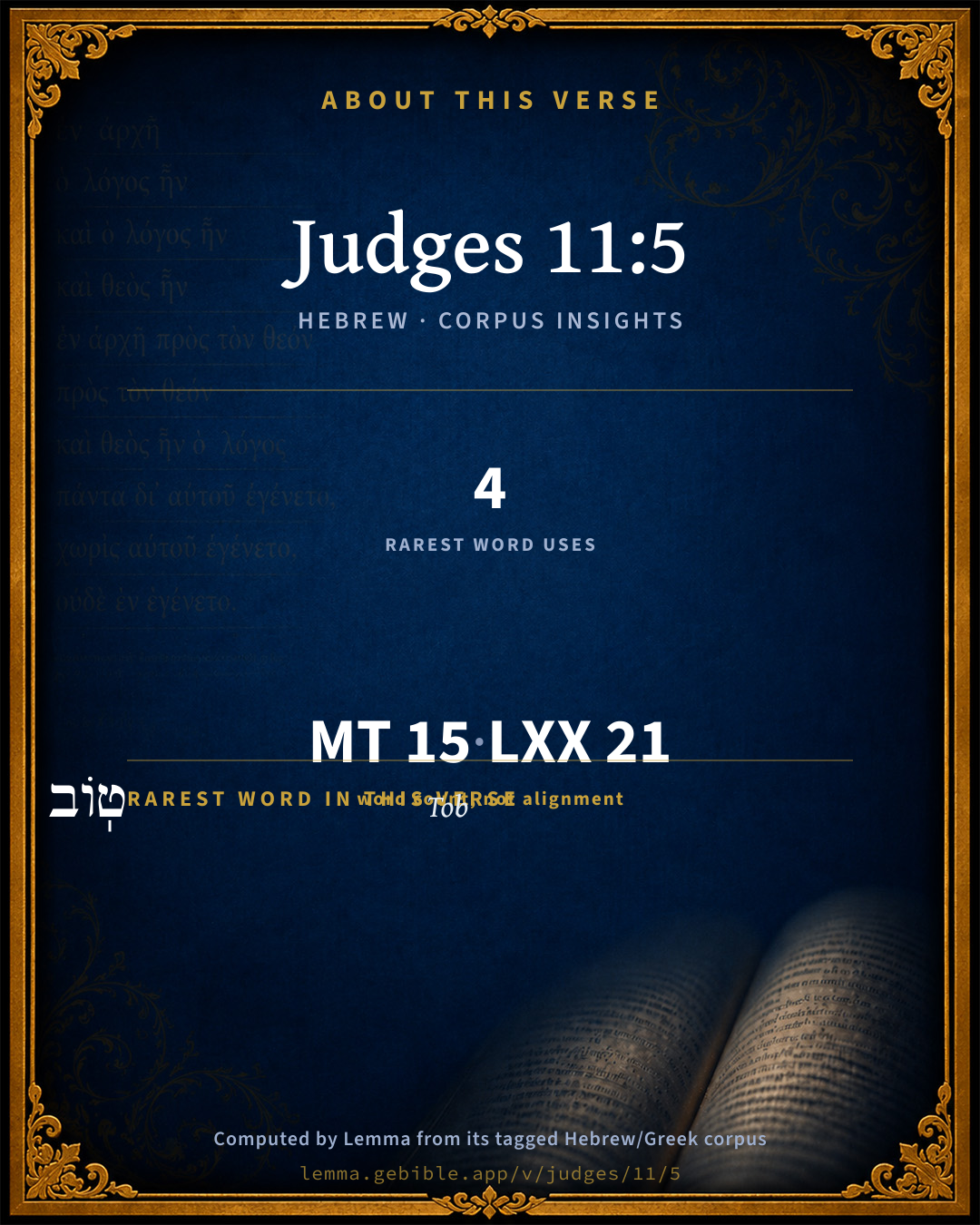
The rarest word here is טֽוֹב Tob H2897 — appearing just 4 times in the whole Hebrew Bible.

Shared distinctive vocabulary

טֽוֹב Tob H2897 occurs in 4 verses of the Hebrew Bible. Also found in:

Grammatical profile

  • 4 verbs
  • 7 nouns
  • 1 adjective
  • 1 preposition
  • 2 particles

Verb forms

  • וַיְהִ֕י Qal · Sequential Imperfect
  • נִלְחֲמ֥וּ Niphal · Perfect
  • וַיֵּֽלְכוּ֙ Qal · Sequential Imperfect
  • לָקַ֥חַת Qal · Infinitive Construct

Hebrew & Septuagint length

In English translation the verse runs 27 words from the Hebrew and 14 from the Septuagint (LXX English) — the Septuagint runs noticeably shorter here. See the side-by-side →

A rough comparison of the two English renderings, which tokenize alike — not a word-level alignment.

Word counts can differ between the Hebrew and the Greek without any difference in meaning — e.g. the Hebrew direct-object marker אֵת has no separate Greek word, and Greek often adds the article ὁ.

In the original languages it is 15 Hebrew tokens and 21 Greek tokens — but the two are counted differently (Hebrew bundles its prefixes and suffixes into one token; the Greek is in lemma form), so that isn’t a like-for-like length.

Cross-references

8

Topical passages linked to Judges 11:5 in the Treasury of Scripture Knowledge — connected by theme and wording, ordered by reader-vote popularity; previews shown in the World English Bible.

  • 1 Corinthians 1:27–29 but God chose the foolish things of the world that he might put to shame those who are wise. God chose the weak things of the world, that he might put to shame the things that are strong;
  • 1 Samuel 11:12 The people said to Samuel, Who is he who said, Shall Saul reign over us? bring the men, that we may put them to death.
  • Psalms 118:22–23 The stone which the builders rejected has become the head of the corner.
  • Acts 7:35–39 "This Moses, whom they refused, saying, 'Who made you a ruler and a judge?'--God has sent him as both a ruler and a deliverer by the hand of the angel who appeared to him in the bush.
  • Judges 10:9 The children of Ammon passed over the Jordan to fight also against Judah, and against Benjamin, and against the house of Ephraim; so that Israel was sore distressed.
  • Judges 10:17–18 Then the children of Ammon were gathered together, and encamped in Gilead. The children of Israel assembled themselves together, and encamped in Mizpah.
  • 1 Samuel 10:27 But certain worthless fellows said, How shall this man save us? They despised him, and brought him no present. But he held his peace.
  • 1 Samuel 11:6–7 The Spirit of God came mightily on Saul when he heard those words, and his anger was kindled greatly.

Cross-references courtesy of OpenBible.info (CC BY 4.0).

Hebrew and Greek witnesses Masoretic Hebrew ↔ Greek Septuagint

The same verse in the two great witnesses to the Old Testament, shown verse-for-verse.

Here the Septuagint runs noticeably shorter than the Hebrew — LXX2012 (modern English Septuagint) 14 words vs World English Bible 27. A rough length comparison of the two English translations, not a word-level alignment — read both below.

These are two independent witnesses, not word-aligned to each other, and the Septuagint is shown in lemma (dictionary) form.

Hebrew Judges 11:5 Masoretic · Westminster Leningrad Codex

וַיְהִ֕י כַּאֲשֶׁר נִלְחֲמ֥וּ בְנֵֽי עַמּ֖וֹן עִם יִשְׂרָאֵ֑ל וַיֵּֽלְכוּ֙ זִקְנֵ֣י גִלְעָ֔ד לָקַ֥חַת אֶת יִפְתָּ֖ח מֵאֶ֥רֶץ טֽוֹב

It was so, that when the children of Ammon made war against Israel, the elders of Gilead went to get Jephthah out of the land of Tob;

World English Bible · Public Domain

Greek LXX Judges 11:5 Septuagint · lemma form

καί γίγνομαι ἡνίκα παρατάσσω ὁ υἱός αμμων μετά ἰσραήλ καί πορεύομαι ὁ πρεσβύτερος γαλαάδ λαμβάνω ὁ ιεφθαε ἀπό ὁ γῆ τωβ

that the elders of Galaad went to fetch Jephthae from the land of Tob.

LXX2012 (modern English Septuagint) · Public Domain

On this verse, The Cambridge Bible for Schools and Colleges discusses the Septuagint’s reading. Read the note in Commentary ↓

Hebrew: Westminster Leningrad Codex (CC BY 4.0). Greek: Septuagint (public domain); English from LXX2012 (modern English Septuagint) (Public Domain). How the Septuagint differs from the Hebrew →

Targum (Aramaic paraphrase)

1

The Targum is the ancient Jewish Aramaic paraphrase of the Hebrew Scriptures — an interpretive translation, not the Hebrew text itself. Onkelos (literal) and Pseudo-Jonathan (expansive) render the Torah, and Jonathan the Prophets. Coverage is partial: where no permissively-licensed English translation exists for a verse, only the Aramaic is shown. This is verse-level text, not a word-by-word alignment to the Hebrew.

  1. Targum Jonathan Prophets (Joshua–Malachi)
    וַהֲוָה כַּד אַגִיחוּ קְרָבָא בְּנֵי עַמוֹן עִם יִשְׂרָאֵל וַאֲזַלוּ סָבֵי גִלְעָד לְמִדְבַּר יַת יִפְתַּח מֵאֲרַע טָב:

    (no public-domain English translation for this verse)

    Targum Jonathan — Aramaic: “Mikraot Gedolot” (public domain). English: “Sefaria Community Translation” (CC0 1.0 (public-domain dedication)); “London "Chaldee Paraphrase," 1871” (public domain). Text via Sefaria.

Commentary

Notes on Judges 11:5 from classic Christian and Jewish commentators (each source and its license shown beneath its notes). The classic Christian expositions comment on the surrounding passage and are grouped to its opening verse, so a note may address several verses; the Jewish commentaries on the Tanakh (Rashi and others) are per-verse, so they appear only where the commentator wrote on this verse.

Lemma curates 59 commentaries, every one of them public domain or Creative Commons licensed, each selected and text-cleaned for this edition rather than reprinted as found. About our sources →

Trapp's Complete Commentary

John Trapp

Jdg 11:5 And it was so, that when the children of Ammon made war against Israel, the elders of Gilead went to fetch Jephthah out of the land of Tob:

Ver. 5. The elders of Gilead went to fetch Jephthah.] Whereunto they were necessitated: for else a bastard might not bear office, {Deu 23:2} for an admonition of chastity in regard of the infamy and contempt of such a polluted posterity. Upon a like necessity of the Catalinarian conspiracy breaking out in Rome, M. Tullius Cicero was made consul, though a new man, and none of the ancient nobility: which when it was objected unto him, he answered, Satius est meis gestis florere, quam maiorum opinione uti, &c., { a} that it was better to be a foundation of nobility to his posterity, and a pattern of virtue, than to be famous only for his noble ancestors. Two things he said he had to support him under whatsoever crosses or obloquies of men, Optimarum artium scientiam et maximarum rerum gloriam, {b} the knowledge of good arts, and the glory of his great acts: the one whereof should never be taken from him whilst alive; the other, no not when he was dead.

{a} Sallust.

{b} Epist. Famil., lib. vii.

John Trapp, A Commentary or Exposition upon All the Books of the Old and New Testament (1647–1656) — public domain. Text from a community e-Sword module.

Geneva Bible (1599)

Geneva Bible translators

Or, ambassadors, sent for that purpose.

Geneva Bible (1599) marginal notes — public domain. Text via Bolls.life.

Jamieson, Fausset & Brown

Robert Jamieson, A. R. Fausset & David Brown

the elders of Gilead went to fetch Jephthah--All eyes were directed towards him as the only person possessed of the qualities requisite for the preservation of the country in this time of imminent danger; and a deputation of the chief men was despatched from the Hebrew camp at Mizpeh to solicit his services.

Jamieson, Fausset & Brown — Commentary Critical and Explanatory on the Whole Bible (1871) — public domain (CC PDM 1.0). Text via the HelloAO Bible API.

Ellicott's Commentary for English Readers

(5) When the children of Ammon made war.—The allusion is to some special threat of invasion (acriter instantibus, Vulg.) at the close of the eighteen years of oppression (Jdg_10:9).

To fetch Jephthah.—Because by this time he had made himself a great name as a brave and successful chieftain of marauders, who would doubtless come with him to lead the Gileadites.

A Bible Commentary for English Readers, edited by Charles John Ellicott (1878–1897) — public domain. Text from a community e-Sword module.

The Cambridge Bible for Schools and Colleges

gen. ed. J. J. S. Perowne

5. And it was so … against Israel] These words, which merely repeat Jdg_11:4, presuppose that the history has already begun, and were perhaps inserted to connect with Jdg_10:17 f. In some recensions of the LXX they are wanting, in others Jdg_11:4 is omitted.

the elders of Gilead] means no more than the sheikhs of the district.

The Cambridge Bible for Schools and Colleges (gen. ed. J. J. S. Perowne; Cambridge University Press, 1878–1918) — public domain. Text from a community e-Sword module.

John Gill's Exposition

And it was so, that when the children of Ammon made war against Israel,.... Were preparing for it, and had assembled their forces near them, and had began to make some efforts against them:

the elders of Gilead went to fetch Jephthah out of the land of Tob; they did not send messengers to him, but went themselves, partly to show greater respect to him, and partly in hopes of better success, being aware of objections he would make, which they could better answer themselves than a deputation.

John Gill's Exposition of the Whole Bible (1746–1763) — public domain (CC PDM 1.0). Text via the HelloAO Bible API.

Haydock's Catholic Bible Commentary

Hard. Hebrew, "and when the Ammonites made war." As both armies were encamped near Maspha, they could hardly avoid having some skirmishes. But the Israelites durst not come to a pitched battle till they had Jephte at their head. (Haydock) --- The Ammonites infested them every year with similar incursions, ver. 12. (Calmet)

George Leo Haydock (1774–1849), Haydock's Catholic Family Bible and Commentary, 1859 edition — public domain. Excludes Psalms (Douay-Rheims chapter numbering differs from Protestant) and Deuterocanonical books (Catholic canon only).

Matthew Poole's English Annotations

By direction or instinct from God, who both qualified him for and called him to the office of a judge. See Jdg 12:7; Heb 11:32. Otherwise they might not have chosen a bastard, Deu 23:2. Unless we will say, that there being no other person among them fit for and willing to this work, necessity dispensed with this law, as it did with other positive laws, as those of the sabbath and sacrifices.

Matthew Poole's English Annotations on the Holy Bible (1683–1685) — public domain. Text from a community e-Sword/MySword module.

Whedon's Commentary on the Bible

Daniel D. Whedon

5. Elders of Gilead went — These were doubtless delegates from the assembly of princes of Gilead, mentioned Jdg_10:18. There the question was raised, Who shall be our leader against Ammon? and this verse shows that their choice had fallen on Jephthah. His fame as a bold and warlike chieftain was doubtless the reason of this choice.

Daniel D. Whedon (gen. ed.), Commentary on the Old and New Testaments (1874–1909) — public domain. Text from a community e-Sword module.

The Pulpit Commentary

The elders of Gilead. The same as the princes in Jud_1:10:18.

The Pulpit Commentary (1880–1919), ed. H.D.M. Spence-Jones & Joseph S. Exell — public domain. Text from a community e-Sword module.

John Wesley's Explanatory Notes

Went - By direction from God, who both qualified him for, and called him to the office of a judge, otherwise they might not have chosen a bastard.

John Wesley, Explanatory Notes Upon the Whole Bible (1754–1765) — public domain. Text via the GEBible commentary corpus.

Lesson kit

Teaching starters — assembled from the data on this page, not authored interpretation. Every prompt links to the verse data it draws on. Edit before teaching.

Judges, in the Historical, opens this verse with 15 words (15 distinct Hebrew lemmas). Its most distinctive word is Ṭôwb (“Tob”). The Greek Septuagint runs shorter here. A historical commentator’s framing appears above. Read the whole chapter for the surrounding context.

Discussion questions

  1. The word Ṭôwb carries the sense “Tob.” How does it shape the verse?
  2. How does Judges 11:3, which shares the word «Tob», read alongside this verse?
  3. The Septuagint runs shorter here than the Hebrew. What might account for the difference?
  4. These translations render this verse differently. What is at stake in choosing one wording over another?
  5. «וַיְהִ֕י» is a Qal Sequential Imperfect verb. How does that grammatical form shape the action described?
  6. Compare how Trapp's Complete Commentary and Geneva Bible (1599) read this verse. Where do they agree or differ?

Things to notice

Reading settings

Reading text

Shown beneath each verse's original-language words.

Old Testament
Old Testament edition

Read the OT as the Masoretic Hebrew (MT) or the Greek Septuagint (LXX).

English shown for the Greek Septuagint (in the Hebrew ↔ Greek comparison).

Comparing translations? Open the Compare panel on any verse page to stack up to four side by side.