
2 Kings 10:5

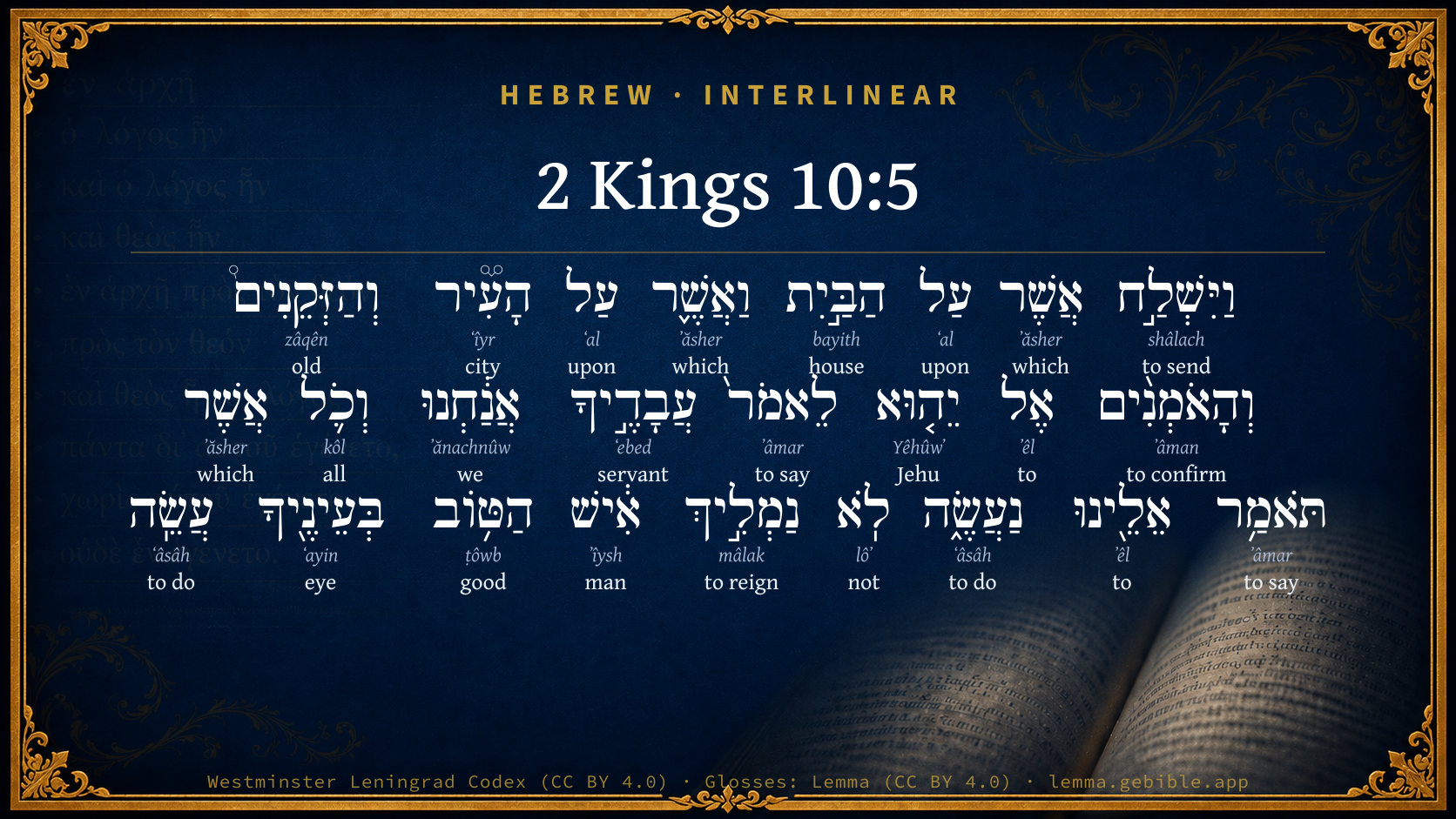
Hebrew (Westminster Leningrad Codex) 2 Kings 10:5 appears in the Hebrew Old Testament. The text above is from the Westminster Leningrad Codex. Each word links to its Strong’s number, a concise gloss, and parsing drawn from the Open Scriptures Hebrew Bible morphology. Click any word for its full Brown-Driver-Briggs (BDB) entry.
Download image
Cite this verse

2 Kings 10:5 (World English Bible). Public Domain. Lemma interlinear Bible study tool, https://lemma.gebible.app/v/2-kings/10/5.

Show BibTeX & RIS
BibTeX
RIS
English Translation
He who was over the household, and he who was over the city, the elders also, and those who brought up [the children], sent to Jehu, saying, We are your servants, and will do all that you shall bid us; we will not make any man king: you do that which is good in your eyes.
World English Bible · Public Domain
Download a study sheet

One document with this verse’s original text, its word-by-word gloss line, the meaning frame, cross-references with their text, attributed commentary, and full source and license credits — printable, and it pastes into notes with its structure intact.

This verse Autodidact and up

Study sheet (.html) Plain text (.txt)

A passage Seminary Student

Up to 50 verses in one chapter. A passage sheet keeps up to 6 commentary sources and 12 cross-references per verse, in the order this page ranks them, and says so on the sheet whenever that leaves anything out. Ask for a single verse and you get the Autodidact verse sheet above.

Everything on this page stays free to read, with no account — the sheet is a download of what is already on screen, not access to it.

Want to remove ads? Support Godless Engineer
Compare translations 3

The same verse in 3 English versions, stacked beneath the original-language interlinear above. Click any original word for its lexicon entry.

Each is an independent rendering of the whole verse — the interlinear is not word-aligned to these translations.

Highlighted words mark where these versions differ — a whole-verse word diff, not a word-by-word alignment.

  • World English Bible Public Domain
    He who was over the household, and he who was over the city, the elders also, and those who brought up [the children], sent to Jehu, saying, We are your servants, and will do all that you shall bid us; we will not make any man king: you do that which is good in your eyes.
  • King James Version Public Domain
    And he that was over the house, and he that was over the city, the elders also, and the bringers up of the children, sent to Jehu, saying, We are thy servants, and will do all that thou shalt bid us; we will not make any king: do thou that which is good in thine eyes.
  • unfoldingWord Literal Text CC BY-SA 4.0
    And he who over the house and he who over the city and the elders and the guardians sent to Jehu, saying, “We your servants, and all that you say to us, we will do. We will not make a man king. Do the good in your eyes.”

unfoldingWord Literal Text — © unfoldingWord, licensed CC BY-SA 4.0. Word-aligned USFM3 via Door43 (git.door43.org/unfoldingWord/en_ult).

Versions to compare (up to 4)

3 of 4 selected

Show all 18 translations

Every available English version of this verse, each an independent rendering of the whole verse.

  • World English Bible Public Domain
    He who was over the household, and he who was over the city, the elders also, and those who brought up [the children], sent to Jehu, saying, We are your servants, and will do all that you shall bid us; we will not make any man king: you do that which is good in your eyes.
  • Berean Standard Bible Public Domain
    So the palace administrator, the overseer of the city, the elders, and the guardians sent a message to Jehu: “We are your servants, and we will do whatever you say. We will not make anyone king. Do whatever is good in your sight.”
  • Majority Standard Bible Public Domain
    So the palace administrator, the overseer of the city, the elders, and the guardians sent a message to Jehu: “We are your servants, and we will do whatever you say. We will not make anyone king. Do whatever is good in your sight.”
  • King James Version Public Domain
    And he that was over the house, and he that was over the city, the elders also, and the bringers up of the children, sent to Jehu, saying, We are thy servants, and will do all that thou shalt bid us; we will not make any king: do thou that which is good in thine eyes.
  • American Standard Version (1901) Public Domain
    And he that was over the household, and he that was over the city, the elders also, and they that brought up `the children', sent to Jehu, saying, We are thy servants, and will do all that thou shalt bid us; we will not make any man king: do thou that which is good in thine eyes.
  • Revised Version (1885) Public Domain
    And he that was over the household, and he that was over the city, the elders also, and they that brought up the children, sent to Jehu, saying, We are thy servants, and will do all that thou shalt bid us; we will not make any man king: do thou that which is good in thine eyes.
  • Geneva Bible (1599) Public Domain
    And he that was gouernour of Ahabs house, and he that ruled the citie, and the Elders, and the bringers vp of the children sent to Iehu, saying, We are thy seruants, and will doe all that thou shalt bid vs: we will make no King: do what seemeth good to thee.
  • Douay-Rheims (1899) Public Domain
    Therefore the overseers of the house, and the rulers of the city, and the ancients, and the tutors sent to Jehu, saying: We are thy servants, whatsoever thou shalt command us we will do, neither will we make us a king: do thou all that pleaseth thee.
  • Young's Literal Translation Public Domain
    And he who `is' over the house, and he who `is' over the city, and the elders, and the supporters, send unto Jehu, saying, `Thy servants we `are', and all that thou sayest unto us we do; we do not make any one king -- that which `is' good in thine eyes do.'
  • Literal Standard Version CC BY-SA 4.0
    And he who [is] over the house, and he who [is] over the city, and the elderly, and those supporting, send to Jehu, saying, “We [are] your servants, and all that you say to us we do; we do not make anyone king—do that which [is] good in your eyes.”
  • Unlocked Literal Bible CC BY-SA 4.0
    Then the man who was in charge of the palace, and the man who was over the city, and the elders also, and they who raised the children, sent word back to Jehu, saying, “We are your servants. We will do everything that you command us. We will not make any man king. Do what is good in your eyes.”
  • unfoldingWord Literal Text CC BY-SA 4.0
    And he who over the house and he who over the city and the elders and the guardians sent to Jehu, saying, “We your servants, and all that you say to us, we will do. We will not make a man king. Do the good in your eyes.”
  • Darby Bible Public Domain
    And he that was over the house, and he that was over the city, and the elders, and the guardians sent to Jehu, saying, We are thy servants, and will do all that thou shalt bid us; we will not make any one king; do what is good in thy sight.
  • World Messianic Bible Public Domain
    He who was over the household, and he who was over the city, the elders also, and those who raised the children, sent to Jehu, saying, “We are your servants, and will do all that you ask us. We will not make any man king. You do that which is good in your eyes.”
  • Webster's Bible Public Domain
    And he that was over the house, and he that was over the city, the elders also, and those who brought up the children, sent to Jehu, saying, We are thy servants, and will do all that thou shalt bid us; we will not make any king: do thou that which is good in thy eyes.
  • Free Bible Version CC BY-SA 4.0
    So the palace and the city leaders, the elders, and the guardians sent a message to Jehu: “We are your servants, and we will do whatever you tell us. We're not going to make anyone king. Do what you think is best.”
  • Bible in Basic English Public Domain
    So the controller of the king's house, with the ruler of the town, and the responsible men, and those who had the care of Ahab's sons, sent to Jehu, saying, We are your servants and will do all your orders; we will not make any man king; do whatever seems best to you.
  • JPS Tanakh (1917) Public Domain
    And he that was over the household, and he that was over the city, the elders also, and they that brought up the children, sent to Jehu, saying: 'We are thy servants, and will do all that thou shalt bid us; we will not make any man king; do thou that which is good in thine eyes.'

Literal Standard Version (2020), Covenant Press — licensed CC BY-SA 4.0. Text via the HelloAO Bible API (eBible.org). Unlocked Literal Bible (unfoldingWord) — licensed CC BY-SA 4.0. Text via the HelloAO Bible API (eBible.org). unfoldingWord Literal Text — © unfoldingWord, licensed CC BY-SA 4.0. Word-aligned USFM3 via Door43 (git.door43.org/unfoldingWord/en_ult). Free Bible Version, Dr. Jonathan Gallagher — licensed CC BY-SA 4.0. Text via the HelloAO Bible API (eBible.org).

Word by word

More ways to search: Search by grammar → Find every occurrence → Compare this word →

Practice this passage: Drill this verse → Learn its vocabulary →

יֵה֤וּא
Yêhûwʼ
H3058
“Jehu”
Noun, Proper
Part of Speech
Noun
Type
Proper
Full BDB Definition

Origin: from H3068 and H1931

TWOT: None

Jehu = "Jehovah is He" - the king of the northern kingdom Israel who overthrew the dynasty of Omri - son of Hanani and an Israelite prophet in the time of Baasha and Jehoshaphat - the Antothite, a Benjamite, one of David's mighty warriors - a descendant of Judah of the house of Hezron - son of Josibiah and a chief of the tribe of Simeon
  1. וַיִּשְׁלַ֣ח shâlach H7971 “and · to send” Conjunction + Verb, Qal, Sequential Imperfect, 3rd Person, Masculine, Singular
  2. אֲשֶׁר ʼăsher H834 “which” Particle, Relative
  3. עַל ʻal H5921 “upon” Preposition
  4. הַבַּ֣יִת bayith H1004 “the · house” Particle, Definite Article + Noun, Common, Masculine, Singular, Absolute
  5. וַאֲשֶׁ֪ר ʼăsher H834 “and · which” Conjunction + Particle, Relative
  6. עַל ʻal H5921 “upon” Preposition
  7. הָעִ֟יר ʻîyr H5892 “the · city” Particle, Definite Article + Noun, Common, Feminine, Singular, Absolute
  8. וְהַזְּקֵנִים֩ zâqên H2205 “and · the · old” Conjunction + Particle, Definite Article + Adjective, Adjective, Masculine, Plural, Absolute
  9. וְהָאֹמְנִ֨ים ʼâman H539 “and · the · confirming” Conjunction + Particle, Definite Article + Verb, Qal, Participle Active, Masculine, Plural, Absolute
  10. אֶל ʼêl H413 “to” Preposition
  11. לֵאמֹר֙ ʼâmar H559 “to say” Preposition + Verb, Qal, Infinitive Construct
  12. עֲבָדֶ֣יךָ ʻebed H5650 “servants · your” Noun, Common, Masculine, Plural, Construct + Suffix, Personal, 2nd Person, Masculine, Singular
  13. אֲנַ֔חְנוּ ʼănachnûw H587 “we” Pronoun, Personal, 1st Person, Common, Plural
  14. וְכֹ֛ל kôl H3605 “and · all” Conjunction + Noun, Common, Masculine, Singular, Absolute
  15. אֲשֶׁר ʼăsher H834 “which” Particle, Relative
  16. תֹּאמַ֥ר ʼâmar H559 “to say” Verb, Qal, Imperfect, 2nd Person, Masculine, Singular
  17. אֵלֵ֖ינוּ ʼêl H413 “to · us” Preposition + Suffix, Personal, 1st Person, Common, Plural
  18. נַעֲשֶׂ֑ה ʻâsâh H6213 “to do” Verb, Qal, Imperfect, 1st Person, Common, Plural
  19. לֹֽא lôʼ H3808 “not” Particle, Negative
  20. נַמְלִ֣יךְ mâlak H4427 “to reign” Verb, Hiphil, Imperfect, 1st Person, Common, Plural
  21. אִ֔ישׁ ʼîysh H376 “man” Noun, Common, Masculine, Singular, Absolute
  22. הַטּ֥וֹב ṭôwb H2896 “the · good” Particle, Definite Article + Adjective, Adjective, Masculine, Singular, Absolute
  23. בְּעֵינֶ֖יךָ ʻayin H5869 “in/at · eyes · your” Preposition + Noun, Common, Both, Dual, Construct + Suffix, Personal, 2nd Person, Masculine, Singular
  24. עֲשֵֽׂה ʻâsâh H6213 “do” Verb, Qal, Imperative, 2nd Person, Masculine, Singular

About this verse

These counts appear in no published source. They are computed here, from the morphology-tagged text and Lemma’s own curated glosses. What Lemma adds →

25
words
19
distinct lemmas
Historical
section

Shared distinctive vocabulary

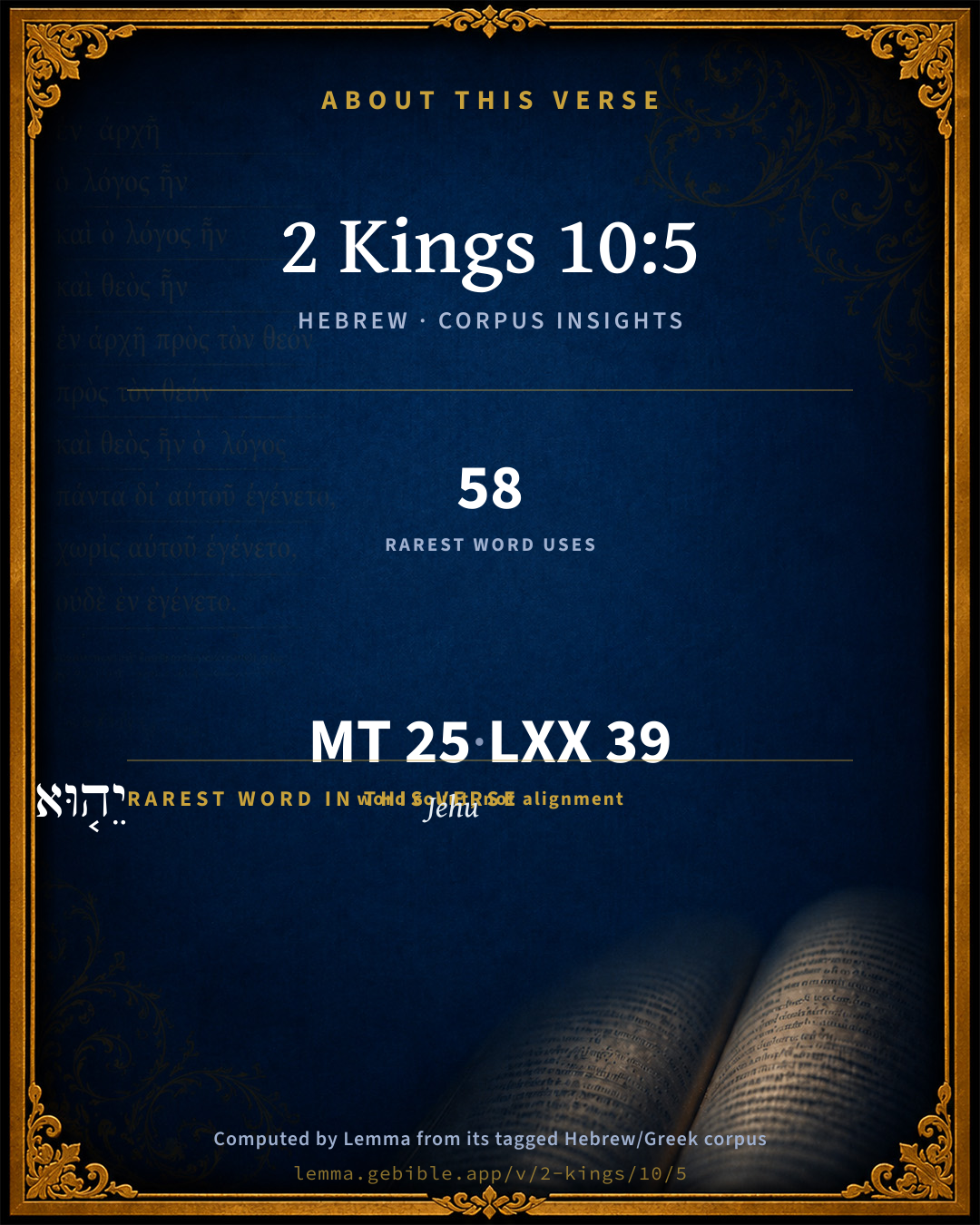
יֵה֤וּא Jehu H3058 occurs in 54 verses of the Hebrew Bible. Also found in:

Grammatical profile

  • 7 verbs
  • 7 nouns
  • 2 adjectives
  • 1 pronoun
  • 4 prepositions
  • 4 particles

Verb forms

  • וַיִּשְׁלַ֣ח Qal · Sequential Imperfect
  • וְהָאֹמְנִ֨ים Qal · Participle Active
  • לֵאמֹר֙ Qal · Infinitive Construct
  • תֹּאמַ֥ר Qal · Imperfect
  • נַעֲשֶׂ֑ה Qal · Imperfect
  • נַמְלִ֣יךְ Hiphil · Imperfect
  • עֲשֵֽׂה Qal · Imperative

Repetition

Words recur within this verse — often emphatic in Hebrew:

  • עַל upon H5921 ×2
  • לֵאמֹר֙ to say H559 ×2
  • נַעֲשֶׂ֑ה to do H6213 ×2
  • אֲשֶׁר which H834 ×3
  • אֶל to H413 ×2

Hebrew & Septuagint length

In English translation the verse runs 56 words from the Hebrew and 56 from the Septuagint (LXX English) — the same length.

A rough comparison of the two English renderings, which tokenize alike — not a word-level alignment.

Word counts can differ between the Hebrew and the Greek without any difference in meaning — e.g. the Hebrew direct-object marker אֵת has no separate Greek word, and Greek often adds the article ὁ.

In the original languages it is 25 Hebrew tokens and 39 Greek tokens — but the two are counted differently (Hebrew bundles its prefixes and suffixes into one token; the Greek is in lemma form), so that isn’t a like-for-like length.

Cross-references

9

Topical passages linked to 2 Kings 10:5 in the Treasury of Scripture Knowledge — connected by theme and wording, ordered by reader-vote popularity; previews shown in the World English Bible.

  • Joshua 9:11 Our elders and all the inhabitants of our country spoke to us, saying, Take provision in your hand for the journey, and go to meet them, and tell them, We are your servants: and now make you a covenant with us.
  • 1 Kings 20:4 The king of Israel answered, It is according to your saying, my lord, O king; I am yours, and all that I have.
  • 1 Kings 20:32 So they girded sackcloth on their loins, and [put] ropes on their heads, and came to the king of Israel, and said, Your servant Ben Hadad says, please let me live. He said, Is he yet alive? he is my brother.
  • Joshua 9:8 They said to Joshua, We are your servants. Joshua said to them, Who are you? and from whence come you?
  • 2 Kings 18:14 Hezekiah king of Judah sent to the king of Assyria to Lachish, saying, I have offended; return from me: that which you put on me will I bear. The king of Assyria appointed to Hezekiah king of Judah three hundred talents of silver and thirty talents of gold.
  • Joshua 9:24–25 They answered Joshua, and said, Because it was certainly told your servants, how that Yahweh your God commanded his servant Moses to give you all the land, and to destroy all the inhabitants of the land from before you; therefore we were sore afraid for our lives because of you, and have done this thing.
  • Jeremiah 27:7–8 All the nations shall serve him, and his son, and his son's son, until the time of his own land come: and then many nations and great kings shall make him their bondservant.
  • Jeremiah 27:17 Don't listen to them; serve the king of Babylon, and live: why should this city become a desolation?
  • John 12:26 If anyone serves me, let him follow me. Where I am, there will my servant also be. If anyone serves me, the Father will honor him.

Cross-references courtesy of OpenBible.info (CC BY 4.0).

Hebrew and Greek witnesses Masoretic Hebrew ↔ Greek Septuagint

The same verse in the two great witnesses to the Old Testament, shown verse-for-verse.

These are two independent witnesses, not word-aligned to each other, and the Septuagint is shown in lemma (dictionary) form.

Hebrew 2 Kings 10:5 Masoretic · Westminster Leningrad Codex

וַיִּשְׁלַ֣ח אֲשֶׁר עַל הַבַּ֣יִת וַאֲשֶׁ֪ר עַל הָעִ֟יר וְהַזְּקֵנִים֩ וְהָאֹמְנִ֨ים אֶל יֵה֤וּא לֵאמֹר֙ עֲבָדֶ֣יךָ אֲנַ֔חְנוּ וְכֹ֛ל אֲשֶׁר תֹּאמַ֥ר אֵלֵ֖ינוּ נַעֲשֶׂ֑ה לֹֽא נַמְלִ֣יךְ אִ֔ישׁ הַטּ֥וֹב בְּעֵינֶ֖יךָ עֲשֵֽׂה

He who was over the household, and he who was over the city, the elders also, and those who brought up [the children], sent to Jehu, saying, We are your servants, and will do all that you shall bid us; we will not make any man king: you do that which is good in your eyes.

World English Bible · Public Domain

Greek LXX 2 Kings 10:5 Septuagint · lemma form

καί ἀποστέλλω ὁ ἐπί ὁ οἶκος καί ὁ ἐπί ὁ πόλις καί ὁ πρεσβύτερος καί ὁ τιθηνός πρός ιου λέγω παῖς σύ ἐγώ καί ὅσος ἐάν εἶπον πρός ἐγώ ποιέω οὐ βασιλεύω ἀνήρ ὁ ἀγαθός ἐν ὀφθαλμός σύ ποιέω

So they that were over the house, and they that were over the city, and the elders and the guardians, sent to Ju, saying, We also are your servants, and whatever you shall say to us we will do; we will not make any man king: we will do that which is right in your eyes.

LXX2012 (modern English Septuagint) · Public Domain

On this verse, The Cambridge Bible for Schools and Colleges discusses the Septuagint’s reading. Read the note in Commentary ↓

Hebrew: Westminster Leningrad Codex (CC BY 4.0). Greek: Septuagint (public domain); English from LXX2012 (modern English Septuagint) (Public Domain). How the Septuagint differs from the Hebrew →

Targum (Aramaic paraphrase)

1

The Targum is the ancient Jewish Aramaic paraphrase of the Hebrew Scriptures — an interpretive translation, not the Hebrew text itself. Onkelos (literal) and Pseudo-Jonathan (expansive) render the Torah, and Jonathan the Prophets. Coverage is partial: where no permissively-licensed English translation exists for a verse, only the Aramaic is shown. This is verse-level text, not a word-by-word alignment to the Hebrew.

  1. Targum Jonathan Prophets (Joshua–Malachi)
    וּשְׁלַח דִמְמַנָא עַל בֵּיתָא וְדִמְמַנָא עַל קַרְתָּא וְסָבַיָא וְתוּרְבְיָנַיָא לְוַת יֵהוּא לְמֵימַר עַבְדָךְ אֲנַחְנָא וְכָל דְתֵימַר לָנָא נַעְבֵּיד לָא נַמְלִיךְ גְבַר דְתַקִין בְּעֵינָךְ עֱבֵיד:

    (no public-domain English translation for this verse)

    Targum Jonathan — Aramaic: “Mikraot Gedolot” (public domain). English: “Sefaria Community Translation” (CC0 1.0 (public-domain dedication)); “London "Chaldee Paraphrase," 1871” (public domain). Text via Sefaria.

Commentary

Notes on 2 Kings 10:5 from classic Christian and Jewish commentators (each source and its license shown beneath its notes). The classic Christian expositions comment on the surrounding passage and are grouped to its opening verse, so a note may address several verses; the Jewish commentaries on the Tanakh (Rashi and others) are per-verse, so they appear only where the commentator wrote on this verse.

Lemma curates 59 commentaries, every one of them public domain or Creative Commons licensed, each selected and text-cleaned for this edition rather than reprinted as found. About our sources →

Trapp's Complete Commentary

John Trapp

2Ki 10:5 And he that [was] over the house, and he that [was] over the city, the elders also, and the bringers up [of the children], sent to Jehu, saying, We [are] thy servants, and will do all that thou shalt bid us; we will not make any king: do thou [that which is] good in thine eyes.

Ver. 5. We are thy servants, and will do all that thou shalt bid us, &c.] Surely it is meet to be said thus unto God, and to him alone. "Be not ye the servants of men" in St Paul’s sense. {1Co 7:23}

John Trapp, A Commentary or Exposition upon All the Books of the Old and New Testament (1647–1656) — public domain. Text from a community e-Sword module.

Joseph Benson's Commentary

2Ki 10:5. He that was over the house — The chief governor of the king’s palace. He that was over the city — The chief magistrate, or military governor. We will do all that thou shalt bid us — They propose no conditions or delays, but submit all to his mercy.

Joseph Benson's Commentary on the Old and New Testaments (1811–1818) — public domain. Text from a community e-Sword module.

Jamieson, Fausset & Brown

Robert Jamieson, A. R. Fausset & David Brown

he that was over the house--the governor or chamberlain of the palace.

the bringers-up of the children--Anciently, and still also in many Eastern countries, the principal grandees were charged with the support and education of the royal princes. This involved a heavy expense which they were forced to bear, but for which they endeavored to find some compensation in the advantages of their connection with the court.

Jamieson, Fausset & Brown — Commentary Critical and Explanatory on the Whole Bible (1871) — public domain (CC PDM 1.0). Text via the HelloAO Bible API.

Adam Clarke's Commentary

Verse 5. He that was over the house, &c.] Thus all the constituted authorities agreed to submit.

Will do all that thou shalt bid us] They made no conditions, and stood pledged to commit the horrid murders which this most execrable man afterwards commanded.

Adam Clarke's Commentary on the Bible (1810–1826) — public domain. Text from a community e-Sword/MySword module.

Ellicott's Commentary for English Readers

(5) He that was over the house.—The prefect of the palace, or major-domo. A similar official is mentioned on the Egyptian monuments. His position and influence would resemble that of the great chamberlain of the Byzantine court.

He that was over the city.—The prefect or governor of the city, called in 1Ki_22:26 “the prince (sar) of the city.” These two are the “rulers” (sârîm) of 2Ki_10:1.

A Bible Commentary for English Readers, edited by Charles John Ellicott (1878–1897) — public domain. Text from a community e-Sword module.

The Cambridge Bible for Schools and Colleges

gen. ed. J. J. S. Perowne

5. And he that was over the house] R.V. household. This was an official personage, the chief of the royal personal officers. So it appears from the enumeration in this verse that all the authorities yielded at once. The LXX. gives the phrase in the plural ‘they that were over the household &c.’ With the singular it is not necessary to think of one officer merely. ‘Every one of the king’s personal servants’ is implied.

the bringers up of [R.V. they that brought up] the children] Thus the word is translated in the same manner in both verses.

and will do all that thou shalt bid us] As the extermination of every person who might hereafter put forward a claim to the throne was the general rule in Eastern revolutions, we shall hardly be wrong in supposing that these men knew, when they tendered their service to Jehu, the sort of work he would wish them to undertake.

we will not make any king] R.V. any man king. The noun is expressed in the original, and makes the profession of submission somewhat more emphatic. There should be no opposition either on behalf of Ahab’s family or anybody else.

do thou that which is good] The LXX. has ‘we will do &c.’ But this they had already said.

The Cambridge Bible for Schools and Colleges (gen. ed. J. J. S. Perowne; Cambridge University Press, 1878–1918) — public domain. Text from a community e-Sword module.

John Gill's Exposition

And he that was over the house,.... The king's palace in Samaria, who had the custody, care, and government of it:

and he that was over the city; the commander and governor of it, that had the highest post in it under the king;

the elders also all other subordinate officers and magistrates:

and the bringers up of the children; who had the education of the king's sons committed to them:

sent to Jehu, saying, we are thy servants, and will do all that thou shall bid us. They were ready to do homage, and swear allegiance to him as their king, and obey all his commands as faithful subjects:

we will not make any king; or set up any on the throne, no, not any of the sons or grandsons of Ahab:

do thou that which is good in thine eyes, we will never oppose thee.

John Gill's Exposition of the Whole Bible (1746–1763) — public domain (CC PDM 1.0). Text via the HelloAO Bible API.

Albert Barnes' Notes on the Bible

The officer who had the charge of the place (1Ki 4:6 note) and the governor of the town (1Ki 22:26 note) seem to correspond to the “rulers” of 2Ki 10:1.

Albert Barnes' Notes on the Bible (1834–1885) — public domain. Text from a community e-Sword/MySword module.

Matthew Poole's English Annotations

He that was over the house; the chief governor of the king’s palace or castle there.

He that was over the city; the chief magistrate or military governor.

We will do all that thou shalt bid us; they make no delays or conditions, but submit all to his mercy.

Matthew Poole's English Annotations on the Holy Bible (1683–1685) — public domain. Text from a community e-Sword/MySword module.

Whedon's Commentary on the Bible

Daniel D. Whedon

5. He that was over the house — That one of the supreme princes or rulers who, like Ahishar in Solomon’s time, (1Ki_4:6,) was the king’s chamberlain.

He that was over the city — The marshal, or, like Amon in the time of Ahab, (1Ki_22:26,) the chief military governor of the city.

We will not make any king — They at once acknowledge Jehu as king, and pledged submission to his will.

Daniel D. Whedon (gen. ed.), Commentary on the Old and New Testaments (1874–1909) — public domain. Text from a community e-Sword module.

The Pulpit Commentary

And he that was ever the housei.e. the officer in charge of the royal palace. (1Ki_4:6) and he that was over the city. There would be a single "governor of the city net the commandant of the garrison, but the chief civil ruler nearly corresponding to a modern "mayor". (see 1Ki_22:26) The elders also (comp. ver. 1). The "governor" of a town was assisted by a council of elders. And the bringers up of the children (see the comment on ver. 1). Sent to Jehu, saying, We are thy servants, and will do sit that thou shalt bid us; we will not make any king. Jehu"s letter had the effect which he intended, of making the authorities of Samaria declare themselves. They might, perhaps, have temporized, have sent an ambiguous answer, or have sent no answer at all, and have let their action be guided by the course of events. But, taken aback by Jehu"s directness and plainness of speech, it did not occur to them to be diplomatic; they felt driven into a corner, and compelled to make their choice at once. Either they must resist Jehu in arms or they must submit to him. If they submitted, they had best (they thought) do it with a good grace. Accordingly, his letter produced a reply, more favorable than he can possibly have expected were his servants," or "his slaves," ready to do all his pleasure; they would not set up a king, or in any way dispute his succession; they submitted themselves wholly to his will. Do thou they said that which is good in thine eyes; i.e. "take what steps thou pleasest to confirm thyself in the kingdom."

The Pulpit Commentary (1880–1919), ed. H.D.M. Spence-Jones & Joseph S. Exell — public domain. Text from a community e-Sword module.

John Wesley's Explanatory Notes

The house - The chief governor of the kings palace. City - The chief magistrate or military governor.

John Wesley, Explanatory Notes Upon the Whole Bible (1754–1765) — public domain. Text via the GEBible commentary corpus.

Lesson kit

Teaching starters — assembled from the data on this page, not authored interpretation. Every prompt links to the verse data it draws on. Edit before teaching.

2 Kings, in the Historical, opens this verse with 25 words (19 distinct Hebrew lemmas). Its most distinctive word is Yêhûwʼ (“Jehu”). A historical commentator’s framing appears above. Read the whole chapter for the surrounding context.

Discussion questions

  1. The word Yêhûwʼ carries the sense “Jehu.” How does it shape the verse?
  2. 1 Kings 16:1 shares the word «Jehu» with this verse. How do the two illuminate each other?
  3. “upon” occurs 2× in this one verse. What is the effect of the repetition?
  4. These translations render this verse differently; the difference is in the English rendering, not the original. What questions does that raise?
  5. The verb «וַיִּשְׁלַ֣ח» is Qal Sequential Imperfect. How does its form color the action?
  6. Reading how Trapp's Complete Commentary and Joseph Benson's Commentary read this verse, where do the two commentators agree and where do they part?

Things to notice

Reading settings

Reading text

Shown beneath each verse's original-language words.

Old Testament
Old Testament edition

Read the OT as the Masoretic Hebrew (MT) or the Greek Septuagint (LXX).

English shown for the Greek Septuagint (in the Hebrew ↔ Greek comparison).

Comparing translations? Open the Compare panel on any verse page to stack up to four side by side.