

2 Samuel 17:4

Hebrew (Westminster Leningrad Codex) 2 Samuel 17:4 appears in the Hebrew Old Testament. The text above is from the Westminster Leningrad Codex. Each word links to its Strong’s number, a concise gloss, and parsing drawn from the Open Scriptures Hebrew Bible morphology. Click any word for its full Brown-Driver-Briggs (BDB) entry.
Download image
Cite this verse

2 Samuel 17:4 (World English Bible). Public Domain. Lemma interlinear Bible study tool, https://lemma.gebible.app/v/2-samuel/17/4.

Show BibTeX & RIS
BibTeX
RIS
English Translation
The saying pleased Absalom well, and all the elders of Israel.
World English Bible · Public Domain
Download a study sheet

One document with this verse’s original text, its word-by-word gloss line, the meaning frame, cross-references with their text, attributed commentary, and full source and license credits — printable, and it pastes into notes with its structure intact.

This verse Autodidact and up

Study sheet (.html) Plain text (.txt)

A passage Seminary Student

Up to 50 verses in one chapter. A passage sheet keeps up to 6 commentary sources and 12 cross-references per verse, in the order this page ranks them, and says so on the sheet whenever that leaves anything out. Ask for a single verse and you get the Autodidact verse sheet above.

Everything on this page stays free to read, with no account — the sheet is a download of what is already on screen, not access to it.

Want to remove ads? Support Godless Engineer
Compare translations 3

The same verse in 3 English versions, stacked beneath the original-language interlinear above. Click any original word for its lexicon entry.

Each is an independent rendering of the whole verse — the interlinear is not word-aligned to these translations.

Highlighted words mark where these versions differ — a whole-verse word diff, not a word-by-word alignment.

  • World English Bible Public Domain
    The saying pleased Absalom well, and all the elders of Israel.
  • King James Version Public Domain
    And the saying pleased Absalom well, and all the elders of Israel.
  • unfoldingWord Literal Text CC BY-SA 4.0
    And the word was right in the eyes of Absalom and in the eyes of all of the elders of Israel.

unfoldingWord Literal Text — © unfoldingWord, licensed CC BY-SA 4.0. Word-aligned USFM3 via Door43 (git.door43.org/unfoldingWord/en_ult).

Versions to compare (up to 4)

3 of 4 selected

Show all 18 translations

Every available English version of this verse, each an independent rendering of the whole verse.

  • World English Bible Public Domain
    The saying pleased Absalom well, and all the elders of Israel.
  • Berean Standard Bible Public Domain
    This proposal seemed good to Absalom and all the elders of Israel.
  • Majority Standard Bible Public Domain
    This proposal seemed good to Absalom and all the elders of Israel.
  • King James Version Public Domain
    And the saying pleased Absalom well, and all the elders of Israel.
  • American Standard Version (1901) Public Domain
    And the saying pleased Absalom well, and all the elders of Israel.
  • Revised Version (1885) Public Domain
    And the saying pleased Absalom well, and all the elders of Israel.
  • Geneva Bible (1599) Public Domain
    And the saying pleased Absalom well, and all the Elders of Israel.
  • Douay-Rheims (1899) Public Domain
    And his saying pleased Absalom, and all the ancients of Israel.
  • Young's Literal Translation Public Domain
    And the thing is right in the eyes of Absalom, and in the eyes of all the elders of Israel.
  • Literal Standard Version CC BY-SA 4.0
    And the word is right in the eyes of Absalom, and in the eyes of all [the] elderly of Israel.
  • Unlocked Literal Bible CC BY-SA 4.0
    What Ahithophel said pleased Absalom and all the elders of Israel.
  • unfoldingWord Literal Text CC BY-SA 4.0
    And the word was right in the eyes of Absalom and in the eyes of all of the elders of Israel.
  • Darby Bible Public Domain
    And the saying was right in the eyes of Absalom, and in the eyes of all the elders of Israel.
  • World Messianic Bible Public Domain
    The saying pleased Absalom well, and all the elders of Israel.
  • Webster's Bible Public Domain
    And the saying, pleased Absalom well, and all the elders of Israel.
  • Free Bible Version CC BY-SA 4.0
    This plan looked good to Absalom and to all the elders of Israel.
  • Bible in Basic English Public Domain
    And the saying was pleasing to Absalom and to the responsible men of Israel.
  • JPS Tanakh (1917) Public Domain
    And the saying pleased Absalom well, and all the elders of Israel.

Literal Standard Version (2020), Covenant Press — licensed CC BY-SA 4.0. Text via the HelloAO Bible API (eBible.org). Unlocked Literal Bible (unfoldingWord) — licensed CC BY-SA 4.0. Text via the HelloAO Bible API (eBible.org). unfoldingWord Literal Text — © unfoldingWord, licensed CC BY-SA 4.0. Word-aligned USFM3 via Door43 (git.door43.org/unfoldingWord/en_ult). Free Bible Version, Dr. Jonathan Gallagher — licensed CC BY-SA 4.0. Text via the HelloAO Bible API (eBible.org).

Word by word

More ways to search: Search by grammar → Find every occurrence → Compare this word →

Practice this passage: Drill this verse → Learn its vocabulary →

וַיִּישַׁ֥ר
yâshar
H3474
“and · to be right”
Conjunction + Verb, Qal, Sequential Imperfect, 3rd Person, Masculine, Singular
Part of Speech
Conjunction + Verb
Stem
Qal
Form
Sequential Imperfect
Person
3rd Person
Gender
Masculine
Number
Singular
Full BDB Definition

Origin: a primitive root

TWOT: 930

to be right, be straight, be level, be upright, be just, be lawful, be smooth - (Qal) - to go straight - to be pleasing, be agreeable, be right (figuratively) - to be straightforward, be upright - (Piel) - to make right, make smooth, make straight - to lead, direct, lead straight along - to esteem right, approve - (Pual) to be made level, be laid smoothly out - (Hiphil) to make straight, look straight
  1. הַדָּבָ֖ר dâbâr H1697 “the · word” Particle, Definite Article + Noun, Common, Masculine, Singular, Absolute
  2. בְּעֵינֵ֣י ʻayin H5869 “in/at · eyes of” Preposition + Noun, Common, Both, Dual, Construct
  3. אַבְשָׁלֹ֑ם ʼĂbîyshâlôwm H53 “Absalom” Noun, Proper
  4. וּבְעֵינֵ֖י ʻayin H5869 “and · in/at · eyes of” Conjunction + Preposition + Noun, Common, Both, Dual, Construct
  5. כָּל kôl H3605 “all of” Noun, Common, Masculine, Singular, Construct
  6. זִקְנֵ֥י zâqên H2205 “old of” Adjective, Adjective, Masculine, Plural, Construct
  7. יִשְׂרָאֵֽל Yisrâʼêl H3478 “Israel” Noun, Proper

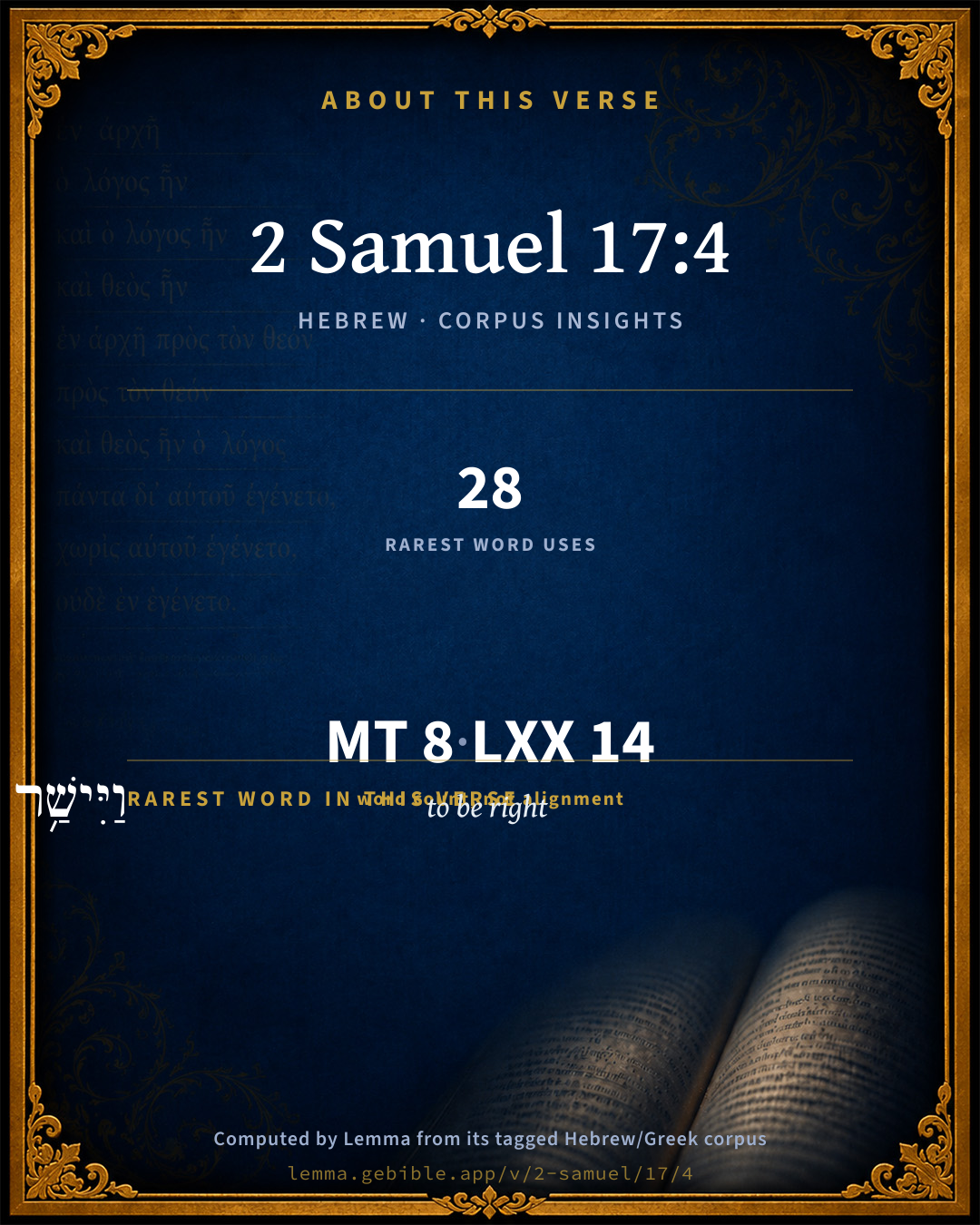
About this verse

These counts appear in no published source. They are computed here, from the morphology-tagged text and Lemma’s own curated glosses. What Lemma adds →

8
words
7
distinct lemmas
Historical
section

Shared distinctive vocabulary

וַיִּישַׁ֥ר to be right H3474 occurs in 26 verses of the Hebrew Bible. Also found in:

Grammatical profile

  • 1 verb
  • 6 nouns
  • 1 adjective

Verb forms

  • וַיִּישַׁ֥ר Qal · Sequential Imperfect

Repetition

A word recurs within this verse — often emphatic in Hebrew:

  • בְּעֵינֵ֣י eye H5869 ×2

Hebrew & Septuagint length

In English translation the verse runs 11 words from the Hebrew and 20 from the Septuagint (LXX English) — the Septuagint runs noticeably longer here. See the side-by-side →

A rough comparison of the two English renderings, which tokenize alike — not a word-level alignment.

Word counts can differ between the Hebrew and the Greek without any difference in meaning — e.g. the Hebrew direct-object marker אֵת has no separate Greek word, and Greek often adds the article ὁ.

In the original languages it is 8 Hebrew tokens and 14 Greek tokens — but the two are counted differently (Hebrew bundles its prefixes and suffixes into one token; the Greek is in lemma form), so that isn’t a like-for-like length.

Cross-references

6

Topical passages linked to 2 Samuel 17:4 in the Treasury of Scripture Knowledge — connected by theme and wording, ordered by reader-vote popularity; previews shown in the World English Bible.

  • 1 Samuel 18:20–21 Michal, Saul's daughter, loved David: and they told Saul, and the thing pleased him.
  • 1 Samuel 23:21 Saul said, Blessed be you of Yahweh; for you have had compassion on me.
  • 2 Chronicles 30:4 The thing was right in the eyes of the king and of all the assembly.
  • Esther 1:21 The saying pleased the king and the princes; and the king did according to the word of Memucan:
  • Esther 5:14 Then said Zeresh his wife and all his friends to him, Let a gallows be made fifty cubits high, and in the morning speak you to the king that Mordecai may be hanged thereon: then go you in merrily with the king to the banquet. The thing pleased Haman; and he caused the gallows to be made.
  • Romans 1:32 who, knowing the ordinance of God, that those who practice such things are worthy of death, not only do the same, but also approve of those who practice them.

Cross-references courtesy of OpenBible.info (CC BY 4.0).

Hebrew and Greek witnesses Masoretic Hebrew ↔ Greek Septuagint

The same verse in the two great witnesses to the Old Testament, shown verse-for-verse.

Here the Septuagint runs noticeably longer than the Hebrew — LXX2012 (modern English Septuagint) 20 words vs World English Bible 11. A rough length comparison of the two English translations, not a word-level alignment — read both below.

These are two independent witnesses, not word-aligned to each other, and the Septuagint is shown in lemma (dictionary) form.

Hebrew 2 Samuel 17:4 Masoretic · Westminster Leningrad Codex

וַיִּישַׁ֥ר הַדָּבָ֖ר בְּעֵינֵ֣י אַבְשָׁלֹ֑ם וּבְעֵינֵ֖י כָּל זִקְנֵ֥י יִשְׂרָאֵֽל

The saying pleased Absalom well, and all the elders of Israel.

World English Bible · Public Domain

Greek LXX 2 Samuel 17:4 Septuagint · lemma form

καί εὐθής ὁ λόγος ἐν ὀφθαλμός αβεσσαλωμ καί ἐν ὀφθαλμός πᾶς ὁ πρεσβύτερος ἰσραήλ

And the saying was right in the eyes of Abessalom, and in the eyes of all the elders of Israel.

LXX2012 (modern English Septuagint) · Public Domain

Hebrew: Westminster Leningrad Codex (CC BY 4.0). Greek: Septuagint (public domain); English from LXX2012 (modern English Septuagint) (Public Domain). How the Septuagint differs from the Hebrew →

Targum (Aramaic paraphrase)

1

The Targum is the ancient Jewish Aramaic paraphrase of the Hebrew Scriptures — an interpretive translation, not the Hebrew text itself. Onkelos (literal) and Pseudo-Jonathan (expansive) render the Torah, and Jonathan the Prophets. Coverage is partial: where no permissively-licensed English translation exists for a verse, only the Aramaic is shown. This is verse-level text, not a word-by-word alignment to the Hebrew.

  1. Targum Jonathan Prophets (Joshua–Malachi)
    וּכְשַׁר פִּתְגָמָא בְּעֵינֵי אַבְשָׁלוֹם וּבְעֵינֵי כָּל סָבֵי יִשְׂרָאֵל:

    (no public-domain English translation for this verse)

    Targum Jonathan — Aramaic: “Mikraot Gedolot” (public domain). English: “Sefaria Community Translation” (CC0 1.0 (public-domain dedication)); “London "Chaldee Paraphrase," 1871” (public domain). Text via Sefaria.

Commentary

Notes on 2 Samuel 17:4 from classic Christian and Jewish commentators (each source and its license shown beneath its notes). The classic Christian expositions comment on the surrounding passage and are grouped to its opening verse, so a note may address several verses; the Jewish commentaries on the Tanakh (Rashi and others) are per-verse, so they appear only where the commentator wrote on this verse.

Lemma curates 59 commentaries, every one of them public domain or Creative Commons licensed, each selected and text-cleaned for this edition rather than reprinted as found. About our sources →

Trapp's Complete Commentary

John Trapp

2Sa 17:4 And the saying pleased Absalom well, and all the elders of Israel.

Ver. 4. And the saying pleased Absalom well.] Heb., Was right in the eyes of Absalom, &c. Nam quae recta sunt placent. {a} Man is a rational creature: and everywise man will be mancipium rationis, ruled by reason, in matters of greatest consequence especially. Howbeit, all men are mutable, as appeareth in that this counsel, while so applauded, was so soon again misliked.

{a} Vat.

John Trapp, A Commentary or Exposition upon All the Books of the Old and New Testament (1647–1656) — public domain. Text from a community e-Sword module.

Joseph Benson's Commentary

2Sa 17:4. The saying pleased Absalom well, and all the elders of Israel — That such a wretch as Absalom should aim at his father’s throat is not strange. But that the body of the people, to whom David had been so great a blessing, should join with him in it, is amazing. But the finger of God was in it. Let not the best of parents, or the best of princes, think it strange if they are injured by those who should be their support and joy, when they (like David) have provoked God to turn against them.

Joseph Benson's Commentary on the Old and New Testaments (1811–1818) — public domain. Text from a community e-Sword module.

Geneva Bible (1599)

Geneva Bible translators

Hebrew, was right in the eyes of Absalom.

Geneva Bible (1599) marginal notes — public domain. Text via Bolls.life.

The Cambridge Bible for Schools and Colleges

gen. ed. J. J. S. Perowne

4. the elders of Israel] Who were sitting in council with Absalom. For the various functions of the elders, see note on 1Sa_8:4.

The Cambridge Bible for Schools and Colleges (gen. ed. J. J. S. Perowne; Cambridge University Press, 1878–1918) — public domain. Text from a community e-Sword module.

John Gill's Exposition

And the saying pleased Absalom well, and all elders of Israel. That were of the privy council; for it was a well contrived scheme to surprise David his men by night, in the condition they were in; nothing like seizing an opportunity, and making quick dispatch in executing a villainous design; only it is strange that Absalom could so easily come into a scheme to take away the life of so indulgent a father, which is only to be accounted for by his ambition; but it is stranger still that the elders of Israel should be pleased with it, and agree to and determine upon the death of a prince, who had so many years ruled them with justice and equity, clemency and mercy; and fought their battles for them, and raised their nation to such a pitch of glory it never had before.

And the saying pleased Absalom well, and all elders of Israel. That were of the privy council; for it was a well contrived scheme to surprise David his men by night, in the condition they were in; nothing like seizing an opportunity, and making quick dispatch in executing a villainous design; only it is strange that Absalom could so easily come into a scheme to take away the life of so indulgent a father, which is only to be accounted for by his ambition; but it is stranger still that the elders of Israel should be pleased with it, and agree to and determine upon the death of a prince, who had so many years ruled them with justice and equity, clemency and mercy; and fought their battles for them, and raised their nation to such a pitch of glory it never had before.

2 Samuel 17:5

sa2 17:5

sa2 17:5

sa2 17:5Then said Absalom, call now Hushai the Archite also,.... For it seems he was not at the council board at this time; whether he was as yet admitted to it is not certain: there is something very remarkable in the providence of God, to incline Absalom to have the opinion of Hushai upon this point, when the counsel of Ahithophel was so universally approved of; and Hushai also being well known to have been an intimate friend and confident of David's, and not so settled and established in the interest of Absalom, and such a sworn friend of his as Ahithophel was; this can only be ascribed to the will of God, to defeat the counsel of Ahithophel, and the wisdom of divine Providence in blinding the mind of Absalom with respect to his counsel, and inclining it to take the opinion of Hushai:

and let us hear likewise what he saith; which he might say without any diffidence about the "counsel" given, but knowing that in the multitude of counsellors there is safety; and Hushai being a wise and good counsellor, he might hope and expect that he would give the same advice, and so strengthen and confirm it.

John Gill's Exposition of the Whole Bible (1746–1763) — public domain (CC PDM 1.0). Text via the HelloAO Bible API.

The Pulpit Commentary

All the elders of Israel. Their presence seems to show that Absalom professed to act in an orderly and constitutional manner, and with the advice of those in authority. It was possibly this wish to keep up appearances which made him command Hushai to be summoned, as he was one whose advice would certainly have been asked had matters gone on in their ordinary channel. So again in vers. 14, 15, Absalom acts only with the popular consent. Very probably the royal power was gradually superseding that of the tribal authorities, and this may have made David unpopular with many of the great nobles. Absalom would thus gain many adherents by associating "elders" and "men of Israel" with him in his councils.

The Pulpit Commentary (1880–1919), ed. H.D.M. Spence-Jones & Joseph S. Exell — public domain. Text from a community e-Sword module.

Keil & Delitzsch

C. F. Keil & F. Delitzsch

Although this advice pleased Absalom and all the elders of Israel (present), Absalom sent for Hushai the Archite to hear his opinion. גּם־הוּא serves to strengthen the suffix in בּפיו (cf. Ewald, 311, a.).

Keil & Delitzsch — Biblical Commentary on the Old Testament (1861–1891) — public domain (CC PDM 1.0). Text via the HelloAO Bible API. (Old Testament only.)

Rashi

Rabbi Shlomo Yitzchaki (Rashi)

And in the eyes of all of the elders of Yisroel. Wicked elders.

Rashi on the Tanakh — English translations: “The Judaica Press complete Tanach with Rashi, translated by A. J. Rosenberg” (CC BY 4.0); “Pentateuch with Rashi's commentary by M. Rosenbaum and A.M. Silbermann, 1929-1934” (public domain); “The Metsudah Tanach series, Lakewood, N.J” (CC BY 4.0); and “The Book of Joshua, Metsudah Publications, 1997” (CC BY 4.0). Text via Sefaria.

Lesson kit

Teaching starters — assembled from the data on this page, not authored interpretation. Every prompt links to the verse data it draws on. Edit before teaching.

2 Samuel, in the Historical, opens this verse with 8 words (7 distinct Hebrew lemmas). Its most distinctive word is yâshar (“to be right”). The Greek Septuagint runs longer here. A historical commentator’s framing appears above. Read the whole chapter for the surrounding context.

Discussion questions

  1. How does “to be right” (yâshar) shape what this verse is saying?
  2. How does Numbers 23:27, which shares the word «to be right», read alongside this verse?
  3. What does the repetition of “eye” (2× in this one verse) do in this verse?
  4. The Septuagint runs longer here than the Hebrew. What might account for the difference?
  5. The translations on this page render this verse differently — a whole-verse word diff, not a word-by-word alignment. What might account for the different wordings?
  6. «וַיִּישַׁ֥ר» is a Qal Sequential Imperfect verb. How does that grammatical form shape the action described?
  7. Compare how Trapp's Complete Commentary and Joseph Benson's Commentary read this verse. Where do they agree or differ?

Things to notice

Reading settings

Reading text

Shown beneath each verse's original-language words.

Old Testament
Old Testament edition

Read the OT as the Masoretic Hebrew (MT) or the Greek Septuagint (LXX).

English shown for the Greek Septuagint (in the Hebrew ↔ Greek comparison).

Comparing translations? Open the Compare panel on any verse page to stack up to four side by side.