
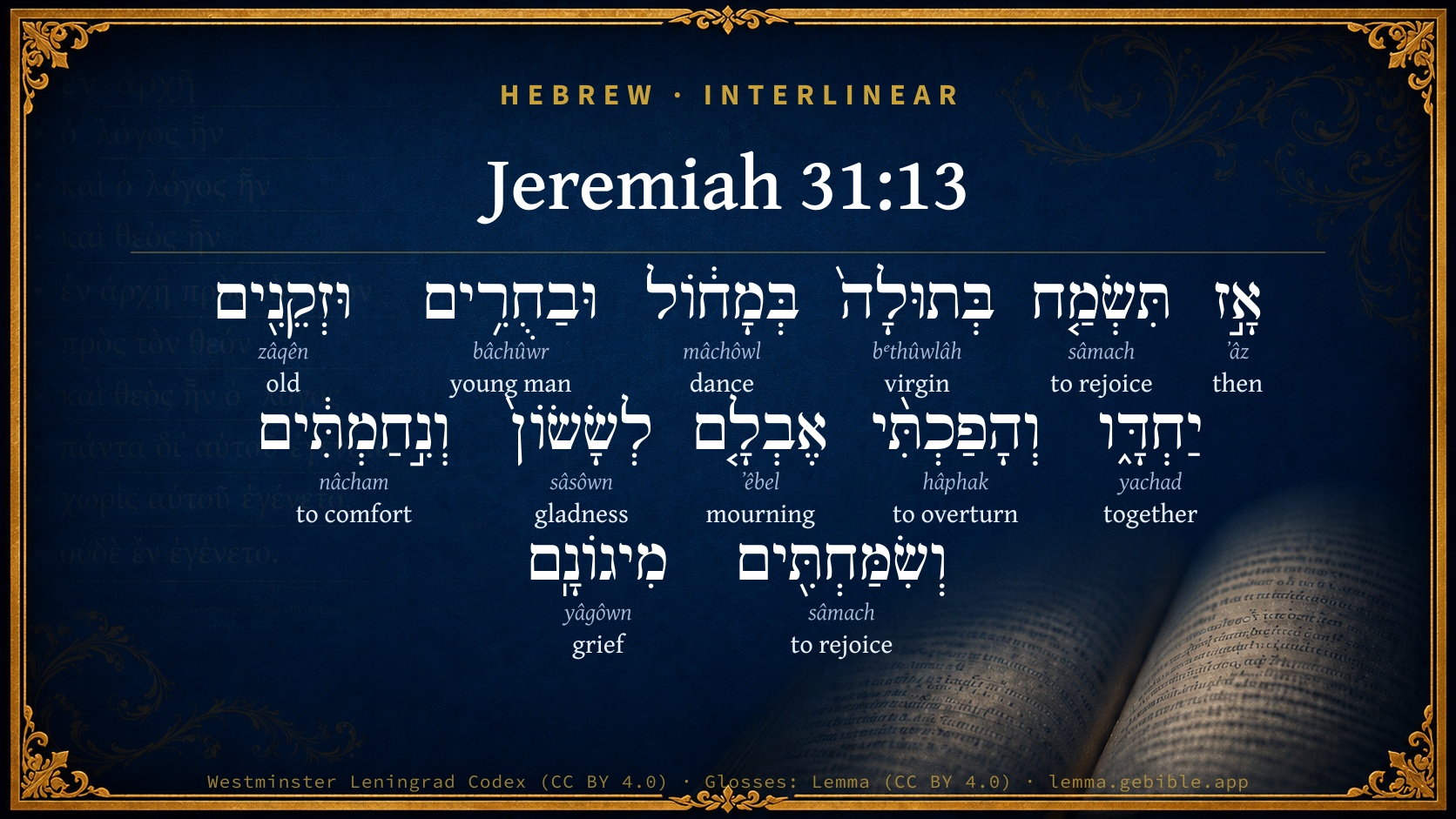
Jeremiah 31:13

Hebrew (Westminster Leningrad Codex) Jeremiah 31:13 appears in the Hebrew Old Testament. The text above is from the Westminster Leningrad Codex. Each word links to its Strong’s number, a concise gloss, and parsing drawn from the Open Scriptures Hebrew Bible morphology. Click any word for its full Brown-Driver-Briggs (BDB) entry.
Download image
Cite this verse

Jeremiah 31:13 (World English Bible). Public Domain. Lemma interlinear Bible study tool, https://lemma.gebible.app/v/jeremiah/31/13.

Show BibTeX & RIS
BibTeX
RIS
English Translation
Then shall the virgin rejoice in the dance, and the young men and the old together; for I will turn their mourning into joy, and will comfort them, and make them rejoice from their sorrow.
World English Bible · Public Domain
Download a study sheet

One document with this verse’s original text, its word-by-word gloss line, the meaning frame, cross-references with their text, attributed commentary, and full source and license credits — printable, and it pastes into notes with its structure intact.

This verse Autodidact and up

Study sheet (.html) Plain text (.txt)

A passage Seminary Student

Up to 50 verses in one chapter. A passage sheet keeps up to 6 commentary sources and 12 cross-references per verse, in the order this page ranks them, and says so on the sheet whenever that leaves anything out. Ask for a single verse and you get the Autodidact verse sheet above.

Everything on this page stays free to read, with no account — the sheet is a download of what is already on screen, not access to it.

Want to remove ads? Support Godless Engineer
Compare translations 3

The same verse in 3 English versions, stacked beneath the original-language interlinear above. Click any original word for its lexicon entry.

Each is an independent rendering of the whole verse — the interlinear is not word-aligned to these translations.

Highlighted words mark where these versions differ — a whole-verse word diff, not a word-by-word alignment.

  • World English Bible Public Domain
    Then shall the virgin rejoice in the dance, and the young men and the old together; for I will turn their mourning into joy, and will comfort them, and make them rejoice from their sorrow.
  • King James Version Public Domain
    Then shall the virgin rejoice in the dance, both young men and old together: for I will turn their mourning into joy, and will comfort them, and make them rejoice from their sorrow.
  • unfoldingWord Literal Text CC BY-SA 4.0
    Then virgins will rejoice with dancing, and young and old men will be together. For I will change their mourning into celebration. I will have compassion on them and cause them to rejoice instead of sorrowing.

unfoldingWord Literal Text — © unfoldingWord, licensed CC BY-SA 4.0. Word-aligned USFM3 via Door43 (git.door43.org/unfoldingWord/en_ult).

Versions to compare (up to 4)

3 of 4 selected

Show all 18 translations

Every available English version of this verse, each an independent rendering of the whole verse.

  • World English Bible Public Domain
    Then shall the virgin rejoice in the dance, and the young men and the old together; for I will turn their mourning into joy, and will comfort them, and make them rejoice from their sorrow.
  • Berean Standard Bible Public Domain
    Then the maidens will rejoice with dancing, young men and old as well. I will turn their mourning into joy, and give them comfort and joy for their sorrow.
  • Majority Standard Bible Public Domain
    Then the maidens will rejoice with dancing, young men and old as well. I will turn their mourning into joy, and give them comfort and joy for their sorrow.
  • King James Version Public Domain
    Then shall the virgin rejoice in the dance, both young men and old together: for I will turn their mourning into joy, and will comfort them, and make them rejoice from their sorrow.
  • American Standard Version (1901) Public Domain
    Then shall the virgin rejoice in the dance, and the young men and the old together; for I will turn their mourning into joy, and will comfort them, and make them rejoice from their sorrow.
  • Revised Version (1885) Public Domain
    Then shall the virgin rejoice in the dance, and the young men and the old together: for I will turn their mourning into joy, and will comfort them, and make them rejoice from their sorrow.
  • Geneva Bible (1599) Public Domain
    Then shall ye virgine reioyce in the dance, and the yong men and the old men together: for I wil turne their mourning into ioy, and wil comfort them, and giue them ioy for their sorowes.
  • Douay-Rheims (1899) Public Domain
    Then shall the virgin rejoice in the dance, the young men and old men together: and I will turn their mourning into joy, and will comfort them, and make them joyful after their sorrow.
  • Young's Literal Translation Public Domain
    Then rejoice doth a virgin in a chorus, Both young men and old men -- together, And I have turned their mourning to joy, And have comforted them, And gladdened them above their sorrow,
  • Literal Standard Version CC BY-SA 4.0
    “Then a virgin rejoices in a chorus, || Both young men and old men—together, || And I have turned their mourning to joy, || And have comforted them, || And gladdened them above their sorrow,
  • Unlocked Literal Bible CC BY-SA 4.0
    Then virgins will rejoice with dancing, and young and old men will be together. For I will change their mourning into celebration. I will have compassion on them and cause them to rejoice instead of sorrowing.
  • unfoldingWord Literal Text CC BY-SA 4.0
    Then virgins will rejoice with dancing, and young and old men will be together. For I will change their mourning into celebration. I will have compassion on them and cause them to rejoice instead of sorrowing.
  • Darby Bible Public Domain
    Then shall the virgin rejoice in the dance, and the young men and old together; for I will turn their mourning into gladness, and will comfort them, and make them rejoice after their sorrow.
  • World Messianic Bible Public Domain
    Then the virgin will rejoice in the dance, the young men and the old together; for I will turn their mourning into joy, and will comfort them, and make them rejoice from their sorrow.
  • Webster's Bible Public Domain
    Then shall the virgin rejoice in the dance, both young men and old together: for I will turn their mourning into joy, and will comfort them, and make them rejoice from their sorrow.
  • Free Bible Version CC BY-SA 4.0
    The girls will dance in celebration; young men and old people will join in too. I will turn their sorrow into joy, and I will comfort them and change their sadness into happiness.
  • Bible in Basic English Public Domain
    Then the virgin will have joy in the dance, and the young men and the old will be glad: for I will have their weeping turned into joy, I will give them comfort and make them glad after their sorrow.
  • JPS Tanakh (1917) Public Domain
    Then shall the virgin rejoice in the dance, and the young men and the old together; for I will turn their mourning into joy, and will comfort them, and make them rejoice from their sorrow.

Literal Standard Version (2020), Covenant Press — licensed CC BY-SA 4.0. Text via the HelloAO Bible API (eBible.org). Unlocked Literal Bible (unfoldingWord) — licensed CC BY-SA 4.0. Text via the HelloAO Bible API (eBible.org). unfoldingWord Literal Text — © unfoldingWord, licensed CC BY-SA 4.0. Word-aligned USFM3 via Door43 (git.door43.org/unfoldingWord/en_ult). Free Bible Version, Dr. Jonathan Gallagher — licensed CC BY-SA 4.0. Text via the HelloAO Bible API (eBible.org).

Word by word

More ways to search: Search by grammar → Find every occurrence → Compare this word →

Practice this passage: Drill this verse → Learn its vocabulary →

בְּמָח֔וֹל
mâchôwl
H4234
“in/at · dance”
Preposition + Noun, Common, Masculine, Singular, Absolute
Part of Speech
Preposition + Noun
Type
Common
Gender
Masculine
Number
Singular
State
Absolute
Full BDB Definition

Origin: from H2342

TWOT: 623g

dance, dancing
  1. אָ֣ז ʼâz H227 “then” Adverb
  2. תִּשְׂמַ֤ח sâmach H8055 “to rejoice” Verb, Qal, Imperfect, 3rd Person, Feminine, Singular
  3. בְּתוּלָה֙ bᵉthûwlâh H1330 “virgin” Noun, Common, Feminine, Singular, Absolute
  4. וּבַחֻרִ֥ים bâchûwr H970 “and · young men” Conjunction + Noun, Common, Masculine, Plural, Absolute
  5. וּזְקֵנִ֖ים zâqên H2205 “and · old” Conjunction + Adjective, Adjective, Masculine, Plural, Absolute
  6. יַחְדָּ֑ו yachad H3162 “together” Adverb
  7. וְהָפַכְתִּ֨י hâphak H2015 “and · to overturn” Conjunction + Verb, Qal, Sequential Perfect, 1st Person, Common, Singular
  8. אֶבְלָ֤ם ʼêbel H60 “mourning · their” Noun, Common, Masculine, Singular, Construct + Suffix, Personal, 3rd Person, Masculine, Plural
  9. לְשָׂשׂוֹן֙ sâsôwn H8342 “to/for · gladness” Preposition + Noun, Common, Masculine, Singular, Absolute
  10. וְנִ֣חַמְתִּ֔ים nâcham H5162 “and · to comfort · them” Conjunction + Verb, Piel, Sequential Perfect, 1st Person, Common, Singular + Suffix, Personal, 3rd Person, Masculine, Plural
  11. וְשִׂמַּחְתִּ֖ים sâmach H8055 “and · to rejoice · them” Conjunction + Verb, Piel, Perfect, 1st Person, Common, Singular + Suffix, Personal, 3rd Person, Masculine, Plural
  12. מִיגוֹנָֽם yâgôwn H3015 “from · grief · their” Preposition + Noun, Common, Masculine, Singular, Construct + Suffix, Personal, 3rd Person, Masculine, Plural

About this verse

These counts appear in no published source. They are computed here, from the morphology-tagged text and Lemma’s own curated glosses. What Lemma adds →

13
words
12
distinct lemmas
Prophets
section

Notable vocabulary

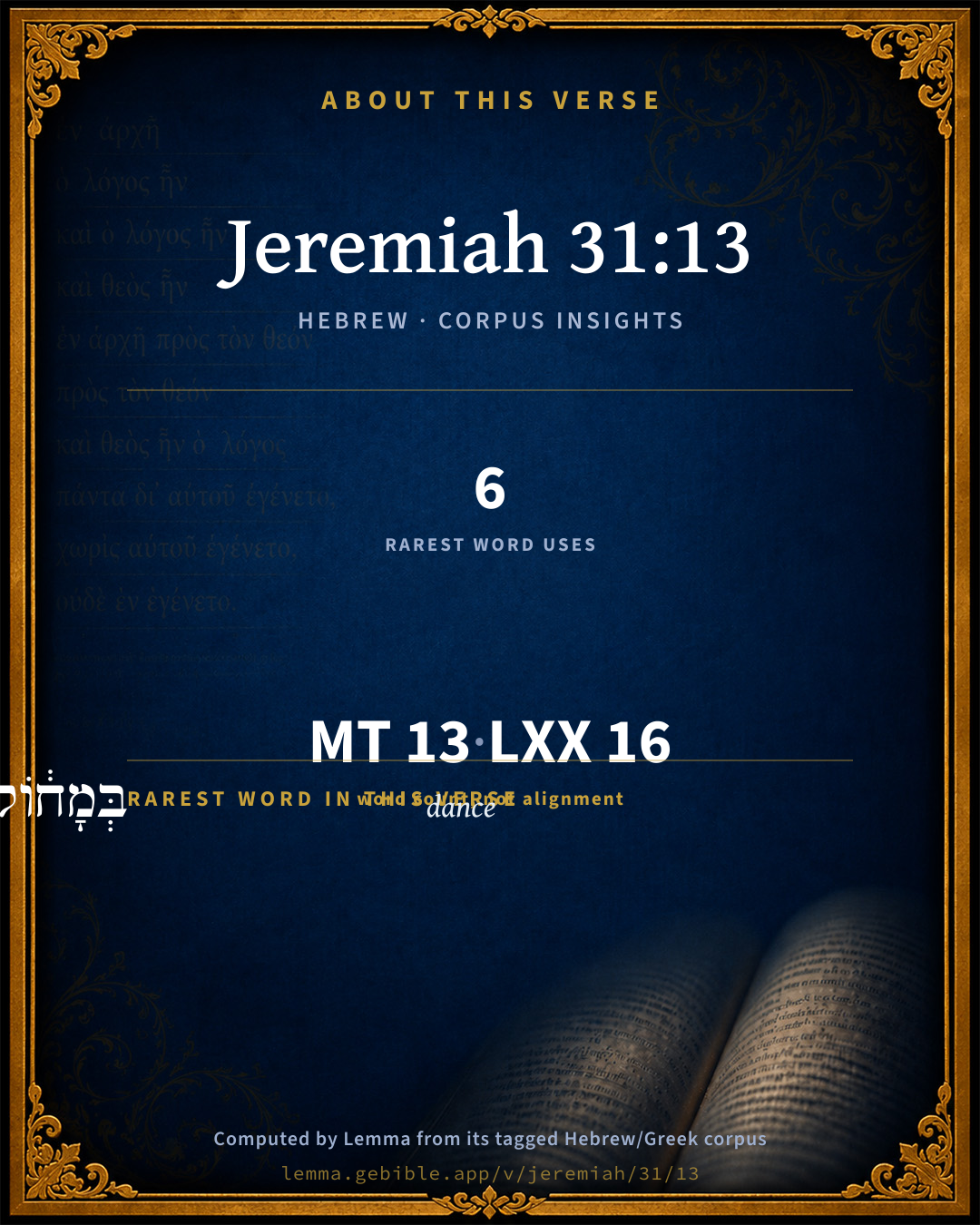
The rarest word here is בְּמָח֔וֹל dance H4234 — appearing just 6 times in the whole Hebrew Bible.

Shared distinctive vocabulary

בְּמָח֔וֹל dance H4234 occurs in 6 verses of the Hebrew Bible. Also found in:

Grammatical profile

  • 4 verbs
  • 6 nouns
  • 1 adjective
  • 2 adverbs

Verb forms

  • תִּשְׂמַ֤ח Qal · Imperfect
  • וְהָפַכְתִּ֨י Qal · Sequential Perfect
  • וְנִ֣חַמְתִּ֔ים Piel · Sequential Perfect
  • וְשִׂמַּחְתִּ֖ים Piel · Perfect

Repetition

A word recurs within this verse — often emphatic in Hebrew:

  • תִּשְׂמַ֤ח to rejoice H8055 ×2

Hebrew & Septuagint length

In the original languages it is 13 Hebrew tokens and 16 Greek tokens — but the two are counted differently (Hebrew bundles its prefixes and suffixes into one token; the Greek is in lemma form), so that isn’t a like-for-like length.

Cross-references

16

Topical passages linked to Jeremiah 31:13 in the Treasury of Scripture Knowledge — connected by theme and wording, ordered by reader-vote popularity; previews shown in the World English Bible.

  • Psalms 30:11 You have turned my mourning into dancing for me. You have removed my sackcloth, and clothed me with gladness,
  • Isaiah 61:3 to appoint to those who mourn in Zion, to give to them a garland for ashes, the oil of joy for mourning, the garment of praise for the spirit of heaviness; that they may be called trees of righteousness, the planting of Yahweh, that he may be glorified.
  • Isaiah 51:11 The ransomed of Yahweh shall return, and come with singing to Zion; and everlasting joy shall be on their heads: they shall obtain gladness and joy; [and] sorrow and sighing shall flee away.
  • Isaiah 51:3 For Yahweh has comforted Zion; he has comforted all her waste places, and has made her wilderness like Eden, and her desert like the garden of Yahweh; joy and gladness shall be found therein, thanksgiving, and the voice of melody.
  • Esther 9:22 as the days in which the Jews had rest from their enemies, and the month which was turned to them from sorrow to gladness, and from mourning into a good day; that they should make them days of feasting and gladness, and of sending portions one to another, and gifts to the needy.
  • Psalms 149:3 Let them praise his name in the dance! Let them sing praises to him with tambourine and harp!
  • Isaiah 60:20 Your sun shall no more go down, neither shall your moon withdraw itself; for Yahweh will be your everlasting light, and the days of your mourning shall be ended.
  • Jeremiah 31:4 Again will I build you, and you shall be built, O virgin of Israel: again shall you be adorned with your tambourines, and shall go forth in the dances of those who make merry.
  • Isaiah 35:10 and the ransomed of Yahweh shall return, and come with singing to Zion; and everlasting joy shall be on their heads: they shall obtain gladness and joy, and sorrow and sighing shall flee away.
  • Isaiah 65:18–19 But be you glad and rejoice forever in that which I create; for, behold, I create Jerusalem a rejoicing, and her people a joy.
  • John 16:22 Therefore you now have sorrow, but I will see you again, and your heart will rejoice, and no one will take your joy away from you.
  • Ezra 6:22 and kept the feast of unleavened bread seven days with joy: for Yahweh had made them joyful, and had turned the heart of the king of Assyria to them, to strengthen their hands in the work of the house of God, the God of Israel.
  • Nehemiah 12:27 At the dedication of the wall of Jerusalem they sought the Levites out of all their places, to bring them to Jerusalem, to keep the dedication with gladness, both with giving thanks, and with singing, with cymbals, psalteries, and with harps.
  • Nehemiah 12:43 They offered great sacrifices that day, and rejoiced; for God had made them rejoice with great joy; and the women also and the children rejoiced: so that the joy of Jerusalem was heard even afar off.
  • Zechariah 8:4–5 Thus says Yahweh of Hosts: "Old men and old women will again dwell in the streets of Jerusalem, every man with his staff in his hand for very age.
  • Zechariah 8:19 Thus says Yahweh of Hosts: "The fasts of the fourth fifth, seventh, and tenth months shall be for the house of Judah joy and gladness, and cheerful feasts. Therefore love truth and peace."

Cross-references courtesy of OpenBible.info (CC BY 4.0).

Hebrew and Greek witnesses Masoretic Hebrew ↔ Greek Septuagint

The same verse in the two great witnesses to the Old Testament, shown verse-for-verse.

These are two independent witnesses, not word-aligned to each other, and the Septuagint is shown in lemma (dictionary) form.

Hebrew Jeremiah 31:13 Masoretic · Westminster Leningrad Codex

אָ֣ז תִּשְׂמַ֤ח בְּתוּלָה֙ בְּמָח֔וֹל וּבַחֻרִ֥ים וּזְקֵנִ֖ים יַחְדָּ֑ו וְהָפַכְתִּ֨י אֶבְלָ֤ם לְשָׂשׂוֹן֙ וְנִ֣חַמְתִּ֔ים וְשִׂמַּחְתִּ֖ים מִיגוֹנָֽם

Then shall the virgin rejoice in the dance, and the young men and the old together; for I will turn their mourning into joy, and will comfort them, and make them rejoice from their sorrow.

World English Bible · Public Domain

Greek LXX Structure differs

In the Septuagint, Jeremiah is about an eighth shorter than the Hebrew and arranges its material differently — the Oracles Against the Nations (Hebrew chapters 46–51) appear in the middle of the Greek book, after 25:13. Because the chapter and verse boundaries do not line up, a verse-for-verse comparison with the Hebrew is not shown.

A verse-for-verse comparison isn’t shown here because the chapters and verses don’t line up. Switch to the LXX edition with the MT / LXX toggle above to read the Greek directly.

On this verse, The Cambridge Bible for Schools and Colleges discusses the Septuagint’s reading. Read the note in Commentary ↓

Hebrew: Westminster Leningrad Codex (CC BY 4.0). Greek: Septuagint (public domain); English from a public-domain English Septuagint. How the Septuagint differs from the Hebrew →

Targum (Aramaic paraphrase)

1

The Targum is the ancient Jewish Aramaic paraphrase of the Hebrew Scriptures — an interpretive translation, not the Hebrew text itself. Onkelos (literal) and Pseudo-Jonathan (expansive) render the Torah, and Jonathan the Prophets. Coverage is partial: where no permissively-licensed English translation exists for a verse, only the Aramaic is shown. This is verse-level text, not a word-by-word alignment to the Hebrew.

  1. Targum Jonathan Prophets (Joshua–Malachi)
    בְּכֵן תֶּחְדִין כְּנִשְׁתָּא דְיִשְׂרָאֵל כַּד בְּחִנְגִין וְעוּלֵימִין וְסָבִין כַּחֲדָא וֶאֶהֱפוֹךְ אֶבְלְהוֹן לְבִיעַ וֶאֱנָחֵמִינוּן וְאַחֲדִינוּן מִדְווֹנְהוֹן:

    Therefore, let the congregation of Israel rejoice as with dancing, young men and old men together; I will turn their mourning into feasting, and I will console them from their sadness.

    Targum Jonathan — Aramaic: “Mikraot Gedolot” (public domain). English: “Sefaria Community Translation” (CC0 1.0 (public-domain dedication)); “London "Chaldee Paraphrase," 1871” (public domain). Text via Sefaria.

Commentary

Notes on Jeremiah 31:13 from classic Christian and Jewish commentators (each source and its license shown beneath its notes). The classic Christian expositions comment on the surrounding passage and are grouped to its opening verse, so a note may address several verses; the Jewish commentaries on the Tanakh (Rashi and others) are per-verse, so they appear only where the commentator wrote on this verse.

Lemma curates 59 commentaries, every one of them public domain or Creative Commons licensed, each selected and text-cleaned for this edition rather than reprinted as found. About our sources →

Trapp's Complete Commentary

John Trapp

Jer 31:13 Then shall the virgin rejoice in the dance, both young men and old together: for I will turn their mourning into joy, and will comfort them, and make them rejoice from their sorrow.

Ver. 13. And make them rejoice from their sorrow.] Or, After their sorrow. I will turn all their sadness into gladness, their sighing into singing, their tears into triumphs, &c.

John Trapp, A Commentary or Exposition upon All the Books of the Old and New Testament (1647–1656) — public domain. Text from a community e-Sword module.

The Biblical Illustrator

Joseph S. Exell

Jer_31:13

I will turn their mourning into Joy, and will comfort them, and make them rejoice from their sorrow.

Transfigured troubles

In one of the German picture galleries is a painting called Cloudland. It hangs at the end of a long gallery, and at first sight it looks like a huge, repulsive daub of confused colour, without form or comeliness. As you walk towards it the picture begins to take shape. It proves to be a mass of exquisite little cherub faces, like those at the head of the canvas in Raphaels Madonna San Sisto. If you come close to the picture you see only an innumerable company of little angels and cherubim. How often the soul that is frightened by trial sees nothing but a confused mass of crushed hopes! But if that soul, instead of fleeing away into unbelief and despair, would only draw up nearer to God, it would soon discover that the cloud was full of angels of mercy. In one cherub face it would see, Whom I love I chasten. Another angel would say, All things work together for good to them that love God. In still another sweet face the heavenly words are coming forth, Let not your heart be troubled: in My Fathers house are many mansions. (T. L. Cuyler.)

The Biblical Illustrator, edited by Joseph S. Exell (c. 1880s–1900s) — public domain. Text from a community e-Sword module.

Tyndale Open Study Notes

Tyndale Open Resources

31:13 The Lord would replace mourning, a daily experience in exile, with his comfort and a continual outpouring of rejoicing (see Isa 40:1-3; 61:3).

Tyndale Open Study Notes — © Tyndale Open Resources, licensed CC BY-SA 4.0. Text via the HelloAO Bible API.

Geneva Bible (1599)

Geneva Bible translators

In the company of the faithful, which ever praise God for his benefits.

Geneva Bible (1599) marginal notes — public domain. Text via Bolls.life.

Jamieson, Fausset & Brown

Robert Jamieson, A. R. Fausset & David Brown

young . . . old-- (Zac 8:4-5).

Jamieson, Fausset & Brown — Commentary Critical and Explanatory on the Whole Bible (1871) — public domain (CC PDM 1.0). Text via the HelloAO Bible API.

John Calvin's Commentaries

This is a confirmation of the former verse; for he says that joy would be in common to young women and young men, and also to the old. He had spoken of the perpetuity of joy; but he now extends this joy to both sexes, women and men, and to all ages. Of the dance we have spoken elsewhere, — that wantonness in which the world indulges in its hilarity, was not permitted; as to profane men, there is no moderation in their joy. The Prophets followed the common mode of speaking; and, indeed, the Israelites had their dances while celebrating the praises of God; but it was a chaste and modest joy, yea, and a sacred joy, for it was a mode of worshipping God. Yet the Prophet speaks according to the common practices of the people, as in many other places, when he says that young women and young men would rejoice in the dance

He then adds, I will turn their mourning to joy, I will console them and exhilarate them from their grief Here the Prophet averts the thoughts of the Israelites from the evils they then had, lest their grief should so darken their minds as to prevent them to taste of God’s goodness promised them. That the feeling, then, of present evils might not hinder them to come to God and receive his favor, he speaks of their grief and mourning, and intimates that the change would be easily made by God’s hand, when it pleased him to deliver his people and restore them to their former state, so that their complete happiness would take place under the reign of Christ.

John Calvin's Commentaries (1540-1563) — public domain. Text from the Calvin Translation Society English edition (1840s-50s) via the Christian Classics Ethereal Library (ccel.org). Calvin's coverage is partial (roughly two-thirds of the Bible); uncommented books and verses are honest gaps, never fabricated. The 19th-century editor's footnotes and remarks are omitted so the notes are faithfully Calvin's own voice.

The Cambridge Bible for Schools and Colleges

gen. ed. J. J. S. Perowne

13. the young men and the old, etc.] For “together” it is best (pointing the MT. differently) to read with LXX “shall rejoice.”

The Cambridge Bible for Schools and Colleges (gen. ed. J. J. S. Perowne; Cambridge University Press, 1878–1918) — public domain. Text from a community e-Sword module.

John Gill's Exposition

Then shall the virgin rejoice in the dance, both young men and old together,.... Not any particular virgin, but all virgins, as Kimchi interprets it. The Targum is,

"then shall the congregation of Israel rejoice as in dances;''

it may very well be understood of the church of Christ, espoused to him as a chaste virgin, and of her spiritual joy in him, in allusion to the joy expressed by such persons in dancing, both upon civil and religious accounts; and it denotes that the joy should be very general and extensive, that persons of every age and sex should partake of it; see Zac 9:17;

for I will turn their mourning into joy: their mourning for sin, and for want of the divine presence, into joy, on account of the goodness of the Lord to them, and the large provisions made for them; though they come weeping to Zion, yet, when come thither, sing in the height of it, Jer 31:9; their fasts, as elsewhere, are turned into festivals; sometimes the joy of the saints is suddenly turned into grief, and again their sorrow turned into joy; see Psa 30:5;

and will comfort them; with the discoveries of love, with the divine Presence, and views of pardoning grace:

and make them rejoice from their sorrow; cause their sorrow to break off through joy: or, "after their sorrow" (p); that being ended, joy shall succeed.

(p) "post moerorem suum", Cataker.

John Gill's Exposition of the Whole Bible (1746–1763) — public domain (CC PDM 1.0). Text via the HelloAO Bible API.

Albert Barnes' Notes on the Bible

Both gives the idea of the men dancing, which is incorrect. Except at a religious solemnity 2Sa 6:14, dancing was confined to women. Render and young men and old rejoice together.

Albert Barnes' Notes on the Bible (1834–1885) — public domain. Text from a community e-Sword/MySword module.

Matthew Poole's English Annotations

This verse containeth only a further variety of expressions, all signifying the same thing, viz. their happy state for some time after the captivity. We may understand the dancings here of all sorts of people, either of their religious rejoicing in their holy festivals, (for under the Old Testament in their religious rejoicing they used these external expressions of joy, as appears from Psa 150:4, and from David’s dancing before the ark,) or of their civil joy, where dancing was more usual: the last words of the verse expound all the former.

Matthew Poole's English Annotations on the Holy Bible (1683–1685) — public domain. Text from a community e-Sword/MySword module.

Whedon's Commentary on the Bible

Daniel D. Whedon

13. Young men and old shall rejoice together — See Zec_8:4-5.

Daniel D. Whedon (gen. ed.), Commentary on the Old and New Testaments (1874–1909) — public domain. Text from a community e-Sword module.

The Pulpit Commentary

Young and old, men and women, shall give themselves up to joy and merriment, the centre of the mirth being the maidens with the timbrels (ver. 4). Both young men and old together; rather, and young men and old (shall rejoice) together.

The Pulpit Commentary (1880–1919), ed. H.D.M. Spence-Jones & Joseph S. Exell — public domain. Text from a community e-Sword module.

unfoldingWord translationNotes

Door43 World Missions Community

I will change their mourning into celebration

The abstract nouns "mourning" and "celebration" can be translated as verbs. AT: "I will cause them to mourn no longer but instead to celebrate" or "I will make it so they are no longer sad but happy"

I will change

"Yahweh will change"

I will saturate the lives of the priests in abundance

The abstract noun "abundance" can be translated as "many good things." The lives of the priests are spoken of as if they were a field that would become completely wet when much rain falls on it. Life is a metonym for the person. AT: "I will give the priests all the good things they would like" or "I will satisfy the priests with good things" (See: Abstract Nouns and Metaphor and Metonymy)

My people will fill themselves with my goodness

"My goodness will satisfy my people"

this is Yahweh's declaration

Yahweh speaks of himself by name to express the certainty of what he is declaring. See how you translated this in Jeremiah 1:8. AT: "this is what Yahweh has declared" or "this is what I, Yahweh, have declared" (See: First, Second, or Third Person)

translationWords

virgin

mourn

compassion

priest

people of God

declare

unfoldingWord translationNotes — © Distant Shores Media and the Door43 World Missions Community, licensed CC BY-SA 4.0. Source: git.door43.org/Door43/en_tn.

Lesson kit

Teaching starters — assembled from the data on this page, not authored interpretation. Every prompt links to the verse data it draws on. Edit before teaching.

Jeremiah, in the Prophets, opens this verse with 13 words (12 distinct Hebrew lemmas). Its most distinctive word is mâchôwl (“dance”). A historical commentator’s framing appears above. Read the whole chapter for the surrounding context.

Discussion questions

  1. The word mâchôwl carries the sense “dance.” How does it shape the verse?
  2. How does Psalms 30:11, which shares the word «dance», read alongside this verse?
  3. What does the repetition of “to rejoice” (2× in this one verse) do in this verse?
  4. The translations on this page render this verse differently — a whole-verse word diff, not a word-by-word alignment. What might account for the different wordings?
  5. «תִּשְׂמַ֤ח» is a Qal Imperfect verb. How does that grammatical form shape the action described?
  6. Compare how Trapp's Complete Commentary and The Biblical Illustrator read this verse. Where do they agree or differ?

Things to notice

Reading settings

Reading text

Shown beneath each verse's original-language words.

Old Testament
Old Testament edition

Read the OT as the Masoretic Hebrew (MT) or the Greek Septuagint (LXX).

English shown for the Greek Septuagint (in the Hebrew ↔ Greek comparison).

Comparing translations? Open the Compare panel on any verse page to stack up to four side by side.