1 Samuel 2:31

Hebrew (Westminster Leningrad Codex) 1 Samuel 2:31 appears in the Hebrew Old Testament. The text above is from the Westminster Leningrad Codex. Each word links to its Strong’s number, a concise gloss, and parsing drawn from the Open Scriptures Hebrew Bible morphology. Click any word for its full Brown-Driver-Briggs (BDB) entry.
Download image
Cite this verse

1 Samuel 2:31 (World English Bible). Public Domain. Lemma interlinear Bible study tool, https://lemma.gebible.app/v/1-samuel/2/31.

Show BibTeX & RIS
BibTeX
RIS
English Translation
Behold, the days come, that I will cut off your arm, and the arm of your father's house, that there shall not be an old man in your house.
World English Bible · Public Domain
Download a study sheet

One document with this verse’s original text, its word-by-word gloss line, the meaning frame, cross-references with their text, attributed commentary, and full source and license credits — printable, and it pastes into notes with its structure intact.

This verse Autodidact and up

Study sheet (.html) Plain text (.txt)

A passage Seminary Student

Up to 50 verses in one chapter. A passage sheet keeps up to 6 commentary sources and 12 cross-references per verse, in the order this page ranks them, and says so on the sheet whenever that leaves anything out. Ask for a single verse and you get the Autodidact verse sheet above.

Everything on this page stays free to read, with no account — the sheet is a download of what is already on screen, not access to it.

Want to remove ads? Support Godless Engineer
Compare translations 3

The same verse in 3 English versions, stacked beneath the original-language interlinear above. Click any original word for its lexicon entry.

Each is an independent rendering of the whole verse — the interlinear is not word-aligned to these translations.

Highlighted words mark where these versions differ — a whole-verse word diff, not a word-by-word alignment.

  • World English Bible Public Domain
    Behold, the days come, that I will cut off your arm, and the arm of your father's house, that there shall not be an old man in your house.
  • King James Version Public Domain
    Behold, the days come, that I will cut off thine arm, and the arm of thy father's house, that there shall not be an old man in thine house.
  • unfoldingWord Literal Text CC BY-SA 4.0
    Behold, the days are coming when I will cut off your arm and the arm of the house of your father from the being of an old man in your house.

unfoldingWord Literal Text — © unfoldingWord, licensed CC BY-SA 4.0. Word-aligned USFM3 via Door43 (git.door43.org/unfoldingWord/en_ult).

Versions to compare (up to 4)

3 of 4 selected

Show all 18 translations

Every available English version of this verse, each an independent rendering of the whole verse.

  • World English Bible Public Domain
    Behold, the days come, that I will cut off your arm, and the arm of your father's house, that there shall not be an old man in your house.
  • Berean Standard Bible Public Domain
    Behold, the days are coming when I will cut off your strength and the strength of your father’s house, so that no older man will be left in your house.
  • Majority Standard Bible Public Domain
    Behold, the days are coming when I will cut off your strength and the strength of your father’s house, so that no one in it will reach old age.
  • King James Version Public Domain
    Behold, the days come, that I will cut off thine arm, and the arm of thy father's house, that there shall not be an old man in thine house.
  • American Standard Version (1901) Public Domain
    Behold, the days come, that I will cut off thine arm, and the arm of thy father's house, that there shall not be an old man in thy house.
  • Revised Version (1885) Public Domain
    Behold, the days come, that I will cut off thine arm, and the arm of thy father’s house, that there shall not be an old man in thine house.
  • Geneva Bible (1599) Public Domain
    Beholde, the dayes come, that I will cut off thine arme, and the arme of thy fathers house, that there shall not be an olde man in thine house.
  • Douay-Rheims (1899) Public Domain
    Behold the days come: and I will cut off thy arm, and the arm of thy father's house, that there shall not be an old man in thy house.
  • Young's Literal Translation Public Domain
    `Lo, days `are' coming, and I have cut off thine arm, and the arm of the house of thy father, that an old man is not in thy house;
  • Literal Standard Version CC BY-SA 4.0
    Behold, days [are] coming, and I have cut off your arm, and the arm of the house of your father, that an old man is not in your house;
  • Unlocked Literal Bible CC BY-SA 4.0
    See, the days are coming when I will cut off your strength and the strength of your father's house, so that there will no longer be any old man in your house.
  • unfoldingWord Literal Text CC BY-SA 4.0
    Behold, the days are coming when I will cut off your arm and the arm of the house of your father from the being of an old man in your house.
  • Darby Bible Public Domain
    Behold, days come, that I will cut off thine arm, and the arm of thy father's house, that there shall not be an old man in thy house.
  • World Messianic Bible Public Domain
    Behold, the days come that I will cut off your arm and the arm of your father’s house, that there will not be an old man in your house.
  • Webster's Bible Public Domain
    Behold, the days come, that I will cut off thy arm, and the arm of thy father's house, that there shall not be an old man in thy house.
  • Free Bible Version CC BY-SA 4.0
    The time is coming when I will bring your family and your father's family to an end. No one will live to an old age.
  • Bible in Basic English Public Domain
    See, the days are coming when your arm and the arm of your father's people will be cut off;
  • JPS Tanakh (1917) Public Domain
    Behold, the days come, that I will cut off thine arm, and the arm of thy father's house, that there shall not be an old man in thy house.

Literal Standard Version (2020), Covenant Press — licensed CC BY-SA 4.0. Text via the HelloAO Bible API (eBible.org). Unlocked Literal Bible (unfoldingWord) — licensed CC BY-SA 4.0. Text via the HelloAO Bible API (eBible.org). unfoldingWord Literal Text — © unfoldingWord, licensed CC BY-SA 4.0. Word-aligned USFM3 via Door43 (git.door43.org/unfoldingWord/en_ult). Free Bible Version, Dr. Jonathan Gallagher — licensed CC BY-SA 4.0. Text via the HelloAO Bible API (eBible.org).

Word by word

More ways to search: Search by grammar → Find every occurrence → Compare this word →

Practice this passage: Drill this verse → Learn its vocabulary →

וְגָֽדַעְתִּי֙
gâdaʻ
H1438
“and · to hew”
Conjunction + Verb, Qal, Sequential Perfect, 1st Person, Common, Singular
Part of Speech
Conjunction + Verb
Stem
Qal
Form
Sequential Perfect
Person
1st Person
Gender
Common
Number
Singular
Full BDB Definition

Origin: a primitive root

TWOT: 316

to cut, hew, chop, cut down, hew down, hew off, cut off, cut in two, shave off - (Qal) to hew, chop in two - (Niphal) to be chopped off, be hewn off - (Piel) to cut off or down in two, hew off or down in two - (Pual) to chop down, hew down
  1. הִנֵּה֙ hinnêh H2009 “behold” Particle, Demonstrative
  2. יָמִ֣ים yôwm H3117 “days” Noun, Common, Masculine, Plural, Absolute
  3. בָּאִ֔ים bôwʼ H935 “entering” Verb, Qal, Participle Active, Masculine, Plural, Absolute
  4. אֶת ʼêth H853 “-” Particle, Direct Object
  5. זְרֹ֣עֲךָ֔ zᵉrôwaʻ H2220 “arm · your” Noun, Common, Both, Singular, Construct + Suffix, Personal, 2nd Person, Masculine, Singular
  6. וְאֶת ʼêth H853 “and · -” Conjunction + Particle, Direct Object
  7. זְרֹ֖עַ zᵉrôwaʻ H2220 “arm of” Noun, Common, Both, Singular, Construct
  8. בֵּ֣ית bayith H1004 “house of” Noun, Common, Masculine, Singular, Construct
  9. אָבִ֑יךָ ʼâb H1 “father · your” Noun, Common, Masculine, Singular, Construct + Suffix, Personal, 2nd Person, Masculine, Singular
  10. מִֽהְי֥וֹת hâyâh H1961 “from · to be” Preposition + Verb, Qal, Infinitive Construct
  11. זָקֵ֖ן zâqên H2205 “old” Adjective, Adjective, Masculine, Singular, Absolute
  12. בְּבֵיתֶֽךָ bayith H1004 “in/at · house · your” Preposition + Noun, Common, Masculine, Singular, Construct + Suffix, Personal, 2nd Person, Masculine, Singular

About this verse

These counts appear in no published source. They are computed here, from the morphology-tagged text and Lemma’s own curated glosses. What Lemma adds →

13
words
10
distinct lemmas
Historical
section

Notable vocabulary

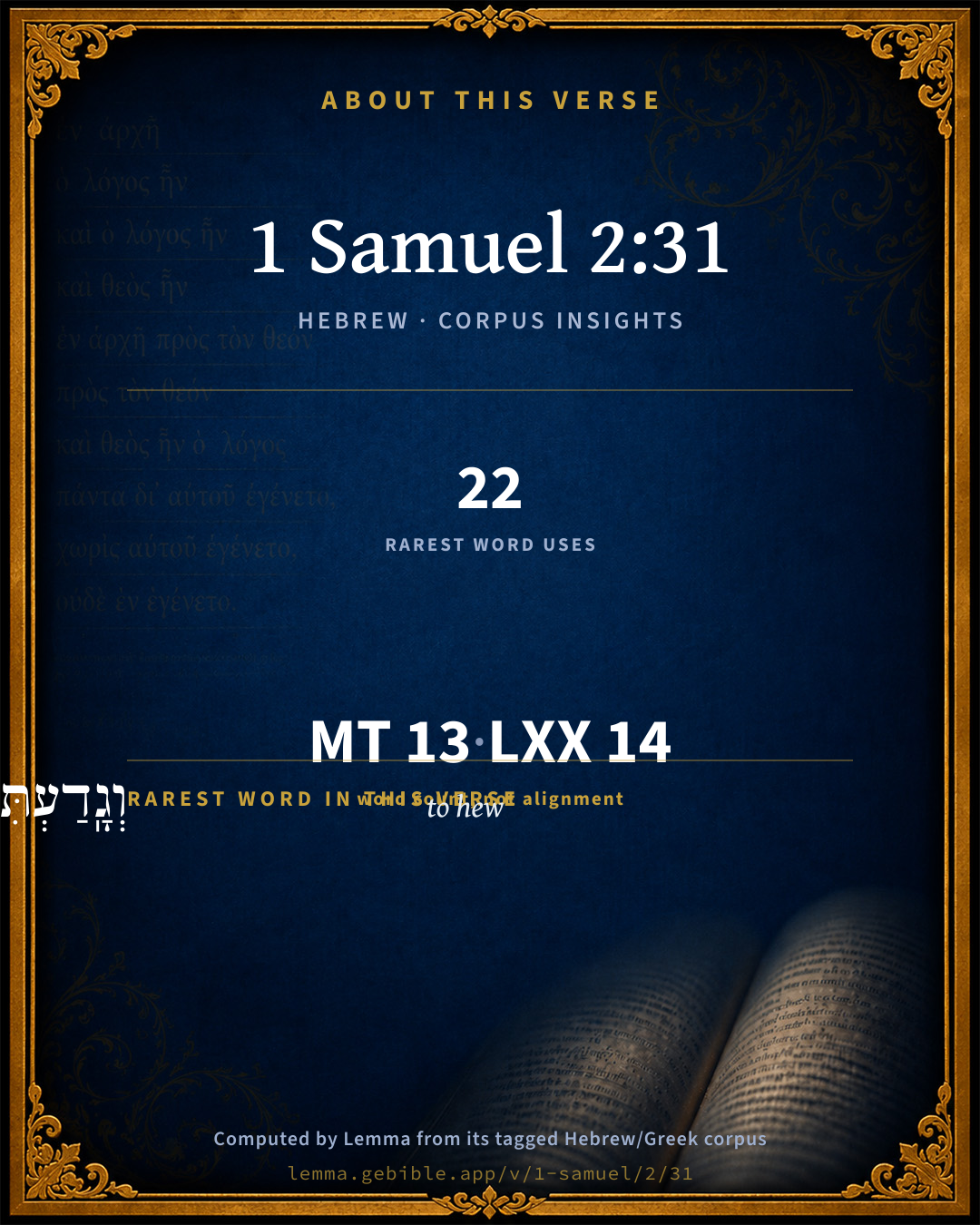
The rarest word here is וְגָֽדַעְתִּי֙ to hew H1438 — appearing just 22 times in the whole Hebrew Bible.

Shared distinctive vocabulary

וְגָֽדַעְתִּי֙ to hew H1438 occurs in 22 verses of the Hebrew Bible. Also found in:

Grammatical profile

  • 3 verbs
  • 6 nouns
  • 1 adjective
  • 3 particles

Verb forms

  • בָּאִ֔ים Qal · Participle Active
  • וְגָֽדַעְתִּי֙ Qal · Sequential Perfect
  • מִֽהְי֥וֹת Qal · Infinitive Construct

Repetition

Words recur within this verse — often emphatic in Hebrew:

  • זְרֹ֣עֲךָ֔ arm H2220 ×2
  • בֵּ֣ית house H1004 ×2

Hebrew & Septuagint length

In English translation the verse runs 29 words from the Hebrew and 17 from the Septuagint (LXX English) — the Septuagint runs noticeably shorter here. See the side-by-side →

A rough comparison of the two English renderings, which tokenize alike — not a word-level alignment.

Word counts can differ between the Hebrew and the Greek without any difference in meaning — e.g. the Hebrew direct-object marker אֵת has no separate Greek word, and Greek often adds the article ὁ.

In the original languages it is 13 Hebrew tokens and 14 Greek tokens — but the two are counted differently (Hebrew bundles its prefixes and suffixes into one token; the Greek is in lemma form), so that isn’t a like-for-like length.

Cross-references

10

Topical passages linked to 1 Samuel 2:31 in the Treasury of Scripture Knowledge — connected by theme and wording, ordered by reader-vote popularity; previews shown in the World English Bible.

  • 1 Samuel 22:17–20 The king said to the guard who stood about him, Turn, and kill the priests of Yahweh; because their hand also is with David, and because they knew that he fled, and didn't disclose it to me. But the servants of the king wouldn't put forth their hand to fall on the priests of Yahweh.
  • 1 Samuel 4:2 The Philistines put themselves in array against Israel: and when they joined battle, Israel was struck before the Philistines; and they killed of the army in the field about four thousand men.
  • 1 Samuel 4:11–20 The ark of God was taken; and the two sons of Eli, Hophni and Phinehas, were slain.
  • 1 Samuel 14:3 and Ahijah, the son of Ahitub, Ichabod's brother, the son of Phinehas, the son of Eli, the priest of Yahweh in Shiloh, wearing an ephod. The people didn't know that Jonathan was gone.
  • 1 Kings 2:26–27 To Abiathar the priest said the king, Get you to Anathoth, to your own fields; for you are worthy of death: but I will not at this time put you to death, because you bear the ark of the Lord Yahweh before David my father, and because you were afflicted in all in which my father was afflicted.
  • 1 Kings 2:35 The king put Benaiah the son of Jehoiada in his room over the host; and Zadok the priest did the king put in the room of Abiathar.
  • Job 22:9 You have sent widows away empty, And the arms of the fatherless have been broken.
  • Psalms 37:17 For the arms of the wicked shall be broken, But Yahweh upholds the righteous.
  • Ezekiel 30:21–24 Son of man, I have broken the arm of Pharaoh king of Egypt; and, behold, it has not been bound up, to apply [healing] medicines, to put a bandage to bind it, that it be strong to hold the sword.
  • Ezekiel 44:10 But the Levites who went far from me, when Israel went astray, who went astray from me after their idols, they shall bear their iniquity.

Cross-references courtesy of OpenBible.info (CC BY 4.0).

Hebrew and Greek witnesses Masoretic Hebrew ↔ Greek Septuagint

The same verse in the two great witnesses to the Old Testament, shown verse-for-verse.

Here the Septuagint runs noticeably shorter than the Hebrew — LXX2012 (modern English Septuagint) 17 words vs World English Bible 29. A rough length comparison of the two English translations, not a word-level alignment — read both below.

These are two independent witnesses, not word-aligned to each other, and the Septuagint is shown in lemma (dictionary) form.

Hebrew 1 Samuel 2:31 Masoretic · Westminster Leningrad Codex

הִנֵּה֙ יָמִ֣ים בָּאִ֔ים וְגָֽדַעְתִּי֙ אֶת זְרֹ֣עֲךָ֔ וְאֶת זְרֹ֖עַ בֵּ֣ית אָבִ֑יךָ מִֽהְי֥וֹת זָקֵ֖ן בְּבֵיתֶֽךָ

Behold, the days come, that I will cut off your arm, and the arm of your father's house, that there shall not be an old man in your house.

World English Bible · Public Domain

Greek LXX 1 Samuel 2:31 Septuagint · lemma form

ἰδού ἡμέρα ἔρχομαι καί ἐκὀλεθρεύω ὁ σπέρμα σύ καί ὁ σπέρμα οἶκος πατήρ σύ

Behold, the days come when I will destroy your seed and the seed of your father's house.

LXX2012 (modern English Septuagint) · Public Domain

Hebrew: Westminster Leningrad Codex (CC BY 4.0). Greek: Septuagint (public domain); English from LXX2012 (modern English Septuagint) (Public Domain). How the Septuagint differs from the Hebrew →

Targum (Aramaic paraphrase)

1

The Targum is the ancient Jewish Aramaic paraphrase of the Hebrew Scriptures — an interpretive translation, not the Hebrew text itself. Onkelos (literal) and Pseudo-Jonathan (expansive) render the Torah, and Jonathan the Prophets. Coverage is partial: where no permissively-licensed English translation exists for a verse, only the Aramaic is shown. This is verse-level text, not a word-by-word alignment to the Hebrew.

  1. Targum Jonathan Prophets (Joshua–Malachi)
    הָא יוֹמַיָא אָתָאן וְאֶקְטוֹף יַת תְּקוֹף דַרְעָךְ וְיַת תְּקוֹף דְרַע בֵּית אָבוּךְ מִלְמֶהֱוֵי סִיב בְּבֵיתָךְ:

    (no public-domain English translation for this verse)

    Targum Jonathan — Aramaic: “Mikraot Gedolot” (public domain). English: “Sefaria Community Translation” (CC0 1.0 (public-domain dedication)); “London "Chaldee Paraphrase," 1871” (public domain). Text via Sefaria.

Commentary

Notes on 1 Samuel 2:31 from classic Christian and Jewish commentators (each source and its license shown beneath its notes). The classic Christian expositions comment on the surrounding passage and are grouped to its opening verse, so a note may address several verses; the Jewish commentaries on the Tanakh (Rashi and others) are per-verse, so they appear only where the commentator wrote on this verse.

Lemma curates 59 commentaries, every one of them public domain or Creative Commons licensed, each selected and text-cleaned for this edition rather than reprinted as found. About our sources →

John Gill's Exposition

And thou shalt see an enemy in my habitation,.... Either the Philistines in the land of Israel, where God chose to dwell, who quickly after made war against Israel, and pitched in Aphek, Sa1 4:1 or, as in the margin of our Bibles, and other versions (i), "thou shalt see the affliction of the tabernacle"; as he did when the ark of God was taken, at the news of which he died, Sa1 4:17 and so the Targum understands it of affliction and calamity, yet not of the house of God, but of his own house; paraphrasing the words thus,"and thou shall see the calamity that shall come upon the men of thine house, for the sins which they have committed before me in the house of my sanctuary:''but it seems best to interpret it of a rival, which not he in his own person should see, but whom his posterity should see high priest in the temple; as they did in Solomon's time, when Abiathar, of the family of Eli, was thrust out, and Zadok, of the family of Eleazar, was put in; for, as Kimchi observes, when a man has two wives, they are rivals or adversaries to one another, jealous and emulous of each other, as Elkanah's two wives were, and of one of them the same word is used as here, Sa1 1:6 so when one high priest was put out, and another taken in, the one was the rival or adversary of the other, as in the case referred to:

in all the wealth which God shall give Israel; which points exactly at the time when this should be, even men God did well to Israel, gave them great prosperity, wealth and riches, quietness and safety, a famous temple built for the worship of God, and everything in a flourishing condition, both with respect to temporals and spirituals, as was in the days of Solomon, see Kg1 4:20 and then it was amidst all that plenty and prosperity, and when the high priesthood was most honourable and profitable, that Eli's family was turned out of it, and another put into it:

and there shall not be an old man in thine house for ever; See Gill on Sa1 2:31 this is repeated for confirmation, and with this addition, that this would be the case for ever.

(i) Symmachus; "angustiam tabernaculi", Junius & Tremellius. Piscator.

John Gill's Exposition of the Whole Bible (1746–1763) — public domain (CC PDM 1.0). Text via the HelloAO Bible API.

Trapp's Complete Commentary

John Trapp

1Sa 2:31 Behold, the days come, that I will cut off thine arm, and the arm of thy father’s house, that there shall not be an old man in thine house.

Ver. 31. I will cut off thine arm,] e.g., The ability and dignity of thy family. See Zec 11:17. {See Trapp on "Zec 11:17"}

There shall not be an old man in thine house,] Because, being an old man, thou hast no better quitted thyself in thy place and station, This was not executed for many years after, that it might be considered, and course taken to prevent it. God therefore threateneth, that he may not be put to punish.

John Trapp, A Commentary or Exposition upon All the Books of the Old and New Testament (1647–1656) — public domain. Text from a community e-Sword module.

The Biblical Illustrator

Joseph S. Exell

1Sa_2:31-34

I will cut off thine arm.

Judgment upon a false priesthood

As a priest or interpreter of the holy is the noblest and highest of all men, so is a sham priest the falsest and basest; neither is it doubtful that his canonicals, were they the Popes tiaras, will be torn from him one day to make bandages for the wounds of mankind, or even to burn into tinder for honest scientific or culinary purposes. (T. Carlyle.)

The Biblical Illustrator, edited by Joseph S. Exell (c. 1880s–1900s) — public domain. Text from a community e-Sword module.

Joseph Benson's Commentary

1Sa 2:31. I will cut off thine arm — I will take away thy strength, or all that in which thou placest thy confidence. This threatening was fulfilled, when the ark, which is called God’s strength, (Psa 78:61,) and was Eli’s strength, was delivered into the hands of the Philistines; and more especially when God took away all power and authority from him and his family, both as he was a priest and as he was a judge. Or, thine arm, may mean thy children, to whom the words following seem to confine the expression. Of thy father’s house — That is, thy children’s children, and all thy family; which was in a great measure accomplished, 1Sa 22:16.

Joseph Benson's Commentary on the Old and New Testaments (1811–1818) — public domain. Text from a community e-Sword module.

Geneva Bible (1599)

Geneva Bible translators

Thy power and authority.

Geneva Bible (1599) marginal notes — public domain. Text via Bolls.life.

Jamieson, Fausset & Brown

Robert Jamieson, A. R. Fausset & David Brown

I will cut off thine arm, and the arm of thy father's house--By the withdrawal of the high priesthood from Eleazar, the elder of Aaron's two sons (after Nadab and Abihu were destroyed, [Num 3:4]), that dignity had been conferred on the family of Ithamar, to which Eli belonged, and now that his descendants had forfeited the honor, it was to be taken from them and restored to the elder branch.

Jamieson, Fausset & Brown — Commentary Critical and Explanatory on the Whole Bible (1871) — public domain (CC PDM 1.0). Text via the HelloAO Bible API.

Adam Clarke's Commentary

Verse 31. I will cut off thine arm] I will destroy the strength, power, and influence of thy family.

Adam Clarke's Commentary on the Bible (1810–1826) — public domain. Text from a community e-Sword/MySword module.

Ellicott's Commentary for English Readers

(31) I will cut off thine arm.—“The arm” signifies power and strength: “Thy power and strength, and that of thy house is doomed.” (See for the figure Job_22:9; Psa_37:17.)

And there shall not be an old man in thine house.—No one more in thy house, O High Priest, who hast so signally failed in thy solemn duty, shall attain to old age; sickness or the sword shall ever early consume its members. This strange denunciation of the “man of God” is emphasised by being repeated in the next (32) verse, and in different words again in 1Sa_2:33.

A Bible Commentary for English Readers, edited by Charles John Ellicott (1878–1897) — public domain. Text from a community e-Sword module.

The Cambridge Bible for Schools and Colleges

gen. ed. J. J. S. Perowne

31. I will cut off thine arm] = I will destroy thy strength. “The arm” is a common expression for “might,” “strength.” Cp. Psa_10:15; Zec_11:17. One signal fulfilment of this doom was the massacre of the priests at Nob (1Sa_22:18-19).

The Cambridge Bible for Schools and Colleges (gen. ed. J. J. S. Perowne; Cambridge University Press, 1878–1918) — public domain. Text from a community e-Sword module.

Albert Barnes' Notes on the Bible

I will cut off thine arm ... - A strong phrase for breaking down the strength and power, of which the arm is the instrument in man (compare Zec 11:17). See 1Sa 2:33.

Albert Barnes' Notes on the Bible (1834–1885) — public domain. Text from a community e-Sword/MySword module.

Haydock's Catholic Bible Commentary

Arm, strength or children. I will slay some; others I will reduce to extreme want. Some explain it of the ark, which was the protection of Israel. (Calmet) --- Old man, to govern. (Du Hamel) --- It is often a title of dignity. But the four succeeding pontiffs did not live long. In the course of little more than 100 years, the last was deposed. (Calmet)

George Leo Haydock (1774–1849), Haydock's Catholic Family Bible and Commentary, 1859 edition — public domain. Excludes Psalms (Douay-Rheims chapter numbering differs from Protestant) and Deuterocanonical books (Catholic canon only).

Matthew Poole's English Annotations

I will cut off thine arm, i.e. I will take away thy strength, which is oft signified by the arm, as Job 22:8; Psa 37:17, or all that in which thou placest thy confidence and security; either,

1. The ark, which is called God’s strength, Psa 78:61, and was Eli’s strength, who therefore was not able to beat the very tidings of the loss of it, 1Sa 4:18. Or,

2. His priestly dignity or employment, whence he had all his honour and substance. Or rather,

3. His children, to whom the words following here, and in the succeeding verses, seem to confine it, who are the strength of parents: see Gen 49:3; Deu 21:17; Psa 127:4,5.

The arm of thy father’s house, i.e. thy children’s children, and all thy family; which was in great measure accomplished, 1Sa 22:16, &c.

There shall not be an old man in thine house; they shall generally be cut off by an untimely death before they be old.

Matthew Poole's English Annotations on the Holy Bible (1683–1685) — public domain. Text from a community e-Sword/MySword module.

Whedon's Commentary on the Bible

Daniel D. Whedon

31. Cut off thine arm — To cut off one’s arm is to deprive him of strength and render him helpless. Thus was Eli’s house disabled. Compare Job_22:9; Psa_37:17; Zec_11:17.

Not be an old man in thine house — Because the rest of his family should die in the flower of their age. 1Sa_2:33.

Daniel D. Whedon (gen. ed.), Commentary on the Old and New Testaments (1874–1909) — public domain. Text from a community e-Sword module.

The Pulpit Commentary

I will cut off thine arm. The arm is the usual metaphor for strength. As Eli had preferred the exaltation of his sons to God"s honour, he is condemned to see the strength of his house broken. Nay, more; there is not to be an "old man in his house." The young men full of energy and vigour perish by the sword; the Survivors fade away by disease. The Jews say that the house of Ithamar was peculiarly short-lived, but the prophecy was amply fulfilled in the slaughter of Eli"s house, first at Shiloh, and then at Nob by Doeg the Edomite at the command of Saul. There is nothing to warrant an abiding curse upon his family. The third or fourth generation is the limit of the visitation of the sins of the fathers upon the children.

The Pulpit Commentary (1880–1919), ed. H.D.M. Spence-Jones & Joseph S. Exell — public domain. Text from a community e-Sword module.

John Wesley's Explanatory Notes

Arm - That is, I will take away thy strength, or all that in which thou placest thy confidence, either,

1. the ark, which is called God's strength, Psalm lxxviii, 61, and was Eli's strength, who therefore was not able to bear the very tidings of the loss of it. Or,

2. his priestly dignity or employment, whence he had all his honour and substance. Or rather,

3. his children, to whom the words following here, and in the succeeding verses, seem to confine it. Father's house - That is, thy children's children, and all thy family which was in great measure accomplished, chap. xxii, 16, &c.

John Wesley, Explanatory Notes Upon the Whole Bible (1754–1765) — public domain. Text via the GEBible commentary corpus.

unfoldingWord translationNotes

Door43 World Missions Community

See

"Listen carefully to what I am about to say" or "What I am about to say is very important"

I will cut off your strength and the strength of your father's house

The words "cut off ... strength" are probably a euphemism for the death of strong, young men; the words "your father's house" are a metonym for "your family." AT: "I will kill you and all strong, young male descendants in your family" (See: Euphemism and Metonymy)

be any old man

"be any old men" or "be any men who grow old"

cause your eyes to fail

"cause you to lose your eyesight" or "cause you to go blind"

translationWords

cut off

die

unfoldingWord translationNotes — © Distant Shores Media and the Door43 World Missions Community, licensed CC BY-SA 4.0. Source: git.door43.org/Door43/en_tn.

Rashi

Rabbi Shlomo Yitzchaki (Rashi)

I shall cut off your arm. I.e., the power which you exert in My House, for you say, "or else I will take it by force."

Rashi on the Tanakh — English translations: “The Judaica Press complete Tanach with Rashi, translated by A. J. Rosenberg” (CC BY 4.0); “Pentateuch with Rashi's commentary by M. Rosenbaum and A.M. Silbermann, 1929-1934” (public domain); “The Metsudah Tanach series, Lakewood, N.J” (CC BY 4.0); and “The Book of Joshua, Metsudah Publications, 1997” (CC BY 4.0). Text via Sefaria.

Lesson kit

Teaching starters — assembled from the data on this page, not authored interpretation. Every prompt links to the verse data it draws on. Edit before teaching.

1 Samuel, in the Historical, opens this verse with 13 words (10 distinct Hebrew lemmas). Its most distinctive word is gâdaʻ (“to hew”). The Greek Septuagint runs shorter here. A historical commentator’s framing appears above. Read the whole chapter for the surrounding context.

Discussion questions

  1. How does “to hew” (gâdaʻ) shape what this verse is saying?
  2. Deuteronomy 7:5 shares the word «to hew» with this verse. How do the two illuminate each other?
  3. “arm” occurs 2× in this one verse. What is the effect of the repetition?
  4. Compared with the Hebrew, the Septuagint runs shorter here. What questions does that raise?
  5. These translations render this verse differently; the difference is in the English rendering, not the original. What questions does that raise?
  6. The verb «בָּאִ֔ים» is Qal Participle Active. How does its form color the action?
  7. Reading how John Gill's Exposition and Trapp's Complete Commentary read this verse, where do the two commentators agree and where do they part?

Things to notice

Reading settings

Reading text

Shown beneath each verse's original-language words.

Old Testament
Old Testament edition

Read the OT as the Masoretic Hebrew (MT) or the Greek Septuagint (LXX).

English shown for the Greek Septuagint (in the Hebrew ↔ Greek comparison).

Comparing translations? Open the Compare panel on any verse page to stack up to four side by side.