
1 Kings 13:25

Hebrew (Westminster Leningrad Codex) 1 Kings 13:25 appears in the Hebrew Old Testament. The text above is from the Westminster Leningrad Codex. Each word links to its Strong’s number, a concise gloss, and parsing drawn from the Open Scriptures Hebrew Bible morphology. Click any word for its full Brown-Driver-Briggs (BDB) entry.
Download image
Cite this verse

1 Kings 13:25 (World English Bible). Public Domain. Lemma interlinear Bible study tool, https://lemma.gebible.app/v/1-kings/13/25.

Show BibTeX & RIS
BibTeX
RIS
English Translation
Behold, men passed by, and saw the body cast in the way, and the lion standing by the body; and they came and told it in the city where the old prophet lived.
World English Bible · Public Domain
Download a study sheet

One document with this verse’s original text, its word-by-word gloss line, the meaning frame, cross-references with their text, attributed commentary, and full source and license credits — printable, and it pastes into notes with its structure intact.

This verse Autodidact and up

Study sheet (.html) Plain text (.txt)

A passage Seminary Student

Up to 50 verses in one chapter. A passage sheet keeps up to 6 commentary sources and 12 cross-references per verse, in the order this page ranks them, and says so on the sheet whenever that leaves anything out. Ask for a single verse and you get the Autodidact verse sheet above.

Everything on this page stays free to read, with no account — the sheet is a download of what is already on screen, not access to it.

Want to remove ads? Support Godless Engineer
Compare translations 3

The same verse in 3 English versions, stacked beneath the original-language interlinear above. Click any original word for its lexicon entry.

Each is an independent rendering of the whole verse — the interlinear is not word-aligned to these translations.

Highlighted words mark where these versions differ — a whole-verse word diff, not a word-by-word alignment.

  • World English Bible Public Domain
    Behold, men passed by, and saw the body cast in the way, and the lion standing by the body; and they came and told it in the city where the old prophet lived.
  • King James Version Public Domain
    And, behold, men passed by, and saw the carcass cast in the way, and the lion standing by the carcass: and they came and told it in the city where the old prophet dwelt.
  • unfoldingWord Literal Text CC BY-SA 4.0
    And behold, men were passing by, and they saw the corpse thrown in the road and the lion standing beside the corpse. And they came and spoke in the city in which the old prophet was dwelling.

unfoldingWord Literal Text — © unfoldingWord, licensed CC BY-SA 4.0. Word-aligned USFM3 via Door43 (git.door43.org/unfoldingWord/en_ult).

Versions to compare (up to 4)

3 of 4 selected

Show all 18 translations

Every available English version of this verse, each an independent rendering of the whole verse.

  • World English Bible Public Domain
    Behold, men passed by, and saw the body cast in the way, and the lion standing by the body; and they came and told it in the city where the old prophet lived.
  • Berean Standard Bible Public Domain
    And there were men passing by who saw the body lying in the road with the lion standing beside it, and they went and reported this in the city where the old prophet lived.
  • Majority Standard Bible Public Domain
    And there were men passing by who saw the body lying in the road with the lion standing beside it, and they went and reported this in the city where the old prophet lived.
  • King James Version Public Domain
    And, behold, men passed by, and saw the carcass cast in the way, and the lion standing by the carcass: and they came and told it in the city where the old prophet dwelt.
  • American Standard Version (1901) Public Domain
    And, behold, men passed by, and saw the body cast in the way, and the lion standing by the body; and they came and told it in the city where the old prophet dwelt.
  • Revised Version (1885) Public Domain
    And, behold, men passed by, and saw the carcase cast in the way, and the lion standing by the carcase: and they came and told it in the city where the old prophet dwelt.
  • Geneva Bible (1599) Public Domain
    And beholde, men that passed by, sawe the carkeis cast in the way, and the lion standing by the corps: and they came and tolde it in ye towne where the olde Prophet dwelt.
  • Douay-Rheims (1899) Public Domain
    And behold, men passing by saw the dead body cast in the way, and the lion standing by the body. And they came and told it in the city, wherein that old prophet dwelt.
  • Young's Literal Translation Public Domain
    And lo, men are passing by, and see the carcase cast in the way, and the lion standing near the carcase, and they come and speak `of it' in the city in which the old prophet is dwelling.
  • Literal Standard Version CC BY-SA 4.0
    And behold, men are passing by, and see the carcass cast in the way, and the lion standing near the carcass, and they come and speak [of it] in the city in which the old prophet is dwelling.
  • Unlocked Literal Bible CC BY-SA 4.0
    When men passed by and saw the body left on the road, and the lion standing by the body, they came and told it in the city where the old prophet lived.
  • unfoldingWord Literal Text CC BY-SA 4.0
    And behold, men were passing by, and they saw the corpse thrown in the road and the lion standing beside the corpse. And they came and spoke in the city in which the old prophet was dwelling.
  • Darby Bible Public Domain
    And behold, men passed by, and saw the corpse cast in the way and the lion standing by the corpse; and they came and told it in the city where the old prophet dwelt.
  • World Messianic Bible Public Domain
    Behold, men passed by and saw the body thrown on the path, and the lion standing by the body; and they came and told it in the city where the old prophet lived.
  • Webster's Bible Public Domain
    And behold, men passed by, and saw the carcass cast in the way, and the lion standing by the carcass: and they came and told it in the city where the old prophet dwelt.
  • Free Bible Version CC BY-SA 4.0
    Some passers-by saw the body lying in the road with the lion standing beside it, so they went and let people know about it in the town where the old prophet lived.
  • Bible in Basic English Public Domain
    And some men, going by, saw the body stretched out in the road with the lion by its side; and they came and gave news of it in the town where the old prophet was living.
  • JPS Tanakh (1917) Public Domain
    And, behold, men passed by, and saw the carcass cast in the way, and the lion standing by the carcass; and they came and told it in the city where the old prophet dwelt.

Literal Standard Version (2020), Covenant Press — licensed CC BY-SA 4.0. Text via the HelloAO Bible API (eBible.org). Unlocked Literal Bible (unfoldingWord) — licensed CC BY-SA 4.0. Text via the HelloAO Bible API (eBible.org). unfoldingWord Literal Text — © unfoldingWord, licensed CC BY-SA 4.0. Word-aligned USFM3 via Door43 (git.door43.org/unfoldingWord/en_ult). Free Bible Version, Dr. Jonathan Gallagher — licensed CC BY-SA 4.0. Text via the HelloAO Bible API (eBible.org).

Word by word

More ways to search: Search by grammar → Find every occurrence → Compare this word →

Practice this passage: Drill this verse → Learn its vocabulary →

הַנְּבֵלָה֙
nᵉbêlâh
H5038
“the · carcass”
Particle, Definite Article + Noun, Common, Feminine, Singular, Absolute
Part of Speech
Particle + Noun
Type
Common
Gender
Feminine
Number
Singular
State
Absolute
Full BDB Definition

Origin: from H5034

TWOT: 1286a

carcass, corpse - of humans, idols, animals
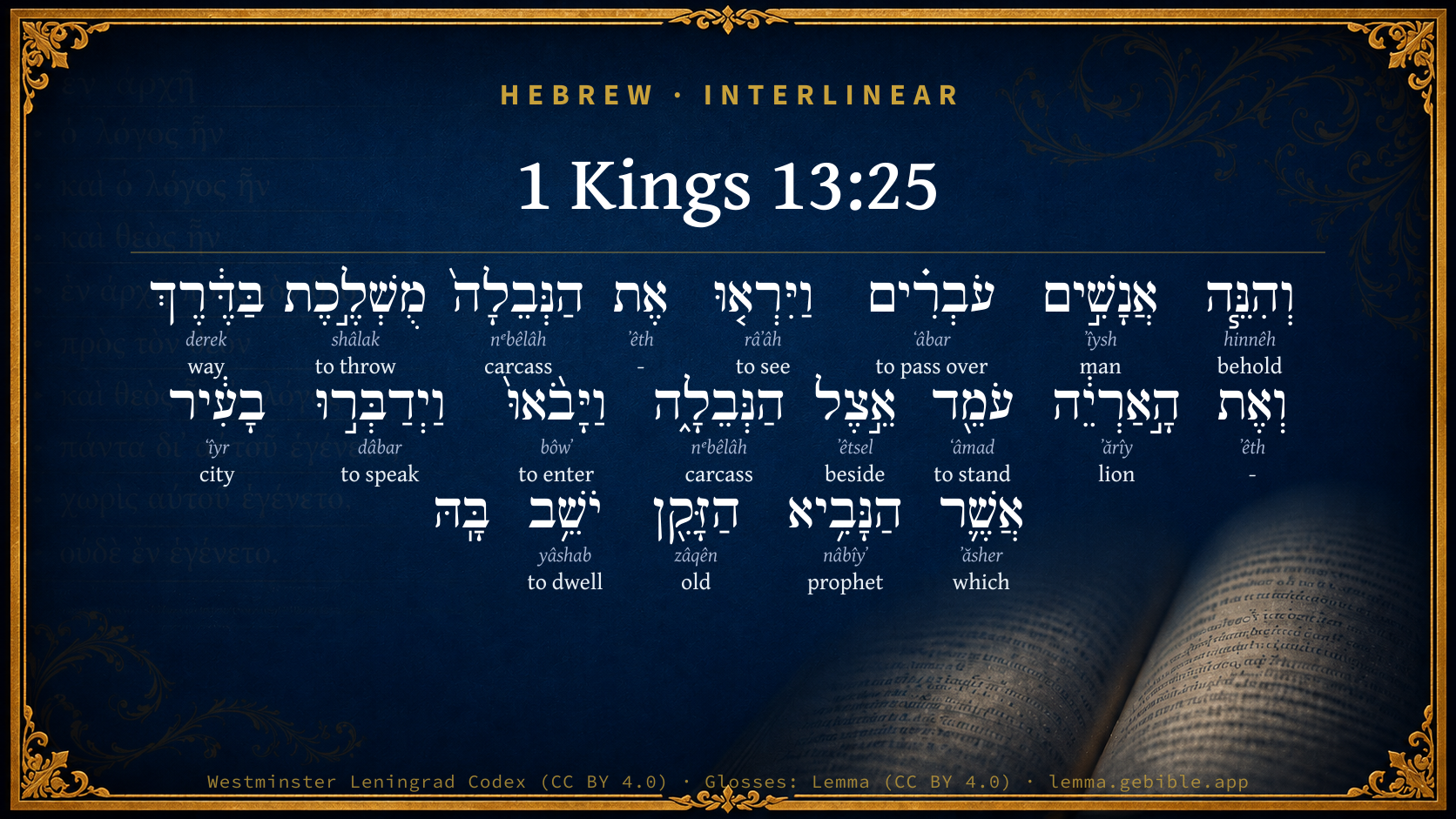
  1. וְהִנֵּ֧ה hinnêh H2009 “and · behold” Conjunction + Particle, Demonstrative
  2. אֲנָשִׁ֣ים ʼîysh H376 “men” Noun, Common, Masculine, Plural, Absolute
  3. עֹבְרִ֗ים ʻâbar H5674 “passing over” Verb, Qal, Participle Active, Masculine, Plural, Absolute
  4. וַיִּרְא֤וּ râʼâh H7200 “and · to see” Conjunction + Verb, Qal, Sequential Imperfect, 3rd Person, Masculine, Plural
  5. אֶת ʼêth H853 “-” Particle, Direct Object
  6. מֻשְׁלֶ֣כֶת shâlak H7993 “thrown” Verb, Hophal, Participle Passive, Feminine, Singular, Absolute
  7. בַּדֶּ֔רֶךְ derek H1870 “in/at the · way” Preposition, Determined + Noun, Common, Both, Singular, Absolute
  8. וְאֶת ʼêth H853 “and · -” Conjunction + Particle, Direct Object
  9. הָ֣אַרְיֵ֔ה ʼărîy H738 “the · lion” Particle, Definite Article + Noun, Common, Masculine, Singular, Absolute
  10. עֹמֵ֖ד ʻâmad H5975 “standing” Verb, Qal, Participle Active, Masculine, Singular, Absolute
  11. אֵ֣צֶל ʼêtsel H681 “beside” Preposition
  12. הַנְּבֵלָ֑ה nᵉbêlâh H5038 “the · carcass” Particle, Definite Article + Noun, Common, Feminine, Singular, Absolute
  13. וַיָּבֹ֨אוּ֙ bôwʼ H935 “and · to enter” Conjunction + Verb, Qal, Sequential Imperfect, 3rd Person, Masculine, Plural
  14. וַיְדַבְּר֣וּ dâbar H1696 “and · to speak” Conjunction + Verb, Piel, Sequential Imperfect, 3rd Person, Masculine, Plural
  15. בָעִ֔יר ʻîyr H5892 “in/at the · city” Preposition, Determined + Noun, Common, Feminine, Singular, Absolute
  16. אֲשֶׁ֛ר ʼăsher H834 “which” Particle, Relative
  17. הַנָּבִ֥יא nâbîyʼ H5030 “the · prophet” Particle, Definite Article + Noun, Common, Masculine, Singular, Absolute
  18. הַזָּקֵ֖ן zâqên H2205 “the · old” Particle, Definite Article + Adjective, Adjective, Masculine, Singular, Absolute
  19. יֹשֵׁ֥ב yâshab H3427 “dwelling” Verb, Qal, Participle Active, Masculine, Singular, Absolute

About this verse

These counts appear in no published source. They are computed here, from the morphology-tagged text and Lemma’s own curated glosses. What Lemma adds →

21
words
18
distinct lemmas
Historical
section

Shared distinctive vocabulary

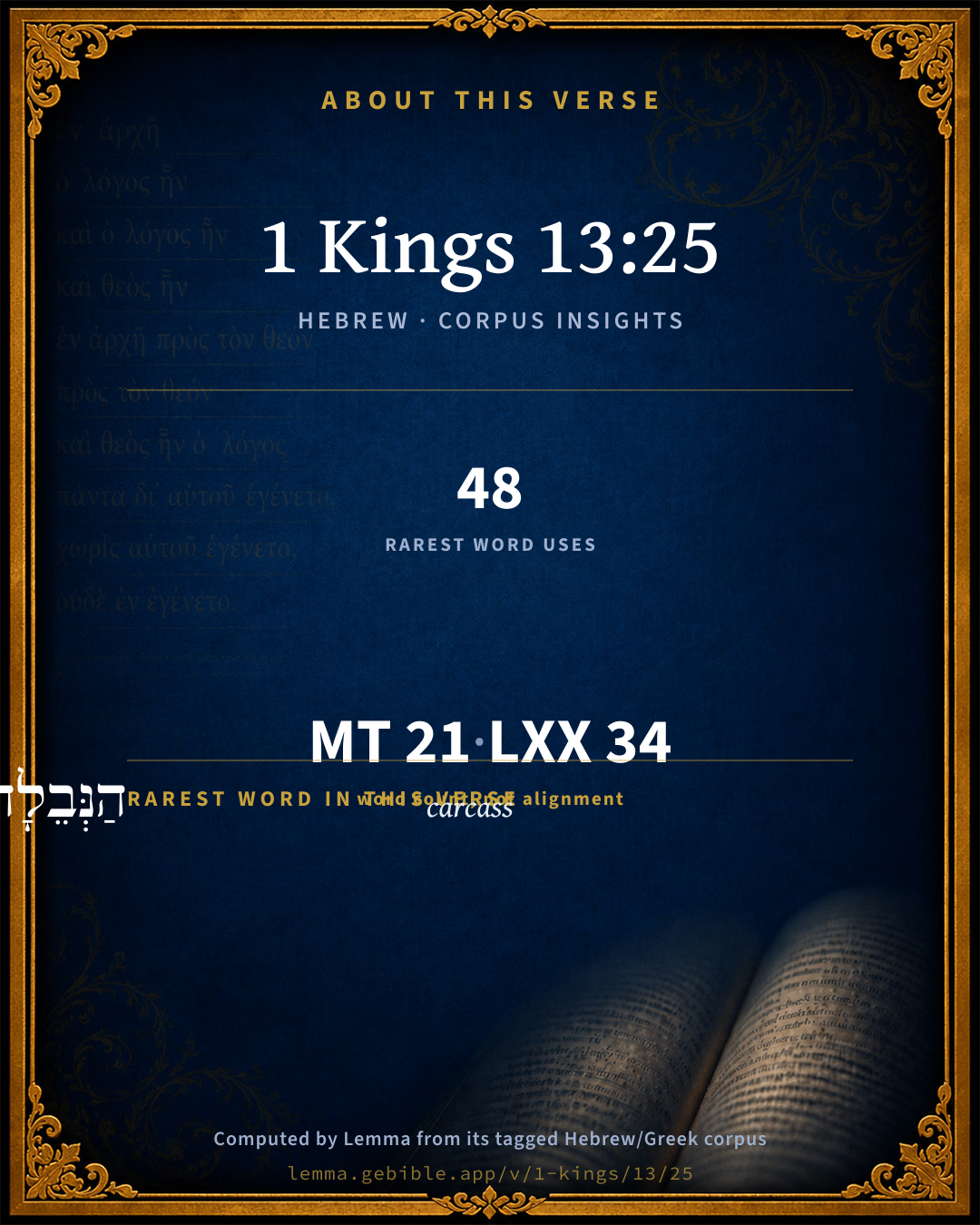
הַנְּבֵלָה֙ carcass H5038 occurs in 41 verses of the Hebrew Bible. Also found in:

Grammatical profile

  • 7 verbs
  • 7 nouns
  • 1 adjective
  • 2 prepositions
  • 4 particles

Verb forms

  • עֹבְרִ֗ים Qal · Participle Active
  • וַיִּרְא֤וּ Qal · Sequential Imperfect
  • מֻשְׁלֶ֣כֶת Hophal · Participle Passive
  • עֹמֵ֖ד Qal · Participle Active
  • וַיָּבֹ֨אוּ֙ Qal · Sequential Imperfect
  • וַיְדַבְּר֣וּ Piel · Sequential Imperfect
  • יֹשֵׁ֥ב Qal · Participle Active

Repetition

A word recurs within this verse — often emphatic in Hebrew:

  • הַנְּבֵלָה֙ carcass H5038 ×2

Hebrew & Septuagint length

In English translation the verse runs 33 words from the Hebrew and 38 from the Septuagint (LXX English) — closely comparable.

A rough comparison of the two English renderings, which tokenize alike — not a word-level alignment.

Word counts can differ between the Hebrew and the Greek without any difference in meaning — e.g. the Hebrew direct-object marker אֵת has no separate Greek word, and Greek often adds the article ὁ.

In the original languages it is 21 Hebrew tokens and 34 Greek tokens — but the two are counted differently (Hebrew bundles its prefixes and suffixes into one token; the Greek is in lemma form), so that isn’t a like-for-like length.

Cross-references

1

Topical passages linked to 1 Kings 13:25 in the Treasury of Scripture Knowledge — connected by theme and wording, ordered by reader-vote popularity; previews shown in the World English Bible.

  • 1 Kings 13:11 Now there lived an old prophet in Bethel; and one of his sons came and told him all the works that the man of God had done that day in Bethel: the words which he had spoken to the king, them also they told to their father.

Cross-references courtesy of OpenBible.info (CC BY 4.0).

Hebrew and Greek witnesses Masoretic Hebrew ↔ Greek Septuagint

The same verse in the two great witnesses to the Old Testament, shown verse-for-verse.

These are two independent witnesses, not word-aligned to each other, and the Septuagint is shown in lemma (dictionary) form.

Hebrew 1 Kings 13:25 Masoretic · Westminster Leningrad Codex

וְהִנֵּ֧ה אֲנָשִׁ֣ים עֹבְרִ֗ים וַיִּרְא֤וּ אֶת הַנְּבֵלָה֙ מֻשְׁלֶ֣כֶת בַּדֶּ֔רֶךְ וְאֶת הָ֣אַרְיֵ֔ה עֹמֵ֖ד אֵ֣צֶל הַנְּבֵלָ֑ה וַיָּבֹ֨אוּ֙ וַיְדַבְּר֣וּ בָעִ֔יר אֲשֶׁ֛ר הַנָּבִ֥יא הַזָּקֵ֖ן יֹשֵׁ֥ב בָּֽהּ

Behold, men passed by, and saw the body cast in the way, and the lion standing by the body; and they came and told it in the city where the old prophet lived.

World English Bible · Public Domain

Greek LXX 1 Kings 13:25 Septuagint · lemma form

καί ἰδού ἀνήρ παραπορεύομαι καί ὁράω ὁ θνησιμαῖος ῥίπτω ἐν ὁ ὁδός καί ὁ λέων ἵστημι ἔχω ὁ θνησιμαῖος καί εἰςἔρχομαι καί λαλέω ἐν ὁ πόλις ὅς ὁ προφήτης ὁ πρεσβύτης καταοἰκέω ἐν αὐτός

And, behold, men were passing by, and saw the carcass cast in the way, and the lion was standing near the carcass: and they went in and spoke of it in the city where the old prophet lived.

LXX2012 (modern English Septuagint) · Public Domain

Hebrew: Westminster Leningrad Codex (CC BY 4.0). Greek: Septuagint (public domain); English from LXX2012 (modern English Septuagint) (Public Domain). How the Septuagint differs from the Hebrew →

Targum (Aramaic paraphrase)

1

The Targum is the ancient Jewish Aramaic paraphrase of the Hebrew Scriptures — an interpretive translation, not the Hebrew text itself. Onkelos (literal) and Pseudo-Jonathan (expansive) render the Torah, and Jonathan the Prophets. Coverage is partial: where no permissively-licensed English translation exists for a verse, only the Aramaic is shown. This is verse-level text, not a word-by-word alignment to the Hebrew.

  1. Targum Jonathan Prophets (Joshua–Malachi)
    וְהָא גַבְרַיָא עָבְרִין וַחֲזוֹ יַת נְבֵלְתָּא רַמְיָא בְאוֹרְחָא וְיַת אַרְיָא קָאִים בִּסְטַר נְבֵלְתָּא וַאֲתוֹ וּמַלִילוּ בְקַרְתָּא דִנְבִיָא שַׁקְרָא סָבָא יָתֵיב בָּהּ:

    (no public-domain English translation for this verse)

    Targum Jonathan — Aramaic: “Mikraot Gedolot” (public domain). English: “Sefaria Community Translation” (CC0 1.0 (public-domain dedication)); “London "Chaldee Paraphrase," 1871” (public domain). Text via Sefaria.

Commentary

Notes on 1 Kings 13:25 from classic Christian and Jewish commentators (each source and its license shown beneath its notes). The classic Christian expositions comment on the surrounding passage and are grouped to its opening verse, so a note may address several verses; the Jewish commentaries on the Tanakh (Rashi and others) are per-verse, so they appear only where the commentator wrote on this verse.

Lemma curates 59 commentaries, every one of them public domain or Creative Commons licensed, each selected and text-cleaned for this edition rather than reprinted as found. About our sources →

Trapp's Complete Commentary

John Trapp

1Ki 13:25 And, behold, men passed by, and saw the carcase cast in the way, and the lion standing by the carcase: and they came and told [it] in the city where the old prophet dwelt.

Ver. 25. And they came and told it in the city,] i.e., Bethel; the inhabitants whereof could not but hear this sad news with aching and quaking hearts, if they had any sense left. For they could not but hereby see that he was indeed a prophet of God - whose hand was so heavy upon him for not persevering to obey this command - and that therefore whatsoever he had foretold, should in due time be fulfilled, as the old prophet also herehence concluded. {1Ki 13:32}

John Trapp, A Commentary or Exposition upon All the Books of the Old and New Testament (1647–1656) — public domain. Text from a community e-Sword module.

Joseph Benson's Commentary

1Ki 13:25-26. They came and told it in the city — As a wonderful thing that the lion should neither fall upon his prey, nor hurt them who passed by, but suffer them to go on quietly, Who was disobedient unto the word of the Lord — Which was the true reason why he was so severely punished, in order that other prophets might not, upon any pretence or excuse, neglect punctually to attend to, and observe all the divine injunctions; for, had they not been deterred from neglecting and disregarding them, the authority of prophecy would have been soon lessened, and consequently the people have sooner or more readily fallen into idolatry. Which hath torn and slain him, according to the word of the Lord — God had not expressly said that a lion should tear him; but, that he should suffer a violent death in some way, was implied in the threatening that his carcass should not come into the sepulchre of his fathers.

Joseph Benson's Commentary on the Old and New Testaments (1811–1818) — public domain. Text from a community e-Sword module.

The Cambridge Bible for Schools and Colleges

gen. ed. J. J. S. Perowne

25. told it in the city where the old prophet dwelt] As Bethel has been already mentioned it is not easy to see why this circumlocution is made use of. Perhaps the idea is that the news was carried in all directions by the passers by and so came among other places to that where he dwelt whom it specially concerned.

The Cambridge Bible for Schools and Colleges (gen. ed. J. J. S. Perowne; Cambridge University Press, 1878–1918) — public domain. Text from a community e-Sword module.

John Gill's Exposition

And he spoke to his sons, saying, saddle me the ass,.... For it seems he had more than one, for he had sent away the man of God with one before: and they saddled him; the ass he commonly rode on.

And he spoke to his sons, saying, saddle me the ass,.... For it seems he had more than one, for he had sent away the man of God with one before: and they saddled him; the ass he commonly rode on.

1 Kings 13:28

kg1 13:28

kg1 13:28

kg1 13:28And he went and found his carcass cast in the way, and the ass and the lion standing by the carcass,.... As before described:

the lion had not eaten the carcass, nor torn the ass; both which were very marvellous; as also that the ass should stand so quietly, and without fear, by the carcass along with the lion and not run away; but here both stayed till the prophet came to take care of the carcass, which shows the singular providence of God in this affair; and that though he chastised the man of God with a temporal judgment for his offence, yet he was dear to him, and even his carcass precious in his sight.

John Gill's Exposition of the Whole Bible (1746–1763) — public domain (CC PDM 1.0). Text via the HelloAO Bible API.

The Pulpit Commentary

And, behold, men passed by, and saw the carcase cast in the way, and the lion standing by the carcase: and they came and told it in the city where the old prophet dwelt. This was precisely what God had designed. By this means, the very disobedience and death of the man of God became a part of the protest against the new rites. "For if the partaking of food against the commandment of God, though the result not of indulgence, but of deceit, brought so great a punishment upon a righteous man, what sort of chastisements would befall those who had left God their Maker and were worshipping senseless images" (Theodoret.)

The Pulpit Commentary (1880–1919), ed. H.D.M. Spence-Jones & Joseph S. Exell — public domain. Text from a community e-Sword module.

Lesson kit

Teaching starters — assembled from the data on this page, not authored interpretation. Every prompt links to the verse data it draws on. Edit before teaching.

1 Kings, in the Historical, opens this verse with 21 words (18 distinct Hebrew lemmas). Its most distinctive word is nᵉbêlâh (“carcass”). A historical commentator’s framing appears above. Read the whole chapter for the surrounding context.

Discussion questions

  1. What does “carcass” (nᵉbêlâh) contribute to the verse as a whole?
  2. Leviticus 5:2 shares the word «carcass» with this verse. How do the two illuminate each other?
  3. “carcass” occurs 2× in this one verse. What is the effect of the repetition?
  4. The translations on this page render this verse differently — a whole-verse word diff, not a word-by-word alignment. What might account for the different wordings?
  5. The verb «עֹבְרִ֗ים» is Qal Participle Active. How does its form color the action?
  6. Reading how Trapp's Complete Commentary and Joseph Benson's Commentary read this verse, where do the two commentators agree and where do they part?

Things to notice

Reading settings

Reading text

Shown beneath each verse's original-language words.

Old Testament
Old Testament edition

Read the OT as the Masoretic Hebrew (MT) or the Greek Septuagint (LXX).

English shown for the Greek Septuagint (in the Hebrew ↔ Greek comparison).

Comparing translations? Open the Compare panel on any verse page to stack up to four side by side.