
2 Samuel 19:11

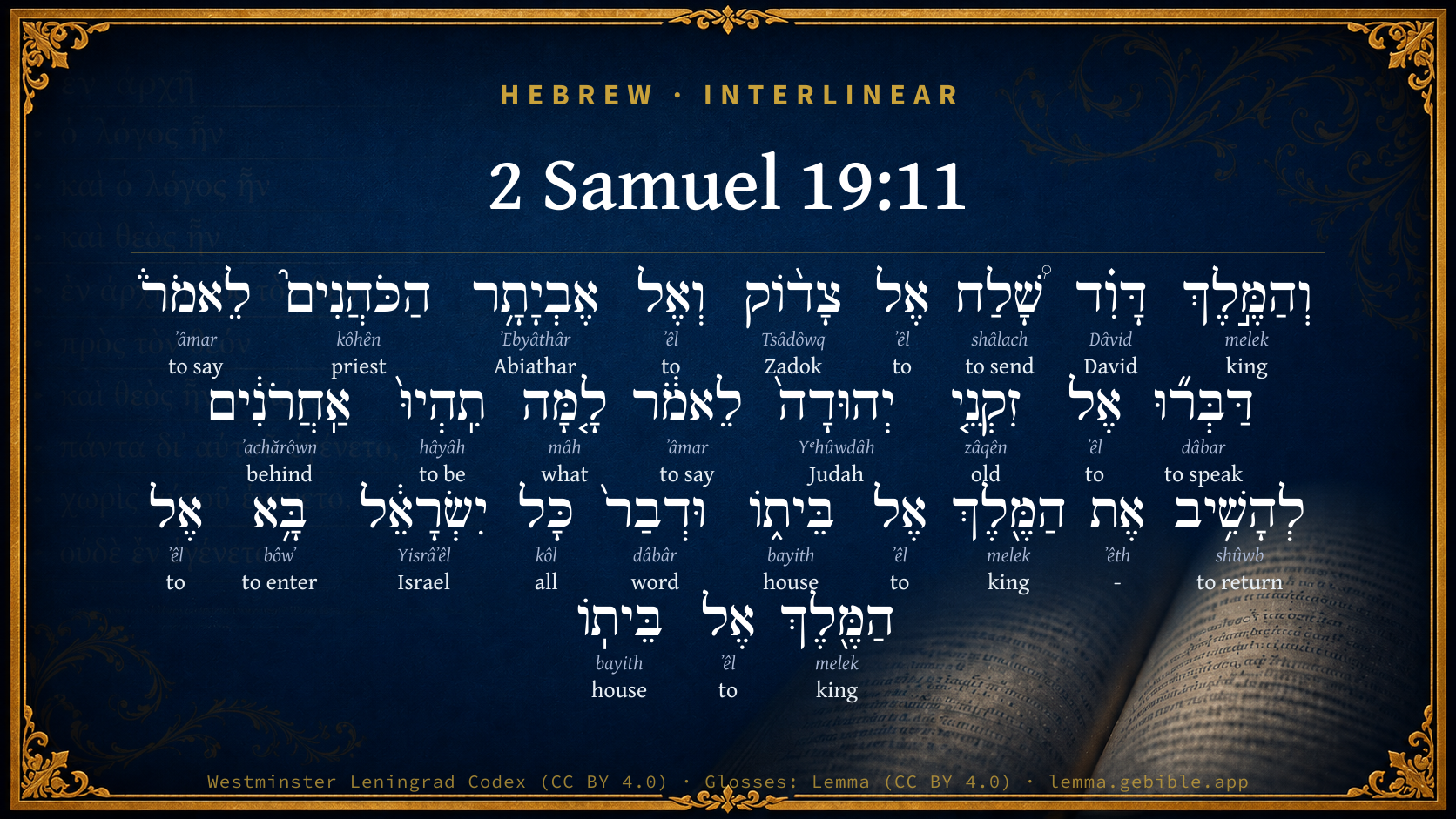
Hebrew (Westminster Leningrad Codex) 2 Samuel 19:11 appears in the Hebrew Old Testament. The text above is from the Westminster Leningrad Codex. Each word links to its Strong’s number, a concise gloss, and parsing drawn from the Open Scriptures Hebrew Bible morphology. Click any word for its full Brown-Driver-Briggs (BDB) entry.
Download image
Cite this verse

2 Samuel 19:11 (World English Bible). Public Domain. Lemma interlinear Bible study tool, https://lemma.gebible.app/v/2-samuel/19/11.

Show BibTeX & RIS
BibTeX
RIS
English Translation
King David sent to Zadok and to Abiathar the priests, saying, Speak to the elders of Judah, saying, Why are you the last to bring the king back to his house? seeing the speech of all Israel is come to the king, [to bring him] to his house.
World English Bible · Public Domain
Download a study sheet

One document with this verse’s original text, its word-by-word gloss line, the meaning frame, cross-references with their text, attributed commentary, and full source and license credits — printable, and it pastes into notes with its structure intact.

This verse Autodidact and up

Study sheet (.html) Plain text (.txt)

A passage Seminary Student

Up to 50 verses in one chapter. A passage sheet keeps up to 6 commentary sources and 12 cross-references per verse, in the order this page ranks them, and says so on the sheet whenever that leaves anything out. Ask for a single verse and you get the Autodidact verse sheet above.

Everything on this page stays free to read, with no account — the sheet is a download of what is already on screen, not access to it.

Want to remove ads? Support Godless Engineer
Compare translations 3

The same verse in 3 English versions, stacked beneath the original-language interlinear above. Click any original word for its lexicon entry.

Each is an independent rendering of the whole verse — the interlinear is not word-aligned to these translations.

Highlighted words mark where these versions differ — a whole-verse word diff, not a word-by-word alignment.

  • World English Bible Public Domain
    King David sent to Zadok and to Abiathar the priests, saying, Speak to the elders of Judah, saying, Why are you the last to bring the king back to his house? seeing the speech of all Israel is come to the king, [to bring him] to his house.
  • King James Version Public Domain
    And king David sent to Zadok and to Abiathar the priests, saying, Speak unto the elders of Judah, saying, Why are ye the last to bring the king back to his house? seeing the speech of all Israel is come to the king, even to his house.
  • unfoldingWord Literal Text CC BY-SA 4.0
    And King David sent to Zadok and to Abiathar, the priests, saying, “Speak to the elders of Judah, saying, ‘Why are you the last to bring back the king to his house? For the word of all of Israel has come to the king, to his house.

unfoldingWord Literal Text — © unfoldingWord, licensed CC BY-SA 4.0. Word-aligned USFM3 via Door43 (git.door43.org/unfoldingWord/en_ult).

Versions to compare (up to 4)

3 of 4 selected

Show all 18 translations

Every available English version of this verse, each an independent rendering of the whole verse.

  • World English Bible Public Domain
    King David sent to Zadok and to Abiathar the priests, saying, Speak to the elders of Judah, saying, Why are you the last to bring the king back to his house? seeing the speech of all Israel is come to the king, [to bring him] to his house.
  • Berean Standard Bible Public Domain
    Then King David sent this message to Zadok and Abiathar, the priests: “Say to the elders of Judah, ‘Why should you be the last to restore the king to his palace, since the talk of all Israel has reached the king at his quarters?
  • Majority Standard Bible Public Domain
    Then King David sent this message to Zadok and Abiathar, the priests: “Say to the elders of Judah, ‘Why should you be the last to restore the king to his palace, since the talk of all Israel has reached the king at his quarters?
  • King James Version Public Domain
    And king David sent to Zadok and to Abiathar the priests, saying, Speak unto the elders of Judah, saying, Why are ye the last to bring the king back to his house? seeing the speech of all Israel is come to the king, even to his house.
  • American Standard Version (1901) Public Domain
    And king David sent to Zadok and to Abiathar the priests, saying, Speak unto the elders of Judah, saying, Why are ye the last to bring the king back to his house? seeing the speech of all Israel is come to the king, `to bring him' to his house.
  • Revised Version (1885) Public Domain
    And king David sent to Zadok and to Abiathar the priests, saying, Speak unto the elders of Judah, saying, Why are ye the last to bring the king back to his house? seeing the speech of all Israel is come to the king, to bring him to his house.
  • Geneva Bible (1599) Public Domain
    But King Dauid sent to Zadok and to Abiathar the Priestes, saying, Speake vnto the Elders of Iudah, and say, Why are ye behind to bring the King againe to his house, (for the saying of al Israel is come vnto the king, euen to his house)
  • Douay-Rheims (1899) Public Domain
    And king David sent to Sadoc, and Abiathar the priests, saying: Speak to the ancients of Juda, saying: Why are you the last to bring the king back to his house? (For the talk of all Israel was come to the king in his house.)
  • Young's Literal Translation Public Domain
    And king David sent unto Zadok and unto Abiathar the priests, saying, `Speak ye unto the elders of Judah, saying, Why are ye last to bring back the king unto his house? (and the word of all Israel hath come unto the king, unto his house;)
  • Literal Standard Version CC BY-SA 4.0
    And King David sent to Zadok and to Abiathar the priests, saying, “Speak to [the] elderly of Judah, saying, Why are you last to bring back the king to his house, since the word of all Israel has come to the king, to his house;
  • Unlocked Literal Bible CC BY-SA 4.0
    King David sent to Zadok and to Abiathar the priests saying, “Speak to the elders of Judah saying, 'Why are you the last to bring the king back to his palace, since the talk of all Israel favors the king, to bring him back to his palace?
  • unfoldingWord Literal Text CC BY-SA 4.0
    And King David sent to Zadok and to Abiathar, the priests, saying, “Speak to the elders of Judah, saying, ‘Why are you the last to bring back the king to his house? For the word of all of Israel has come to the king, to his house.
  • Darby Bible Public Domain
    And king David sent to Zadok and to Abiathar the priests, saying, Speak to the elders of Judah saying, Why are ye the last to bring the king back to his house? seeing the speech of all Israel is come to the king, to his house.
  • World Messianic Bible Public Domain
    King David sent to Zadok and to Abiathar the priests, saying, “Speak to the elders of Judah, saying, ‘Why are you the last to bring the king back to his house, since the speech of all Israel has come to the king, to return him to his house?
  • Webster's Bible Public Domain
    And king David sent to Zadok and to Abiathar the priests, saying, Speak to the elders of Judah, saying, Why are ye the last to bring the king back to his house? seeing the speech of all Israel is come to the king, even to his house.
  • Free Bible Version CC BY-SA 4.0
    King David sent this message to Zadok and Abiathar, the priests: “Tell the elders of Judah, ‘Are you going to be the last people to bring the king back to his palace, since the king has heard that all of Israel wants it?
  • Bible in Basic English Public Domain
    And King David sent word to Zadok and Abiathar, the priests, Say to the responsible men of Judah, Why are you the last to take steps to get the king back to his house?
  • JPS Tanakh (1917) Public Domain
    (19-12) And king David sent to Zadok and to Abiathar the priests, saying: 'Speak unto the elders of Judah, saying: Why are ye the last to bring the king back to his house? — For the speech of all Israel was come to the king, to bring him to his house. —

Literal Standard Version (2020), Covenant Press — licensed CC BY-SA 4.0. Text via the HelloAO Bible API (eBible.org). Unlocked Literal Bible (unfoldingWord) — licensed CC BY-SA 4.0. Text via the HelloAO Bible API (eBible.org). unfoldingWord Literal Text — © unfoldingWord, licensed CC BY-SA 4.0. Word-aligned USFM3 via Door43 (git.door43.org/unfoldingWord/en_ult). Free Bible Version, Dr. Jonathan Gallagher — licensed CC BY-SA 4.0. Text via the HelloAO Bible API (eBible.org).

Word by word

More ways to search: Search by grammar → Find every occurrence → Compare this word →

Practice this passage: Drill this verse → Learn its vocabulary →

אֶבְיָתָ֥ר
ʼEbyâthâr
H54
“Abiathar”
Noun, Proper
Part of Speech
Noun
Type
Proper
Full BDB Definition

Origin: contracted from H1 and H3498

TWOT: None

Abiathar = "my father is great" - priest, son of Ahitub (Ahimelech), faithful to David, but later rebelled with Adonijah
  1. וְהַמֶּ֣לֶךְ melek H4428 “and · the · king” Conjunction + Particle, Definite Article + Noun, Common, Masculine, Singular, Absolute
  2. דָּוִ֗ד Dâvid H1732 “David” Noun, Proper
  3. שָׁ֠לַח shâlach H7971 “to send” Verb, Qal, Perfect, 3rd Person, Masculine, Singular
  4. אֶל ʼêl H413 “to” Preposition
  5. צָד֨וֹק Tsâdôwq H6659 “Zadok” Noun, Proper
  6. וְאֶל ʼêl H413 “and · to” Conjunction + Preposition
  7. הַכֹּהֲנִים֮ kôhên H3548 “the · priests” Particle, Definite Article + Noun, Common, Masculine, Plural, Absolute
  8. לֵאמֹר֒ ʼâmar H559 “to say” Preposition + Verb, Qal, Infinitive Construct
  9. דַּבְּר֞וּ dâbar H1696 “speak” Verb, Piel, Imperative, 2nd Person, Masculine, Plural
  10. אֶל ʼêl H413 “to” Preposition
  11. זִקְנֵ֤י zâqên H2205 “old of” Adjective, Adjective, Masculine, Plural, Construct
  12. יְהוּדָה֙ Yᵉhûwdâh H3063 “Judah” Noun, Proper
  13. לֵאמֹ֔ר ʼâmar H559 “to say” Preposition + Verb, Qal, Infinitive Construct
  14. לָ֤מָּה mâh H4100 “to/for · what” Preposition + Particle, Interrogative
  15. תִֽהְיוּ֙ hâyâh H1961 “to be” Verb, Qal, Imperfect, 2nd Person, Masculine, Plural
  16. אַֽחֲרֹנִ֔ים ʼachărôwn H314 “behind” Adjective, Adjective, Masculine, Plural, Absolute
  17. לְהָשִׁ֥יב shûwb H7725 “to return” Preposition + Verb, Hiphil, Infinitive Construct
  18. אֶת ʼêth H853 “-” Particle, Direct Object
  19. הַמֶּ֖לֶךְ melek H4428 “the · king” Particle, Definite Article + Noun, Common, Masculine, Singular, Absolute
  20. אֶל ʼêl H413 “to” Preposition
  21. בֵּית֑וֹ bayith H1004 “house · his” Noun, Common, Masculine, Singular, Construct + Suffix, Personal, 3rd Person, Masculine, Singular
  22. וּדְבַר֙ dâbâr H1697 “and · word of” Conjunction + Noun, Common, Masculine, Singular, Construct
  23. כָּל kôl H3605 “all of” Noun, Common, Masculine, Singular, Construct
  24. יִשְׂרָאֵ֔ל Yisrâʼêl H3478 “Israel” Noun, Proper
  25. בָּ֥א bôwʼ H935 “to enter” Verb, Qal, Perfect, 3rd Person, Masculine, Singular
  26. אֶל ʼêl H413 “to” Preposition
  27. הַמֶּ֖לֶךְ melek H4428 “the · king” Particle, Definite Article + Noun, Common, Masculine, Singular, Absolute
  28. אֶל ʼêl H413 “to” Preposition
  29. בֵּיתֽוֹ bayith H1004 “house · his” Noun, Common, Masculine, Singular, Construct + Suffix, Personal, 3rd Person, Masculine, Singular

About this verse

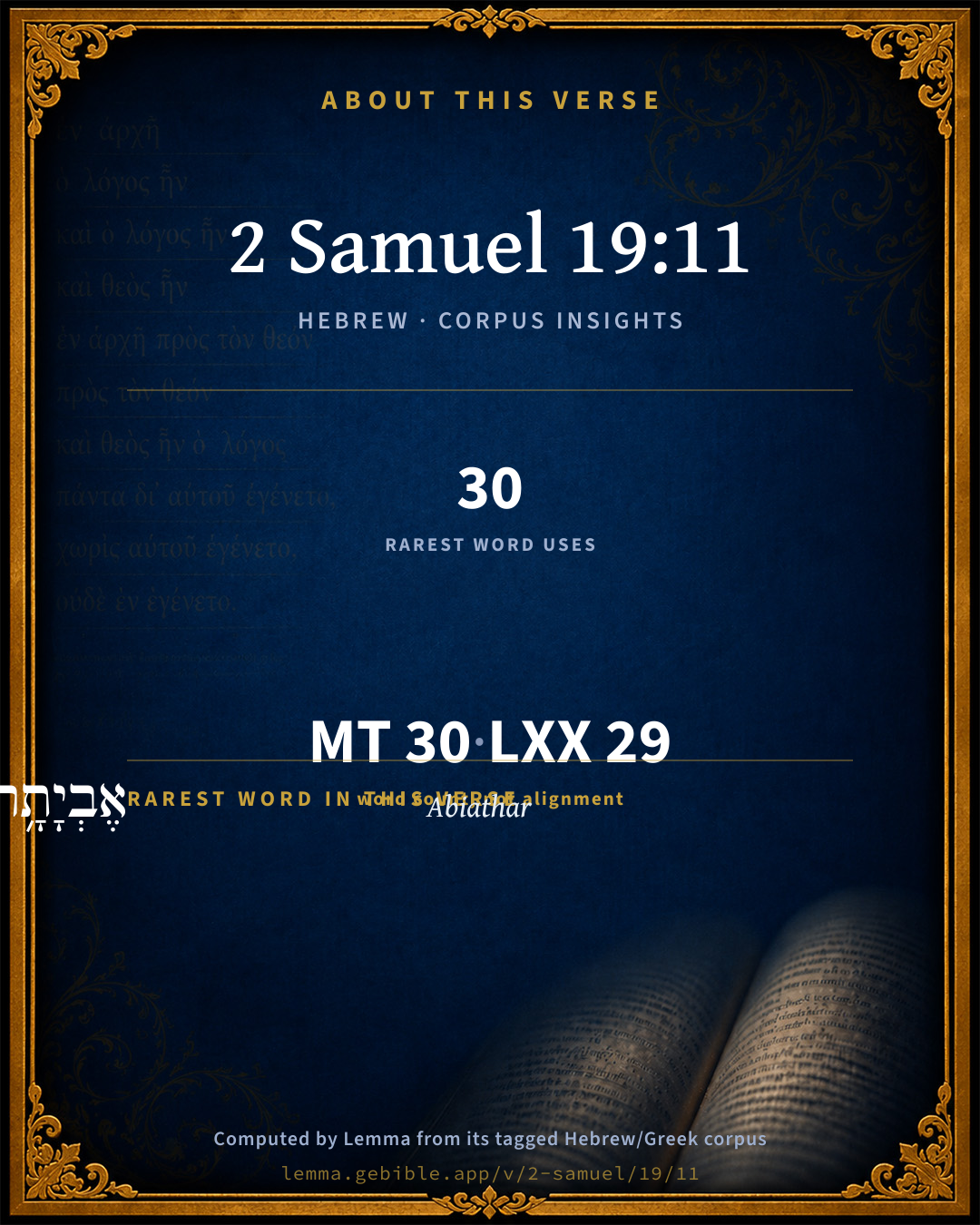
These counts appear in no published source. They are computed here, from the morphology-tagged text and Lemma’s own curated glosses. What Lemma adds →

30
words
21
distinct lemmas
Historical
section

Shared distinctive vocabulary

אֶבְיָתָ֥ר Abiathar H54 occurs in 28 verses of the Hebrew Bible. Also found in:

Grammatical profile

  • 7 verbs
  • 13 nouns
  • 2 adjectives
  • 6 prepositions
  • 2 particles

Verb forms

  • שָׁ֠לַח Qal · Perfect
  • לֵאמֹר֒ Qal · Infinitive Construct
  • דַּבְּר֞וּ Piel · Imperative
  • לֵאמֹ֔ר Qal · Infinitive Construct
  • תִֽהְיוּ֙ Qal · Imperfect
  • לְהָשִׁ֥יב Hiphil · Infinitive Construct
  • בָּ֥א Qal · Perfect

Repetition

Words recur within this verse — often emphatic in Hebrew:

  • וְהַמֶּ֣לֶךְ king H4428 ×3
  • לֵאמֹר֒ to say H559 ×2
  • בֵּית֑וֹ house H1004 ×2
  • אֶל to H413 ×6

Hebrew & Septuagint length

In English translation the verse runs 48 words from the Hebrew and 45 from the Septuagint (LXX English) — closely comparable.

A rough comparison of the two English renderings, which tokenize alike — not a word-level alignment.

Word counts can differ between the Hebrew and the Greek without any difference in meaning — e.g. the Hebrew direct-object marker אֵת has no separate Greek word, and Greek often adds the article ὁ.

In the original languages it is 30 Hebrew tokens and 29 Greek tokens — but the two are counted differently (Hebrew bundles its prefixes and suffixes into one token; the Greek is in lemma form), so that isn’t a like-for-like length.

Cross-references

7

Topical passages linked to 2 Samuel 19:11 in the Treasury of Scripture Knowledge — connected by theme and wording, ordered by reader-vote popularity; previews shown in the World English Bible.

  • 2 Samuel 15:29 Zadok therefore and Abiathar carried the ark of God again to Jerusalem: and they abode there.
  • 2 Samuel 15:35–36 Don't you have Zadok and Abiathar the priests there with you? therefore it shall be, that whatever thing you shall hear out of the king's house, you shall tell it to Zadok and Abiathar the priests.
  • 1 Kings 2:25–26 King Solomon sent by Benaiah the son of Jehoiada; and he fell on him, so that he died.
  • 1 Kings 2:35 The king put Benaiah the son of Jehoiada in his room over the host; and Zadok the priest did the king put in the room of Abiathar.
  • Matthew 5:16 Even so, let your light shine before men; that they may see your good works, and glorify your Father who is in heaven.
  • 2 Corinthians 5:20 We are therefore ambassadors on behalf of Christ, as though God were entreating by us. We beg you on behalf of Christ, be reconciled to God.
  • 2 Thessalonians 3:9 not because we don't have the right, but to make ourselves an example to you, that you should imitate us.

Cross-references courtesy of OpenBible.info (CC BY 4.0).

Hebrew and Greek witnesses Masoretic Hebrew ↔ Greek Septuagint

The same verse in the two great witnesses to the Old Testament, shown verse-for-verse.

These are two independent witnesses, not word-aligned to each other, and the Septuagint is shown in lemma (dictionary) form.

Hebrew 2 Samuel 19:11 Masoretic · Westminster Leningrad Codex

וְהַמֶּ֣לֶךְ דָּוִ֗ד שָׁ֠לַח אֶל צָד֨וֹק וְאֶל אֶבְיָתָ֥ר הַכֹּהֲנִים֮ לֵאמֹר֒ דַּבְּר֞וּ אֶל זִקְנֵ֤י יְהוּדָה֙ לֵאמֹ֔ר לָ֤מָּה תִֽהְיוּ֙ אַֽחֲרֹנִ֔ים לְהָשִׁ֥יב אֶת הַמֶּ֖לֶךְ אֶל בֵּית֑וֹ וּדְבַר֙ כָּל יִשְׂרָאֵ֔ל בָּ֥א אֶל הַמֶּ֖לֶךְ אֶל בֵּיתֽוֹ

King David sent to Zadok and to Abiathar the priests, saying, Speak to the elders of Judah, saying, Why are you the last to bring the king back to his house? seeing the speech of all Israel is come to the king, [to bring him] to his house.

World English Bible · Public Domain

Greek LXX 2 Samuel 19:11 Septuagint · lemma form

καί αβεσσαλωμ ὅς χρίω ἐπί ἐγώ ἀποθνήσκω ἐν ὁ πόλεμος καί νῦν ἵνα τίς σύ κωφεύω ὁ ἐπιστρέφω ὁ βασιλεύς καί ὁ ῥῆμα πᾶς ἰσραήλ ἔρχομαι πρός ὁ βασιλεύς

And king David sent to Sadoc and Abiathar the priests, saying, Speak to the elders of Israel, saying, Why are you⌃ the last to bring back the king to his house? whereas the word of all Israel is come to the king to his house.

LXX2012 (modern English Septuagint) · Public Domain

On this verse, Keil & Delitzsch discusses the Septuagint’s reading. Read the note in Commentary ↓

Hebrew: Westminster Leningrad Codex (CC BY 4.0). Greek: Septuagint (public domain); English from LXX2012 (modern English Septuagint) (Public Domain). How the Septuagint differs from the Hebrew →

Targum (Aramaic paraphrase)

1

The Targum is the ancient Jewish Aramaic paraphrase of the Hebrew Scriptures — an interpretive translation, not the Hebrew text itself. Onkelos (literal) and Pseudo-Jonathan (expansive) render the Torah, and Jonathan the Prophets. Coverage is partial: where no permissively-licensed English translation exists for a verse, only the Aramaic is shown. This is verse-level text, not a word-by-word alignment to the Hebrew.

  1. Targum Jonathan Prophets (Joshua–Malachi)
    וְאַבְשָׁלוֹם דִמְשַׁחְנָא עֲלָנָא מִית בִּקְרָבָא וּכְעַן לְמָה אַתּוּן שַׁתְקִין לַאֲתָבָא יַת מַלְכָּא:

    (no public-domain English translation for this verse)

    Targum Jonathan — Aramaic: “Mikraot Gedolot” (public domain). English: “Sefaria Community Translation” (CC0 1.0 (public-domain dedication)); “London "Chaldee Paraphrase," 1871” (public domain). Text via Sefaria.

Commentary

Notes on 2 Samuel 19:11 from classic Christian and Jewish commentators (each source and its license shown beneath its notes). The classic Christian expositions comment on the surrounding passage and are grouped to its opening verse, so a note may address several verses; the Jewish commentaries on the Tanakh (Rashi and others) are per-verse, so they appear only where the commentator wrote on this verse.

Lemma curates 59 commentaries, every one of them public domain or Creative Commons licensed, each selected and text-cleaned for this edition rather than reprinted as found. About our sources →

Trapp's Complete Commentary

John Trapp

2Sa 19:11 And king David sent to Zadok and to Abiathar the priests, saying, Speak unto the elders of Judah, saying, Why are ye the last to bring the king back to his house? seeing the speech of all Israel is come to the king, [even] to his house.

Ver. 11. Speak unto the elders of Judah.] Who having been most forward in the late horrid rebellion, might haply most despair of pardon, and thereupon hang back. To these David sendeth and sueth; like as Christ also doth to his greatest enemies for reconciliation. {2Co 5:20} His grace doth in a manner kneel to us, who are naturally both averse and adverse thereunto.

John Trapp, A Commentary or Exposition upon All the Books of the Old and New Testament (1647–1656) — public domain. Text from a community e-Sword module.

Joseph Benson's Commentary

2Sa 19:11-12. Speak unto the elders of Judah — Absalom had begun his conspiracy in Jerusalem itself, and perfected it in Hebron, both cities of Judah; and the people of that tribe had been the first to join him in his rebellion, and to aid and abet his designs; conscious of this, and that, as David was of their tribe, and had long shown them peculiar kindness, their guilt was the greater, they probably despaired of pardon, and, therefore, were backward to promote the king’s restoration. Seeing the speech of all Israel is come to the king — That is, their wishes and desires to bring him back to his throne and palace in Jerusalem. Ye are my bone and my flesh — Ye are related to me by consanguinity, and therefore I cannot be severe with you, nor need you fear lest I should revenge myself of you. Wherefore, then, are ye the last to bring back the king? — This delay doth not suit with the relation you have, and the affection you owe to me.

Joseph Benson's Commentary on the Old and New Testaments (1811–1818) — public domain. Text from a community e-Sword module.

Keil & Delitzsch

C. F. Keil & F. Delitzsch

When these words of all Israel were reported to David, he sent to the priests Zadok and Abiathar, saying, "Speak to the elders of Judah, why will ye be the last to bring back the king to his palace? ... Ye are my brethren, my bones and flesh (i.e., my blood relations): why then," etc.? The last clause of Sa2 19:11, "the speech of all Israel is come to the king, even to his house," is a circumstantial clause inserted in the midst of David's words, to explain the appeal to the men of Judah not to be the last. In the lxx, and some Codices of the Vulgate, this sentence occurs twice, viz., at the end of Sa2 19:10, and also of Sa2 19:11; and Thenius, Ewald, and Bttcher regard the clause at the end of Sa2 19:10 as the original one, and the repetition of it at the close of Sa2 19:11 as a gloss. But this is certainly a mistake: for if the clause, "and the speech of all Israel came to the king to his house (at Mahanaim)," ought to stand at the close of Sa2 19:10, and assigns the reason for David's sending to Zadok and Abiathar, Sa2 19:11 would certainly, or rather necessarily, commence with המּלך ויּשׁלח: "The word of all Israel came to the king, and then king David sent," etc. But instead of this, it commences with שׁלח דּיד והמּלך, "But king David sent." This construction of the sentence decidedly favour the correctness of the Hebrew text; whereas the text of the Septuagint, apart altogether from the tautological repetition of the whole of the sentence in question, shows obviously enough that it is nothing more than a conjecture, by which the attempt was made to remove the difficulty occasioned by the striking position in which the circumstantial clause occurred.

Keil & Delitzsch — Biblical Commentary on the Old Testament (1861–1891) — public domain (CC PDM 1.0). Text via the HelloAO Bible API. (Old Testament only.)

Tyndale Open Study Notes

Tyndale Open Resources

19:11-12 When David realized that the northern tribes would welcome him (19:9-10), he sent emissaries to goad Judah, his own tribesmen, into welcoming him as well. See also study note on 19:41-43.

Tyndale Open Study Notes — © Tyndale Open Resources, licensed CC BY-SA 4.0. Text via the HelloAO Bible API.

Geneva Bible (1599)

Geneva Bible translators

That they should reprove the negligence of the Elders, seeing the people were so forward.

Geneva Bible (1599) marginal notes — public domain. Text via Bolls.life.

Adam Clarke's Commentary

Verse 11. Speak unto the elders of Judah] David was afraid to fall out with this tribe: they were in possession of Jerusalem, and this was a city of great importance to him. They had joined Absalom in his rebellion; and doubtless were now ashamed of their conduct. David appears to take no notice of their infidelity, but rather to place confidence in them, that their confidence in him might be naturally excited: and, to oblige them yet farther, purposes to make Amasa captain of the host in the place of Joab.

Adam Clarke's Commentary on the Bible (1810–1826) — public domain. Text from a community e-Sword/MySword module.

Ellicott's Commentary for English Readers

(11) The elders of Judah.—Judah was naturally particularly slow in returning to its allegiance. It had shown especial ingratitude to David, and had formed the cradle and centre of the rebellion, and even now Jerusalem probably had a garrison of Absalom’s soldiers. They might naturally doubt how they would be received, and their military organisation in Absalom’s interest threw especial obstacles in their way. The last words of the verse, “to his house,” may be an accidental repetition from the previous clause.

A Bible Commentary for English Readers, edited by Charles John Ellicott (1878–1897) — public domain. Text from a community e-Sword module.

The Cambridge Bible for Schools and Colleges

gen. ed. J. J. S. Perowne

11. the elders of Judah] The representatives of the tribe, who would naturally be its leaders in the restoration of the king. Cp. ch. 2Sa_5:3. Their backwardness is explained by the prominent part which Judah had taken in the insurrection (see note on ch. 2Sa_15:10), while David’s message to the priests was prompted by the desire to conciliate the good will of the most powerful tribe of the nation, and persuade them to take a leading part in his recall.

seeing the speech … even to his house] The words even to his house give no satisfactory sense, and are probably an accidental repetition of the previous to his house: and the clause seeing the speech of all Israel is come to the king may either have stood here originally as well as at the end of 2Sa_19:10, where it is certainly required, or have been repeated by a transcriber’s error.

The Cambridge Bible for Schools and Colleges (gen. ed. J. J. S. Perowne; Cambridge University Press, 1878–1918) — public domain. Text from a community e-Sword module.

John Gill's Exposition

And King David sent to Zadok and to Abiathar the priests,.... Who were at Jerusalem, and in his interest; perhaps by Ahimaaz and Jonathan their sons:

saying, speak unto the elders of Judah; particularly those that were at Jerusalem, with whom they had an interest:

saying, why are ye the last to bring back the king to his house? to his palace at Jerusalem, since David was of their tribe, and was first anointed their king: what might make them the more backward to it was their being so deep in the rebellion, which was formed and cherished among them, and brought to the height it was, through their connivance and encouragement, both at Hebron and Jerusalem; and therefore they might fear the resentment of David, and that he would not be easily reconciled unto them:

seeing the speech of all Israel is come to the king, even to his house: or he has received invitations from all the tribes of Israel to return to his house or palace at Jerusalem; and so this was a part of the message of David to the priests, to be told to the elders as an aggravation of their backwardness, and as an argument to excite them to their duty; though some think these are the words of the historian, to be inserted in a parenthesis, as in our version.

John Gill's Exposition of the Whole Bible (1746–1763) — public domain (CC PDM 1.0). Text via the HelloAO Bible API.

Haydock's Catholic Bible Commentary

Priests, whose influence was very great. (Haydock) --- Last. David, like an able politician, shews the men of his own tribe, how dishonourable it will be for them to be outdone by the rest. (Calmet) --- Talk: reported by a solemn ceremony. (St. Jerome, Trad.) (Menochius) --- Septuagint Greek: logos, "the word, (Haydock) council," &c. (Salien)

George Leo Haydock (1774–1849), Haydock's Catholic Family Bible and Commentary, 1859 edition — public domain. Excludes Psalms (Douay-Rheims chapter numbering differs from Protestant) and Deuterocanonical books (Catholic canon only).

Matthew Poole's English Annotations

Speak unto the elders of Judah; who being the first and chief abettors of Absalom’s rebellion, despaired of ever obtaining the king’s grace and pardon, and therefore were backward to promote the king’s restoration.

To his house; to his royal palace at Jerusalem.

To the king, even to his house, i.e. even to Mahanaim, where now the king’s house and family is. Thus sometimes one word is taken in divers senses in the same verse, as Mat 8:22. Or rather thus, About bringing the king back to his house: for, first, Those words are very fitly and easily understood here out of the foregoing member of the verse; such defects being usual in the Hebrew, which is a very concise or short language. So it is Exo 22:15; Deu 1:4, &c.

Secondly, It seems most reasonable to understand the same phrase,

to his house, being twice here used in the same sense in both places, to wit, of his house in Jerusalem; and this is most agreeable to rule and to Scripture usage.

Thirdly, Thus the words have more emphasis than the other way; for if the speech came to the king at Mahanaim, it matters not whether it found him in his house there, or in the gate-house, or in the field.

Fourthly, David had no house in Mahanaim which could properly be called his house, as he had in Jerusalem. And then the parenthesis should close before those last words,

even to his house, or even to his own house, to wit, that at Jerusalem.

Matthew Poole's English Annotations on the Holy Bible (1683–1685) — public domain. Text from a community e-Sword/MySword module.

Whedon's Commentary on the Bible

Daniel D. Whedon

11. Speak unto the elders of Judah — It was wise in David thus to appeal to his own tribe and secure their co-operation with the rest of Israel in bringing him back to his throne in Jerusalem, for otherwise it would appear that the men of Judah were indifferent about his restoration. But it was unwise to accept their guidance back without also waiting for the co-operation of the ten northern tribes.

Daniel D. Whedon (gen. ed.), Commentary on the Old and New Testaments (1874–1909) — public domain. Text from a community e-Sword module.

The Pulpit Commentary

David sent to Zadok and to Abiathar. The two high priests had remained behind at Jerusalem, to watch over David"s interests, and he now, by a messenger, probably Ahimaaz or Jonathan, urges them to quicken the proceedings of his own tribe. We may feel quite sure that there was discussion in Judah as well as in the other tribes; but the rebellion had begun at Hebron, and probably many of the leading chiefs were deeply implicated in Absalom"s proceedings. Probably they now regretted it, but hung back through fear of punishment. It was politic, therefore, to assure them of David"s kindly feelings, and that overtures on their side would be readily received, and the past forgiven.

The Pulpit Commentary (1880–1919), ed. H.D.M. Spence-Jones & Joseph S. Exell — public domain. Text from a community e-Sword module.

John Wesley's Explanatory Notes

Judah - Who being the abettors of Absalom's rebellion, despaired of pardon, and therefore were backward to promote the king's restoration. His house - Even to Mahanaim, where now the king's house and family is.

John Wesley, Explanatory Notes Upon the Whole Bible (1754–1765) — public domain. Text via the GEBible commentary corpus.

unfoldingWord translationNotes

Door43 World Missions Community

sent to Zadok and to Abiathar

This means that David sent a messenger to Zadok and Abiathar. AT: "sent a messenger to Zadok and to Abiathar" (See: Idiom)

Why are you the last to bring the king back ... to bring him back to his palace?

This rhetorical question is asked to rebuke the elders in Judah. This can be written as a statement. AT: "You should have been the first to favor the king and bring him back to the palace, not the people of the nation of Israel." (See: Rhetorical Question)

since the talk of all Israel favors the king, to bring

The noun "talk" can be expressed with the verb "talk" or "speak." AT: "since all Israel speaks favorably about the king and desires to bring" or "since what the people of Israel are saying is in the king's favor, to bring" (See: Abstract Nouns)

to bring the king back to his palace

Here restoring the king's authority to rule is spoken of as bringing him back to his palace. AT: "to restore the king's authority as king" (See: Metaphor)

You are my brothers, my flesh and bone

The king uses these to phrases to emphasize that they are closely related. Being or having the same flesh is a metaphor for belonging to the same family or tribe. AT: "You are my brothers, and we have the same flesh and bone" or "You are my brothers, my close relatives" (See: Metaphor)

Why then are you the last to bring back the king?

This is the second rhetorical question here and it is also a rebuke for the elders of Judah. This can be written as a statement. AT: "You should have been the first, not the last, to bring back the king." (See: Rhetorical Question)

translationWords

David

Zadok

Abiathar

priest

Judah

favor

brother

flesh

unfoldingWord translationNotes — © Distant Shores Media and the Door43 World Missions Community, licensed CC BY-SA 4.0. Source: git.door43.org/Door43/en_tn.

Lesson kit

Teaching starters — assembled from the data on this page, not authored interpretation. Every prompt links to the verse data it draws on. Edit before teaching.

2 Samuel, in the Historical, opens this verse with 30 words (21 distinct Hebrew lemmas). Its most distinctive word is ʼEbyâthâr (“Abiathar”). A historical commentator’s framing appears above. Read the whole chapter for the surrounding context.

Discussion questions

  1. The word ʼEbyâthâr carries the sense “Abiathar.” How does it shape the verse?
  2. How does 1 Samuel 22:20, which shares the word «Abiathar», read alongside this verse?
  3. What does the repetition of “king” (3× in this one verse) do in this verse?
  4. These translations render this verse differently. What is at stake in choosing one wording over another?
  5. «שָׁ֠לַח» is a Qal Perfect verb. How does that grammatical form shape the action described?
  6. Compare how Trapp's Complete Commentary and Joseph Benson's Commentary read this verse. Where do they agree or differ?

Things to notice

Reading settings

Reading text

Shown beneath each verse's original-language words.

Old Testament
Old Testament edition

Read the OT as the Masoretic Hebrew (MT) or the Greek Septuagint (LXX).

English shown for the Greek Septuagint (in the Hebrew ↔ Greek comparison).

Comparing translations? Open the Compare panel on any verse page to stack up to four side by side.