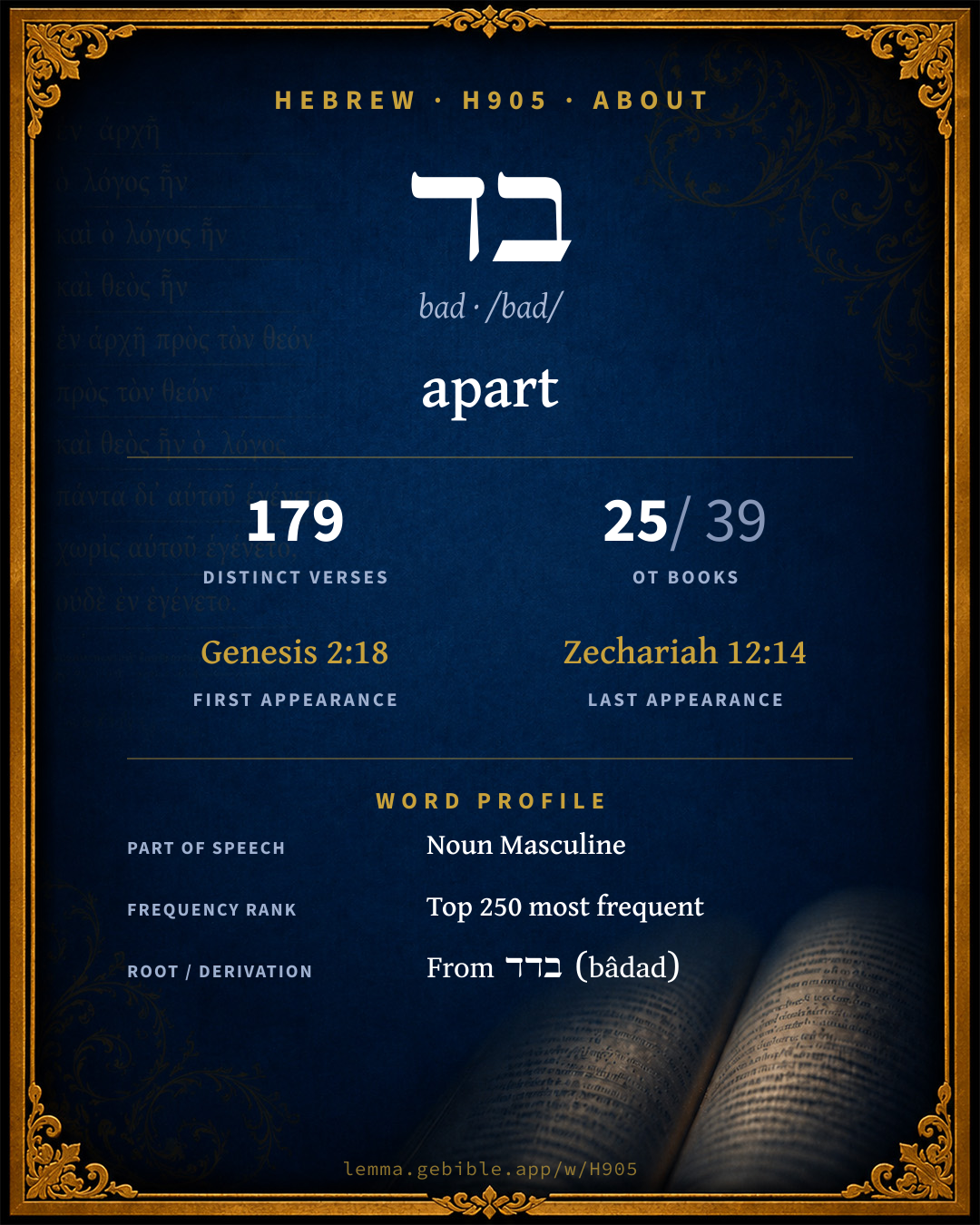
בַּד
apart
‘apart’ is one of 4 main senses fuller range ↓
Full lexicon entry — Brown-Driver-Briggs (BDB)
From Brown-Driver-Briggs (BDB)
Where this word appears
See every Construct-state word in the Hebrew Bible →
Grammar key — what these labels mean
Part of speech
- Noun
- A naming word — a person, place, thing, or idea.
Noun type
- Common
- A common noun — a general class of person, place, or thing (“king,” “city,” “water”), not a specific name.
State
- Construct
- A noun bound to a following noun in a possessive / “of” relationship (the construct chain).
- Absolute
- The independent form of a noun, not bound to a following word.
Gender
- Masculine
- Grammatically masculine.
Number
- Singular
- One.
- Plural
- More than one (in Hebrew, generally three or more).
Grammatical forms
- Noun, Common, Masculine, Singular, Construct 121 times (60%)
- Noun, Common, Masculine, Singular, Absolute 38 times (19%)
- Noun, Common, Masculine, Plural, Absolute 22 times (11%)
- Noun, Common, Masculine, Plural, Construct 21 times (10%)
Parsed forms decoded from the imported morphology (morphhb / Westminster Leningrad Codex — WLC text public domain, morphhb tagging CC BY 4.0), counted across 202 parsed occurrences — not distinct verses.
Every verse where H905 appears — 179 distinct verses across 25 books. Click any verse to open its interlinear word-by-word view. Verse text shown in the World English Bible for context — . Each verse’s Hebrew form is shown with its reference; the English is not keyword-highlighted, since the data carries no word-level English alignment. Use “Compare translations” on any verse to read it across multiple English versions. This concordance covers the Hebrew Bible; Septuagint (Greek Old Testament) occurrences are not indexed here.
Genesis 12 verses
- Genesis 2:18 לְ/בַדּ֑/וֹ prep + n c ms cs + sfx pers 3ms Yahweh God said, "It is not good that the man should be alone; I will make him a helper suitable for him."
- Genesis 21:28 לְ/בַדְּ/הֶֽן prep + n c ms cs + sfx pers 3fp Abraham set seven ewe lambs of the flock by themselves.
- Genesis 21:29 לְ/בַדָּֽ/נָה prep + n c ms cs + sfx pers 3fp Abimelech said to Abraham, "What do these seven ewe lambs which you have set by themselves mean?"
- Genesis 26:1 מִ/לְּ/בַד֙ prep + prep + n c ms cs There was a famine in the land, besides the first famine that was in the days of Abraham. Isaac went to Abimelech king of the Philistines, to Gerar.
- Genesis 30:40 לְ/בַדּ֔/וֹ prep + n c ms cs + sfx pers 3ms Jacob separated the lambs, and set the faces of the flocks toward the streaked and all the black in the flock of Laban: and he put his own droves apart, and didn't put them into Laban's flock.
- Genesis 32:16 לְ/בַדּ֑/וֹ prep + n c ms cs + sfx pers 3ms He delivered them into the hands of his servants, every herd by itself, and said to his servants, "Pass over before me, and put a space between herd and herd."
- Genesis 32:24 לְ/בַדּ֑/וֹ prep + n c ms cs + sfx pers 3ms Jacob was left alone, and wrestled with a man there until the breaking of the day.
- Genesis 42:38 לְ/בַדּ֣/וֹ prep + n c ms cs + sfx pers 3ms He said, "My son shall not go down with you; for his brother is dead, and he only is left. If harm happens to him by the way in which you go, then you will bring down my gray hairs with sorrow to Sheol."
- Genesis 43:32 לְ/בַדּ֖/וֹ לְ/בַדָּ֑/ם לְ/בַדָּ֔/ם prep + n c ms cs + sfx pers 3ms prep + n c ms cs + sfx pers 3mp prep + n c ms cs + sfx pers 3mp They served him by himself, and them by themselves, and the Egyptians, that ate with him, by themselves, because the Egyptians don't eat bread with the Hebrews, for that is an abomination to the Egyptians.
- Genesis 44:20 לְ/בַדּ֛/וֹ prep + n c ms cs + sfx pers 3ms We said to my lord, 'We have a father, an old man, and a child of his old age, a little one; and his brother is dead, and he alone is left of his mother; and his father loves him.'
- Genesis 46:26 מִ/לְּ/בַ֖ד prep + prep + n c ms cs All the souls who came with Jacob into Egypt, who were his direct descendants, besides Jacob's sons' wives, all the souls were sixty-six.
- Genesis 47:26 לְ/בַדָּ֔/ם prep + n c ms cs + sfx pers 3mp Joseph made it a statute concerning the land of Egypt to this day, that Pharaoh should have the fifth. Only the land of the priests alone didn't become Pharaoh's.
Exodus 35 verses
- Exodus 12:16 לְ/בַדּ֖/וֹ prep + n c ms cs + sfx pers 3ms In the first day there shall be to you a holy convocation, and in the seventh day a holy convocation; no manner of work shall be done in them, except that which every man must eat, that only may be done by you.
- Exodus 12:37 לְ/בַ֥ד prep + n c ms The children of Israel traveled from Rameses to Succoth, about six hundred thousand on foot who were men, besides children.
- Exodus 18:14 לְ/בַדֶּ֔/ךָ prep + n c ms cs + sfx pers 2ms When Moses' father-in-law saw all that he did to the people, he said, "What is this thing that you do for the people? Why do you sit alone, and all the people stand around you from morning to evening?"
- Exodus 18:18 לְ/בַדֶּֽ/ךָ prep + n c ms cs + sfx pers 2ms You will surely wear away, both you, and this people that is with you; for the thing is too heavy for you. You are not able to perform it yourself alone.
- Exodus 22:20 לְ/בַדּֽ/וֹ prep + n c ms cs + sfx pers 3ms "He who sacrifices to any god, except to Yahweh only, shall be utterly destroyed.
- Exodus 22:27 לְ/בַדָּ֔/הּ prep + n c ms cs + sfx pers 3fs for that is his only covering, it is his garment for his skin. What would he sleep in? It will happen, when he cries to me, that I will hear, for I am gracious.
- Exodus 24:2 לְ/בַדּ/וֹ֙ prep + n c ms cs + sfx pers 3ms Moses alone shall come near to Yahweh, but they shall not come near, neither shall the people go up with him."
- Exodus 25:13 בַדֵּ֖י n c mp cs You shall make poles of acacia wood, and overlay them with gold.
- Exodus 25:14 הַ/בַּדִּים֙ ptcl def.art + n c mp You shall put the poles into the rings on the sides of the ark to carry the ark.
- Exodus 25:15 הַ/בַּדִּ֑ים ptcl def.art + n c mp The poles shall be in the rings of the ark. They shall not be taken from it.
- Exodus 25:27 לְ/בַדִּ֔ים prep + n c mp the rings shall be close to the rim, for places for the poles to carry the table.
- Exodus 25:28 הַ/בַּדִּים֙ ptcl def.art + n c mp You shall make the poles of acacia wood, and overlay them with gold, that the table may be carried with them.
- Exodus 26:9 לְ/בָ֔ד לְ/בָ֑ד prep + n c ms prep + n c ms You shall couple five curtains by themselves, and six curtains by themselves, and shall double over the sixth curtain in the forefront of the tent.
- Exodus 27:6 בַדִּים֙ בַּדֵּ֖י n c mp n c mp cs You shall make poles for the altar, poles of acacia wood, and overlay them with brass.
- Exodus 27:7 בַּדָּ֖י/ו הַ/בַּדִּ֗ים n c mp cs + sfx pers 3ms ptcl def.art + n c mp Its poles shall be put into the rings, and the poles shall be on the two sides of the altar, when carrying it.
- Exodus 30:4 לְ/בַדִּ֔ים prep + n c mp You shall make two golden rings for it under its molding; on its two ribs, on its two sides you shall make them; and they shall be for places for poles with which to bear it.
- Exodus 30:5 הַ/בַּדִּ֖ים ptcl def.art + n c mp You shall make the poles of acacia wood, and overlay them with gold.
- Exodus 30:34 בַּ֥ד בְּ/בַ֖ד n c ms prep + n c ms Yahweh said to Moses, "Take to yourself sweet spices, gum resin, and onycha, and galbanum; sweet spices with pure frankincense: of each shall there be an equal weight;
- Exodus 35:12 בַּדָּ֖י/ו n c mp cs + sfx pers 3ms the ark, and its poles, the mercy seat, the veil of the screen;
- Exodus 35:13 בַּדָּ֖י/ו n c mp cs + sfx pers 3ms the table with its poles and all its vessels, and the show bread;
- Exodus 35:15 בַּדָּ֔י/ו n c mp cs + sfx pers 3ms and the altar of incense with its poles, the anointing oil, the sweet incense, the screen for the door, at the door of the tent;
- Exodus 35:16 בַּדָּ֖י/ו n c mp cs + sfx pers 3ms the altar of burnt offering, with its grating of brass, it poles, and all its vessels, the basin and its base;
- Exodus 36:16 לְ/בָ֑ד לְ/בָֽד prep + n c ms prep + n c ms He coupled five curtains by themselves, and six curtains by themselves.
- Exodus 37:4 בַּדֵּ֖י n c mp cs He made poles of acacia wood, and overlaid them with gold.
- Exodus 37:5 הַ/בַּדִּים֙ ptcl def.art + n c mp He put the poles into the rings on the sides of the ark, to bear the ark.
- Exodus 37:14 לַ/בַּדִּ֔ים prep det + n c mp The rings were close by the border, the places for the poles to carry the table.
- Exodus 37:15 הַ/בַּדִּים֙ ptcl def.art + n c mp He made the poles of acacia wood, and overlaid them with gold, to carry the table.
- Exodus 37:27 לְ/בַדִּ֔ים prep + n c mp He made two golden rings for it under its molding crown, on its two ribs, on its two sides, for places for poles with which to carry it.
- Exodus 37:28 הַ/בַּדִּ֖ים ptcl def.art + n c mp He made the poles of acacia wood, and overlaid them with gold.
- Exodus 38:5 לַ/בַּדִּֽים prep det + n c mp He cast four rings for the four ends of brass grating, to be places for the poles.
- Exodus 38:6 הַ/בַּדִּ֖ים ptcl def.art + n c mp He made the poles of acacia wood, and overlaid them with brass.
- Exodus 38:7 הַ/בַּדִּ֜ים ptcl def.art + n c mp He put the poles into the rings on the sides of the altar, with which to carry it. He made it hollow with planks.
- Exodus 39:35 בַּדָּ֑י/ו n c mp cs + sfx pers 3ms the ark of the testimony with its poles, the mercy seat,
- Exodus 39:39 בַּדָּ֖י/ו n c mp cs + sfx pers 3ms the brazen altar, its grating of brass, its poles, all of its vessels, the basin and its base,
- Exodus 40:20 הַ/בַּדִּ֖ים ptcl def.art + n c mp He took and put the testimony into the ark, and set the poles on the ark, and put the mercy seat above on the ark.
Leviticus 2 verses
- Leviticus 9:17 מִ/לְּ/בַ֖ד prep + prep + n c ms cs He presented the meal offering, and filled his hand from there, and burned it upon the altar, besides the burnt offering of the morning.
- Leviticus 23:38 מִ/לְּ/בַ֖ד וּ/מִ/לְּ/בַ֣ד וּ/מִ/לְּ/בַ֤ד וּ/מִ/לְּ/בַד֙ prep + prep + n c ms cs conj + prep + Preposition + n c ms cs conj + prep + Preposition + n c ms cs conj + prep + Preposition + n c ms cs besides the Sabbaths of Yahweh, and besides your gifts, and besides all your vows, and besides all your freewill offerings, which you give to Yahweh.
Numbers 22 verses
- Numbers 4:6 בַּדָּֽי/ו n c mp cs + sfx pers 3ms and shall put a covering of sealskin on it, and shall spread over it a cloth all of blue, and shall put in its poles.
- Numbers 4:8 בַּדָּֽי/ו n c mp cs + sfx pers 3ms They shall spread on them a scarlet cloth, and cover the same with a covering of sealskin, and shall put in its poles.
- Numbers 4:11 בַּדָּֽי/ו n c mp cs + sfx pers 3ms On the golden altar they shall spread a blue cloth, and cover it with a covering of sealskin, and shall put in its poles.
- Numbers 4:14 בַדָּֽי/ו n c mp cs + sfx pers 3ms They shall put on it all its vessels, with which they minister about it, the fire pans, the flesh hooks, the shovels, and the basins; all the vessels of the altar; and they shall spread on it a covering of sealskin, and put in its poles.
- Numbers 5:8 מִ/לְּ/בַ֗ד prep + prep + n c ms cs But if the man has no kinsman to whom restitution may be made for the guilt, the restitution for guilt which is made to Yahweh shall be the priest's; besides the ram of the atonement, by which atonement shall be made for him.
- Numbers 6:21 מִ/לְּ/בַ֖ד prep + prep + n c ms cs "This is the law of the Nazirite who vows, and of his offering to Yahweh for his separation, besides that which he is able to get. According to his vow which he vows, so he must do after the law of his separation."
- Numbers 11:14 לְ/בַדִּ֔/י prep + n c ms cs + sfx pers 1cs I am not able to bear all this people alone, because it is too heavy for me.
- Numbers 11:17 לְ/בַדֶּֽ/ךָ prep + n c ms cs + sfx pers 2ms I will come down and talk with you there: and I will take of the Spirit which is on you, and will put it on them; and they shall bear the burden of the people with you, that you not bear it yourself alone.
- Numbers 16:49 מִ/לְּ/בַ֥ד prep + prep + n c ms cs Now those who died by the plague were fourteen thousand and seven hundred, besides those who died about the matter of Korah.
- Numbers 28:23 מִ/לְּ/בַד֙ prep + prep + n c ms cs You shall offer these besides the burnt offering of the morning, which is for a continual burnt offering.
- Numbers 28:31 מִ/לְּ/בַ֞ד prep + prep + n c ms cs Besides the continual burnt offering, and the meal-offering of it, you shall offer them (they shall be to you without blemish), and their drink-offerings.
- Numbers 29:6 מִ/לְּ/בַד֩ prep + prep + n c ms cs besides the burnt offering of the new moon, and the meal-offering of it, and the continual burnt offering and the meal-offering of it, and their drink-offerings, according to their ordinance, for a sweet savor, an offering made by fire to Yahweh.
- Numbers 29:11 מִ/לְּ/בַ֞ד prep + prep + n c ms cs one male goat for a sin-offering; besides the sin-offering of atonement, and the continual burnt offering, and the meal-offering of it, and their drink-offerings.
- Numbers 29:16 מִ/לְּ/בַד֙ prep + prep + n c ms cs and one male goat for a sin-offering, besides the continual burnt offering, the meal-offering of it, and the drink-offering of it.
- Numbers 29:19 מִ/לְּ/בַד֙ prep + prep + n c ms cs and one male goat for a sin-offering; besides the continual burnt offering, and the meal-offering of it, and their drink-offerings.
- Numbers 29:22 מִ/לְּ/בַד֙ prep + prep + n c ms cs and one male goat for a sin-offering; besides the continual burnt offering, and the meal-offering of it, and the drink-offering of it.
- Numbers 29:25 מִ/לְּ/בַד֙ prep + prep + n c ms cs and one male goat for a sin-offering; besides the continual burnt offering, the meal-offering of it, and the drink-offering of it.
- Numbers 29:28 מִ/לְּ/בַד֙ prep + prep + n c ms cs and one male goat for a sin-offering, besides the continual burnt offering, and the meal-offering of it, and the drink-offering of it.
- Numbers 29:31 מִ/לְּ/בַד֙ prep + prep + n c ms cs and one male goat for a sin-offering; besides the continual burnt offering, the meal-offering of it, and the drink-offerings of it.
- Numbers 29:34 מִ/לְּ/בַד֙ prep + prep + n c ms cs and one male goat for a sin-offering; besides the continual burnt offering, the meal-offering of it, and the drink-offering of it.
- Numbers 29:38 מִ/לְּ/בַד֙ prep + prep + n c ms cs and one male goat for a sin-offering, besides the continual burnt offering, and the meal-offering of it, and the drink-offering of it.
- Numbers 29:39 לְ/בַ֨ד prep + n c ms These you shall offer to Yahweh in your set feasts, besides your vows, and your freewill-offerings, for your burnt offerings, and for your meal-offerings, and for your drink-offerings, and for your peace-offerings.
Deuteronomy 9 verses
- Deuteronomy 1:9 לְ/בַדִּ֖/י prep + n c ms cs + sfx pers 1cs I spoke to you at that time, saying, I am not able to bear you myself alone:
- Deuteronomy 1:12 לְ/בַדִּ֑/י prep + n c ms cs + sfx pers 1cs How can I myself alone bear your encumbrance, and your burden, and your strife?
- Deuteronomy 3:5 לְ/בַ֛ד prep + n c ms All these were cities fortified with high walls, gates, and bars; besides the unwalled towns a great many.
- Deuteronomy 4:35 מִ/לְ/בַדּֽ/וֹ prep + prep + n c ms cs + sfx pers 3ms To you it was shown, that you might know that Yahweh he is God; there is none else besides him.
- Deuteronomy 8:3 לְ/בַדּ/וֹ֙ prep + n c ms cs + sfx pers 3ms He humbled you, and allowed you to hunger, and fed you with manna, which you didn't know, neither did your fathers know; that he might make you know that man does not live by bread only, but by everything that proceeds out of the mouth of Yahweh does man live.
- Deuteronomy 18:8 לְ/בַ֥ד prep + n c ms They shall have like portions to eat, besides that which comes of the sale of his patrimony.
- Deuteronomy 22:25 לְ/בַדּֽ/וֹ prep + n c ms cs + sfx pers 3ms But if the man find the lady who is pledged to be married in the field, and the man force her, and lie with her; then the man only who lay with her shall die:
- Deuteronomy 29:1 מִ/לְּ/בַ֣ד prep + prep + n c ms cs These are the words of the covenant which Yahweh commanded Moses to make with the children of Israel in the land of Moab, besides the covenant which he made with them in Horeb.
- Deuteronomy 29:14 לְ/בַדְּ/כֶ֑ם prep + n c ms cs + sfx pers 2mp Neither with you only do I make this covenant and this oath,
Joshua 3 verses
- Joshua 11:13 לְ/בַדָּ֖/הּ prep + n c ms cs + sfx pers 3fs But as for the cities that stood on their mounds, Israel burned none of them, save Hazor only; that did Joshua burn.
- Joshua 17:5 לְ/בַ֞ד prep + n c ms There fell ten parts to Manasseh, besides the land of Gilead and Bashan, which is beyond the Jordan;
- Joshua 22:29 מִ/לְּ/בַ֗ד prep + prep + n c ms cs Far be it from us that we should rebel against Yahweh, and turn away this day from following Yahweh, to build an altar for burnt-offering, for meal-offering, or for sacrifice, besides the altar of Yahweh our God that is before his tent.
Judges 8 verses
- Judges 3:20 לְ/בַדּ֔/וֹ prep + n c ms cs + sfx pers 3ms Ehud came to him; and he was sitting by himself alone in the cool upper room. Ehud said, I have a message from God to you. He arose out of his seat.
- Judges 6:37 לְ/בַדָּ֗/הּ prep + n c ms cs + sfx pers 3fs behold, I will put a fleece of wool on the threshing floor; if there be dew on the fleece only, and it be dry on all the ground, then shall I know that you will save Israel by my hand, as you have spoken.
- Judges 6:39 לְ/בַדָּ֔/הּ prep + n c ms cs + sfx pers 3fs Gideon said to God, Don't let your anger be kindled against me, and I will speak but this once: Please let me make a trial just this once with the fleece; let it now be dry only on the fleece, and on all the ground let there be dew.
- Judges 6:40 לְ/בַדָּ֔/הּ prep + n c ms cs + sfx pers 3fs God did so that night: for it was dry on the fleece only, and there was dew on all the ground.
- Judges 7:5 לְ/בָ֔ד prep + n c ms So he brought down the people to the water: and Yahweh said to Gideon, Everyone who laps of the water with his tongue, as a dog laps, him shall you set by himself; likewise everyone who bows down on his knees to drink.
- Judges 8:26 לְ֠/בַד וּ/לְ/בַד֙ prep + n c ms conj + prep + n c ms The weight of the golden ear-rings that he requested was one thousand and seven hundred [shekels] of gold, besides the crescents, and the pendants, and the purple clothing that was on the kings of Midian, and besides the chains that were about their camels' necks.
- Judges 20:15 לְ֠/בַד prep + n c ms The children of Benjamin were numbered on that day out of the cities twenty-six thousand men who drew the sword, besides the inhabitants of Gibeah, who were numbered seven hundred chosen men.
- Judges 20:17 לְ/בַד֙ prep + n c ms The men of Israel, besides Benjamin, were numbered four hundred thousand men who drew sword: all these were men of war.
1 Samuel 3 verses
- 1 Samuel 7:3 לְ/בַדּ֔/וֹ prep + n c ms cs + sfx pers 3ms Samuel spoke to all the house of Israel, saying, If you do return to Yahweh with all your heart, then put away the foreign gods and the Ashtaroth from among you, and direct your hearts to Yahweh, and serve him only; and he will deliver you out of the hand of the Philistines.
- 1 Samuel 7:4 לְ/בַדּֽ/וֹ prep + n c ms cs + sfx pers 3ms Then the children of Israel did put away the Baals and the Ashtaroth, and served Yahweh only.
- 1 Samuel 21:1 לְ/בַדֶּ֔/ךָ prep + n c ms cs + sfx pers 2ms Then came David to Nob to Ahimelech the priest: and Ahimelech came to meet David trembling, and said to him, Why are you alone, and no man with you?
2 Samuel 8 verses
- 2 Samuel 10:8 לְ/בַדָּ֖/ם prep + n c ms cs + sfx pers 3mp The children of Ammon came out, and put the battle in array at the entrance of the gate: and the Syrians of Zobah and of Rehob, and the men of Tob and Maacah, were by themselves in the field.
- 2 Samuel 13:32 לְ/בַדּ֖/וֹ prep + n c ms cs + sfx pers 3ms Jonadab, the son of Shimeah, David's brother, answered, Don't let my lord suppose that they have killed all the young men the king's sons; for Amnon only is dead; for by the appointment of Absalom this has been determined from the day that he forced his sister Tamar.
- 2 Samuel 13:33 לְ/בַדּ֖/וֹ prep + n c ms cs + sfx pers 3ms Now therefore don't let my lord the king take the thing to his heart, to think that all the king's sons are dead; for Amnon only is dead.
- 2 Samuel 17:2 לְ/בַדּֽ/וֹ prep + n c ms cs + sfx pers 3ms and I will come on him while he is weary and weak-handed, and will make him afraid; and all the people who are with him shall flee; and I will strike the king only;
- 2 Samuel 18:24 לְ/בַדּֽ/וֹ prep + n c ms cs + sfx pers 3ms Now David was sitting between the two gates: and the watchman went up to the roof of the gate to the wall, and lifted up his eyes, and looked, and, behold, a man running alone.
- 2 Samuel 18:25 לְ/בַדּ֖/וֹ prep + n c ms cs + sfx pers 3ms The watchman cried, and told the king. The king said, If he be alone, there is news in his mouth. He came apace, and drew near.
- 2 Samuel 18:26 לְ/בַדּ֑/וֹ prep + n c ms cs + sfx pers 3ms The watchman saw another man running; and the watchman called to the porter, and said, Behold, [another] man running alone. The king said, He also brings news.
- 2 Samuel 20:21 לְ/בַדּ֔/וֹ prep + n c ms cs + sfx pers 3ms The matter is not so: but a man of the hill-country of Ephraim, Sheba the son of Bichri by name, has lifted up his hand against the king, even against David; deliver him only, and I will depart from the city. The woman said to Joab, Behold, his head shall be thrown to you over the wall.
1 Kings 16 verses
- 1 Kings 4:23 לְ֠/בַד prep + n c ms ten fat oxen, and twenty oxen out of the pastures, and one hundred sheep, besides harts, and gazelles, and roebucks, and fattened fowl.
- 1 Kings 5:16 לְ֠/בַד prep + n c ms besides Solomon's chief officers who were over the work, three thousand and three hundred, who bore rule over the people who labored in the work.
- 1 Kings 8:7 בַּדָּ֖י/ו n c mp cs + sfx pers 3ms For the cherubim spread forth their wings over the place of the ark, and the cherubim covered the ark and the poles of it above.
- 1 Kings 8:8 הַ/בַּדִּים֒ הַ/בַּדִּ֤ים ptcl def.art + n c mp ptcl def.art + n c mp The poles were so long that the ends of the poles were seen from the holy place before the oracle; but they were not seen outside: and there they are to this day.
- 1 Kings 8:39 לְ/בַדְּ/ךָ֔ prep + n c ms cs + sfx pers 2ms then hear in heaven, your dwelling-place, and forgive, and do, and render to every man according to all his ways, whose heart you know; (for you, even you only, know the hearts of all the children of men;)
- 1 Kings 10:13 מִ/לְּ/בַד֙ prep + prep + n c ms King Solomon gave to the queen of Sheba all her desire, whatever she asked, besides that which Solomon gave her of his royal bounty. So she turned, and went to her own land, she and her servants.
- 1 Kings 10:15 לְ/בַד֙ prep + n c ms besides [that which] the traders [brought], and the traffic of the merchants, and of all the kings of the mixed people, and of the governors of the country.
- 1 Kings 11:29 לְ/בַדָּ֖/ם prep + n c ms cs + sfx pers 3mp It happened at that time, when Jeroboam went out of Jerusalem, that the prophet Ahijah the Shilonite found him in the way; now [Ahijah] had clad himself with a new garment; and they two were alone in the field.
- 1 Kings 12:20 לְ/בַדּֽ/וֹ prep + n c ms cs + sfx pers 3ms It happened, when all Israel heard that Jeroboam was returned, that they sent and called him to the congregation, and made him king over all Israel: there was none who followed the house of David, but the tribe of Judah only.
- 1 Kings 12:33 מ/ל/בד prep + prep + n c ms He went up to the altar which he had made in Bethel on the fifteenth day in the eighth month, even in the month which he had devised of his own heart: and he ordained a feast for the children of Israel, and went up to the altar, to burn incense.
- 1 Kings 14:13 לְ/בַדּ֔/וֹ prep + n c ms cs + sfx pers 3ms All Israel shall mourn for him, and bury him; for he only of Jeroboam shall come to the grave, because in him there is found some good thing toward Yahweh, the God of Israel, in the house of Jeroboam.
- 1 Kings 18:6 לְ/בַדּ֔/וֹ לְ/בַדּֽ/וֹ prep + n c ms cs + sfx pers 3ms prep + n c ms cs + sfx pers 3ms So they divided the land between them to pass throughout it: Ahab went one way by himself, and Obadiah went another way by himself.
- 1 Kings 18:22 לְ/בַדִּ֑/י prep + n c ms cs + sfx pers 1cs Then Elijah said to the people, "I, even I only, am left a prophet of Yahweh; but Baal's prophets are four hundred fifty men.
- 1 Kings 19:10 לְ/בַדִּ֔/י prep + n c ms cs + sfx pers 1cs He said, I have been very jealous for Yahweh, the God of hosts; for the children of Israel have forsaken your covenant, thrown down your altars, and slain your prophets with the sword: and I, even I only, am left; and they seek my life, to take it away.
- 1 Kings 19:14 לְ/בַדִּ֔/י prep + n c ms cs + sfx pers 1cs He said, I have been very jealous for Yahweh, the God of hosts; for the children of Israel have forsaken your covenant, thrown down your altars, and slain your prophets with the sword; and I, even I only, am left; and they seek my life, to take it away.
- 1 Kings 22:31 לְ/בַדּֽ/וֹ prep + n c ms cs + sfx pers 3ms Now the king of Syria had commanded the thirty-two captains of his chariots, saying, Fight neither with small nor great, save only with the king of Israel.
2 Kings 5 verses
- 2 Kings 10:23 לְ/בַדָּֽ/ם prep + n c ms cs + sfx pers 3mp Jehu went, and Jehonadab the son of Rechab, into the house of Baal; and he said to the worshippers of Baal, Search, and look that there be here with you none of the servants of Yahweh, but the worshippers of Baal only.
- 2 Kings 17:18 לְ/בַדּֽ/וֹ prep + n c ms cs + sfx pers 3ms Therefore Yahweh was very angry with Israel, and removed them out of his sight: there was none left but the tribe of Judah only.
- 2 Kings 19:15 לְ/בַדְּ/ךָ֔ prep + n c ms cs + sfx pers 2ms Hezekiah prayed before Yahweh, and said, Yahweh, the God of Israel, who sit [above] the cherubim, you are the God, even you alone, of all the kingdoms of the earth; you have made heaven and earth.
- 2 Kings 19:19 לְ/בַדֶּֽ/ךָ prep + n c ms cs + sfx pers 2ms Now therefore, Yahweh our God, save you us, I beg you, out of his hand, that all the kingdoms of the earth may know that you Yahweh are God alone.
- 2 Kings 21:16 לְ/בַ֤ד prep + n c ms Moreover Manasseh shed innocent blood very much, until he had filled Jerusalem from one end to another; besides his sin with which he made Judah to sin, in doing that which was evil in the sight of Yahweh.
1 Chronicles 2 verses
- 1 Chronicles 3:9 מִ/לְּ/בַ֥ד prep + prep + n c ms cs All these were the sons of David, besides the sons of the concubines; and Tamar was their sister.
- 1 Chronicles 19:9 לְ/בַדָּ֖/ם prep + n c ms cs + sfx pers 3mp The children of Ammon came out, and put the battle in array at the gate of the city: and the kings who had come were by themselves in the field.
2 Chronicles 8 verses
- 2 Chronicles 5:8 בַּדָּ֖י/ו n c mp cs + sfx pers 3ms For the cherubim spread forth their wings over the place of the ark, and the cherubim covered the ark and the poles of it above.
- 2 Chronicles 5:9 הַ/בַּדִּים֒ הַ/בַּדִּ֤ים ptcl def.art + n c mp ptcl def.art + n c mp The poles were so long that the ends of the poles were seen from the ark before the oracle; but they were not seen outside: and there it is to this day.
- 2 Chronicles 6:30 לְ/בַדְּ/ךָ֣ prep + n c ms cs + sfx pers 2ms then hear from heaven, your dwelling-place and forgive, and render to every man according to all his ways, whose heart you know; (for you, even you only, know the hearts of the children of men;)
- 2 Chronicles 9:12 מִ/לְּ/בַ֖ד prep + prep + n c ms cs King Solomon gave to the queen of Sheba all her desire, whatever she asked, besides that which she had brought to the king. So she turned, and went to her own land, she and her servants.
- 2 Chronicles 9:14 לְ/בַ֞ד prep + n c ms besides that which the traders and merchants brought: and all the kings of Arabia and the governors of the country brought gold and silver to Solomon.
- 2 Chronicles 17:19 מִ/לְּ/בַ֞ד prep + prep + n c ms cs These were those who waited on the king, besides those whom the king put in the fortified cities throughout all Judah.
- 2 Chronicles 18:30 לְ/בַדּֽ/וֹ prep + n c ms cs + sfx pers 3ms Now the king of Syria had commanded the captains of his chariots, saying, Fight neither with small nor great, save only with the king of Israel.
- 2 Chronicles 31:16 מִ/לְּ/בַ֞ד prep + prep + n c ms cs besides those who were reckoned by genealogy of males, from three years old and upward, even everyone who entered into the house of Yahweh, as the duty of every day required, for their service in their offices according to their divisions;
Ezra 2 verses
- Ezra 1:6 לְ/בַ֖ד prep + n c ms All those who were round about them strengthened their hands with vessels of silver, with gold, with goods, and with animals, and with precious things, besides all that was willingly offered.
- Ezra 2:65 מִ֠/לְּ/בַד prep + prep + n c ms cs besides their men-servants and their maid-servants, of whom there were seven thousand three hundred thirty-seven: and they had two hundred singing men and singing women.
Nehemiah 2 verses
- Nehemiah 7:67 מִ֠/לְּ/בַד prep + prep + n c ms cs besides their men-servants and their maid-servants, of whom there were seven thousand three hundred thirty-seven: and they had two hundred forty-five singing men and singing women.
- Nehemiah 9:6 לְ/בַדֶּ/ךָ֒ prep + n c ms cs + sfx pers 2ms You are Yahweh, even you alone; you have made heaven, the heaven of heavens, with all their host, the earth and all things that are thereon, the seas and all that is in them, and you preserve them all; and the host of heaven worships you.
Esther 3 verses
- Esther 1:16 לְ/בַדּ֔/וֹ prep + n c ms cs + sfx pers 3ms Memucan answered before the king and the princes, Vashti the queen has not done wrong to the king only, but also to all the princes, and to all the peoples who are in all the provinces of the king Ahasuerus.
- Esther 3:6 לְ/בַדּ֔/וֹ prep + n c ms cs + sfx pers 3ms But he scorned the thought of laying hands on Mordecai alone; for they had made known to him the people of Mordecai: therefore Haman sought to destroy all the Jews who were throughout the whole kingdom of Ahasuerus, even the people of Mordecai.
- Esther 4:11 לְ֠/בַד prep + n c ms All the king's servants, and the people of the king's provinces, do know, that whoever, whether man or woman, shall come to the king into the inner court, who is not called, there is one law for him, that he be put to death, except those to whom the king shall hold out the golden scepter, that he may live: but I have not been called to come in to the king these thirty days.
Job 9 verses
- Job 1:15 לְ/בַדִּ֖/י prep + n c ms cs + sfx pers 1cs and the Sabeans attacked, and took them away. Yes, they have killed the servants with the edge of the sword, and I alone have escaped to tell you."
- Job 1:16 לְ/בַדִּ֖/י prep + n c ms cs + sfx pers 1cs While he was still speaking, there also came another, and said, "The fire of God has fallen from the sky, and has burned up the sheep and the servants, and consumed them, and I alone have escaped to tell you."
- Job 1:17 לְ/בַדִּ֖/י prep + n c ms cs + sfx pers 1cs While he was still speaking, there came also another, and said, "The Chaldeans made three bands, and swept down on the camels, and have taken them away, yes, and killed the servants with the edge of the sword; and I alone have escaped to tell you."
- Job 1:19 לְ/בַדִּ֖/י prep + n c ms cs + sfx pers 1cs and, behold, there came a great wind from the wilderness, and struck the four corners of the house, and it fell on the young men, and they are dead. I alone have escaped to tell you."
- Job 9:8 לְ/בַדּ֑/וֹ prep + n c ms cs + sfx pers 3ms Who alone stretches out the heavens, Treads on the waves of the sea;
- Job 15:19 לְ֭/בַדָּ/ם prep + n c ms cs + sfx pers 3mp To whom alone the land was given, And no stranger passed among them):
- Job 17:16 בַּדֵּ֣י n c mp cs Shall it go down with me to the gates of Sheol, Or descend together into the dust?"
- Job 18:13 בַּדֵּ֣י בַּ֝דָּ֗י/ו n c mp cs n c mp cs + sfx pers 3ms The members of his body shall be devoured, The firstborn of death shall devour his members.
- Job 31:17 לְ/בַדִּ֑/י prep + n c ms cs + sfx pers 1cs Or have eaten my morsel alone, And the fatherless has not eaten of it
Psalms 7 verses
- Psalms 51:4 לְ/בַדְּ/ךָ֨ prep + n c ms cs + sfx pers 2ms Against you, and you only, have I sinned, And done that which is evil in your sight; That you may be proved right when you speak, And justified when you judge.
- Psalms 71:16 לְ/בַדֶּֽ/ךָ prep + n c ms cs + sfx pers 2ms I will come with the mighty acts of the Lord Yahweh. I will make mention of your righteousness, even of yours alone.
- Psalms 72:18 לְ/בַדּֽ/וֹ prep + n c ms cs + sfx pers 3ms Praise be to Yahweh God, the God of Israel, Who alone does marvelous deeds.
- Psalms 83:18 לְ/בַדֶּ֑/ךָ prep + n c ms cs + sfx pers 2ms That they may know that you alone, whose name is Yahweh, Are the Most High over all the earth.
- Psalms 86:10 לְ/בַדֶּֽ/ךָ prep + n c ms cs + sfx pers 2ms For you are great, and do wondrous things. You are God alone.
- Psalms 136:4 לְ/בַדּ֑/וֹ prep + n c ms cs + sfx pers 3ms To him who alone does great wonders; For his loving kindness endures forever:
- Psalms 148:13 לְ/בַדּ֑/וֹ prep + n c ms cs + sfx pers 3ms Let them praise the name of Yahweh, For his name alone is exalted. His glory is above the earth and the heavens.
Proverbs 2 verses
Ecclesiastes 1 verse
Isaiah 9 verses
- Isaiah 2:11 לְ/בַדּ֖/וֹ prep + n c ms cs + sfx pers 3ms The lofty looks of man will be brought low, The haughtiness of men will be bowed down, And Yahweh alone will be exalted in that day.
- Isaiah 2:17 לְ/בַדּ֖/וֹ prep + n c ms cs + sfx pers 3ms The loftiness of man shall be bowed down, And the haughtiness of men shall be brought low; And Yahweh alone shall be exalted in that day.
- Isaiah 5:8 לְ/בַדְּ/כֶ֖ם prep + n c ms cs + sfx pers 2mp Woe to those who join house to house, Who lay field to field, until there is no room, And you are made to dwell alone in the midst of the land!
- Isaiah 26:13 לְ/בַד prep + n c ms Yahweh our God, other lords besides you have had dominion over us; but by you only will we make mention of your name.
- Isaiah 37:16 לְ/בַדְּ/ךָ֔ prep + n c ms cs + sfx pers 2ms Yahweh of hosts, the God of Israel, who sits [above] the cherubim, you are the God, even you alone, of all the kingdoms of the earth; you have made heaven and earth.
- Isaiah 37:20 לְ/בַדֶּֽ/ךָ prep + n c ms cs + sfx pers 2ms Now therefore, Yahweh our God, save us from his hand, that all the kingdoms of the earth may know that you are Yahweh, even you only.
- Isaiah 44:24 לְ/בַדִּ֔/י prep + n c ms cs + sfx pers 1cs Thus says Yahweh, your Redeemer, and he who formed you from the womb: I am Yahweh, who makes all things; who stretches forth the heavens alone; who spreads abroad the earth (who is with me?);
- Isaiah 49:21 לְ/בַדִּ֔/י prep + n c ms cs + sfx pers 1cs Then shall you say in your heart, Who has conceived these for me, seeing I have been bereaved of my children, and am solitary, an exile, and wandering back and forth? and who has brought up these? Behold, I was left alone; these, where were they?
- Isaiah 63:3 לְ/בַדִּ֗/י prep + n c ms cs + sfx pers 1cs I have trodden the winepress alone; and of the peoples there was no man with me: yes, I trod them in my anger, and trampled them in my wrath; and their lifeblood is sprinkled on my garments, and I have stained all my clothing.
Ezekiel 4 verses
- Ezekiel 14:16 לְ/בַדָּ/ם֙ prep + n c ms cs + sfx pers 3mp though these three men were in it, as I live, says the Lord Yahweh, they should deliver neither sons nor daughters; they only should be delivered, but the land should be desolate.
- Ezekiel 14:18 לְ/בַדָּ֖/ם prep + n c ms cs + sfx pers 3mp though these three men were in it, as I live, says the Lord Yahweh, they should deliver neither sons nor daughters, but they only should be delivered themselves.
- Ezekiel 17:6 בַּדִּ֔ים n c mp It grew, and became a spreading vine of low stature, whose branches turned toward him, and the roots of it were under him: so it became a vine, and brought forth branches, and shot forth sprigs.
- Ezekiel 19:14 בַדֶּ֨י/הָ֙ n c mp cs + sfx pers 3fs Fire is gone out of the rods of its branches, it has devoured its fruit, so that there is in it no strong rod to be a scepter to rule. This is a lamentation, and shall be for a lamentation.
Daniel 3 verses
- Daniel 10:7 לְ/בַדִּ/י֙ prep + n c ms cs + sfx pers 1cs I, Daniel, alone saw the vision; for the men who were with me didn't see the vision; but a great quaking fell on them, and they fled to hide themselves.
- Daniel 10:8 לְ/בַדִּ֔/י prep + n c ms cs + sfx pers 1cs So I was left alone, and saw this great vision, and there remained no strength in me; for my comeliness was turned in me into corruption, and I retained no strength.
- Daniel 11:4 מִ/לְּ/בַד prep + prep + n c ms cs When he shall stand up, his kingdom shall be broken, and shall be divided toward the four winds of the sky, but not to his posterity, nor according to his dominion with which he ruled; for his kingdom shall be plucked up, even for others besides these.
Hosea 1 verse
Zechariah 3 verses
- Zechariah 12:12 לְ/בָ֑ד לְ/בָד֙ לְ/בָ֔ד לְ/בָ֔ד לְ/בָֽד prep + n c ms prep + n c ms prep + n c ms prep + n c ms prep + n c ms The land will mourn, every family apart; the family of the house of David apart, and their wives apart; the family of the house of Nathan apart, and their wives apart;
- Zechariah 12:13 לְ/בָ֔ד לְ/בָ֑ד לְ/בָ֔ד לְ/בָֽד prep + n c ms prep + n c ms prep + n c ms prep + n c ms the family of the house of Levi apart, and their wives apart; the family of the Shimeites apart, and their wives apart;
- Zechariah 12:14 לְ/בָ֑ד לְ/בָֽד prep + n c ms prep + n c ms all the families who remain, every family apart, and their wives apart.
About this entry
At a glance — auto-summarized from this page’s data, not written by a person. Every figure links to its source below. This summary describes the numbers; it doesn’t interpret them.
“apart” is the headline sense of the Hebrew noun בד (bad). Translators differ — “staves” in the King James Version, then “alone” (Berean Standard Bible), as the renderings breakdown shows. With 179 verses in 25 books, it is a common word in the Hebrew Bible. First canonically at Genesis 2:18, it enters the text early. Its meaning spans more than one sense — see its full sense range. See the sense tree, 179-verse concordance, and the renderings breakdown below.
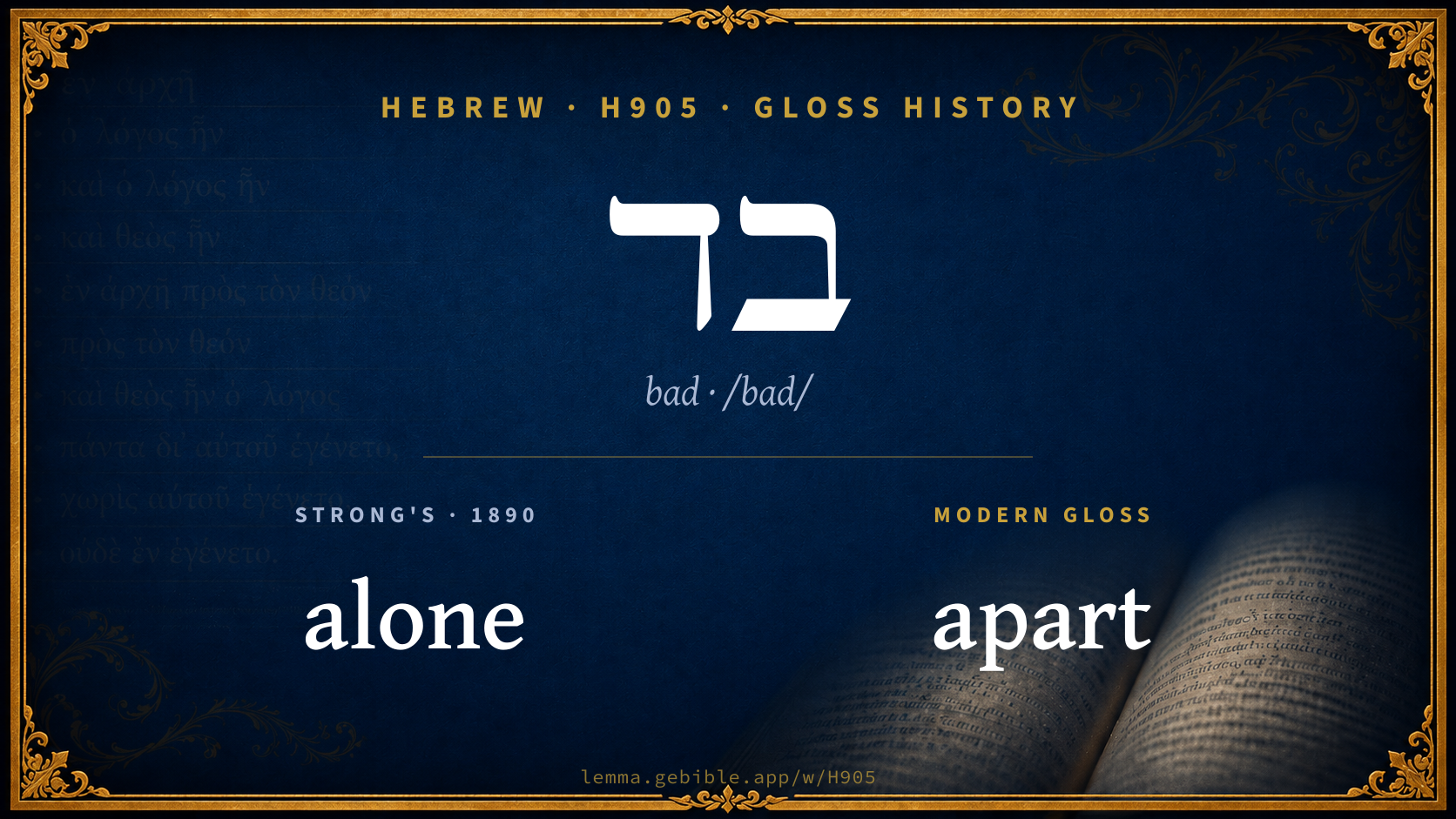
Gloss history
Strong's 1890 vs modern scholarship
About this word
Strong's H905 catalogs a Hebrew word from the Hebrew Old Testament.
These counts are not copied from any lexicon or concordance. They are computed here, from the morphology-tagged Hebrew Old Testament. What Lemma adds →
- 179
- distinct verses
- The word appears in 179 distinct verses.
- 25 / 39
- OT books
- The word appears in 25 of 39 Old Testament books.
- #236
- by frequency
- Top 250 most frequent Hebrew words (rank 236 of 8,640 Hebrew words by occurrence).
View all 179 occurrences in the concordance →
By section of the Old Testament
By traditional corpus
Conventional, traditional groupings — biblical authorship is debated, so this is a traditional corpus grouping, not an authorship claim. Each share is this word’s portion of its verses in that division of the Hebrew canon. Each figure is a share of the word’s 179 distinct verses.
- Torah (Pentateuch) 80 verses · 45%
- Prophets (Nevi'im) 60 verses · 34%
- Writings (Ketuvim) 39 verses · 22%
How translations render this word
Counts come from each version’s own published word-to-Strong’s tagging or interlinear alignment — an approximate guide to how each version renders this word, not a word-level alignment the data otherwise carries. Because each total is that version’s own tagged count, the per-version totals vary from one another and need not match the appearance or distinct-verse counts above. These counts may also differ from a printed concordance because Lemma counts each distinctly tagged rendering and does not collapse phrase taggings into a single head-word total. This is a fixed set of word-tagged versions (KJV, ASV, BSB, ULT) and does not change with the reading translation you choose elsewhere. Each version’s license is shown beside its name below (and on Sources).
BDB lists this Strong’s number as 4 distinct words (homographs). Each count above pools all of them and is not split by sense — see the Senses section below. A low-frequency rendering may belong to a different one of those words, not the primary meaning.
- King James Version†: Staves 37×, Beside 3×, Branches 3×
- American Standard Version†: Staves 30×, Staves thereof 4×, Besides 3×
- Berean Standard Bible†: Alone 36×, Poles 34×, Addition to 23×
- unfoldingWord Literal Text†: Alone 41×, Poles 30×, Besides 20×
King James Version Public Domain
Renders H905 across 56† tagged occurrences — most commonly:
Plus 9 renderings that appear only once — usually multi-word phrases or single function words the recovered tagging swept in, not distinct renderings.
American Standard Version Public Domain
Renders H905 across 56† tagged occurrences — most commonly:
Plus 11 renderings that appear only once — usually multi-word phrases or single function words the recovered tagging swept in, not distinct renderings.
Berean Standard Bible Public Domain
Renders H905 across 163† tagged occurrences — most commonly:
Plus other, less common renderings. Plus 34 renderings that appear only once — usually multi-word phrases or single function words the recovered tagging swept in, not distinct renderings. Not rendered by a distinct English word in 38 further occurrences.
unfoldingWord Literal Text CC BY-SA 4.0
Renders H905 across 203† tagged occurrences — most commonly:
Plus other, less common renderings. Plus 18 renderings that appear only once — usually multi-word phrases or single function words the recovered tagging swept in, not distinct renderings.
10 senses and sub-senses in the full BDB
What do BDB’s symbols mean?
BDB uses these scholarly abbreviations:
| Symbol | Meaning |
|---|---|
| 𝔊 | the Septuagint (the ancient Greek translation, LXX) |
| 𝔙 | the Vulgate (the Latin translation) |
| 𝔖 | the Syriac version (the Peshitta) |
| 𝔗 | the Targum (the Aramaic translation) |
| ψ | the Psalms |
| √ | root (the underlying root or stem) |
| ‖ | parallel passage (a synonymous or contrasted parallel) |
| † | the dagger: every passage where the word occurs is cited |
The 10 senses and sub-senses the full Brown-Driver-Briggs lexicon distinguishes for this word, in lexicon order (not ranked by frequency), with BDB’s own verbatim wording and sub-sense lettering. Shown in Hebrew script with BDB’s own scholarly abbreviations. The condensed entry is in the Lexicon Entry tab. See also the Forms in the corpus table below.
בד I [m.] white linen (deriv. unknown) pl. בַּדִּים
בד II separation concr. part (بِدٌّ, بِدَّةٌ portion)
- 1. with לְ, only in sg., לְבַד proposes in a state of (v sub לְ) separation, alone, by itself (Fr à part).
- a. Ex 26:9 (= 36:16) five curtains לְבַד by themselves, and six curtains לְבַד by themselves, Ju 7:5 him shalt thou set לבד apart, Zc 12:12–14. e.g. Exodus 26:9
- b. with sf. (89 times) to express the idea of by oneself, alone (proposes in his, thy, my separation), Gn 2:18 it is not good for man to be לְבַדּוֹ alone, 21:28 and A. set the seven lambs לְבַדְּהֶן by themselves (lit. in their separation), 32:17; 43:32; 2 S 10:8; Is 5:8; Gn 42:38 הוּא לְבַדּוֹ he alone, Ex 18:14 אַתָּה לְבַדְּךָ thou alone, Nu 11:14 אָנֹכִי לְבַדִּי I alone, 1 K 19:10, 14; Dt 8:3 not upon bread alone, 29:13; 2 S 13:32; 18:24; Is 44:24; 49:21; 63:3 +; after an oblique case, as a dat. Ex 22:19; Ju 3:20 ψ 51:6 לְךָ לְבַדְּךָ against thee alone have I sinned; a genit. 71:16 I will make mention of צִדְקָֽתְךָ לְבַדֶּֽךָ׃ the righteousness of thee alone. e.g. Genesis 2:18
- c. as adv. of limitation, †Is 26:13 only through thee do we celebrate thy name, Ex 7:29. e.g. Isaiah 26:13
- d. followed by מִן it becomes a prep., apart from, besides, Ex 12:37; Nu 29:39; Dt 3:5; 18:8 (read מִמְּכָרָיו with 𝔊 𝔖 𝔗 Aq Ew Di) Ju 8:26; 20:15 al. (15 times); once, Ezr 1:6, with עַל instead of מִן. e.g. Exodus 12:37
- e. מִלְּבַד33 (prob. inverted for לְבַד מִן) besides (chiefly P and late): Gn 26:1; 46:26; Lv 9:17; 23:38 (4 times) Nu 5:8; 6:21; 17:14 + 12 times Nu 28–29; Dt 28:69; Jos 22:29; 1 K 10:13; 1 Ch 3:9; 2 Ch 9:12; 17:19; 31:16; Ezr 2:65 = Ne 7:67; Dn 11:4. With sf. †Dt 4:35 אֵין עוֹד מִלְּבַדּוֹ there is none else besides him (cf. מִבַּלְעָדַי Is 45:21). e.g. Genesis 26:1
- 2. concr. part Ex 30:34 (P) בַּד בְּבַד יִהְיֶה part for (i.e. like; cf. בְּ III. 3 end) part shall it be. e.g. Exodus 30:34
- 3. בַּדִּים parts, spec. extended from something, i.e. (a) of a body, members, limbs Jb 18:13 (of man), 41:4 (of crocodile); (b) of a vine, rods or shoots Ez 17:6; 19:14; (c) of poles or staves used for carrying the ark Ex 25:13, 14, 15; 35:12; 37:4, 5; 39:35; 40:20; Nu 4:6 1 K 8:7, 8(×2) (= 2 Ch 5:8, 9(×2)) or table of shewbread Ex 25:27, 28; 35:13; 37:14, 15; Nu 4:8, or altar of B. O. Ex 27:6(×2), 7(×2); 35:16; 38:5, 6, 7; 39:39 Nu 4:14, or altar of incense Ex 30:4, 5; 35:15; 37:27, 28; Nu 4:11; (d) more gen. bars (of fortress) Ho 11:6, (of a gate) Jb 17:16 fig. בַּדֵּי שְׁאֹל (cf. Is 38:10). read הַעִמָּדִי (for בַּדֵּי) 𝔊 Du Dr, with נֵחָ֑ת in v b (for נָ֫חַת). e.g. Job 18:13
בד III only Pl. בַּדִּים.
- a. empty, idle talk (Ph. CIS 3, 6 listen not to בדנם = Heb. בַּדֵּיהֶם; cf. ܒܶܕܝܳܐ vain talk), especially with collat. idea of imaginary pretensions or claims: Jb 11:3 בַּדֶּיךָ מְתִים יַחֲרִישׁוּ thy idle talk brings men to silence (‖ וַתִּלְעַג), Is 16:6 (of Moab) לֹא כֵן בַּדָּיו his boastings are not right (unfounded), hence Je 48:30. e.g. Job 11:3
- b. concr. empty talkers, praters (cf. NH בַּדָּאָה, Syriac ܒܳܕܽܘܝܳܐ liar), of false prophets, Is 44:25; Je 50:36. e.g. Isaiah 44:25
Senses from the full Brown-Driver-Briggs lexicon (Brown, Driver, Briggs; Oxford 1906 — public domain), digitized via Sefaria, supplemented by the OpenScriptures HebrewLexicon (CC BY 4.0). Full attribution on Sources.
Word origin
I. n.[m.] white linen (deriv. unknown) pl. בַּדִּים—אֵפוֹד בָּ֑ד 1 S 2:18 (Samuel), 1 S 22:18 (priests of Nob), 2 S 6:14 = 1 Ch 15:27 (David): in P as material of diff. priestly vestments Ex 28:42; 39:28 Lv 6:3(×2) 16:4(×4), 23, 32. Pl. (ה)לבושׁ (הַ)בַּדִּים clad in (the) linen garments, of angel Ez 9:2, 3, 11; 10:2, 6, 7; Dn 10:5; 12:6, 7.
II. v. sub I, II. בדד.
III. n.m. separation concr. part (بِدٌّ, بِدَّةٌ portion)—sf. (always with לְ) לְבַדִּי, לְבַדּוֹ etc., 3 f. pl. †Gn 21:28 לְבַדְּהֶן, v 29 לְבַדָּ֫נָה;—
— Brown-Driver-Briggs (Oxford 1906, public domain), digitized via Sefaria, supplemented by the OpenScriptures HebrewLexicon (CC BY 4.0). See Sources.
Derived from בדד (bâdad) (H909) — to separate.
Jastrow Dictionary
A second Hebrew/Aramaic lexicon for comparison, covering Aramaic and post-biblical (Talmudic, Targumic, Midrashic) usage that the biblical-Hebrew BDB does not. Matched by lemma rather than by Strong’s number, so a lemma may carry more than one Jastrow headword (shown separately below), and the entries cover usage well beyond the Bible.
בִּדְּ־
- prefix (comp. of בְּ a. דְּ = h. בְּשֶׁ־, בְּשֶׁל)
- 1. concerning that (those) of; at the time of; treating of what refers to. Sabb. 112ᵃ בדטייעי in the case of those (sandals) of the travelling merchants (Arabs). Yoma 78ᵇ, v. הוּצָא. Ḥull. 20ᵃ ומתני׳ בדלא אהדר our Mishnah treats of a case when he did not turn. Gitt. 49ᵃ בדניזק וכ׳ we go in our assessment by (the property) of the injured; a. v. fr.
- 2. if, when. Targ. Y. Gen. XLIII, 5 בִּדְּלֵית unless. Targ. O. Deut. IX, 4 בִּדְּיִתְּבַר; a. e.
*בַּד I
- = אֲבַד. Targ. Y. II, Num. XXI, 29 ובָדְתוּן (Var. וּבַדְתּוּן = וַאֲ׳). Ithpe. אִתְבִּיד, v. אֲבַד
בַּד II
- (בדד) olive press (cmp. גַּת), tank. Shebi. VIII, 6 אין … בַּבַּד you must not press olives in the tank (in the Sabbath year).—בית הַבַּד the building containing the tank and all implements for pressing olives. Sabb. I, 9 קורת ב׳ הב׳ the beam of the press; a. fr.—Bets. 19ᵃ; Tosef. ib. II, 7, v. גַּב.—Pl. בַּדִּים, בַּדִּין. B. Bath. IV, 7 בית הב׳. Toh. IX, 7 בד אחד או שני ב׳ a quantity of olives for one tank or for two; a. fr.
בַּד III
- 1. single, separate. Ber. 63ᵇ (play on baddim, Jer. L, 36) שיושבין ב׳ ב׳ who study separately (without interchange of ideas). Kerith 5ᵃ expl. Ex. XXX, 34 ב׳ בב׳. e.g. Jeremiah 50:36
- 2. with pref. לְ, לְבַד (b. h.) alone, only. Sot. 8ᵃ אותה לְבַדָּהּ her (Num. V, 19) indicates her alone (each separately); a. fr.—בִּלְבַד (adv.) only. Ber. I, 1 ולא זו ב׳ (usu. with אמרו) and not only in this case did they make such a rule. Meg. I, 5 אין בין … אלא … ב׳ there is no difference between Festivals and the Sabbath (as to forbidden labors) except only as to the preparation of the necessaries of life; a. fr.—וּבִלְבַד but only, provided. Zeb. V, 8; a. fr. e.g. Numbers 5:19
בַּד IV
- chosen, fine linen. Zeb. 18ᵇ ב׳ שיהו של בוץ וכ׳ wherever the Law speaks of garments of bad, it means that they must be of byssus, new &c. Ib. how do we know דהאי ב׳ כיתנא הוא that bad (as material for garments) means linen (and no other fine stuff)? Answ. Something which grows בד בבד in single stalks (v. preced. a. next w.); Yoma 71ᵇ. Ib. 35ᵃ bad is used four times, intimating מובחר בב׳ the choicest of &c. (for diff. vers. v. Rabb. D. S. a. l. note); [cmp. Targ. Jer. XLVIII, 30].
בַּד V
- (בדד) single stalk, twig; also (b. h.) pole, bar. Zeb. 18ᵇ; Yoma 71ᵇ; v. preced. Keth. 17ᵃ ב׳ של הדס myrtle twig. Succ. 44ᵇ even one leaf וב׳ אחד and (on) one twig. B. Mets. 24ᵃ anything on which something is suspended ב׳ קרו ליה is called bad.—Pl. בַּדִּים. Y. Yoma V, 42ᵇ bot., a. e. בין הב׳ between the bars projecting from the Ark (i.e. their corresponding place in the Second Temple). B. Mets. l. c. בַּדֵּי מחטין וכ׳ poles of peddlars for needles &c. Ib. מאי בדי what does baddé mean? Answ. Twigs.—And why do they call them baddé? Answ., v. supra. V. אַנְפּוֹרְיָא.
A Dictionary of the Targumim, the Talmud Babli and Yerushalmi, and the Midrashic Literature (Marcus Jastrow; London, Luzac, 1903) — Public Domain. Digitized via Sefaria. Digitized via Sefaria. Full attribution on Sources.
Forms in the corpus
The 86 distinct written forms H905 takes in the Hebrew Bible, most frequent first — each parse links to that state’s occurrences in the concordance. Hebrew forms include their vowel points and cantillation, so a single lemma takes many written forms.
The 60 most common forms are shown; 26 rarer forms follow in the full concordance.
Same root — word family
Other BDB entries built from the same root as H905, grouped by Strong’s listed origin. These share a root / origin per the lexicon — not necessarily a shared meaning. Each links to that word’s own entry.
Derives from
Shares the same root
Proper names from this root
People and places named from this root — a name, not an additional meaning of the word.
Compare all same-root words → Showing 4 of 5 — not the complete family. 1 of the same-root words is a proper name (a person or place). They share a root, not necessarily a meaning.
Septuagint verse parallels
This word appears in 167 verses that also exist in the Greek Old Testament (Septuagint), out of the 179 Hebrew verses it occurs in. You can read those verses in Greek by switching the Old Testament edition to the Septuagint.
Read these verses in the Septuagint
- Genesis 2:18
- Exodus 12:16
- Leviticus 9:17
- Numbers 4:6
- Deuteronomy 1:9
- Joshua 11:13
- Judges 3:20
- 1 Samuel 7:3
- 2 Samuel 10:8
- 1 Kings 5:16
- 2 Kings 10:23
- 1 Chronicles 3:9
This is a verse-level parallel only — the same verses exist in both the Hebrew and Greek Old Testaments. No word-level Hebrew↔Greek correspondence is claimed: the data carries no such alignment, so no Greek word is shown as this Hebrew word’s translation. Coverage is not total — the Septuagint omits the deuterocanon and renumbers the Psalms, so some Hebrew verses have no direct Greek parallel.