
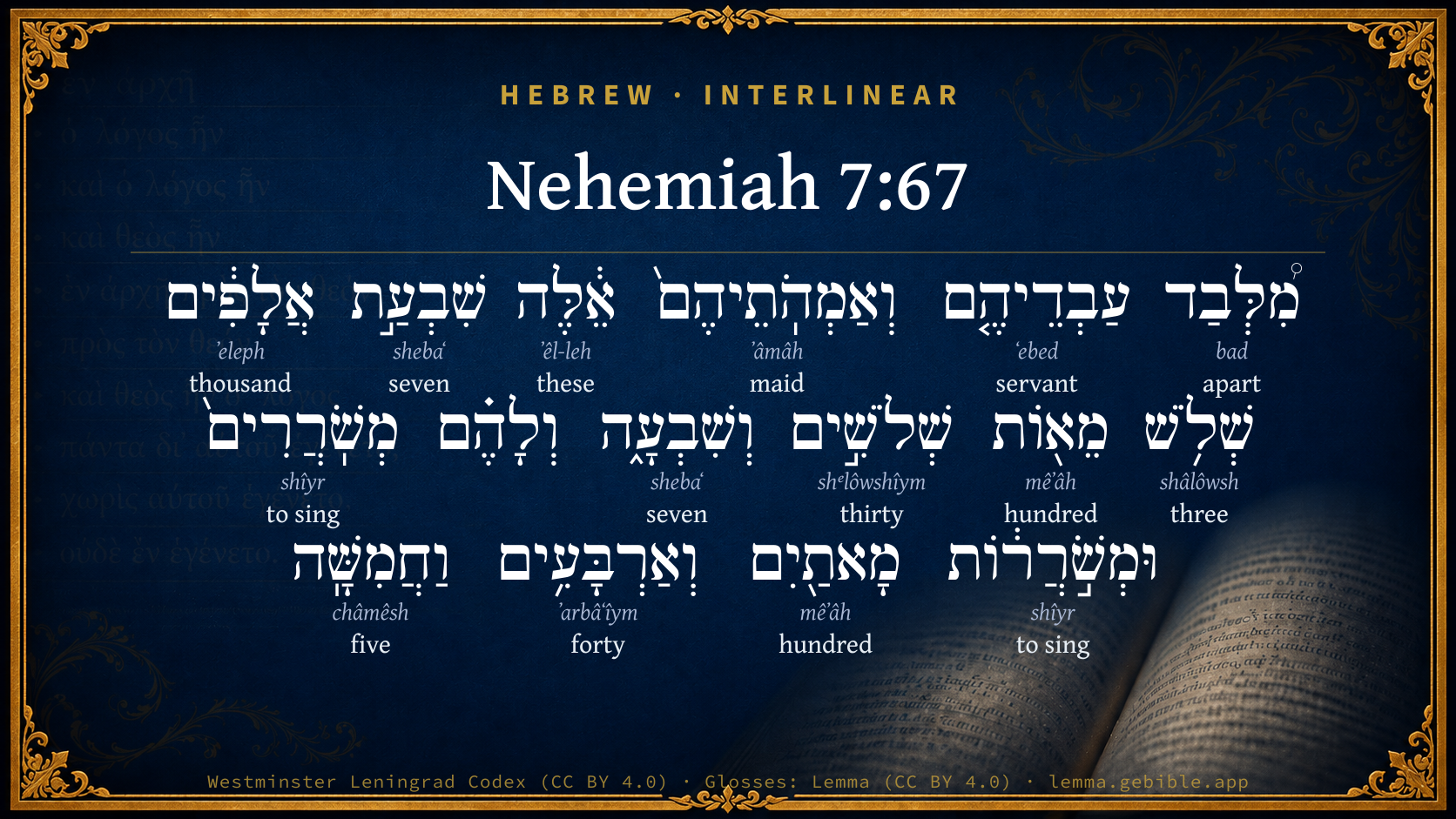
Nehemiah 7:67

Hebrew (Westminster Leningrad Codex) Nehemiah 7:67 appears in the Hebrew Old Testament. The text above is from the Westminster Leningrad Codex. Each word links to its Strong’s number, a concise gloss, and parsing drawn from the Open Scriptures Hebrew Bible morphology. Click any word for its full Brown-Driver-Briggs (BDB) entry.
Download image
Cite this verse

Nehemiah 7:67 (World English Bible). Public Domain. Lemma interlinear Bible study tool, https://lemma.gebible.app/v/nehemiah/7/67.

Show BibTeX & RIS
BibTeX
RIS
English Translation
besides their men-servants and their maid-servants, of whom there were seven thousand three hundred thirty-seven: and they had two hundred forty-five singing men and singing women.
World English Bible · Public Domain
Download a study sheet

One document with this verse’s original text, its word-by-word gloss line, the meaning frame, cross-references with their text, attributed commentary, and full source and license credits — printable, and it pastes into notes with its structure intact.

This verse Autodidact and up

Study sheet (.html) Plain text (.txt)

A passage Seminary Student

Up to 50 verses in one chapter. A passage sheet keeps up to 6 commentary sources and 12 cross-references per verse, in the order this page ranks them, and says so on the sheet whenever that leaves anything out. Ask for a single verse and you get the Autodidact verse sheet above.

Everything on this page stays free to read, with no account — the sheet is a download of what is already on screen, not access to it.

Want to remove ads? Support Godless Engineer
Compare translations 3

The same verse in 3 English versions, stacked beneath the original-language interlinear above. Click any original word for its lexicon entry.

Each is an independent rendering of the whole verse — the interlinear is not word-aligned to these translations.

Highlighted words mark where these versions differ — a whole-verse word diff, not a word-by-word alignment.

  • World English Bible Public Domain
    besides their men-servants and their maid-servants, of whom there were seven thousand three hundred thirty-seven: and they had two hundred forty-five singing men and singing women.
  • King James Version Public Domain
    Beside their manservants and their maidservants, of whom there were seven thousand three hundred thirty and seven: and they had two hundred forty and five singing men and singing women.
  • unfoldingWord Literal Text CC BY-SA 4.0
    apart from their male servants and their female servants, these were 7, 337; and for them, the men who sang and the women who sang were 245.

unfoldingWord Literal Text — © unfoldingWord, licensed CC BY-SA 4.0. Word-aligned USFM3 via Door43 (git.door43.org/unfoldingWord/en_ult).

Versions to compare (up to 4)

3 of 4 selected

Show all 18 translations

Every available English version of this verse, each an independent rendering of the whole verse.

  • World English Bible Public Domain
    besides their men-servants and their maid-servants, of whom there were seven thousand three hundred thirty-seven: and they had two hundred forty-five singing men and singing women.
  • Berean Standard Bible Public Domain
    in addition to their 7,337 menservants and maidservants, as well as their 245 male and female singers.
  • Majority Standard Bible Public Domain
    in addition to their 7,337 menservants and maidservants, as well as their 245 male and female singers.
  • King James Version Public Domain
    Beside their manservants and their maidservants, of whom there were seven thousand three hundred thirty and seven: and they had two hundred forty and five singing men and singing women.
  • American Standard Version (1901) Public Domain
    besides their men-servants and their maid-servants, of whom there were seven thousand three hundred thirty and seven: and they had two hundred forty and five singing men and singing women.
  • Revised Version (1885) Public Domain
    beside their menservants and their maidservants, of whom there were seven thousand three hundred thirty and seven, and they had two hundred forty and five singing men and singing women.
  • Geneva Bible (1599) Public Domain
    Besides their seruantes and their maydes, which were seuen thousand, three hundreth and seuen and thirtie: and they had two hundreth and fiue and fourtie singing men and singing women.
  • Douay-Rheims (1899) Public Domain
    Beside their menservants and womenservants, who were seven thousand three hundred thirty-seven: and among them singing men, and singing women, two hundred forty-five.
  • Young's Literal Translation Public Domain
    apart from their servants and their handmaids -- these `are' seven thousand three hundred thirty and seven; and of them `are' singers and songstresses, two hundred forty and five.
  • Literal Standard Version CC BY-SA 4.0
    apart from their servants and their handmaids—these [are] seven thousand three hundred thirty-seven; and of them [are] male and female singers, two hundred forty-five.
  • Unlocked Literal Bible CC BY-SA 4.0
    besides their male servants and their female servants, of whom there were 7,337. They had 245 singing men and women.
  • unfoldingWord Literal Text CC BY-SA 4.0
    apart from their male servants and their female servants, these were 7, 337; and for them, the men who sang and the women who sang were 245.
  • Darby Bible Public Domain
    besides their servants and their maids, of whom there were seven thousand three hundred and thirty-seven; and they had two hundred and forty-five singing-men and singing-women.
  • World Messianic Bible Public Domain
    in addition to their male servants and their female servants, of whom there were seven thousand three hundred thirty-seven. They had two hundred forty-five singing men and singing women.
  • Webster's Bible Public Domain
    Besides their man-servants and their maid-servants, of whom there were seven thousand three hundred and thirty seven: and they had two hundred and forty five singing-men and singing-women.
  • Free Bible Version CC BY-SA 4.0
    In addition there were 7,337 servants and 245 male and female singers.
  • Bible in Basic English Public Domain
    As well as their men-servants and their women-servants, of whom there were seven thousand, three hundred and thirty-seven; and they had two hundred and forty-five men and women to make music.
  • JPS Tanakh (1917) Public Domain
    beside their men-servants and their maid-servants, of whom there were seven thousand three hundred thirty and seven; and they had two hundred forty and five singing men and singing women.

Literal Standard Version (2020), Covenant Press — licensed CC BY-SA 4.0. Text via the HelloAO Bible API (eBible.org). Unlocked Literal Bible (unfoldingWord) — licensed CC BY-SA 4.0. Text via the HelloAO Bible API (eBible.org). unfoldingWord Literal Text — © unfoldingWord, licensed CC BY-SA 4.0. Word-aligned USFM3 via Door43 (git.door43.org/unfoldingWord/en_ult). Free Bible Version, Dr. Jonathan Gallagher — licensed CC BY-SA 4.0. Text via the HelloAO Bible API (eBible.org).

Word by word

More ways to search: Search by grammar → Find every occurrence → Compare this word →

Practice this passage: Drill this verse → Learn its vocabulary →

וְאַמְהֹֽתֵיהֶם֙
ʼâmâh
H519
“and · maids · their”
Conjunction + Noun, Common, Feminine, Plural, Construct + Suffix, Personal, 3rd Person, Masculine, Plural
Part of Speech
Conjunction + Noun
Type
Common
Gender
Feminine
Number
Plural
State
Construct
Full BDB Definition

Origin: apparently a primitive word

TWOT: 112

maid-servant, female slave, maid, handmaid, concubine - of humility (figuratively)
  1. מִ֠לְּבַד bad H905 “from · to/for · apart of” Preposition + Preposition + Noun, Common, Masculine, Singular, Construct
  2. עַבְדֵיהֶ֤ם ʻebed H5650 “servants · their” Noun, Common, Masculine, Plural, Construct + Suffix, Personal, 3rd Person, Masculine, Plural
  3. אֵ֔לֶּה ʼêl-leh H428 “these” Pronoun, Demonstrative, Common, Plural
  4. שִׁבְעַ֣ת shebaʻ H7651 “seven” Adjective, Cardinal number, Masculine, Singular, Construct
  5. אֲלָפִ֔ים ʼeleph H505 “thousand” Adjective, Cardinal number, Both, Plural, Absolute
  6. שְׁלֹ֥שׁ shâlôwsh H7969 “three” Adjective, Cardinal number, Feminine, Singular, Absolute
  7. מֵא֖וֹת mêʼâh H3967 “hundred” Adjective, Cardinal number, Both, Plural, Absolute
  8. שְׁלֹשִׁ֣ים shᵉlôwshîym H7970 “thirty” Adjective, Cardinal number, Both, Plural, Absolute
  9. וְשִׁבְעָ֑ה shebaʻ H7651 “and · seven” Conjunction + Adjective, Cardinal number, Masculine, Singular, Absolute
  10. מְשֹֽׁרֲרִים֙ shîyr H7891 “singing” Verb, Polel, Participle Active, Masculine, Plural, Absolute
  11. וּמְשֹׁ֣רֲר֔וֹת shîyr H7891 “and · singing” Conjunction + Verb, Polel, Participle Active, Feminine, Plural, Absolute
  12. מָאתַ֖יִם mêʼâh H3967 “hundred” Adjective, Cardinal number, Both, Dual, Absolute
  13. וְאַרְבָּעִ֥ים ʼarbâʻîym H705 “and · forty” Conjunction + Adjective, Cardinal number, Both, Plural, Absolute
  14. וַחֲמִשָּֽׁה châmêsh H2568 “and · five” Conjunction + Adjective, Cardinal number, Masculine, Singular, Absolute

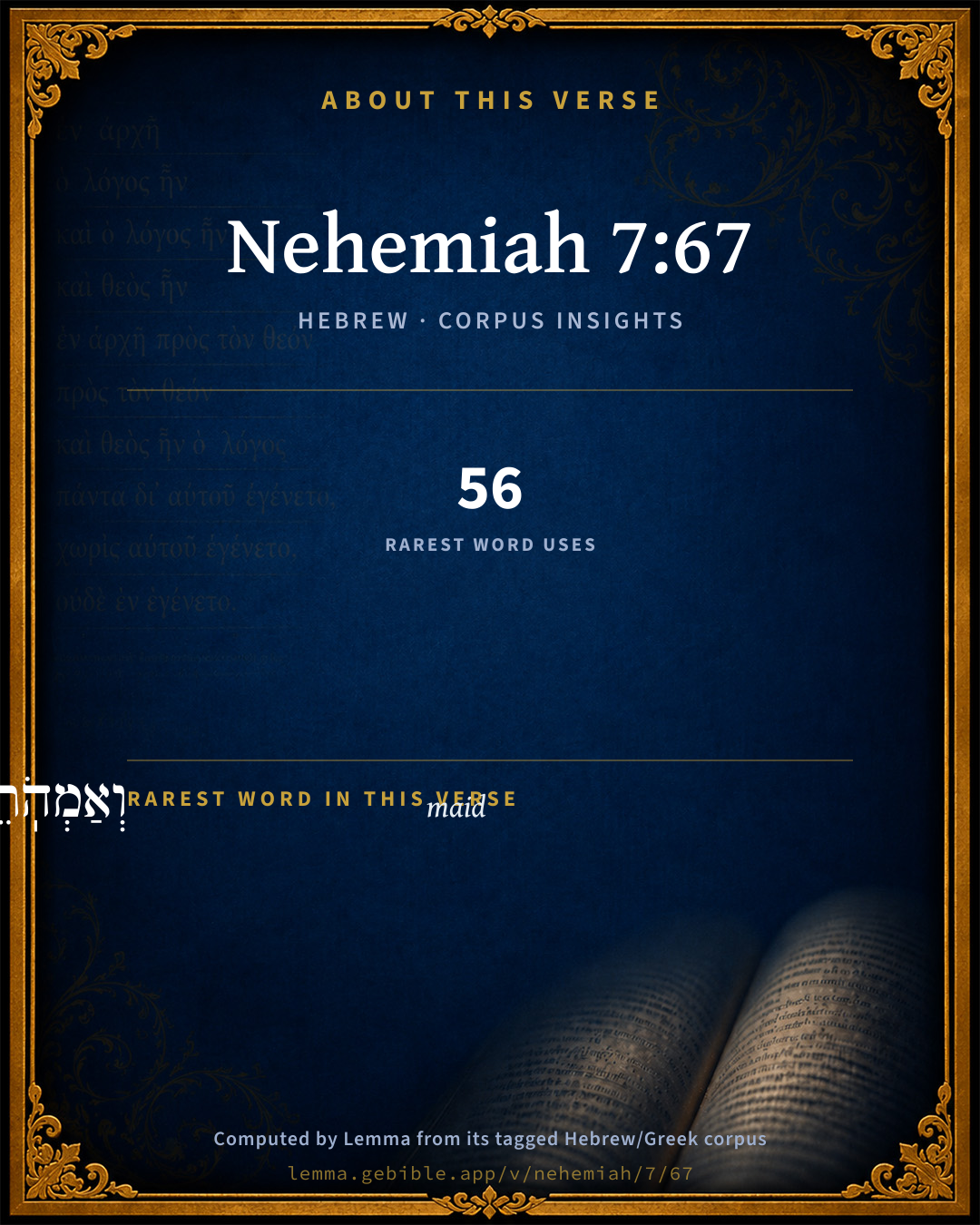
About this verse

These counts appear in no published source. They are computed here, from the morphology-tagged text and Lemma’s own curated glosses. What Lemma adds →

16
words
12
distinct lemmas
Historical
section

Shared distinctive vocabulary

וְאַמְהֹֽתֵיהֶם֙ maid H519 occurs in 49 verses of the Hebrew Bible. Also found in:

Grammatical profile

  • 2 verbs
  • 3 nouns
  • 9 adjectives
  • 1 pronoun
  • 1 preposition

Verb forms

  • מְשֹֽׁרֲרִים֙ Polel · Participle Active
  • וּמְשֹׁ֣רֲר֔וֹת Polel · Participle Active

Repetition

Words recur within this verse — often emphatic in Hebrew:

  • שִׁבְעַ֣ת seven H7651 ×2
  • מֵא֖וֹת hundred H3967 ×2
  • מְשֹֽׁרֲרִים֙ to sing H7891 ×2

Cross-references

3

Topical passages linked to Nehemiah 7:67 in the Treasury of Scripture Knowledge — connected by theme and wording, ordered by reader-vote popularity; previews shown in the World English Bible.

  • Ezra 2:65 besides their men-servants and their maid-servants, of whom there were seven thousand three hundred thirty-seven: and they had two hundred singing men and singing women.
  • Isaiah 45:1–2 Thus says Yahweh to his anointed, to Cyrus, whose right hand I have held, to subdue nations before him, and I will loose the loins of kings; to open the doors before him, and the gates shall not be shut:
  • Jeremiah 27:7 All the nations shall serve him, and his son, and his son's son, until the time of his own land come: and then many nations and great kings shall make him their bondservant.

Cross-references courtesy of OpenBible.info (CC BY 4.0).

Hebrew and Greek witnesses Masoretic Hebrew ↔ Greek Septuagint

The same verse in the two great witnesses to the Old Testament, shown verse-for-verse.

These are two independent witnesses, not word-aligned to each other, and the Septuagint is shown in lemma (dictionary) form.

Hebrew Nehemiah 7:67 Masoretic · Westminster Leningrad Codex

מִ֠לְּבַד עַבְדֵיהֶ֤ם וְאַמְהֹֽתֵיהֶם֙ אֵ֔לֶּה שִׁבְעַ֣ת אֲלָפִ֔ים שְׁלֹ֥שׁ מֵא֖וֹת שְׁלֹשִׁ֣ים וְשִׁבְעָ֑ה וְלָהֶ֗ם מְשֹֽׁרֲרִים֙ וּמְשֹׁ֣רֲר֔וֹת מָאתַ֖יִם וְאַרְבָּעִ֥ים וַחֲמִשָּֽׁה

besides their men-servants and their maid-servants, of whom there were seven thousand three hundred thirty-seven: and they had two hundred forty-five singing men and singing women.

World English Bible · Public Domain

Greek LXX Structure differs

The Septuagint has no separate book of Nehemiah. Its Greek text is the second half of Esdras B (2 Esdras), chapters 11–23; Ezra is the first half (1–10).

A verse-for-verse comparison isn’t shown here because the chapters and verses don’t line up. Switch to the LXX edition with the MT / LXX toggle above to read the Greek directly.

Hebrew: Westminster Leningrad Codex (CC BY 4.0). Greek: Septuagint (public domain); English from a public-domain English Septuagint. How the Septuagint differs from the Hebrew →

Commentary

Notes on Nehemiah 7:67 from classic Christian and Jewish commentators (each source and its license shown beneath its notes). The classic Christian expositions comment on the surrounding passage and are grouped to its opening verse, so a note may address several verses; the Jewish commentaries on the Tanakh (Rashi and others) are per-verse, so they appear only where the commentator wrote on this verse.

Lemma curates 59 commentaries, every one of them public domain or Creative Commons licensed, each selected and text-cleaned for this edition rather than reprinted as found. About our sources →

The Biblical Illustrator

Joseph S. Exell

Neh_7:67

And they had two hundred forty and five singing men and singing women.

Church music

The captives in the text had music left in them, and if they could find, amid all their trials, two hundred and forty and five singing men and singing women, then in this day of gospel sunlight and freedom from all persecution there ought to be a great multitude of men and women willing to sing the praises of God. All our churches need arousal on this subject. Those who can sing must throw their souls into the exercise, and those who cannot sing must learn how, and it shall be heart to heart, voice to voice, and the music shall swell jubilant with thanksgiving and tremulous with pardon. Have you ever noticed the construction of the human throat as indicative of what God means us to do with it ? In only an ordinary throat and lungs there are fourteen direct muscles that produce 16,888 sounds, and thirty indirect muscles that produce 173,741,828 sounds, and the human voice can produce seventeen trillion, five hundred and ninety-two billion, one hundred and eighty-six million, forty-four thousand, four hundred and fifteen different sounds. What does that mean? It means that you should sing! Do you suppose that God, who gives us such a musical instrument as that, intends us to keep it shut? Suppose some great tyrant should get possession of the musical instruments of the world, and should lock up the organ of Westminster Abbey, and the organ of Lucerne, and the organ at Haarlem, and the organ at Freiburg, and all the other great musical instruments of the world--you would call such a man as that a monster; and yet you are more wicked if, with the human voice--a musical instrument of more wonderful adaptation than all the musical instruments that man ever created--you shut it against the praise of God.

I. Music seems to have been born in the soul of the world. The omnipotent voice with which God commanded the world into being seems to linger yet with its majesty and sweetness, and you hear it in the grain-field, in the swoop of the wind amid the mountain fastnesses, in canary's warble and in thunder-shock, in brook's tinkle and in ocean's paean. There are soft cadences in nature, and loud notes, some of which we cannot hear at all, and others are so terrific that we cannot appreciate them. The animalcules have their music, and the spicula of hay and the globule of water are as certainly resonant with the voice of God as the highest heavens in which the armies of the redeemed celebrate their victories. When the breath of the flower strikes the air and the wing of the firefly cleaves it, there is sound and there is melody ; and as to those utterances of nature which seem harsh and overwhelming, it is as when you stand in the midst of a great orchestra, and the sound almost rends your ear because you are too near to catch the blending Of the music.

II. Music seems dependent on the laws of acoustics and mathematics, and yet where these laws are not understood at all the art is practised There are to-day five hundred musical journals in China. Two thousand years before Christ the Egyptians practised this art. Pythagoras learned it. Lasus, of Hermione, wrote essays on it. Plato and Aristotle introduced it into their schools; but I have not much interest in that. My chief interest is in the music of the Bible. The Bible, like a great harp with innumerable strings, swept by the fingers of inspiration, trembles with it. So far back as the fourth chapter of Genesis you find the first organist and harper--Jubal. So far back as the thirty-first chapter of Genesis you find the first choir. All up and down the Bible you find sacred music--at weddings, at inaugurations, at the treading of the wine-press. The Hebrews understood how to make musical signs above the musical text. When the Jews came from their distant homes to the great festivals at Jerusalem they brought harp and timbrel and trumpet, and poured along the great Judaean highways a river of harmony, until in and around the temple the wealth of a nations song and gladness had accumulated. All through the ages there has been great attention paid to sacred music. Ambrosius, Augustine, Gregory the Great, Charlemagne, gave it their mighty influence, and in our day the best musical genius is throwing itself on the altars of God. Handel, and Mozart, and Bach, and Durante, and Wolf, and scores of other men and women have given the best part of their genius to Church music. A truth in words is not half so mighty as a truth in song. Luthers sermons have been forgotten, but the Judgment Hymn he composed is resounding yet all through Christendom.

III. While there may be great varieties of opinion in regard to music, it seems to me that the general spirit of the word of God indicates what ought to be the great characteristics.

1. A prominent characteristic ought to be adaptiveness. Music that may be appropriate for a concert-hall or the opera-house or the drawing-room may be shocking in church. Glees, madrigals, ballads may be as innocent as psalms in their places. There is no reason why music should always be religious music. So I am in favour of concert-halls as well as churches. But church music has only one design, and that is devotion, and that which comes with the toss, the song, and the display of an opera-house is a hindrance to the worship. From such performances we go away saying, What splendid execution! Did you ever hear such a soprano? Which of those solos did you like the better? When, if we had been rightly wrought upon, we would have gone away saying, Oh! how my soul was lifted up in the presence of God while they were staging the first hymn; I never had such rapturous views of Jesus Christ as my Saviour as when they were singing that last doxology. There is an everlasting distinction between music as an art and music as a help to devotion. Though a Schumann composed it, though a Mozart played it, though a Sontag sang it, away with it if it does not make the heart better and honour Christ.

2. Correctness ought to be a characteristic of church music. God loves harmony, and we ought to love it. There is no devotion in a howl or yelp.

3. Another characteristic must be spirit and life. Music ought to rush from the audience like the water from a rock--clear, bright, sparkling. If all the other part of the church service is dull, do not have the music dull. With so many thrilling things to sing about, away with all drawling and stupidity. Let our song be like an acclamation of victory. You have a right to sing. Do not surrender your prerogative. If, in the performance of your duty, or the attempt at it, you should lose your place in the musical scale and be on C below when you ought to be on C above, or you should come in half a bar behind, we will excuse you. Still, it is better to do as Paul says, and sing with the spirit, and the understanding also.

4. Again, I remark, church music must be congregational. This opportunity must be brought down within the range of the whole audience. A song that the worshippers cannot sing is of no more use to them than a sermon in Choctaw. Let us wake up to this duty. Let us sing alone, sing in our families, sing in our schools, sing in our churches. I never shall forget hearing a Frenchman singing the Marseillaise Hymn on the Champs Elysees, Paris, just before the battle of Sedan. I never saw such enthusiasm before or since. As he sang that national air, oh I how the Frenchmen shouted. Have you ever in an English assemblage heard a band play God Save the Queen? If you have, you know something about the enthusiasm of a national air. Now, I tell you that these songs we sing Sabbath by Sabbath are the national airs of Jesus Christ and of the kingdom of heaven, and if you do not learn to sing them here, how do you ever expect to sing the song of Moses and the Lamb? (T. De Witt Talmage.)

The Biblical Illustrator, edited by Joseph S. Exell (c. 1880s–1900s) — public domain. Text from a community e-Sword module.

The Cambridge Bible for Schools and Colleges

gen. ed. J. J. S. Perowne

67. two hundred forty and five] So 1Es_5:41, Ezr_2:65 ‘two hundred.’

The Cambridge Bible for Schools and Colleges (gen. ed. J. J. S. Perowne; Cambridge University Press, 1878–1918) — public domain. Text from a community e-Sword module.

The Pulpit Commentary

Two hundred and forty-five singing men and singing women. Ezra says 200; but this must be a round number. 1 Esdras confirms Nehemiah. (RAPC 1Est 5:42)

The Pulpit Commentary (1880–1919), ed. H.D.M. Spence-Jones & Joseph S. Exell — public domain. Text from a community e-Sword module.

Lesson kit

Teaching starters — assembled from the data on this page, not authored interpretation. Every prompt links to the verse data it draws on. Edit before teaching.

Nehemiah, in the Historical, opens this verse with 16 words (12 distinct Hebrew lemmas). Its most distinctive word is ʼâmâh (“maid”). A historical commentator’s framing appears above. Read the whole chapter for the surrounding context.

Discussion questions

  1. How does “maid” (ʼâmâh) shape what this verse is saying?
  2. How does Genesis 20:17, which shares the word «maid», read alongside this verse?
  3. What does the repetition of “seven” (2× in this one verse) do in this verse?
  4. The translations on this page render this verse differently — a whole-verse word diff, not a word-by-word alignment. What might account for the different wordings?
  5. «מְשֹֽׁרֲרִים֙» is a Polel Participle Active verb. How does that grammatical form shape the action described?
  6. Compare how The Biblical Illustrator and The Cambridge Bible for Schools and Colleges read this verse. Where do they agree or differ?

Things to notice

Reading settings

Reading text

Shown beneath each verse's original-language words.

Old Testament
Old Testament edition

Read the OT as the Masoretic Hebrew (MT) or the Greek Septuagint (LXX).

English shown for the Greek Septuagint (in the Hebrew ↔ Greek comparison).

Comparing translations? Open the Compare panel on any verse page to stack up to four side by side.