
Psalms 72:18

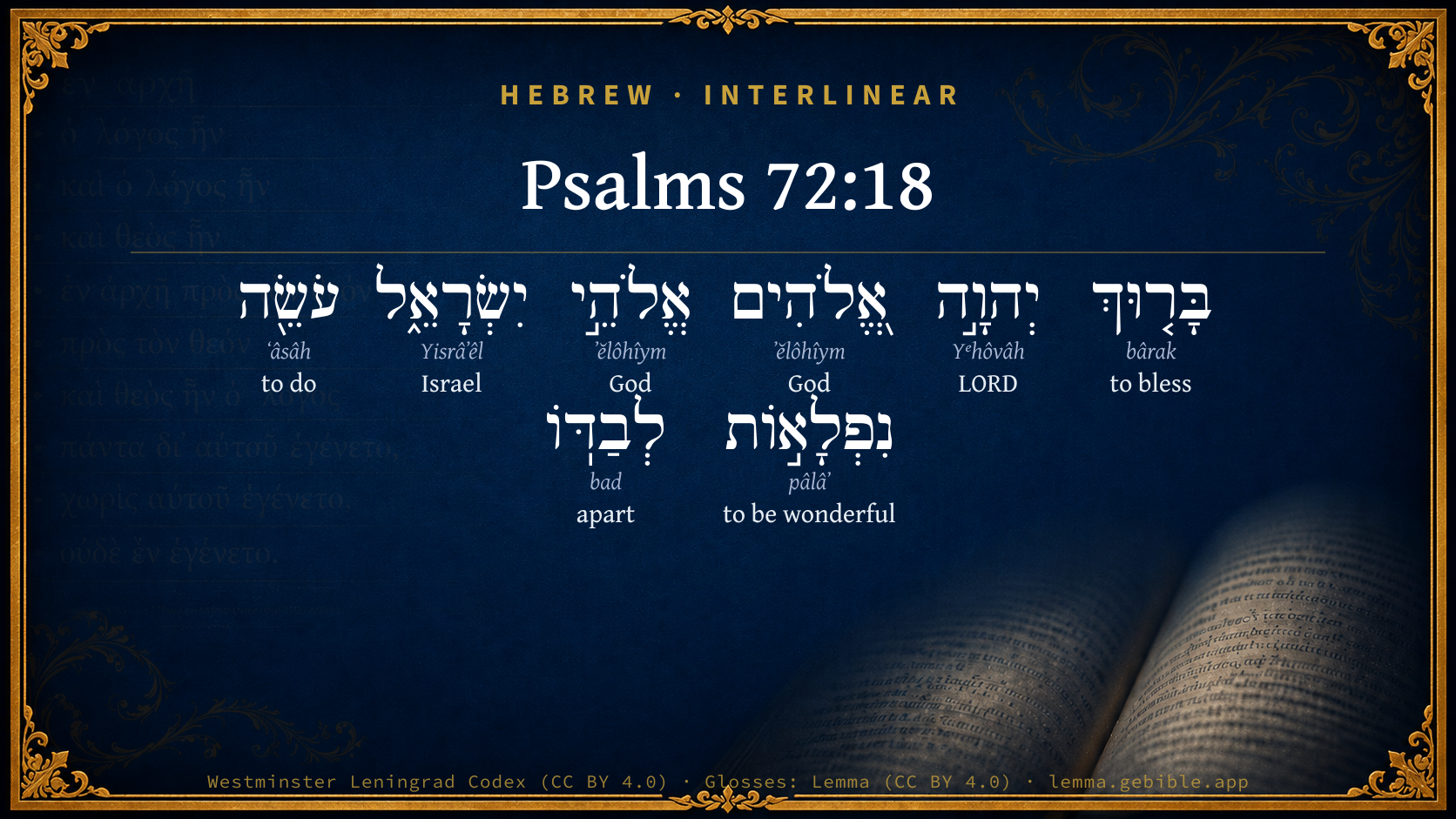
Hebrew (Westminster Leningrad Codex) Psalms 72:18 appears in the Hebrew Old Testament. The text above is from the Westminster Leningrad Codex. Each word links to its Strong’s number, a concise gloss, and parsing drawn from the Open Scriptures Hebrew Bible morphology. Click any word for its full Brown-Driver-Briggs (BDB) entry.
Download image
Cite this verse

Psalms 72:18 (World English Bible). Public Domain. Lemma interlinear Bible study tool, https://lemma.gebible.app/v/psalms/72/18.

Show BibTeX & RIS
BibTeX
RIS
English Translation
Praise be to Yahweh God, the God of Israel, Who alone does marvelous deeds.
World English Bible · Public Domain
Download a study sheet

One document with this verse’s original text, its word-by-word gloss line, the meaning frame, cross-references with their text, attributed commentary, and full source and license credits — printable, and it pastes into notes with its structure intact.

This verse Autodidact and up

Study sheet (.html) Plain text (.txt)

A passage Seminary Student

Up to 50 verses in one chapter. A passage sheet keeps up to 6 commentary sources and 12 cross-references per verse, in the order this page ranks them, and says so on the sheet whenever that leaves anything out. Ask for a single verse and you get the Autodidact verse sheet above.

Everything on this page stays free to read, with no account — the sheet is a download of what is already on screen, not access to it.

Want to remove ads? Support Godless Engineer
Compare translations 3

The same verse in 3 English versions, stacked beneath the original-language interlinear above. Click any original word for its lexicon entry.

Each is an independent rendering of the whole verse — the interlinear is not word-aligned to these translations.

Highlighted words mark where these versions differ — a whole-verse word diff, not a word-by-word alignment.

  • World English Bible Public Domain
    Praise be to Yahweh God, the God of Israel, Who alone does marvelous deeds.
  • King James Version Public Domain
    Blessed be the LORD God, the God of Israel, who only doeth wondrous things.
  • unfoldingWord Literal Text CC BY-SA 4.0
    Blessed Yahweh God, the God of Israel, the one doing wonders, he alone.

unfoldingWord Literal Text — © unfoldingWord, licensed CC BY-SA 4.0. Word-aligned USFM3 via Door43 (git.door43.org/unfoldingWord/en_ult).

Versions to compare (up to 4)

3 of 4 selected

Show all 18 translations

Every available English version of this verse, each an independent rendering of the whole verse.

  • World English Bible Public Domain
    Praise be to Yahweh God, the God of Israel, Who alone does marvelous deeds.
  • Berean Standard Bible Public Domain
    Blessed be the LORD God, the God of Israel, who alone does marvelous deeds.
  • Majority Standard Bible Public Domain
    Blessed be the LORD God, the God of Israel, who alone does marvelous deeds.
  • King James Version Public Domain
    Blessed be the LORD God, the God of Israel, who only doeth wondrous things.
  • American Standard Version (1901) Public Domain
    Blessed be Jehovah God, the God of Israel, Who only doeth wondrous things:
  • Revised Version (1885) Public Domain
    Blessed be the LORD God, the God of Israel, who only doeth wondrous things:
  • Geneva Bible (1599) Public Domain
    Blessed be the Lord God, euen the God of Israel, which onely doeth wonderous things.
  • Douay-Rheims (1899) Public Domain
    Blessed be the Lord, the God of Israel, who alone doth wonderful things.
  • Young's Literal Translation Public Domain
    Blessed is Jehovah God, God of Israel, He alone is doing wonders,
  • Literal Standard Version CC BY-SA 4.0
    Blessed is YHWH God, God of Israel, || He alone is doing wonders,
  • Unlocked Literal Bible CC BY-SA 4.0
    May Yahweh God, the God of Israel, be blessed, who alone does wonderful things.
  • unfoldingWord Literal Text CC BY-SA 4.0
    Blessed Yahweh God, the God of Israel, the one doing wonders, he alone.
  • Darby Bible Public Domain
    Blessed be Jehovah Elohim, the God of Israel, who alone doeth wondrous things!
  • World Messianic Bible Public Domain
    Praise be to the LORD God, the God of Israel, who alone does marvelous deeds.
  • Webster's Bible Public Domain
    Blessed be the LORD God, the God of Israel, who only doeth wondrous things.
  • Free Bible Version CC BY-SA 4.0
    Praise the Lord God, the God of Israel, who is the only one who can do such fantastic things!
  • Bible in Basic English Public Domain
    Praise be to the Lord God, the God of Israel, the only doer of wonders.
  • JPS Tanakh (1917) Public Domain
    Blessed be the LORD God, the God of Israel, who only doeth wondrous things;

Literal Standard Version (2020), Covenant Press — licensed CC BY-SA 4.0. Text via the HelloAO Bible API (eBible.org). Unlocked Literal Bible (unfoldingWord) — licensed CC BY-SA 4.0. Text via the HelloAO Bible API (eBible.org). unfoldingWord Literal Text — © unfoldingWord, licensed CC BY-SA 4.0. Word-aligned USFM3 via Door43 (git.door43.org/unfoldingWord/en_ult). Free Bible Version, Dr. Jonathan Gallagher — licensed CC BY-SA 4.0. Text via the HelloAO Bible API (eBible.org).

Word by word

More ways to search: Search by grammar → Find every occurrence → Compare this word →

Practice this passage: Drill this verse → Learn its vocabulary →

נִפְלָא֣וֹת
pâlâʼ
H6381
“being wonderful”
Verb, Niphal, Participle Active, Feminine, Plural, Absolute
Part of Speech
Verb
Stem
Niphal
Form
Participle Active
Gender
Feminine
Number
Plural
State
Absolute
Full BDB Definition

Origin: a primitive root

TWOT: 1768

to be marvellous, be wonderful, be surpassing, be extraordinary, separate by distinguishing action - (Niphal) - to be beyond one's power, be difficult to do - to be difficult to understand - to be wonderful, be extraordinary - marvellous (participle) - (Piel) to separate (an offering) - (Hiphil) - to do extraordinary or hard or difficult thing - to make wonderful, do wondrously - (Hithpael) to show oneself wonderful or marvellous
  1. בָּר֤וּךְ bârak H1288 “blessed” Verb, Qal, Participle Passive, Masculine, Singular, Absolute
  2. יְהוָ֣ה Yᵉhôvâh H3068 “LORD” Noun, Proper
  3. אֱ֭לֹהִים ʼĕlôhîym H430 “God(s)” Noun, Common, Masculine, Plural, Absolute
  4. אֱלֹהֵ֣י ʼĕlôhîym H430 “God(s) of” Noun, Common, Masculine, Plural, Construct
  5. יִשְׂרָאֵ֑ל Yisrâʼêl H3478 “Israel” Noun, Proper
  6. עֹשֵׂ֖ה ʻâsâh H6213 “doing” Verb, Qal, Participle Active, Masculine, Singular, Construct
  7. לְבַדּֽוֹ bad H905 “to/for · apart · his” Preposition + Noun, Common, Masculine, Singular, Construct + Suffix, Personal, 3rd Person, Masculine, Singular

About this verse

These counts appear in no published source. They are computed here, from the morphology-tagged text and Lemma’s own curated glosses. What Lemma adds →

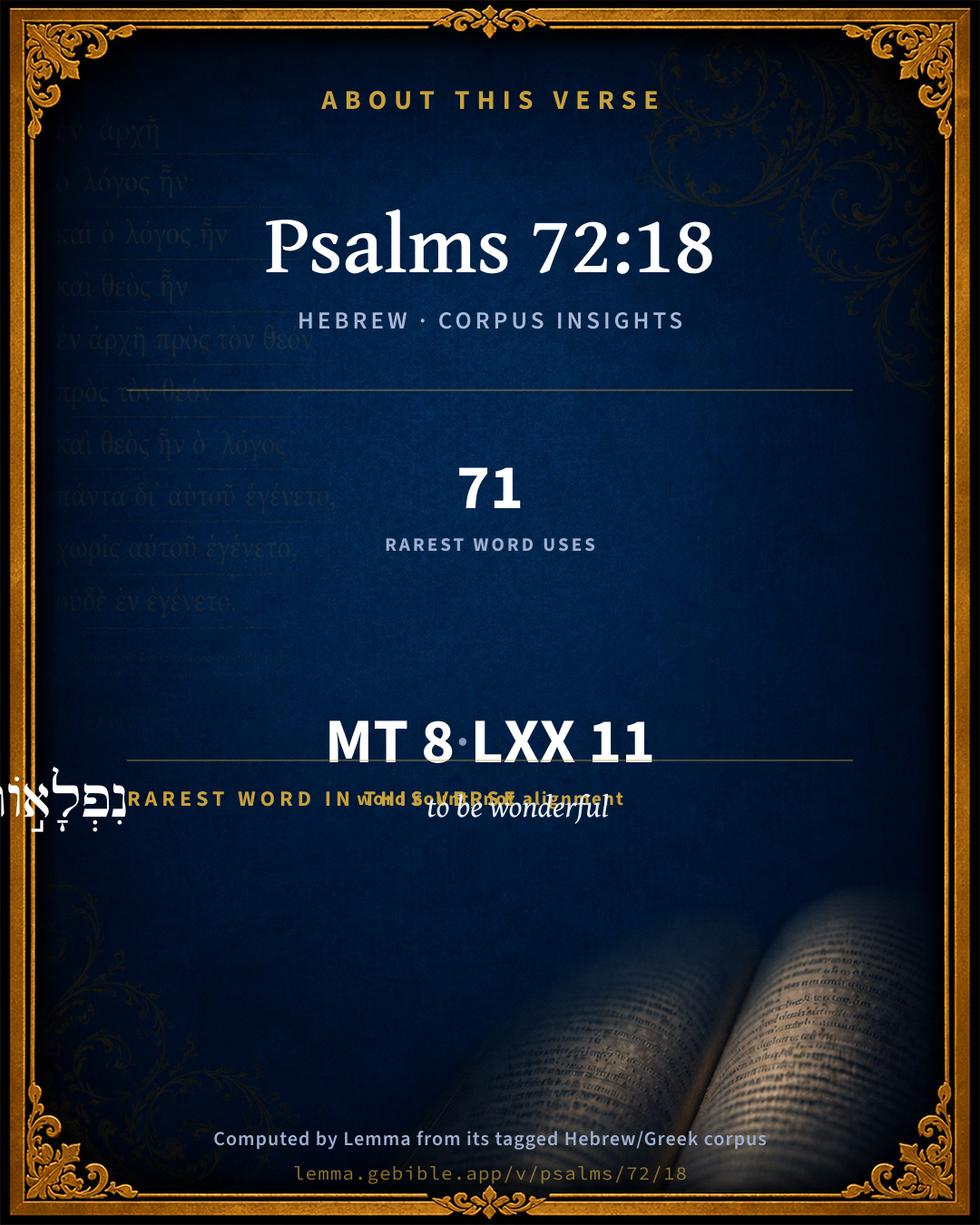
8
words
7
distinct lemmas
Wisdom
section

Grammatical profile

  • 3 verbs
  • 5 nouns

Verb forms

  • בָּר֤וּךְ Qal · Participle Passive
  • עֹשֵׂ֖ה Qal · Participle Active
  • נִפְלָא֣וֹת Niphal · Participle Active

Repetition

A word recurs within this verse — often emphatic in Hebrew:

  • אֱ֭לֹהִים God H430 ×2

Hebrew & Septuagint length

In English translation the verse runs 14 words from the Hebrew and 11 from the Septuagint (LXX English) — closely comparable.

A rough comparison of the two English renderings, which tokenize alike — not a word-level alignment.

Word counts can differ between the Hebrew and the Greek without any difference in meaning — e.g. the Hebrew direct-object marker אֵת has no separate Greek word, and Greek often adds the article ὁ.

In the original languages it is 8 Hebrew tokens and 11 Greek tokens — but the two are counted differently (Hebrew bundles its prefixes and suffixes into one token; the Greek is in lemma form), so that isn’t a like-for-like length.

Cross-references

12

Topical passages linked to Psalms 72:18 in the Treasury of Scripture Knowledge — connected by theme and wording, ordered by reader-vote popularity; previews shown in the World English Bible.

  • Psalms 41:13 Blessed be Yahweh, the God of Israel, From everlasting and to everlasting! Amen and amen.
  • Psalms 106:48 Blessed be Yahweh, the God of Israel, From everlasting even to everlasting! Let all the people say, "Amen." Praise Yah!
  • Exodus 15:11 Who is like you, Yahweh, among the gods? Who is like you, glorious in holiness, Fearful in praises, doing wonders?
  • 1 Chronicles 29:10 Therefore David blessed Yahweh before all the assembly; and David said, You are blessed, Yahweh, the God of Israel our father, forever and ever.
  • Psalms 86:10 For you are great, and do wondrous things. You are God alone.
  • Psalms 136:4 To him who alone does great wonders; For his loving kindness endures forever:
  • Psalms 77:14 You are the God who does wonders. You have made your strength known among the peoples.
  • Job 5:9 Who does great things that can't be fathomed, Marvelous things without number;
  • Psalms 68:35 You are awesome, God, in your sanctuaries. The God of Israel gives strength and power to his people. Praise be to God!
  • 1 Chronicles 29:20 David said to all the assembly, Now bless Yahweh your God. All the assembly blessed Yahweh, the God of their fathers, and bowed down their heads, and worshiped Yahweh, and the king.
  • Daniel 4:2–3 It has seemed good to me to show the signs and wonders that the Most High God has worked toward me.
  • Job 9:10 Who does great things past finding out, Yes, marvelous things without number.

Cross-references courtesy of OpenBible.info (CC BY 4.0).

Hebrew and Greek witnesses Masoretic Hebrew ↔ Greek Septuagint

The same verse in the two great witnesses to the Old Testament, shown verse-for-verse.

You’re reading Greek Psalm 71 (Hebrew Psalm 72). The Septuagint counts the superscription, so verse numbers can differ from the Hebrew — chapter-level alignment, not verse-by-verse. Numbering follows Rahlfs.

These are two independent witnesses, not word-aligned to each other, and the Septuagint is shown in lemma (dictionary) form.

Hebrew Psalms 72:18 Masoretic · Westminster Leningrad Codex

בָּר֤וּךְ יְהוָ֣ה אֱ֭לֹהִים אֱלֹהֵ֣י יִשְׂרָאֵ֑ל עֹשֵׂ֖ה נִפְלָא֣וֹת לְבַדּֽוֹ

Praise be to Yahweh God, the God of Israel, Who alone does marvelous deeds.

World English Bible · Public Domain

Greek LXX Greek Psalm 71:18 Septuagint · lemma form

εὐλογητός κύριος ὁ θεός ὁ θεός ἰσραήλ ὁ ποιέω θαυμάσιος μόνος

Blessed is the Lord God of Israel, who alone does wonders.

LXX2012 (modern English Septuagint) · Public Domain

Hebrew: Westminster Leningrad Codex (CC BY 4.0). Greek: Septuagint (public domain); English from LXX2012 (modern English Septuagint) (Public Domain). How the Septuagint differs from the Hebrew →

Commentary

Notes on Psalms 72:18 from classic Christian and Jewish commentators (each source and its license shown beneath its notes). The classic Christian expositions comment on the surrounding passage and are grouped to its opening verse, so a note may address several verses; the Jewish commentaries on the Tanakh (Rashi and others) are per-verse, so they appear only where the commentator wrote on this verse.

Lemma curates 59 commentaries, every one of them public domain or Creative Commons licensed, each selected and text-cleaned for this edition rather than reprinted as found. About our sources →

Trapp's Complete Commentary

John Trapp

Psa 72:18 Blessed [be] the LORD God, the God of Israel, who only doeth wondrous things.

Ver. 18. Blessed be the Lord God] Sunt verba componentis; these are the words of the psalmist, say the Rabbis, blessing God, who had given Leiagneph choach, strength to him fainting to finish the second book of the Psalms, as he had done the first; or rather praising God for all the forementioned benefits by the Lord Christ, Sunt verba scribae, ut hodie, Aben Ezra, ex R. Jehudah.

John Trapp, A Commentary or Exposition upon All the Books of the Old and New Testament (1647–1656) — public domain. Text from a community e-Sword module.

The Biblical Illustrator

Joseph S. Exell

Psa_72:18-19

Blessed be the Lord God, the God of Israel, who only doeth wondrous things.

The law of suggestion in religious life

The law of memory recalls the same things; of association, different things. Certain sounds or sights awaken in our minds ideas which have been associated by the eye and by the ear. The name of, say, a horse calls up the picture of the horse, because of this law of association. Now, this law solves some remarkable phenomena. There are views of doctrine in whose presence devout souls are stirred with strong emotions, and these emotions are taken as evidences of the truth of the doctrines. For, say these people, How could a false doctrine fill me with such holy thought and feeling? But this reasoning will not hold. The emotions are the result not of the truth of the doctrine, but because men have been trained to experience such emotion in the presence of the doctrine: as men will in the presence of a picture, an image, an idol. A doctrine all unbeautiful and false may be so associated with things of beauty that it appears beautiful to those by whom it is so associated. Hard doctrines are like hard logs, which, if you let them lie long enough in the open air, under the softening influence of Gods rain and dew, become overgrown with lichens and mosses until they are beautiful. It is not the beauty of the log, but of that which is associated with and sticks to it. And so it is of places and actions, of religious observances and reasons. It is this law of association that determines our conduct in regard to them. If they have been linked on to what is beautiful and good in our experience, we love them, and keep to them. And vice versa. What responsibility, then, does this involve for those who have the training of children. What associations will they have with the Bible, the Sabbath, with the idea of God? Our text shows that David had gained such associations with the thought of God, that this outburst of praise is the natural utterance of his heart. (H. Ward Beecher.)

The general extension of Christs kingdom fervently implored

I. As a prophetic oracle. It assures us--

1. That the whole earth will be filled with Gods glory (Isa_11:9; Hab_2:14). The glory of the Lord implies--

(1) A display of His perfections in the salvation of mankind.

(2) The pious acknowledgment of Gods saving goodness.

2. That the earth will be filled with Gods glory, by means of Christs administration in His mediatorial kingdom.

II. As a source of sacred instruction. Thus considered, it teaches us--

1. That Christ is a Divine person.

2. That His regal acts are wondrous.

(1) He did wondrous things as the God of Israel, in behalf of His Hebrew subjects, by delivering them from grievous bondage, by preserving them amidst a dangerous wilderness, and by blessing them with a desirable inheritance (<191K10>Psa_136:10-23).

(2) He still doeth wondrous things as the King of saints, in behalf of His Christian subjects, by delivering them from a worse than Egyptian bondage (Mat_11:28; Joh_8:36); by preserving them amidst most alarming dangers (Psa_17:7; Joh_10:27-28); and by blessing them with a better country than that of the earthly Canaan (Heb_13:14; Heb_11:16; 1Pe_1:3-5).

III. As an example of acceptable devotion. Thus considered, we are led to regard it as containing--

1. Grateful adoration. Blessed be the Lord God, etc.

(1) To praise God for His goodness is our duty, for He requires it by express injunctions (Psa_50:14, and Psa_107:1; Psa_107:8 etc.).

(2) To praise God is our honour, for this is the most disinterested part of devotion; more so than that of deprecation and petition, in which we refer to our own interests. At the same time, praise renders our worship most like the worship of heaven (Rev_15:8).

(3) To praise God is our wisdom. This duty is attended with pleasure (Psa_147:1-20.), and is the means of obtaining renewed favours (Psa_50:23).

2. Humble acknowledgment. Who only doeth wondrous things. This should be the language of all Christs gracious subjects, for they are saved, not by their own merit, but through Gods mercy (Tit_3:6-7). This should also be the language of all Gods honoured instruments, for Gods work is effected by His own agency. It is He who removes all hindrances that would impede the labours of His servants (Zec_4:6-7); and it is He alone who crowns their labours with success (1Co_3:6-7).

3. Fervent desire. Let the whole earth be filled, etc. It is desirable that the whole earth may be filled with Gods glory--

(1) On principles of piety, because hereby the felicity of angels will be augmented (Luk_15:10); the most pleasing satisfaction will be afforded to our gracious Redeemer (Isa_53:10-11); and God will become generally honoured by the human race (Mal_1:11).

(2) On principles of benevolence; for hereby much moral evil, or sin, will be prevented (Jam_5:19-20); much natural evil, or misery, will be avoided, as national judgments (2Ch_7:14); political discord (Isa_2:4); and the eternal death of immortal souls (Jam_5:20); and much good, or human happiness, will be occasioned. From this interesting subject we may infer--

1. The certain fulfilment of Gods purpose to fill the earth with His glory.

2. The propriety of concurring with God in fulfilling His purpose. (Sketches of Four Hundred Sermons.)

The Biblical Illustrator, edited by Joseph S. Exell (c. 1880s–1900s) — public domain. Text from a community e-Sword module.

Joseph Benson's Commentary

Psa 72:18-19. Blessed be the Lord God of Israel — If the psalmist, in the name of the Jewish Church, had reason to bless God in this manner, for such a glorious and excellent king and governor as Solomon, and such great blessings as they did and should enjoy under his government, how much more reason has the Christian Church to bless him for that divine king, of whom Solomon was but a type, and for the infinitely greater and more lasting blessings of his righteous and beneficent reign. Surely such an illustrious prophecy of the Messiah and his kingdom as is contained in the foregoing verses, may well be concluded with thanksgivings and praises. For we cannot but own that for all the great things which he has done for the world, for the church, for the children of men, for his own children, in the kingdom of providence, in the kingdom of grace; for all the power and trust lodged in the hands of the Redeemer, God is worthy to be praised; and we ought to stir up ourselves and all that is within us to praise him after the best manner, and to desire that all others may do it. Who only doth wondrous things — In creation and providence, and especially in this work of redemption, which excelleth them all. Men’s works are little, common, trifling things, and things which, without him, they could not do. But God doth all by his own power, and they are wondrous things which he doth, and such as will be the eternal admiration of saints and angels. And blessed be his glorious name — For it is only in his name that we can contribute any thing to his glory and blessedness, and that is exalted above all blessing and praise. Let it be blessed for ever, for it deserves to be blessed for ever, and we hope to be for ever blessing it, and that with angels, and archangels, and all the company of heaven. And let the whole earth be filled with his glory — As it will be, when the kings of Tarshish and the isles shall bring presents to him, when to him every knee shall bow, and all shall know him, from the least to the greatest. It is lamentable to think how empty the earth is of the glory of God, how little honour and service he has from a world which he made and upholds, and to which he is such a bountiful benefactor. And, therefore, all that wish well to the honour of God and the welfare of mankind, cannot but desire that the earth may be filled with discoveries of his glory, suitably returned in thankful acknowledgments of it. Let every heart then, and every mouth, and every assembly, be filled with the high praises of God. We see how earnest David was in this prayer, and how much his heart was in it, by observing, 1st, How he shuts it up with a double seal, Amen, and amen: and, 2d, How he even shuts up his life with this prayer; for this, it appears Psa 72:20, was the last Psalm that ever he composed, though not placed last in this collection: he penned it when he lay, on his death-bed, and with this he breathes his last. Let God be glorified; let the kingdom of the Messiah be set up and established in the world and I have enough, I desire no more. With this let our prayers, like the prayers of David the son of Jesse, be ended: and with our last breath let us say, Come, Lord Jesus, come quickly!

Joseph Benson's Commentary on the Old and New Testaments (1811–1818) — public domain. Text from a community e-Sword module.

J. A. Alexander on Psalms

Joseph Addison Alexander

Psa 72:18-19. Blessed (be) Jehovah, God, the God of Israel, doing wonders alone, and blessed (be) his glorious name to eternity, and filled with his glory be the whole earth. Amen and Amen. This is commonly explained as a doxology belonging, not to this psalm, but to the second book, of which it marks the close belonging, above, on Psa 41:13. But as the psalm wouldend somewhat abruptly with the foregoing verse, and as this addition carries out the idea there expressed, by giving, as it were, the very words in which the nations shall pronounce him blessed, we have reason to believe that the doxology was added by the author, and that this conclusion of the psalm was not the effect but the occasion of its being placed at the close of one of the traditional divisions of the psalter. The wish in the second clause of ver. 19 is borrowed from the promise in Num 14:21, of which this whole psalm is in fact a prolonged echo.

Joseph Addison Alexander, The Psalms Translated and Explained (1850) — public domain. Text from a community e-Sword module.

Tyndale Open Study Notes

Tyndale Open Resources

72:18-19 This doxology concludes Book Two of the Psalter.

Tyndale Open Study Notes — © Tyndale Open Resources, licensed CC BY-SA 4.0. Text via the HelloAO Bible API.

Geneva Bible (1599)

Geneva Bible translators

He confesseth that except God miraculously preserve his people, that neither the king nor the kingdom can continue.

Geneva Bible (1599) marginal notes — public domain. Text via Bolls.life.

Adam Clarke's Commentary

Verse 18. Blessed be the Lord God] David foresaw all Solomon's grandeur; his justice, equity, and the happiness of the subjects under his government; and his soul has, in consequence, sensations of pleasure and gratitude to God, which even his own wondrous pen cannot describe. But it is worthy of remark, that God did not reveal to him the apostasy of this beloved son. He did not foresee that this once holy, happy, wise, and prosperous man would be the means of debasing the Divine worship, and establishing the grossest idolatry in Israel. God hid this from his eyes, that his heart might not be grieved, and that he might die in peace. Besides, there was still much contingency in the business. God would not predict a thing as absolutely certain, which was still poised between a possibility of being and not being; the scale of which he had left, as he does all contingencies, to the free-will of his creature to turn.

Who only doeth wondrous things.] God alone works miracles: wherever there is a miracle, there is God. No creature can invert or suspend the course and laws of nature; this is properly the work of God. Jesus Christ, most incontrovertibly, wrought such miracles; therefore, most demonstrably, Jesus Christ is GOD.

Adam Clarke's Commentary on the Bible (1810–1826) — public domain. Text from a community e-Sword/MySword module.

John Calvin's Commentaries

18. Blessed be Jehovah God! the God of Israel. David, after having prayed for prosperity to his successors, breaks forth in praising God, because he was assured by the divine oracle that his prayers would not be in vain. Had he not with the eyes of faith beheld those things which we have seen above, his rejoicing would have been less free and lively. When he says that God alone doeth wonderful things, this, no doubt, is spoken in reference to the subject of which he is presently treating, with the view not only of commending the excellence of the kingdom, but also to admonish himself and others of the need which there is that God should display his wonderful and stupendous power for its preservation. And certainly it was not owing to any of David’s successors, a few excepted, that the royal throne did not fall a hundred times, yea, was not even completely ruined. To go no farther, was not Solomon’s most disgraceful apostasy deserving of utter destruction? And as to the rest of his successors, with the exception of Josias, Hezekiah, Jehoshaphat, and a few others, did they not fall from evil to worse, as if each strove to outstrip his predecessor, and thus so provoked the wrath of God, as it were deliberately, that it is wonderful that he did not immediately launch the thunderbolts of his vengeance upon the whole race utterly to destroy them? Moreover, as David, being endued with the Spirit of prophecy, was not ignorant that Satan would always continue to be a cruel enemy of the Church’s welfare, he doubtless knew that the grace of God, of which he presently speaks, would have great and arduous difficulties to overcome in order to continue for ever in his own nation. And the event afterwards unquestionably showed by how many miracles God accomplished his promises, whether we consider the return of his people from the captivity of Babylon, or the astonishing deliverances which followed until Christ as a tender branch sprung out of a dead tree. David, therefore, with good reason prays that the glory of the divine name may fill the whole earth, since that kingdom was to be extended even to the uttermost boundaries of the globe, And that all the godly, with earnest and ardent affection of heart, may unite with him in the same prayers, there is added a confirmation in the words, Amen, and Amen

John Calvin's Commentaries (1540-1563) — public domain. Text from the Calvin Translation Society English edition (1840s-50s) via the Christian Classics Ethereal Library (ccel.org). Calvin's coverage is partial (roughly two-thirds of the Bible); uncommented books and verses are honest gaps, never fabricated. The 19th-century editor's footnotes and remarks are omitted so the notes are faithfully Calvin's own voice.

The Cambridge Bible for Schools and Colleges

gen. ed. J. J. S. Perowne

18. who only doeth wondrous things] Cp. Psa_86:10; Psa_136:4; Job_9:10; and note on Psa_71:17.

18, 19. This doxology is no part of the Psalm, but marks the close of Book ii. It is fuller than the corresponding doxology at the end of Book i (Psa_41:13), and those at the end of Books iii (Psa_89:52) and iv (Psa_106:48).

The Cambridge Bible for Schools and Colleges (gen. ed. J. J. S. Perowne; Cambridge University Press, 1878–1918) — public domain. Text from a community e-Sword module.

John Gill's Exposition

Blessed be the Lord God,.... The Messiah, who is truly and properly God, Jehovah, Lord of all, and the Lord our righteousness; to whom such a doxology or ascription of glory and blessing properly belongs, since all good things are from him, and by him;

the God of Israel; that brought Israel out of Egypt; went before them in the wilderness; redeemed and saved them, and bore and carried them all the days of old; and in whom all the true Israel of God are justified, and shall be saved with an everlasting salvation;

who only doeth wondrous things; in the creation of all things out of nothing; in the government of the world; and in the redemption and salvation of his people; which is a very marvellous thing: as that God should become man, suffer and die in the room of men, and save them from sin and ruin; this wondrous thing. Christ has done alone, and there was none with him.

John Gill's Exposition of the Whole Bible (1746–1763) — public domain (CC PDM 1.0). Text via the HelloAO Bible API.

Albert Barnes' Notes on the Bible

Blessed be the Lord God, the God of Israel - The God who rules over Israel; the God who is worshipped by the Hebrew people, and who is recognized as their God. They adore him as the true God; and he “is” their God, their Protector, their Friend.

Who only doeth wondrous things - Things that can properly be regarded as “wonders;” things suited to excite admiration by their vastness and power. Compare Exo 15:11.

Albert Barnes' Notes on the Bible (1834–1885) — public domain. Text from a community e-Sword/MySword module.

Matthew Poole's English Annotations

Who hath given to his people such a glorious and excellent king and governor, and such wonderful blessings as they do and shall enjoy under his government.

Matthew Poole's English Annotations on the Holy Bible (1683–1685) — public domain. Text from a community e-Sword/MySword module.

Whedon's Commentary on the Bible

Daniel D. Whedon

18, 19. Blessed be the Lord—This doxology, which closes the second book of the Hebrew Psalter, is more full and rich than that which closes the first book, (Psa_41:13,) or, indeed, any other, befitting the solemnity and triumph of David’s closing life as king, and as “the sweet psalmist of Israel.”

Daniel D. Whedon (gen. ed.), Commentary on the Old and New Testaments (1874–1909) — public domain. Text from a community e-Sword module.

The Pulpit Commentary

Vers. 18, 19. Blessed be the Lord God, the God of Israel (compare the other doxologies, which begin similarly. (Psa_41:13 Psa_89:52 Psa_106:42) Who only doeth wondrous things. (comp. Psa_86:8, Psa_86:10; and Job_5:9) And blessed be his glorious Name forever. (comp. Psa_29:2 Psa_34:3 Psa_46:2 Psa_69:30 Psa_113:2, etc.) And let the whole earth be filled with his glory. The whole earth can no otherwise be filled with the glory of God, than by men everywhere glorifying him, and bowing clown in adoration before his Son. The promise had been made that so it should one day be; (Num_14:21) and the psalmist anticipates the fulfilment of the promise. Amen, and Amen. (comp. Psa_41:13 Psa_89:52 Psa_106:48)

The Pulpit Commentary (1880–1919), ed. H.D.M. Spence-Jones & Joseph S. Exell — public domain. Text from a community e-Sword module.

Keil & Delitzsch

C. F. Keil & F. Delitzsch

Closing Beracha of the Second Book of the Psalter. It is more full-toned than that of the First Book, and God is intentionally here called Jahve Elohim the God of Israel because the Second Book contains none but Elohim-Psalms, and not, as there, Jahve the God of Israel. "Who alone doeth wonders" is a customary praise of God, Psa 86:10; Psa 136:4, cf. Job 9:8. שׁם כּבודו is a favourite word in the language of divine worship in the period after the Exile (Neh 9:5); it is equivalent to the שׁם כּבוד מלכוּתו in the liturgical Beracha, God's glorious name, the name that bears the impress of His glory. The closing words: and let the whole earth be full, etc., are taken from Num 14:21. Here, as there, the construction of the active with a double accusative of that which fills and that which is to be filled is retained in connection with the passive; for כבודו is also accusative: let be filled with His glory the whole earth (let one make it full of it). The אמן coupled by means of Waw is, in the Old Testament, exclusively peculiar to these doxologies of the Psalter.

Keil & Delitzsch — Biblical Commentary on the Old Testament (1861–1891) — public domain (CC PDM 1.0). Text via the HelloAO Bible API. (Old Testament only.)

unfoldingWord translationNotes

Door43 World Missions Community

General Information:

These verses are more than the end of this psalm. It is the closing statement for all of Book 2 of the Psalms, which starts at Psalm 42 and ends with Psalm 72.

May Yahweh God, the God of Israel, be blessed

This can be stated in active form. AT: "May people bless Yahweh God, the God of Israel" (See: Active or Passive)

May his glorious name be blessed forever

This can be stated in active form. AT: "May people bless his glorious name forever" or, treating "name" as a metonym for Yahweh himself, "May people forever know how glorious he is" (See: Active or Passive and Metonymy)

his glorious name be blessed

"he, who is glorious, be blessed"

may the whole earth be filled with his glory

This can be stated in active form. AT: "may his glory fill the whole earth" or "may he fill the whole earth with his glory" (See: Active or Passive)

Amen and Amen

The word "Amen" is repeated to emphasize approval of what has been said. See how you translated this in Psalms 41:13. AT: "May it certainly be so"

The prayers of David son of Jesse are finished

This can be stated in active form. AT: "David, the son of Jesse has finished his prayers" or "This is the last prayer of the David the son of Jesse" (See: Active or Passive)

translationWords

Yahweh

God

Israel

amazed

glory

eternity

earth

amen

David

Jesse

unfoldingWord translationNotes — © Distant Shores Media and the Door43 World Missions Community, licensed CC BY-SA 4.0. Source: git.door43.org/Door43/en_tn.

Rashi

Rabbi Shlomo Yitzchaki (Rashi)

Blessed is the Lord, etc., Who performs wonders alone When the fire descended from the heavens through Solomon, his son.

Rashi on the Tanakh — English translations: “The Judaica Press complete Tanach with Rashi, translated by A. J. Rosenberg” (CC BY 4.0); “Pentateuch with Rashi's commentary by M. Rosenbaum and A.M. Silbermann, 1929-1934” (public domain); “The Metsudah Tanach series, Lakewood, N.J” (CC BY 4.0); and “The Book of Joshua, Metsudah Publications, 1997” (CC BY 4.0). Text via Sefaria.

Lesson kit

Teaching starters — assembled from the data on this page, not authored interpretation. Every prompt links to the verse data it draws on. Edit before teaching.

Psalms, in the Wisdom, opens this verse with 8 words (7 distinct Hebrew lemmas). Its most distinctive word is pâlâʼ (“to be wonderful”). A historical commentator’s framing appears above. Read the whole chapter for the surrounding context.

Discussion questions

  1. What does “to be wonderful” (pâlâʼ) contribute to the verse as a whole?
  2. Psalms 41:13 shares this passage’s theme. How do the two illuminate each other?
  3. “God” occurs 2× in this one verse. What is the effect of the repetition?
  4. These translations render this verse differently. What is at stake in choosing one wording over another?
  5. The verb «בָּר֤וּךְ» is Qal Participle Passive. How does its form color the action?
  6. Reading how Trapp's Complete Commentary and The Biblical Illustrator read this verse, where do the two commentators agree and where do they part?

Things to notice

Reading settings

Reading text

Shown beneath each verse's original-language words.

Old Testament
Old Testament edition

Read the OT as the Masoretic Hebrew (MT) or the Greek Septuagint (LXX).

English shown for the Greek Septuagint (in the Hebrew ↔ Greek comparison).

Comparing translations? Open the Compare panel on any verse page to stack up to four side by side.