
Job 31:17

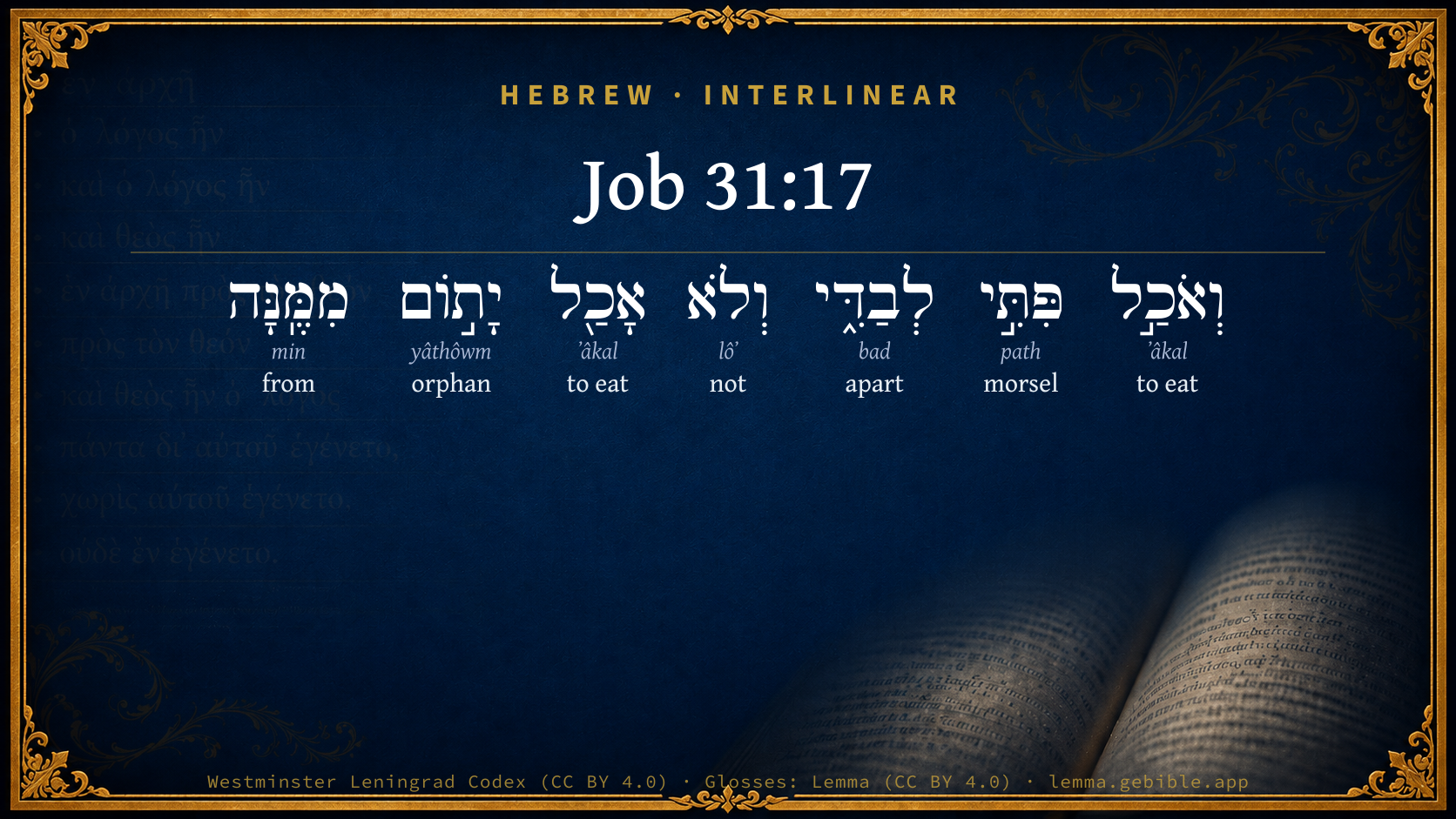
Hebrew (Westminster Leningrad Codex) Job 31:17 appears in the Hebrew Old Testament. The text above is from the Westminster Leningrad Codex. Each word links to its Strong’s number, a concise gloss, and parsing drawn from the Open Scriptures Hebrew Bible morphology. Click any word for its full Brown-Driver-Briggs (BDB) entry.
Download image
Cite this verse

Job 31:17 (World English Bible). Public Domain. Lemma interlinear Bible study tool, https://lemma.gebible.app/v/job/31/17.

Show BibTeX & RIS
BibTeX
RIS
English Translation
Or have eaten my morsel alone, And the fatherless has not eaten of it
World English Bible · Public Domain
Download a study sheet

One document with this verse’s original text, its word-by-word gloss line, the meaning frame, cross-references with their text, attributed commentary, and full source and license credits — printable, and it pastes into notes with its structure intact.

This verse Autodidact and up

Study sheet (.html) Plain text (.txt)

A passage Seminary Student

Up to 50 verses in one chapter. A passage sheet keeps up to 6 commentary sources and 12 cross-references per verse, in the order this page ranks them, and says so on the sheet whenever that leaves anything out. Ask for a single verse and you get the Autodidact verse sheet above.

Everything on this page stays free to read, with no account — the sheet is a download of what is already on screen, not access to it.

Want to remove ads? Support Godless Engineer
Compare translations 3

The same verse in 3 English versions, stacked beneath the original-language interlinear above. Click any original word for its lexicon entry.

Each is an independent rendering of the whole verse — the interlinear is not word-aligned to these translations.

Highlighted words mark where these versions differ — a whole-verse word diff, not a word-by-word alignment.

  • World English Bible Public Domain
    Or have eaten my morsel alone, And the fatherless has not eaten of it
  • King James Version Public Domain
    Or have eaten my morsel myself alone, and the fatherless hath not eaten thereof;
  • unfoldingWord Literal Text CC BY-SA 4.0
    or I have eaten my morsel alone and the fatherless did not eat from it—

unfoldingWord Literal Text — © unfoldingWord, licensed CC BY-SA 4.0. Word-aligned USFM3 via Door43 (git.door43.org/unfoldingWord/en_ult).

Versions to compare (up to 4)

3 of 4 selected

Show all 18 translations

Every available English version of this verse, each an independent rendering of the whole verse.

  • World English Bible Public Domain
    Or have eaten my morsel alone, And the fatherless has not eaten of it
  • Berean Standard Bible Public Domain
    if I have eaten my morsel alone, not sharing it with the fatherless—
  • Majority Standard Bible Public Domain
    if I have eaten my morsel alone, not sharing it with the fatherless—
  • King James Version Public Domain
    Or have eaten my morsel myself alone, and the fatherless hath not eaten thereof;
  • American Standard Version (1901) Public Domain
    Or have eaten my morsel alone, And the fatherless hath not eaten thereof;
  • Revised Version (1885) Public Domain
    Or have eaten my morsel alone, and the fatherless hath not eaten thereof;
  • Geneva Bible (1599) Public Domain
    Or haue eaten my morsels alone, and the fatherles hath not eaten thereof,
  • Douay-Rheims (1899) Public Domain
    If I have eaten my morsel alone, and the fatherless hath not eaten thereof:
  • Young's Literal Translation Public Domain
    And I do eat my morsel by myself, And the orphan hath not eat of it,
  • Literal Standard Version CC BY-SA 4.0
    And I eat my morsel by myself, || And the orphan has nothing [to] eat of it,
  • Unlocked Literal Bible CC BY-SA 4.0
    or if I have eaten my morsel alone and not allowed those without fathers to eat it also—
  • unfoldingWord Literal Text CC BY-SA 4.0
    or I have eaten my morsel alone and the fatherless did not eat from it—
  • Darby Bible Public Domain
    Or have eaten my morsel alone, so that the fatherless ate not thereof,
  • World Messianic Bible Public Domain
    or have eaten my morsel alone, and the fatherless has not eaten of it
  • Webster's Bible Public Domain
    Or have eaten my morsel myself alone, and the fatherless hath not eaten of it;
  • Free Bible Version CC BY-SA 4.0
    Have I even eaten just a piece of bread by myself? Haven't I always shared my food with orphans?
  • Bible in Basic English Public Domain
    If I kept my food for myself, and did not give some of it to the child with no father;
  • JPS Tanakh (1917) Public Domain
    Or have eaten my morsel myself alone, and the fatherless hath not eaten thereof —

Literal Standard Version (2020), Covenant Press — licensed CC BY-SA 4.0. Text via the HelloAO Bible API (eBible.org). Unlocked Literal Bible (unfoldingWord) — licensed CC BY-SA 4.0. Text via the HelloAO Bible API (eBible.org). unfoldingWord Literal Text — © unfoldingWord, licensed CC BY-SA 4.0. Word-aligned USFM3 via Door43 (git.door43.org/unfoldingWord/en_ult). Free Bible Version, Dr. Jonathan Gallagher — licensed CC BY-SA 4.0. Text via the HelloAO Bible API (eBible.org).

Word by word

More ways to search: Search by grammar → Find every occurrence → Compare this word →

Practice this passage: Drill this verse → Learn its vocabulary →

About this verse

These counts appear in no published source. They are computed here, from the morphology-tagged text and Lemma’s own curated glosses. What Lemma adds →

7
words
6
distinct lemmas
Wisdom
section

Notable vocabulary

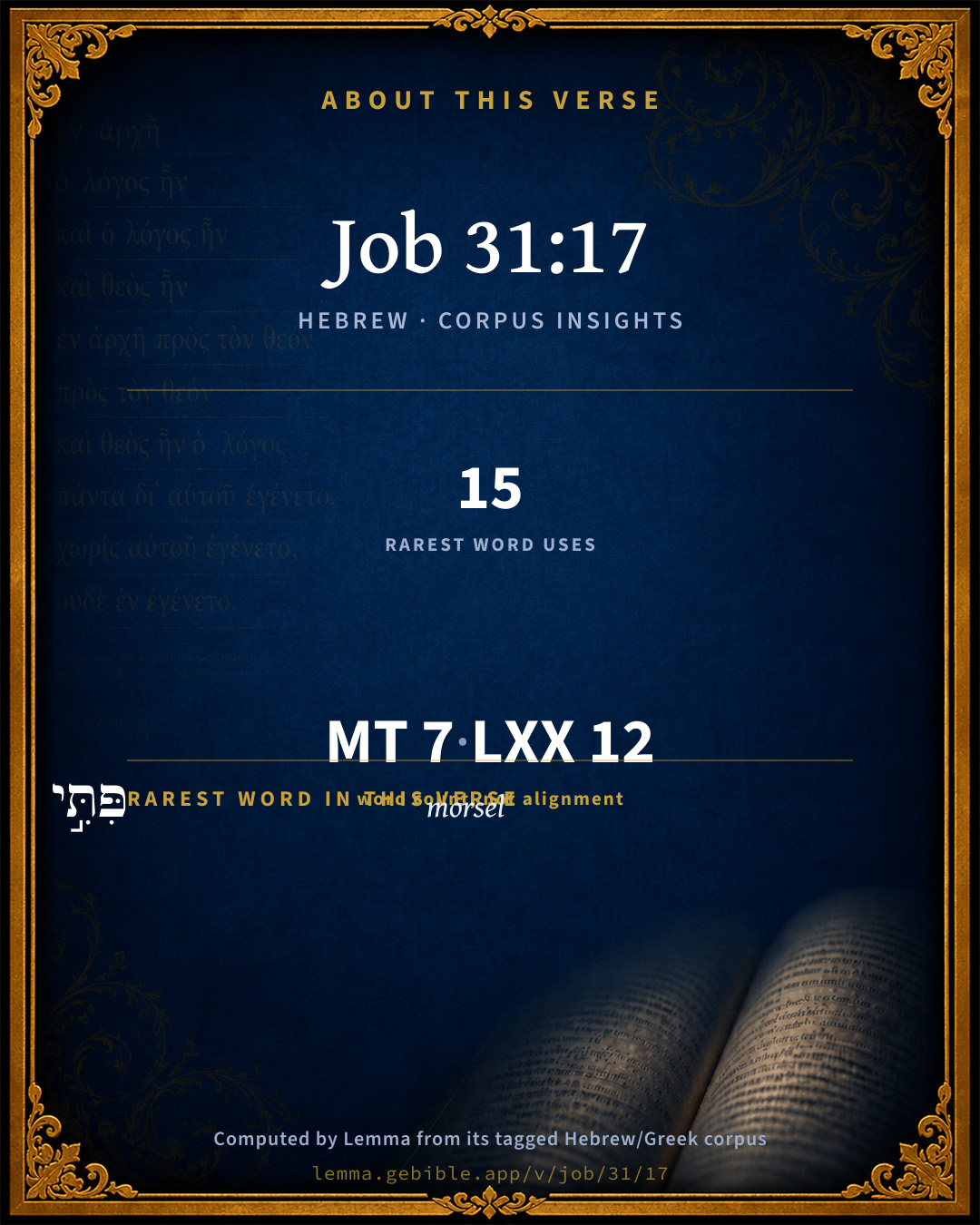
The rarest word here is פִּתִּ֣י morsel H6595 — appearing just 15 times in the whole Hebrew Bible.

Shared distinctive vocabulary

פִּתִּ֣י morsel H6595 occurs in 15 verses of the Hebrew Bible. Also found in:

Grammatical profile

  • 2 verbs
  • 3 nouns
  • 1 preposition
  • 1 particle

Verb forms

  • וְאֹכַ֣ל Qal · Imperfect
  • אָכַ֖ל Qal · Perfect

Repetition

A word recurs within this verse — often emphatic in Hebrew:

  • וְאֹכַ֣ל to eat H398 ×2

Hebrew & Septuagint length

In English translation the verse runs 14 words from the Hebrew and 17 from the Septuagint (LXX English) — closely comparable.

A rough comparison of the two English renderings, which tokenize alike — not a word-level alignment.

Word counts can differ between the Hebrew and the Greek without any difference in meaning — e.g. the Hebrew direct-object marker אֵת has no separate Greek word, and Greek often adds the article ὁ.

In the original languages it is 7 Hebrew tokens and 12 Greek tokens — but the two are counted differently (Hebrew bundles its prefixes and suffixes into one token; the Greek is in lemma form), so that isn’t a like-for-like length.

Cross-references

13

Topical passages linked to Job 31:17 in the Treasury of Scripture Knowledge — connected by theme and wording, ordered by reader-vote popularity; previews shown in the World English Bible.

  • Deuteronomy 15:11 For the poor will never cease out of the land: therefore I command you, saying, You shall surely open your hand to your brother, to your needy, and to your poor, in your land.
  • Deuteronomy 15:14 you shall furnish him liberally out of your flock, and out of your threshing floor, and out of your winepress; as Yahweh your God has blessed you, you shall give to him.
  • Nehemiah 8:10 Then he said to them, Go your way, eat the fat, and drink the sweet, and send portions to him for whom nothing is prepared; for this day is holy to our Lord: neither be you grieved; for the joy of Yahweh is your strength.
  • Job 22:7 You haven't given water to the weary to drink, And you have withheld bread from the hungry.
  • Job 29:12–16 Because I delivered the poor who cried, And the fatherless also, who had none to help him.
  • Ezekiel 18:7 and has not wronged any, but has restored to the debtor his pledge, has taken nothing by robbery, has given his bread to the hungry, and has covered the naked with a garment;
  • Ezekiel 18:16 neither has wronged any, has not taken anything to pledge, neither has taken by robbery, but has given his bread to the hungry, and has covered the naked with a garment;
  • Luke 11:41 But give for gifts to the needy those things which are within, and behold, all things will be clean to you.
  • John 13:29 For some thought, because Judas had the money box, that Jesus said to him, "Buy what things we need for the feast," or that he should give something to the poor.
  • Acts 4:32 The multitude of those who believed were of one heart and soul. Not one of them claimed that anything of the things which he possessed was his own, but they had all things in common.
  • Romans 12:13 contributing to the needs of the saints; given to hospitality.
  • James 1:27 Pure religion and undefiled before our God and Father is this: to visit the fatherless and widows in their affliction, and to keep oneself unstained by the world.
  • 1 John 3:17 But whoever has the world's goods, and sees his brother in need, and closes his heart of compassion against him, how does the love of God remain in him?

Cross-references courtesy of OpenBible.info (CC BY 4.0).

Hebrew and Greek witnesses Masoretic Hebrew ↔ Greek Septuagint

The same verse in the two great witnesses to the Old Testament, shown verse-for-verse.

These are two independent witnesses, not word-aligned to each other, and the Septuagint is shown in lemma (dictionary) form.

Hebrew Job 31:17 Masoretic · Westminster Leningrad Codex

וְאֹכַ֣ל פִּתִּ֣י לְבַדִּ֑י וְלֹא אָכַ֖ל יָת֣וֹם מִמֶּֽנָּה

Or have eaten my morsel alone, And the fatherless has not eaten of it

World English Bible · Public Domain

Greek LXX Job 31:17 Septuagint · lemma form

εἰ δέ καί ὁ ψωμός ἐγώ ἐσθίω μόνος καί οὐ ὀρφανός μεταδίδωμι

And if too I ate my morsel alone, and did not impart of it to the orphan;

LXX2012 (modern English Septuagint) · Public Domain

Hebrew: Westminster Leningrad Codex (CC BY 4.0). Greek: Septuagint (public domain); English from LXX2012 (modern English Septuagint) (Public Domain). How the Septuagint differs from the Hebrew →

Commentary

Notes on Job 31:17 from classic Christian and Jewish commentators (each source and its license shown beneath its notes). The classic Christian expositions comment on the surrounding passage and are grouped to its opening verse, so a note may address several verses; the Jewish commentaries on the Tanakh (Rashi and others) are per-verse, so they appear only where the commentator wrote on this verse.

Lemma curates 59 commentaries, every one of them public domain or Creative Commons licensed, each selected and text-cleaned for this edition rather than reprinted as found. About our sources →

Trapp's Complete Commentary

John Trapp

Job 31:17 Or have eaten my morsel myself alone, and the fatherless hath not eaten thereof;

Ver. 17. Or have eaten my morsel myself alone] As that churl Nabal did, and therefore merited the title of Pamphagus. Many rich wretches are like little children, who, though they have their mouths full of food and both their hands full, yet will part with none to another, but rather mar it. The richer they are the harder, as Dives; whom, to upbraid, Lazarus was laid in the bosom of liberal Abraham, of whom it is recorded, that he sat in the door of his tent in the heat of the day (the usual time of repose and repast) purposely to invite passengers, Gen 18:1. He pursued hospitality, as the apostle’s expression is, Rom 12:13, and a very hearty householder he was. Think the same of Job, whose cup overflowed into other men’s lesser vessels, as Psa 23:5, neither did anything he eat do him good without some good company to take part with him. Charity is no churl. Of a certan bishop of Lincoln the story is told, that he never thought he had that thing which he did not give, Quod nondum dederit, nondum se credit habere. Hoc habeo quodcunque dedi, saith Seneca; and another (Martial),

Quas dederis solas, semper habebis, opes.

And the fatherless hath not eaten thereof] These were his fellow commoners; and the like is reported of Charles the Great, and of Bishop Hooper, who had his board of beggars, widows, and orphans sent for to his palace in Worcester, and served every day with whole and wholesome meats ere himself sat down to dinner. Neither were these any losers by their liberality. The flowers hurt not their own fruit, though they yield honey to the painful bee. The sun loseth not light, though it lend it to the moon. But as the moon, the fuller she is of light the farther she gets from the sun, and as the sun moveth slowest when he is highest in the zodiac; so are those farthest off from bounty, for the most part, who abound most in plenty. Your fattest men have the least blood, and your richest men do the least good. Whereas those that are rich in this world should be rich in good works, ready to distribute, willing to communicate to widows and fatherless especially, sith those are God’s own clients, 1Ti 6:17.

John Trapp, A Commentary or Exposition upon All the Books of the Old and New Testament (1647–1656) — public domain. Text from a community e-Sword module.

Jamieson, Fausset & Brown

Robert Jamieson, A. R. Fausset & David Brown

Arabian rules of hospitality require the stranger to be helped first, and to the best.

Jamieson, Fausset & Brown — Commentary Critical and Explanatory on the Whole Bible (1871) — public domain (CC PDM 1.0). Text via the HelloAO Bible API.

Adam Clarke's Commentary

Verse 17. Or have eaten my morsel myself alone] Hospitality was a very prominent virtue among the ancients in almost all nations: friends and strangers were equally welcome to the board of the affluent. The supper was their grand meal: it was then that they saw their friends; the business and fatigues of the day being over, they could then enjoy themselves comfortably together. The supper was called coena on this account; or, as Plutarch says, Το μεν γαρ δειπνον φασι κοινα δια την κοινωνιαν καλεισθαι· καθ' ἑαυτους γαρ ηριστων επιεικως οἱ παλαι ρωμαιοι, συνδειπνουντες τοις φιλοις. "The ancient Romans named supper COENA, (κοινα,) which signifies communion (κοινωνια) or fellowship; for although they dined alone, they supped with their friends." - PLUT. Symp. lib. viii., prob. 6, p. 687. But Job speaks here of dividing his bread with the hungry: Or have eaten my morsel myself alone. And he is a poor despicable caitiff who would eat it alone, while there was another at hand, full as hungry as himself.

Adam Clarke's Commentary on the Bible (1810–1826) — public domain. Text from a community e-Sword/MySword module.

John Gill's Exposition

For from my youth he was brought up with me as with a father,.... That is, the poor or the fatherless, one or both; as soon as he was at years of discretion, and was capable of observing the distressed circumstances of others, he had a tender and compassionate regard to the poor and fatherless, and acted the part of a father to them; was as affectionately concerned for them as if he had been their father, and took such care of them as if they were his children; see Job 29:16;

and I have guided her from my mother's womb; the widow, by his counsel and advice; an hyperbolical expression, signifying how early he was a succourer of such persons, by giving his friendly advice, or needful assistance; the Vulgate Latin version renders it, "from my youth mercy grew up with me", &c. a merciful disposition, a compassionate regard to the poor and fatherless; this was as it were connatural to him; for though there is no good disposition really in man, without the grace of God, of which Job might early partake, yet there is a show of it in some persons, in comparison of others; some have a natural tender disposition to the poor, when others are naturally cruel and hardhearted to them; and so Mr. Broughton renders the words to this sense,

"for from my youth this grew with me as a father, and from my mother did I tender it:''

but the first sense seems best.

John Gill's Exposition of the Whole Bible (1746–1763) — public domain (CC PDM 1.0). Text via the HelloAO Bible API.

Albert Barnes' Notes on the Bible

Or have eaten my morsel myself alone - If I have not imparted what I had though ever so small, to others. This was in accordance with the Oriental laws of hospitality. It is regarded as a fixed law among the Arabians, that the guest shall always be helped first, and to that which is best; and no matter how needy the family may be, or how much distressed with hunger, the settled laws of hospitality demand that the stranger-guest shall have the first and best portion. Dr. Robinson, in his “Biblical Researches,” gives an amusing instance of the extent to which this law is carried, and the sternness with which it is executed among the Arabs. In the journey from Suez to Mount Sinai, intending to furnish a supper for the Arabs in their employ, he and his fellow-travelers had bought a kid, and led it along to the place of their encampment. At night the kid was killed and roasted, and the Arabs were anticipating a savory supper.

But those of whom they had bought the kid, learned in some way that they were to encamp near, and naturally concluded that the kid was bought to be eaten, and followed them to the place of encampment, to the number of five or six persons. “Now the stern law of Arabian hospitality demands, that whenever a guest is present at a meal, whether there be much or little, the first and best portion must be laid before the stranger. In this instance the five or six guests attained their object, and had not only the selling of the kid, but also the eating of it, while our poor Arabs, whose mouths had long been watering with expectation, were forced to take up with the fragments.” Vol. 1:118. There is often, indeed, much ostentation in the hospitality of the Orientals, but the law is stern and inflexible. “No sooner,” says Shaw (Travels, vol. 1:p. 20), “was our food prepared, than one of the Arabs, having placed himself on the highest spot of ground in the neighborhood, called out thrice with a loud voice to all their brethren, the sons of the faithful, to come and partake of it; though none of them were in view, or perhaps within a hundred miles of them.” The great law of hospitality Job says he had carefully observed, and had not withheld what he had from the poor and the fatherless.

Albert Barnes' Notes on the Bible (1834–1885) — public domain. Text from a community e-Sword/MySword module.

Haydock's Catholic Bible Commentary

Alone. This was objected to St. Chrysostom. (Calmet) --- But his conduct proceeded not from pride or avarice. (Haydock) --- The ancient patriarchs delighted much in the exercise of hospitality; and Tobias (iv. 17.) exhorts his son to invite the poor. Cœna, or "supper," received its name from many eating "together," while people dined alone. (Plut.[Plutarch?] Sym. viii. prob. 6.)

George Leo Haydock (1774–1849), Haydock's Catholic Family Bible and Commentary, 1859 edition — public domain. Excludes Psalms (Douay-Rheims chapter numbering differs from Protestant) and Deuterocanonical books (Catholic canon only).

Matthew Poole's English Annotations

Eaten my morsel myself alone; without communicating part of my provisions or estate to the poor, as it follows.

The fatherless: this one kind of necessitous persons is put for all the rest.

Matthew Poole's English Annotations on the Holy Bible (1683–1685) — public domain. Text from a community e-Sword/MySword module.

The Pulpit Commentary

Or have eaten my morsel myself alone, and the fatherless hath not eaten thereof. With the widow, the fatherless is usually conjoined, as an equal object of compassion. (see Exo_22:22 Deu_10:18 Psa_68:5 Isa_1:17 Jer_22:3 Eze_22:7 Zec_7:10, etc.) Eliphaz had specially charged Job with oppression of the fatherless, (Job_22:9) and his charge had been denied by Job. (Job_29:12) He now claims to have always shared his bread with orphans, and made them partakers or his abundance.

The Pulpit Commentary (1880–1919), ed. H.D.M. Spence-Jones & Joseph S. Exell — public domain. Text from a community e-Sword module.

Lesson kit

Teaching starters — assembled from the data on this page, not authored interpretation. Every prompt links to the verse data it draws on. Edit before teaching.

Job, in the Wisdom, opens this verse with 7 words (6 distinct Hebrew lemmas). Its most distinctive word is path (“morsel”). A historical commentator’s framing appears above. Read the whole chapter for the surrounding context.

Discussion questions

  1. The word path carries the sense “morsel.” How does it shape the verse?
  2. How does Genesis 18:5, which shares the word «morsel», read alongside this verse?
  3. What does the repetition of “to eat” (2× in this one verse) do in this verse?
  4. These translations render this verse differently; the difference is in the English rendering, not the original. What questions does that raise?
  5. «וְאֹכַ֣ל» is a Qal Imperfect verb. How does that grammatical form shape the action described?
  6. Compare how Trapp's Complete Commentary and Jamieson, Fausset & Brown read this verse. Where do they agree or differ?

Things to notice

Reading settings

Reading text

Shown beneath each verse's original-language words.

Old Testament
Old Testament edition

Read the OT as the Masoretic Hebrew (MT) or the Greek Septuagint (LXX).

English shown for the Greek Septuagint (in the Hebrew ↔ Greek comparison).

Comparing translations? Open the Compare panel on any verse page to stack up to four side by side.