
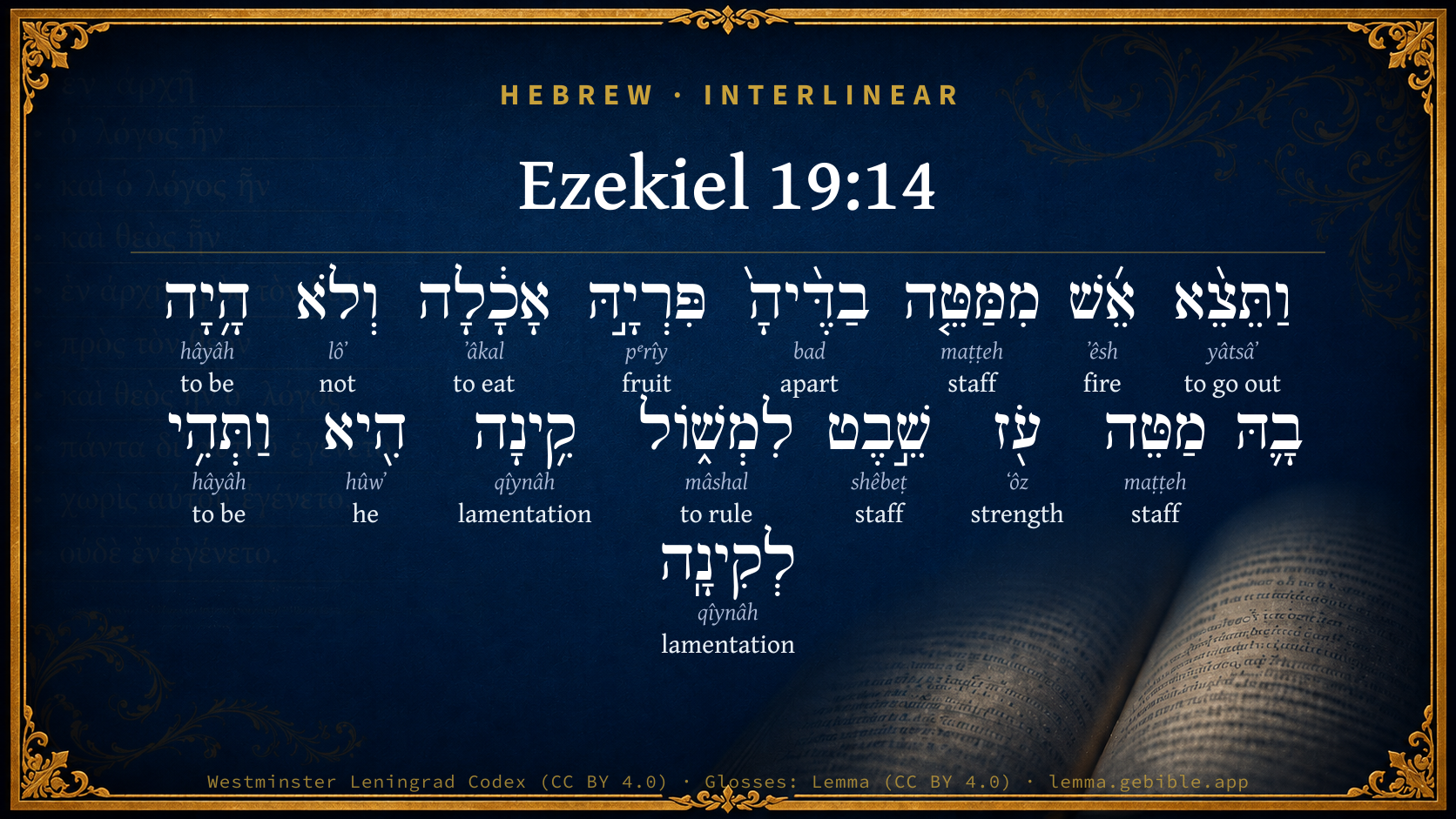
Ezekiel 19:14

Hebrew (Westminster Leningrad Codex) Ezekiel 19:14 appears in the Hebrew Old Testament. The text above is from the Westminster Leningrad Codex. Each word links to its Strong’s number, a concise gloss, and parsing drawn from the Open Scriptures Hebrew Bible morphology. Click any word for its full Brown-Driver-Briggs (BDB) entry.
Download image
Cite this verse

Ezekiel 19:14 (World English Bible). Public Domain. Lemma interlinear Bible study tool, https://lemma.gebible.app/v/ezekiel/19/14.

Show BibTeX & RIS
BibTeX
RIS
English Translation
Fire is gone out of the rods of its branches, it has devoured its fruit, so that there is in it no strong rod to be a scepter to rule. This is a lamentation, and shall be for a lamentation.
World English Bible · Public Domain
Download a study sheet

One document with this verse’s original text, its word-by-word gloss line, the meaning frame, cross-references with their text, attributed commentary, and full source and license credits — printable, and it pastes into notes with its structure intact.

This verse Autodidact and up

Study sheet (.html) Plain text (.txt)

A passage Seminary Student

Up to 50 verses in one chapter. A passage sheet keeps up to 6 commentary sources and 12 cross-references per verse, in the order this page ranks them, and says so on the sheet whenever that leaves anything out. Ask for a single verse and you get the Autodidact verse sheet above.

Everything on this page stays free to read, with no account — the sheet is a download of what is already on screen, not access to it.

Want to remove ads? Support Godless Engineer
Compare translations 3

The same verse in 3 English versions, stacked beneath the original-language interlinear above. Click any original word for its lexicon entry.

Each is an independent rendering of the whole verse — the interlinear is not word-aligned to these translations.

Highlighted words mark where these versions differ — a whole-verse word diff, not a word-by-word alignment.

  • World English Bible Public Domain
    Fire is gone out of the rods of its branches, it has devoured its fruit, so that there is in it no strong rod to be a scepter to rule. This is a lamentation, and shall be for a lamentation.
  • King James Version Public Domain
    And fire is gone out of a rod of her branches, which hath devoured her fruit, so that she hath no strong rod to be a sceptre to rule. This is a lamentation, and shall be for a lamentation.
  • unfoldingWord Literal Text CC BY-SA 4.0
    For fire went out from her large branches and consumed its fruit. There is no strong branch on it, no scepter to rule.’ This is a lamentation and will be sung as a lamentation.”

unfoldingWord Literal Text — © unfoldingWord, licensed CC BY-SA 4.0. Word-aligned USFM3 via Door43 (git.door43.org/unfoldingWord/en_ult).

Versions to compare (up to 4)

3 of 4 selected

Show all 18 translations

Every available English version of this verse, each an independent rendering of the whole verse.

  • World English Bible Public Domain
    Fire is gone out of the rods of its branches, it has devoured its fruit, so that there is in it no strong rod to be a scepter to rule. This is a lamentation, and shall be for a lamentation.
  • Berean Standard Bible Public Domain
    Fire has gone out from its main branch and devoured its fruit; on it no strong branch remains fit for a ruler’s scepter.’ This is a lament and shall be used as a lament.”
  • Majority Standard Bible Public Domain
    Fire has gone out from its main branch and devoured its fruit; on it no strong branch remains fit for a ruler’s scepter.’ This is a lament and shall be used as a lament.”
  • King James Version Public Domain
    And fire is gone out of a rod of her branches, which hath devoured her fruit, so that she hath no strong rod to be a sceptre to rule. This is a lamentation, and shall be for a lamentation.
  • American Standard Version (1901) Public Domain
    And fire is gone out of the rods of its branches, it hath devoured its fruit, so that there is in it no strong rod to be a sceptre to rule. This is a lamentation, and shall be for a lamentation.
  • Revised Version (1885) Public Domain
    And fire is gone out of the rods of her branches, it hath devoured her fruit, so that there is in her no strong rod to be a sceptre to rule. This is a lamentation, and shall be for a lamentation.
  • Geneva Bible (1599) Public Domain
    And fire is gone out of a rod of her branches, which hath deuoured her fruite, so that she hath no strong rod to be a scepter to rule: this is a lamentation and shalbe for a lamentation.
  • Douay-Rheims (1899) Public Domain
    And a fire is gone out from a rod of her branches, which hath devoured her fruit: so that she now hath no strong rod, to be a sceptre of rulers. This is a lamentation, and it shall be for a lamentation.
  • Young's Literal Translation Public Domain
    And go forth doth fire from a rod of its boughs, Its fruit it hath devoured, And it hath no rod of strength -- a sceptre to rule, Lamentation it `is' -- and it is for a lamentation!'
  • Literal Standard Version CC BY-SA 4.0
    And fire goes forth from a rod of her boughs, || It has devoured her fruit, || And she has no rod of strength—a scepter to rule, || A lamentation—and she has become for a lamentation!”
  • Unlocked Literal Bible CC BY-SA 4.0
    For fire went out from her large branches and consumed its fruit. There is no strong branch on it, no scepter to rule.' This is a lamentation and will be sung as a lamentation.”
  • unfoldingWord Literal Text CC BY-SA 4.0
    For fire went out from her large branches and consumed its fruit. There is no strong branch on it, no scepter to rule.’ This is a lamentation and will be sung as a lamentation.”
  • Darby Bible Public Domain
    and a fire is gone out of a rod of its branches, [which] hath devoured its fruit; so that it hath no strong rod to be a sceptre for ruling. This is a lamentation, and shall be for a lamentation.
  • World Messianic Bible Public Domain
    Fire has gone out of its branches. It has devoured its fruit, so that there is in it no strong branch to be a scepter to rule.’ This is a lamentation, and shall be for a lamentation.”
  • Webster's Bible Public Domain
    And fire hath gone out of a rod of her branches, which hath devoured her fruit, so that she hath no strong rod to be a scepter to rule. This is a lamentation, and shall be for a lamentation.
  • Free Bible Version CC BY-SA 4.0
    A fire blazed out from its main trunk and burned up its fruit. None of its branches that were once like a ruler's scepter are strong any more.” This is a funeral song and is to be used for mourning.
  • Bible in Basic English Public Domain
    And fire has gone out from her rod, causing the destruction of her branches, so that there is no strong rod in her to be the ruler's rod of authority. This is a song of grief, and it was for a song of grief.
  • JPS Tanakh (1917) Public Domain
    And fire is gone out of the rod of her branches, it hath devoured her fruit, so that there is in her no strong rod to be a sceptre to rule.' This is a lamentation, and it was for a lamentation.

Literal Standard Version (2020), Covenant Press — licensed CC BY-SA 4.0. Text via the HelloAO Bible API (eBible.org). Unlocked Literal Bible (unfoldingWord) — licensed CC BY-SA 4.0. Text via the HelloAO Bible API (eBible.org). unfoldingWord Literal Text — © unfoldingWord, licensed CC BY-SA 4.0. Word-aligned USFM3 via Door43 (git.door43.org/unfoldingWord/en_ult). Free Bible Version, Dr. Jonathan Gallagher — licensed CC BY-SA 4.0. Text via the HelloAO Bible API (eBible.org).

Word by word

More ways to search: Search by grammar → Find every occurrence → Compare this word →

Practice this passage: Drill this verse → Learn its vocabulary →

קִ֥ינָה
qîynâh
H7015
“lamentation”
Noun, Common, Feminine, Singular, Absolute
Part of Speech
Noun
Type
Common
Gender
Feminine
Number
Singular
State
Absolute
Full BDB Definition

Origin: from H6969

TWOT: 2018a

lamentation, dirge, elegy
  1. וַתֵּצֵ֨א yâtsâʼ H3318 “and · to go out” Conjunction + Verb, Qal, Sequential Imperfect, 3rd Person, Feminine, Singular
  2. אֵ֜שׁ ʼêsh H784 “fire” Noun, Common, Both, Singular, Absolute
  3. מִמַּטֵּ֤ה maṭṭeh H4294 “from · staff of” Preposition + Noun, Common, Masculine, Singular, Construct
  4. בַדֶּ֨יהָ֙ bad H905 “poles · her” Noun, Common, Masculine, Plural, Construct + Suffix, Personal, 3rd Person, Feminine, Singular
  5. פִּרְיָ֣הּ pᵉrîy H6529 “fruit · her” Noun, Common, Masculine, Singular, Construct + Suffix, Personal, 3rd Person, Feminine, Singular
  6. אָכָ֔לָה ʼâkal H398 “to eat” Verb, Qal, Perfect, 3rd Person, Feminine, Singular
  7. וְלֹא lôʼ H3808 “and · not” Conjunction + Particle, Negative
  8. הָ֥יָה hâyâh H1961 “to be” Verb, Qal, Perfect, 3rd Person, Masculine, Singular
  9. מַטֵּה maṭṭeh H4294 “staff of” Noun, Common, Masculine, Singular, Construct
  10. עֹ֖ז ʻôz H5797 “strength” Noun, Common, Masculine, Singular, Absolute
  11. שֵׁ֣בֶט shêbeṭ H7626 “staff” Noun, Common, Masculine, Singular, Absolute
  12. לִמְשׁ֑וֹל mâshal H4910 “to rule” Preposition + Verb, Qal, Infinitive Construct
  13. הִ֖יא hûwʼ H1931 “he” Pronoun, Personal, 3rd Person, Feminine, Singular
  14. וַתְּהִ֥י hâyâh H1961 “and · to be” Conjunction + Verb, Qal, Sequential Imperfect, 3rd Person, Feminine, Singular
  15. לְקִינָֽה qîynâh H7015 “to/for · lamentation” Preposition + Noun, Common, Feminine, Singular, Absolute

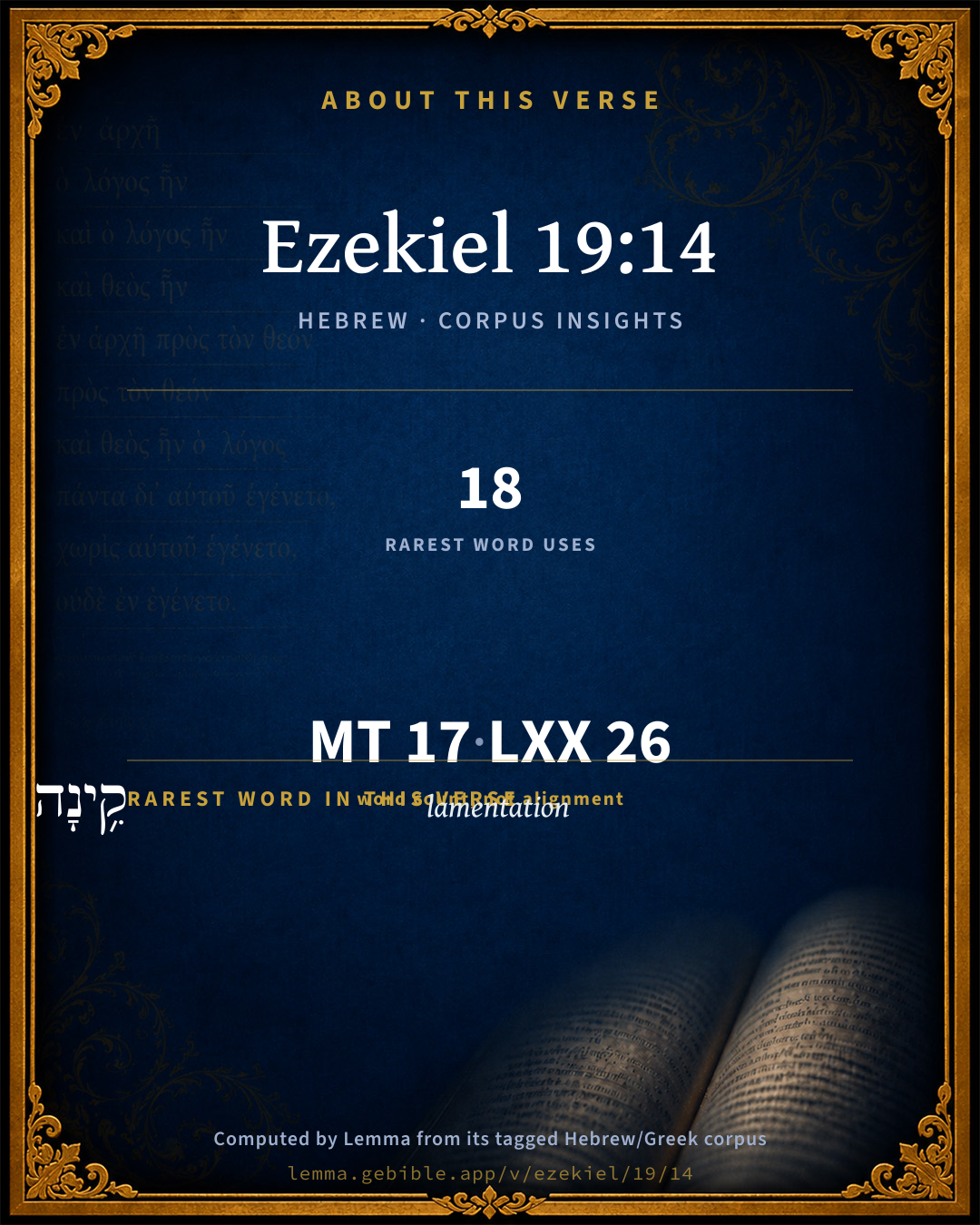
About this verse

These counts appear in no published source. They are computed here, from the morphology-tagged text and Lemma’s own curated glosses. What Lemma adds →

17
words
13
distinct lemmas
Prophets
section

Notable vocabulary

The rarest word here is קִ֥ינָה lamentation H7015 — appearing just 18 times in the whole Hebrew Bible.

Shared distinctive vocabulary

קִ֥ינָה lamentation H7015 occurs in 16 verses of the Hebrew Bible. Also found in:

Grammatical profile

  • 5 verbs
  • 9 nouns
  • 1 pronoun
  • 1 preposition
  • 1 particle

Verb forms

  • וַתֵּצֵ֨א Qal · Sequential Imperfect
  • אָכָ֔לָה Qal · Perfect
  • הָ֥יָה Qal · Perfect
  • לִמְשׁ֑וֹל Qal · Infinitive Construct
  • וַתְּהִ֥י Qal · Sequential Imperfect

Repetition

Words recur within this verse — often emphatic in Hebrew:

  • מִמַּטֵּ֤ה staff H4294 ×2
  • הָ֥יָה to be H1961 ×2
  • קִ֥ינָה lamentation H7015 ×2

Hebrew & Septuagint length

In English translation the verse runs 40 words from the Hebrew and 40 from the Septuagint (LXX English) — the same length.

A rough comparison of the two English renderings, which tokenize alike — not a word-level alignment.

Word counts can differ between the Hebrew and the Greek without any difference in meaning — e.g. the Hebrew direct-object marker אֵת has no separate Greek word, and Greek often adds the article ὁ.

In the original languages it is 17 Hebrew tokens and 26 Greek tokens — but the two are counted differently (Hebrew bundles its prefixes and suffixes into one token; the Greek is in lemma form), so that isn’t a like-for-like length.

Cross-references

23

Topical passages linked to Ezekiel 19:14 in the Treasury of Scripture Knowledge — connected by theme and wording, ordered by reader-vote popularity; previews shown in the World English Bible.

  • 2 Kings 24:20 For through the anger of Yahweh did it happen in Jerusalem and Judah, until he had cast them out from his presence. Zedekiah rebelled against the king of Babylon.
  • Psalms 80:15–16 The stock which your right hand planted, The branch that you made strong for yourself.
  • Isaiah 9:18–19 For wickedness burns as the fire; it devours the briers and thorns; yes, it kindles in the thickets of the forest, and they roll upward in a column of smoke.
  • Ezekiel 19:1 Moreover, take up a lamentation for the princes of Israel,
  • Ezekiel 19:11 It had strong rods for the scepters of those who bore rule, and their stature was exalted among the thick boughs, and they were seen in their height with the multitude of their branches.
  • Genesis 49:10 The scepter will not depart from Judah, Nor the ruler's staff from between his feet, Until he comes to whom it belongs. To him will the obedience of the peoples be.
  • Judges 9:15 The bramble said to the trees, If in truth you anoint me king over you, then come and take refuge in my shade; and if not, let fire come out of the bramble, and devour the cedars of Lebanon.
  • 2 Chronicles 36:13 He also rebelled against king Nebuchadnezzar, who had made him swear by God: but he stiffened his neck, and hardened his heart against turning to Yahweh, the God of Israel.
  • Nehemiah 9:37 It yields much increase to the kings whom you have set over us because of our sins: also they have power over our bodies, and over our cattle, at their pleasure, and we are in great distress.
  • Psalms 79:7 For they have devoured Jacob, And destroyed his homeland.
  • Jeremiah 38:23 They shall bring out all your wives and your children to the Chaldeans; and you shall not escape out of their hand, but shall be taken by the hand of the king of Babylon: and you shall cause this city to be burned with fire.
  • Jeremiah 52:3 For through the anger of Yahweh did it happen in Jerusalem and Judah, until he had cast them out from his presence. Zedekiah rebelled against the king of Babylon.
  • Lamentations 4:20 The breath of our nostrils, the anointed of Yahweh, was taken in their pits; Of whom we said, Under his shadow we shall live among the nations.
  • Ezekiel 15:4 Behold, it is cast into the fire for fuel; the fire has devoured both the ends of it, and the midst of it is burned: is it profitable for any work?
  • Ezekiel 17:18–20 For he has despised the oath by breaking the covenant; and behold, he had given his hand, and yet has done all these things; he shall not escape.
  • Ezekiel 20:47 and tell the forest of the South, Hear the word of Yahweh: Thus says the Lord Yahweh, Behold, I will kindle a fire in you, and it shall devour every green tree in you, and every dry tree: the flaming flame shall not be quenched, and all faces from the south to the north shall be burnt thereby.
  • Ezekiel 21:25–27 You, deadly wounded wicked one, the prince of Israel, whose day is come, in the time of the iniquity of the end,
  • Hosea 3:4 For the children of Israel shall abide many days without king, and without prince, and without sacrifice, and without sacred stone, and without ephod or idols.
  • Hosea 10:3 Surely now they will say, "We have no king; for we don't fear Yahweh; And the king, what can he do for us?"
  • Amos 9:11 In that day I will raise up the tent of David who is fallen, and close up its breaches, and I will raise up its ruins, and I will build it as in the days of old;
  • Luke 19:41 When he drew near, he saw the city and wept over it,
  • John 19:15 They cried out, "Away with him! Away with him! Crucify him!" Pilate said to them, "Shall I crucify your King?" The chief priests answered, "We have no king but Caesar!"
  • Romans 9:2–4 that I have great sorrow and unceasing pain in my heart.

Cross-references courtesy of OpenBible.info (CC BY 4.0).

Hebrew and Greek witnesses Masoretic Hebrew ↔ Greek Septuagint

The same verse in the two great witnesses to the Old Testament, shown verse-for-verse.

These are two independent witnesses, not word-aligned to each other, and the Septuagint is shown in lemma (dictionary) form.

Hebrew Ezekiel 19:14 Masoretic · Westminster Leningrad Codex

וַתֵּצֵ֨א אֵ֜שׁ מִמַּטֵּ֤ה בַדֶּ֨יהָ֙ פִּרְיָ֣הּ אָכָ֔לָה וְלֹא הָ֥יָה בָ֛הּ מַטֵּה עֹ֖ז שֵׁ֣בֶט לִמְשׁ֑וֹל קִ֥ינָה הִ֖יא וַתְּהִ֥י לְקִינָֽה

Fire is gone out of the rods of its branches, it has devoured its fruit, so that there is in it no strong rod to be a scepter to rule. This is a lamentation, and shall be for a lamentation.

World English Bible · Public Domain

Greek LXX Ezekiel 19:14 Septuagint · lemma form

καί ἐκἔρχομαι πῦρ ἐκ ῥάβδος ἐκλεκτός αὐτός καί καταἐσθίω αὐτός καί οὐ εἰμί ἐν αὐτός ῥάβδος ἰσχύς φυλή εἰς παραβολή θρῆνος εἰμί καί εἰμί εἰς θρῆνος

And fire is gone out of a rod of her choice boughs, and has devoured her; and there was no rod of strength in her. Her race is become a parable of lamentation, and it shall be for a lamentation.

LXX2012 (modern English Septuagint) · Public Domain

Hebrew: Westminster Leningrad Codex (CC BY 4.0). Greek: Septuagint (public domain); English from LXX2012 (modern English Septuagint) (Public Domain). How the Septuagint differs from the Hebrew →

Targum (Aramaic paraphrase)

1

The Targum is the ancient Jewish Aramaic paraphrase of the Hebrew Scriptures — an interpretive translation, not the Hebrew text itself. Onkelos (literal) and Pseudo-Jonathan (expansive) render the Torah, and Jonathan the Prophets. Coverage is partial: where no permissively-licensed English translation exists for a verse, only the Aramaic is shown. This is verse-level text, not a word-by-word alignment to the Hebrew.

  1. Targum Jonathan Prophets (Joshua–Malachi)
    וַאֲתוֹ עַמְמַיָא דְתַקִיפִין כְּאֶשְׁתָּא מֵחוֹבֵי זְדוֹנָהּ עַמָהּ קְטִילוּ וְלָא הֲווֹ בָהּ שִׁלְטוֹנִין תַּקִיפִין מַלְכִין דְגִבָּרִין לְשַׁעְבָּדָא מַלְכוּ אֲמַר נְבִיָא אִלְיָא הִיא נְבוּאֲתָא וּתְהֵי לְאִלְיָא:

    (no public-domain English translation for this verse)

    Targum Jonathan — Aramaic: “Mikraot Gedolot” (public domain). English: “Sefaria Community Translation” (CC0 1.0 (public-domain dedication)); “London "Chaldee Paraphrase," 1871” (public domain). Text via Sefaria.

Commentary

Notes on Ezekiel 19:14 from classic Christian and Jewish commentators (each source and its license shown beneath its notes). The classic Christian expositions comment on the surrounding passage and are grouped to its opening verse, so a note may address several verses; the Jewish commentaries on the Tanakh (Rashi and others) are per-verse, so they appear only where the commentator wrote on this verse.

Lemma curates 59 commentaries, every one of them public domain or Creative Commons licensed, each selected and text-cleaned for this edition rather than reprinted as found. About our sources →

Trapp's Complete Commentary

John Trapp

Eze 19:14 And fire is gone out of a rod of her branches, [which] hath devoured her fruit, so that she hath no strong rod [to be] a sceptre to rule. This [is] a lamentation, and shall be for a lamentation.

Ver. 14. And fire is gone out of a rod of her branches,] i.e., Zedekiah, by his perjury and rebellion, hath ruined all, set all on a light fire.

So that she hath no strong rod, &c.] None to speak of till Shiloh come. Rulers indeed they had after this and governors, {Hag 2:21} but no kings of their own nation.

This is a lamentation.] See on Eze 19:1.

And shall be for a lamentation.] Jerusalem plangitur et plangetur. The nation of the Jews shall never want matter for mourning.

John Trapp, A Commentary or Exposition upon All the Books of the Old and New Testament (1647–1656) — public domain. Text from a community e-Sword module.

Geneva Bible (1599)

Geneva Bible translators

Destruction is come by Zedekiah, who was the occasion of this rebellion.

Geneva Bible (1599) marginal notes — public domain. Text via Bolls.life.

Jamieson, Fausset & Brown

Robert Jamieson, A. R. Fausset & David Brown

fire . . . out of a rod of her branches--The Jews' disaster was to be ascribed, not so much to the Chaldeans as to themselves; the "fire out of the rod" is God's wrath kindled by the perjury of Zedekiah (Eze 17:18). "The anger of the Lord" against Judah is specified as the cause why Zedekiah was permitted to rebel against Babylon (Kg2 24:20; compare Jdg 9:15), thus bringing Nebuchadnezzar against Jerusalem.

no strong rod . . . sceptre to rule--No more kings of David's stock are now to rule the nation. Not at least until "the Lord shall send the rod of His strength ("Messiah," Psa 110:2; Isa 11:1) out of Zion," to reign first as a spiritual, then hereafter as a literal king.

is . . . and shall be for a lamentation--Part of the lamentation (that as to Jehoahaz and Jehoiakim) was matter of history as already accomplished; part (as to Zedekiah) was yet to be fulfilled; or, this prophecy both is a subject for lamentation, and shall be so to distant posterity.

Next: Ezekiel Chapter 20

Jamieson, Fausset & Brown — Commentary Critical and Explanatory on the Whole Bible (1871) — public domain (CC PDM 1.0). Text via the HelloAO Bible API.

Adam Clarke's Commentary

Verse 14. Fire is gone out] A vindictive and murderous disposition has taken hold-

Of a rod of her branches] Ishmael, son of Nethaniah, who was of the blood-royal of Judah-

Hath devoured her fruit] Hath assassinated Gedaliah, slain many people, and carried off others into the country of the Ammonites. But he was pursued by Jonathan, the son of Kareah, who slew many of his adherents, and delivered much of the people.

She hath no strong rod] None of the blood-royal of Judah left. And from that time not one of her own royal race ever sat upon the throne of Israel.

This is a lamentation] This is a most lamentable business.

And shall be for a lamentation.] These predictions shall be so punctually fulfilled, and the catastrophe shall be so complete, that it shall ever remain as a lamentation; as this state of Jerusalem shall never be restored. Even to the present day this, to a Jew, is a subject of mourning.

Adam Clarke's Commentary on the Bible (1810–1826) — public domain. Text from a community e-Sword/MySword module.

John Calvin's Commentaries

Here the Prophet comes down to the close of their woes, when Zedekiah was dragged into captivity, and so the people’s independence was abolished. God had formerly planted that vine, or at least some of the branches, in a desert spot, since first four tribes, and afterwards seven, were led away, and last of all, the greater part of the tribe of Judea; but the little that remained with King Zedekiah perished. He says, therefore, that the fire went forth from the vine branches: thus he shows that the last slaughter proceeded only from the people themselves; and lest they should utter their accustomed complaints, the Prophet meets them by saying that they were consumed by intestine fire; that is, their slaughter could not be ascribed to their Chaldaean conquerors, but to themselves; because King Zedekiah, by his own perfidy, had stirred up the king of Babylon against himself; for he might have spent his time in his kingdom, but he could not refrain himself from throwing off the yoke; for this reason he armed himself against the king of Babylon, because he was a breaker of treaties: and thus the Prophet says, with propriety, that a fire went forth from one rod, or twig of its branches, and hence the fruit of the whole vine was consumed; that is, the remnant was lost by the fault of that perfidious king. He now adds, there was no scepter for ruling among its rods. Hence it appears that the exposition which I have advanced suits best, and is entirely genuine. He said first that the rods were for a scepter of the rulers; but he here says there was no scepter for them among these rods. What follows we will treat tomorrow.

John Calvin's Commentaries (1540-1563) — public domain. Text from the Calvin Translation Society English edition (1840s-50s) via the Christian Classics Ethereal Library (ccel.org). Calvin's coverage is partial (roughly two-thirds of the Bible); uncommented books and verses are honest gaps, never fabricated. The 19th-century editor's footnotes and remarks are omitted so the notes are faithfully Calvin's own voice.

Ellicott's Commentary for English Readers

(14) Fire is gone out of a rod of her branches.—The rods, as shown in Eze_19:11, are the royal sceptres of her kings. It was by the sin and folly of these kings, together with the sins and follies of the whole people, that judgment was drawn down upon them. Many of them did their full share of the evil work; but a “rod” is here spoken of in the singular, with especial reference to the last king, Zedekiah, who finally brought on the utter ruin of both himself and his people.

This is . . . and shall be.—It is a lamentation now in the half accomplished desolation; it shall remain for a lamentation when all shall be fulfilled.

A Bible Commentary for English Readers, edited by Charles John Ellicott (1878–1897) — public domain. Text from a community e-Sword module.

The Cambridge Bible for Schools and Colleges

gen. ed. J. J. S. Perowne

14. The fire that consumed the vine went out from her own rods. The royal house brought destruction on the nation as well as on itself. Reference is to the rebellion of Zedekiah.

gone out of a rod] Possibly collective: out of the rods. The reference to Zedekiah is expressed generally in terms of the royal house.

shall be for a lamentation] Lit. and is become a lamentation. Sad enough is the history, ch. Eze_32:16. It is not necessary, however, to infer from this that the lamentation was written after the exile. The passage Eze_19:10-14 is prophetic, cf. Isaiah 47; Jer_9:16-21. In the Book of Kings both Jehoahaz and Jehoiachin are said to have “done evil.” A three months’ reign afforded little scope for much mischief. Ezekiel’s treatment of the young lions is ideal, and in the case of Jehoiachin the reference is rather to the evils which his attitude brought upon the country, than to any ravages which he wrought personally.

The Cambridge Bible for Schools and Colleges (gen. ed. J. J. S. Perowne; Cambridge University Press, 1878–1918) — public domain. Text from a community e-Sword module.

John Gill's Exposition

And fire is gone out of a rod of her branches,.... By "her branches" are meant the rest of the Jews left in the land; and by the "rod" of them King Zedekiah, now on the throne, when this prophecy was given out; the "fire" said to go out of him signifies his rebellion against the king of Babylon, his breaking covenant and oath with him, which greatly provoked the Lord, and brought down the fire of his wrath upon him, Kg2 24:20;

which hath devoured her fruit; destroyed the people by sword, famine pestilence, and captivity; yea, the city and temple of Jerusalem, with the palaces and houses therein, were burnt with material fire; their king was taken, and his eyes put out; his sons were slain, and all the princes of Judah:

so that she hath no strong rod to be a sceptre to rule; none to be king, or succeed in the kingdom; and there never was a king after of the family of David, or of the tribe of Judah, till Shiloh the Messiah came; though there were princes and governors, yet no sceptre bearer, no king. The Targum of the whole is,

"and there came people who were strong as fire, and, because of the sins of her pride, slew her people; and there were not in her strong rulers, kings that are mighty to subdue kingdoms;''

this is a lamentation, and shall be for a lamentation; that is, this prophecy, as the Targum, is a lamentation, or matter of lamentation; what of it had been already fulfilled occasioned lamentation; and, when the rest should be fulfilled, it would be the cause of more. Lamentable was the case of the Jews already, but it would be still more so when all that was foretold of them should be accomplished. It denotes the continuance of the sad estate of that people; and perhaps may refer to their present condition, which will continue till they are turned to the Lord.

Next: Ezekiel Chapter 20

John Gill's Exposition of the Whole Bible (1746–1763) — public domain (CC PDM 1.0). Text via the HelloAO Bible API.

Albert Barnes' Notes on the Bible

Fire is gone out - Compare the marginal reference. Zedekiah is regarded, like Abimelech, as all usurper and the ruin of his people.

Albert Barnes' Notes on the Bible (1834–1885) — public domain. Text from a community e-Sword/MySword module.

Haydock's Catholic Bible Commentary

Fire. Ismael, who slew Godolias, was of the royal family, Jeremias xli., &c. (Calmet)

George Leo Haydock (1774–1849), Haydock's Catholic Family Bible and Commentary, 1859 edition — public domain. Excludes Psalms (Douay-Rheims chapter numbering differs from Protestant) and Deuterocanonical books (Catholic canon only).

Matthew Poole's English Annotations

This verse gives you account of the immediate cause of this hasty, furious, total pulling up of this vine.

And fire, of rebellion, will be kindled by a rod of her branches, Zedekiah, who is of the blood royal, made king by Nebuchadnezzar, and who swore allegiance to him.

Hath devoured her fruit; brought the land, city, king’s palaces, and God’s temple to utter desolation. She hath no strong rod to be a sceptre to rule; the regal dignity is ceased, and shall no more rise, you shall never have a crowned head to rule you more.

This is a lamentation; this I have told you is the subject of my mournful thoughts.

And shall be for a lamentation; my the execution of these things which shall be much more terrible, shall make you lament at sight of them, and at remembrance of them, as long as you live.

Matthew Poole's English Annotations on the Holy Bible (1683–1685) — public domain. Text from a community e-Sword/MySword module.

Whedon's Commentary on the Bible

Daniel D. Whedon

14. A rod of her branches — Or, from her rod of branches. The conflagration which devoured Jerusalem and the kingdom of Judah was started among her firebrand princes.

Shall be for a lamentation — Rather, is become a lamentation (Eze_32:16). This lamentation appears to have been written before Zedekiah’s captivity. It was the prophecy of a calamity which might have been averted by repentance (Eze_18:21; Eze_18:30), but was not averted (Jeremiah 39, 52).

Daniel D. Whedon (gen. ed.), Commentary on the Old and New Testaments (1874–1909) — public domain. Text from a community e-Sword module.

The Pulpit Commentary

Fire is gone out. The words are an echo of Jud_1:9:15.Zedekiah"s reign was to work destruction for his people, as that of Abimelech had done.

The Pulpit Commentary (1880–1919), ed. H.D.M. Spence-Jones & Joseph S. Exell — public domain. Text from a community e-Sword module.

John Wesley's Explanatory Notes

Fire - The fire of rebellion, kindled by Zedekiah, who is of the blood-royal. No strong rod - The regal dignity is ceased.

John Wesley, Explanatory Notes Upon the Whole Bible (1754–1765) — public domain. Text via the GEBible commentary corpus.

unfoldingWord translationNotes

Door43 World Missions Community

General Information:

Yahweh continues to tell a story in which the nation of Israel is a vine. (See: Metaphor)

no scepter to rule

The implicit information may be supplied from Ezekiel 19:11. AT: "no branch strong enough for a ruler's scepter" (See: Assumed Knowledge and Implicit Information)

will be sung as a lamentation

This can be stated in active form. AT: "you must sing it as a lamentation" (See: Active or Passive)

translationWords

consume

scepter

lament

unfoldingWord translationNotes — © Distant Shores Media and the Door43 World Missions Community, licensed CC BY-SA 4.0. Source: git.door43.org/Door43/en_tn.

Rashi

Rabbi Shlomo Yitzchaki (Rashi)

And fire came out of the staff of its sturdy branches From the iniquity of its kings and princes, the evil came to it.

It is a lamentation, and it will be a lamentation The prophecy is a lamentation, and it will be a lamentation.

Rashi on the Tanakh — English translations: “The Judaica Press complete Tanach with Rashi, translated by A. J. Rosenberg” (CC BY 4.0); “Pentateuch with Rashi's commentary by M. Rosenbaum and A.M. Silbermann, 1929-1934” (public domain); “The Metsudah Tanach series, Lakewood, N.J” (CC BY 4.0); and “The Book of Joshua, Metsudah Publications, 1997” (CC BY 4.0). Text via Sefaria.

Lesson kit

Teaching starters — assembled from the data on this page, not authored interpretation. Every prompt links to the verse data it draws on. Edit before teaching.

Ezekiel, in the Prophets, opens this verse with 17 words (13 distinct Hebrew lemmas). Its most distinctive word is qîynâh (“lamentation”). A historical commentator’s framing appears above. Read the whole chapter for the surrounding context.

Discussion questions

  1. How does “lamentation” (qîynâh) shape what this verse is saying?
  2. 2 Samuel 1:17 shares the word «lamentation» with this verse. How do the two illuminate each other?
  3. “staff” occurs 2× in this one verse. What is the effect of the repetition?
  4. These translations render this verse differently. What is at stake in choosing one wording over another?
  5. The verb «וַתֵּצֵ֨א» is Qal Sequential Imperfect. How does its form color the action?
  6. Reading how Trapp's Complete Commentary and Geneva Bible (1599) read this verse, where do the two commentators agree and where do they part?

Things to notice

Reading settings

Reading text

Shown beneath each verse's original-language words.

Old Testament
Old Testament edition

Read the OT as the Masoretic Hebrew (MT) or the Greek Septuagint (LXX).

English shown for the Greek Septuagint (in the Hebrew ↔ Greek comparison).

Comparing translations? Open the Compare panel on any verse page to stack up to four side by side.