Exodus 25:28

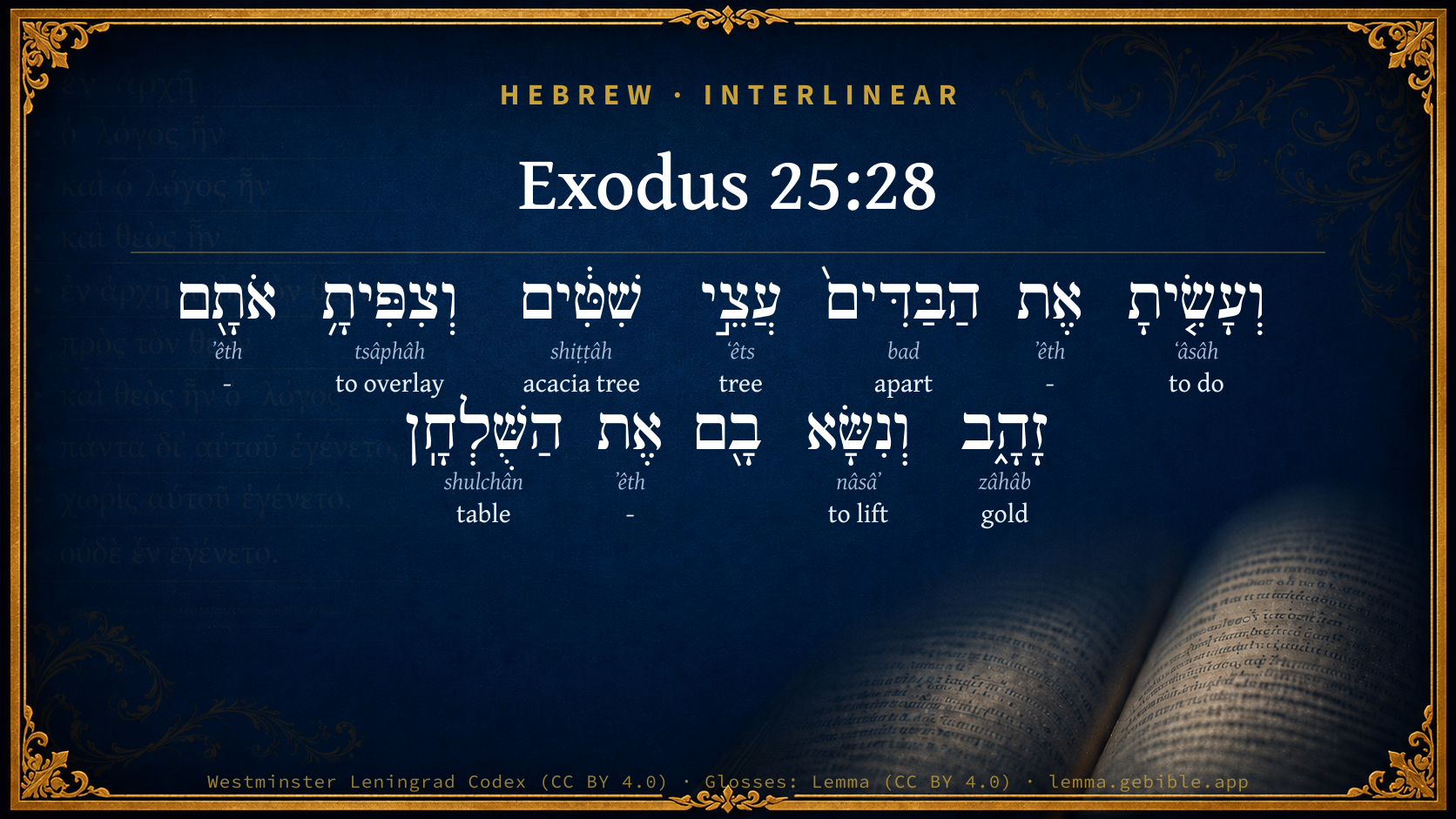
Hebrew (Westminster Leningrad Codex) Exodus 25:28 appears in the Hebrew Old Testament. The text above is from the Westminster Leningrad Codex. Each word links to its Strong’s number, a concise gloss, and parsing drawn from the Open Scriptures Hebrew Bible morphology. Click any word for its full Brown-Driver-Briggs (BDB) entry.
Download image
Cite this verse

Exodus 25:28 (World English Bible). Public Domain. Lemma interlinear Bible study tool, https://lemma.gebible.app/v/exodus/25/28.

Show BibTeX & RIS
BibTeX
RIS
English Translation
You shall make the poles of acacia wood, and overlay them with gold, that the table may be carried with them.
World English Bible · Public Domain
Download a study sheet

One document with this verse’s original text, its word-by-word gloss line, the meaning frame, cross-references with their text, attributed commentary, and full source and license credits — printable, and it pastes into notes with its structure intact.

This verse Autodidact and up

Study sheet (.html) Plain text (.txt)

A passage Seminary Student

Up to 50 verses in one chapter. A passage sheet keeps up to 6 commentary sources and 12 cross-references per verse, in the order this page ranks them, and says so on the sheet whenever that leaves anything out. Ask for a single verse and you get the Autodidact verse sheet above.

Everything on this page stays free to read, with no account — the sheet is a download of what is already on screen, not access to it.

Want to remove ads? Support Godless Engineer
Compare translations 3

The same verse in 3 English versions, stacked beneath the original-language interlinear above. Click any original word for its lexicon entry.

Each is an independent rendering of the whole verse — the interlinear is not word-aligned to these translations.

Highlighted words mark where these versions differ — a whole-verse word diff, not a word-by-word alignment.

  • World English Bible Public Domain
    You shall make the poles of acacia wood, and overlay them with gold, that the table may be carried with them.
  • King James Version Public Domain
    And thou shalt make the staves of shittim wood, and overlay them with gold, that the table may be borne with them.
  • unfoldingWord Literal Text CC BY-SA 4.0
    And you shall make the poles wood of acacias and cover them gold, and the table shall be carried with them.

unfoldingWord Literal Text — © unfoldingWord, licensed CC BY-SA 4.0. Word-aligned USFM3 via Door43 (git.door43.org/unfoldingWord/en_ult).

Versions to compare (up to 4)

3 of 4 selected

Show all 18 translations

Every available English version of this verse, each an independent rendering of the whole verse.

  • World English Bible Public Domain
    You shall make the poles of acacia wood, and overlay them with gold, that the table may be carried with them.
  • Berean Standard Bible Public Domain
    Make the poles of acacia wood and overlay them with gold, so that the table may be carried with them.
  • Majority Standard Bible Public Domain
    Make the poles of acacia wood and overlay them with gold, so that the table may be carried with them.
  • King James Version Public Domain
    And thou shalt make the staves of shittim wood, and overlay them with gold, that the table may be borne with them.
  • American Standard Version (1901) Public Domain
    And thou shalt make the staves of acacia wood, and overlay them with gold, that the table may be borne with them.
  • Revised Version (1885) Public Domain
    And thou shalt make the staves of acacia wood, and overlay them with gold, that the table may be borne with them.
  • Geneva Bible (1599) Public Domain
    And thou shalt make the barres of Shittim wood, and shalt ouerlay them with golde, that the Table may be borne with them.
  • Douay-Rheims (1899) Public Domain
    The bars also themselves thou shalt make of setim wood, and shalt overlay them with gold to bear up the table.
  • Young's Literal Translation Public Domain
    and thou hast made the staves of shittim wood, and hast overlaid them with gold, and the table hath been borne with them;
  • Literal Standard Version CC BY-SA 4.0
    and you have made the poles of shittim wood, and have overlaid them with gold, and the table has been carried with them;
  • Unlocked Literal Bible CC BY-SA 4.0
    You must make the poles out of acacia wood and cover them with gold so that the table may be carried with them.
  • unfoldingWord Literal Text CC BY-SA 4.0
    And you shall make the poles wood of acacias and cover them gold, and the table shall be carried with them.
  • Darby Bible Public Domain
    And thou shalt make the staves of acacia-wood, and overlay them with gold; and the table shall be carried upon them.
  • World Messianic Bible Public Domain
    You shall make the poles of acacia wood, and overlay them with gold, that the table may be carried with them.
  • Webster's Bible Public Domain
    And thou shalt make the staffs of shittim wood, and overlay them with gold, that the table may be borne with them.
  • Free Bible Version CC BY-SA 4.0
    Make the poles of acacia wood for carrying the table and cover them with gold.
  • Bible in Basic English Public Domain
    Make rods of the same wood, plated with gold, for lifting the table.
  • JPS Tanakh (1917) Public Domain
    And thou shalt make the staves of acacia-wood, and overlay them with gold, that the table may be borne with them.

Literal Standard Version (2020), Covenant Press — licensed CC BY-SA 4.0. Text via the HelloAO Bible API (eBible.org). Unlocked Literal Bible (unfoldingWord) — licensed CC BY-SA 4.0. Text via the HelloAO Bible API (eBible.org). unfoldingWord Literal Text — © unfoldingWord, licensed CC BY-SA 4.0. Word-aligned USFM3 via Door43 (git.door43.org/unfoldingWord/en_ult). Free Bible Version, Dr. Jonathan Gallagher — licensed CC BY-SA 4.0. Text via the HelloAO Bible API (eBible.org).

Word by word

More ways to search: Search by grammar → Find every occurrence → Compare this word →

Practice this passage: Drill this verse → Learn its vocabulary →

שִׁטִּ֔ים
shiṭṭâh
H7848
“acacia trees”
Noun, Common, Feminine, Plural, Absolute
Part of Speech
Noun
Type
Common
Gender
Feminine
Number
Plural
State
Absolute
Full BDB Definition

Origin: meaning the sticks of wood [from the same as H7850 ]

TWOT: 2371

acacia tree, acacia wood
  1. וְעָשִׂ֤יתָ ʻâsâh H6213 “and · to do” Conjunction + Verb, Qal, Sequential Perfect, 2nd Person, Masculine, Singular
  2. אֶת ʼêth H853 “-” Particle, Direct Object
  3. הַבַּדִּים֙ bad H905 “the · poles” Particle, Definite Article + Noun, Common, Masculine, Plural, Absolute
  4. עֲצֵ֣י ʻêts H6086 “trees of” Noun, Common, Masculine, Plural, Construct
  5. וְצִפִּיתָ֥ tsâphâh H6823 “and · to overlay” Conjunction + Verb, Piel, Sequential Perfect, 2nd Person, Masculine, Singular
  6. אֹתָ֖ם ʼêth H853 “- · them” Particle, Direct Object + Suffix, Personal, 3rd Person, Masculine, Plural
  7. זָהָ֑ב zâhâb H2091 “gold” Noun, Common, Masculine, Singular, Absolute
  8. וְנִשָּׂא nâsâʼ H5375 “and · to lift” Conjunction + Verb, Niphal, Sequential Perfect, 3rd Person, Masculine, Singular
  9. אֶת ʼêth H853 “-” Particle, Direct Object
  10. הַשֻּׁלְחָֽן shulchân H7979 “the · table” Particle, Definite Article + Noun, Common, Masculine, Singular, Absolute

About this verse

These counts appear in no published source. They are computed here, from the morphology-tagged text and Lemma’s own curated glosses. What Lemma adds →

12
words
9
distinct lemmas
Pentateuch
section

Shared distinctive vocabulary

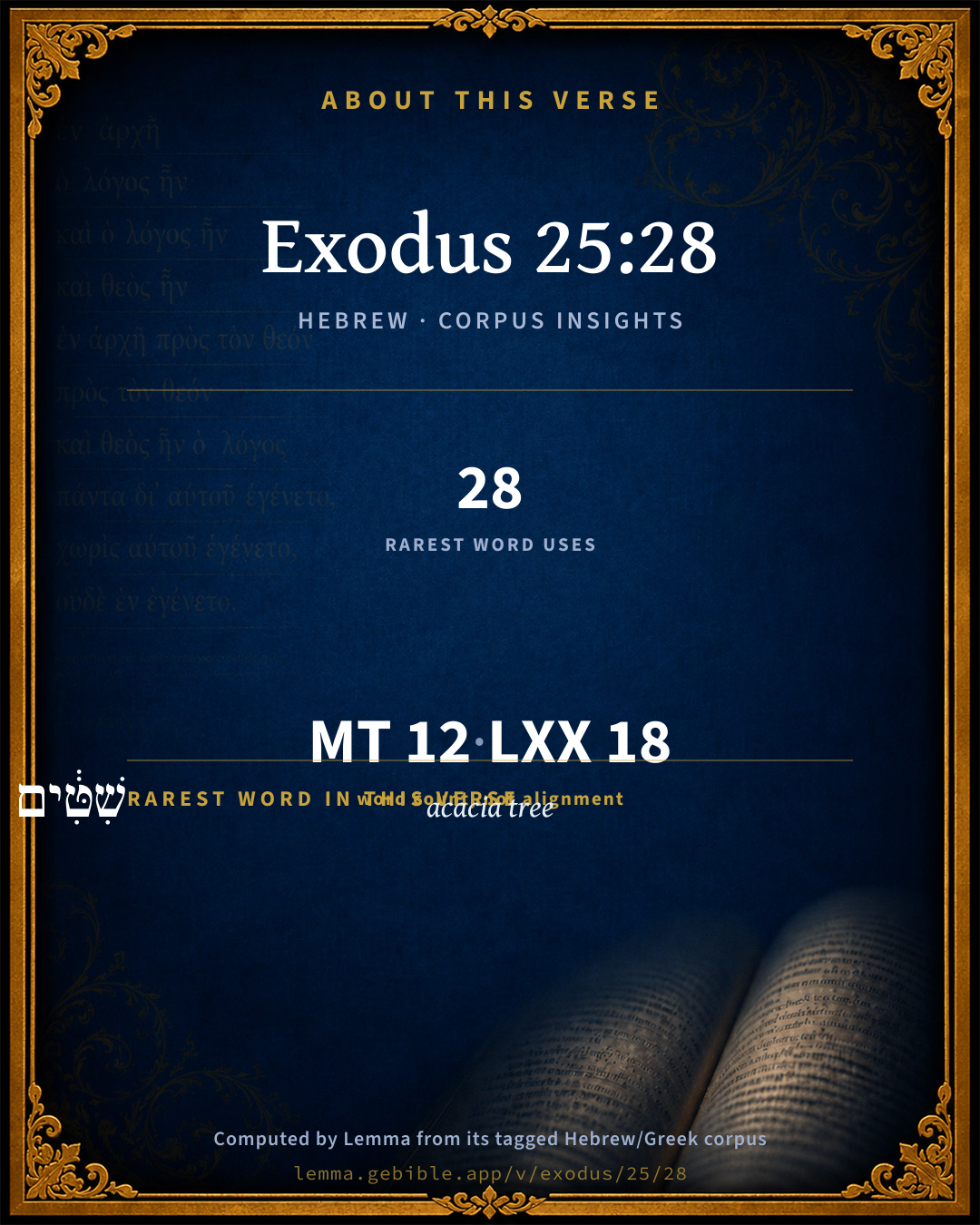
שִׁטִּ֔ים acacia tree H7848 occurs in 28 verses of the Hebrew Bible. Also found in:

Grammatical profile

  • 3 verbs
  • 5 nouns
  • 1 preposition
  • 3 particles

Verb forms

  • וְעָשִׂ֤יתָ Qal · Sequential Perfect
  • וְצִפִּיתָ֥ Piel · Sequential Perfect
  • וְנִשָּׂא Niphal · Sequential Perfect

Hebrew & Septuagint length

In English translation the verse runs 21 words from the Hebrew and 25 from the Septuagint (LXX English) — closely comparable.

A rough comparison of the two English renderings, which tokenize alike — not a word-level alignment.

Word counts can differ between the Hebrew and the Greek without any difference in meaning — e.g. the Hebrew direct-object marker אֵת has no separate Greek word, and Greek often adds the article ὁ.

In the original languages it is 12 Hebrew tokens and 18 Greek tokens — but the two are counted differently (Hebrew bundles its prefixes and suffixes into one token; the Greek is in lemma form), so that isn’t a like-for-like length.

Cross-references

4

Topical passages linked to Exodus 25:28 in the Treasury of Scripture Knowledge — connected by theme and wording, ordered by reader-vote popularity; previews shown in the World English Bible.

  • Exodus 25:14 You shall put the poles into the rings on the sides of the ark to carry the ark.
  • Exodus 25:27 the rings shall be close to the rim, for places for the poles to carry the table.
  • Numbers 10:17 The tent was taken down; and the sons of Gershon and the sons of Merari, who bore the tent, set forward.
  • Acts 9:15 But the Lord said to him, "Go your way, for he is my chosen vessel to bear my name before the nations and kings, and the children of Israel.

Cross-references courtesy of OpenBible.info (CC BY 4.0).

Hebrew and Greek witnesses Masoretic Hebrew ↔ Greek Septuagint

The same verse in the two great witnesses to the Old Testament, shown verse-for-verse.

These are two independent witnesses, not word-aligned to each other, and the Septuagint is shown in lemma (dictionary) form.

Hebrew Exodus 25:28 Masoretic · Westminster Leningrad Codex

וְעָשִׂ֤יתָ אֶת הַבַּדִּים֙ עֲצֵ֣י שִׁטִּ֔ים וְצִפִּיתָ֥ אֹתָ֖ם זָהָ֑ב וְנִשָּׂא בָ֖ם אֶת הַשֻּׁלְחָֽן

You shall make the poles of acacia wood, and overlay them with gold, that the table may be carried with them.

World English Bible · Public Domain

Greek LXX Exodus 25:28 Septuagint · lemma form

καί ποιέω ὁ ἀναφορεύς ἐκ ξύλον ἄσηπτος καί καταχρυσόω αὐτός χρυσίον καθαρός καί αἴρω ἐν αὐτός ὁ τράπεζα

And you shall make the staves of incorruptible wood, and you shall gild them with pure gold; and the table shall be borne with them.

LXX2012 (modern English Septuagint) · Public Domain

Hebrew: Westminster Leningrad Codex (CC BY 4.0). Greek: Septuagint (public domain); English from LXX2012 (modern English Septuagint) (Public Domain). How the Septuagint differs from the Hebrew →

Targum (Aramaic paraphrase)

2

The Targum is the ancient Jewish Aramaic paraphrase of the Hebrew Scriptures — an interpretive translation, not the Hebrew text itself. Onkelos (literal) and Pseudo-Jonathan (expansive) render the Torah, and Jonathan the Prophets. Coverage is partial: where no permissively-licensed English translation exists for a verse, only the Aramaic is shown. This is verse-level text, not a word-by-word alignment to the Hebrew.

  1. Targum Onkelos Torah (Genesis–Deuteronomy)
    וְתַעְבֵּד יָת אֲרִיחַיָא דְאָעֵי שִׁיטִין וְתַחֲפֵי יָתְהוֹן דַהֲבָא וִיהוֹן נָטְלִין בְּהוֹן יָת פָּתוֹרָא:

    (no public-domain English translation for this verse)

    Targum Onkelos — Aramaic: “Onkelos Genesis” (public domain); “Onkelos Exodus” (public domain); “Onkelos Leviticus” (public domain); “Onkelos Numbers” (public domain); “Onkelos Deuteronomy” (public domain). English: “Sefaria Community Translation” (CC0 1.0 (public-domain dedication)); “J.W. Etheridge. The Targums of Onkelos and Jonathan Ben Uzziel on the Pentateuch. London: Longmans, Green, 1862” (public domain). Text via Sefaria.

  2. Targum Pseudo-Jonathan Torah (Genesis–Deuteronomy)
    וְתַעֲבֵיד יַת אֲרִיחַיָיא דְקֵיסֵי שִׁיטָא וְתַחְפֵי יַתְהוֹן דַּהֲבָא וִיהוֹן נַטְלִין בְּהוֹן יַת פְּתוֹרָא

    (no public-domain English translation for this verse)

    Targum Pseudo-Jonathan — Aramaic: “Targum Jonathan on Genesis” (public domain); “Targum Jonathan on Exodus” (public domain); “Targum Jonathan on Leviticus” (public domain); “Targum Jonathan on Numbers” (public domain); “Targum Jonathan on Deuteronomy” (public domain). English: “The Targum of Jonathan ben Uzziel, trans. J. W. Etheridge, London, 1862” (public domain). Text via Sefaria.

Commentary

Notes on Exodus 25:28 from classic Christian and Jewish commentators (each source and its license shown beneath its notes). The classic Christian expositions comment on the surrounding passage and are grouped to its opening verse, so a note may address several verses; the Jewish commentaries on the Tanakh (Rashi and others) are per-verse, so they appear only where the commentator wrote on this verse.

Lemma curates 59 commentaries, every one of them public domain or Creative Commons licensed, each selected and text-cleaned for this edition rather than reprinted as found. About our sources →

Trapp's Complete Commentary

John Trapp

Exo 25:28 And thou shalt make the staves [of] shittim wood, and overlay them with gold, that the table may be borne with them.

Ver. 28. Of shittim wood.] See Exo 25:23. A wood much commended for lightness, firmness, fairness, and lastingness.

John Trapp, A Commentary or Exposition upon All the Books of the Old and New Testament (1647–1656) — public domain. Text from a community e-Sword module.

The Preacher's Complete Homiletical Commentary

Joseph S. Exell (gen. ed.)

MAIN HOMILETICS OF THE PARAGRAPH.—Exo_25:28-30

THE TABLE OF SHEW BREAD

This table, with its burden and furniture, must be regarded in a two-fold sense. It teaches—

I. That all life springs from God. These loaves on the golden table certainly signify the fact that out of the love of God comes the sustenance of man.

1. God is the supporter of our natural life. The golden table reminds us of the golden harvest which God gives for the preservation of the world. As the loaves were continually renewed, so from year to year does God give us rain and fruitful seasons, filling the heart of man with food and gladness. But,

2. God is the giver of spiritual nourishment to the world of souls. Man lives not by bread alone, but by every word which proceedeth out of the mouth of God. This is the heavenly bread which is given in Jesus Christ.

(1.) The shewbread was made of the finest of the flour, and in Christ we have the pure spiritual truth for which the soul longs (Isa_55:2).

(2.) The number of the loaves, twelve, indicate the fulness of the provision that there is in Christ for the soul. It satisfies the intellect, the affections, the conscience. He “satisfieth the longing soul, and filleth the hungry soul with goodness” (Psa_107:9).

(3.) The continued renewal of the bread signifies the everlasting power and grace of Christ. It always satisfies—it satisfies for ever (Joh_6:35; Joh_6:51). In Christ we have not a hollow shape of old history, not a phantom shape of the imagination, but food for the heart and life—a living, loving, personal, strengthening Saviour. “Whoso eats His flesh and drinks His blood hath eternal life.”

II. That all life must be consecrated to God. These loaves were to lie before the face of Jehovah as a meat-offering presented by the children of Israel (Lev_24:8). The frankincense sprinkled upon the bread, or consumed over it, indicated that it was offered up to God, and thus all life must be consecrated to God. It comes from Him, and it must be yielded up to Him. Fully given to Him—constantly given up. To Him must ever go up the offering of our love, the incense of our worship, the sacrifices of our obedience. The table of pure gold on which the loaves stood may well suggest the pure heart, without which all our gifts and services are rejected. The cans, cups, dishes, &c, of the table, all of pure gold, remind us that we must keep our members as instruments of righteousness unto God, and that all our gifts and possessions, all the associations and details of life, must be holy and undefiled.

SUGGESTIVE COMMENTS ON THE VERSES

Exo_25:23 to Exo_30:1. Fine flour was to form the ingredient of the bread, and even this was to pass through a fiery ordeal in its preparation: thus the very purest bread must furnish the table of the holy place. See we not here the impressive import of the words, My Father giveth you the true bread from heaven? The bread of God is He which cometh down from heaven, and giveth life unto the world (Joh_6:32-33). Inconceivably fine and free from all impurity is this bread. Still, it pleased the Lord to bruise Him (Isa_53:10). The Son of God passes through most appalling trial in order to the demonstration of His glorious perfection (Heb_2:10); and, blessedly to observe, every succeeding humiliation and sorrow, though deepening in agony and increasing in intensity at every step, endured by Jesus Christ, does but leave Him more triumphant in righteousness and glorious in holiness.—W. Mudge.

We observe another direction which God gave with regard to the table of shewbread. God said to Moses, “Thou shalt put pure frankincense upon each row, that it may be on the bread”—not mixed up with it, but “on the bread, for a memorial.” The “pure frankincense” was to be placed on the “pure table.” The sweetness of that provision which God has made for His people is here set before us. We want this idea to be fastened on our minds, dear brethren, that Jehovah is as much delighted with that which is the food and nourishment of His people, as they themselves can be, when they find their wants satisfied to the very utmost. There is such communion, such oneness between God and His Church, that the very thing His people want is the very thing in which He Himself takes de light. So that when the believing soul feeds upon Jesus, the bread of life, this, like sweet incense, comes up with acceptance before the Lord.

Observe the two ideas suggested by this continual placing of bread before the Lord. First, it was the very food which God provided for His people; it was abundantly good food for them, and it was always the same. Just as it is said of the manna, “The children of Israel did eat manna forty years”—all the time of their wilderness history. A spiritual appetite will always like the same food, even the Lord Jesus Christ.

But there is a second idea suggested by the continual placing of this bread before the Lord. You mark there was provision made for all the tribes. Not one of the Lord’s people shall want the spiritual food that is best for them. God is bound, by everlasting covenant engagements, to nourish and to feed all His people. Not one of them shall ever complain that good food has not been provided for him. According to the greatness of our wants, the Lord will abundantly satisfy our necessities. This is a truth which the Lord’s people are very slow to receive. We look at others, and we say, Oh, if I had the faith, the love, the diligence of such or such an individual in the family of God, all would be well. Depend upon it, brethren, the Lord knows how to satisfy all His people with the food that is best for them.—W. Krause.

ILLUSTRATIONS

BY

REV. WILLIAM ADAMSON

Typology! Exo_25:1-40. If you hold up your hand between the candle and the wall, what do you see? That shadow of your hand is not, however, of the same size and colour. It is only an outline. Holding up some beautiful object which we have never seen before, its shadow would give but a feeble impression of itself. So Heb_10:1 says, that the Law had a shadow of good things to come. Those good things have come; and

“Man has gazed on heavenly secrets,

Sunned himself in heavenly glow;

Seen the glory, heard the music,—

We are wiser than we know.”

—Mackay.

Shewbread! Exo_25:30.

1. Literally it means “bread of faces,” or “bread of presence,” from being always set before the face and presence of God. This bread was composed of twelve unleavened loaves, which were sprinkled over with frankincense, and, it is stated in the Alexandria version, with salt likewise. Jahn says that they were placed in two piles, one above another, and were changed every Sunday by the priests.

2. Law says that faith knows this emblem well, having often sat at the feet of Jesus with rapture, and heard Him say, “I am the Bread of Life.” The numbered bread is a clear picture of the numbered Church, whose members sit together with Christ in heavenly places, on whom rests the constant fragrance of His infinite merits. The ministers of Christ every Sunday place Christ before their flocks,—ever the same, yet ever new.

3. Gray sees in this presence-bread the tribute of Christian hearts; the outflow of our gratitude. As flowers carry dewdrops, trembling on the edges of the petals, and ready to fall at the first waft of wind, or brush of bird; so the heart should carry its beaded words of thanksgiving, and at the first breath of heavenly flavour let down the shower, perfumed with the heart’s gratitude.

“Angels, help us to adore Him,

To behold Him face to face;

Sun and moon bow down before Him,

Dwellers all in time and space,

Praise Him! Praise Him!

Praise with us the GOD OF GRACE.”

—Lyte.

The Preacher's Complete Homiletical Commentary (gen. ed. Joseph S. Exell; Funk & Wagnalls, c. 1892) — public domain (pre-1929). A full-Bible homiletical/sermon-outline anthology covering 65 of 66 books (2 John is absent from the source module). Text from a community e-Sword module.

The Cambridge Bible for Schools and Colleges

gen. ed. J. J. S. Perowne

28. The staves, or poles, were to be like those for the ark, v. 13.

The Cambridge Bible for Schools and Colleges (gen. ed. J. J. S. Perowne; Cambridge University Press, 1878–1918) — public domain. Text from a community e-Sword module.

John Gill's Exposition

And thou shall set upon the table shewbread before me always. Which consisted of twelve cakes loaves, set in two rows upon the table, and stood there a whole week, and every sabbath were renewed; and when the old ones were took away, which were eaten by the priests, new ones were set, so that they were always before the Lord; and being continually before him, were called shewbread, or "bread of faces", being always before the face of God. This was a memorial of the goodness of God in daily providing bread for the people of Israel, and was presented to him as a thankful acknowledgment of it, and being the same they ate at their own tables; and this being eaten by the priests, was expressive of the communion between God and them, they being guests of his, and feeding on the same provisions. This shewbread may be considered either as typical of the church and people of God, who are all one bread, Co1 10:17, these pure and unleavened cakes may denote their purity, simplicity, and sincerity, being without the leaven of malice and wickedness; the number twelve, the twelve tribes of Israel, the whole spiritual Israel of God; their being called shewbread, or bread of faces, the presentation of themselves to the Lord in public worship, and their being ever under the eye and care of God; their being set on the table, their standing in Christ, and security by him, who is the foundation of the apostles and prophets; and being set in rows, their order and harmony; being renewed every sabbath, the constancy of their worship, and the succession of them in all ages; the frankincense put on each row, the acceptance of their persons and services through the incense of Christ's mediation; the border round about them, the power of Christ around them to keep them from falling: or else as typical of Christ himself, of his being the food of believers, the bread of life: the shewbread of fine flour may fitly signify Christ, the finest of the wheat, the corn of heaven, the bread that comes from thence; its quantity, twelve cakes, the sufficiency of food with him, bread enough and to spare for the whole Israel of God; its continuance, the permanency of Christ as the food believers have always to feed upon; the frankincense on it, the gratefulness of Christ to such, to whom his flesh is meat indeed, and his blood drink indeed; and being set for priests, and only for them, may show that Christ is only food to such who are made priests to God: or this may be an emblem of the intercession of Christ, who is the Angel of God's presence, ever before him, and represents the whole Israel of God, for whom he intercedes; and his intercession is continual, he ever lives to make intercession for them, and that is always acceptable to God. The twelve loaves, Josephus (a) says, signify the year divided into so many months.

(a) Antiqu. l. 3. c. 7. sect. 7.

John Gill's Exposition of the Whole Bible (1746–1763) — public domain (CC PDM 1.0). Text via the HelloAO Bible API.

Scofield Reference Notes

C. I. Scofield

shittim wood

i.e. acacia.

The Scofield Reference Bible (1917 edition), notes by C. I. Scofield — public domain. Text from a community e-Sword module.

unfoldingWord translationNotes

Door43 World Missions Community

General Information:

Yahweh continues to tell Moses what the people must do.

so that the table may be carried with them

This can be stated in active form. AT: "so that you may carry the table with them" (See: Active or Passive)

to be used to pour out drink offerings

This can be stated in active form. AT: "so that you may use them to pour out drink offerings" (See: Active or Passive)

bread of the presence

This bread represented the presence of God.

translationWords

acacia

gold

drink offering

bread

unfoldingWord translationNotes — © Distant Shores Media and the Door43 World Missions Community, licensed CC BY-SA 4.0. Source: git.door43.org/Door43/en_tn.

Rashi

Rabbi Shlomo Yitzchaki (Rashi)

ונשא בם — The word ונשא is a passive (Niphal) form; the meaning is: THAT THE TABLE MAY BE BORNE BY THEM.

Rashi on the Tanakh — English translations: “The Judaica Press complete Tanach with Rashi, translated by A. J. Rosenberg” (CC BY 4.0); “Pentateuch with Rashi's commentary by M. Rosenbaum and A.M. Silbermann, 1929-1934” (public domain); “The Metsudah Tanach series, Lakewood, N.J” (CC BY 4.0); and “The Book of Joshua, Metsudah Publications, 1997” (CC BY 4.0). Text via Sefaria.

Lesson kit

Teaching starters — assembled from the data on this page, not authored interpretation. Every prompt links to the verse data it draws on. Edit before teaching.

Exodus, in the Pentateuch, opens this verse with 12 words (9 distinct Hebrew lemmas). Its most distinctive word is shiṭṭâh (“acacia tree”). A historical commentator’s framing appears above. Read the whole chapter for the surrounding context.

Discussion questions

  1. The word shiṭṭâh carries the sense “acacia tree.” How does it shape the verse?
  2. How does Exodus 25:5, which shares the word «acacia tree», read alongside this verse?
  3. The translations on this page render this verse differently — a whole-verse word diff, not a word-by-word alignment. What might account for the different wordings?
  4. «וְעָשִׂ֤יתָ» is a Qal Sequential Perfect verb. How does that grammatical form shape the action described?
  5. Compare how Trapp's Complete Commentary and The Preacher's Complete Homiletical Commentary read this verse. Where do they agree or differ?

Things to notice

Reading settings

Reading text

Shown beneath each verse's original-language words.

Old Testament
Old Testament edition

Read the OT as the Masoretic Hebrew (MT) or the Greek Septuagint (LXX).

English shown for the Greek Septuagint (in the Hebrew ↔ Greek comparison).

Comparing translations? Open the Compare panel on any verse page to stack up to four side by side.