
Job 15:19

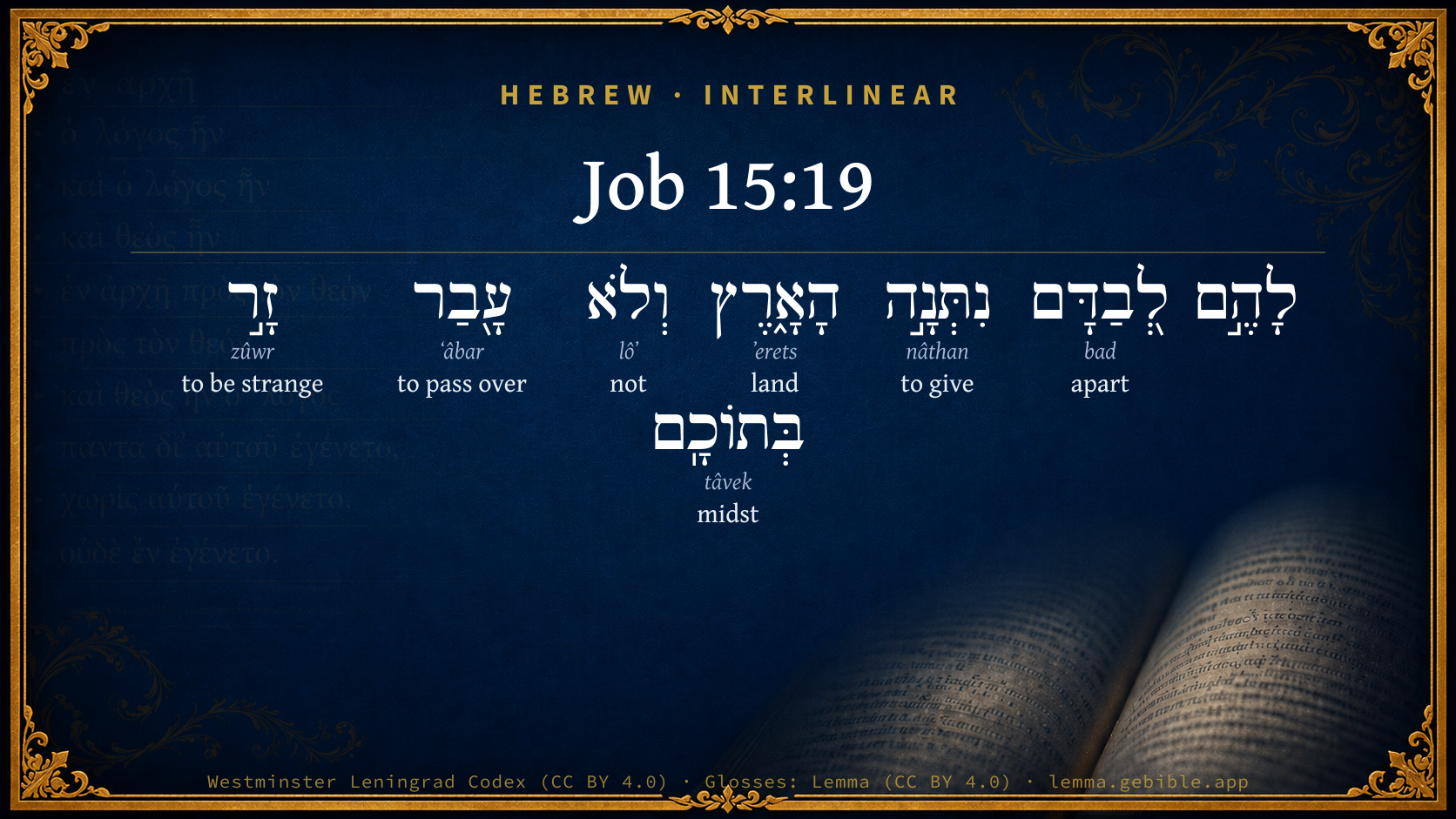
Hebrew (Westminster Leningrad Codex) Job 15:19 appears in the Hebrew Old Testament. The text above is from the Westminster Leningrad Codex. Each word links to its Strong’s number, a concise gloss, and parsing drawn from the Open Scriptures Hebrew Bible morphology. Click any word for its full Brown-Driver-Briggs (BDB) entry.
Download image
Cite this verse

Job 15:19 (World English Bible). Public Domain. Lemma interlinear Bible study tool, https://lemma.gebible.app/v/job/15/19.

Show BibTeX & RIS
BibTeX
RIS
English Translation
To whom alone the land was given, And no stranger passed among them):
World English Bible · Public Domain
Download a study sheet

One document with this verse’s original text, its word-by-word gloss line, the meaning frame, cross-references with their text, attributed commentary, and full source and license credits — printable, and it pastes into notes with its structure intact.

This verse Autodidact and up

Study sheet (.html) Plain text (.txt)

A passage Seminary Student

Up to 50 verses in one chapter. A passage sheet keeps up to 6 commentary sources and 12 cross-references per verse, in the order this page ranks them, and says so on the sheet whenever that leaves anything out. Ask for a single verse and you get the Autodidact verse sheet above.

Everything on this page stays free to read, with no account — the sheet is a download of what is already on screen, not access to it.

Want to remove ads? Support Godless Engineer
Compare translations 3

The same verse in 3 English versions, stacked beneath the original-language interlinear above. Click any original word for its lexicon entry.

Each is an independent rendering of the whole verse — the interlinear is not word-aligned to these translations.

Highlighted words mark where these versions differ — a whole-verse word diff, not a word-by-word alignment.

  • World English Bible Public Domain
    To whom alone the land was given, And no stranger passed among them):
  • King James Version Public Domain
    Unto whom alone the earth was given, and no stranger passed among them.
  • unfoldingWord Literal Text CC BY-SA 4.0
    To them alone the land was given, and no stranger passed in their midst.

unfoldingWord Literal Text — © unfoldingWord, licensed CC BY-SA 4.0. Word-aligned USFM3 via Door43 (git.door43.org/unfoldingWord/en_ult).

Versions to compare (up to 4)

3 of 4 selected

Show all 18 translations

Every available English version of this verse, each an independent rendering of the whole verse.

  • World English Bible Public Domain
    To whom alone the land was given, And no stranger passed among them):
  • Berean Standard Bible Public Domain
    to whom alone the land was given when no foreigner passed among them.
  • Majority Standard Bible Public Domain
    to whom alone the land was given when no foreigner passed among them.
  • King James Version Public Domain
    Unto whom alone the earth was given, and no stranger passed among them.
  • American Standard Version (1901) Public Domain
    Unto whom alone the land was given, And no stranger passed among them):
  • Revised Version (1885) Public Domain
    Unto whom alone the land was given, and no stranger passed among them:)
  • Geneva Bible (1599) Public Domain
    To whome alone the land was giuen and no stranger passed through them.
  • Douay-Rheims (1899) Public Domain
    To whom alone the earth was given, and no stranger hath passed among them.
  • Young's Literal Translation Public Domain
    To them alone was the land given, And a stranger passed not over into their midst:
  • Literal Standard Version CC BY-SA 4.0
    To them alone was the land given, || And a stranger did not pass over into their midst:
  • Unlocked Literal Bible CC BY-SA 4.0
    These were their ancestors, to whom alone the land was given, and among whom no stranger ever passed.
  • unfoldingWord Literal Text CC BY-SA 4.0
    To them alone the land was given, and no stranger passed in their midst.
  • Darby Bible Public Domain
    Unto whom alone the earth was given, and no stranger passed among them.
  • World Messianic Bible Public Domain
    to whom alone the land was given, and no stranger passed among them):
  • Webster's Bible Public Domain
    To whom alone the earth was given, and no stranger passed among them.
  • Free Bible Version CC BY-SA 4.0
    those to whom alone the land was given before foreigners ever were there.
  • Bible in Basic English Public Domain
    For only to them was the land given, and no strange people were among them:)
  • JPS Tanakh (1917) Public Domain
    Unto whom alone the land was given, and no stranger passed among them.

Literal Standard Version (2020), Covenant Press — licensed CC BY-SA 4.0. Text via the HelloAO Bible API (eBible.org). Unlocked Literal Bible (unfoldingWord) — licensed CC BY-SA 4.0. Text via the HelloAO Bible API (eBible.org). unfoldingWord Literal Text — © unfoldingWord, licensed CC BY-SA 4.0. Word-aligned USFM3 via Door43 (git.door43.org/unfoldingWord/en_ult). Free Bible Version, Dr. Jonathan Gallagher — licensed CC BY-SA 4.0. Text via the HelloAO Bible API (eBible.org).

Word by word

More ways to search: Search by grammar → Find every occurrence → Compare this word →

Practice this passage: Drill this verse → Learn its vocabulary →

זָ֣ר
zûwr
H2114
“strange”
Adjective, Adjective, Masculine, Singular, Absolute
Part of Speech
Adjective
Type
Adjective
Gender
Masculine
Number
Singular
State
Absolute
Full BDB Definition

Origin: a primitive root

TWOT: 541

to be strange, be a stranger - (Qal) - to become estranged - strange, another, stranger, foreigner, an enemy (participle) - loathsome (of breath) (participle) - strange woman, prostitute, harlot (metonymy) - (Niphal) to be estranged - (Hophal) to be a stranger, be one alienated
  1. לְ֭בַדָּם bad H905 “to/for · apart · their” Preposition + Noun, Common, Masculine, Singular, Construct + Suffix, Personal, 3rd Person, Masculine, Plural
  2. נִתְּנָ֣ה nâthan H5414 “to give” Verb, Niphal, Perfect, 3rd Person, Feminine, Singular
  3. הָאָ֑רֶץ ʼerets H776 “the · land” Particle, Definite Article + Noun, Common, Both, Singular, Absolute
  4. וְלֹא lôʼ H3808 “and · not” Conjunction + Particle, Negative
  5. עָ֖בַר ʻâbar H5674 “to pass over” Verb, Qal, Perfect, 3rd Person, Masculine, Singular
  6. בְּתוֹכָֽם tâvek H8432 “in/at · midst · their” Preposition + Noun, Common, Masculine, Singular, Construct + Suffix, Personal, 3rd Person, Masculine, Plural

About this verse

These counts appear in no published source. They are computed here, from the morphology-tagged text and Lemma’s own curated glosses. What Lemma adds →

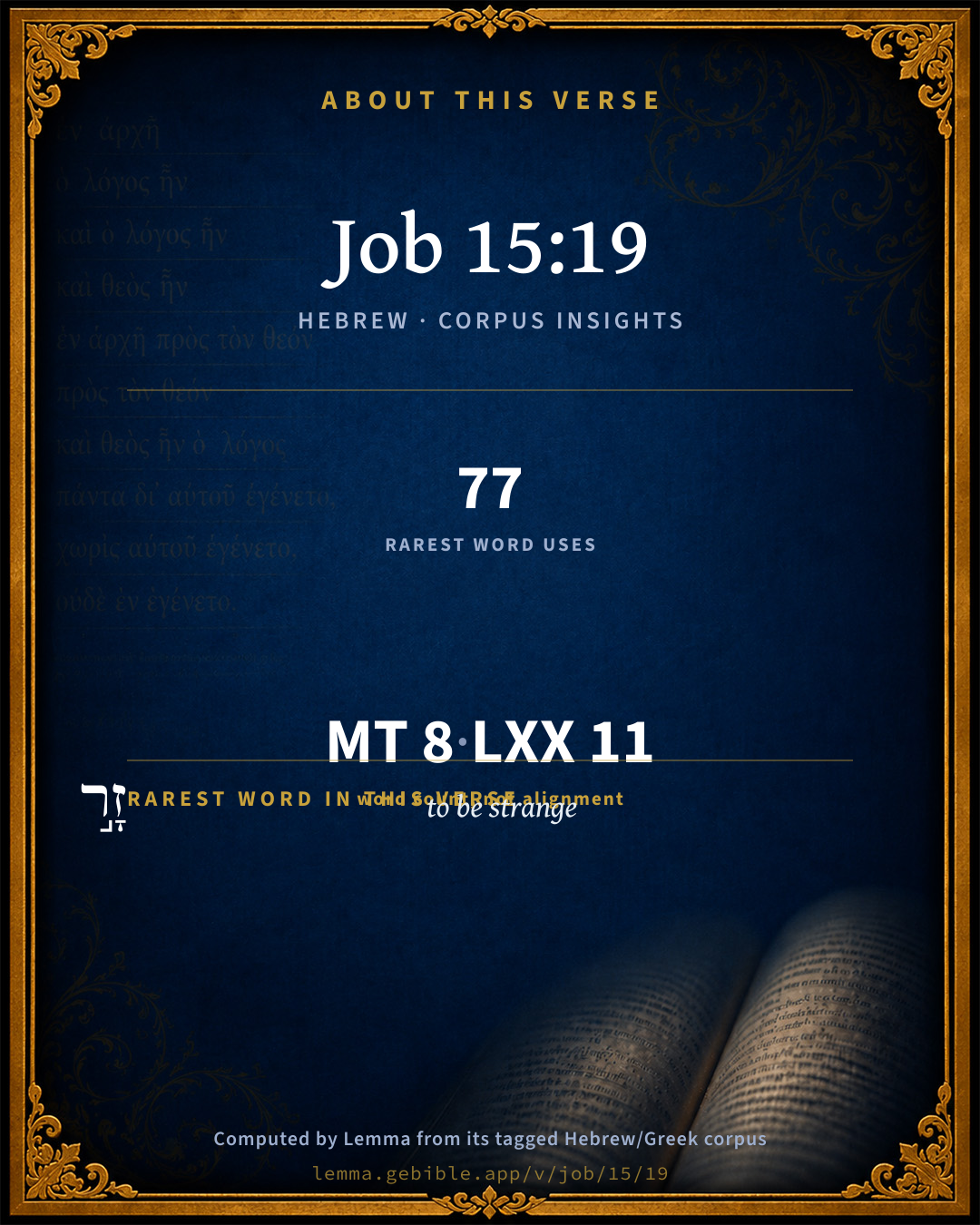
8
words
7
distinct lemmas
Wisdom
section

Grammatical profile

  • 2 verbs
  • 3 nouns
  • 1 adjective
  • 1 preposition
  • 1 particle

Verb forms

  • נִתְּנָ֣ה Niphal · Perfect
  • עָ֖בַר Qal · Perfect

Hebrew & Septuagint length

In English translation the verse runs 13 words from the Hebrew and 13 from the Septuagint (LXX English) — the same length.

A rough comparison of the two English renderings, which tokenize alike — not a word-level alignment.

Word counts can differ between the Hebrew and the Greek without any difference in meaning — e.g. the Hebrew direct-object marker אֵת has no separate Greek word, and Greek often adds the article ὁ.

In the original languages it is 8 Hebrew tokens and 11 Greek tokens — but the two are counted differently (Hebrew bundles its prefixes and suffixes into one token; the Greek is in lemma form), so that isn’t a like-for-like length.

Cross-references

4

Topical passages linked to Job 15:19 in the Treasury of Scripture Knowledge — connected by theme and wording, ordered by reader-vote popularity; previews shown in the World English Bible.

  • Joel 3:17 "So you will know that I am Yahweh, your God, Dwelling in Zion, my holy mountain. Then Jerusalem will be holy, And no strangers will pass through her any more.
  • Genesis 10:25 To Eber were born two sons. The name of the one was Peleg, for in his days was the earth divided. His brother's name was Joktan.
  • Genesis 10:32 These are the families of the sons of Noah, after their generations, in their nations. Of these were the nations divided in the earth after the flood.
  • Deuteronomy 32:8 When the Most High gave to the nations their inheritance, When he separated the children of men, He set the bounds of the peoples According to the number of the children of Israel.

Cross-references courtesy of OpenBible.info (CC BY 4.0).

Hebrew and Greek witnesses Masoretic Hebrew ↔ Greek Septuagint

The same verse in the two great witnesses to the Old Testament, shown verse-for-verse.

These are two independent witnesses, not word-aligned to each other, and the Septuagint is shown in lemma (dictionary) form.

Hebrew Job 15:19 Masoretic · Westminster Leningrad Codex

לָהֶ֣ם לְ֭בַדָּם נִתְּנָ֣ה הָאָ֑רֶץ וְלֹא עָ֖בַר זָ֣ר בְּתוֹכָֽם

To whom alone the land was given, And no stranger passed among them):

World English Bible · Public Domain

Greek LXX Job 15:19 Septuagint · lemma form

αὐτός μόνος δίδωμι ὁ γῆ καί οὐ ἐπιἔρχομαι ἀλλογενής ἐπί αὐτός

To them alone the earth was given, and no stranger came upon them.

LXX2012 (modern English Septuagint) · Public Domain

Hebrew: Westminster Leningrad Codex (CC BY 4.0). Greek: Septuagint (public domain); English from LXX2012 (modern English Septuagint) (Public Domain). How the Septuagint differs from the Hebrew →

Commentary

Notes on Job 15:19 from classic Christian and Jewish commentators (each source and its license shown beneath its notes). The classic Christian expositions comment on the surrounding passage and are grouped to its opening verse, so a note may address several verses; the Jewish commentaries on the Tanakh (Rashi and others) are per-verse, so they appear only where the commentator wrote on this verse.

Lemma curates 59 commentaries, every one of them public domain or Creative Commons licensed, each selected and text-cleaned for this edition rather than reprinted as found. About our sources →

Trapp's Complete Commentary

John Trapp

Job 15:19 Unto whom alone the earth was given, and no stranger passed among them.

Ver. 19. To whom alone the earth was given] Noah and his pious posterity (as was above noted), whom Methodius and other ancients call, Mundi chiliarchos, the lords of the whole world, given them by the possessor of heaven and earth, as Melchisedek first called God, Gen 14:19, and from him Abraham, another prince of God, Gen 22:3, as those heathens acknowledged him, and heir of the whole world, Rom 4:13 As for Melchisedek (commonly taken to be Shem), he was king in Salem, and no stranger, that is, no enemy, molested him; no, not those great spoilers, Chedorlaomer and his accomplices; these never meddled with Melchisedek and his subjects (probably out of respect to his wisdom and holiness, for which he was famous), no, not when, marching against the kings of Sodom and Gomorrah, they wasted and smote all the neighbour countries. So true of his subjects and territories was that which followeth here,

And no stranger passed among them] viz. In a hostile way, in a warlike manner, Neh 4:15 Some read, No strange thing passeth among them; as not the devouring sword, so neither the pestilence that walketh in darkness nor the destruction that wasteth at noonday, Psa 91:6. Such as was the reign of Ferdinando III, king of Spain, for five and thirty years’ time. In quibus nec fames nec pestes fuit ni regno, saith Lopez, wherein there happened neither famine nor pestilence (Gloss. in Prolog. par. 1).

John Trapp, A Commentary or Exposition upon All the Books of the Old and New Testament (1647–1656) — public domain. Text from a community e-Sword module.

Joseph Benson's Commentary

Job 15:19. Unto whom alone the earth was given — By the gracious gift of God: this he alleges to make their testimony more considerable, because these were no obscure men, but the most worthy and famous men in their ages; and to confute what Job had said, Job 9:24, that the earth was given into the hand of the wicked. By the earth he means the dominion and possession of it. No stranger passed among them — No person of a strange nation and disposition, or religion, passed through their land, so as to disturb or spoil them, as the Sabeans and Chaldeans did thee. God watched over those holy men so that no enemy could invade them; and so he would have done over thee, if thou hadst been such a one. It seems evident, that Noah and his sons, Melchizedeck, Abraham, and others of the patriarchs, who lived before Job, are here intended.

Joseph Benson's Commentary on the Old and New Testaments (1811–1818) — public domain. Text from a community e-Sword module.

Geneva Bible (1599)

Geneva Bible translators

Who by their wisdom so governed, that no stranger invaded them, and so the land seemed to be given to them alone.

Geneva Bible (1599) marginal notes — public domain. Text via Bolls.life.

Jamieson, Fausset & Brown

Robert Jamieson, A. R. Fausset & David Brown

Eliphaz speaks like a genuine Arab when he boasts that his ancestors had ever possessed the land unmixed with foreigners [UMBREIT]. His words are intended to oppose Job's (Job 9:24); "the earth" in their case was not "given into the hand of the wicked." He refers to the division of the earth by divine appointment (Gen 10:5; Gen 25:32). Also he may insinuate that Job's sentiments had been corrupted from original purity by his vicinity to the Sabeans and Chaldeans [ROSENMULLER].

Jamieson, Fausset & Brown — Commentary Critical and Explanatory on the Whole Bible (1871) — public domain (CC PDM 1.0). Text via the HelloAO Bible API.

Adam Clarke's Commentary

Verse 19. Unto whom alone the earth was given] He very likely refers to the Israelites, who got possession of the promised land from God himself; no stranger being permitted to dwell in it, as the old inhabitants were to be exterminated. Some think that Noah and his sons may be intended; as it is certain that the whole earth was given to them, when there were no strangers-no other family of mankind-in being. But, system apart, the words seem to apply more clearly to the Israelites.

Adam Clarke's Commentary on the Bible (1810–1826) — public domain. Text from a community e-Sword/MySword module.

The Cambridge Bible for Schools and Colleges

gen. ed. J. J. S. Perowne

19. And it is a tradition pure and uncorrupted by admixture of foreign elements, for it is the moral wisdom of races to whom alone the land has been given, who have dwelt always in the same seats, and never been displaced, and among whom foreign and inferior races have never penetrated.

The Cambridge Bible for Schools and Colleges (gen. ed. J. J. S. Perowne; Cambridge University Press, 1878–1918) — public domain. Text from a community e-Sword module.

John Gill's Exposition

Unto whom alone the earth was given,.... Who were intrusted with the government of whole kingdoms and nations; and therefore not mean men, but persons of great consequence, and to be credited; being such as were appointed by God, and by him put into such an high office, for which they were qualified by him; and being observed to be such by men, were made choice of by them to take the government of them: this is not to be restrained to the land of Canaan, and to Abraham, Isaac, and Jacob, to whom it was given, and to their posterity; and who it is very probable at this time did not yet enjoy it; but it respects more and larger tracts of land, and the rulers of them, and at a greater distance of time, and very likely Noah and his sons, to whom the whole earth was given, and by whom it was replenished, and among whom it was divided; this seems opposed to what Job had said, Job 9:24;

and no stranger passed among them; either there was no wicked man among them, a stranger to God and godliness; or an enemy that invaded them, passed through them, disturbed and dispossessed them of their power and substance; which shows how wise and good men are regarded by the Lord, and not distressed and afflicted as wicked men be; as well as serves to strengthen the credit of their character, and the report received and derived from them by tradition, and tacitly glances at Job's distress and disturbance by the Chaldeans and Sabeans; next follows the account of the things either seen by Eliphaz, or handed down from such credible persons now described.

John Gill's Exposition of the Whole Bible (1746–1763) — public domain (CC PDM 1.0). Text via the HelloAO Bible API.

Albert Barnes' Notes on the Bible

Unto whom alone the earth was given - The land; the land or country where they dwelt. He refers to the period before they became intermingled with other nations, and before they imbibed any sentiments or opinions from strangers. The meaning is, “I will give you the result of the observations of the golden age of the world when our fathers dwelt alone, and it could not be pretended that they had been corrupted by foreign philosophy; and when in morals and in sentiment they were pure.” Probably all nations look back to such times of primeval simplicity, and freedom from corruption, when the sentiments on morals and religion were comparatively pure, and before the people became corrupt by the importation of foreign opinions. It is a pleasing delusion to look back to such times - to some innocent Arcadia, or to a golden age - but usually all such retrospections are the mere work of fancy. The world really grows wiser as it grows older; and in the progress of society it is a rare thing when the present is not more pure and happy than its early stages. The comforts, privileges, and intelligence of the patriarchal age were not to be compared with those which we enjoy - any more than the condition of the wandering Arab is to be preferred to the quiet, peace, intelligence, and order of a calm, Christian home.

No stranger passed among them - No foreigner came to corrupt their sentiments by an admixture of strange doctrines. “Eliphaz here speaks like a genuine Arab, whose pride is in his tongue, his sword, and his pure blood.” Umbreit. It is possible, as Rosenmuller suggests, that Eliphaz means to insinuate that Job had been corrupted by the sentiments of the Chaldeans and Sabeans, and had departed from the pure doctrines of earlier times.

Albert Barnes' Notes on the Bible (1834–1885) — public domain. Text from a community e-Sword/MySword module.

Haydock's Catholic Bible Commentary

Them. Their antiquity, courage, and purity of morals must consequently be greater, as they have preserved themselves from the inroads of strangers. (Calmet)

George Leo Haydock (1774–1849), Haydock's Catholic Family Bible and Commentary, 1859 edition — public domain. Excludes Psalms (Douay-Rheims chapter numbering differs from Protestant) and Deuterocanonical books (Catholic canon only).

Matthew Poole's English Annotations

Unto whom alone the earth was given; either,

1. By the special and gracious gift of God; whereas wicked men invaded their parts of the earth, and took them away by force. Or,

2. By the choice and consent of the people, who for their great and known wisdom and virtue conferred this power and trust upon them. This he allegeth, partly to make their testimony more considerable, because these were not obscure, and mean, and foolish men, whose words are commonly despised, but the most worthy and famous men in their places and ages; and partly to contradict and confute what Job had said, Job 9:24, that the earth was given into the hand of the wicked. By the earth he means either the dominion of the earth, to wit, of that part of the earth in or nigh which Job and his friends lived; or rather, the possession of the earth, i.e. of a great portion of worldly goods; or particularly, the land, or that land, (as the word properly signifies,) to wit, the land of Canaan, which was given by special gift unto Abraham, (from whom it seems most probable that both Job and his friends were descended,) and to Isaac, and to Jacob; who, though they met with some common and ordinary afflictions, yet enjoyed a great measure of comfort, and wealth, and honour, and power in the world, as the fruits of God’s blessing, and of his covenant made with good men, whilst wicked men were exposed to manifold distresses and grievous calamities; all which those holy patriarchs diligently observed, and industriously imparted to their children, to encourage them to continue and proceed in the ways of true piety. But how was the earth or land given to them alone, as is here said?

Answ. Either,

1. Because Noah and his sons (of whom some understand these words) had the sole possession and dominion of the earth. Or,

2. Because Canaan was given to Abraham and to his seed alone; and some of Abraham’s children had the dominion of, or an ample possession in, those parts where Job and his friends lived, who also seem to be in the number of them. Or,

3. Because they only had it either by God’s special and gracious providence, or by the choice and approbation of the people; whereas wicked men took it by rapine and violence, without asking leave either from God or men.

No stranger, i.e. the enemy; for such are called strangers, both in Scripture, as Pro 5:10; Isa 1:7; Eze 11:9; 28:10, and in other authors. No person of a strange nation and disposition or religion.

Among them, i.e. through their land, as this phrase is used, Num 20:18, to wit, so as to molest, or disturb, or spoil them, as the Sabeans and Chaldeans did thee. God watched over those wise and holy men so carefully, that no enemy should invade them; and so he would have done over thee, if thou hadst been such a one.

Matthew Poole's English Annotations on the Holy Bible (1683–1685) — public domain. Text from a community e-Sword/MySword module.

Whedon's Commentary on the Bible

Daniel D. Whedon

Fourth strophe — The remarkable fragment out of the experience and wisdom of the ancients which Eliphaz is about to recite in confirmation of his own views as to the miserableness of the wicked, he thinks is worthy of the more consideration, because of the purity of the race-stock by whom it has been preserved and transmitted, Job_15:17-19. The strophe is transitional.

19. The earth — The land. Eliphaz boasts, like a true Ishmaelite, that his ancestors had kept their land against the intrusion of strangers, and their blood free from foreign commixture. Hence their doctrines and faith were more trustworthy because unalloyed. With Arabs even at the present day, purity of blood is the highest nobility, and a guarantee of superior wisdom. An unmixed Temanite was necessarily a wise man. See note Job_2:11, and Delitzsch, 1:259.

Rosenmuller suggests that Eliphaz means to insinuate that Job’s belief had been corrupted by association with the Chaldaeans and Sabeans; and he might have added the Egyptians, for Job makes more frequent allusions to their customs than to those of either of the others.

Daniel D. Whedon (gen. ed.), Commentary on the Old and New Testaments (1874–1909) — public domain. Text from a community e-Sword module.

The Pulpit Commentary

Unto whom alone the earth was given. The reference is clearly to a very remote time, when men were comparatively few, and lived in quiet possession of their own lands, undisturbed by invasions, wars, or struggles for territory. Professor Lee thinks that the times immediately after, and even those before, the Flood are glanced at; while Schultens regards Eliphaz as alluding to the first settlements of the Joktanidae in Arabia. In either case, the passage tells in favour or, and not against, the antiquity of the Book of Job, since it marks the composer as "living at a time when the memory of an age of patriarchal simplicity was yet fresh in men"s minds" (Canon Cook). And no stranger passed among them. Races were not mixed up one with another, and so the purity of primitive doctrine remained undisturbed.

The Pulpit Commentary (1880–1919), ed. H.D.M. Spence-Jones & Joseph S. Exell — public domain. Text from a community e-Sword module.

John Wesley's Explanatory Notes

To whom - By the gracious gift of God: this he alleges to make their testimony more considerable, because these were no obscure men, but the most worthy and famous men in their ages; and to confute what Job had said, chap. ix, 24, that the earth was given into the hand of the wicked. By the earth he means the dominion and possession of it. Stranger - No person of a strange nation and disposition, or religion. Passed - Through their land, so as to disturb, or spoil them, as the Sabeans and Chaldeans did thee. God watched over those holy men so, that no enemy could invade them; and so he would have done over thee, if thou hadst been such an one.

John Wesley, Explanatory Notes Upon the Whole Bible (1754–1765) — public domain. Text via the GEBible commentary corpus.

unfoldingWord translationNotes

Door43 World Missions Community

to whom alone the land was given

This can be stated in active form. AT: "to whom alone God gave the land" (See: Active or Passive)

among whom no stranger ever passed

This means that no foreigner lived among them, specifically so that they would not be influenced by pagan religions. AT: "no one from another country came and caused them to think wrongly about God" (See: Assumed Knowledge and Implicit Information)

twists in pain

"suffers a lot of pain." This is either physical or emotional pain.

the number of years that are laid up

This can be stated in active form. AT: "all the years that God has laid up" (See: Active or Passive)

that are laid up

This is an idiom. AT: "that are prepared" or "that are set aside" (See: Idiom)

A sound of terrors is in his ears

"He constantly hears sounds that terrify him"

translationWords

evil

oppress

suffer

terror

prosper

destroy

unfoldingWord translationNotes — © Distant Shores Media and the Door43 World Missions Community, licensed CC BY-SA 4.0. Source: git.door43.org/Door43/en_tn.

Rashi

Rabbi Shlomo Yitzchaki (Rashi)

To them alone the land was given As a reward for this, Judah merited eternal kingship, and both took their share of the heritage, and they were not driven out of their heritage because of their iniquity, since they confessed.

and no stranger passed in their midst when Moses came to bless them, as it is stated (Deut. 33:6f): “Reuben shall live and not die etc. And is this for Judah?” And no stranger passed in their midst in the heritage of the future that is apportioned in the Book of Ezekiel (48). But...

Rashi on the Tanakh — English translations: “The Judaica Press complete Tanach with Rashi, translated by A. J. Rosenberg” (CC BY 4.0); “Pentateuch with Rashi's commentary by M. Rosenbaum and A.M. Silbermann, 1929-1934” (public domain); “The Metsudah Tanach series, Lakewood, N.J” (CC BY 4.0); and “The Book of Joshua, Metsudah Publications, 1997” (CC BY 4.0). Text via Sefaria.

Lesson kit

Teaching starters — assembled from the data on this page, not authored interpretation. Every prompt links to the verse data it draws on. Edit before teaching.

Job, in the Wisdom, opens this verse with 8 words (7 distinct Hebrew lemmas). Its most distinctive word is zûwr (“to be strange”). A historical commentator’s framing appears above. Read the whole chapter for the surrounding context.

Discussion questions

  1. What does “to be strange” (zûwr) contribute to the verse as a whole?
  2. How does Joel 3:17, which shares this passage’s theme, read alongside this verse?
  3. The translations on this page render this verse differently — a whole-verse word diff, not a word-by-word alignment. What might account for the different wordings?
  4. «נִתְּנָ֣ה» is a Niphal Perfect verb. How does that grammatical form shape the action described?
  5. Compare how Trapp's Complete Commentary and Joseph Benson's Commentary read this verse. Where do they agree or differ?

Things to notice

Reading settings

Reading text

Shown beneath each verse's original-language words.

Old Testament
Old Testament edition

Read the OT as the Masoretic Hebrew (MT) or the Greek Septuagint (LXX).

English shown for the Greek Septuagint (in the Hebrew ↔ Greek comparison).

Comparing translations? Open the Compare panel on any verse page to stack up to four side by side.