
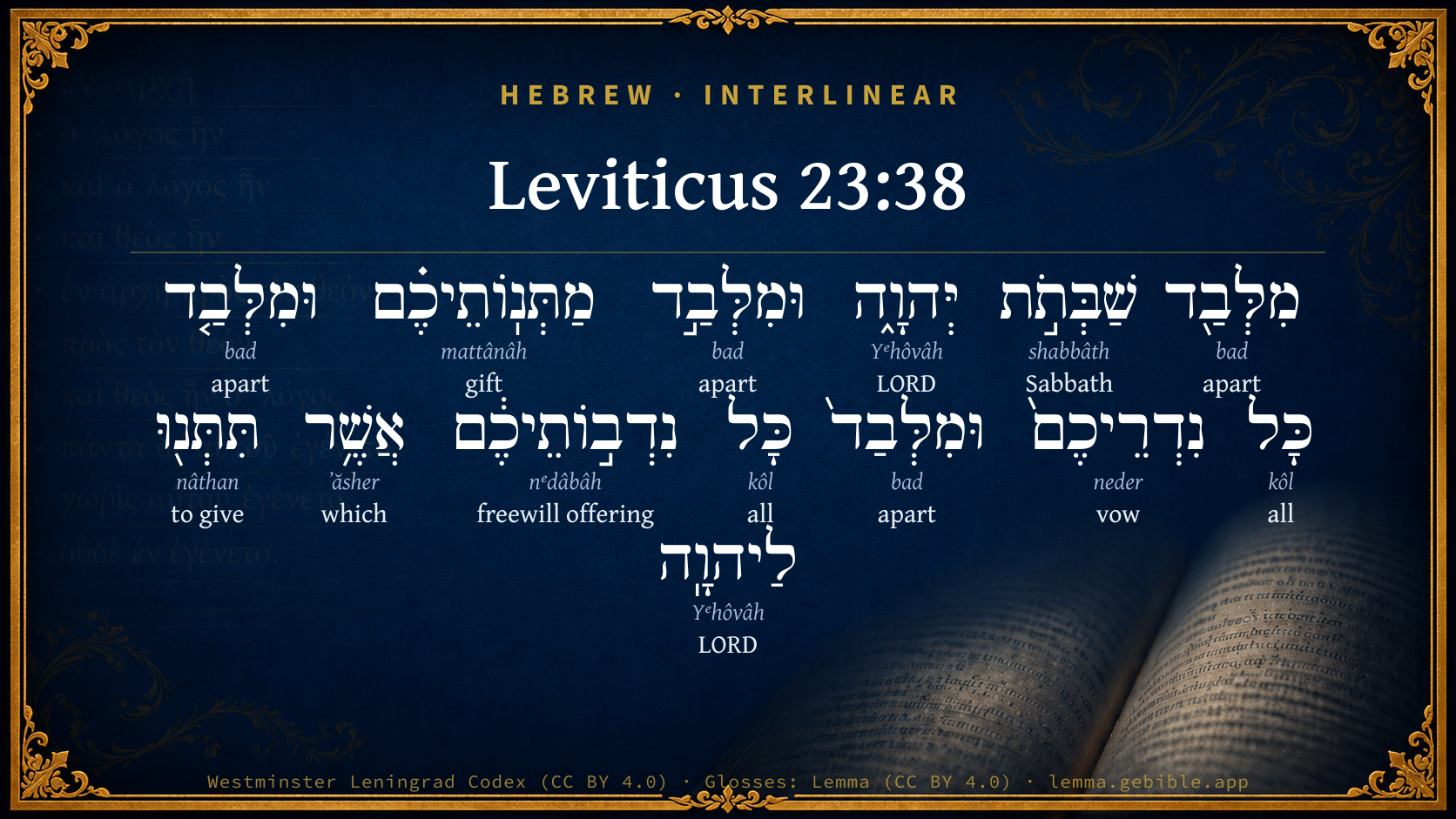
Leviticus 23:38

Hebrew (Westminster Leningrad Codex) Leviticus 23:38 appears in the Hebrew Old Testament. The text above is from the Westminster Leningrad Codex. Each word links to its Strong’s number, a concise gloss, and parsing drawn from the Open Scriptures Hebrew Bible morphology. Click any word for its full Brown-Driver-Briggs (BDB) entry.
Download image
Cite this verse

Leviticus 23:38 (World English Bible). Public Domain. Lemma interlinear Bible study tool, https://lemma.gebible.app/v/leviticus/23/38.

Show BibTeX & RIS
BibTeX
RIS
English Translation
besides the Sabbaths of Yahweh, and besides your gifts, and besides all your vows, and besides all your freewill offerings, which you give to Yahweh.
World English Bible · Public Domain
Download a study sheet

One document with this verse’s original text, its word-by-word gloss line, the meaning frame, cross-references with their text, attributed commentary, and full source and license credits — printable, and it pastes into notes with its structure intact.

This verse Autodidact and up

Study sheet (.html) Plain text (.txt)

A passage Seminary Student

Up to 50 verses in one chapter. A passage sheet keeps up to 6 commentary sources and 12 cross-references per verse, in the order this page ranks them, and says so on the sheet whenever that leaves anything out. Ask for a single verse and you get the Autodidact verse sheet above.

Everything on this page stays free to read, with no account — the sheet is a download of what is already on screen, not access to it.

Want to remove ads? Support Godless Engineer
Compare translations 3

The same verse in 3 English versions, stacked beneath the original-language interlinear above. Click any original word for its lexicon entry.

Each is an independent rendering of the whole verse — the interlinear is not word-aligned to these translations.

Highlighted words mark where these versions differ — a whole-verse word diff, not a word-by-word alignment.

  • World English Bible Public Domain
    besides the Sabbaths of Yahweh, and besides your gifts, and besides all your vows, and besides all your freewill offerings, which you give to Yahweh.
  • King James Version Public Domain
    Beside the sabbaths of the LORD, and beside your gifts, and beside all your vows, and beside all your freewill offerings, which ye give unto the LORD.
  • unfoldingWord Literal Text CC BY-SA 4.0
    besides the sabbaths of Yahweh and besides your gifts and besides all your vows and besides all your freewill offerings that you give to Yahweh.

unfoldingWord Literal Text — © unfoldingWord, licensed CC BY-SA 4.0. Word-aligned USFM3 via Door43 (git.door43.org/unfoldingWord/en_ult).

Versions to compare (up to 4)

3 of 4 selected

Show all 18 translations

Every available English version of this verse, each an independent rendering of the whole verse.

  • World English Bible Public Domain
    besides the Sabbaths of Yahweh, and besides your gifts, and besides all your vows, and besides all your freewill offerings, which you give to Yahweh.
  • Berean Standard Bible Public Domain
    These offerings are in addition to the offerings for the LORD’s Sabbaths, and in addition to your gifts, to all your vow offerings, and to all the freewill offerings you give to the LORD.
  • Majority Standard Bible Public Domain
    These offerings are in addition to the offerings for the LORD’s Sabbaths, and in addition to your gifts, to all your vow offerings, and to all the freewill offerings you give to the LORD.
  • King James Version Public Domain
    Beside the sabbaths of the LORD, and beside your gifts, and beside all your vows, and beside all your freewill offerings, which ye give unto the LORD.
  • American Standard Version (1901) Public Domain
    besides the sabbaths o Jehovah, and besides your gifts, and besides all your vows, and besides all your freewill-offerings, which ye give unto Jehovah.
  • Revised Version (1885) Public Domain
    beside the sabbaths of the LORD, and beside your gifts, and beside all your vows, and beside all your freewill offerings, which ye give unto the LORD.
  • Geneva Bible (1599) Public Domain
    Beside the Sabbaths of the Lord, and beside your giftes, and beside al your vowes, and beside all your free offrings, which ye shall giue vnto the Lord.
  • Douay-Rheims (1899) Public Domain
    Besides the sabbaths of the Lord, and your gifts, and those things that you offer by vow, or which you shall give to the Lord voluntarily.
  • Young's Literal Translation Public Domain
    apart from the sabbaths of Jehovah, and apart from your gifts, and apart from all your vows, and apart from all your willing-offerings, which ye give to Jehovah.
  • Literal Standard Version CC BY-SA 4.0
    apart from the Sabbaths of YHWH, and apart from your gifts, and apart from all your vows, and apart from all your willing-offerings, which you give to YHWH.
  • Unlocked Literal Bible CC BY-SA 4.0
    These festivals will be in addition to the Sabbaths of Yahweh and your gifts, all your vows, and all your freewill offerings that you give to Yahweh.
  • unfoldingWord Literal Text CC BY-SA 4.0
    besides the sabbaths of Yahweh and besides your gifts and besides all your vows and besides all your freewill offerings that you give to Yahweh.
  • Darby Bible Public Domain
    besides the sabbaths of Jehovah, and besides your gifts, and besides all your vows, and besides all your voluntary offerings, which ye give to Jehovah.
  • World Messianic Bible Public Domain
    in addition to the Sabbaths of the LORD, and in addition to your gifts, and in addition to all your vows, and in addition to all your free will offerings, which you give to the LORD.
  • Webster's Bible Public Domain
    Beside the sabbaths of the LORD, and beside your gifts, and beside all your vows, and beside all your free-will-offerings, which ye give to the LORD.
  • Free Bible Version CC BY-SA 4.0
    All of these offerings are in addition to those for the Lord's Sabbaths. They are also in addition to your gifts, to all your offerings to fulfill promises, and to all the freewill offerings you present to the Lord.
  • Bible in Basic English Public Domain
    In addition to the Sabbaths of the Lord, and in addition to the things you give and the oaths you make and the free offerings to the Lord.
  • JPS Tanakh (1917) Public Domain
    beside the sabbaths of the LORD, and beside your gifts, and beside all your vows, and beside all your freewill-offerings, which ye give unto the LORD.

Literal Standard Version (2020), Covenant Press — licensed CC BY-SA 4.0. Text via the HelloAO Bible API (eBible.org). Unlocked Literal Bible (unfoldingWord) — licensed CC BY-SA 4.0. Text via the HelloAO Bible API (eBible.org). unfoldingWord Literal Text — © unfoldingWord, licensed CC BY-SA 4.0. Word-aligned USFM3 via Door43 (git.door43.org/unfoldingWord/en_ult). Free Bible Version, Dr. Jonathan Gallagher — licensed CC BY-SA 4.0. Text via the HelloAO Bible API (eBible.org).

Word by word

More ways to search: Search by grammar → Find every occurrence → Compare this word →

Practice this passage: Drill this verse → Learn its vocabulary →

מַתְּנֽוֹתֵיכֶ֗ם
mattânâh
H4979
“gifts · your”
Noun, Common, Feminine, Plural, Construct + Suffix, Personal, 2nd Person, Masculine, Plural
Part of Speech
Noun
Type
Common
Gender
Feminine
Number
Plural
State
Construct
Full BDB Definition

Origin: from H4976

TWOT: 1443c

gift
  1. מִלְּבַ֖ד bad H905 “from · to/for · apart of” Preposition + Preposition + Noun, Common, Masculine, Singular, Construct
  2. שַׁבְּתֹ֣ת shabbâth H7676 “Sabbaths of” Noun, Common, Both, Plural, Construct
  3. יְּהוָ֑ה Yᵉhôvâh H3068 “LORD” Noun, Proper
  4. וּמִלְּבַ֣ד bad H905 “and · from · to/for · apart of” Conjunction + Preposition + Preposition + Noun, Common, Masculine, Singular, Construct
  5. וּמִלְּבַ֤ד bad H905 “and · from · to/for · apart of” Conjunction + Preposition + Preposition + Noun, Common, Masculine, Singular, Construct
  6. כָּל kôl H3605 “all of” Noun, Common, Masculine, Singular, Construct
  7. נִדְרֵיכֶם֙ neder H5088 “vows · your” Noun, Common, Masculine, Plural, Construct + Suffix, Personal, 2nd Person, Masculine, Plural
  8. וּמִלְּבַד֙ bad H905 “and · from · to/for · apart of” Conjunction + Preposition + Preposition + Noun, Common, Masculine, Singular, Construct
  9. כָּל kôl H3605 “all of” Noun, Common, Masculine, Singular, Construct
  10. נִדְב֣וֹתֵיכֶ֔ם nᵉdâbâh H5071 “freewill offerings · your” Noun, Common, Feminine, Plural, Construct + Suffix, Personal, 2nd Person, Masculine, Plural
  11. אֲשֶׁ֥ר ʼăsher H834 “which” Particle, Relative
  12. תִּתְּנ֖וּ nâthan H5414 “to give” Verb, Qal, Imperfect, 2nd Person, Masculine, Plural
  13. לַיהוָֽה Yᵉhôvâh H3068 “to/for · LORD” Preposition + Noun, Proper

About this verse

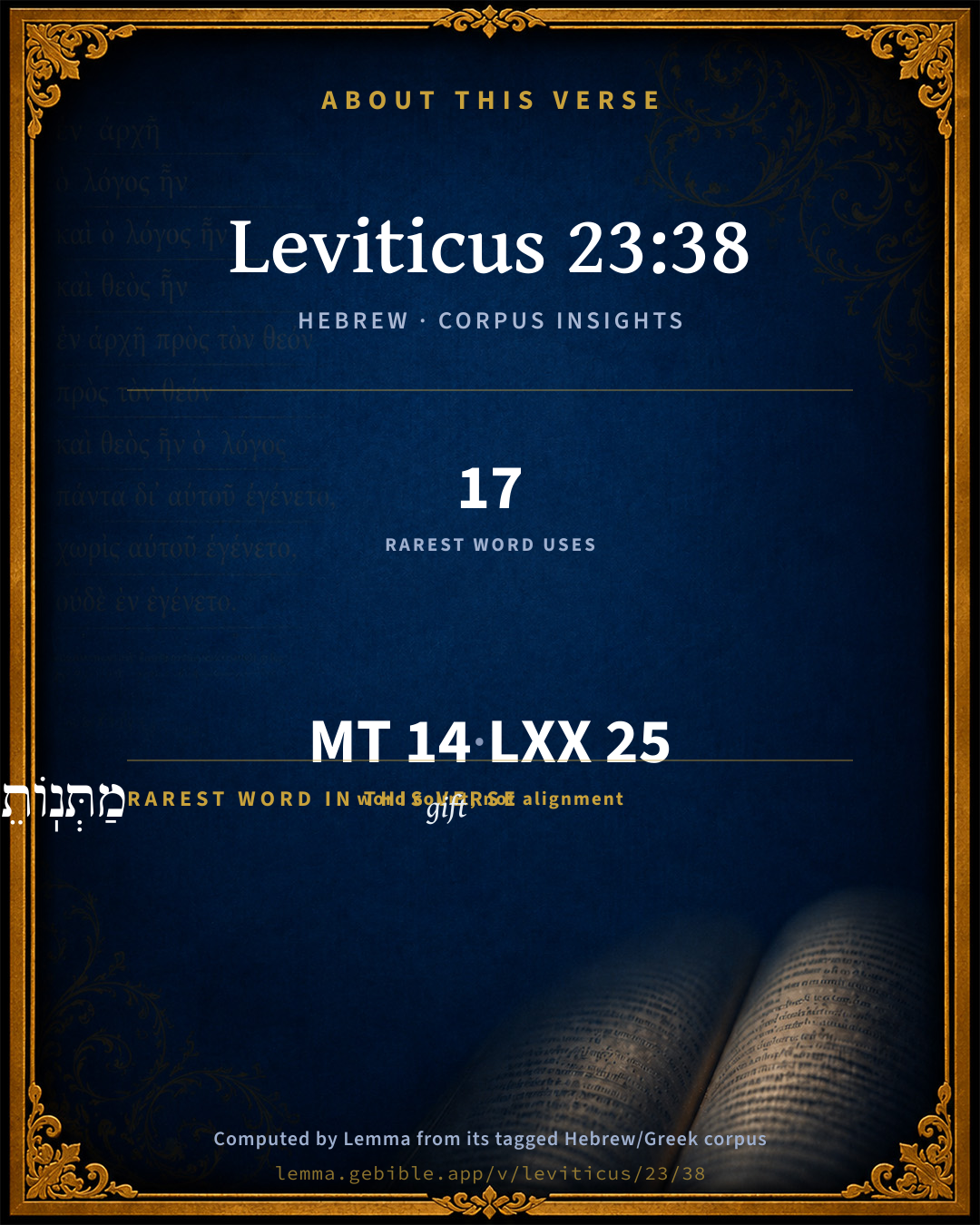
These counts appear in no published source. They are computed here, from the morphology-tagged text and Lemma’s own curated glosses. What Lemma adds →

14
words
9
distinct lemmas
Pentateuch
section

Notable vocabulary

The rarest word here is מַתְּנֽוֹתֵיכֶ֗ם gift H4979 — appearing just 17 times in the whole Hebrew Bible.

Shared distinctive vocabulary

מַתְּנֽוֹתֵיכֶ֗ם gift H4979 occurs in 17 verses of the Hebrew Bible. Also found in:

Grammatical profile

  • 1 verb
  • 12 nouns
  • 1 particle

Verb forms

  • תִּתְּנ֖וּ Qal · Imperfect

Repetition

Words recur within this verse — often emphatic in Hebrew:

  • מִלְּבַ֖ד apart H905 ×4
  • יְּהוָ֑ה LORD H3068 ×2
  • כָּל all H3605 ×2

Hebrew & Septuagint length

In English translation the verse runs 25 words from the Hebrew and 28 from the Septuagint (LXX English) — closely comparable.

A rough comparison of the two English renderings, which tokenize alike — not a word-level alignment.

Word counts can differ between the Hebrew and the Greek without any difference in meaning — e.g. the Hebrew direct-object marker אֵת has no separate Greek word, and Greek often adds the article ὁ.

In the original languages it is 14 Hebrew tokens and 25 Greek tokens — but the two are counted differently (Hebrew bundles its prefixes and suffixes into one token; the Greek is in lemma form), so that isn’t a like-for-like length.

Cross-references

9

Topical passages linked to Leviticus 23:38 in the Treasury of Scripture Knowledge — connected by theme and wording, ordered by reader-vote popularity; previews shown in the World English Bible.

  • Numbers 29:39 These you shall offer to Yahweh in your set feasts, besides your vows, and your freewill-offerings, for your burnt offerings, and for your meal-offerings, and for your drink-offerings, and for your peace-offerings.
  • Genesis 2:2–3 On the seventh day God finished his work which he had made; and he rested on the seventh day from all his work which he had made.
  • Exodus 20:8–11 "Remember the Sabbath day, to keep it holy.
  • Leviticus 19:3 "'Each one of you shall respect his mother and his father. You shall keep my Sabbaths. I am Yahweh your God.
  • Leviticus 23:3 "'Six days shall work be done: but on the seventh day is a Sabbath of solemn rest, a holy convocation; you shall do no manner of work. It is a Sabbath to Yahweh in all your dwellings.
  • Deuteronomy 12:6 and there you shall bring your burnt offerings, and your sacrifices, and your tithes, and the heave-offering of your hand, and your vows, and your freewill-offerings, and the firstborn of your herd and of your flock:
  • 1 Chronicles 29:3–8 In addition, because I have set my affection on the house of my God, seeing that I have a treasure of my own of gold and silver, I give it to the house of my God, over and above all that I have prepared for the holy house,
  • 2 Chronicles 35:7–8 Josiah gave to the children of the people, of the flock, lambs and kids, all of them for the Passover offerings, to all who were present, to the number of thirty thousand, and three thousand bulls: these were of the king's substance.
  • Ezra 2:68–69 Some of the heads of fathers' [houses], when they came to the house of Yahweh which is in Jerusalem, offered willingly for the house of God to set it up in its place:

Cross-references courtesy of OpenBible.info (CC BY 4.0).

Hebrew and Greek witnesses Masoretic Hebrew ↔ Greek Septuagint

The same verse in the two great witnesses to the Old Testament, shown verse-for-verse.

These are two independent witnesses, not word-aligned to each other, and the Septuagint is shown in lemma (dictionary) form.

Hebrew Leviticus 23:38 Masoretic · Westminster Leningrad Codex

מִלְּבַ֖ד שַׁבְּתֹ֣ת יְּהוָ֑ה וּמִלְּבַ֣ד מַתְּנֽוֹתֵיכֶ֗ם וּמִלְּבַ֤ד כָּל נִדְרֵיכֶם֙ וּמִלְּבַד֙ כָּל נִדְב֣וֹתֵיכֶ֔ם אֲשֶׁ֥ר תִּתְּנ֖וּ לַיהוָֽה

besides the Sabbaths of Yahweh, and besides your gifts, and besides all your vows, and besides all your freewill offerings, which you give to Yahweh.

World English Bible · Public Domain

Greek LXX Leviticus 23:38 Septuagint · lemma form

πλήν ὁ σάββατον κύριος καί πλήν ὁ δόμα σύ καί πλήν πᾶς ὁ εὐχή σύ καί πλήν ὁ ἑκούσιος σύ ὅς ἄν δίδωμι ὁ κύριος

besides the sabbaths of the Lord, and besides your gifts, and besides all your vows, and besides your free will offerings, which you⌃ shall give to the Lord.

LXX2012 (modern English Septuagint) · Public Domain

Hebrew: Westminster Leningrad Codex (CC BY 4.0). Greek: Septuagint (public domain); English from LXX2012 (modern English Septuagint) (Public Domain). How the Septuagint differs from the Hebrew →

Targum (Aramaic paraphrase)

2

The Targum is the ancient Jewish Aramaic paraphrase of the Hebrew Scriptures — an interpretive translation, not the Hebrew text itself. Onkelos (literal) and Pseudo-Jonathan (expansive) render the Torah, and Jonathan the Prophets. Coverage is partial: where no permissively-licensed English translation exists for a verse, only the Aramaic is shown. This is verse-level text, not a word-by-word alignment to the Hebrew.

  1. Targum Onkelos Torah (Genesis–Deuteronomy)
    בַּר שַׁבַּיָא דַיְיָ וּבַר מַתְּנָתֵיכוֹן וּבַר כָּל נִדְרֵיכוֹן וּבַר כָּל נִדְבָתֵיכוֹן דִי תִתְּנוּן קֳדָם יְיָ

    (no public-domain English translation for this verse)

    Targum Onkelos — Aramaic: “Onkelos Genesis” (public domain); “Onkelos Exodus” (public domain); “Onkelos Leviticus” (public domain); “Onkelos Numbers” (public domain); “Onkelos Deuteronomy” (public domain). English: “Sefaria Community Translation” (CC0 1.0 (public-domain dedication)); “J.W. Etheridge. The Targums of Onkelos and Jonathan Ben Uzziel on the Pentateuch. London: Longmans, Green, 1862” (public domain). Text via Sefaria.

  2. Targum Pseudo-Jonathan Torah (Genesis–Deuteronomy)
    בַּר מִן יוֹמֵי שַׁבַּיָא דַיְיָ בַּר מִמַתְּנוֹתֵיכוֹן וּבַר מִנִדְרֵיכוֹן וּבַר מִכָּל נְסִיבְתֵּיכוֹן דְתִתְּנוּן קֳדָם יְיָ

    beside the days of the Lord's Sabbaths, beside your gifts, and beside your vows, and beside your free-will offering which you bring before the Lord.

    Targum Pseudo-Jonathan — Aramaic: “Targum Jonathan on Genesis” (public domain); “Targum Jonathan on Exodus” (public domain); “Targum Jonathan on Leviticus” (public domain); “Targum Jonathan on Numbers” (public domain); “Targum Jonathan on Deuteronomy” (public domain). English: “The Targum of Jonathan ben Uzziel, trans. J. W. Etheridge, London, 1862” (public domain). Text via Sefaria.

Commentary

Notes on Leviticus 23:38 from classic Christian and Jewish commentators (each source and its license shown beneath its notes). The classic Christian expositions comment on the surrounding passage and are grouped to its opening verse, so a note may address several verses; the Jewish commentaries on the Tanakh (Rashi and others) are per-verse, so they appear only where the commentator wrote on this verse.

Lemma curates 59 commentaries, every one of them public domain or Creative Commons licensed, each selected and text-cleaned for this edition rather than reprinted as found. About our sources →

Joseph Benson's Commentary

Lev 23:38. Besides the sabbaths — The offerings of the weekly sabbaths. God will not have any sabbath-sacrifice diminished because of the addition of others, proper to any other feast. And it is here to be noted, that though other festival days are sometimes called sabbaths, yet these are here called the sabbaths of the Lord, in the way of contradistinction, to show that these were more eminently such than other feast-days. Your gifts — Which, being here distinguished from the free-will-offerings made to the Lord, may denote what they freely gave to the priests over and above their first-fruits and tithes or other things which they were enjoined to give.

Joseph Benson's Commentary on the Old and New Testaments (1811–1818) — public domain. Text from a community e-Sword module.

Ellicott's Commentary for English Readers

(38) Beside the sabbaths.—By a figure of speech called metonymy, which is frequently used both in the Old and New Testaments, the expression sabbaths stands here for the sacrifices of the sabbaths, just as in Lev_25:6 “sabbath of the land” denotes the produce of the sabbath of the land, or of the sabbatic year, and as the phrase “it is written in the prophets” (Mar_1:2) is used for “it is written in the writings of the prophets.” (Comp. also Mat_5:17; Mat_7:12; Mat_22:40, &c.) The meaning, therefore, of the passage before us is that the sacrifices ordered for each of these festivals are to be in addition to the sacrifices appointed to each weekly sabbath in the year; so that when one of these festivals falls on a sabbath, the sacrifices due to the latter are not set aside by the former. Both must be offered in their proper order.

Beside your gifts.—Nor are they to interfere with the voluntary offerings which each individual brought privately (Deu_16:10; Deu_16:17; 2Ch_25:7-8), or with the performance of vows (Deu_12:6-12).

A Bible Commentary for English Readers, edited by Charles John Ellicott (1878–1897) — public domain. Text from a community e-Sword module.

The Cambridge Bible for Schools and Colleges

gen. ed. J. J. S. Perowne

38. beside the sabbaths of the Lord] See on Lev_23:2-3.

The Cambridge Bible for Schools and Colleges (gen. ed. J. J. S. Perowne; Cambridge University Press, 1878–1918) — public domain. Text from a community e-Sword module.

John Gill's Exposition

Beside the sabbaths of the Lord,.... The seventh day sabbaths, which were of his appointing, and sacred to his service and worship; on which, when any of the feasts fell, it did not hinder the observance of them, or the offering of the several sacrifices on them; nor were those of the sabbath to be omitted on the account of them:

and beside your gifts; either of the whole congregation, or of a private person, which they thought well to give of their own good will on these festivals, over and above the sacrifices enjoined:

and beside all your vows, and beside all your freewill offerings, which ye give unto the Lord; which seem to explain what is meant before by gifts.

John Gill's Exposition of the Whole Bible (1746–1763) — public domain (CC PDM 1.0). Text via the HelloAO Bible API.

Matthew Poole's English Annotations

Beside the sabbaths, i.e. the offerings of the weekly sabbaths, by a metonymy, as the day is sometimes put for the actions done in it, as Pro 27:1; 1Co 3:13. God will not have any sabbath sacrifice diminished, because of the addition of others proper to any, other feast. And it is here to be noted, that though other festival days are sometimes called sabbaths, as here Lev 23:39, yet these are here called

the sabbaths of the Lord, in way of contradistinction to other days of rest, to show that this was more eminently such than other feast-days, which also sufficiently appears from the fourth commandment.

Beside your gifts, which, being here distinguished from free-will offerings made to the Lord, may seem to note what they freely gave to the priests over and above their first-fruits and tithes, or other things which they were enjoined to give.

Matthew Poole's English Annotations on the Holy Bible (1683–1685) — public domain. Text from a community e-Sword/MySword module.

Whedon's Commentary on the Bible

Daniel D. Whedon

38. Gifts — Sacrificial gifts, especially heave offerings for the priests, are intended. See note on Lev_7:14.

Vows… freewill offerings — The second and third kinds of peace offerings. See notes on Lev_7:11; Lev_7:16.

Daniel D. Whedon (gen. ed.), Commentary on the Old and New Testaments (1874–1909) — public domain. Text from a community e-Sword module.

John Wesley's Explanatory Notes

Beside the sabbaths - The offerings of the weekly sabbaths. God will not have any sabbath-sacrifice diminished because of the addition of others, proper to any other feast. And it is here to be noted, that though other festival days are sometimes called sabbaths, yet these are here called the sabbaths of the Lord, in way of contradistinction, to shew that this was more eminently such than other feast days. Your gifts - Which being here distinguished from the free-will-offerings made to the Lord, may note what they freely gave to the priests over and above their first-fruits and tithes or other things which they were enjoined to give.

John Wesley, Explanatory Notes Upon the Whole Bible (1754–1765) — public domain. Text via the GEBible commentary corpus.

Keil & Delitzsch

C. F. Keil & F. Delitzsch

"Beside the Sabbaths:" i.e., the Sabbath sacrifices (see Num 28:9-10), and the gifts and offerings, which formed no integral part of the keeping of the feasts and Sabbaths, but might be offered on those days. מתּנות, gifts, include all the dedicatory offerings, which were presented to the Lord without being intended to be burned upon the altar; such, for example, as the dedicatory gifts of the tribe-princes (Num 7), the firstlings and tithes, and other so-called heave-offerings (Num 18:11, Num 18:29). By the "vows" and נדבות, "freewill-offerings," we are to understand not only the votive and freewill slain or peace-offerings, but burnt-offerings also, and meat-offerings, which were offered in consequence of a vow, or from spontaneous impulse (see Jdg 11:31, where Jephthah vows a burnt-offering). - In Lev 23:39. there follows a fuller description of the observance of the last feast of the year, for which the title, "feast of Tabernacles" (Lev 23:34), had prepared the way, as the feast had already been mentioned briefly in Exo 23:16 and Exo 34:22 as "feast of Ingathering," though hitherto no rule had been laid down concerning the peculiar manner in which it was to be observed. In connection with this epithet in Exodus, it is described again in Lev 23:39, as in Lev 23:35, Lev 23:36, as a seven days' feast, with sabbatical rest on the first and eighth day; and in Lev 23:40. the following rule is given for its observance: "Take to you fruit of ornamental trees, palm-branches, and boughs of trees with thick foliage, and willows of the brook, and rejoice before the Lord your God seven days, every native in Israel." If we observe that there are only three kinds of boughs that are connected together by the copula (vav) in Lev 23:40, and that it is wanting before תם כּפּת, there can hardly be any doubt that הדר עץ פּרי is the generic term, and that the three names which follow specify the particular kinds of boughs. By "the fruits," therefore, we understand the shoots and branches of the trees, as well as the blossom and fruit that grew out of them. הדר עץ, "trees of ornament:" we are not to understand by these only such trees as the orange and citron, which were placed in gardens for ornament rather than use, as the Chald. and Syr. indicate, although these trees grow in the gardens of Palestine (Rob., Pal. i. 327, iii. 420). The expression is a more general one, and includes myrtles, which were great favourites with the ancients, on account of their beauty and the fragrant odour which they diffused, olive-trees, palms, and other trees, which were used as booths in Ezra's time (Neh 8:15). In the words, "Take fruit of ornamental trees," it is not expressly stated, it is true, that this fruit was to be used, like the palm-branches, for constructing booths; but this is certainly implied in the context: "Take...and rejoice...and keep a feast...in the booths shall he dwell." בּסּכּת with the article is equivalent to "in the booths which ye have constructed from the branches mentioned" (cf. Ges. 109, 3). It was in this sense that the law was understood and carried out in the time of Ezra (Neh 8:15.).

(Note: Even in the time of the Maccabees, on the other hand (cf. 2 Macc. 10:6, 7), the feast of the Purification of the Temple was celebrated by the Jews after the manner of the Tabernacles (κατὰ σκηνωμάτων τρόπον); so that they offered songs of praise, holding (ἔχοντες, carrying?) leafy poles (θύρσους, not branches of ivy, cf. Grimm. ad l.c.) and beautiful branches, also palms; in the time of Christ it was the custom to have sticks or poles (staves) of palm-trees and citron-trees (θύρσους ἐκ φοινίκων καὶ κιτρέων: Josephus, Ant. xiii. 13, 5), or to carry in the hand a branch of myrtle and willow bound round with wool, with palms at the top and an apple of the περσέα (peach or pomegranate?) upon it (εἰρεσιώνην μυρσίνης καὶ ἰτέας σὺν κράδῃ φοίνικος πεποιημένην τοῦ μήλου τοῦ τῆς Περσέας προσόντος). This custom, which was still further developed in the Talmud, where a bunch made of palm, myrtle, and willow boughs is ordered to be carried in the right hand, and a citron or orange in the left, has no foundation in the law: it sprang rather out of an imitation of the Greek harvest-feast of the Pyanepsia and Bacchus festivals, from which the words θύρσοι and εἰρεσιώνη were borrowed by Josephus, and had been tacked on by the scribes to the text of the Bible (v. 40) in the best way they could. See Bδhr, Symbol. ii. p. 625, and the innumerable trivial laws in Mishna Succa and Succa Codex talm. babyl. sive de tabernaculorum festo ed. Dachs. Utr. 1726, 4.)

The leading character of the feast of Tabernacles, which is indicated at the outset by the emphatic אך (Lev 23:39, see at Lev 23:27), was to consist in "joy before the Lord." As a "feast," i.e., a feast of joy (חג, from חגג = חוּג, denoting the circular motion of the dance, Sa1 30:16), it was to be kept for seven days; so that Israel "should be only rejoicing," and give itself up entirely to joy (Deu 16:15). Now, although the motive assigned in Deut. is this: "for God will bless thee (Israel) in all thine increase, and in all the work of thine hands;" and although the feast, as a "feast of ingathering," was a feast of thanksgiving for the gathering in of the produce of the land, "the produce of the floor and wine-press;" and the blessing they had received in the harvested fruits, the oil and wine, which contributed even more to the enjoyment of life than the bread that was needed for daily food, furnished in a very high degree the occasion and stimulus to the utterance of grateful joy: the origin and true signification of the feast of Tabernacles are not to be sought for in this natural allusion to the blessing of the harvest, but the dwelling in booths was the principal point in the feast; and this was instituted as a law for all future time (Lev 23:41), that succeeding generations might know that Jehovah had caused the children of Israel to dwell in booths when He led them out of Egypt (Lev 23:43). סכּה, a booth or hut, is not to be confounded with אחל a tent, but comes from סכך texuit, and signifies casa, umbraculum ex frondibus ramisque consertum (Ges. thes. s. v.), serving as a defence both against the heat of the sun, and also against wind and rain (Psa 31:21; Isa 4:6; Jon 4:5). Their dwelling in booths was by no means intended, as Bhr supposes, to bring before the minds of the people the unsettled wandering life of the desert, and remind them of the trouble endured there, for the recollection of privation and want can never be an occasion of joy; but it was to place vividly before the eyes of the future generations of Israel a memorial of the grace, care, and protection which God afforded to His people in the great and terrible wilderness (Deu 8:15). Whether the Israelites, in their journey through the wilderness, not only used the tents which they had taken with them (cf. Lev 14:8; Exo 16:1; Exo 18:7; Exo 33:8.; Num 16:26., Lev 24:5, etc.), but erected booths of branches and bushes in those places of encampment where they remained for a considerable time, as the Bedouins still do sometimes in the peninsula of Sinai (Burckhardt, Syrien, p. 858), or not; at all events, the shielding and protecting presence of the Lord in the pillar of cloud and fire was, in the words of the prophet, "a booth (tabernacle) for a shadow in the day-time from the heat, and for a place of refuge, and for a covert from storm and from rain" (Isa 4:6) in the barren wilderness, to those who had just been redeemed out of Egypt. Moreover, the booths used at this feast were not made of miserable shrubs of the desert, but of branches of fruit-trees, palms and thickly covered trees, the produce of the good and glorious land into which God had brought them (Deu 8:7.); and in this respect they presented a living picture of the plenteous fulness of blessing with which the Lord had enriched His people. This fulness of blessing was to be called to mind by their dwelling in booths; in order that, in the land "wherein they ate bread without scarceness and lacked nothing, where they built goodly houses and dwelt therein; where their herds and flocks, their silver and their gold, and all that they had, multiplied" (Deu 8:9, Deu 8:12-13), they might not say in their hearts, "My power, and the might of mine hand, hath gotten me this wealth," but might remember that Jehovah was their God, who gave them power to get wealth (Lev 23:17, Lev 23:18), that so their heart might not "be lifted up and forget Jehovah their God, who had led them out of the land of Egypt, the house of bondage." If, therefore, the foliage of the booths pointed to the glorious possessions of the inheritance, which the Lord had prepared for His redeemed people in Canaan, yet the natural allusion of the feast, which was superadded to the historical, and subordinate to it, - viz., to the plentiful harvest of rich and beautiful fruits, which they had gathered in from this inheritance, and could now enjoy in peace after the toil of cultivating the land was over, - would necessarily raise their hearts to still higher joy through their gratitude to the Lord and Giver of all, and make this feats a striking figure of the blessedness of the people of God when resting from their labours.

Keil & Delitzsch — Biblical Commentary on the Old Testament (1861–1891) — public domain (CC PDM 1.0). Text via the HelloAO Bible API. (Old Testament only.)

Lesson kit

Teaching starters — assembled from the data on this page, not authored interpretation. Every prompt links to the verse data it draws on. Edit before teaching.

Leviticus, in the Pentateuch, opens this verse with 14 words (9 distinct Hebrew lemmas). Its most distinctive word is mattânâh (“gift”). A historical commentator’s framing appears above. Read the whole chapter for the surrounding context.

Discussion questions

  1. The word mattânâh carries the sense “gift.” How does it shape the verse?
  2. Genesis 25:6 shares the word «gift» with this verse. How do the two illuminate each other?
  3. “apart” occurs 4× in this one verse. What is the effect of the repetition?
  4. These translations render this verse differently; the difference is in the English rendering, not the original. What questions does that raise?
  5. The verb «תִּתְּנ֖וּ» is Qal Imperfect. How does its form color the action?
  6. Reading how Joseph Benson's Commentary and Ellicott's Commentary for English Readers read this verse, where do the two commentators agree and where do they part?

Things to notice

Reading settings

Reading text

Shown beneath each verse's original-language words.

Old Testament
Old Testament edition

Read the OT as the Masoretic Hebrew (MT) or the Greek Septuagint (LXX).

English shown for the Greek Septuagint (in the Hebrew ↔ Greek comparison).

Comparing translations? Open the Compare panel on any verse page to stack up to four side by side.