Isaiah 2:17

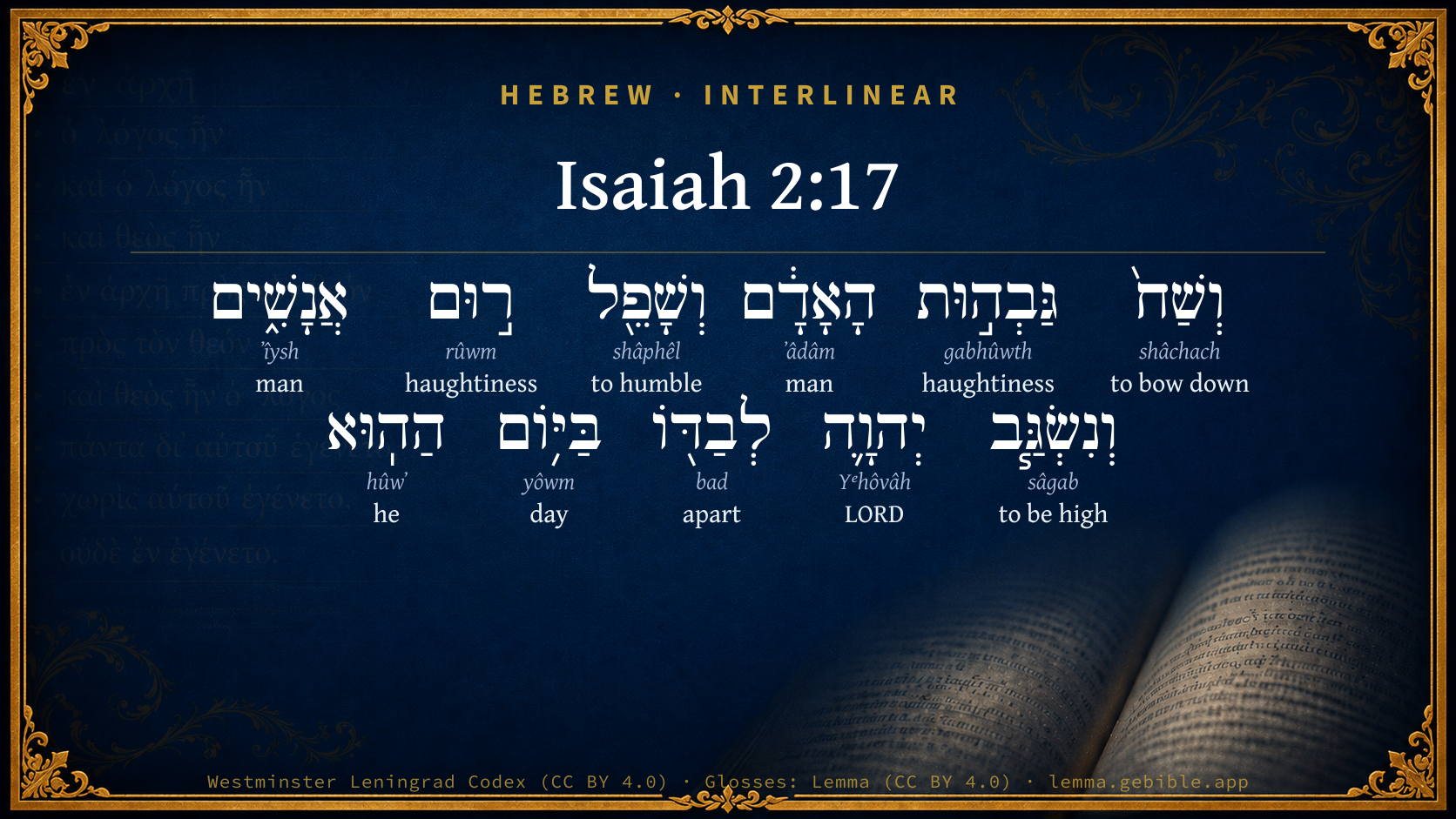
Hebrew (Westminster Leningrad Codex) Isaiah 2:17 appears in the Hebrew Old Testament. The text above is from the Westminster Leningrad Codex. Each word links to its Strong’s number, a concise gloss, and parsing drawn from the Open Scriptures Hebrew Bible morphology. Click any word for its full Brown-Driver-Briggs (BDB) entry.
Download image
Cite this verse

Isaiah 2:17 (World English Bible). Public Domain. Lemma interlinear Bible study tool, https://lemma.gebible.app/v/isaiah/2/17.

Show BibTeX & RIS
BibTeX
RIS
English Translation
The loftiness of man shall be bowed down, And the haughtiness of men shall be brought low; And Yahweh alone shall be exalted in that day.
World English Bible · Public Domain
Download a study sheet

One document with this verse’s original text, its word-by-word gloss line, the meaning frame, cross-references with their text, attributed commentary, and full source and license credits — printable, and it pastes into notes with its structure intact.

This verse Autodidact and up

Study sheet (.html) Plain text (.txt)

A passage Seminary Student

Up to 50 verses in one chapter. A passage sheet keeps up to 6 commentary sources and 12 cross-references per verse, in the order this page ranks them, and says so on the sheet whenever that leaves anything out. Ask for a single verse and you get the Autodidact verse sheet above.

Everything on this page stays free to read, with no account — the sheet is a download of what is already on screen, not access to it.

Want to remove ads? Support Godless Engineer
Compare translations 3

The same verse in 3 English versions, stacked beneath the original-language interlinear above. Click any original word for its lexicon entry.

Each is an independent rendering of the whole verse — the interlinear is not word-aligned to these translations.

Highlighted words mark where these versions differ — a whole-verse word diff, not a word-by-word alignment.

  • World English Bible Public Domain
    The loftiness of man shall be bowed down, And the haughtiness of men shall be brought low; And Yahweh alone shall be exalted in that day.
  • King James Version Public Domain
    And the loftiness of man shall be bowed down, and the haughtiness of men shall be made low: and the LORD alone shall be exalted in that day.
  • unfoldingWord Literal Text CC BY-SA 4.0
    And the loftiness of a human will become humbled, and the haughtiness of men will become low, and Yahweh alone will be exalted on that day.

unfoldingWord Literal Text — © unfoldingWord, licensed CC BY-SA 4.0. Word-aligned USFM3 via Door43 (git.door43.org/unfoldingWord/en_ult).

Versions to compare (up to 4)

3 of 4 selected

Show all 18 translations

Every available English version of this verse, each an independent rendering of the whole verse.

  • World English Bible Public Domain
    The loftiness of man shall be bowed down, And the haughtiness of men shall be brought low; And Yahweh alone shall be exalted in that day.
  • Berean Standard Bible Public Domain
    So the pride of man will be brought low, and the loftiness of men will be humbled; the LORD alone will be exalted in that day,
  • Majority Standard Bible Public Domain
    So the pride of man will be brought low, and the loftiness of men will be humbled; the LORD alone will be exalted in that day,
  • King James Version Public Domain
    And the loftiness of man shall be bowed down, and the haughtiness of men shall be made low: and the LORD alone shall be exalted in that day.
  • American Standard Version (1901) Public Domain
    And the loftiness of man shall be bowed down, and the haughtiness of men shall be brought low; and Jehovah alone shall be exalted in that day.
  • Revised Version (1885) Public Domain
    And the loftiness of man shall be bowed down, and the haughtiness of men shall be brought low: and the LORD alone shall be exalted in that day.
  • Geneva Bible (1599) Public Domain
    And the hautinesse of men shalbe brought low, and the loftinesse of men shalbe abased, and the Lord shall onely be exalted in that day.
  • Douay-Rheims (1899) Public Domain
    And the loftiness of men shall be bowed down, and the haughtiness of men shall be humbled, and the Lord alone shall be exalted in that day.
  • Young's Literal Translation Public Domain
    And bowed down hath been the haughtiness of man, And humbled the loftiness of men, And set on high hath Jehovah alone been in that day.
  • Literal Standard Version CC BY-SA 4.0
    And the haughtiness of man has been bowed down, || And the loftiness of men humbled, || And YHWH alone has been set on high in that day.
  • Unlocked Literal Bible CC BY-SA 4.0
    The pride of man will be brought low, and the haughtiness of men will fall; Yahweh alone will be exalted on that day.
  • unfoldingWord Literal Text CC BY-SA 4.0
    And the loftiness of a human will become humbled, and the haughtiness of men will become low, and Yahweh alone will be exalted on that day.
  • Darby Bible Public Domain
    And the loftiness of man shall be bowed down, and the haughtiness of men shall be brought low; and Jehovah alone shall be exalted in that day:
  • World Messianic Bible Public Domain
    The loftiness of man shall be bowed down, and the arrogance of men shall be brought low; and the LORD alone shall be exalted in that day.
  • Webster's Bible Public Domain
    And the loftiness of man shall be abased, and the haughtiness of men shall be made low: and the LORD alone shall be exalted in that day.
  • Free Bible Version CC BY-SA 4.0
    The arrogant will be humbled; the proud will be brought low. On that day only the Lord will be lifted high.
  • Bible in Basic English Public Domain
    And the high looks of man will be put to shame, and the pride of men will be made low: and only the Lord will be lifted up in that day.
  • JPS Tanakh (1917) Public Domain
    And the loftiness of man shall be bowed down, and the haughtiness of men shall be brought low; and the LORD alone shall be exalted in that day.

Literal Standard Version (2020), Covenant Press — licensed CC BY-SA 4.0. Text via the HelloAO Bible API (eBible.org). Unlocked Literal Bible (unfoldingWord) — licensed CC BY-SA 4.0. Text via the HelloAO Bible API (eBible.org). unfoldingWord Literal Text — © unfoldingWord, licensed CC BY-SA 4.0. Word-aligned USFM3 via Door43 (git.door43.org/unfoldingWord/en_ult). Free Bible Version, Dr. Jonathan Gallagher — licensed CC BY-SA 4.0. Text via the HelloAO Bible API (eBible.org).

Word by word

More ways to search: Search by grammar → Find every occurrence → Compare this word →

Practice this passage: Drill this verse → Learn its vocabulary →

גַּבְה֣וּת
gabhûwth
H1365
“haughtiness of”
Noun, Common, Feminine, Singular, Construct
Part of Speech
Noun
Type
Common
Gender
Feminine
Number
Singular
State
Construct
Full BDB Definition

Origin: from H1361

TWOT: 305c

haughtiness
  1. וְשַׁח֙ shâchach H7817 “and · to bow down” Conjunction + Verb, Qal, Sequential Perfect, 3rd Person, Masculine, Singular
  2. הָאָדָ֔ם ʼâdâm H120 “the · man” Particle, Definite Article + Noun, Common, Masculine, Singular, Absolute
  3. וְשָׁפֵ֖ל shâphêl H8213 “and · to humble” Conjunction + Verb, Qal, Sequential Perfect, 3rd Person, Masculine, Singular
  4. ר֣וּם rûwm H7312 “haughtiness of” Noun, Common, Masculine, Singular, Construct
  5. אֲנָשִׁ֑ים ʼîysh H376 “men” Noun, Common, Masculine, Plural, Absolute
  6. וְנִשְׂגַּ֧ב sâgab H7682 “and · to be high” Conjunction + Verb, Niphal, Sequential Perfect, 3rd Person, Masculine, Singular
  7. יְהוָ֛ה Yᵉhôvâh H3068 “LORD” Noun, Proper
  8. לְבַדּ֖וֹ bad H905 “to/for · apart · his” Preposition + Noun, Common, Masculine, Singular, Construct + Suffix, Personal, 3rd Person, Masculine, Singular
  9. בַּיּ֥וֹם yôwm H3117 “in/at the · day” Preposition, Determined + Noun, Common, Masculine, Singular, Absolute
  10. הַהֽוּא hûwʼ H1931 “the · he” Particle, Definite Article + Pronoun, Personal, 3rd Person, Masculine, Singular

About this verse

These counts appear in no published source. They are computed here, from the morphology-tagged text and Lemma’s own curated glosses. What Lemma adds →

11
words
11
distinct lemmas
Prophets
section

Notable vocabulary

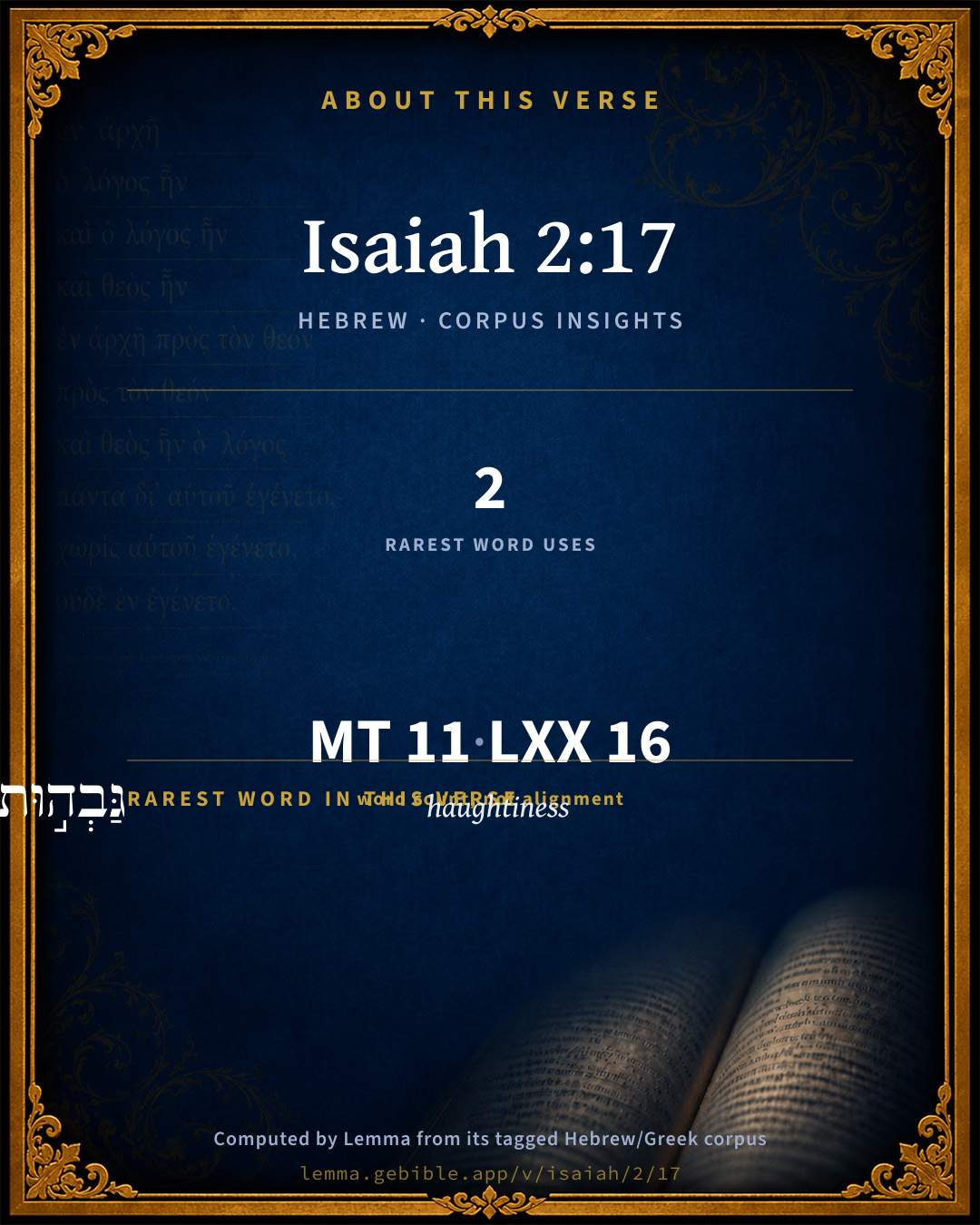
The rarest word here is גַּבְה֣וּת haughtiness H1365 — appearing just 2 times in the whole Hebrew Bible.

Shared distinctive vocabulary

גַּבְה֣וּת haughtiness H1365 occurs in 2 verses of the Hebrew Bible. Also found in:

Grammatical profile

  • 3 verbs
  • 7 nouns
  • 1 pronoun

Verb forms

  • וְשַׁח֙ Qal · Sequential Perfect
  • וְשָׁפֵ֖ל Qal · Sequential Perfect
  • וְנִשְׂגַּ֧ב Niphal · Sequential Perfect

Hebrew & Septuagint length

In English translation the verse runs 26 words from the Hebrew and 24 from the Septuagint (LXX English) — closely comparable.

A rough comparison of the two English renderings, which tokenize alike — not a word-level alignment.

Word counts can differ between the Hebrew and the Greek without any difference in meaning — e.g. the Hebrew direct-object marker אֵת has no separate Greek word, and Greek often adds the article ὁ.

In the original languages it is 11 Hebrew tokens and 16 Greek tokens — but the two are counted differently (Hebrew bundles its prefixes and suffixes into one token; the Greek is in lemma form), so that isn’t a like-for-like length.

Cross-references

4

Topical passages linked to Isaiah 2:17 in the Treasury of Scripture Knowledge — connected by theme and wording, ordered by reader-vote popularity; previews shown in the World English Bible.

  • Isaiah 2:11 The lofty looks of man will be brought low, The haughtiness of men will be bowed down, And Yahweh alone will be exalted in that day.
  • Jeremiah 48:29–30 We have heard of the pride of Moab, [that] he is very proud; his loftiness, and his pride, and his arrogance, and the haughtiness of his heart.
  • Isaiah 13:11 I will punish the world for [their] evil, and the wicked for their iniquity: and I will cause the arrogance of the proud to cease, and will lay low the haughtiness of the terrible.
  • Ezekiel 28:2–7 Son of man, tell the prince of Tyre, Thus says the Lord Yahweh: Because your heart is lifted up, and you have said, I am a god, I sit in the seat of God, in the midst of the seas; yet you are man, and not God, though you did set your heart as the heart of God;-

Cross-references courtesy of OpenBible.info (CC BY 4.0).

Hebrew and Greek witnesses Masoretic Hebrew ↔ Greek Septuagint

The same verse in the two great witnesses to the Old Testament, shown verse-for-verse.

These are two independent witnesses, not word-aligned to each other, and the Septuagint is shown in lemma (dictionary) form.

Hebrew Isaiah 2:17 Masoretic · Westminster Leningrad Codex

וְשַׁח֙ גַּבְה֣וּת הָאָדָ֔ם וְשָׁפֵ֖ל ר֣וּם אֲנָשִׁ֑ים וְנִשְׂגַּ֧ב יְהוָ֛ה לְבַדּ֖וֹ בַּיּ֥וֹם הַהֽוּא

The loftiness of man shall be bowed down, And the haughtiness of men shall be brought low; And Yahweh alone shall be exalted in that day.

World English Bible · Public Domain

Greek LXX Isaiah 2:17 Septuagint · lemma form

καί ταπεινόω πᾶς ἄνθρωπος καί πίπτω ὕψος ἄνθρωπος καί ὑψόω κύριος μόνος ἐν ὁ ἡμέρα ἐκεῖνος

And every man shall be brought low, and the pride of men shall fall: and the Lord alone shall be exalted in that day.

LXX2012 (modern English Septuagint) · Public Domain

Hebrew: Westminster Leningrad Codex (CC BY 4.0). Greek: Septuagint (public domain); English from LXX2012 (modern English Septuagint) (Public Domain). How the Septuagint differs from the Hebrew →

Targum (Aramaic paraphrase)

1

The Targum is the ancient Jewish Aramaic paraphrase of the Hebrew Scriptures — an interpretive translation, not the Hebrew text itself. Onkelos (literal) and Pseudo-Jonathan (expansive) render the Torah, and Jonathan the Prophets. Coverage is partial: where no permissively-licensed English translation exists for a verse, only the Aramaic is shown. This is verse-level text, not a word-by-word alignment to the Hebrew.

  1. Targum Jonathan Prophets (Joshua–Malachi)
    וְיִמְאַךְ רָמוּת אֱנָשָׁא וְיֶחֱלַשׁ תְּקוֹף גַבְרִין וְתַקִיף יְיָ בִּלְחוֹדוֹהִי בְּעִדָנָא הַהִיא:

    The pride of the common man shall be humbled, and the strength of the great men shall become weak, and the Lord alone shall be mighty in that time.

    Targum Jonathan — Aramaic: “Mikraot Gedolot” (public domain). English: “Sefaria Community Translation” (CC0 1.0 (public-domain dedication)); “London "Chaldee Paraphrase," 1871” (public domain). Text via Sefaria.

Commentary

Notes on Isaiah 2:17 from classic Christian and Jewish commentators (each source and its license shown beneath its notes). The classic Christian expositions comment on the surrounding passage and are grouped to its opening verse, so a note may address several verses; the Jewish commentaries on the Tanakh (Rashi and others) are per-verse, so they appear only where the commentator wrote on this verse.

Lemma curates 59 commentaries, every one of them public domain or Creative Commons licensed, each selected and text-cleaned for this edition rather than reprinted as found. About our sources →

Trapp's Complete Commentary

John Trapp

Isa 2:17 And the loftiness of man shall be bowed down, and the haughtiness of men shall be made low: and the LORD alone shall be exalted in that day.

Ver. 17. And the loftiness of man shall be.] This is oft inculcated, and all little enough to abate and abase the pride of people, and to "bring down every high thought that exalteth itself against the knowledge of God, and the obedience of Jesus Christ." {2Co 10:5} This holy fisherman, that he might catch souls, spreads his net, dilates his discourse, telling the proud person over and over what to trust to.

John Trapp, A Commentary or Exposition upon All the Books of the Old and New Testament (1647–1656) — public domain. Text from a community e-Sword module.

Joseph Benson's Commentary

Isa 2:17-18. And the loftiness of man shall be bowed down — Here the prophet expresses literally what he had delivered metaphorically in the preceding verses. The same things were asserted Isa 2:11, but they are here repeated, partly to assure the people of the certainty of them, and partly to fix them more deeply in their minds, because men are very backward to believe and consider things of this nature. And the idols he shall utterly abolish — He will discover the impotency of idols to succour their worshippers, and thereby destroy the worship of them in the world.

Joseph Benson's Commentary on the Old and New Testaments (1811–1818) — public domain. Text from a community e-Sword module.

The Preacher's Complete Homiletical Commentary

Joseph S. Exell (gen. ed.)

GOD EXALTED IN THE GREAT DAY

(Advent Sermon.)

Isa_2:17. The Lord alone shall be exalted in that day.

Two questions: What is “that day?” How shall the Lord then be exalted?

I. “That day.” “The first five verses of this chapter foretell the kingdom of the Messiah, the conversion of the Gentiles, and their admission into the Church. From the sixth verse to the end is foretold the punishment of the unbelieving Jews for their idolatrous practices, their confidence in their own strength, and distrust of God’s protection; and, moreover, the destruction of idolatry in consequence of the establishment of Messiah’s kingdom.”—Lowth. But here, as in many other portions of Scripture, a larger and remoter meaning looms beyond and behind the first sense of the expressions, which would otherwise be too big and swelling for the actual interpretation of them. Compare the description in which the text twice occurs with the almost parallel passages in chap. Isa_5:14-16. How magnificent! What startling terms! What emphatic iterations! Surely a want of fitness and congruity would almost be felt if expressions such as these referred only to some temporal calamity of the Jewish nation; surely we cannot mistake in looking onward to some mightier catastrophe, to some final exaltation of God and abasement of all creatures. By “that day,” therefore, we mean what is elsewhere called “the day,” “the great day,” “the day of judgment,” “the great and terrible day of the Lord”—the consummation of all things.

When that day shall come I do not know, and I am content to remain in ignorance. It may come suddenly, without warning, unannounced. Then it is for men always to have their lamps burning and their hearts in readiness, lest they be taken by surprise. It may come with great signs preceding and accompanying it. Then it is for men, according to their capacity, to note and discern those signs. It is the very uncertainty connected with it that is to make us watchful (Mat_24:36; Mat_24:42). We are to be vigilant and observant, without pretending to determine what God has left unrevealed. Such attempts have in all ages been made, and in all ages have been falsified. The failure of those attempts has not only covered those who made them or believed in them with ridicule, it has brought into discredit the sacred Book which the aim was to expound. It is our first duty and highest interest to be at every moment prepared; but a far other and better preparation may, and must be made for it, than in the futile endeavour to discover its precise date. [1294]

[1294] During the fifth century Chrysostom expressed himself in language which sounds almost like an anticipation of much that we hear at the present day. “No long time now remains until the consummation; but the world is hastening to its end. This the wars declare, this the afflictions, this the love which hath waxed cold. For as the body, when in its last gasp and near to death, draws to itself ten thousand sufferings; and as when a house is about to fall, many portions are wont to fall beforehand from the roofs and walls; so is the end of the world nigh and at the very doors, and, therefore, ten thousand woes are everywhere scattered abroad” (Homily xxxiv.) Towards the close of the tenth century, Bernhard, a hermit of Thuringia, and other persons, spread or encouraged the belief, that after the end of the thousandth year, the fetters of Satan were to be broken; and that, after the reign of Antichrist should be terminated, the world would be consumed by sudden conflagration. This wild and extraordinary delusion pervaded and possessed every rank of society. It seized on nobles, princes, and even bishops, as well as on the common people. Many renounced their pursuits and professions; abandoned their friends and families; gave themselves up to superstitious prayer and terrifying expectations, and made over all their substance to some adjacent church or monastery. Almost all the donations which were made to the Church in this century proceeded from this avowed motive, that the end of the world was drawing near. The form ran, “Appropinquante jam mundi termino,” &c. Others permitted their lands to lie waste, and their houses to decay; or betook themselves in hasty flight to the shelter of rocks and caverns, as if the temples of nature were destined to preservation amidst the wreck of man and his works.—Boone.

Equally unwise is the disposition to specify with a minute particularity the events which are to usher in the great day of the Lord, or the convulsions of nature which shall herald and proclaim it, or the astonishing circumstances with which it shall be arrayed. God has chosen to involve them in a mysterious and solemn indistinctness. In bold and sublime figures the inspired writers have delineated a scene which must stand singular and by itself, without any precedent or parallel, and which, therefore, neither human language can directly express nor human understanding adequately comprehend. Instead of endeavouring to explain the images and symbols employed, prudence will lead us to confine ourselves to the very words of Scripture, such as Dan_12:2; Joe_3:11-15; 2Co_5:10; Mat_25:31-32; Rev_20:11-13; 1Co_15:51-53. [1297] On these declarations we should meditate with serious and chastened minds, for if Scripture be true these words cannot be without a real and solemn meaning, and that meaning can only be that there shall be a day in which the world shall be judged by God in Christ, and that from before the Divine tribunal the good and the evil, separated from each other, shall depart to destinies final and irreversible (P. D. 2109).

[1297] I forbear to expatiate on the phenomena or the tokens which shall be premonitory of the Millennium or of the day of judgment. God has not seen fit, even in Scripture, to withdraw the curtain of obscurity from between us and that supreme future. We may well be content that our apprehensions should be vague, when the language of the Bible is not definite, and when we find rather the sublime and half-luminous gloom with which poetry or painting can invest its delineations, than the sharp and precise outline which the chisel can carve.—Boone.

II. In that day the Lord alone shall be exalted.

1. How is this possible? Is not God always exalted far above all blessing and praise? He will then be exalted in the sense in which He is now said to be glorified. He will be exalted in the visible homage and submission of an assembled universe. He will be exalted by the full manifestation of His attributes, in their unclouded and effulgent lustre, by the exhibition, before men and angels, of His omnipotence and justice, His wisdom and truth, His love and mercy, of the holiness of His law, the equity of His administration, the abundance of His grace, so that all hearts shall be bowed down at His footstool, and every mouth shall be stopped.

2. In that day God shall be exalted alone.

(1) The text may lead our minds to other deities as opposed to Jehovah. They shall indeed be gone; in that day they shall be seen to be less than the least of all their worshippers.

(2) It will be the great day of the disclosure of all things; and all creatures shall see the Lord as He is, and themselves also as they are. Therefore shall all the highest orders of celestial intelligences, the cherubim and seraphim, and all the ranks of existence which may occupy the interval between man and his Maker, veil their faces before His throne; they shall be as nothing in His sight. Then shall all creatureship fall low before the one Creator; all derived, dependent being shall shrink into its true dimensions before the Absolute, the Eternal, the I AM.

(3) Even Christ Himself, His office as the Messiah having been accomplished, and His administration of the Church, in His human character, being brought to a close, shall resign His mediatorial sway (1Co_15:24-28; H. E. I. 985).

(4) But our chief concern, as we are men, is with humanity: “The lofty looks of man shall be humbled, and the haughtiness of man shall be bowed down; and the Lord alone shall be exalted in that day.”

That day shall indeed declare the impotence of human power, the emptiness of human ambition, the nothingness of human renown. [1300] The very circumstances on account of which men have most lifted themselves up in their lifetime will be the occasions of their profoundest humiliation then.

[1300] What shall they all be, the strong rivalries and contentions, which shall have been hushed in the grave; the towering structures of vanity and earthly hope, which shall have been crushed before the moth; the schemes and plottings, the contrivances and expectations, the struggles and triumphs, which shall have been dropped into the burial-place where the worm is feeding on them! Oh, the thrones and dominions of mortality, the crowns and sceptres, the regal splendours and the imperial sway, how shall they then be reduced to their real and intrinsic insignificance! The victories of the warrior who conquered in a hundred fights, and the projects of the politician, whose statesmanship could grasp the globe; the famous men and heroes of the earth, with the poets who celebrated them, and the historians who recounted their exploits, what shall they be before the word of Omnipotence! The learning and science of the philosophers who framed their system of the universe for the admiration of posterity, what shall they be, before the blaze of illumination which shall be poured upon us in another world! The pageantries of courts and palaces; the banquets and the wine-cups, the spectacles and the entertainments, the mirrors and the lamps, the golden furniture of pomp, and the flowing robe of luxury; the great and the affluent, whose patronage was requested for busy undertakings, who were besieged with flattery and obsequiousness from morning to night; the noble and the beautiful, who gathered homage as they moved; the writers and the orators, whose popularity was unbounded, and who lived amidst the incense of human applause; they, and all that appertained to them, where and what shall they be, as we stand poor, and naked, and miserable before Him with whom we have to do! They, the heedless and the selfish, swimming in pleasure, who thought that the whole voyage of life was to be like Cleopatra’s passage along the Cydnus, one scene of mirth and gorgeousness; of prodigal dissipation and fatal revelry, with soft music and delicate odours floating in the air; what shall become of them! How black and cold shall be the cinders of their joy!

All human dynasties will then have crumbled to pieces, and all the gradations in the scale of human rank will then have been blotted out; for all must be dwarfed and prostrated before the ineffable majesty of the Most High God. All other differences must fade when the Divine summits are placed in contrast with them; as from the top of an exceeding high mountain the whole ground beneath is as a level plain, because from that vast altitude all smaller elevations are lost, all minuter inequalities of surface vanish. Human celebrity will then be as a sound, the very echoes of which will have departed. The pompous titles with which the vanity of man was pampered; the distinctions which kings could confer, or heraldry emblazon; privileges of caste, nobility of blood, the pride of ancestry, the blaze of reputation, the splendour of talents, shall then be confounded, one and all, as frivolous toys and trifling baubles. The mighty ones of the earth shall be no more than they who were of the poorest condition; the great shall stand abashed with the mean, the learned with the ignorant, monarchs with their subjects, senators and princes, commanders of fleets and armies, the loftiest and most renowned by the side of the husbandman and the labourer; for what shall they all be in contrast with Him, the Universal Creator, whose dwelling-place is eternity, and to whom belong, throughout all ages, all glory and dominion, sovereignty and praise?—Boone.

In that day our sinfulnesses shall sink us into the dust, and cover us with shame and confusion even more than our vanities. Shall any one of us hope then to be exalted, when the memories of us all shall retrace so many sterile and unproductive intentions, so many good impressions never fostered and ripened into fruits of righteousness, so many talents misused by our iniquity, or buried by our idleness? Then there shall be no more concealments, no more deceits, no more false excuses, no more of those pretences, equivocations, subterfuges, and sophisms which our reason is now so fatally ingenious in playing off upon itself (P. D. 661, 2106). Oh, think of these things, and let not your sins be dearer to you than your salvation. Think of them ere the night cometh, and the sun of your probation has quite gone down.

“The Lord alone shall be exalted in that day.” Will He then confound the righteous with the wicked? As compared with God there shall be no distinctions between men. All men on that great day at the bar of the Omniscient and the All Holy shall have upon them a universal sense of imperfection, unworthiness, insufficiency, nothingness. But as compared with each other there will be immense differences between them. It is one purpose of the great day to make manifest to all orders of being the infinite value and superiority of moral goodness, the infinite preciousness of a holy obedience above and beyond all else; then God, who sees it in secret, will reward it openly. When the wicked shall be turned into hell, with all the people that forget God, the righteous shall shine forth as the stars of heaven. Therefore estimate all things now as you will estimate them then. Lean less upon earth and man and the things present, set your affections more upon the things to come, upon heaven, and upon the Ruler of heaven. Cultivate diligently those dispositions which are pleasing in His sight. For then, when all social forms shall have vanished away, when all material substances shall have been obliterated, as the shapes in a cloud, and dissipated as the morning dew, your moral temper will abide with you, and your spiritual state, as discerned by the unerring Judge, will decide, and will attend, your immortal destiny (H. E. I. 720).—James Shergold Boone, M.A.: Sermons, pp. 359–399.

The Preacher's Complete Homiletical Commentary (gen. ed. Joseph S. Exell; Funk & Wagnalls, c. 1892) — public domain (pre-1929). A full-Bible homiletical/sermon-outline anthology covering 65 of 66 books (2 John is absent from the source module). Text from a community e-Sword module.

Keil & Delitzsch

C. F. Keil & F. Delitzsch

Isa 2:17 closes the second strophe of the proclamation of judgment appended to the earlier prophetic word: "And the haughtiness of the people is bowed down, and the pride of the lords brought low; and Jehovah, He alone, stands exalted on that day." The closing refrain only varies a little from Isa 2:11. The subjects of the verbs are transposed. With a feminine noun denoting a thing, it is almost a rule that the predicate shall be placed before it in masculine (Ges. 147, a).

Keil & Delitzsch — Biblical Commentary on the Old Testament (1861–1891) — public domain (CC PDM 1.0). Text via the HelloAO Bible API. (Old Testament only.)

Tyndale Open Study Notes

Tyndale Open Resources

2:17 The day of judgment is the “day of the Lord” (see 13:4-13).

Tyndale Open Study Notes — © Tyndale Open Resources, licensed CC BY-SA 4.0. Text via the HelloAO Bible API.

Jamieson, Fausset & Brown

Robert Jamieson, A. R. Fausset & David Brown

Repeated from Isa 2:11, for emphatic confirmation.

Jamieson, Fausset & Brown — Commentary Critical and Explanatory on the Whole Bible (1871) — public domain (CC PDM 1.0). Text via the HelloAO Bible API.

Ellicott's Commentary for English Readers

(17) And the loftiness of man shall be bowed down.—Iteration is used as the most solemn form of emphasis. That was the burden of the prophet’s song.

A Bible Commentary for English Readers, edited by Charles John Ellicott (1878–1897) — public domain. Text from a community e-Sword module.

John Gill's Exposition

And they shall go into the holes of the rocks, and into the caves of the earth,.... That is, the worshippers of idols, as they are bid to do, Isa 2:10.

for fear of the Lord, and for the glory of his majesty; see Gill on Isa 2:10.

when be ariseth; out of his place; Jarchi says, at the day of judgment; but it respects the judgment of the great whore, and the time when Babylon the great shall come in remembrance before God:

to shake terribly the earth; at which earthquake, or shaking of the earth, that is, a revolution of the antichristian state, the tenth part of the city will fall, and seven thousand men of name be slain, Rev 9:13 and so the Targum paraphrases it,

"when he shall be revealed, to break in pieces the wicked of the earth;''

which will be done by him, as the vessels of a potter are broken to shivers, Rev 2:27.

John Gill's Exposition of the Whole Bible (1746–1763) — public domain (CC PDM 1.0). Text via the HelloAO Bible API.

Albert Barnes' Notes on the Bible

And the loftiness ... - see the note at Isa 2:11. The repetition of this makes it strongly emphatic.

Albert Barnes' Notes on the Bible (1834–1885) — public domain. Text from a community e-Sword/MySword module.

Matthew Poole's English Annotations

This he repeats again, partly to assure us of the certainty of it, and partly to fix it deeper in men’s minds, because they are very backward to believe and consider things of this nature.

Matthew Poole's English Annotations on the Holy Bible (1683–1685) — public domain. Text from a community e-Sword/MySword module.

Whedon's Commentary on the Bible

Daniel D. Whedon

17. The proposition of Isa_2:11 is here resumed, as if to say, The case is made out. “So sinks the loftiness of man, and so bows the pride of man, and Jehovah alone is exalted.”

Daniel D. Whedon (gen. ed.), Commentary on the Old and New Testaments (1874–1909) — public domain. Text from a community e-Sword module.

The Pulpit Commentary

The loftiness of man. This verse interrupts the sequence of the thoughts somewhat awkwardly. It is a sort of refrain, (see ver. 11; and for the use of refrains in Hebrew poetry, see Exo_15:1, Exo_15:21) and perhaps comes in for rhythmical reasons, to the detriment of the sense.

The Pulpit Commentary (1880–1919), ed. H.D.M. Spence-Jones & Joseph S. Exell — public domain. Text from a community e-Sword module.

J. A. Alexander on Isaiah

Joseph Addison Alexander

This verse, by repeating the terms of v. 11, brings us back from details to the general proposition which they were designed to illustrate and enforce, and at the same time has the effect of a strophical arrangement, in which the same burden or chorus recurs at stated intervals. “And (thus, by this means, or in this way) shall the loftiness of man be cast down, and the pride of men be brought low, and Jehovah alone be exalted in that day.” Or retaining the form of the first two verbs, which are not passive but neuter, and exchanging the future for the present, the sentence may be thus translated. “So sinks the loftiness of man and bows the pride of men, and Jehovah alone is exalted in that day.”

Joseph Addison Alexander, The Prophecies of Isaiah (1846–1847; New York: Scribner, 1870–1878) — public domain. Text from a community e-Sword module.

unfoldingWord translationNotes

Door43 World Missions Community

General Information:

Isaiah speaks to the people of Judah in the form of a poem. He continues to describe what will happen on the day of Yahweh of Hosts (Isaiah 2:12). (See: Parallelism)

The pride of man will be brought low

This can be stated in active form. AT: "He will bring low every proud man" or "He will humiliate every proud man" (See: Active or Passive)

the haughtiness of men will fall

The abstract noun "haughtiness" can be translated as an adjective. AT: "those people who are haughty will stop being haughty" (See: Abstract Nouns)

Yahweh alone will be exalted

This can be stated in active form. See how you translated this in Isaiah 2:11. AT: "people will praise only Yahweh" (See: Active or Passive)

The idols will completely pass away

"All idols will disappear" or "There will be no more idols"

Men will go ... from the terror

The full meaning of this statement can be made clear. AT: "Men will go ... to hide from the terror" (See: Assumed Knowledge and Implicit Information)

the caves of the rocks

"the caves in the rocks." These are large rocks, not small stones that can be held in the hand.

from the terror of Yahweh, and from the glory of his majesty

See how you translated this in Isaiah 2:10.

from the terror of Yahweh

because they are very afraid of Yahweh

the glory of his majesty

Here the word "glory" describes "majesty." AT: "the beauty he has as king" (See: Hendiadys)

when he rises to terrify the earth

"when Yahweh takes action and causes the people of the earth to be terribly afraid of him"

translationWords

proud

haughty

exalt

day of the Lord

false god

terror

unfoldingWord translationNotes — © Distant Shores Media and the Door43 World Missions Community, licensed CC BY-SA 4.0. Source: git.door43.org/Door43/en_tn.

Rashi

Rabbi Shlomo Yitzchaki (Rashi)

on that day That is the Day of Judgment.

Rashi on the Tanakh — English translations: “The Judaica Press complete Tanach with Rashi, translated by A. J. Rosenberg” (CC BY 4.0); “Pentateuch with Rashi's commentary by M. Rosenbaum and A.M. Silbermann, 1929-1934” (public domain); “The Metsudah Tanach series, Lakewood, N.J” (CC BY 4.0); and “The Book of Joshua, Metsudah Publications, 1997” (CC BY 4.0). Text via Sefaria.

Ibn Ezra

Rabbi Abraham ibn Ezra

And the loftiness, etc. This idea is repeated here, because all the objects previously enumerated, excite pride in those that possess them, and cause dejection to those that lose them.

Ibn Ezra on the Tanakh — English translations: “Sefaria Community Translation” (CC0 1.0 (public-domain dedication)); “Yalkut, Sifsei Chachomim Chumash, Metsudah Publications, 2009” (CC BY 4.0); and “Commentary of Ibn Ezra on Isaiah - trans. by M. Friedlander, 1873” (public domain). Text via Sefaria.

Lesson kit

Teaching starters — assembled from the data on this page, not authored interpretation. Every prompt links to the verse data it draws on. Edit before teaching.

Isaiah, in the Prophets, opens this verse with 11 words (11 distinct Hebrew lemmas). Its most distinctive word is gabhûwth (“haughtiness”). A historical commentator’s framing appears above. Read the whole chapter for the surrounding context.

Discussion questions

  1. How does “haughtiness” (gabhûwth) shape what this verse is saying?
  2. How does Isaiah 2:11, which shares the word «haughtiness», read alongside this verse?
  3. These translations render this verse differently; the difference is in the English rendering, not the original. What questions does that raise?
  4. «וְשַׁח֙» is a Qal Sequential Perfect verb. How does that grammatical form shape the action described?
  5. Compare how Trapp's Complete Commentary and Joseph Benson's Commentary read this verse. Where do they agree or differ?

Things to notice

Reading settings

Reading text

Shown beneath each verse's original-language words.

Old Testament
Old Testament edition

Read the OT as the Masoretic Hebrew (MT) or the Greek Septuagint (LXX).

English shown for the Greek Septuagint (in the Hebrew ↔ Greek comparison).

Comparing translations? Open the Compare panel on any verse page to stack up to four side by side.