
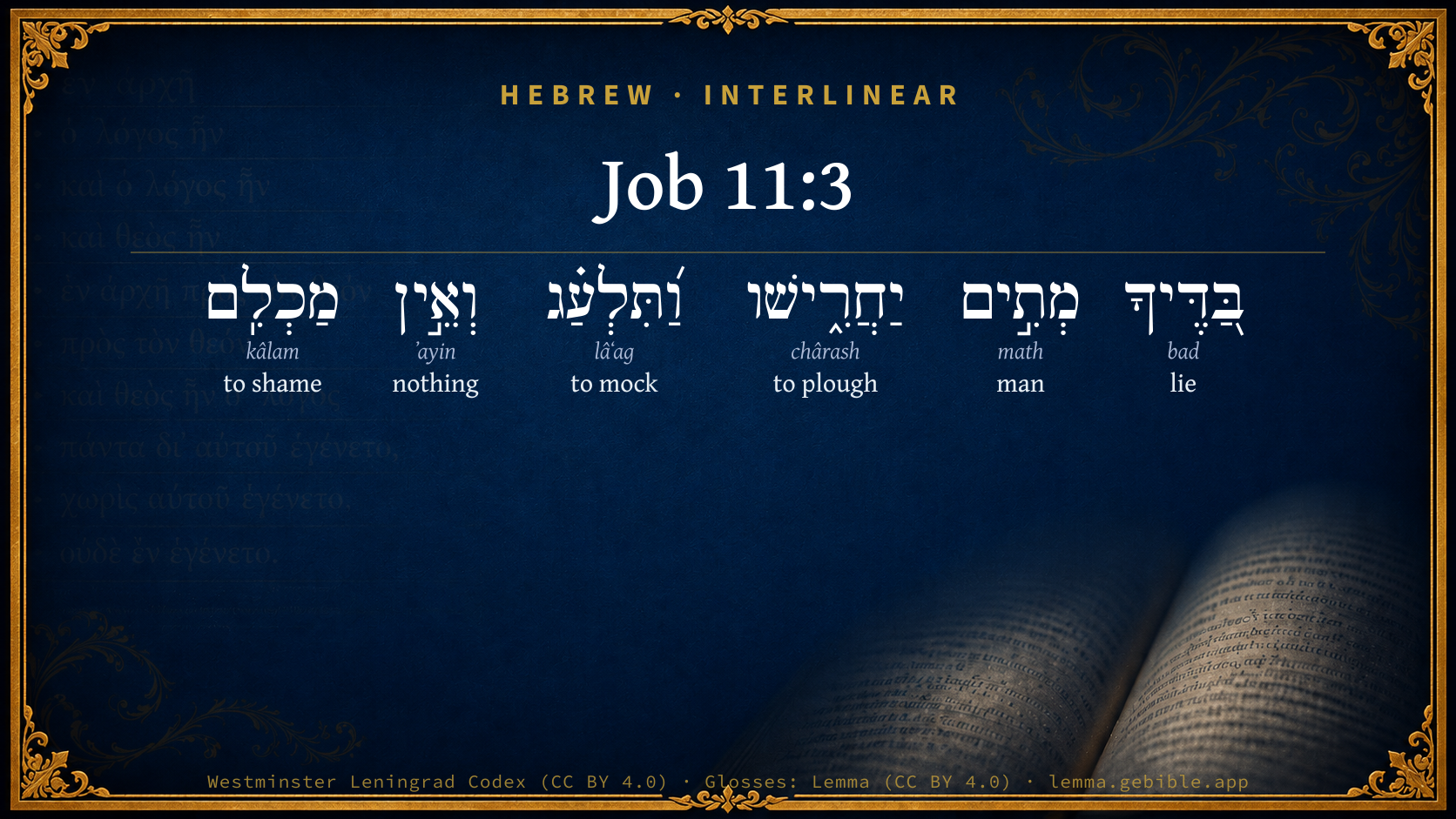
Job 11:3

Hebrew (Westminster Leningrad Codex) Job 11:3 appears in the Hebrew Old Testament. The text above is from the Westminster Leningrad Codex. Each word links to its Strong’s number, a concise gloss, and parsing drawn from the Open Scriptures Hebrew Bible morphology. Click any word for its full Brown-Driver-Briggs (BDB) entry.
Download image
Cite this verse

Job 11:3 (World English Bible). Public Domain. Lemma interlinear Bible study tool, https://lemma.gebible.app/v/job/11/3.

Show BibTeX & RIS
BibTeX
RIS
English Translation
Should your boastings make men hold their peace? When you mock, shall no man make you ashamed?
World English Bible · Public Domain
Highlights
  • 1 first appearance in the Hebrew Bible
Full analysis ↓
Download a study sheet

One document with this verse’s original text, its word-by-word gloss line, the meaning frame, cross-references with their text, attributed commentary, and full source and license credits — printable, and it pastes into notes with its structure intact.

This verse Autodidact and up

Study sheet (.html) Plain text (.txt)

A passage Seminary Student

Up to 50 verses in one chapter. A passage sheet keeps up to 6 commentary sources and 12 cross-references per verse, in the order this page ranks them, and says so on the sheet whenever that leaves anything out. Ask for a single verse and you get the Autodidact verse sheet above.

Everything on this page stays free to read, with no account — the sheet is a download of what is already on screen, not access to it.

Want to remove ads? Support Godless Engineer
Compare translations 3

The same verse in 3 English versions, stacked beneath the original-language interlinear above. Click any original word for its lexicon entry.

Each is an independent rendering of the whole verse — the interlinear is not word-aligned to these translations.

Highlighted words mark where these versions differ — a whole-verse word diff, not a word-by-word alignment.

  • World English Bible Public Domain
    Should your boastings make men hold their peace? When you mock, shall no man make you ashamed?
  • King James Version Public Domain
    Should thy lies make men hold their peace? and when thou mockest, shall no man make thee ashamed?
  • unfoldingWord Literal Text CC BY-SA 4.0
    Will your boastings make people silent? Or will you mock and no one shaming?

unfoldingWord Literal Text — © unfoldingWord, licensed CC BY-SA 4.0. Word-aligned USFM3 via Door43 (git.door43.org/unfoldingWord/en_ult).

Versions to compare (up to 4)

3 of 4 selected

Show all 18 translations

Every available English version of this verse, each an independent rendering of the whole verse.

  • World English Bible Public Domain
    Should your boastings make men hold their peace? When you mock, shall no man make you ashamed?
  • Berean Standard Bible Public Domain
    Should your babbling put others to silence? Will you scoff without rebuke?
  • Majority Standard Bible Public Domain
    Should your babbling put others to silence? Will you scoff without rebuke?
  • King James Version Public Domain
    Should thy lies make men hold their peace? and when thou mockest, shall no man make thee ashamed?
  • American Standard Version (1901) Public Domain
    Should thy boastings make men hold their peace? And when thou mockest, shall no man make thee ashamed?
  • Revised Version (1885) Public Domain
    Should thy boastings make men hold their peace? and when thou mockest, shall no man make thee ashamed?
  • Geneva Bible (1599) Public Domain
    Should men holde their peace at thy lyes? and when thou mockest others, shall none make thee ashamed?
  • Douay-Rheims (1899) Public Domain
    Shall men hold their peace to thee only? and when thou hast mocked others, shall no man confute thee?
  • Young's Literal Translation Public Domain
    Thy devices make men keep silent, Thou scornest, and none is causing blushing!
  • Literal Standard Version CC BY-SA 4.0
    Your boastings make men keep silent, || You scorn, and none is causing blushing!
  • Unlocked Literal Bible CC BY-SA 4.0
    Should your boasting make others remain silent? When you mock, will no one make you feel ashamed?
  • unfoldingWord Literal Text CC BY-SA 4.0
    Will your boastings make people silent? Or will you mock and no one shaming?
  • Darby Bible Public Domain
    Should thy fictions make men hold their peace? and shouldest thou mock, and no one make [thee] ashamed?
  • World Messianic Bible Public Domain
    Should your boastings make men hold their peace? When you mock, will no man make you ashamed?
  • Webster's Bible Public Domain
    Should thy falsehoods make men hold their peace? and when thou mockest, shall no man make thee ashamed?
  • Free Bible Version CC BY-SA 4.0
    Should all your babbling force people to keep quiet? When you mock, shouldn't someone make you feel ashamed?
  • Bible in Basic English Public Domain
    Are your words of pride to make men keep quiet? and are you to make sport, with no one to put you to shame?
  • JPS Tanakh (1917) Public Domain
    Thy boastings have made men hold their peace, and thou hast mocked, with none to make thee ashamed;

Literal Standard Version (2020), Covenant Press — licensed CC BY-SA 4.0. Text via the HelloAO Bible API (eBible.org). Unlocked Literal Bible (unfoldingWord) — licensed CC BY-SA 4.0. Text via the HelloAO Bible API (eBible.org). unfoldingWord Literal Text — © unfoldingWord, licensed CC BY-SA 4.0. Word-aligned USFM3 via Door43 (git.door43.org/unfoldingWord/en_ult). Free Bible Version, Dr. Jonathan Gallagher — licensed CC BY-SA 4.0. Text via the HelloAO Bible API (eBible.org).

Word by word

More ways to search: Search by grammar → Find every occurrence → Compare this word →

Practice this passage: Drill this verse → Learn its vocabulary →

About this verse

These counts appear in no published source. They are computed here, from the morphology-tagged text and Lemma’s own curated glosses. What Lemma adds →

6
words
6
distinct lemmas
Wisdom
section

Notable vocabulary

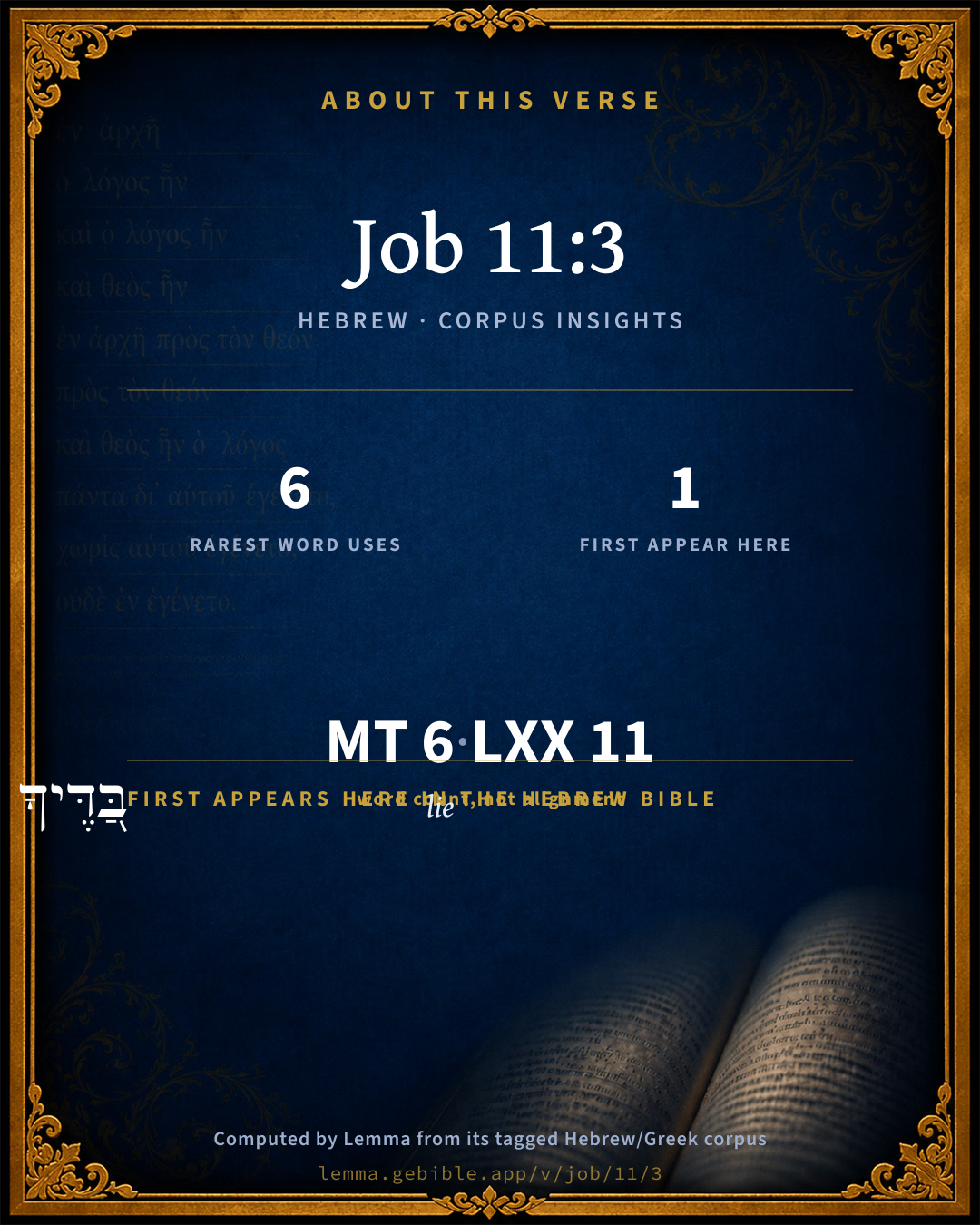
The rarest word here is בַּ֭דֶּיךָ lie H907 — appearing just 6 times in the whole Hebrew Bible.

First appearance in Scripture

This word makes its first canonical appearance in the Hebrew Bible here:

  • בַּ֭דֶּיךָ lie H907

Shared distinctive vocabulary

בַּ֭דֶּיךָ lie H907 occurs in 6 verses of the Hebrew Bible. Also found in:

Grammatical profile

  • 3 verbs
  • 2 nouns
  • 1 particle

Verb forms

  • יַחֲרִ֑ישׁו Hiphil · Imperfect
  • וַ֝תִּלְעַ֗ג Qal · Sequential Imperfect
  • מַכְלִֽם Hiphil · Participle Active

Hebrew & Septuagint length

In English translation the verse runs 17 words from the Hebrew and 14 from the Septuagint (LXX English) — closely comparable.

A rough comparison of the two English renderings, which tokenize alike — not a word-level alignment.

Word counts can differ between the Hebrew and the Greek without any difference in meaning — e.g. the Hebrew direct-object marker אֵת has no separate Greek word, and Greek often adds the article ὁ.

In the original languages it is 6 Hebrew tokens and 11 Greek tokens — but the two are counted differently (Hebrew bundles its prefixes and suffixes into one token; the Greek is in lemma form), so that isn’t a like-for-like length.

Cross-references

14

Topical passages linked to Job 11:3 in the Treasury of Scripture Knowledge — connected by theme and wording, ordered by reader-vote popularity; previews shown in the World English Bible.

  • Job 17:2 Surely there are mockers with me, My eye dwells on their provocation.
  • Job 12:4 I am like one who is a joke to his neighbor, I, who called on God, and he answered. The just, the blameless man is a joke.
  • Job 13:4 But you are forgers of lies. You are all physicians of no value.
  • Job 13:9 Is it good that he should search you out? Or as one deceives a man, will you deceive him?
  • Job 15:2–3 "Should a wise man answer with vain knowledge, And fill himself with the east wind?
  • Job 21:3 Allow me, and I also will speak; After I have spoken, mock on.
  • Job 24:25 If it isn't so now, who will prove me a liar, And make my speech worth nothing?"
  • Job 34:7 What man is like Job, Who drinks scorn like water,
  • Psalms 35:16 Like the profane mockers in feasts, They gnashed their teeth at me.
  • Psalms 83:16 Fill their faces with confusion, That they may seek your name, Yahweh.
  • Jeremiah 15:17 I didn't sit in the assembly of those who make merry, nor rejoiced; I sat alone because of your hand; for you have filled me with indignation.
  • 2 Thessalonians 3:14 If any man doesn't obey our word in this letter, note that man, that you have no company with him, to the end that he may be ashamed.
  • Titus 2:8 and soundness of speech that can't be condemned; that he who opposes you may be ashamed, having no evil thing to say about us.
  • Jude 1:18 They said to you that "In the last time there will be mockers, walking after their own ungodly lusts."

Cross-references courtesy of OpenBible.info (CC BY 4.0).

Hebrew and Greek witnesses Masoretic Hebrew ↔ Greek Septuagint

The same verse in the two great witnesses to the Old Testament, shown verse-for-verse.

These are two independent witnesses, not word-aligned to each other, and the Septuagint is shown in lemma (dictionary) form.

Hebrew Job 11:3 Masoretic · Westminster Leningrad Codex

בַּ֭דֶּיךָ מְתִ֣ים יַחֲרִ֑ישׁו וַ֝תִּלְעַ֗ג וְאֵ֣ין מַכְלִֽם

Should your boastings make men hold their peace? When you mock, shall no man make you ashamed?

World English Bible · Public Domain

Greek LXX Job 11:3 Septuagint · lemma form

μή πολύς ἐν ῥῆμα γίγνομαι οὐ γάρ εἰμί ὁ ἀντικρίνω σύ

Be not a speaker of many words; for is there none to answer you?

LXX2012 (modern English Septuagint) · Public Domain

On this verse, Trapp's Complete Commentary discusses the Septuagint’s reading. Read the note in Commentary ↓

Hebrew: Westminster Leningrad Codex (CC BY 4.0). Greek: Septuagint (public domain); English from LXX2012 (modern English Septuagint) (Public Domain). How the Septuagint differs from the Hebrew →

Commentary

Notes on Job 11:3 from classic Christian and Jewish commentators (each source and its license shown beneath its notes). The classic Christian expositions comment on the surrounding passage and are grouped to its opening verse, so a note may address several verses; the Jewish commentaries on the Tanakh (Rashi and others) are per-verse, so they appear only where the commentator wrote on this verse.

Lemma curates 59 commentaries, every one of them public domain or Creative Commons licensed, each selected and text-cleaned for this edition rather than reprinted as found. About our sources →

Trapp's Complete Commentary

John Trapp

Job 11:3 Should thy lies make men hold their peace? and when thou mockest, shall no man make thee ashamed?

Ver. 3. Should thy lies make men hold their peace?] Or, thy toys, toilsome toys, hammered in thine own head, hatched in thine own heart, which is deceitful above all things, and so a fit shop to frame lies in; but should we be silent at the hearing of them, and so become guilty of thy sin by a tacit consent? Can any mortal wight hear what thou hast said in behalf of thine own imaginary innocence, Job 6:29-30, and how bold an appeal thou hast made to God as a witness thereof, Job 10:7, and not reply upon thee, and reprove thee? The truth is, had Job been a liar, as Zophar would make of him (even mendaciorum loquacissimum, as Tertullian saith of Tacitus, one that fearing his many words would not carry his cause, had intermixed various untruths, the better to grace the business), he ought not to have been forborne by Zophar or any else that wished well to his soul: but it was far from good Job to be guilty of this foul sin, so hated of God, so like the devil, so inconsistent with religion. Christianus est, non mentietur, he is a Christian, you may be sure he will not lie, was the old argument; he will rather die than lie. David indeed, in a distress, roundly told two or three lies together to Abimelech the high priest, who suspected that he fled as a proscribed person, 1Sa 21:2; 1Sa 21:8; 1Sa 27:10. But that he allowed not this sin in himself it appeareth in that, 1. He had chosen the way of truth, his election was truth, Psa 119:30. And, 2. He prayed against the contrary evil, "remove from me the way of lying," Psa 119:29. He was not one of those that took fast hold of deceit, as Jeremiah phraseth it, Job 8:5. Much less was Job; however, Zophar was mistaken in him, as he was much more in his next charge, wherein he maketh him a scoffer of God and good people.

And when thou mockest, shall no man make thee ashamed?] Job is made a mocker here; yea, a scorner, and derider, as the word signifieth, such as David describeth, Psa 22:6, and the author to the Hebrews, Heb 11:36, where he speaks of cruel mockings, such as the Scripture everywhere (but especially in the Proverbs) brandeth for the worst sort of sinners. See Psa 1:1, where the Septuagint translate for scorners, pests; as elsewhere incorrigible, Pro 21:1; naught, Pro 9:12; λοιμοι, ακολαστος, κακος, proud, Pro 3:34; workers of iniquity, υπερηφανοι παρηνομουν, Psa 119:51. But where did Job mock in Zophar’s judgment? First, he spoke contemptuously (as he thought) of God, as Job 10:3, "Is it good unto thee that thou shouldest oppress?" &c. And whereas he spake better sometimes of God’s wisdom and righteousness, Zophar thought it was but from the teeth outward; but poor Job had little list or leisure to mock and jeer. Next, he mocked his friends for saving that he was justly afflicted, saying that they were cold comforters, void of God s fear, merciless men, &c. This they took in very ill part, and Zophar thinks to make him ashamed of it; for saith he,

Shall no man make thee ashamed?] sc. By refuting thee, and by bringing thee to a due sight of thine error. This good office he that shall undertake to do for another, must be sure that he be able to do it effectually, else better not to attempt it. When Carolostadius opposed Luther’s consubstantiation only weakly and insufficiently, Zuinglius said, he was sorry that so good a cause lacked shoulders, Non satis humerorum haberet.

John Trapp, A Commentary or Exposition upon All the Books of the Old and New Testament (1647–1656) — public domain. Text from a community e-Sword module.

Albert Barnes' Notes on the Bible

Should thy lies - Margin, “devices.” Rosenmuller renders this, “should men bear thy boastings with silence?” Dr. Good, “before thee would man-kind keep silence?” Vulgate, “tibi soli tacebunt homines?” “Shall men be silent before thee alone? The Septuagint tenders the whole passage, “he who speaketh much should also hear in turn; else the fine speaker (εὔλαλος eulalos) thinketh himself just. - Blessed be the short-lived offspring of woman. Be not profuse of words, for there is no one that judges against thee, and do not say that I am pure in works and blameless before him?” How this was made out of the Hebrew, or what is its exact sense, I am unable to say. There can be no doubt, I think, that our present translation is altogether too harsh, and that Zophar by no means designs to charge Job with uttering lies. The Hebrew word commonly used for lies, is wholly different from that which is used here. The word here (בד bad) denotes properly “separation;” then a part; and in various combinations as a preposition, “alone separate.” “besides.” Then the noun means empty talk, vain boasting; and then it may denote lies or falsehood. The leading idea is that of separation or of remoteness from anything, as from prudence, wisdom, propriety, or truth. It is a general term, like our word “bad,” which I presume has been derived from this Hebrew word (בד bad), or from the Arabic “bad.” In the plural (בדים badı̂ym) it is rendered “liars” in Isa 44:25; Jer 50:36; “lies” in Job 11:3; Isa 16:6; Jer 48:30; and “parts” in Job 41:12. It is also often rendered “staves,” Exo 27:6; Exo 25:14-15, Exo 25:28, et sap, at. That it may mean “lies” here I admit, but it may also mean talk that is aside from propriety, and may refer here to a kind of discourse that was destitute of propriety, empty, vain talk.

And when thou mockest - That-is, “shalt thou be permitted to use the language of reproach and of complaint, and no one attempt to make thee sensible of its impropriety?” The complaints and arguments of Job he represented as in fact mocking God.

Shall no man make thee ashamed? - Shall no one show thee the impropriety of it, and bring thy mind to a sense of shame for what it has done? This was what Zophar now proposed to do.

Albert Barnes' Notes on the Bible (1834–1885) — public domain. Text from a community e-Sword/MySword module.

Joseph Benson's Commentary

Job 11:3. Should thy lies — That is, thy false opinions and assertions, both concerning thyself and thy own innocence, and concerning the counsels and ways of God, make men hold their peace? — As if thy arguments were unanswerable. And when thou mockest — Both God and us, and our friendly and faithful counsels; shall no man make thee ashamed? — By discovering thy errors and follies.

Joseph Benson's Commentary on the Old and New Testaments (1811–1818) — public domain. Text from a community e-Sword module.

Jamieson, Fausset & Brown

Robert Jamieson, A. R. Fausset & David Brown

lies--rather, "vain boasting" (Isa 16:6; Jer 48:30). The "men" is emphatic; men of sense; in antithesis to "vain boasting."

mockest--upbraidest God by complaints, "shall no man make thee ashamed?"

Jamieson, Fausset & Brown — Commentary Critical and Explanatory on the Whole Bible (1871) — public domain (CC PDM 1.0). Text via the HelloAO Bible API.

Adam Clarke's Commentary

Verse 3. Should thy lies make men hold their peace?] This is a very severe reproof, and not justified by the occasion.

And when thou mockest] As thou despisest others, shall no man put thee to scorn? Zophar could never think that the solemn and awful manner in which Job spoke could be called bubbling, as some would translate the term לעג laag. He might consider Job's speech as sarcastic and severe, but he could not consider it as nonsense.

Adam Clarke's Commentary on the Bible (1810–1826) — public domain. Text from a community e-Sword/MySword module.

The Cambridge Bible for Schools and Colleges

gen. ed. J. J. S. Perowne

3. Should thy lies] Or, Shall thy boastings, or, as Reuss, “ton verbiage.” The reference is probably to Job’s assertions of his own innocence, or perhaps the general scope of his speech. The word “men” is as we should say “people”—shall thy boastings put people to silence?

and when thou mockest] Or, so that thou mockest, none putting thee to shame. Job’s “mockery” or irreligious, sceptical talk is summed up in Job_11:4. This mockery is called “scorning,” ch. Job_34:6.

The Cambridge Bible for Schools and Colleges (gen. ed. J. J. S. Perowne; Cambridge University Press, 1878–1918) — public domain. Text from a community e-Sword module.

John Gill's Exposition

Should thy lies make men hold their peace?.... By which he means, either lies in common, untruths wilfully told, which are sins of a scandalous nature, which good men will not dare to commit knowingly; and to give a man, especially such a man, the lie, is very indecent; and to charge a man falsely with it is very injurious: or else doctrinal ones, errors in judgment, falsehoods concerning God and things divine; which not only are not of the truth, for no lie is of the truth, but are against it; and indeed where the case is notorious in either sense, men should not be silent, or be as men deaf and dumb, as the word (u) signifies, as if they did not hear the lies told them, or were unconcerned about them, or connived at them: David would not suffer a liar to be near him, nor dwell in his house, Psa 101:7; a common liar ought to be reproved and rejected; and doctrinal liars and lies should be opposed and resisted; truth should be contended for, and nothing be done against it, but everything for it: it is criminal to be silent at either sort of lies; nor should the bold and blustering manner in which they are told frighten men from a detection of them, which perhaps is what may be hinted at here (w); some render the words (x), "should thine iniquity frighten men?" they are not so strong and nervous as to appear unanswerable, and deter men from undertaking a reply unto them:

and, when thou mockest, shall no man make thee ashamed? here Job is represented as a mocker of God, which is inferred from Job 10:3; and at his friends, and the arguments they used, and the advice they gave, which is concluded from his words in Job 6:25; and as one hardened, who was not, and could not be made ashamed of what he had said against either, by anything that had been offered for his reproof and conviction: to make a mock of God, or a jest of divine things, or scoff at good men, is very bad; indeed it is the character of the worst of men; and such should be made ashamed, if possible, by exposing their sin and folly; and if not here, they will be covered with shame hereafter, when they shall appear before God, the Judge of all, who will not be mocked, and shall see the saints at the right hand of Christ, whom they have jeered and scoffed at: but this was not Job's true character; he was no mocker of God nor of good men; in this he was wronged and injured, and had nothing of this sort to be made ashamed of.

(u) So Ben Melech. (w) "jactantias tuas", Cocceius. (x) "Tuane argumenta mortales consternabunt?" Codurcus.

John Gill's Exposition of the Whole Bible (1746–1763) — public domain (CC PDM 1.0). Text via the HelloAO Bible API.

Haydock's Catholic Bible Commentary

Men. Hebrew, "shall thy lies make men keep silence?" Septuagint, "Blessed be the short-lived son of a woman. Speak not much, for there is no one to give sentence against thee." (Haydock) --- Mocked, by not acquiescing to their solid arguments, (Menochius) and speaking with much animation. (Pineda)

George Leo Haydock (1774–1849), Haydock's Catholic Family Bible and Commentary, 1859 edition — public domain. Excludes Psalms (Douay-Rheims chapter numbering differs from Protestant) and Deuterocanonical books (Catholic canon only).

Matthew Poole's English Annotations

Thy lies, i.e. thy false opinions and assertions, both concerning thyself and thy own innocency, and concerning the counsels and ways of God, make men hold their peace; as if thy arguments were unanswerable.

When thou mockest, both God, Job 10:3, and us, and our friendly and faithful counsels, Job 6:14,15,25,26,

shall no man make thee ashamed, by discovering thy errors and follies?

Matthew Poole's English Annotations on the Holy Bible (1683–1685) — public domain. Text from a community e-Sword/MySword module.

Whedon's Commentary on the Bible

Daniel D. Whedon

3. Thy lies — The Hebrew also means babblings, boastings. “To say or to suggest that a man lies, is, with us, enough to kindle the weakest spirit, and is, with many, a murderous affront, while an Oriental will listen to the coarsest imputations of falsehood with an undisturbed countenance.” — KITTO, D. B. Illus. The present stage of the debate would hardly justify so offensive a word as that of the Authorized Version, lies. Zophar has in view such expressions as Job_9:21; Job_9:35; Job_10:7.

Daniel D. Whedon (gen. ed.), Commentary on the Old and New Testaments (1874–1909) — public domain. Text from a community e-Sword module.

The Pulpit Commentary

Should thy lies make men hold their peace? or, thy boastings. (see the Revised Version; and comp. Isa_16:5 Jer_48:30) Zophar probably refers to such passages as Job_9:20, 35 10:7, 15, where Job might seem to have justified himself altogether. And when thou mockest, shall no man make thee ashamed I It is not quite easy to see what in Job"s speeches up to this point could be regarded as "mocking." But perhaps Zophar would have thus characterized the following passages: Job_6:13, Job_6:14, 25-27 7:12 9:22-24.

The Pulpit Commentary (1880–1919), ed. H.D.M. Spence-Jones & Joseph S. Exell — public domain. Text from a community e-Sword module.

John Wesley's Explanatory Notes

Lies - Both concerning thy own innocency, and concerning the counsels and ways of God. Mockest - Our friendly and faithful counsels, chap. vi, 14, 15, 25, 26.

John Wesley, Explanatory Notes Upon the Whole Bible (1754–1765) — public domain. Text via the GEBible commentary corpus.

Rashi

Rabbi Shlomo Yitzchaki (Rashi)

Your fabrications that you invent from your heart.

may silence men Heb. מתים, people.

Rashi on the Tanakh — English translations: “The Judaica Press complete Tanach with Rashi, translated by A. J. Rosenberg” (CC BY 4.0); “Pentateuch with Rashi's commentary by M. Rosenbaum and A.M. Silbermann, 1929-1934” (public domain); “The Metsudah Tanach series, Lakewood, N.J” (CC BY 4.0); and “The Book of Joshua, Metsudah Publications, 1997” (CC BY 4.0). Text via Sefaria.

Lesson kit

Teaching starters — assembled from the data on this page, not authored interpretation. Every prompt links to the verse data it draws on. Edit before teaching.

Job, in the Wisdom, opens this verse with 6 words (6 distinct Hebrew lemmas). Its most distinctive word is bad (“lie”). A historical commentator’s framing appears above. Read the whole chapter for the surrounding context.

Discussion questions

  1. How does “lie” (bad) shape what this verse is saying?
  2. The word “lie” first appears here in Scripture. What is being introduced at this debut?
  3. Job 41:12 shares the word «lie» with this verse. How do the two illuminate each other?
  4. These translations render this verse differently. What is at stake in choosing one wording over another?
  5. The verb «יַחֲרִ֑ישׁו» is Hiphil Imperfect. How does its form color the action?
  6. Reading how Trapp's Complete Commentary and Albert Barnes' Notes on the Bible read this verse, where do the two commentators agree and where do they part?

Things to notice

Reading settings

Reading text

Shown beneath each verse's original-language words.

Old Testament
Old Testament edition

Read the OT as the Masoretic Hebrew (MT) or the Greek Septuagint (LXX).

English shown for the Greek Septuagint (in the Hebrew ↔ Greek comparison).

Comparing translations? Open the Compare panel on any verse page to stack up to four side by side.