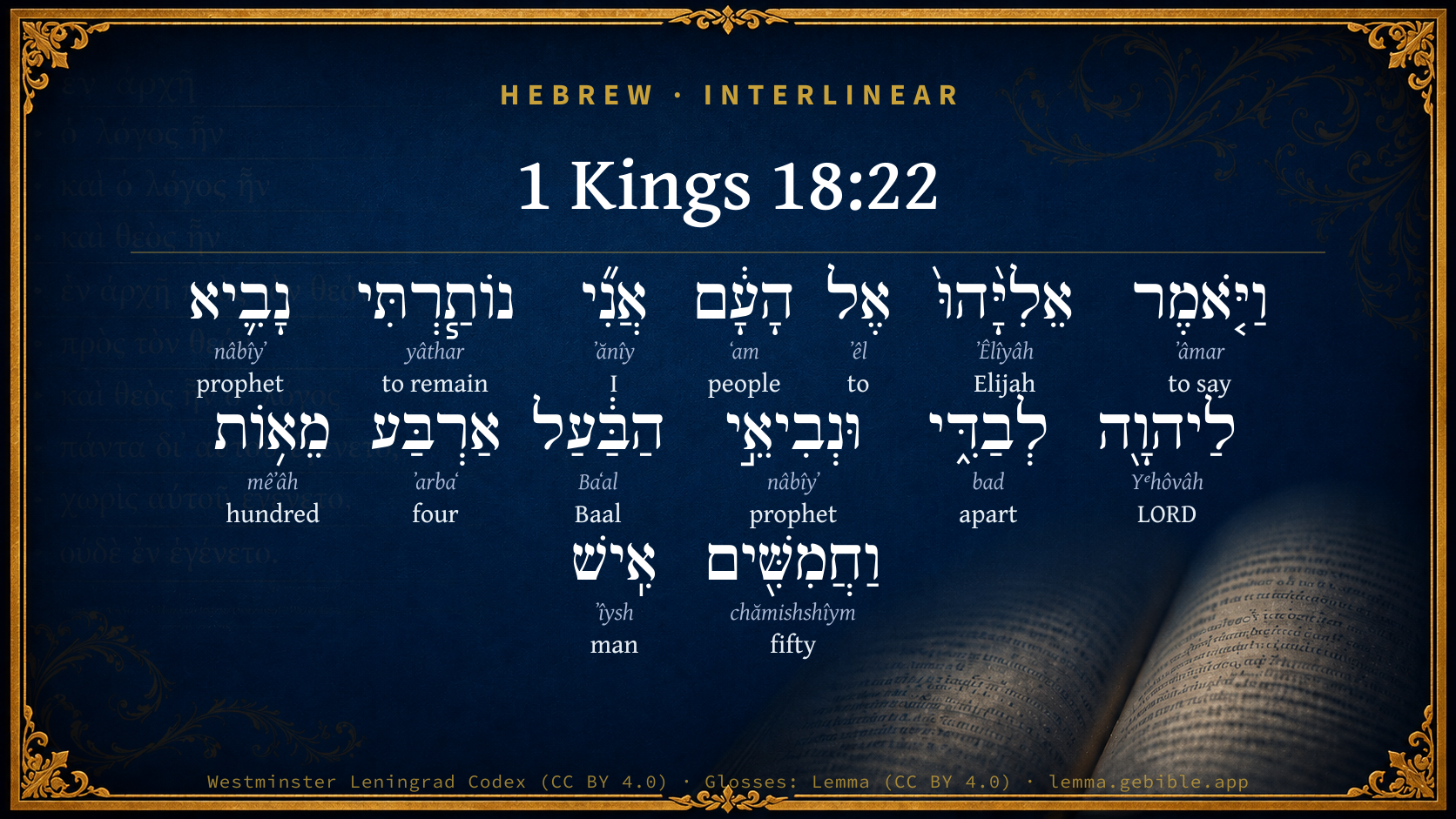
1 Kings 18:22

Hebrew (Westminster Leningrad Codex) 1 Kings 18:22 appears in the Hebrew Old Testament. The text above is from the Westminster Leningrad Codex. Each word links to its Strong’s number, a concise gloss, and parsing drawn from the Open Scriptures Hebrew Bible morphology. Click any word for its full Brown-Driver-Briggs (BDB) entry.
Download image
Cite this verse

1 Kings 18:22 (World English Bible). Public Domain. Lemma interlinear Bible study tool, https://lemma.gebible.app/v/1-kings/18/22.

Show BibTeX & RIS
BibTeX
RIS
English Translation
Then Elijah said to the people, "I, even I only, am left a prophet of Yahweh; but Baal's prophets are four hundred fifty men.
World English Bible · Public Domain
Download a study sheet

One document with this verse’s original text, its word-by-word gloss line, the meaning frame, cross-references with their text, attributed commentary, and full source and license credits — printable, and it pastes into notes with its structure intact.

This verse Autodidact and up

Study sheet (.html) Plain text (.txt)

A passage Seminary Student

Up to 50 verses in one chapter. A passage sheet keeps up to 6 commentary sources and 12 cross-references per verse, in the order this page ranks them, and says so on the sheet whenever that leaves anything out. Ask for a single verse and you get the Autodidact verse sheet above.

Everything on this page stays free to read, with no account — the sheet is a download of what is already on screen, not access to it.

Want to remove ads? Support Godless Engineer
Compare translations 3

The same verse in 3 English versions, stacked beneath the original-language interlinear above. Click any original word for its lexicon entry.

Each is an independent rendering of the whole verse — the interlinear is not word-aligned to these translations.

Highlighted words mark where these versions differ — a whole-verse word diff, not a word-by-word alignment.

  • World English Bible Public Domain
    Then Elijah said to the people, "I, even I only, am left a prophet of Yahweh; but Baal's prophets are four hundred fifty men.
  • King James Version Public Domain
    Then said Elijah unto the people, I, even I only, remain a prophet of the LORD; but Baal's prophets are four hundred and fifty men.
  • unfoldingWord Literal Text CC BY-SA 4.0
    And Elijah said to the people, “I, I remain a prophet of Yahweh by myself, but the prophets of Baal 450 men.

unfoldingWord Literal Text — © unfoldingWord, licensed CC BY-SA 4.0. Word-aligned USFM3 via Door43 (git.door43.org/unfoldingWord/en_ult).

Versions to compare (up to 4)

3 of 4 selected

Show all 18 translations

Every available English version of this verse, each an independent rendering of the whole verse.

  • World English Bible Public Domain
    Then Elijah said to the people, "I, even I only, am left a prophet of Yahweh; but Baal's prophets are four hundred fifty men.
  • Berean Standard Bible Public Domain
    Then Elijah said to the people, “I am the only remaining prophet of the LORD, but Baal has four hundred and fifty prophets.
  • Majority Standard Bible Public Domain
    Then Elijah said to the people, “I am the only remaining prophet of the LORD, but Baal has four hundred and fifty prophets.
  • King James Version Public Domain
    Then said Elijah unto the people, I, even I only, remain a prophet of the LORD; but Baal's prophets are four hundred and fifty men.
  • American Standard Version (1901) Public Domain
    Then said Elijah unto the people, I, even I only, am left a prophet of Jehovah; but Baal's prophets are four hundred and fifty men.
  • Revised Version (1885) Public Domain
    Then said Elijah unto the people, I, even I only, am left a prophet of the LORD; but Baal’s prophets are four hundred and fifty men.
  • Geneva Bible (1599) Public Domain
    Then said Eliiah vnto the people, I onely remayne a Prophet of the Lord: but Baals prophets are foure hundreth and fiftie men.
  • Douay-Rheims (1899) Public Domain
    And Elias said again to the people: I only remain a prophet of the Lord: but the prophets of Baal are four hundred and fifty men.
  • Young's Literal Translation Public Domain
    And Elijah saith unto the people, `I -- I have been left a prophet of Jehovah -- by myself; and the prophets of Baal `are' four hundred and fifty men;
  • Literal Standard Version CC BY-SA 4.0
    And Elijah says to the people, “I have been left, by myself, a prophet of YHWH; and the prophets of Ba‘al [are] four hundred and fifty men;
  • Unlocked Literal Bible CC BY-SA 4.0
    Then Elijah said to the people, “I, I alone, am left as a prophet of Yahweh, but Baal's prophets are 450 men.
  • unfoldingWord Literal Text CC BY-SA 4.0
    And Elijah said to the people, “I, I remain a prophet of Yahweh by myself, but the prophets of Baal 450 men.
  • Darby Bible Public Domain
    And Elijah said to the people, I, only I, remain a prophet of Jehovah; and Baal's prophets are four hundred and fifty men.
  • World Messianic Bible Public Domain
    Then Elijah said to the people, “I, even I only, am left as a prophet of the LORD; but Baal’s prophets are four hundred fifty men.
  • Webster's Bible Public Domain
    Then said Elijah to the people, I even I only, remain a prophet of the LORD; but Baal's prophet's are four hundred and fifty men.
  • Free Bible Version CC BY-SA 4.0
    Then Elijah told them, “I am the only one left of the Lord's prophets—just me alone—but Baal has four hundred and fifty prophets.
  • Bible in Basic English Public Domain
    Then Elijah said to the people, I, even I, am the only living prophet of the Lord; but Baal's prophets are four hundred and fifty men.
  • JPS Tanakh (1917) Public Domain
    Then said Elijah unto the people: 'I, even I only, am left a prophet of the LORD; but Baal's prophets are four hundred and fifty men.

Literal Standard Version (2020), Covenant Press — licensed CC BY-SA 4.0. Text via the HelloAO Bible API (eBible.org). Unlocked Literal Bible (unfoldingWord) — licensed CC BY-SA 4.0. Text via the HelloAO Bible API (eBible.org). unfoldingWord Literal Text — © unfoldingWord, licensed CC BY-SA 4.0. Word-aligned USFM3 via Door43 (git.door43.org/unfoldingWord/en_ult). Free Bible Version, Dr. Jonathan Gallagher — licensed CC BY-SA 4.0. Text via the HelloAO Bible API (eBible.org).

Word by word

More ways to search: Search by grammar → Find every occurrence → Compare this word →

Practice this passage: Drill this verse → Learn its vocabulary →

אֵלִיָּ֨הוּ֙
ʼÊlîyâh
H452
“Elijah”
Noun, Proper
Part of Speech
Noun
Type
Proper
Full BDB Definition

Origin: from H410 and H3050

TWOT: None

Elijah or Eliah = "my God is Jehovah" or " Yah(u) is God" - the great prophet of the reign of Ahab - Benjamite son of Jeroham - a son of Elam with foreign wife during exile - a son of Harim, and priest, with foreign wife during exile
  1. וַיֹּ֤אמֶר ʼâmar H559 “and · to say” Conjunction + Verb, Qal, Sequential Imperfect, 3rd Person, Masculine, Singular
  2. אֶל ʼêl H413 “to” Preposition
  3. הָעָ֔ם ʻam H5971 “the · people” Particle, Definite Article + Noun, Common, Masculine, Singular, Absolute
  4. אֲנִ֞י ʼănîy H589 “I” Pronoun, Personal, 1st Person, Common, Singular
  5. נוֹתַ֧רְתִּי yâthar H3498 “to remain” Verb, Niphal, Perfect, 1st Person, Common, Singular
  6. נָבִ֛יא nâbîyʼ H5030 “prophet” Noun, Common, Masculine, Singular, Absolute
  7. לַיהוָ֖ה Yᵉhôvâh H3068 “to/for · LORD” Preposition + Noun, Proper
  8. לְבַדִּ֑י bad H905 “to/for · apart · my” Preposition + Noun, Common, Masculine, Singular, Construct + Suffix, Personal, 1st Person, Common, Singular
  9. וּנְבִיאֵ֣י nâbîyʼ H5030 “and · prophets of” Conjunction + Noun, Common, Masculine, Plural, Construct
  10. הַבַּ֔עַל Baʻal H1168 “the · Baal” Particle, Definite Article + Noun, Proper
  11. אַרְבַּע ʼarbaʻ H702 “four” Adjective, Cardinal number, Feminine, Singular, Absolute
  12. מֵא֥וֹת mêʼâh H3967 “hundred” Adjective, Cardinal number, Both, Plural, Absolute
  13. וַחֲמִשִּׁ֖ים chămishshîym H2572 “and · fifty” Conjunction + Adjective, Cardinal number, Both, Plural, Absolute
  14. אִֽישׁ ʼîysh H376 “man” Noun, Common, Masculine, Singular, Absolute

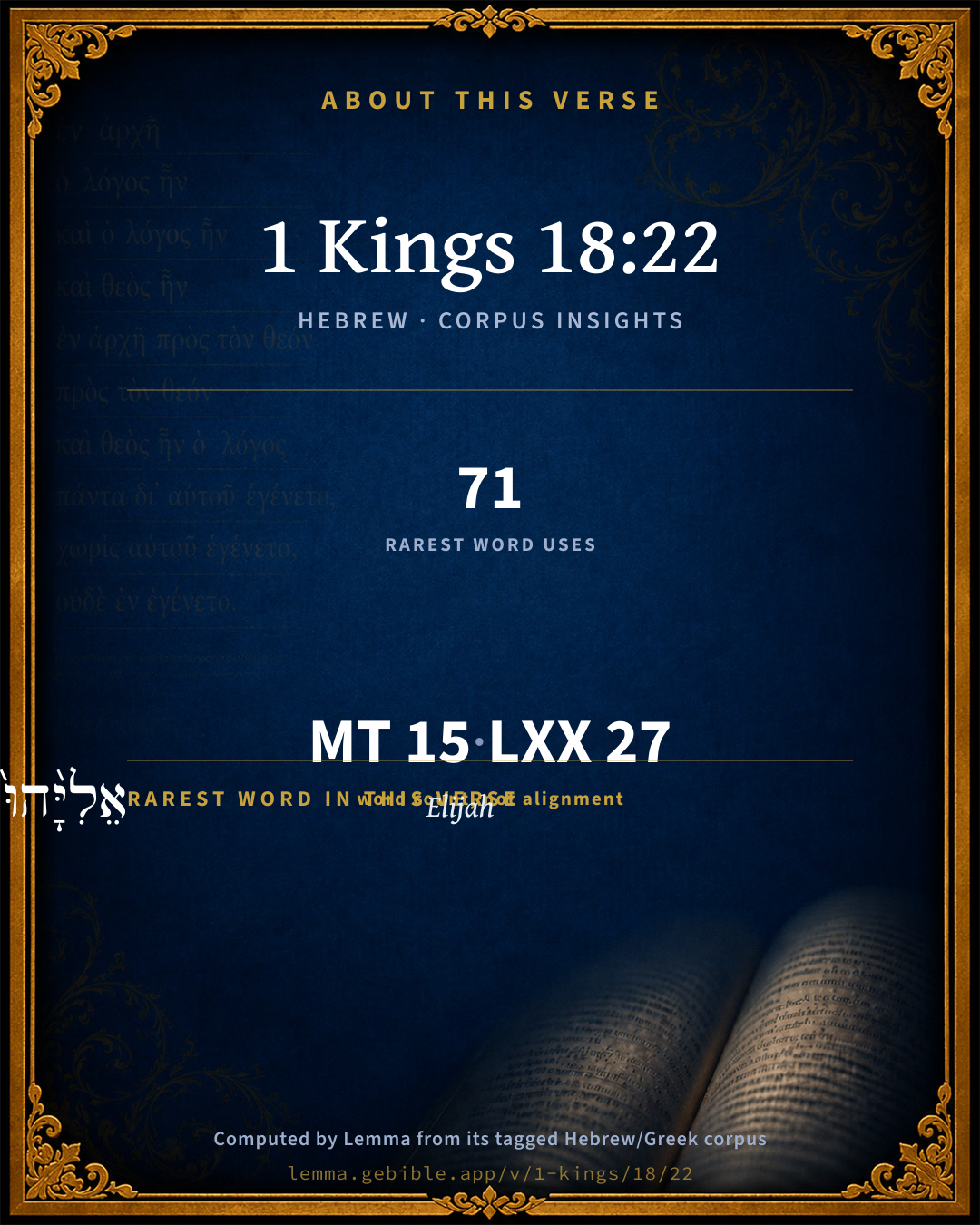
About this verse

These counts appear in no published source. They are computed here, from the morphology-tagged text and Lemma’s own curated glosses. What Lemma adds →

15
words
14
distinct lemmas
Historical
section

Grammatical profile

  • 2 verbs
  • 8 nouns
  • 3 adjectives
  • 1 pronoun
  • 1 preposition

Verb forms

  • וַיֹּ֤אמֶר Qal · Sequential Imperfect
  • נוֹתַ֧רְתִּי Niphal · Perfect

Repetition

A word recurs within this verse — often emphatic in Hebrew:

  • נָבִ֛יא prophet H5030 ×2

Hebrew & Septuagint length

In English translation the verse runs 24 words from the Hebrew and 35 from the Septuagint (LXX English) — the Septuagint runs noticeably longer here. See the side-by-side →

A rough comparison of the two English renderings, which tokenize alike — not a word-level alignment.

Word counts can differ between the Hebrew and the Greek without any difference in meaning — e.g. the Hebrew direct-object marker אֵת has no separate Greek word, and Greek often adds the article ὁ.

In the original languages it is 15 Hebrew tokens and 27 Greek tokens — but the two are counted differently (Hebrew bundles its prefixes and suffixes into one token; the Greek is in lemma form), so that isn’t a like-for-like length.

Cross-references

12

Topical passages linked to 1 Kings 18:22 in the Treasury of Scripture Knowledge — connected by theme and wording, ordered by reader-vote popularity; previews shown in the World English Bible.

  • 1 Kings 19:10 He said, I have been very jealous for Yahweh, the God of hosts; for the children of Israel have forsaken your covenant, thrown down your altars, and slain your prophets with the sword: and I, even I only, am left; and they seek my life, to take it away.
  • 1 Kings 19:14 He said, I have been very jealous for Yahweh, the God of hosts; for the children of Israel have forsaken your covenant, thrown down your altars, and slain your prophets with the sword; and I, even I only, am left; and they seek my life, to take it away.
  • 1 Kings 18:19–20 Now therefore send, and gather to me all Israel to Mount Carmel, and the prophets of Baal four hundred fifty, and the prophets of the Asherah four hundred, who eat at Jezebel's table.
  • 1 Kings 20:13 Behold, a prophet came near to Ahab king of Israel, and said, Thus says Yahweh, Have you seen all this great multitude? behold, I will deliver it into your hand this day; and you shall know that I am Yahweh.
  • 1 Kings 20:32 So they girded sackcloth on their loins, and [put] ropes on their heads, and came to the king of Israel, and said, Your servant Ben Hadad says, please let me live. He said, Is he yet alive? he is my brother.
  • 1 Kings 20:35 A certain man of the sons of the prophets said to his fellow by the word of Yahweh, Please strike me. The man refused to strike him.
  • 1 Kings 20:38 So the prophet departed, and waited for the king by the way, and disguised himself with his headband over his eyes.
  • 1 Kings 22:6–8 Then the king of Israel gathered the prophets together, about four hundred men, and said to them, Shall I go against Ramoth-gilead to battle, or shall I forbear? They said, Go up; for the Lord will deliver it into the hand of the king.
  • Matthew 7:13–15 "Enter in by the narrow gate; for wide is the gate and broad is the way that leads to destruction, and many are those who enter in by it.
  • Romans 11:3 "Lord, they have killed your prophets, they have broken down your altars; and I am left alone, and they seek my life."
  • 2 Timothy 4:3–4 For the time will come when they will not listen to the sound doctrine, but, having itching ears, will heap up for themselves teachers after their own lusts;
  • 2 Peter 2:1–3 But there also arose false prophets among the people, as among you also there will be false teachers, who will secretly bring in destructive heresies, denying even the Master who bought them, bringing on themselves swift destruction.

Cross-references courtesy of OpenBible.info (CC BY 4.0).

Hebrew and Greek witnesses Masoretic Hebrew ↔ Greek Septuagint

The same verse in the two great witnesses to the Old Testament, shown verse-for-verse.

Here the Septuagint runs noticeably longer than the Hebrew — LXX2012 (modern English Septuagint) 35 words vs World English Bible 24. A rough length comparison of the two English translations, not a word-level alignment — read both below.

These are two independent witnesses, not word-aligned to each other, and the Septuagint is shown in lemma (dictionary) form.

Hebrew 1 Kings 18:22 Masoretic · Westminster Leningrad Codex

וַיֹּ֤אמֶר אֵלִיָּ֨הוּ֙ אֶל הָעָ֔ם אֲנִ֞י נוֹתַ֧רְתִּי נָבִ֛יא לַיהוָ֖ה לְבַדִּ֑י וּנְבִיאֵ֣י הַבַּ֔עַל אַרְבַּע מֵא֥וֹת וַחֲמִשִּׁ֖ים אִֽישׁ

Then Elijah said to the people, "I, even I only, am left a prophet of Yahweh; but Baal's prophets are four hundred fifty men.

World English Bible · Public Domain

Greek LXX 1 Kings 18:22 Septuagint · lemma form

καί εἶπον ηλιου πρός ὁ λαός ἐγώ ὑπολείπω προφήτης ὁ κύριος μόνος καί ὁ προφήτης ὁ βααλ τετρακόσιοι καί πεντήκοντα ἀνήρ καί ὁ προφήτης ὁ ἄλσος τετρακόσιοι

And Eliu said to the people, I am left, the only one prophet of the Lord; and the prophets of Baal are four hundred and fifty men, and the prophets of the groves four hundred.

LXX2012 (modern English Septuagint) · Public Domain

On this verse, The Cambridge Bible for Schools and Colleges discusses the Septuagint’s reading. Read the note in Commentary ↓

Hebrew: Westminster Leningrad Codex (CC BY 4.0). Greek: Septuagint (public domain); English from LXX2012 (modern English Septuagint) (Public Domain). How the Septuagint differs from the Hebrew →

Targum (Aramaic paraphrase)

1

The Targum is the ancient Jewish Aramaic paraphrase of the Hebrew Scriptures — an interpretive translation, not the Hebrew text itself. Onkelos (literal) and Pseudo-Jonathan (expansive) render the Torah, and Jonathan the Prophets. Coverage is partial: where no permissively-licensed English translation exists for a verse, only the Aramaic is shown. This is verse-level text, not a word-by-word alignment to the Hebrew.

  1. Targum Jonathan Prophets (Joshua–Malachi)
    וַאֲמַר אֵלִיָהוּ לְעַמָא אֲנָא אִשְׁתָּאֲרִית נְבִיָא קֳדָם יְיָ בִּלְחוֹדִי וּנְבִיֵי בַעֲלָא אַרְבַּע מְאָה וְחַמְשִׁין גַבְרָא:

    (no public-domain English translation for this verse)

    Targum Jonathan — Aramaic: “Mikraot Gedolot” (public domain). English: “Sefaria Community Translation” (CC0 1.0 (public-domain dedication)); “London "Chaldee Paraphrase," 1871” (public domain). Text via Sefaria.

Commentary

Notes on 1 Kings 18:22 from classic Christian and Jewish commentators (each source and its license shown beneath its notes). The classic Christian expositions comment on the surrounding passage and are grouped to its opening verse, so a note may address several verses; the Jewish commentaries on the Tanakh (Rashi and others) are per-verse, so they appear only where the commentator wrote on this verse.

Lemma curates 59 commentaries, every one of them public domain or Creative Commons licensed, each selected and text-cleaned for this edition rather than reprinted as found. About our sources →

Trapp's Complete Commentary

John Trapp

1Ki 18:22 Then said Elijah unto the people, I, [even] I only, remain a prophet of the LORD; but Baal’s prophets [are] four hundred and fifty men.

Ver. 22. I, even I, only remain.] So Paphnutius in the Nicene Council carried it for the truth. So before him, did Nicodemus, {Joh 7:51; Joh 7:53} as after, Athanasius and Luther, qui totius orbis impetum soli sustinuerunt. God is the more seen in such cases.

John Trapp, A Commentary or Exposition upon All the Books of the Old and New Testament (1647–1656) — public domain. Text from a community e-Sword module.

Joseph Benson's Commentary

1Ki 18:22. I only remain a prophet of the Lord — Namely, here present, publicly to own and plead the cause of God. As for the other prophets of the Lord, mentioned 1Ki 18:13, we can hardly imagine that they, in general, were men actually inspired and invested with the prophetic character; but such only as were disciples of the prophets, and candidates for the office of prophecy. But if they were even prophets, in the proper sense of the word, many of them doubtless had been slain by Ahab or Jezebel, and others banished, or hid in caves. Baal’s prophets are four hundred and fifty men — He opposes himself only to these, because, it seems, these only were present; the prophets of the groves not being permitted by Jezebel, (through her pride and obstinacy, or care and kindness to them,) to go as far from the royal city as Carmel.

Joseph Benson's Commentary on the Old and New Testaments (1811–1818) — public domain. Text from a community e-Sword module.

Tyndale Open Study Notes

Tyndale Open Resources

18:22 the only prophet of the Lord: Obadiah had previously hidden two groups of fifty prophets to protect them from Jezebel’s purge (18:4, 13). However, Elijah’s public stature must have left him feeling alone in his struggle against false religion (see 19:10, 14); certainly, he did stand alone in confronting the 450 prophets of Baal.

Tyndale Open Study Notes — © Tyndale Open Resources, licensed CC BY-SA 4.0. Text via the HelloAO Bible API.

Adam Clarke's Commentary

Verse 22. I only, remain a prophet of the Lord] That is, I am the only prophet of God present, and can have but the influence of an individual; while the prophets of Baal are four hundred and fifty men! It appears that the queen's prophets, amounting to four hundred, were not at this great assembly; and these are they whom we meet with 1Kg 22:6, and whom the king consulted relative to the battle at Ramoth-gilead.

Adam Clarke's Commentary on the Bible (1810–1826) — public domain. Text from a community e-Sword/MySword module.

The Cambridge Bible for Schools and Colleges

gen. ed. J. J. S. Perowne

22. I, even I only, remain] R.V. am left. As in 1Ki_19:10 for the same word. Elijah means that he is the only one who now stands forward in Jehovah’s name. No doubt there were others of those saved by Obadiah and in other ways, but in such dangerous days they kept out of sight. The scene on Carmel is full of sublimity. Elijah alone against the host of Baal-priests, and with the calm dignity befitting so solemn a time, in the midst of them all, proceeding to repair the broken altar of the Lord.

The LXX. adds at the close of this verse ‘and the prophets of the grove four hundred.’

The Cambridge Bible for Schools and Colleges (gen. ed. J. J. S. Perowne; Cambridge University Press, 1878–1918) — public domain. Text from a community e-Sword module.

John Gill's Exposition

And call ye on the name of your gods,.... The Baalim, the many lords and gods they served:

and I will call on the name of the Lord; the one true Jehovah and God of Israel, whom I serve:

and the God that answereth by fire; by causing fire to come down upon the sacrifice, and consume it:

let him be God; accounted, owned, and acknowledged as the true God, and so afterwards worshipped as such:

and all the people answered and said, it is well spoken; they thought it a very reasonable proposal, a very good method to determine the controversy, and come at the truth, and know who was the true God, and who not.

John Gill's Exposition of the Whole Bible (1746–1763) — public domain (CC PDM 1.0). Text via the HelloAO Bible API.

Albert Barnes' Notes on the Bible

I, even I, only remain - He means, “I only remain in the exercise of the office of a prophet.” The others (Compare 1Ki 18:4) had been forced to fly and hide themselves in dens and caves of the earth; their voices were silenced; they had not ventured to come to Carmel. Elijah contrasts his solitary appearance on the side of Yahweh at the great gathering with the crowd of those opposed to him.

Albert Barnes' Notes on the Bible (1834–1885) — public domain. Text from a community e-Sword/MySword module.

Haydock's Catholic Bible Commentary

I. Hebrew repeats "I," to make the contrast more striking. Elias alone was present, in this assembly, as the prophet of the Lord. (Haydock) --- He knew that Abdias had preserved 100: but they were concealed. --- Men. The other 400 of Jezabel did not appear.

George Leo Haydock (1774–1849), Haydock's Catholic Family Bible and Commentary, 1859 edition — public domain. Excludes Psalms (Douay-Rheims chapter numbering differs from Protestant) and Deuterocanonical books (Catholic canon only).

Matthew Poole's English Annotations

I only remain, to wit, here present, publicly to own and plead the cause of God; for he opposeth himself only to Baal’s four’ hundred and fifty prophets, because they only were present; the prophets of the groves being, it seems, not permitted by Jezebel (through her pride, or obstinacy, or care and kindness to them) to go thither. See 1Ki 22:6. As for the other prophets of the Lord, many of them were slain by Ahab or Jezebel, others banished, or hid in caves.

Matthew Poole's English Annotations on the Holy Bible (1683–1685) — public domain. Text from a community e-Sword/MySword module.

Whedon's Commentary on the Bible

Daniel D. Whedon

22. I only — Strange contrast, and, apparently, unequal contest! Other true prophets may have been hidden in caves, (1Ki_18:4,) but Elijah alone appeared for Jehovah on this occasion. On the one side stood the lone prophet with flowing beard and leathern girdle, (2Ki_1:8,) on the other, four hundred and fifty splendidly robed (2Ki_10:22) priests of Baal, and on the neighbouring slope were assembled thousands of Israelites to witness the memorable contest. It seems that for some reason the queen had kept her Asherah prophets away from the scene of conflict.

Daniel D. Whedon (gen. ed.), Commentary on the Old and New Testaments (1874–1909) — public domain. Text from a community e-Sword module.

The Pulpit Commentary

Then said Elijah unto the people, l, even I only, remain Heb. I, I am left alone. Cf. tatov Gen_32:24; monw a prophet of the Lord Thenius hence concludes that the "hundred prophets" of whom we read in vers. 4, 13 had been discovered in their hiding place and had been put to death. But this by no means follows from Elijah"s statement here or in ch. 19:10 (where see note); and we know that the schools of the prophets had not ceased to exist (2Ki_2:3, 2Ki_2:5, 2Ki_2:7; cf. 1Ki_22:8) All that Elijah says is that he stood that day alone as a prophet of Jehovah. "I only remain in the exercise of the office of a prophet" (Rawlinson). The rest might well hesitate, after me fierce persecution which they had undergone, to face the king and their bitter enemies, the Baal prophets. It must be remembered that Elijah had had no opportunity of communicating with them, and he may have been quite ignorant as to what number had remained steadfast and true. One thing he knew, that he alone was left to prophesy, and to confront the whole hierarchy of the false God; but Baal"s prophets are four hundred and fifty men. It is clear, not only from the silence of this verse and of ver. 25, respecting them, but still more from the fact that they escaped in the general slaughter (ver. 40), that the prophets of Astarte were not present, and the natural inference is that either Jezebel had forbidden their presence or that they shrank from the ordeal. The LXX inserts "and the prophets of the grove, four hundred," but the words are evidently added from ver. 19. The Baal prophets would doubtless have been only too glad to do the same, but they were under the immediate command of the king. It is not certain that they had any forebodings of evil, or dreaded reprisals on Elijah"s part, but they had had proof conclusive of his power and of their impo-fence. We must remember that all through the triennium prayers and sacrifices had, no doubt, been constantly offered with a view to procure rain. We learn from Menander Jos 8, 13:2 that even in Phoenicia supplication had been made for rain by Ethabaal.

Vers. 22-24.

The Test of Fire.

Elijah had appealed to the people on their inconsistency in hesitating between services so widely different and so utterly irreconcilable as those of Jehovah and Baal. He got no response. "The people answered him not a word." Then he proposed the test of fire to determine which was worthy. The conclusiveness of such an appeal could not be challenged; so the people with one voice answered, "It is well spoken.

I THE TEST WAS UNEXCEPTIONABLE.

1. For Baal was the fire god.

(1) His name designates him as the lord or ruler. It comes from the verb (lb) to own or possess, to be master of. But the sun, from its splendour and central position, accounted the visible lord in the material heavens, was their Baal. Sanchoniathon says the Phoenicians thought the sun to be the only lord of heaven, calling him Beelsamen, which in their language is lord of heaven. In "Beelsamen" we at once recognize the Hebrew lb.

(2) Baal was the fire or body of the sun, rather than its light. So in 2Ki_23:5 we find Baal (lb) distinguished from ( the solar light. (See Parkhurst under Parkhurst points out that the Runic or Islandic BAAL signifies fire, the Saxon BAEL, and BAEL-FYR, a burning pile, a pyre, a bonfire. Probably our bonfire is simply a corruption of Bael-fyr.

(3) The image of this idol was a bull. This animal was by the ancients regarded as the emblem of fire. The similitude seems to have been in its red colour, in the curled hair upon its forehead giving the idea of flame, in the horns budding from its head suggesting the darting of rays of light from the sun. In Tobit (1:5) we read of "the heifer called Baal." We have the name of this god still preserved in our English bull.

2. The controversy was whether Baal was independent of Jehovah.

(1) His worshippers claimed this for him.

(2) Elijah maintained the opposite. And with cogent reason, for during three years and six months Jehovah made Baal punish his votaries.

(3) Now the prophet proposes the further test of a sudden miracle. If Baal be god, if he be independent of Jehovah, let him come down and consume the sacrifice offered to him. If he cannot, then why should he be worshipped? If Jehovah can send fire on his sacrifice, then is He manifestly Lord of Baal, and should be so acknowledged.

(4) That suitable acknowledgment of God which such a miracle demands, implies

(a) Recognition of His almighty providence and lordship over the material and moral universe.

(b) The engagement of all our powers in His worship and service.

II SO WAS THE MANNER OF THE TEST.

1. The prophets of Baal had precedence.

(1) Not because Baal was entitled to it, for that would be a concession of the argument, but because they were many. Elijah stood alone the prophet of the Lord, while the idolatrous prophets were 850 men.

(2) They were to provide the sacrifices. They were wealthy. Elijah was poor. They could not object to the test when the sacrifices were of their own selection.

2. The experiment was to be fair.

(1) Not only might the priests of Baal choose their bullock, cut it in pieces after their approved method, lay it on the wood of the altar; but they must "put no fire under." Else where would be the proof of the ability of Baal? Under some heathen altars holes were dug in which fire was concealed, which communicating with the alter set the wood on fire to make the simple people believe that the sacrifice was consumed by miraculous fire. This Elijah would not permit.

(2) Ordinarily the sacrifices offered to Baal were offered in fire; and sometimes human sacrifices were so offered. "They built the high places of Baal to burn their sons with fire, for burnt offerings". (Jer_19:5) The Phoenician Baal seems to have been identical with the Ammonite Molech. "They built the high places of Baal which are in the valley of the son of Hinnom, to cause their sons and their daughters to pass through the fire to Molech". (Jer_32:35)

(3) Ashtaroth also were virtually the same as "Baalim," under which plural term are included diversified Baals, as Baal Peor, etc.; and so in ver. 25 the prophets of Baal are said to have ( "gods," in the plural

(4) These had their various images, in some of which the man and bull came into union. The Assyrian man bull so conspicuous in the Nineveh marbles, is probably one of these.

Let us bless God for our Christianity. It is pure light. Compared with it other systems are dark with ignorance, superstition, and error. It is supreme benevolence. Happy is its contrast to the characteristic cruelties of idolatry. J.A.M.

The Pulpit Commentary (1880–1919), ed. H.D.M. Spence-Jones & Joseph S. Exell — public domain. Text from a community e-Sword module.

John Wesley's Explanatory Notes

I only - Here present, to own the cause of God. As far the other prophets of the Lord, many of them were slain, others banished, or hid in caves.

John Wesley, Explanatory Notes Upon the Whole Bible (1754–1765) — public domain. Text via the GEBible commentary corpus.

unfoldingWord translationNotes

Door43 World Missions Community

I, I alone, am left

The word "I" is repeated for emphasis.

450 men

"four hundred and fifty men" (See: Numbers)

call on the name of your god ... call on the name of Yahweh

"Name" is metonymy for the reputation and honor of someone and "calling on" him represents an appeal. AT: "call to your god ... call to Yahweh" (See: Metonymy)

all the people answered and said, "This is good."

"all the people said, 'This is a good thing to do.'"

translationWords

Elijah

prophet

Baal

cow

fire

call

name

false god

God

good

unfoldingWord translationNotes — © Distant Shores Media and the Door43 World Missions Community, licensed CC BY-SA 4.0. Source: git.door43.org/Door43/en_tn.

Lesson kit

Teaching starters — assembled from the data on this page, not authored interpretation. Every prompt links to the verse data it draws on. Edit before teaching.

1 Kings, in the Historical, opens this verse with 15 words (14 distinct Hebrew lemmas). Its most distinctive word is ʼÊlîyâh (“Elijah”). The Greek Septuagint runs longer here. A historical commentator’s framing appears above. Read the whole chapter for the surrounding context.

Discussion questions

  1. How does “Elijah” (ʼÊlîyâh) shape what this verse is saying?
  2. 1 Kings 19:10 shares this passage’s theme. How do the two illuminate each other?
  3. “prophet” occurs 2× in this one verse. What is the effect of the repetition?
  4. Compared with the Hebrew, the Septuagint runs longer here. What questions does that raise?
  5. The translations on this page render this verse differently — a whole-verse word diff, not a word-by-word alignment. What might account for the different wordings?
  6. The verb «וַיֹּ֤אמֶר» is Qal Sequential Imperfect. How does its form color the action?
  7. Reading how Trapp's Complete Commentary and Joseph Benson's Commentary read this verse, where do the two commentators agree and where do they part?

Things to notice

Reading settings

Reading text

Shown beneath each verse's original-language words.

Old Testament
Old Testament edition

Read the OT as the Masoretic Hebrew (MT) or the Greek Septuagint (LXX).

English shown for the Greek Septuagint (in the Hebrew ↔ Greek comparison).

Comparing translations? Open the Compare panel on any verse page to stack up to four side by side.