
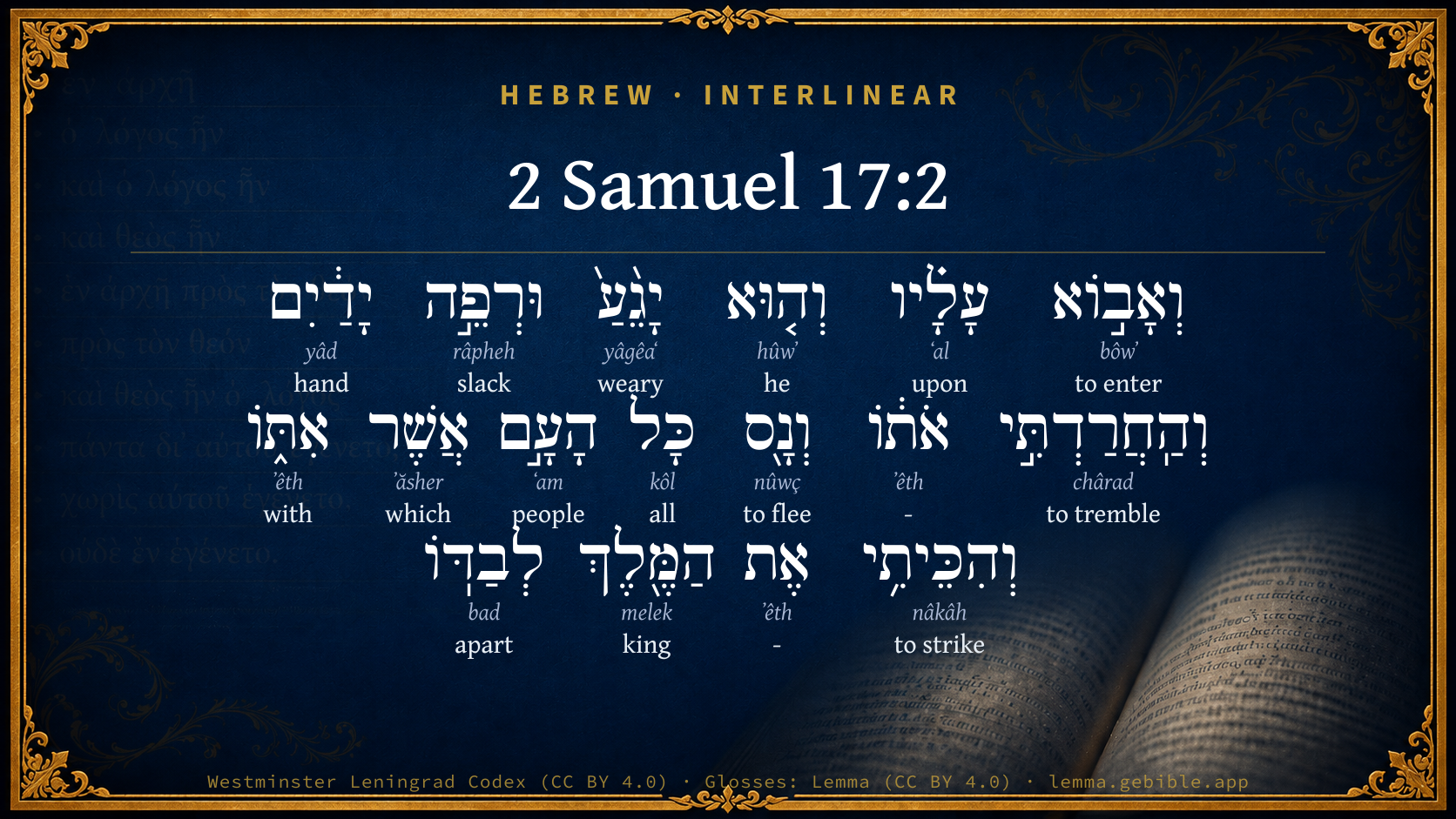
2 Samuel 17:2

Hebrew (Westminster Leningrad Codex) 2 Samuel 17:2 appears in the Hebrew Old Testament. The text above is from the Westminster Leningrad Codex. Each word links to its Strong’s number, a concise gloss, and parsing drawn from the Open Scriptures Hebrew Bible morphology. Click any word for its full Brown-Driver-Briggs (BDB) entry.
Download image
Cite this verse

2 Samuel 17:2 (World English Bible). Public Domain. Lemma interlinear Bible study tool, https://lemma.gebible.app/v/2-samuel/17/2.

Show BibTeX & RIS
BibTeX
RIS
English Translation
and I will come on him while he is weary and weak-handed, and will make him afraid; and all the people who are with him shall flee; and I will strike the king only;
World English Bible · Public Domain
Download a study sheet

One document with this verse’s original text, its word-by-word gloss line, the meaning frame, cross-references with their text, attributed commentary, and full source and license credits — printable, and it pastes into notes with its structure intact.

This verse Autodidact and up

Study sheet (.html) Plain text (.txt)

A passage Seminary Student

Up to 50 verses in one chapter. A passage sheet keeps up to 6 commentary sources and 12 cross-references per verse, in the order this page ranks them, and says so on the sheet whenever that leaves anything out. Ask for a single verse and you get the Autodidact verse sheet above.

Everything on this page stays free to read, with no account — the sheet is a download of what is already on screen, not access to it.

Want to remove ads? Support Godless Engineer
Compare translations 3

The same verse in 3 English versions, stacked beneath the original-language interlinear above. Click any original word for its lexicon entry.

Each is an independent rendering of the whole verse — the interlinear is not word-aligned to these translations.

Highlighted words mark where these versions differ — a whole-verse word diff, not a word-by-word alignment.

  • World English Bible Public Domain
    and I will come on him while he is weary and weak-handed, and will make him afraid; and all the people who are with him shall flee; and I will strike the king only;
  • King James Version Public Domain
    And I will come upon him while he is weary and weak handed, and will make him afraid: and all the people that are with him shall flee; and I will smite the king only:
  • unfoldingWord Literal Text CC BY-SA 4.0
    And I will come upon him, and he weary and weak of hands, and I will make him tremble, and all of the people who with him will flee. And I will strike the king alone.

unfoldingWord Literal Text — © unfoldingWord, licensed CC BY-SA 4.0. Word-aligned USFM3 via Door43 (git.door43.org/unfoldingWord/en_ult).

Versions to compare (up to 4)

3 of 4 selected

Show all 18 translations

Every available English version of this verse, each an independent rendering of the whole verse.

  • World English Bible Public Domain
    and I will come on him while he is weary and weak-handed, and will make him afraid; and all the people who are with him shall flee; and I will strike the king only;
  • Berean Standard Bible Public Domain
    I will attack him while he is weak and weary; I will throw him into a panic, and all the people with him will flee; I will strike down only the king
  • Majority Standard Bible Public Domain
    I will attack him while he is weak and weary; I will throw him into a panic, and all the people with him will flee; I will strike down only the king
  • King James Version Public Domain
    And I will come upon him while he is weary and weak handed, and will make him afraid: and all the people that are with him shall flee; and I will smite the king only:
  • American Standard Version (1901) Public Domain
    and I will come upon him while he is weary and weak-handed, and will make him afraid; and all the people that are with him shall flee; and I will smite the king only;
  • Revised Version (1885) Public Domain
    and I will come upon him while he is weary and weak handed, and will make him afraid: and all the people that are with him shall flee; and I will smite the king only:
  • Geneva Bible (1599) Public Domain
    And I will come vpon him: for he is wearie, and weake handed: so I will feare him, and all the people that are with him, shall flee, and I will smite the King onely,
  • Douay-Rheims (1899) Public Domain
    And coming upon him (for he is now weary, and weak handed) I will defeat him: and when all the people is put to flight that is with him, I will kill the king who will be left alone.
  • Young's Literal Translation Public Domain
    and come upon him, and he weary and feeble-handed, and I have caused him to tremble, and all the people have fled who `are' with him, and I have smitten the king by himself,
  • Literal Standard Version CC BY-SA 4.0
    and come on him, and he [will be] weary and feeble-handed, and I have caused him to tremble, and all the people who [are] with him have fled, and I have struck the king by himself,
  • Unlocked Literal Bible CC BY-SA 4.0
    I will come on him while he is weary and weak and will surprise him with fear. The people who are with him will flee, and I will attack only the king.
  • unfoldingWord Literal Text CC BY-SA 4.0
    And I will come upon him, and he weary and weak of hands, and I will make him tremble, and all of the people who with him will flee. And I will strike the king alone.
  • Darby Bible Public Domain
    and I will come upon him while he is weary and weak-handed, and will make him afraid; and all the people that are with him shall flee; and I will smite the king only;
  • World Messianic Bible Public Domain
    I will come on him while he is weary and exhausted, and will make him afraid. All the people who are with him will flee. I will strike the king only,
  • Webster's Bible Public Domain
    And I will come upon him while he is weary and weak-handed, and will make him afraid: and all the people that are with him shall flee; and I will smite the king only:
  • Free Bible Version CC BY-SA 4.0
    I'll attack him while he is tired and weak. I'll catch him by surprise and all his men will run away. I'll only kill the king
  • Bible in Basic English Public Domain
    And I will come up with him when he is tired and feeble, and make him full of fear: and all the people with him will go in flight; and I will make an attack on the king only:
  • JPS Tanakh (1917) Public Domain
    and I will come upon him while he is weary and weak-handed, and will make him afraid; and all the people that are with him shall flee; and I will smite the king only;

Literal Standard Version (2020), Covenant Press — licensed CC BY-SA 4.0. Text via the HelloAO Bible API (eBible.org). Unlocked Literal Bible (unfoldingWord) — licensed CC BY-SA 4.0. Text via the HelloAO Bible API (eBible.org). unfoldingWord Literal Text — © unfoldingWord, licensed CC BY-SA 4.0. Word-aligned USFM3 via Door43 (git.door43.org/unfoldingWord/en_ult). Free Bible Version, Dr. Jonathan Gallagher — licensed CC BY-SA 4.0. Text via the HelloAO Bible API (eBible.org).

Word by word

More ways to search: Search by grammar → Find every occurrence → Compare this word →

Practice this passage: Drill this verse → Learn its vocabulary →

יָגֵ֨עַ֙
yâgêaʻ
H3023
“weary”
Adjective, Adjective, Masculine, Singular, Absolute
Part of Speech
Adjective
Type
Adjective
Gender
Masculine
Number
Singular
State
Absolute
Full BDB Definition

Origin: from H3021

TWOT: 842b

weary, wearisome
  1. וְאָב֣וֹא bôwʼ H935 “and · to enter” Conjunction + Verb, Qal, Imperfect, 1st Person, Common, Singular
  2. עָלָ֗יו ʻal H5921 “upon · him” Preposition + Suffix, Personal, 3rd Person, Masculine, Singular
  3. וְה֤וּא hûwʼ H1931 “and · he” Conjunction + Pronoun, Personal, 3rd Person, Masculine, Singular
  4. וּרְפֵ֣ה râpheh H7504 “and · slack of” Conjunction + Adjective, Adjective, Masculine, Singular, Construct
  5. יָדַ֔יִם yâd H3027 “hands” Noun, Common, Both, Dual, Absolute
  6. וְהַֽחֲרַדְתִּ֣י chârad H2729 “and · to tremble” Conjunction + Verb, Hiphil, Sequential Perfect, 1st Person, Common, Singular
  7. אֹת֔וֹ ʼêth H853 “- · him” Particle, Direct Object + Suffix, Personal, 3rd Person, Masculine, Singular
  8. וְנָ֖ס nûwç H5127 “and · to flee” Conjunction + Verb, Qal, Sequential Perfect, 3rd Person, Masculine, Singular
  9. כָּל kôl H3605 “all of” Noun, Common, Masculine, Singular, Construct
  10. הָעָ֣ם ʻam H5971 “the · people” Particle, Definite Article + Noun, Common, Masculine, Singular, Absolute
  11. אֲשֶׁר ʼăsher H834 “which” Particle, Relative
  12. אִתּ֑וֹ ʼêth H854 “with · him” Preposition + Suffix, Personal, 3rd Person, Masculine, Singular
  13. וְהִכֵּיתִ֥י nâkâh H5221 “and · to strike” Conjunction + Verb, Hiphil, Sequential Perfect, 1st Person, Common, Singular
  14. אֶת ʼêth H853 “-” Particle, Direct Object
  15. הַמֶּ֖לֶךְ melek H4428 “the · king” Particle, Definite Article + Noun, Common, Masculine, Singular, Absolute
  16. לְבַדּֽוֹ bad H905 “to/for · apart · his” Preposition + Noun, Common, Masculine, Singular, Construct + Suffix, Personal, 3rd Person, Masculine, Singular

About this verse

These counts appear in no published source. They are computed here, from the morphology-tagged text and Lemma’s own curated glosses. What Lemma adds →

17
words
16
distinct lemmas
Historical
section

Notable vocabulary

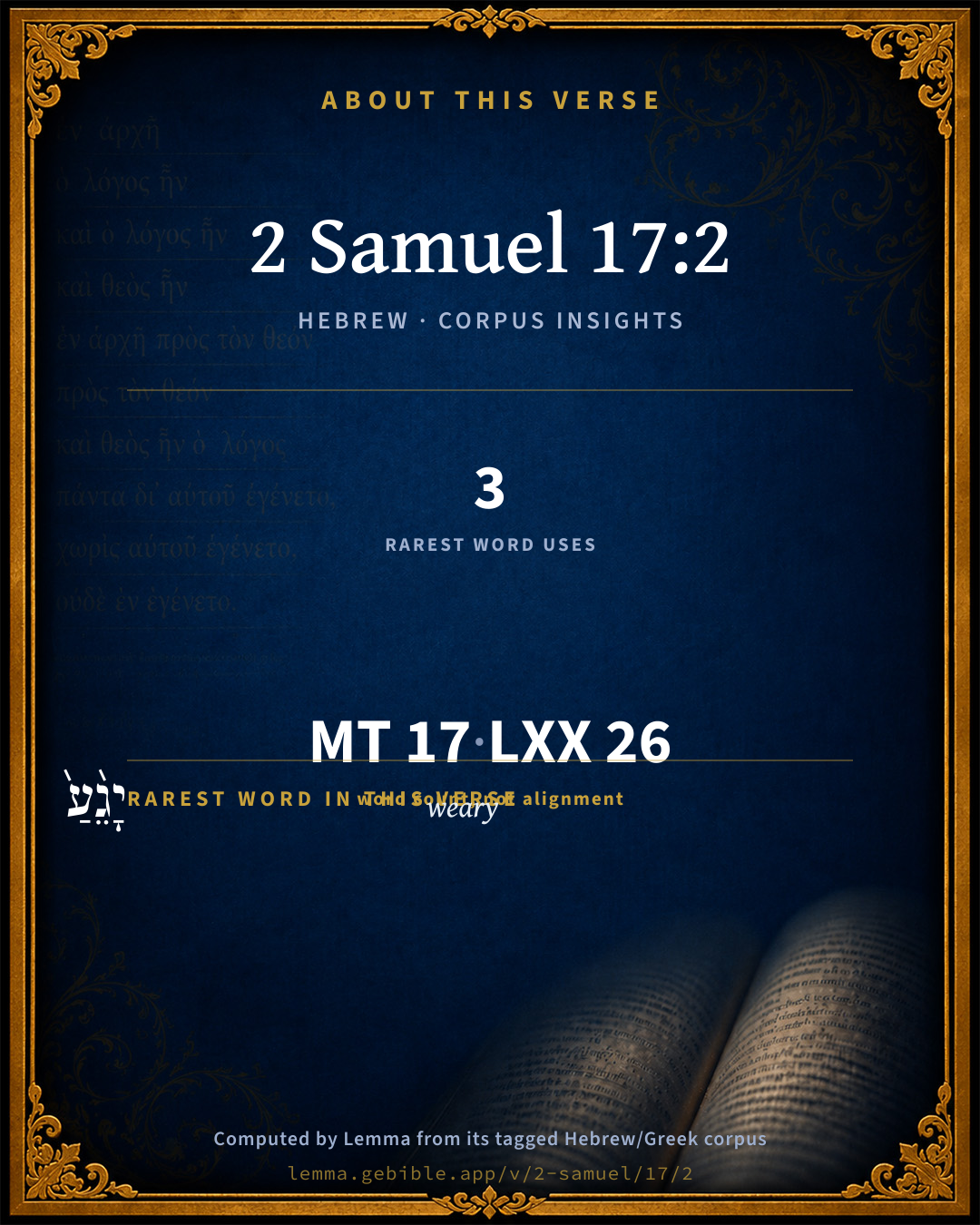
The rarest word here is יָגֵ֨עַ֙ weary H3023 — appearing just 3 times in the whole Hebrew Bible.

Shared distinctive vocabulary

יָגֵ֨עַ֙ weary H3023 occurs in 3 verses of the Hebrew Bible. Also found in:

Grammatical profile

  • 4 verbs
  • 5 nouns
  • 2 adjectives
  • 1 pronoun
  • 2 prepositions
  • 3 particles

Verb forms

  • וְאָב֣וֹא Qal · Imperfect
  • וְהַֽחֲרַדְתִּ֣י Hiphil · Sequential Perfect
  • וְנָ֖ס Qal · Sequential Perfect
  • וְהִכֵּיתִ֥י Hiphil · Sequential Perfect

Hebrew & Septuagint length

In English translation the verse runs 34 words from the Hebrew and 36 from the Septuagint (LXX English) — closely comparable.

A rough comparison of the two English renderings, which tokenize alike — not a word-level alignment.

Word counts can differ between the Hebrew and the Greek without any difference in meaning — e.g. the Hebrew direct-object marker אֵת has no separate Greek word, and Greek often adds the article ὁ.

In the original languages it is 17 Hebrew tokens and 26 Greek tokens — but the two are counted differently (Hebrew bundles its prefixes and suffixes into one token; the Greek is in lemma form), so that isn’t a like-for-like length.

Cross-references

8

Topical passages linked to 2 Samuel 17:2 in the Treasury of Scripture Knowledge — connected by theme and wording, ordered by reader-vote popularity; previews shown in the World English Bible.

  • 2 Samuel 16:14 The king, and all the people who were with him, came weary; and he refreshed himself there.
  • 1 Kings 22:31 Now the king of Syria had commanded the thirty-two captains of his chariots, saying, Fight neither with small nor great, save only with the king of Israel.
  • Zechariah 13:7 "Awake, sword, against my shepherd, And against the man who is close to me," says Yahweh of Hosts. Strike the shepherd, and the sheep will be scattered; And I will turn my hand against the little ones.
  • Matthew 26:31 Then Jesus said to them, "All of you will be made to stumble because of me tonight, for it is written, 'I will strike the shepherd, and the sheep of the flock will be scattered.'
  • John 11:50 nor do you consider that it is advantageous for us that one man should die for the people, and that the whole nation not perish."
  • Deuteronomy 25:18 how he met you by the way, and struck the hindmost of you, all who were feeble behind you, when you were faint and weary; and he didn't fear God.
  • Matthew 21:38 But the farmers, when they saw the son, said among themselves, 'This is the heir. Come, let's kill him, and seize his inheritance.'
  • John 18:4–8 Jesus therefore, knowing all the things that were happening to him, went forth, and said to them, "Who are you looking for?"

Cross-references courtesy of OpenBible.info (CC BY 4.0).

Hebrew and Greek witnesses Masoretic Hebrew ↔ Greek Septuagint

The same verse in the two great witnesses to the Old Testament, shown verse-for-verse.

These are two independent witnesses, not word-aligned to each other, and the Septuagint is shown in lemma (dictionary) form.

Hebrew 2 Samuel 17:2 Masoretic · Westminster Leningrad Codex

וְאָב֣וֹא עָלָ֗יו וְה֤וּא יָגֵ֨עַ֙ וּרְפֵ֣ה יָדַ֔יִם וְהַֽחֲרַדְתִּ֣י אֹת֔וֹ וְנָ֖ס כָּל הָעָ֣ם אֲשֶׁר אִתּ֑וֹ וְהִכֵּיתִ֥י אֶת הַמֶּ֖לֶךְ לְבַדּֽוֹ

and I will come on him while he is weary and weak-handed, and will make him afraid; and all the people who are with him shall flee; and I will strike the king only;

World English Bible · Public Domain

Greek LXX 2 Samuel 17:2 Septuagint · lemma form

καί ἐπιἔρχομαι ἐπί αὐτός καί αὐτός κοπιάω καί ἐκλύω χείρ καί ἐκἵστημι αὐτός καί φεύγω πᾶς ὁ λαός ὁ μετά αὐτός καί πατάσσω ὁ βασιλεύς μόνος

and I will come upon him when he is weary and weak-handed, and I will strike him with terror; and all the people with him shall flee, and I will strike the king only of all.

LXX2012 (modern English Septuagint) · Public Domain

Hebrew: Westminster Leningrad Codex (CC BY 4.0). Greek: Septuagint (public domain); English from LXX2012 (modern English Septuagint) (Public Domain). How the Septuagint differs from the Hebrew →

Targum (Aramaic paraphrase)

1

The Targum is the ancient Jewish Aramaic paraphrase of the Hebrew Scriptures — an interpretive translation, not the Hebrew text itself. Onkelos (literal) and Pseudo-Jonathan (expansive) render the Torah, and Jonathan the Prophets. Coverage is partial: where no permissively-licensed English translation exists for a verse, only the Aramaic is shown. This is verse-level text, not a word-by-word alignment to the Hebrew.

  1. Targum Jonathan Prophets (Joshua–Malachi)
    וְאֵיהַךְ עֲלוֹהִי כַּד הוּא מְשַׁלְהֵי וִידוֹהִי מְרַשְׁלָן וְאָזִיעַ יָתֵיהּ וְיַעֲרוֹק כָּל עַמָא דִי עִמֵיהּ וְאֶקְטוֹל יַת מַלְכָּא בִּלְחוֹדוֹהִי:

    (no public-domain English translation for this verse)

    Targum Jonathan — Aramaic: “Mikraot Gedolot” (public domain). English: “Sefaria Community Translation” (CC0 1.0 (public-domain dedication)); “London "Chaldee Paraphrase," 1871” (public domain). Text via Sefaria.

Commentary

Notes on 2 Samuel 17:2 from classic Christian and Jewish commentators (each source and its license shown beneath its notes). The classic Christian expositions comment on the surrounding passage and are grouped to its opening verse, so a note may address several verses; the Jewish commentaries on the Tanakh (Rashi and others) are per-verse, so they appear only where the commentator wrote on this verse.

Lemma curates 59 commentaries, every one of them public domain or Creative Commons licensed, each selected and text-cleaned for this edition rather than reprinted as found. About our sources →

Trapp's Complete Commentary

John Trapp

2Sa 17:2 And I will come upon him while he [is] weary and weak handed, and will make him afraid: and all the people that [are] with him shall flee; and I will smite the king only:

Ver. 2. And I will come upon him while he is weary and weak-handed.] That indeed had been the ready way to win. Hannibal when he could have taken Rome, would not; when he would, could not. {a} The Protestant princes of Germany lost a fair opportunity at Ingolstadt, August 13, 1546, which they never afterwards could recover. They were far stronger in horse than the emperor, whose forces were but slenderly fortified at that time, and might easily have been worsted; but the next night they so entrenched themselves, that they took better heart, and soon after got the day. This error of the Protestant princes - the elector of Saxony, the landgrave of Hesse, and the rest - was, saith mine author, {b} the rise and cause of their calamity, but of Caesar’s victory, to the grief of all good people.

{a} Plut.

{b} Alsted., Chronol. 545.

John Trapp, A Commentary or Exposition upon All the Books of the Old and New Testament (1647–1656) — public domain. Text from a community e-Sword module.

Joseph Benson's Commentary

2Sa 17:2-3. I will come upon him while he is weary — Before he has had time to breathe from the fatigues he has just gone through; and weak- handed — Before he has collected more forces. I will make him afraid — Strike a terror into him by this sudden attack, made in the night, when he is ill-provided. I will smite the king only — And proclaim pardon to all the rest. And I will bring back all the people — By this means I shall easily bring over their allegiance to thee. The man whom thou seekest is as if they all returned — The killing of David will effectually end the contest, and the whole nation will come in to thee, there being no other to whom they will submit, he being dead. So all the people shall be in peace — The single circumstance of taking and killing him will restore peace, and preserve both the people who are with thee, and those that are with David. They shall all be saved, and he alone destroyed. “The attentive reader will easily perceive that this advice well justifies the character given of Ahithophel in the Scripture; it was, in its several parts, admirably fitted both to the inclinations and interests of his pupil; he consigned him to his pleasures, and took all the danger to himself; and at the same time he relieved his little remains of humanity (if he had any) from the necessity of imbruing his hands in his father’s blood. His incest was, for the present, personal guilt enough; that act of outrage would make Abslom’s reconciliation with his father desperate; and while he indulged his evil appetite, Ahithophel, with a chosen band, would pursue and surprise David. Nothing could be more worldly wise, or more hellishly wicked; it was indeed, as the advice of an oracle, but very different from that dictated by the Spirit of God; and yet, horrid as it was, it pleased that vile son and his associates.” — Delaney.

Joseph Benson's Commentary on the Old and New Testaments (1811–1818) — public domain. Text from a community e-Sword module.

Ellicott's Commentary for English Readers

(2) Will make him afraid.—This translation is hardly strong enough. The thought is that Ahithophel will throw his band into a panic by a sudden night attack, and in the confusion will easily secure the person of the king.

A Bible Commentary for English Readers, edited by Charles John Ellicott (1878–1897) — public domain. Text from a community e-Sword module.

The Cambridge Bible for Schools and Colleges

gen. ed. J. J. S. Perowne

2. will make him afraid] The word describes the panic caused by a sudden night attack, in the confusion of which David might easily be seized.

The Cambridge Bible for Schools and Colleges (gen. ed. J. J. S. Perowne; Cambridge University Press, 1878–1918) — public domain. Text from a community e-Sword module.

John Gill's Exposition

And I will come upon him while he is weary,.... With travelling, and with grief, and when endeavouring to get some rest by sleep, and so surprise him unawares, when not on his guard, and in no posture of defence:

and weak handed; while the number of men with him is small, and before the people from different parts can come to his assistance:

and will make him afraid; strike terror into him and his then, by surprising them suddenly in the night with such a number of men:

and all the people that are with him shall flee; one one way, and another another, for their own security, and leave David alone:

and I will smite the king only; dispatch him, and let the people flee without pursuing them.

John Gill's Exposition of the Whole Bible (1746–1763) — public domain (CC PDM 1.0). Text via the HelloAO Bible API.

Haydock's Catholic Bible Commentary

Handed. He has not had time to collect forces. --- Alone. Hebrew also, "the king also;" so that the people will be saved by flight. (Haydock)

George Leo Haydock (1774–1849), Haydock's Catholic Family Bible and Commentary, 1859 edition — public domain. Excludes Psalms (Douay-Rheims chapter numbering differs from Protestant) and Deuterocanonical books (Catholic canon only).

Matthew Poole's English Annotations

Weary and weak-handed; tired with a tedious march on foot, and destitute of men and military provisions; and disheartened by his own small numbers, and by the general defection of his subjects.

Matthew Poole's English Annotations on the Holy Bible (1683–1685) — public domain. Text from a community e-Sword/MySword module.

John Wesley's Explanatory Notes

And I will, &c. - That such a wretch as Absalom should aim at his father's throat is not strange. But that the body of the people, to whom David had been so great a blessing, should join with him in it, is amazing. But the finger of God was in it. Let not the best of parents, or the best of princes think it strange, if they are injured by those who should be their support and joy, when they (like David) have provoked God to turn against them.

John Wesley, Explanatory Notes Upon the Whole Bible (1754–1765) — public domain. Text via the GEBible commentary corpus.

Lesson kit

Teaching starters — assembled from the data on this page, not authored interpretation. Every prompt links to the verse data it draws on. Edit before teaching.

2 Samuel, in the Historical, opens this verse with 17 words (16 distinct Hebrew lemmas). Its most distinctive word is yâgêaʻ (“weary”). A historical commentator’s framing appears above. Read the whole chapter for the surrounding context.

Discussion questions

  1. What does “weary” (yâgêaʻ) contribute to the verse as a whole?
  2. How does Deuteronomy 25:18, which shares the word «weary», read alongside this verse?
  3. These translations render this verse differently; the difference is in the English rendering, not the original. What questions does that raise?
  4. «וְאָב֣וֹא» is a Qal Imperfect verb. How does that grammatical form shape the action described?
  5. Compare how Trapp's Complete Commentary and Joseph Benson's Commentary read this verse. Where do they agree or differ?

Things to notice

Reading settings

Reading text

Shown beneath each verse's original-language words.

Old Testament
Old Testament edition

Read the OT as the Masoretic Hebrew (MT) or the Greek Septuagint (LXX).

English shown for the Greek Septuagint (in the Hebrew ↔ Greek comparison).

Comparing translations? Open the Compare panel on any verse page to stack up to four side by side.