Zechariah 12:13

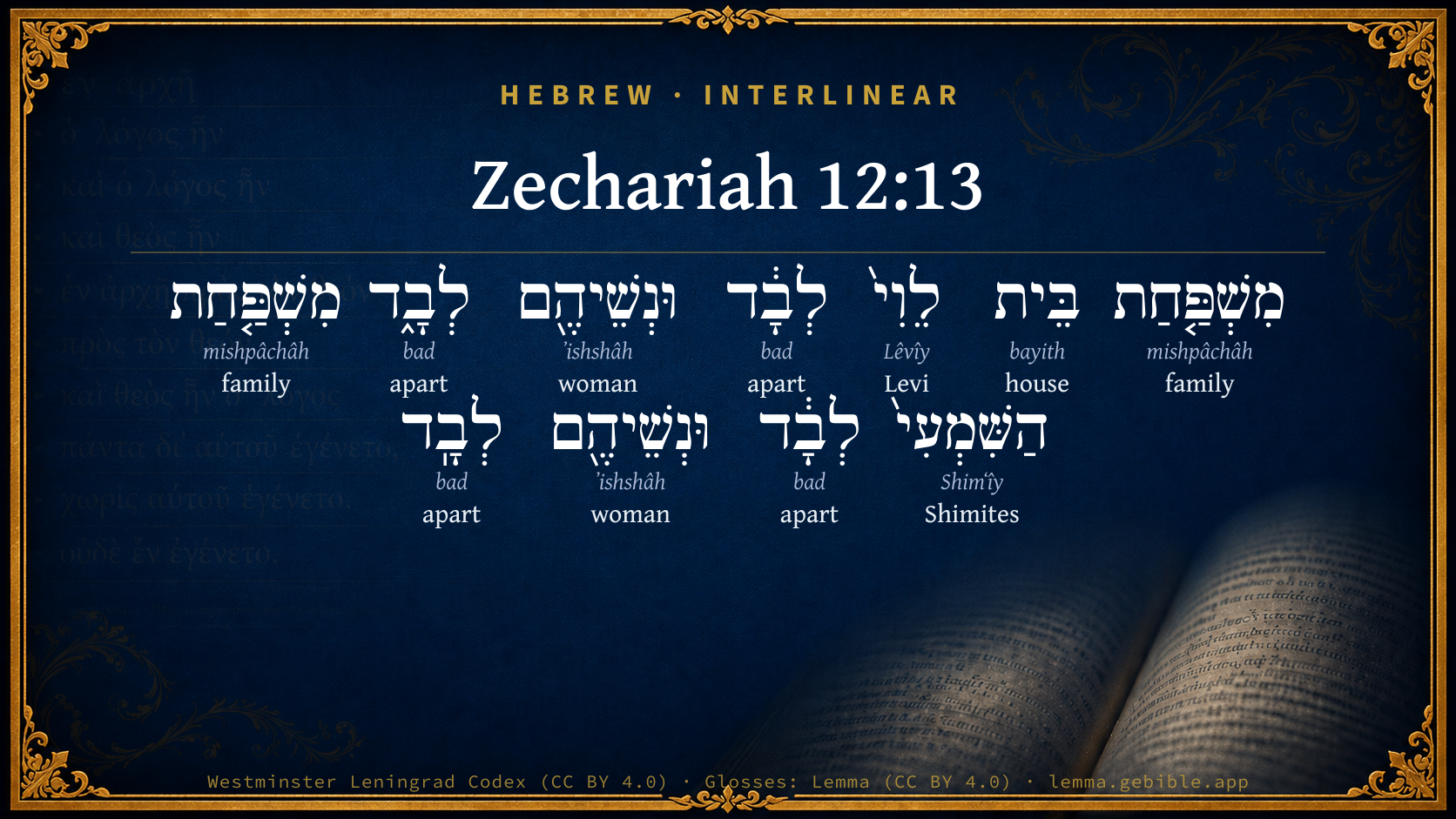
Hebrew (Westminster Leningrad Codex) Zechariah 12:13 appears in the Hebrew Old Testament. The text above is from the Westminster Leningrad Codex. Each word links to its Strong’s number, a concise gloss, and parsing drawn from the Open Scriptures Hebrew Bible morphology. Click any word for its full Brown-Driver-Briggs (BDB) entry.
Download image
Cite this verse

Zechariah 12:13 (World English Bible). Public Domain. Lemma interlinear Bible study tool, https://lemma.gebible.app/v/zechariah/12/13.

Show BibTeX & RIS
BibTeX
RIS
English Translation
the family of the house of Levi apart, and their wives apart; the family of the Shimeites apart, and their wives apart;
World English Bible · Public Domain
Download a study sheet

One document with this verse’s original text, its word-by-word gloss line, the meaning frame, cross-references with their text, attributed commentary, and full source and license credits — printable, and it pastes into notes with its structure intact.

This verse Autodidact and up

Study sheet (.html) Plain text (.txt)

A passage Seminary Student

Up to 50 verses in one chapter. A passage sheet keeps up to 6 commentary sources and 12 cross-references per verse, in the order this page ranks them, and says so on the sheet whenever that leaves anything out. Ask for a single verse and you get the Autodidact verse sheet above.

Everything on this page stays free to read, with no account — the sheet is a download of what is already on screen, not access to it.

Want to remove ads? Support Godless Engineer
Compare translations 3

The same verse in 3 English versions, stacked beneath the original-language interlinear above. Click any original word for its lexicon entry.

Each is an independent rendering of the whole verse — the interlinear is not word-aligned to these translations.

Highlighted words mark where these versions differ — a whole-verse word diff, not a word-by-word alignment.

  • World English Bible Public Domain
    the family of the house of Levi apart, and their wives apart; the family of the Shimeites apart, and their wives apart;
  • King James Version Public Domain
    The family of the house of Levi apart, and their wives apart; the family of Shimei apart, and their wives apart;
  • unfoldingWord Literal Text CC BY-SA 4.0
    The clan of the house of Levi will be separate and their wives will be separate from the men. The clan of the Shimeites will be separate and their wives will be separate from the men.

unfoldingWord Literal Text — © unfoldingWord, licensed CC BY-SA 4.0. Word-aligned USFM3 via Door43 (git.door43.org/unfoldingWord/en_ult).

Versions to compare (up to 4)

3 of 4 selected

Show all 18 translations

Every available English version of this verse, each an independent rendering of the whole verse.

  • World English Bible Public Domain
    the family of the house of Levi apart, and their wives apart; the family of the Shimeites apart, and their wives apart;
  • Berean Standard Bible Public Domain
    the clan of the house of Levi and their wives, the clan of Shimei and their wives,
  • Majority Standard Bible Public Domain
    the clan of the house of Levi and their wives, the clan of Shimei and their wives,
  • King James Version Public Domain
    The family of the house of Levi apart, and their wives apart; the family of Shimei apart, and their wives apart;
  • American Standard Version (1901) Public Domain
    the family of the house of Levi apart, and their wives apart; the family of the Shimeites apart, and their wives apart;
  • Revised Version (1885) Public Domain
    the family of the house of Levi apart, and their wives apart; the family of the Shimeites apart, and their wives apart;
  • Geneva Bible (1599) Public Domain
    The familie of the house of Leui apart, and their wiues apart: the familie of Shemei apart, and their wiues apart:
  • Douay-Rheims (1899) Public Domain
    The families of the house of Nathan apart, and their women apart: the families of the house of Levi apart, and their women apart: the families of Semei apart, and their women apart.
  • Young's Literal Translation Public Domain
    The family of the house of Levi apart, And their women apart; The family of Shimei apart, And their women apart,
  • Literal Standard Version CC BY-SA 4.0
    The family of the house of Levi apart, || And their women apart; The family of Shimei apart, || And their women apart,
  • Unlocked Literal Bible CC BY-SA 4.0
    The clan of the house of Levi will be separate and their wives will be separate from the men. The clan of the Shimeites will be separate and their wives will be separate from the men.
  • unfoldingWord Literal Text CC BY-SA 4.0
    The clan of the house of Levi will be separate and their wives will be separate from the men. The clan of the Shimeites will be separate and their wives will be separate from the men.
  • Darby Bible Public Domain
    the family of the house of Levi apart, and their wives apart; the family of Shimei apart, and their wives apart;
  • World Messianic Bible Public Domain
    the family of the house of Levi apart, and their wives apart; the family of the Shimeites apart, and their wives apart;
  • Webster's Bible Public Domain
    The family of the house of Levi apart, and their wives apart; the family of Shimei apart, and their wives apart;
  • Free Bible Version CC BY-SA 4.0
    Levi, and Shimei—
  • Bible in Basic English Public Domain
    The family of Levi by themselves, and their wives by themselves; the family of Shimei by themselves, and their wives by themselves;
  • JPS Tanakh (1917) Public Domain
    The family of the house of Levi apart, and their wives apart; the family of the Shimeites apart, and their wives apart;

Literal Standard Version (2020), Covenant Press — licensed CC BY-SA 4.0. Text via the HelloAO Bible API (eBible.org). Unlocked Literal Bible (unfoldingWord) — licensed CC BY-SA 4.0. Text via the HelloAO Bible API (eBible.org). unfoldingWord Literal Text — © unfoldingWord, licensed CC BY-SA 4.0. Word-aligned USFM3 via Door43 (git.door43.org/unfoldingWord/en_ult). Free Bible Version, Dr. Jonathan Gallagher — licensed CC BY-SA 4.0. Text via the HelloAO Bible API (eBible.org).

Word by word

More ways to search: Search by grammar → Find every occurrence → Compare this word →

Practice this passage: Drill this verse → Learn its vocabulary →

הַשִּׁמְעִי֙
Shimʻîy
H8097
“the · Shimites”
Particle, Definite Article + Noun, Gentilic, Masculine, Singular, Absolute
Part of Speech
Particle + Noun
Type
Gentilic
Gender
Masculine
Number
Singular
State
Absolute
Full BDB Definition

Origin: patronymically from H8096

TWOT: None

Shimites = see Shimei " renowned" - descendants of Shimei or Shimi
  1. מִשְׁפַּ֤חַת mishpâchâh H4940 “family of” Noun, Common, Feminine, Singular, Construct
  2. בֵּית bayith H1004 “house of” Noun, Common, Masculine, Singular, Construct
  3. לֵוִי֙ Lêvîy H3878 “Levi” Noun, Proper
  4. לְבָ֔ד bad H905 “to/for · apart” Preposition + Noun, Common, Masculine, Singular, Absolute
  5. וּנְשֵׁיהֶ֖ם ʼishshâh H802 “and · women · their” Conjunction + Noun, Common, Feminine, Plural, Construct + Suffix, Personal, 3rd Person, Masculine, Plural
  6. לְבָ֑ד bad H905 “to/for · apart” Preposition + Noun, Common, Masculine, Singular, Absolute
  7. מִשְׁפַּ֤חַת mishpâchâh H4940 “family of” Noun, Common, Feminine, Singular, Construct
  8. לְבָ֔ד bad H905 “to/for · apart” Preposition + Noun, Common, Masculine, Singular, Absolute
  9. וּנְשֵׁיהֶ֖ם ʼishshâh H802 “and · women · their” Conjunction + Noun, Common, Feminine, Plural, Construct + Suffix, Personal, 3rd Person, Masculine, Plural
  10. לְבָֽד bad H905 “to/for · apart” Preposition + Noun, Common, Masculine, Singular, Absolute

About this verse

These counts appear in no published source. They are computed here, from the morphology-tagged text and Lemma’s own curated glosses. What Lemma adds →

11
words
6
distinct lemmas
Prophets
section

Notable vocabulary

The rarest word here is הַשִּׁמְעִי֙ Shimites H8097 — appearing just 2 times in the whole Hebrew Bible.

Shared distinctive vocabulary

הַשִּׁמְעִי֙ Shimites H8097 occurs in 2 verses of the Hebrew Bible. Also found in:

Grammatical profile

  • 11 nouns

Repetition

Words recur within this verse — often emphatic in Hebrew:

  • לְבָ֔ד apart H905 ×4
  • מִשְׁפַּ֤חַת family H4940 ×2
  • וּנְשֵׁיהֶ֖ם woman H802 ×2

Hebrew & Septuagint length

In English translation the verse runs 22 words from the Hebrew and 25 from the Septuagint (LXX English) — closely comparable.

A rough comparison of the two English renderings, which tokenize alike — not a word-level alignment.

Word counts can differ between the Hebrew and the Greek without any difference in meaning — e.g. the Hebrew direct-object marker אֵת has no separate Greek word, and Greek often adds the article ὁ.

Cross-references

10

Topical passages linked to Zechariah 12:13 in the Treasury of Scripture Knowledge — connected by theme and wording, ordered by reader-vote popularity; previews shown in the World English Bible.

  • Exodus 6:16–26 These are the names of the sons of Levi according to their generations: Gershon, and Kohath, and Merari; and the years of the life of Levi were one hundred thirty-seven years.
  • Numbers 3:1–4 Now this is the history of the generations of Aaron and Moses in the day that Yahweh spoke with Moses in Mount Sinai.
  • 2 Samuel 16:5 When king David came to Bahurim, behold, a man of the family of the house of Saul came out, whose name was Shimei, the son of Gera. He came out, and cursed still as he came.
  • 1 Kings 1:8 But Zadok the priest, and Benaiah the son of Jehoiada, and Nathan the prophet, and Shimei, and Rei, and the mighty men who belonged to David, were not with Adonijah.
  • 1 Chronicles 3:19 The sons of Pedaiah: Zerubbabel, and Shimei. The sons of Zerubbabel: Meshullam, and Hananiah; and Shelomith was their sister;
  • 1 Chronicles 4:27 Shimei had sixteen sons and six daughters; but his brothers didn't have many children, neither did all their family multiply like the children of Judah.
  • 1 Chronicles 23:7 Of the Gershonites: Ladan and Shimei.
  • 1 Chronicles 23:10 The sons of Shimei: Jahath, Zina, and Jeush, and Beriah. These four were the sons of Shimei.
  • 2 Chronicles 29:14 and of the sons of Heman, Jehuel and Shimei; and of the sons of Jeduthun, Shemaiah and Uzziel.
  • Malachi 2:4–9 You will know that I have sent this commandment to you, that my covenant may be with Levi," says Yahweh of Hosts.

Cross-references courtesy of OpenBible.info (CC BY 4.0).

Hebrew and Greek witnesses Masoretic Hebrew ↔ Greek Septuagint

The same verse in the two great witnesses to the Old Testament, shown verse-for-verse.

These are two independent witnesses, not word-aligned to each other, and the Septuagint is shown in lemma (dictionary) form.

Hebrew Zechariah 12:13 Masoretic · Westminster Leningrad Codex

מִשְׁפַּ֤חַת בֵּית לֵוִי֙ לְבָ֔ד וּנְשֵׁיהֶ֖ם לְבָ֑ד מִשְׁפַּ֤חַת הַשִּׁמְעִי֙ לְבָ֔ד וּנְשֵׁיהֶ֖ם לְבָֽד

the family of the house of Levi apart, and their wives apart; the family of the Shimeites apart, and their wives apart;

World English Bible · Public Domain

Greek LXX Zechariah 12:13 Septuagint · lemma form

φυλή οἶκος λευί κατά ἑαυτοῦ καί ὁ γυνή αὐτός κατά ἑαυτοῦ φυλή ὁ συμεων κατά ἑαυτοῦ καί ὁ γυνή αὐτός κατά ἑαυτοῦ

the family of the house of Levi by itself, and their wives by themselves; the family of Symeon by itself, and their wives by themselves;

LXX2012 (modern English Septuagint) · Public Domain

On this verse, John Gill's Exposition discusses the Septuagint’s reading. Read the note in Commentary ↓

Hebrew: Westminster Leningrad Codex (CC BY 4.0). Greek: Septuagint (public domain); English from LXX2012 (modern English Septuagint) (Public Domain). How the Septuagint differs from the Hebrew →

Targum (Aramaic paraphrase)

1

The Targum is the ancient Jewish Aramaic paraphrase of the Hebrew Scriptures — an interpretive translation, not the Hebrew text itself. Onkelos (literal) and Pseudo-Jonathan (expansive) render the Torah, and Jonathan the Prophets. Coverage is partial: where no permissively-licensed English translation exists for a verse, only the Aramaic is shown. This is verse-level text, not a word-by-word alignment to the Hebrew.

  1. Targum Jonathan Prophets (Joshua–Malachi)
    זַרְעִית בֵּית לְוִי לְחוֹד גַבְרֵיהוֹן לְחוֹד וּנְשֵׁיהוֹן לְחוֹד זַרְעִית בֵּית שִׁמְעִי גַבְרֵיהוֹן לְחוֹד וּנְשֵׁיהוֹן לְחוֹד:

    (no public-domain English translation for this verse)

    Targum Jonathan — Aramaic: “Mikraot Gedolot” (public domain). English: “Sefaria Community Translation” (CC0 1.0 (public-domain dedication)); “London "Chaldee Paraphrase," 1871” (public domain). Text via Sefaria.

Commentary

Notes on Zechariah 12:13 from classic Christian and Jewish commentators (each source and its license shown beneath its notes). The classic Christian expositions comment on the surrounding passage and are grouped to its opening verse, so a note may address several verses; the Jewish commentaries on the Tanakh (Rashi and others) are per-verse, so they appear only where the commentator wrote on this verse.

Lemma curates 59 commentaries, every one of them public domain or Creative Commons licensed, each selected and text-cleaned for this edition rather than reprinted as found. About our sources →

Geneva Bible (1599)

Geneva Bible translators

Called also Simeon.

Geneva Bible (1599) marginal notes — public domain. Text via Bolls.life.

Jamieson, Fausset & Brown

Robert Jamieson, A. R. Fausset & David Brown

Levi . . . Shimei--the highest and lowest of the priestly order (Num 3:18, Num 3:21). Their example and that of the royal order would of course influence the rest.

Jamieson, Fausset & Brown — Commentary Critical and Explanatory on the Whole Bible (1871) — public domain (CC PDM 1.0). Text via the HelloAO Bible API.

John Calvin's Commentaries

Now, why he names the house of Levi, and the house of Shimei, or of Simeon, and the house of David, and the house of Nathan, rather than the other tribes, is uncertain: yet it seems to me probable that by the family of David he means the whole tribe of Judah, and the same by the family of Nathan. As to the tribe of Levi it excelled in honor on account of the priesthood, but no honor belonged to Simeon. Why then are Issachar and Reuben the first-born, and the other tribes omitted here? It might indeed have been, that there were then remaining more from the tribes of Simeon and Levi than from the tribe of Zebulon or of Issachar or of Reuben; but this is uncertain, and I am not disposed to make much of mere conjectures. But I am inclined to think that the family of David and the tribe of Levi are here mentioned not for the sake of honor but of reproach, because the royal family and the priests were those who crucified Christ, and pierced God in the person of his only-begotten Son. Jerome conjectures, that the family of Nathan is named, because he was a celebrated Prophet and eminent above others, and that the Prophets are designated by him. He says that many teachers arose from the tribe of Simeon; but I know not where he got his information, for he adduces no proofs.

But I am satisfied with the simple view already given, — that the Prophet by mentioning certain families meant to include the whole people, and that he does not omit the royal family nor the priests, because they were especially those who crucified Christ: and we know that Christ descended from Nathan, though Jerome thought the Prophet to be intended here rather than Nathan, one of Christ’s progenitors: but these things are of small moment.

John Calvin's Commentaries (1540-1563) — public domain. Text from the Calvin Translation Society English edition (1840s-50s) via the Christian Classics Ethereal Library (ccel.org). Calvin's coverage is partial (roughly two-thirds of the Bible); uncommented books and verses are honest gaps, never fabricated. The 19th-century editor's footnotes and remarks are omitted so the notes are faithfully Calvin's own voice.

Ellicott's Commentary for English Readers

(13) Shimei.—Not the Benjamite tribe (2Sa_16:5), but of the family of Gershon, son of Levi (Num_3:17). Thus, of the two tribes, he mentions one leading family and one subordinate branch, and then (Zec_12:1) embraces all together, and mentions even “their wives apart,” to show how general, and yet particular, the mourning should be.

A Bible Commentary for English Readers, edited by Charles John Ellicott (1878–1897) — public domain. Text from a community e-Sword module.

John Gill's Exposition

The family of the house of Levi apart, and their wives apart,.... Because of the contempt of the priestly office of Christ, which theirs prefigured, and was abolished by him; because of their trampling upon his blood, righteousness, and sacrifice:

the family of Shimei apart, and their wives apart; not of Shimea the son of David, Ch1 3:5 as Jarchi thinks, for his family is comprehended in the family of David; nor of Shimei the son of Merari, and grandson of Levi, Ch1 6:16, for the same reason: some think that, by way of prophecy, the family of Semei, mentioned among the progenitors of Christ, Luk 3:26, is intended; and others have thought of Shammai, a famous Misnic doctor in the times of Christ, whose disciples were called the house or family of Shammai, of which frequent mention is made in the Misna and Talmud: but the Septuagint, Syriac, and Arabic versions, read "the family of Simeon"; mentioned together with Levi, as brethren in iniquity, and now mourn for the common concern they had in the crucifixion of Christ, and their refusal of him.

John Gill's Exposition of the Whole Bible (1746–1763) — public domain (CC PDM 1.0). Text via the HelloAO Bible API.

Haydock's Catholic Bible Commentary

Nathan. Zorobabel was his descendant. --- Semei, the son of Gershom, 1 Paralipomenon vi. 16. (Calmet) --- "From this tribe the doctors are chosen." (St. Jerome) --- The pious of all ranks bewail the death of Christ, and the share which they had in it. (Haydock) --- He had done good to many; and therefore we may presume that many would grieve in every tribe. (Menochius)

George Leo Haydock (1774–1849), Haydock's Catholic Family Bible and Commentary, 1859 edition — public domain. Excludes Psalms (Douay-Rheims chapter numbering differs from Protestant) and Deuterocanonical books (Catholic canon only).

Matthew Poole's English Annotations

The sacerdotal tribe were the most bitter and fierce persecutors of Christ, they hired the traitor, they sought witness; the high priest (head of that family) condemned him to die; for all which they shall one day reckon with God, and therefore above other tribes they are particularly named as chief mourners for their injustice and cruelty to Christ. Here is one particular branch of Levi’s family mentioned, the family of Shimei, of whom 1Ch 6:17; 23:10. These two families had been deeply guilty; now they do as eminently concern themselves to mourn for him, to lament the sin, deprecate the fierce wrath of God, and submit to his kingdom, which their fathers did not, would not do. In this family, where most were bitter, bloody enemies to Christ, some had other thoughts of him, and mourned for him.

Matthew Poole's English Annotations on the Holy Bible (1683–1685) — public domain. Text from a community e-Sword/MySword module.

The Pulpit Commentary

Levi... Shimei. As before, the priestly family is first mentioned generally, and then individualized by naming Shimei, the son of Gershon, and grandson of Levi, of whom was the family of the Shimeites. (Num_3:17, Num_3:18, Num_3:21) The LXX gives, "the tribe of Simeon," instead of "the family of Shimei." But there is no reason for singling out this tribe. In one sense, this prophecy began to be fulfilled when a great company of priests were converted by the preaching of the apostles. (Act_6:7)

The Pulpit Commentary (1880–1919), ed. H.D.M. Spence-Jones & Joseph S. Exell — public domain. Text from a community e-Sword module.

John Wesley's Explanatory Notes

The house of Levi - The sacerdotal tribe were the most bitter persecutors of Christ, they hired the traitor, they sought witness; the high priest, (head of that family) condemned him to die, for all which they shall one day reckon with God, and therefore above other tribes they are particularly named as chief mourners for their cruelty to Christ.

John Wesley, Explanatory Notes Upon the Whole Bible (1754–1765) — public domain. Text via the GEBible commentary corpus.

Rashi

Rabbi Shlomo Yitzchaki (Rashi)

the house of Levi The priests and the Levites.

the family of the Shimeites Shammua the son of David. Scripture first makes a generality about the house of David, and then it specifies each one.

Rashi on the Tanakh — English translations: “The Judaica Press complete Tanach with Rashi, translated by A. J. Rosenberg” (CC BY 4.0); “Pentateuch with Rashi's commentary by M. Rosenbaum and A.M. Silbermann, 1929-1934” (public domain); “The Metsudah Tanach series, Lakewood, N.J” (CC BY 4.0); and “The Book of Joshua, Metsudah Publications, 1997” (CC BY 4.0). Text via Sefaria.

Lesson kit

Teaching starters — assembled from the data on this page, not authored interpretation. Every prompt links to the verse data it draws on. Edit before teaching.

Zechariah, in the Prophets, opens this verse with 11 words (6 distinct Hebrew lemmas). Its most distinctive word is Shimʻîy (“Shimites”). A historical commentator’s framing appears above. Read the whole chapter for the surrounding context.

Discussion questions

  1. How does “Shimites” (Shimʻîy) shape what this verse is saying?
  2. Numbers 3:21 shares the word «Shimites» with this verse. How do the two illuminate each other?
  3. “apart” occurs 4× in this one verse. What is the effect of the repetition?
  4. The translations on this page render this verse differently — a whole-verse word diff, not a word-by-word alignment. What might account for the different wordings?
  5. Reading how Geneva Bible (1599) and Jamieson, Fausset & Brown read this verse, where do the two commentators agree and where do they part?

Things to notice

  • These translations choose different wording for 8 words in this verse.
  • “apart” occurs 4× in this single verse.
  • 6 distinct Hebrew lemmas span 11 words in this verse.

Reading settings

Reading text

Shown beneath each verse's original-language words.

Old Testament
Old Testament edition

Read the OT as the Masoretic Hebrew (MT) or the Greek Septuagint (LXX).

English shown for the Greek Septuagint (in the Hebrew ↔ Greek comparison).

Comparing translations? Open the Compare panel on any verse page to stack up to four side by side.