
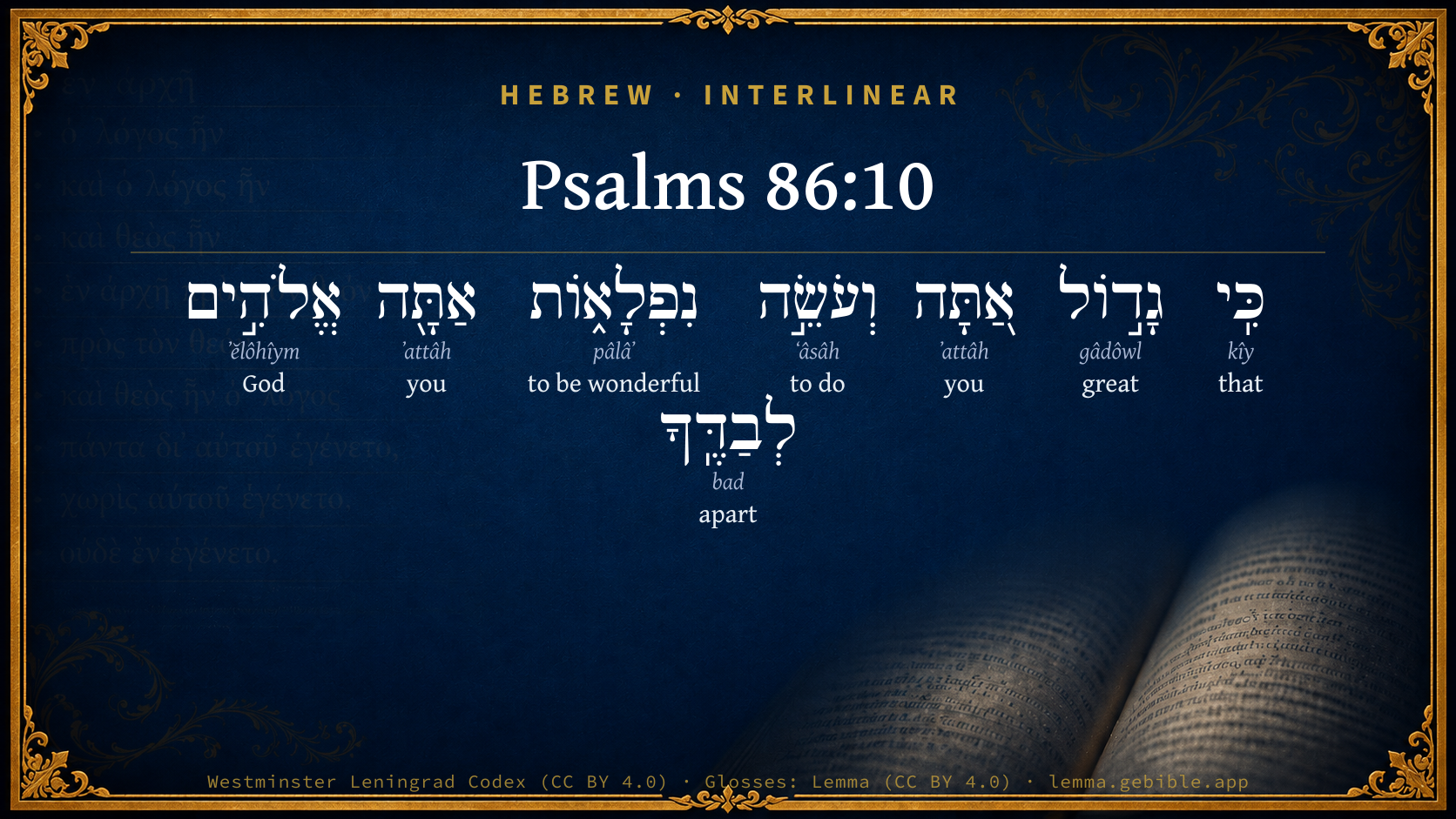
Psalms 86:10

Hebrew (Westminster Leningrad Codex) Psalms 86:10 appears in the Hebrew Old Testament. The text above is from the Westminster Leningrad Codex. Each word links to its Strong’s number, a concise gloss, and parsing drawn from the Open Scriptures Hebrew Bible morphology. Click any word for its full Brown-Driver-Briggs (BDB) entry.
Download image
Cite this verse

Psalms 86:10 (World English Bible). Public Domain. Lemma interlinear Bible study tool, https://lemma.gebible.app/v/psalms/86/10.

Show BibTeX & RIS
BibTeX
RIS
English Translation
For you are great, and do wondrous things. You are God alone.
World English Bible · Public Domain
Download a study sheet

One document with this verse’s original text, its word-by-word gloss line, the meaning frame, cross-references with their text, attributed commentary, and full source and license credits — printable, and it pastes into notes with its structure intact.

This verse Autodidact and up

Study sheet (.html) Plain text (.txt)

A passage Seminary Student

Up to 50 verses in one chapter. A passage sheet keeps up to 6 commentary sources and 12 cross-references per verse, in the order this page ranks them, and says so on the sheet whenever that leaves anything out. Ask for a single verse and you get the Autodidact verse sheet above.

Everything on this page stays free to read, with no account — the sheet is a download of what is already on screen, not access to it.

Want to remove ads? Support Godless Engineer
Compare translations 3

The same verse in 3 English versions, stacked beneath the original-language interlinear above. Click any original word for its lexicon entry.

Each is an independent rendering of the whole verse — the interlinear is not word-aligned to these translations.

Highlighted words mark where these versions differ — a whole-verse word diff, not a word-by-word alignment.

  • World English Bible Public Domain
    For you are great, and do wondrous things. You are God alone.
  • King James Version Public Domain
    For thou art great, and doest wondrous things: thou art God alone.
  • unfoldingWord Literal Text CC BY-SA 4.0
    For you great and are doing wonderful things; you God, you alone.

unfoldingWord Literal Text — © unfoldingWord, licensed CC BY-SA 4.0. Word-aligned USFM3 via Door43 (git.door43.org/unfoldingWord/en_ult).

Versions to compare (up to 4)

3 of 4 selected

Show all 18 translations

Every available English version of this verse, each an independent rendering of the whole verse.

  • World English Bible Public Domain
    For you are great, and do wondrous things. You are God alone.
  • Berean Standard Bible Public Domain
    For You are great and perform wonders; You alone are God.
  • Majority Standard Bible Public Domain
    For You are great and perform wonders; You alone are God.
  • King James Version Public Domain
    For thou art great, and doest wondrous things: thou art God alone.
  • American Standard Version (1901) Public Domain
    For thou art great, and doest wondrous things: Thou art God alone.
  • Revised Version (1885) Public Domain
    For thou art great, and doest wondrous things: thou art God alone.
  • Geneva Bible (1599) Public Domain
    For thou art great and doest wonderous things: thou art God alone.
  • Douay-Rheims (1899) Public Domain
    For thou art great and dost wonderful things: thou art God alone.
  • Young's Literal Translation Public Domain
    For great `art' Thou, and doing wonders, Thou `art' God Thyself alone.
  • Literal Standard Version CC BY-SA 4.0
    For You [are] great, and doing wonders, || You [are] God alone.
  • Unlocked Literal Bible CC BY-SA 4.0
    For you are great and do wonderful things; you only are God.
  • unfoldingWord Literal Text CC BY-SA 4.0
    For you great and are doing wonderful things; you God, you alone.
  • Darby Bible Public Domain
    For thou art great, and doest wondrous things: thou art God, thou alone.
  • World Messianic Bible Public Domain
    For you are great, and do wondrous things. You are God alone.
  • Webster's Bible Public Domain
    For thou art great, and doest wondrous things: thou art God alone.
  • Free Bible Version CC BY-SA 4.0
    For you are great, and do wonderful things! Only you are God.
  • Bible in Basic English Public Domain
    For you are great, and do great works of wonder; you only are God.
  • JPS Tanakh (1917) Public Domain
    For Thou art great, and doest wondrous things; Thou art God alone.

Literal Standard Version (2020), Covenant Press — licensed CC BY-SA 4.0. Text via the HelloAO Bible API (eBible.org). Unlocked Literal Bible (unfoldingWord) — licensed CC BY-SA 4.0. Text via the HelloAO Bible API (eBible.org). unfoldingWord Literal Text — © unfoldingWord, licensed CC BY-SA 4.0. Word-aligned USFM3 via Door43 (git.door43.org/unfoldingWord/en_ult). Free Bible Version, Dr. Jonathan Gallagher — licensed CC BY-SA 4.0. Text via the HelloAO Bible API (eBible.org).

Word by word

More ways to search: Search by grammar → Find every occurrence → Compare this word →

Practice this passage: Drill this verse → Learn its vocabulary →

נִפְלָא֑וֹת
pâlâʼ
H6381
“being wonderful”
Verb, Niphal, Participle Active, Feminine, Plural, Absolute
Part of Speech
Verb
Stem
Niphal
Form
Participle Active
Gender
Feminine
Number
Plural
State
Absolute
Full BDB Definition

Origin: a primitive root

TWOT: 1768

to be marvellous, be wonderful, be surpassing, be extraordinary, separate by distinguishing action - (Niphal) - to be beyond one's power, be difficult to do - to be difficult to understand - to be wonderful, be extraordinary - marvellous (participle) - (Piel) to separate (an offering) - (Hiphil) - to do extraordinary or hard or difficult thing - to make wonderful, do wondrously - (Hithpael) to show oneself wonderful or marvellous
  1. כִּֽי kîy H3588 “that” Conjunction
  2. גָד֣וֹל gâdôwl H1419 “great” Adjective, Adjective, Masculine, Singular, Absolute
  3. אַ֭תָּה ʼattâh H859 “you” Pronoun, Personal, 2nd Person, Masculine, Singular
  4. וְעֹשֵׂ֣ה ʻâsâh H6213 “and · doing” Conjunction + Verb, Qal, Participle Active, Masculine, Singular, Construct
  5. אַתָּ֖ה ʼattâh H859 “you” Pronoun, Personal, 2nd Person, Masculine, Singular
  6. אֱלֹהִ֣ים ʼĕlôhîym H430 “God(s)” Noun, Common, Masculine, Plural, Absolute
  7. לְבַדֶּֽךָ bad H905 “to/for · apart · your” Preposition + Noun, Common, Masculine, Singular, Construct + Suffix, Personal, 2nd Person, Masculine, Singular

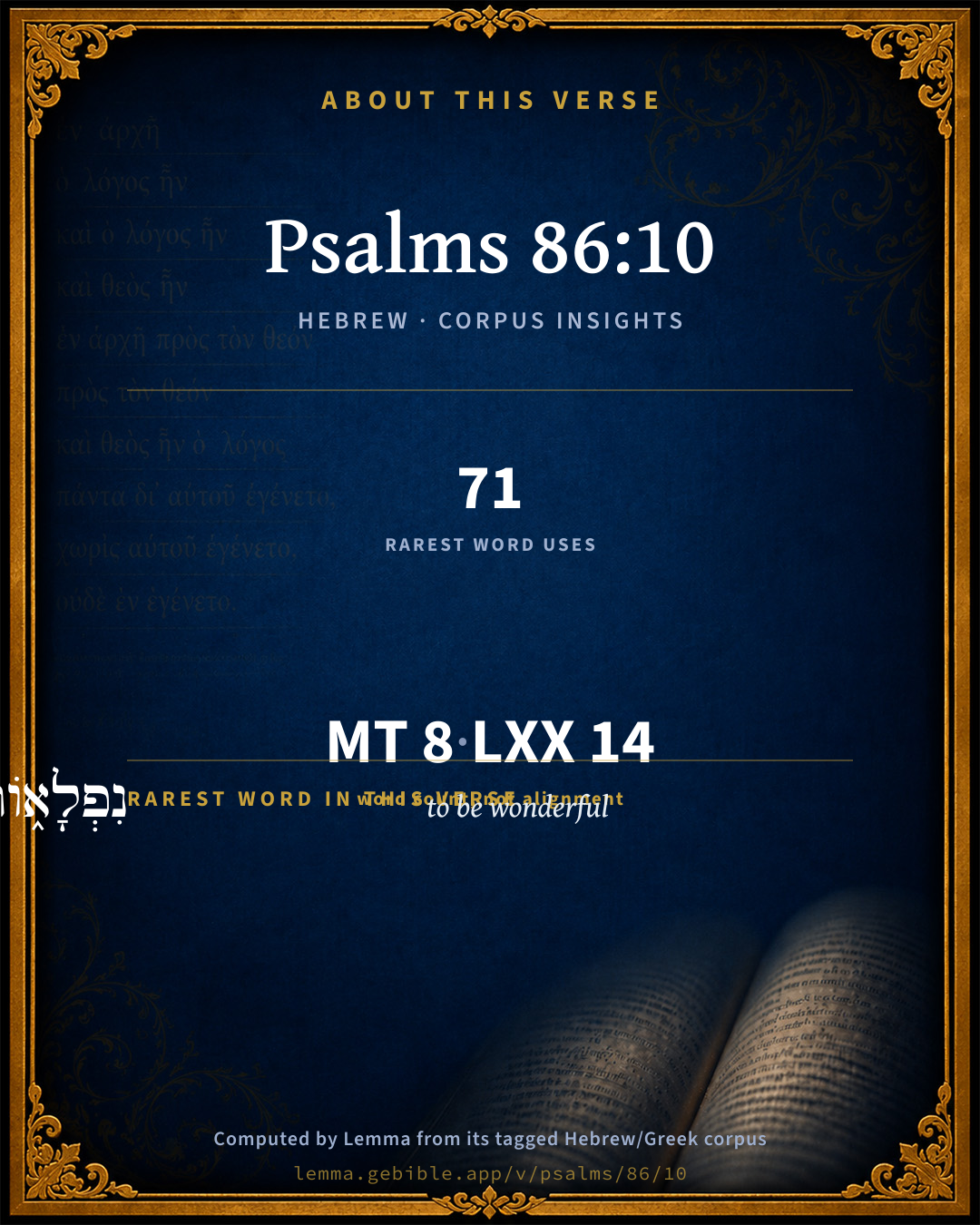
About this verse

These counts appear in no published source. They are computed here, from the morphology-tagged text and Lemma’s own curated glosses. What Lemma adds →

8
words
7
distinct lemmas
Wisdom
section

Grammatical profile

  • 2 verbs
  • 2 nouns
  • 1 adjective
  • 2 pronouns
  • 1 conjunction

Verb forms

  • וְעֹשֵׂ֣ה Qal · Participle Active
  • נִפְלָא֑וֹת Niphal · Participle Active

Repetition

A word recurs within this verse — often emphatic in Hebrew:

  • אַ֭תָּה you H859 ×2

Hebrew & Septuagint length

In English translation the verse runs 12 words from the Hebrew and 15 from the Septuagint (LXX English) — closely comparable.

A rough comparison of the two English renderings, which tokenize alike — not a word-level alignment.

Word counts can differ between the Hebrew and the Greek without any difference in meaning — e.g. the Hebrew direct-object marker אֵת has no separate Greek word, and Greek often adds the article ὁ.

In the original languages it is 8 Hebrew tokens and 14 Greek tokens — but the two are counted differently (Hebrew bundles its prefixes and suffixes into one token; the Greek is in lemma form), so that isn’t a like-for-like length.

Cross-references

19

Topical passages linked to Psalms 86:10 in the Treasury of Scripture Knowledge — connected by theme and wording, ordered by reader-vote popularity; previews shown in the World English Bible.

  • Isaiah 37:16 Yahweh of hosts, the God of Israel, who sits [above] the cherubim, you are the God, even you alone, of all the kingdoms of the earth; you have made heaven and earth.
  • Mark 12:29 Jesus answered, "The greatest is, 'Hear, Israel, the Lord our God, the Lord is one:
  • Psalms 72:18 Praise be to Yahweh God, the God of Israel, Who alone does marvelous deeds.
  • 1 Corinthians 8:4 Therefore concerning the eating of things sacrificed to idols, we know that no idol is anything in the world, and that there is no other God but one.
  • Exodus 15:11 Who is like you, Yahweh, among the gods? Who is like you, glorious in holiness, Fearful in praises, doing wonders?
  • Deuteronomy 32:39 See now that I, even I, am he, There is no god with me: I kill, and I make alive; I wound, and I heal; There is none who can deliver out of my hand.
  • Isaiah 37:20 Now therefore, Yahweh our God, save us from his hand, that all the kingdoms of the earth may know that you are Yahweh, even you only.
  • Isaiah 44:6–8 Thus says Yahweh, the King of Israel, and his Redeemer, Yahweh of Hosts: I am the first, and I am the last; and besides me there is no God.
  • Romans 15:18–19 For I will not dare to speak of any things except those which Christ worked through me, for the obedience of the Gentiles, by word and deed,
  • Ephesians 4:6 one God and Father of all, who is over all, and through all, and in us all.
  • Deuteronomy 6:3–4 Hear therefore, Israel, and observe to do it; that it may be well with you, and that you may increase mightily, as Yahweh, the God of your fathers, has promised to you, in a land flowing with milk and honey.
  • Job 11:7 "Can you fathom the mystery of God? Or can you probe the limits of the Almighty?
  • Psalms 77:13–15 Your way, God, is in the sanctuary. What god is great like God?
  • Psalms 86:8 There is no one like you among the gods, Lord, Nor any deeds like your deeds.
  • Psalms 145:3–5 Great is Yahweh, and greatly to be praised! His greatness is unsearchable.
  • Daniel 6:26–27 I make a decree, that in all the dominion of my kingdom men tremble and fear before the God of Daniel; for he is the living God, and steadfast forever, His kingdom that which shall not be destroyed; and his dominion shall be even to the end.
  • Acts 2:19–22 I will show wonders in the sky above, And signs on the earth beneath; Blood, and fire, and billows of smoke.
  • Acts 4:30 while you stretch out your hand to heal; and that signs and wonders may be done through the name of your holy Servant Jesus."
  • Hebrews 2:4 God also bearing witness with them, both by signs and wonders, and by various works of power, and by gifts of the Holy Spirit, according to his own will?

Cross-references courtesy of OpenBible.info (CC BY 4.0).

Hebrew and Greek witnesses Masoretic Hebrew ↔ Greek Septuagint

The same verse in the two great witnesses to the Old Testament, shown verse-for-verse.

You’re reading Greek Psalm 85 (Hebrew Psalm 86). The Septuagint counts the superscription, so verse numbers can differ from the Hebrew — chapter-level alignment, not verse-by-verse. Numbering follows Rahlfs.

These are two independent witnesses, not word-aligned to each other, and the Septuagint is shown in lemma (dictionary) form.

Hebrew Psalms 86:10 Masoretic · Westminster Leningrad Codex

כִּֽי גָד֣וֹל אַ֭תָּה וְעֹשֵׂ֣ה נִפְלָא֑וֹת אַתָּ֖ה אֱלֹהִ֣ים לְבַדֶּֽךָ

For you are great, and do wondrous things. You are God alone.

World English Bible · Public Domain

Greek LXX Greek Psalm 85:10 Septuagint · lemma form

ὅτι μέγας εἰμί σύ καί ποιέω θαυμάσιος σύ εἰμί ὁ θεός μόνος ὁ μέγας

For you are great, and do wonders: you are the only and the great God.

LXX2012 (modern English Septuagint) · Public Domain

Hebrew: Westminster Leningrad Codex (CC BY 4.0). Greek: Septuagint (public domain); English from LXX2012 (modern English Septuagint) (Public Domain). How the Septuagint differs from the Hebrew →

Commentary

Notes on Psalms 86:10 from classic Christian and Jewish commentators (each source and its license shown beneath its notes). The classic Christian expositions comment on the surrounding passage and are grouped to its opening verse, so a note may address several verses; the Jewish commentaries on the Tanakh (Rashi and others) are per-verse, so they appear only where the commentator wrote on this verse.

Lemma curates 59 commentaries, every one of them public domain or Creative Commons licensed, each selected and text-cleaned for this edition rather than reprinted as found. About our sources →

Trapp's Complete Commentary

John Trapp

Psa 86:10 For thou [art] great, and doest wondrous things: thou [art] God alone.

Ver. 10. For thou art great] Great is the Lord without quantity, good without quality, everlasting without time, omnipresent without place, containing all things without extent; within all things, and contained of nothing; without all things, and sustained of nothing, &c. Now, the least glimpse of this knowledge is worth all the gleams of human wisdom.

And doest wondrous things] The schools have laid down a threefold way of knowing God: first, negation of imperfections; secondly, affirmation of perfections; thirdly, causation of great works.

John Trapp, A Commentary or Exposition upon All the Books of the Old and New Testament (1647–1656) — public domain. Text from a community e-Sword module.

The Biblical Illustrator

Joseph S. Exell

Psa_86:10

Thou . . . doest wondrous things.

Curiosities

In this age a great amount of wealth is lavished on curiosities.

I. One of the greatest curosities which has been made for you is the created world. When you see anything which is wonderful, the first questions are, Who made it? How did it get here? Some people say that this earth made itself; and that the machinery of its creation is a thing of chance. What a grand old curiosity is this world which God has made! It may also be likened to a glorious picture which speaks to us of Him.

II. Another curiosity which is intended for us is the bible. Thank God, the Bible is now so cheap that every man may possess a copy. It was once so scarce and dear that it was chained in the churches. The Bible is the grandest curiosity in the world.

III. Another great curiosity is yourself. What are you? What is your destiny? What is your pathway? Is it for happiness or misery? (W. Birch.)

The Biblical Illustrator, edited by Joseph S. Exell (c. 1880s–1900s) — public domain. Text from a community e-Sword module.

J. A. Alexander on Psalms

Joseph Addison Alexander

10. (Psa 86:10) For great (art) thou and doing wonders, thou (art) God alone. The only new idea here is the evidence afforded of Jehovah's sole divinity by his miraculous performances. The for, at the beginning of the verse, implies that these proofs of divinity must sooner or later have their full effect.

Joseph Addison Alexander, The Psalms Translated and Explained (1850) — public domain. Text from a community e-Sword module.

Adam Clarke's Commentary

Verse 10. For thou art great] Almighty, infinite, eternal.

And doest wondrous things] ועשה נפלאות veoseh niphlaoth; thou art the Worker of miracles. This thou hast done in numerous instances, and thereby showed thy infinite power and wisdom.

This appears to be a prophecy of the calling of the Gentiles to the faith of Christ, and the evidence to be given to his Divine mission by the miracles which he should work.

Thou art God alone.] Συ ει ὁ Θεος μονος ὁ μεγας. - Sept. Thou art the only, THE GREAT God. In this the AEthiopic and Arabic agree.

Adam Clarke's Commentary on the Bible (1810–1826) — public domain. Text from a community e-Sword/MySword module.

John Calvin's Commentaries

10. For thou art great, and thou alone, O God! doest wondrous things. In this verse there is again repeated the cause which will bring all nations to worship before the Lord, namely, the discovery made of his glory by the greatness of his works. The contemplation of God’s glory in his works is the true way of acquiring genuine godliness. The pride of the flesh would always lead it to wing its way into heaven; but, as our understandings fail us in such an extended investigation, our most profitable course is, according to the small measure of our feeble capacity, to seek God in his works, which bear witness of him. Let us therefore learn to awaken our understandings to contemplate the divine works, and let us leave the presumptuous to wander in their own intricate mazes, which, in the end, will invariably land them in an abyss from which they will be unable to extricate themselves. To incline our hearts to exercise this modesty, David magnificently extols the works of God, calling them wondrous things, although to the blind, and those who have no taste for them, they are destitute of attraction. In the meantime, we ought carefully to attend to this truth, That the glory of Godhead belongs exclusively to the one true God; for in no other being is it possible to find the wisdom, or the power, or the righteousness, or any of the numerous marks of divinity which shine forth in his wonderful works. Whence it follows, that the Papists are chargeable with rendering, as much as in them lies, his title to true Godhead nugatory, when despoiling him of his attributes they leave him almost nothing but the bare name.

John Calvin's Commentaries (1540-1563) — public domain. Text from the Calvin Translation Society English edition (1840s-50s) via the Christian Classics Ethereal Library (ccel.org). Calvin's coverage is partial (roughly two-thirds of the Bible); uncommented books and verses are honest gaps, never fabricated. The 19th-century editor's footnotes and remarks are omitted so the notes are faithfully Calvin's own voice.

The Cambridge Bible for Schools and Colleges

gen. ed. J. J. S. Perowne

10. Cp. Psa_77:13-14; Psa_72:18; Psa_83:18; and Exo_15:11; Exo_34:10.

The Cambridge Bible for Schools and Colleges (gen. ed. J. J. S. Perowne; Cambridge University Press, 1878–1918) — public domain. Text from a community e-Sword module.

John Gill's Exposition

For thou art great,.... In his nature, and the perfections of it; in his power, wisdom, truth, faithfulness, love, grace, and mercy; and in all his persons; the Father is great, greater than all; the Son is the great God, and our Saviour; and the Spirit, which is in his people, is greater than he that is in the world:

and doest wondrous things; in nature and providence; such as the forming of all things out of nothing; upholding all things by the word of his power; the formation of man, soul and body, and the union of both; and the constant government of the world; and more especially in grace, as the provision in the covenant in eternity, the mission of Christ in time, the conversion of a sinner, and bringing him to eternal glory:

thou art God alone; to the exclusion of all such who are not gods by nature; but not to the exclusion of the Son and Spirit, who are, with the Father, the one God, Jo1 5:7.

John Gill's Exposition of the Whole Bible (1746–1763) — public domain (CC PDM 1.0). Text via the HelloAO Bible API.

Albert Barnes' Notes on the Bible

For thou art great, and doest wondrous things - Things suited to excite wonder or admiration; things which lie beyond the power of any creature, and which could be performed by no one but a being of almighty power. A God who could do these things could also do that which the psalmist asked of him, for what God actually does proves that there is nothing within the limits of possibility which he cannot perform. The greatness and the power of God are reasons why we should appeal to him in our weakness, and in our times of trouble.

Thou art God alone - Thou only canst do what a God can do, or what belongs to God. In those things, therefore, which require the interposition of divine power our appeal must be to thee alone. So in the matter of salvation.

Albert Barnes' Notes on the Bible (1834–1885) — public domain. Text from a community e-Sword/MySword module.

Matthew Poole's English Annotations

Doest wondrous things: this is added as a reason either why the nations should own the true God, because they should see his wonderful works; or why that great work, Psa 86:9, was not incredible, but should certainly be accomplished.

Art God alone; and all thee idols of the heathen are no gods, but vanities; as the Gentiles themselves shall see and acknowledge.

Matthew Poole's English Annotations on the Holy Bible (1683–1685) — public domain. Text from a community e-Sword/MySword module.

The Treasury of David

Charles H. Spurgeon

Ver. 10. For thou art great. He had before said, "thou art good"; it is a grand thing when greatness and goodness are united; it is only in the Divine Being that either of them exists absolutely, and essentially. Happy is it for us that they both exist in the Lord to an equal degree. To be great and not good might lead to tyranny in the King, and for him to be good and not great might involve countless calamities upon his subjects from foreign foes, so that either alternative would be terrible; let the two be blended, and we have a monarch in whom the nation may rest and rejoice.

And doest wondrous things. Being good, he is said to be ready to forgive: being great, he works wonders: we may blend the two, for there is no wonder so wonderful as the pardon of our transgressions. All that God does or makes has wonder in it; he breathes, and the wind is mystery; he speaks, and the thunder astounds us; even the commonest daisy is a marvel, and a pebble enshrines wisdom. Only to fools is anything which God has made uninteresting: the world is a world of wonders. Note that the verb doest is in the present, the Lord is doing wondrous things, they are transpiring before our eyes. Where are they? Look upon the bursting buds of spring or the maturing fruits of autumn, gaze on the sky or skim the sea, mark the results of providence and the victories of grace, everywhere at all times the great Thaumaturge stretches forth his rod of power.

Thou art God alone. Alone wast thou God before thy creatures were; alone in godhead still art thou now that thou hast given life to throngs of beings; alone for ever shalt thou be, for none can ever rival thee. True religion makes no compromises, it does not admit Baal or Dagon to be a god; it is exclusive and monopolizing, claiming for Jehovah nothing less than all. The vaunted liberality of certain professors of modern thought is not to be cultivated by believers in the truth. "Philosophic breadth" aims at building a Pantheon, and piles a Pandemonium; it is not for us to be helpers in such an evil work. Benevolently intolerant, we would, for the good of mankind, as well as for the glory of God, undeceive mankind as to the value of their compromises, they are mere treason to truth. Our God is not to be worshipped as one among many good and true beings, but as God alone; and his gospel is not to be preached as one of several saving systems, but as the one sole way of salvation. Lies can face each other beneath one common dome; but in the temple of truth the worship is one and indivisible.

Ver. 10.

1. God is "great", therefore great things may be expected of him.

2. He is unsearchable, therefore "wondrous things" may be expected of him.

3. He is irresistible, therefore impossibihties to others may be expected of him: "Thou art God alone". G.R.

Psalms 86:11*

Charles H. Spurgeon's The Treasury of David (1869–1885) — public domain. Psalms only. Text from a community e-Sword/MySword module.

The Pulpit Commentary

For thou art great, and doest wondrous things. The" greatness" of God, in reality most clearly manifested by the facts of his ordinary providence, seems to men in general, as it seemed to this psalmist, especially indicated by the "wonders," or "miracles twOalpn which he wrought. (comp. Exo_15:11 Psa_72:18 Psa_77:14) Thou art God alone. (see 2Ki_19:15 Isa_37:16 Isa_44:6, Isa_44:8)

The Pulpit Commentary (1880–1919), ed. H.D.M. Spence-Jones & Joseph S. Exell — public domain. Text from a community e-Sword module.

unfoldingWord translationNotes

Door43 World Missions Community

wonderful things

"very good things that amaze me"

you only are God

"you are the only God"

Teach me your ways, Yahweh. Then I will walk in your truth

A person who obeys what God wants is spoken of as if he were walking on God's way or road. AT: "Teach me your truth, Yahweh. Then I will obey what you say" (See: Metaphor)

Unite my heart to reverence you

Here "heart" represents a person's thoughts, emotions, and motives. Asking God to cause a person to respect him completely is spoken of as if the person's heart were in many pieces and that God unites them together. AT: "Cause me to respect you sincerely with all my heart" or "Cause me to respect you sincerely" (See: Metonymy and Metaphor)

I will praise you with my whole heart

Here "heart" represents a person's thoughts, emotions, and motives. AT: "I will praise you completely and sincerely" (See: Metonymy)

I will glorify your name

Here "name" represents the whole person. AT: "I will glorify you" (See: Metonymy)

translationWords

God

Yahweh

walk

true

heart

revere

lord

praise

glory

eternity

unfoldingWord translationNotes — © Distant Shores Media and the Door43 World Missions Community, licensed CC BY-SA 4.0. Source: git.door43.org/Door43/en_tn.

Rashi

Rabbi Shlomo Yitzchaki (Rashi)

and perform wonders, You, O God, alone Before the angels were created, heaven and earth were created. Therefore, all the nations will glorify Your name.

Rashi on the Tanakh — English translations: “The Judaica Press complete Tanach with Rashi, translated by A. J. Rosenberg” (CC BY 4.0); “Pentateuch with Rashi's commentary by M. Rosenbaum and A.M. Silbermann, 1929-1934” (public domain); “The Metsudah Tanach series, Lakewood, N.J” (CC BY 4.0); and “The Book of Joshua, Metsudah Publications, 1997” (CC BY 4.0). Text via Sefaria.

Lesson kit

Teaching starters — assembled from the data on this page, not authored interpretation. Every prompt links to the verse data it draws on. Edit before teaching.

Psalms, in the Wisdom, opens this verse with 8 words (7 distinct Hebrew lemmas). Its most distinctive word is pâlâʼ (“to be wonderful”). A historical commentator’s framing appears above. Read the whole chapter for the surrounding context.

Discussion questions

  1. The word pâlâʼ carries the sense “to be wonderful.” How does it shape the verse?
  2. How does Isaiah 37:16, which shares this passage’s theme, read alongside this verse?
  3. What does the repetition of “you” (2× in this one verse) do in this verse?
  4. The translations on this page render this verse differently — a whole-verse word diff, not a word-by-word alignment. What might account for the different wordings?
  5. «וְעֹשֵׂ֣ה» is a Qal Participle Active verb. How does that grammatical form shape the action described?
  6. Compare how Trapp's Complete Commentary and The Biblical Illustrator read this verse. Where do they agree or differ?

Things to notice

Reading settings

Reading text

Shown beneath each verse's original-language words.

Old Testament
Old Testament edition

Read the OT as the Masoretic Hebrew (MT) or the Greek Septuagint (LXX).

English shown for the Greek Septuagint (in the Hebrew ↔ Greek comparison).

Comparing translations? Open the Compare panel on any verse page to stack up to four side by side.