
Isaiah 37:16

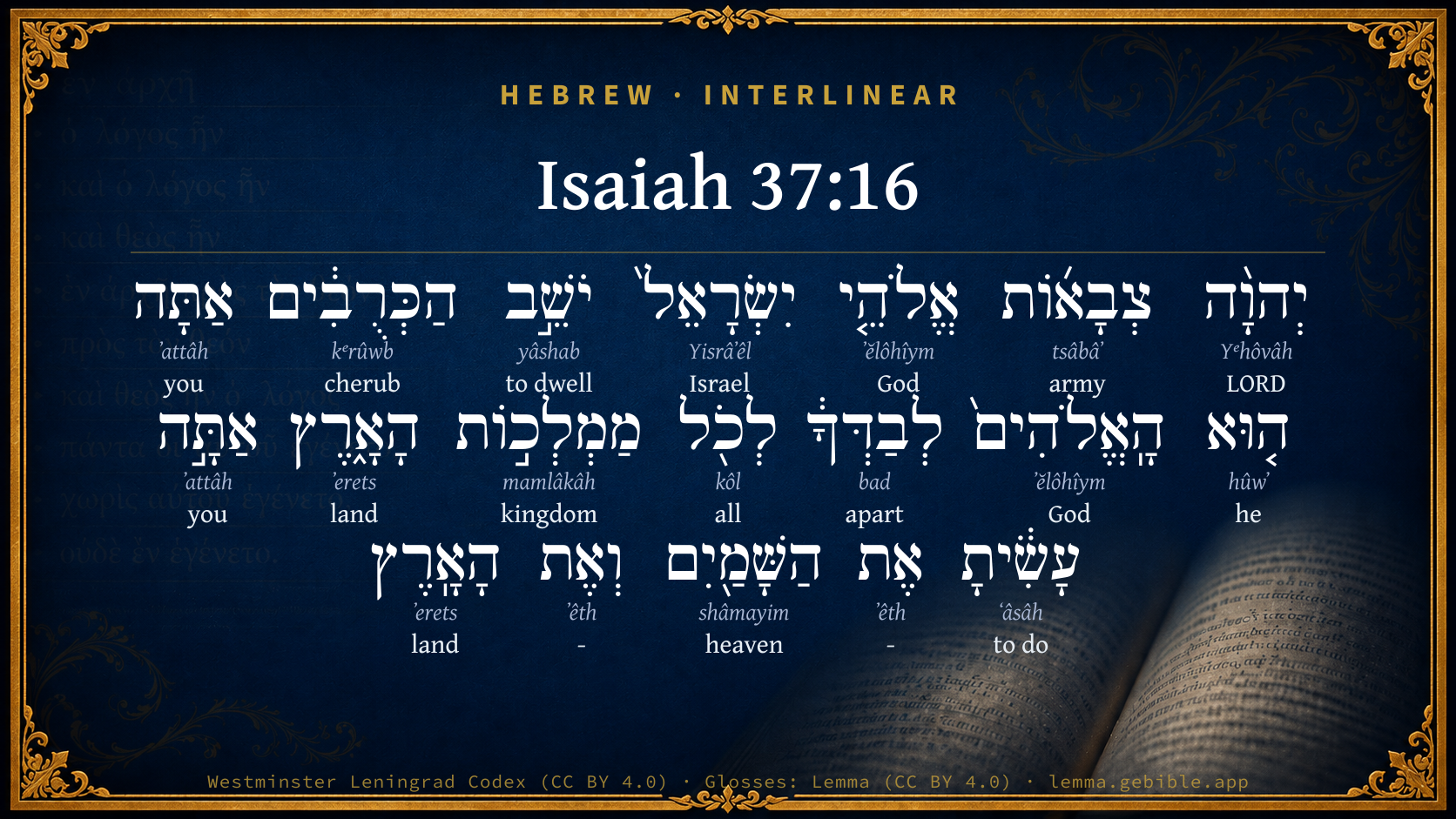
Hebrew (Westminster Leningrad Codex) Isaiah 37:16 appears in the Hebrew Old Testament. The text above is from the Westminster Leningrad Codex. Each word links to its Strong’s number, a concise gloss, and parsing drawn from the Open Scriptures Hebrew Bible morphology. Click any word for its full Brown-Driver-Briggs (BDB) entry.
Download image
Cite this verse

Isaiah 37:16 (World English Bible). Public Domain. Lemma interlinear Bible study tool, https://lemma.gebible.app/v/isaiah/37/16.

Show BibTeX & RIS
BibTeX
RIS
English Translation
Yahweh of hosts, the God of Israel, who sits [above] the cherubim, you are the God, even you alone, of all the kingdoms of the earth; you have made heaven and earth.
World English Bible · Public Domain
Download a study sheet

One document with this verse’s original text, its word-by-word gloss line, the meaning frame, cross-references with their text, attributed commentary, and full source and license credits — printable, and it pastes into notes with its structure intact.

This verse Autodidact and up

Study sheet (.html) Plain text (.txt)

A passage Seminary Student

Up to 50 verses in one chapter. A passage sheet keeps up to 6 commentary sources and 12 cross-references per verse, in the order this page ranks them, and says so on the sheet whenever that leaves anything out. Ask for a single verse and you get the Autodidact verse sheet above.

Everything on this page stays free to read, with no account — the sheet is a download of what is already on screen, not access to it.

Want to remove ads? Support Godless Engineer
Compare translations 3

The same verse in 3 English versions, stacked beneath the original-language interlinear above. Click any original word for its lexicon entry.

Each is an independent rendering of the whole verse — the interlinear is not word-aligned to these translations.

Highlighted words mark where these versions differ — a whole-verse word diff, not a word-by-word alignment.

  • World English Bible Public Domain
    Yahweh of hosts, the God of Israel, who sits [above] the cherubim, you are the God, even you alone, of all the kingdoms of the earth; you have made heaven and earth.
  • King James Version Public Domain
    O LORD of hosts, God of Israel, that dwellest between the cherubims, thou art the God, even thou alone, of all the kingdoms of the earth: thou hast made heaven and earth.
  • unfoldingWord Literal Text CC BY-SA 4.0
    “Yahweh of Armies, the God of Israel, sitter the cherubim, you he, God, you alone, over all of the kingdoms of the earth. You, you made the heavens and the earth.

unfoldingWord Literal Text — © unfoldingWord, licensed CC BY-SA 4.0. Word-aligned USFM3 via Door43 (git.door43.org/unfoldingWord/en_ult).

Versions to compare (up to 4)

3 of 4 selected

Show all 18 translations

Every available English version of this verse, each an independent rendering of the whole verse.

  • World English Bible Public Domain
    Yahweh of hosts, the God of Israel, who sits [above] the cherubim, you are the God, even you alone, of all the kingdoms of the earth; you have made heaven and earth.
  • Berean Standard Bible Public Domain
    “O LORD of Hosts, God of Israel, enthroned above the cherubim, You alone are God over all the kingdoms of the earth. You made the heavens and the earth.
  • Majority Standard Bible Public Domain
    “O LORD of Hosts, God of Israel, enthroned above the cherubim, You alone are God over all the kingdoms of the earth. You made the heavens and the earth.
  • King James Version Public Domain
    O LORD of hosts, God of Israel, that dwellest between the cherubims, thou art the God, even thou alone, of all the kingdoms of the earth: thou hast made heaven and earth.
  • American Standard Version (1901) Public Domain
    O Jehovah of hosts, the God of Israel, that sittest `above' the cherubim, thou art the God, even thou alone, of all the kingdoms of the earth; thou hast made heaven and earth.
  • Revised Version (1885) Public Domain
    O LORD of hosts, the God of Israel, that sittest upon the cherubim, thou art the God, even thou alone, of all the kingdoms of the earth; thou hast made heaven and earth.
  • Geneva Bible (1599) Public Domain
    O Lord of hostes, God of Israel, which dwellest betweene the Cherubims, thou art very God alone ouer all the kingdomes of the earth: thou hast made the heauen and the earth.
  • Douay-Rheims (1899) Public Domain
    O Lord of hosts, God of Israel, who sittest upon the cherubims, thou alone art the God of all the kingdoms of the earth, thou hast made heaven and earth.
  • Young's Literal Translation Public Domain
    `Jehovah of Hosts, God of Israel, inhabiting the cherubs, Thou `art' God Himself -- Thyself alone -- to all kingdoms of the earth, Thou hast made the heavens and the earth.
  • Literal Standard Version CC BY-SA 4.0
    “YHWH of Hosts, God of Israel, inhabiting the cherubim, You [are] God Himself—You alone—to all kingdoms of the earth, You have made the heavens and the earth.
  • Unlocked Literal Bible CC BY-SA 4.0
    “Yahweh of hosts, God of Israel, you who sit above the cherubim, you are God alone over all the kingdoms of the earth. You made the heavens and the earth.
  • unfoldingWord Literal Text CC BY-SA 4.0
    “Yahweh of Armies, the God of Israel, sitter the cherubim, you he, God, you alone, over all of the kingdoms of the earth. You, you made the heavens and the earth.
  • Darby Bible Public Domain
    Jehovah of hosts, the God of Israel, who sittest [between] the cherubim, thou, the Same, thou alone art the God of all the kingdoms of the earth: thou hast made the heavens and the earth.
  • World Messianic Bible Public Domain
    “LORD of Hosts, the God of Israel, who is enthroned among the cherubim, you are the God, even you alone, of all the kingdoms of the earth. You have made heaven and earth.
  • Webster's Bible Public Domain
    O LORD of hosts, God of Israel, that dwellest between the cherubim, thou art the God, even thou alone, of all the kingdoms of the earth: thou hast made heaven and earth.
  • Free Bible Version CC BY-SA 4.0
    “Lord Almighty, God of Israel, you who live above the cherubim, you alone are God over all the kingdoms of the earth, you are Creator of heaven and earth.
  • Bible in Basic English Public Domain
    O Lord of armies, the God of Israel, seated between the winged ones, you only are the God of all the kingdoms of the earth; you have made heaven and earth.
  • JPS Tanakh (1917) Public Domain
    'O LORD of hosts, the God of Israel, that sittest upon the cherubim, Thou art the God, even Thou alone, of all the kingdoms of the earth; Thou hast made heaven and earth.

Literal Standard Version (2020), Covenant Press — licensed CC BY-SA 4.0. Text via the HelloAO Bible API (eBible.org). Unlocked Literal Bible (unfoldingWord) — licensed CC BY-SA 4.0. Text via the HelloAO Bible API (eBible.org). unfoldingWord Literal Text — © unfoldingWord, licensed CC BY-SA 4.0. Word-aligned USFM3 via Door43 (git.door43.org/unfoldingWord/en_ult). Free Bible Version, Dr. Jonathan Gallagher — licensed CC BY-SA 4.0. Text via the HelloAO Bible API (eBible.org).

Word by word

More ways to search: Search by grammar → Find every occurrence → Compare this word →

Practice this passage: Drill this verse → Learn its vocabulary →

הַכְּרֻבִ֔ים
kᵉrûwb
H3742
“the · cherubim”
Particle, Definite Article + Noun, Common, Masculine, Plural, Absolute
Part of Speech
Particle + Noun
Type
Common
Gender
Masculine
Number
Plural
State
Absolute
Full BDB Definition

Origin: of uncertain derivation

TWOT: 1036

cherub, cherubim (plural) - an angelic being - as guardians of Eden - as flanking God's throne - as an image form hovering over the Ark of the Covenant - as the chariot of Jehovah (figuratively)
  1. יְהוָ֨ה Yᵉhôvâh H3068 “LORD” Noun, Proper
  2. צְבָא֜וֹת tsâbâʼ H6635 “armies” Noun, Common, Both, Plural, Absolute
  3. אֱלֹהֵ֤י ʼĕlôhîym H430 “God(s) of” Noun, Common, Masculine, Plural, Construct
  4. יִשְׂרָאֵל֙ Yisrâʼêl H3478 “Israel” Noun, Proper
  5. יֹשֵׁ֣ב yâshab H3427 “dwelling” Verb, Qal, Participle Active, Masculine, Singular, Absolute
  6. אַתָּה ʼattâh H859 “you” Pronoun, Personal, 2nd Person, Masculine, Singular
  7. ה֤וּא hûwʼ H1931 “he” Pronoun, Personal, 3rd Person, Masculine, Singular
  8. הָֽאֱלֹהִים֙ ʼĕlôhîym H430 “the · God(s)” Particle, Definite Article + Noun, Common, Masculine, Plural, Absolute
  9. לְבַדְּךָ֔ bad H905 “to/for · apart · your” Preposition + Noun, Common, Masculine, Singular, Construct + Suffix, Personal, 2nd Person, Masculine, Singular
  10. לְכֹ֖ל kôl H3605 “to/for · all of” Preposition + Noun, Common, Masculine, Singular, Construct
  11. מַמְלְכ֣וֹת mamlâkâh H4467 “kingdoms of” Noun, Common, Feminine, Plural, Construct
  12. הָאָ֑רֶץ ʼerets H776 “the · land” Particle, Definite Article + Noun, Common, Both, Singular, Absolute
  13. אַתָּ֣ה ʼattâh H859 “you” Pronoun, Personal, 2nd Person, Masculine, Singular
  14. עָשִׂ֔יתָ ʻâsâh H6213 “to do” Verb, Qal, Perfect, 2nd Person, Masculine, Singular
  15. אֶת ʼêth H853 “-” Particle, Direct Object
  16. הַשָּׁמַ֖יִם shâmayim H8064 “the · heaven(s)” Particle, Definite Article + Noun, Common, Masculine, Plural, Absolute
  17. וְאֶת ʼêth H853 “and · -” Conjunction + Particle, Direct Object
  18. הָאָֽרֶץ ʼerets H776 “the · land” Particle, Definite Article + Noun, Common, Both, Singular, Absolute

About this verse

These counts appear in no published source. They are computed here, from the morphology-tagged text and Lemma’s own curated glosses. What Lemma adds →

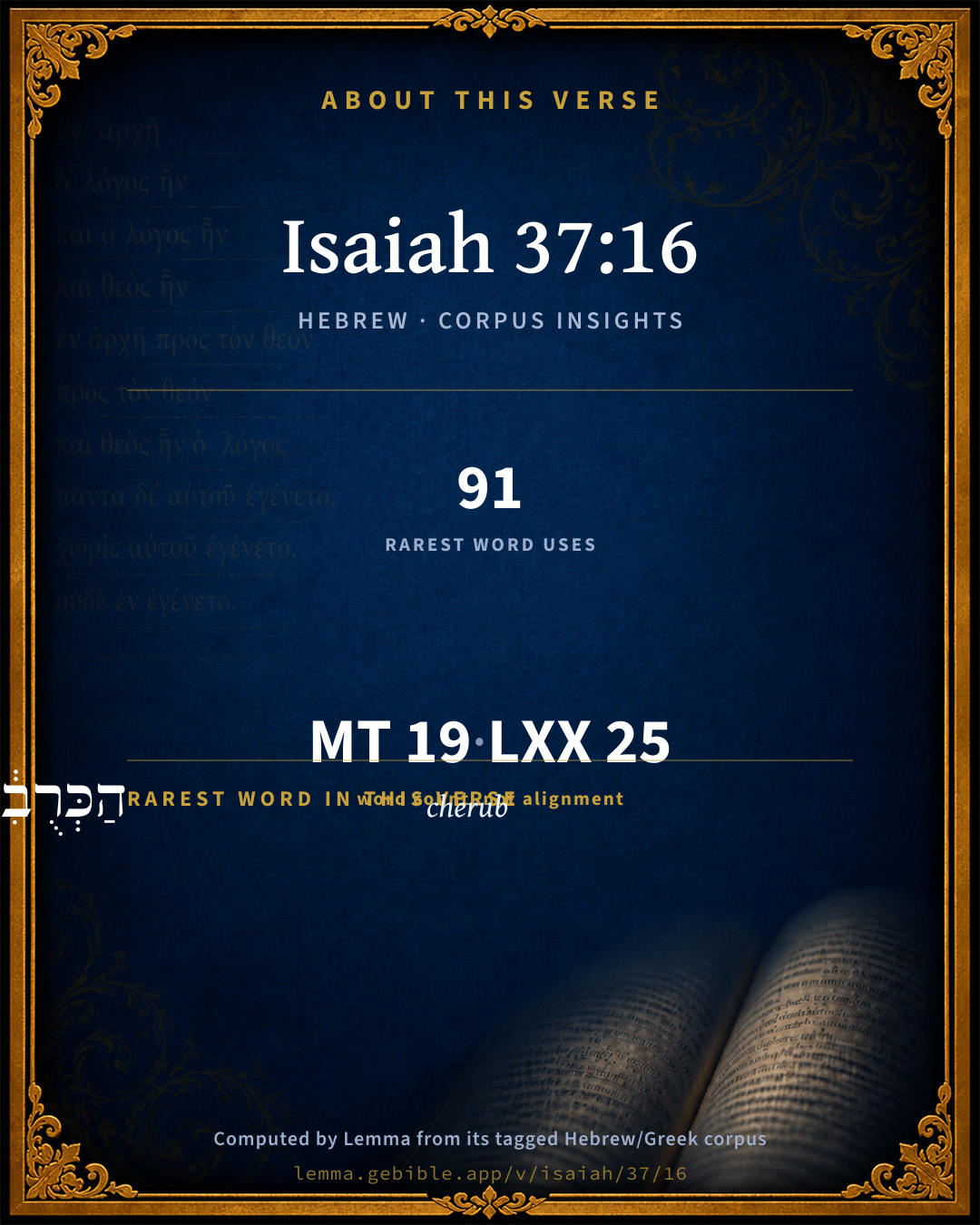
19
words
15
distinct lemmas
Prophets
section

Grammatical profile

  • 2 verbs
  • 12 nouns
  • 3 pronouns
  • 2 particles

Verb forms

  • יֹשֵׁ֣ב Qal · Participle Active
  • עָשִׂ֔יתָ Qal · Perfect

Repetition

Words recur within this verse — often emphatic in Hebrew:

  • אֱלֹהֵ֤י God H430 ×2
  • הָאָ֑רֶץ land H776 ×2
  • אַתָּה you H859 ×2

Hebrew & Septuagint length

In English translation the verse runs 32 words from the Hebrew and 29 from the Septuagint (LXX English) — closely comparable.

A rough comparison of the two English renderings, which tokenize alike — not a word-level alignment.

Word counts can differ between the Hebrew and the Greek without any difference in meaning — e.g. the Hebrew direct-object marker אֵת has no separate Greek word, and Greek often adds the article ὁ.

In the original languages it is 19 Hebrew tokens and 25 Greek tokens — but the two are counted differently (Hebrew bundles its prefixes and suffixes into one token; the Greek is in lemma form), so that isn’t a like-for-like length.

Cross-references

28

Topical passages linked to Isaiah 37:16 in the Treasury of Scripture Knowledge — connected by theme and wording, ordered by reader-vote popularity; previews shown in the World English Bible.

  • Exodus 25:22 There I will meet with you, and I will tell you from above the mercy seat, from between the two cherubim which are on the ark of the testimony, all that I command you for the children of Israel.
  • Psalms 99:1 Yahweh reigns! Let the peoples tremble. He sits enthroned among the cherubim. Let the earth be moved.
  • Psalms 86:10 For you are great, and do wondrous things. You are God alone.
  • 1 Samuel 4:4 So the people sent to Shiloh; and they brought from there the ark of the covenant of Yahweh of Hosts, who sits [above] the cherubim: and the two sons of Eli, Hophni and Phinehas, were there with the ark of the covenant of God.
  • Psalms 80:1 Hear us, Shepherd of Israel, You who lead Joseph like a flock, You who sit above the cherubim, shine forth.
  • Isaiah 44:24 Thus says Yahweh, your Redeemer, and he who formed you from the womb: I am Yahweh, who makes all things; who stretches forth the heavens alone; who spreads abroad the earth (who is with me?);
  • John 1:3 All things were made through him. Without him was not anything made that has been made.
  • Colossians 1:16 For by him were all things created, in the heavens and on the earth, things visible and things invisible, whether thrones or dominions or principalities or powers; all things have been created through him, and for him.
  • Hebrews 4:16 Let us therefore draw near with boldness to the throne of grace, that we may receive mercy, and may find grace for help in time of need.
  • Genesis 1:1 In the beginning God created the heavens and the earth.
  • Deuteronomy 10:17 For Yahweh your God, he is God of gods, and Lord of lords, the great God, the mighty, and the awesome, who doesn't regard persons, nor takes reward.
  • 2 Samuel 7:26 Let your name be magnified forever, saying, Yahweh of hosts is God over Israel; and the house of your servant David shall be established before you.
  • 1 Kings 18:32 With the stones he built an altar in the name of Yahweh; and he made a trench about the altar, as great as would contain two measures of seed.
  • 2 Kings 5:15 He returned to the man of God, he and all his company, and came, and stood before him; and he said, See now, I know that there is no God in all the earth, but in Israel: now therefore, please take a present from your servant.
  • Psalms 46:7 Yahweh of Hosts is with us. The God of Jacob is our refuge. Selah.
  • Psalms 46:11 Yahweh of Hosts is with us. The God of Jacob is our refuge. Selah.
  • Psalms 136:2–3 Give thanks to the God of gods; For his loving kindness endures forever.
  • Psalms 146:6 Who made heaven and earth, The sea, and all that is in them; Who keeps truth forever;
  • Isaiah 6:3 One called to another, and said, "Holy, holy, holy, is Yahweh of Hosts! The whole earth is full of his glory!"
  • Isaiah 8:13 Yahweh of hosts, him shall you sanctify; and let him be your fear, and let him be your dread.
  • Isaiah 37:20 Now therefore, Yahweh our God, save us from his hand, that all the kingdoms of the earth may know that you are Yahweh, even you only.
  • Isaiah 40:28 Have you not known? have you not heard? The everlasting God, Yahweh, the Creator of the ends of the earth, doesn't faint, neither is weary; there is no searching of his understanding.
  • Isaiah 43:10–11 You are my witnesses, says Yahweh, and my servant whom I have chosen; that you may know and believe me, and understand that I am he: before me there was no God formed, neither shall there be after me.
  • Isaiah 44:6 Thus says Yahweh, the King of Israel, and his Redeemer, Yahweh of Hosts: I am the first, and I am the last; and besides me there is no God.
  • Isaiah 45:22 Look to me, and be you saved, all the ends of the earth; for I am God, and there is none else.
  • Isaiah 54:5 For your Maker is your husband; Yahweh of Hosts is his name: and the Holy One of Israel is your Redeemer; the God of the whole earth shall he be called.
  • Jeremiah 10:10–12 But Yahweh is the true God; he is the living God, and an everlasting King: at his wrath the earth trembles, and the nations are not able to abide his indignation.
  • Revelation 11:15–17 The seventh angel sounded, and great voices in heaven followed, saying, "The kingdom of the world has become the Kingdom of our Lord, and of his Christ. He will reign forever and ever!"

Cross-references courtesy of OpenBible.info (CC BY 4.0).

Hebrew and Greek witnesses Masoretic Hebrew ↔ Greek Septuagint

The same verse in the two great witnesses to the Old Testament, shown verse-for-verse.

These are two independent witnesses, not word-aligned to each other, and the Septuagint is shown in lemma (dictionary) form.

Hebrew Isaiah 37:16 Masoretic · Westminster Leningrad Codex

יְהוָ֨ה צְבָא֜וֹת אֱלֹהֵ֤י יִשְׂרָאֵל֙ יֹשֵׁ֣ב הַכְּרֻבִ֔ים אַתָּה ה֤וּא הָֽאֱלֹהִים֙ לְבַדְּךָ֔ לְכֹ֖ל מַמְלְכ֣וֹת הָאָ֑רֶץ אַתָּ֣ה עָשִׂ֔יתָ אֶת הַשָּׁמַ֖יִם וְאֶת הָאָֽרֶץ

Yahweh of hosts, the God of Israel, who sits [above] the cherubim, you are the God, even you alone, of all the kingdoms of the earth; you have made heaven and earth.

World English Bible · Public Domain

Greek LXX Isaiah 37:16 Septuagint · lemma form

κύριος σαβαωθ ὁ θεός ἰσραήλ ὁ καταἧμαι ἐπί ὁ χερουβιν σύ θεός μόνος εἰμί πᾶς βασιλεία ὁ οἰκέω σύ ποιέω ὁ οὐρανός καί ὁ γῆ

O Lord of hosts, God of Israel, who sit upon the cherubs, you alone are the God of every kingdom of the world: you have made heaven and earth.

LXX2012 (modern English Septuagint) · Public Domain

Hebrew: Westminster Leningrad Codex (CC BY 4.0). Greek: Septuagint (public domain); English from LXX2012 (modern English Septuagint) (Public Domain). How the Septuagint differs from the Hebrew →

Targum (Aramaic paraphrase)

1

The Targum is the ancient Jewish Aramaic paraphrase of the Hebrew Scriptures — an interpretive translation, not the Hebrew text itself. Onkelos (literal) and Pseudo-Jonathan (expansive) render the Torah, and Jonathan the Prophets. Coverage is partial: where no permissively-licensed English translation exists for a verse, only the Aramaic is shown. This is verse-level text, not a word-by-word alignment to the Hebrew.

  1. Targum Jonathan Prophets (Joshua–Malachi)
    יְיָ אֱלָהָא צְבָאוֹת אֱלָהָא דְיִשְׂרָאֵל דִשְׁכִינְתֵּהּ שַׁרְיָא עֵיל מִן כְּרוּבַיָא אַתָּה הוּא יְיָ וְלֵית בַּר מִנָךְ לְכָל מַלְכְּוַת אַרְעָא אַתְּ עֲבַדְתָּ יַת שְׁמַיָא וְיַת אַרְעָא:

    O Lord God of hosts, the God of Israel, whose Shekinah dwelleth above the Cherubim! Thou art the Lord, and there is none besides Thee in all the kingdoms of the earth; Thou hast made the heavens and the earth.

    Targum Jonathan — Aramaic: “Mikraot Gedolot” (public domain). English: “Sefaria Community Translation” (CC0 1.0 (public-domain dedication)); “London "Chaldee Paraphrase," 1871” (public domain). Text via Sefaria.

Commentary

Notes on Isaiah 37:16 from classic Christian and Jewish commentators (each source and its license shown beneath its notes). The classic Christian expositions comment on the surrounding passage and are grouped to its opening verse, so a note may address several verses; the Jewish commentaries on the Tanakh (Rashi and others) are per-verse, so they appear only where the commentator wrote on this verse.

Lemma curates 59 commentaries, every one of them public domain or Creative Commons licensed, each selected and text-cleaned for this edition rather than reprinted as found. About our sources →

Tyndale Open Study Notes

Tyndale Open Resources

37:16 God of Israel: Hezekiah was not taken in by the false claims of Sennacherib that the Lord was powerless. In his prayer, Hezekiah acknowledged that, because the Lord is the Creator, he is God of all the kingdoms of the earth. The Lord is sovereign over all kingdoms. • The mighty cherubim were located in the Temple atop the Ark of the Covenant, which was God’s throne in his Temple (see study note on Lev 16:2; see also Pss 80:1; 99:1).

Tyndale Open Study Notes — © Tyndale Open Resources, licensed CC BY-SA 4.0. Text via the HelloAO Bible API.

Geneva Bible (1599)

Geneva Bible translators

He groundeth his prayer on God’s promise, who promised to hear them from between the Cherubims.

Geneva Bible (1599) marginal notes — public domain. Text via Bolls.life.

Jamieson, Fausset & Brown

Robert Jamieson, A. R. Fausset & David Brown

dwellest--the Shekinah, or fiery symbol of God's presence, dwelling in the temple with His people, is from shachan, "to dwell" (Exo 25:22; Psa 80:1; Psa 99:1).

cherubim--derived by transposition from either a Hebrew root, rachab, to "ride"; or rather, barach, to "bless." They were formed out of the same mass of pure gold as the mercy seat itself (Exo 25:19, Margin). The phrase, "dwellest between the cherubim," arose from their position at each end of the mercy seat, while the Shekinah, and the awful name, JEHOVAH, in written letters, were in the intervening space. They are so inseparably associated with the manifestation of God's glory, that whether the Lord is at rest or in motion, they always are mentioned with Him (Num 7:89; Psa 18:10). (1) They are first mentioned (Gen 3:24) "on the edge of" (as "on the east" may be translated) Eden; the Hebrew for "placed" is properly to "place in a tabernacle," which implies that this was a local tabernacle in which the symbols of God's presence were manifested suitably to the altered circumstances in which man, after the fall, came before God. It was here that Cain and Abel, and the patriarchs down to the flood, presented their offerings: and it is called "the presence of the Lord" (Gen 4:16). When those symbols were removed at the close of that early patriarchal dispensation, small models of them were made for domestic use, called, in Chaldee, "seraphim" or "teraphim." (2) The cherubim, in the Mosaic tabernacle and Solomon's temple, were the same in form as those at the outskirts of Eden: compound figures, combining the distinguishing properties of several creatures: the ox, chief among the tame and useful animals; the lion among the wild ones; the eagle among birds; and man, the head of all (the original headship of man over the animal kingdom, about to be restored in Jesus Christ, Psa 8:4-8, is also implied in this combination). They are, throughout Scripture, represented as distinct from God; they could not be likenesses of Him which He forbade in any shape. (3) They are introduced in the third or gospel dispensation (Rev 4:6) as "living creatures" (not so well translated "beasts" in English Version), not angels, but beings closely connected with the redeemed Church. So also in Eze. 1:5-25; 10:1-22. Thus, throughout the three dispensations, they seem to be symbols of those who in every age should officially study and proclaim the manifold wisdom of God.

thou alone--literally, "Thou art He who alone art God of all the kingdoms"; whereas Sennacherib had classed Jehovah with the heathen gods, he asserts the nothingness of the latter and the sole lordship of the former.

Jamieson, Fausset & Brown — Commentary Critical and Explanatory on the Whole Bible (1871) — public domain (CC PDM 1.0). Text via the HelloAO Bible API.

Ellicott's Commentary for English Readers

(16) That dwellest between the cherubims.—A like phrase in Psa_18:10 refers, apparently, to the dark thunder-clouds of heaven. Here, probably, the reference is to the glory-cloud which was the symbol of the Divine presence, and which rested, when it manifested itself, between the cherubim of the ark (Num_7:89), those figures also symbolising the elemental forces of the heavens. (Comp. Psa_68:33.)

Thou art the God, even thou alone.—The absolute monotheism of the faith of Israel is placed in strong antithesis to the polytheism of Rabshakeh (Isa_37:12). (Comp. Jer_10:11, and Isaiah 40-42)

A Bible Commentary for English Readers, edited by Charles John Ellicott (1878–1897) — public domain. Text from a community e-Sword module.

The Cambridge Bible for Schools and Colleges

gen. ed. J. J. S. Perowne

16. The prayer opens with a solemn invocation of Jehovah, first as God of Israel, and second as the only true God and Creator of all things.

that dwellest between (or, art enthroned upon) the cherubims] Cf. 1Sa_4:4; 2Sa_6:2; Psa_80:1. The Cherubim may have been originally symbolic representations of the storm-cloud (see Psa_18:10) and hence bearers of the Divine Presence (Ezekiel 1); but the reference here is undoubtedly to the two figures over the ark in the Temple; Jehovah, therefore, is addressed as the God of the Temple.

thou art the God … alone] Thou art (He that is) God alone. The sole divinity of Jehovah is here presented as a theological consequence of the doctrine of creation, a fundamental idea in the teaching of ch. 40 ff. Although the doctrine of creation was held in Israel from the earliest times, it seems to have been by slow degrees that its full religious significance was apprehended.

The Cambridge Bible for Schools and Colleges (gen. ed. J. J. S. Perowne; Cambridge University Press, 1878–1918) — public domain. Text from a community e-Sword module.

John Gill's Exposition

Of a truth Lord,.... This is a truth and will be readily owned what the king of Assyria has said that his ancestors have destroyed all lands, or at least have endeavoured to do it, and have had it in their hearts to do it:

the kings of Assyria have laid waste all the nations, and their countries: or "all the lands and their land" (m); the Targum is,

"all provinces and their lands;''

the countries and town and villages in them, or the chief cities and villages round about them.

(m) "omnes terras, et terram eorum", Pagninus, Montanus; "vel terram inquam eorum", Vatablus.

John Gill's Exposition of the Whole Bible (1746–1763) — public domain (CC PDM 1.0). Text via the HelloAO Bible API.

Albert Barnes' Notes on the Bible

O Lord of hosts - (See the note at Isa 1:9).

That dwellest between the cherubims - On the cherubim, see the note at Isa 14:13. The reference here is doubtless to the fact that the symbol of the divine presence in the temple the Shechinah (from שׁכן shâkan, to dwell, to inhabit; so called because it was the symbol of God’s dwelling with his people or inhabiting the temple) - rested on the cover of the ark in the temple. Hence, God is frequently represented as dwelling between the cherubim Exo 25:22; Psa 80:1; Psa 99:1. On the whole subject of the cherubim, the reader may consult an article in the Quarterly Christian Spectator for September 1836.

Thou art the God - The only God Isa 43:10-11.

Even thou alone - There is none besides thee - a truth which is often affirmed in the Scriptures Deu 32:39; Psa 86:10; 1Co 8:4.

Thou hast made heaven and earth - It was on the ground of this power and universal dominion that Hezekiah pleaded that God would interpose.

Albert Barnes' Notes on the Bible (1834–1885) — public domain. Text from a community e-Sword/MySword module.

The Pulpit Commentary

O Lord... that dwellest between the cherubims; literally, that sittest upon the cherubim. The allusion is scarcely to the poetic imagery of God riding on the cherubim in the heavens, (Psa_18:10) as Mr. Cheyne suggests; but rather to his dwelling between the two cherubic forms in the holy of holies, and there manifesting himself. (comp. Num_7:89 1Sa_4:4 2Sa_6:2 Psa_80:1 Psa_99:1) Thou art the God, even thou alone, of all the kingdoms of the earth. It has been questioned whether Hezekiah was really as pronounced a monotheist as these expressions would imply, and suggested that his actual words received "a colouring" from a later writer. Hezekiah"s contemporaries, it is said, Isaiah and Micah, make no such strong statements of their belief in one only God as this (Kuenen, Cheyne). But it is difficult to see what can be a clearer revelation of monotheism Isa_6:1-5, or what truth more absolutely underlies the whole of Isaiah"s teaching than the unity of the Supreme Being. The same undercurrent is observable in Micah. (Mic_1:2, 3 4:5 6:6-9 7:17, 18) Sennacherib"s belief, that each country has its own god, (Isa_36:18-20) is not shared by the religious Jews of his time. They are well aware that the heathen gods are "vanity" (Isa_46:3 Hos_4:15; Amos Jon_2:8), "wind" and "confusion". (Isa_41:29, etc.) Thou hast made heaven and earth. (comp. Gen_1:1 Psa_102:25 Isa_40:26-28 Isa_42:5, etc.)

The God of all kingdoms.

This expression indicates Hezekiah"s conviction of the uniqueness of God. He is the one great Over-Lord. He cannot be classed with other gods or other kings. But Hezekiah surely went beyond himself in this hour of pressure and anxiety. The Jewish idea of the supremacy of Jehovah included the speciality of his relation to the Abrahamic race, and the Jew was in danger of making God to be a mere local deity. And we, in these latter days, find it difficult to admit that God"s rule over all kingdoms involves the moral training arid even the redemption of all the races. We limit all the best of God to ourselves, in just the spirit of exclusive Jews. Only our great thought-leaders seem able to see what is involved in recognizing God as the God of all the kingdoms of the earth.

I IF GOD IS GOD OF ALL KINGDOMS, HE HAS SUPREME CLAIMS ON US. Most distressing to men who can create an ideal, and want to put trust in one who is absolutely good, must be the division of their confidences among gods many and lords many. The unrest of pagan intellect and heart was unspeakably painful. With gods in every street, Athenians pined for something more, and more satisfying; so raised an altar to the "Unknown God." Here is rest from all rival claims we yield to one will; all who would command us must express that will.

II IF GOD IS GOD OF ALL KINGDOMS, HE MUST REVEAL HIMSELF TO ALL. To be unrevealed, in adapted relations to each kingdom, is not to be so far as each kingdom is concerned. St. Paul is firm in declaring God has revealed himself to all, at least in "rain from heaven and fruitful seasons." And we have yet to recognize that he has spoken in gracious adaptations, differing, it may be, from the voices that we have heard, in every age and every clime. Very probably on this point there is "yet more light and truth to break forth from his Word.

III IF GOD IS GOD OF ALL KINGDOMS, HE OVERRULES THEM. Their magistracies, and their so-called divinities, when they do not rival him, are his agencies, everywhere they are the "powers that be ordained of God under-rulers practically carrying out the will of the great Over-Ruler, who fits in together man"s obediences and wilfulnesses, guiding all towards the fulfilment of his gracious ends for the whole race.

IV IF GOD IS GOD OF ALL KINGDOMS, HE]PRESIDES OVER THE RELATIONS OF THE NATIONS TO EACH OTHER. This brings us to the case of Hezekiah. If God is the God of Assyria, he knows all the schemings and the ambitions of that nation. Assyria is not acting in any self-strength, or in the inspirations of any rival god. Jehovah presides over the relations between Israel and Assyria. For nations, as for individuals, it is true, but it is most perplexing truth, difficult to grasp; our God is working alike in what we call evil and what we call good. R.T.

The Pulpit Commentary (1880–1919), ed. H.D.M. Spence-Jones & Joseph S. Exell — public domain. Text from a community e-Sword module.

J. A. Alexander on Isaiah

Joseph Addison Alexander

“Jehovah of Hosts, God of Israel, dwelling between (or sitting upon) the cherubim, Thou art He, the God (i.e., the only true God), Thou alone, to all the kingdoms of the earth; Thou hast made the heavens and the earth.” The cherubim were symbolical representations of the superhuman orders of beings, or, as some suppose, of the perfection of the creature in its highest form. Whether Jehovah’s riding on the cherubim (Psa 18:10) or His being enthroned above the material cherubs in the temple, or His dwelling between the cherubim (Exo 25:22) be specifically meant, there is obvious allusion to His manifested presence over the mercy-seat, called by the later Jews shechinah, which word is itself used in the Chaldee Paraphrase of the verse before us.

‘The God of all the kingdoms of the earth’ is not an exact translation of the Hebrew words, in which the God stands by itself as an emphatic phrase, meaning the only God, the true God, and what follows is intended to suggest a contrast with the false gods of the nations. Not simply of all, in all, for all, or over all, but with respect to all. ‘Thou art the one true God, not only with respect to us, but with respect to all the nations of the earth.’ The reason follows: ‘because Thou hast made them all,’ and not the earth only, but the heavens also. All this is indirectly a reply to the Assyrian blasphemies, which questioned the almighty power of Jehovah, and put Him on a, level with the idols of the heathen. The same antithesis between the impotence of idols and the power of God, as shown in the creation of the world, occurs in Psa 96:5 and Jer 10:11.

Joseph Addison Alexander, The Prophecies of Isaiah (1846–1847; New York: Scribner, 1870–1878) — public domain. Text from a community e-Sword module.

Lesson kit

Teaching starters — assembled from the data on this page, not authored interpretation. Every prompt links to the verse data it draws on. Edit before teaching.

Isaiah, in the Prophets, opens this verse with 19 words (15 distinct Hebrew lemmas). Its most distinctive word is kᵉrûwb (“cherub”). A historical commentator’s framing appears above. Read the whole chapter for the surrounding context.

Discussion questions

  1. The word kᵉrûwb carries the sense “cherub.” How does it shape the verse?
  2. Exodus 25:22 shares this passage’s theme. How do the two illuminate each other?
  3. “God” occurs 2× in this one verse. What is the effect of the repetition?
  4. These translations render this verse differently; the difference is in the English rendering, not the original. What questions does that raise?
  5. The verb «יֹשֵׁ֣ב» is Qal Participle Active. How does its form color the action?
  6. Reading how Tyndale Open Study Notes and Geneva Bible (1599) read this verse, where do the two commentators agree and where do they part?

Things to notice

Reading settings

Reading text

Shown beneath each verse's original-language words.

Old Testament
Old Testament edition

Read the OT as the Masoretic Hebrew (MT) or the Greek Septuagint (LXX).

English shown for the Greek Septuagint (in the Hebrew ↔ Greek comparison).

Comparing translations? Open the Compare panel on any verse page to stack up to four side by side.