Judges 6:40

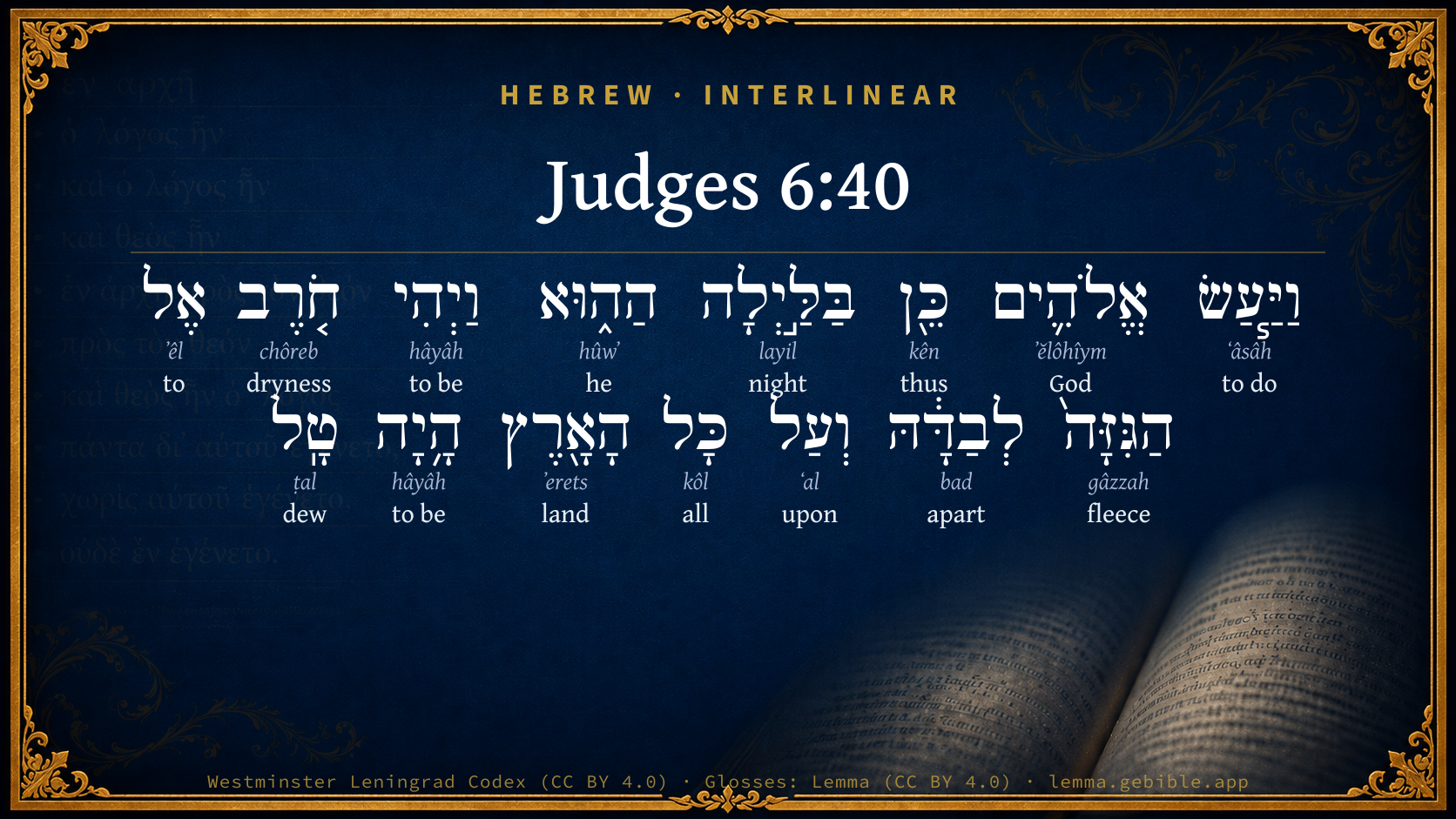
Hebrew (Westminster Leningrad Codex) Judges 6:40 appears in the Hebrew Old Testament. The text above is from the Westminster Leningrad Codex. Each word links to its Strong’s number, a concise gloss, and parsing drawn from the Open Scriptures Hebrew Bible morphology. Click any word for its full Brown-Driver-Briggs (BDB) entry.
Download image
Cite this verse

Judges 6:40 (World English Bible). Public Domain. Lemma interlinear Bible study tool, https://lemma.gebible.app/v/judges/6/40.

Show BibTeX & RIS
BibTeX
RIS
English Translation
God did so that night: for it was dry on the fleece only, and there was dew on all the ground.
World English Bible · Public Domain
Download a study sheet

One document with this verse’s original text, its word-by-word gloss line, the meaning frame, cross-references with their text, attributed commentary, and full source and license credits — printable, and it pastes into notes with its structure intact.

This verse Autodidact and up

Study sheet (.html) Plain text (.txt)

A passage Seminary Student

Up to 50 verses in one chapter. A passage sheet keeps up to 6 commentary sources and 12 cross-references per verse, in the order this page ranks them, and says so on the sheet whenever that leaves anything out. Ask for a single verse and you get the Autodidact verse sheet above.

Everything on this page stays free to read, with no account — the sheet is a download of what is already on screen, not access to it.

Want to remove ads? Support Godless Engineer
Compare translations 3

The same verse in 3 English versions, stacked beneath the original-language interlinear above. Click any original word for its lexicon entry.

Each is an independent rendering of the whole verse — the interlinear is not word-aligned to these translations.

Highlighted words mark where these versions differ — a whole-verse word diff, not a word-by-word alignment.

  • World English Bible Public Domain
    God did so that night: for it was dry on the fleece only, and there was dew on all the ground.
  • King James Version Public Domain
    And God did so that night: for it was dry upon the fleece only, and there was dew on all the ground.
  • unfoldingWord Literal Text CC BY-SA 4.0
    And God did thus during that night. For dryness was on the fleece alone, and on all of the ground was dew.

unfoldingWord Literal Text — © unfoldingWord, licensed CC BY-SA 4.0. Word-aligned USFM3 via Door43 (git.door43.org/unfoldingWord/en_ult).

Versions to compare (up to 4)

3 of 4 selected

Show all 18 translations

Every available English version of this verse, each an independent rendering of the whole verse.

  • World English Bible Public Domain
    God did so that night: for it was dry on the fleece only, and there was dew on all the ground.
  • Berean Standard Bible Public Domain
    And that night God did so. Only the fleece was dry, and dew covered the ground.
  • Majority Standard Bible Public Domain
    And that night God did so. Only the fleece was dry, and dew covered the ground.
  • King James Version Public Domain
    And God did so that night: for it was dry upon the fleece only, and there was dew on all the ground.
  • American Standard Version (1901) Public Domain
    And God did so that night: for it was dry upon the fleece only, and there was dew on all the ground.
  • Revised Version (1885) Public Domain
    And God did so that night: for it was dry upon the fleece only, and there was dew on all the ground.
  • Geneva Bible (1599) Public Domain
    And God did so that same night: for it was drie vpon the fleece onely, and there was dewe on all the ground.
  • Douay-Rheims (1899) Public Domain
    And he said again to God: let not thy wrath be kindled against me if I try once more, seeking a sign in the fleece. I pray that the fleece only may be dry, and all the ground wet with dew.
  • Young's Literal Translation Public Domain
    And God doth so on that night, and there is drought on the fleece alone, and on all the earth there hath been dew.
  • Literal Standard Version CC BY-SA 4.0
    And God does so on that night, and there is only dryness on the fleece, and there has been dew on all the earth.
  • Unlocked Literal Bible CC BY-SA 4.0
    God did what he asked for that night. The fleece was dry, and there was dew on all the ground around it.
  • unfoldingWord Literal Text CC BY-SA 4.0
    And God did thus during that night. For dryness was on the fleece alone, and on all of the ground was dew.
  • Darby Bible Public Domain
    And God did so that night; for it was dry on the fleece only, and on all the ground there was dew.
  • World Messianic Bible Public Domain
    God did so that night; for it was dry on the fleece only, and there was dew on all the ground.
  • Webster's Bible Public Domain
    And God did so that night: for it was dry upon the fleece only, and there was dew on all the ground.
  • Free Bible Version CC BY-SA 4.0
    That night God did exactly that. The fleece alone was dry and the whole ground was covered with dew.
  • Bible in Basic English Public Domain
    And that night God did so; for the wool was dry, and there was dew on all the earth round it.
  • JPS Tanakh (1917) Public Domain
    And God did so that night; for it was dry upon the fleece only, and there was dew on all the ground.

Literal Standard Version (2020), Covenant Press — licensed CC BY-SA 4.0. Text via the HelloAO Bible API (eBible.org). Unlocked Literal Bible (unfoldingWord) — licensed CC BY-SA 4.0. Text via the HelloAO Bible API (eBible.org). unfoldingWord Literal Text — © unfoldingWord, licensed CC BY-SA 4.0. Word-aligned USFM3 via Door43 (git.door43.org/unfoldingWord/en_ult). Free Bible Version, Dr. Jonathan Gallagher — licensed CC BY-SA 4.0. Text via the HelloAO Bible API (eBible.org).

Word by word

More ways to search: Search by grammar → Find every occurrence → Compare this word →

Practice this passage: Drill this verse → Learn its vocabulary →

הַגִּזָּה֙
gâzzah
H1492
“the · fleece”
Particle, Definite Article + Noun, Common, Feminine, Singular, Absolute
Part of Speech
Particle + Noun
Type
Common
Gender
Feminine
Number
Singular
State
Absolute
Full BDB Definition

Origin: from H1494

TWOT: 336b

fleece
  1. וַיַּ֧עַשׂ ʻâsâh H6213 “and · to do” Conjunction + Verb, Qal, Sequential Imperfect, 3rd Person, Masculine, Singular
  2. אֱלֹהִ֛ים ʼĕlôhîym H430 “God(s)” Noun, Common, Masculine, Plural, Absolute
  3. כֵּ֖ן kên H3651 “thus” Particle, Demonstrative
  4. בַּלַּ֣יְלָה layil H3915 “in/at the · night” Preposition, Determined + Noun, Common, Masculine, Singular, Absolute
  5. הַה֑וּא hûwʼ H1931 “the · he” Particle, Definite Article + Pronoun, Personal, 3rd Person, Masculine, Singular
  6. וַיְהִי hâyâh H1961 “and · to be” Conjunction + Verb, Qal, Sequential Imperfect, 3rd Person, Masculine, Singular
  7. חֹ֤רֶב chôreb H2721 “dryness” Noun, Common, Masculine, Singular, Absolute
  8. אֶל ʼêl H413 “to” Preposition
  9. לְבַדָּ֔הּ bad H905 “to/for · apart · her” Preposition + Noun, Common, Masculine, Singular, Construct + Suffix, Personal, 3rd Person, Feminine, Singular
  10. וְעַל ʻal H5921 “and · upon” Conjunction + Preposition
  11. כָּל kôl H3605 “all of” Noun, Common, Masculine, Singular, Construct
  12. הָאָ֖רֶץ ʼerets H776 “the · land” Particle, Definite Article + Noun, Common, Both, Singular, Absolute
  13. הָ֥יָה hâyâh H1961 “to be” Verb, Qal, Perfect, 3rd Person, Masculine, Singular
  14. טָֽל ṭal H2919 “dew” Noun, Common, Masculine, Singular, Absolute

About this verse

These counts appear in no published source. They are computed here, from the morphology-tagged text and Lemma’s own curated glosses. What Lemma adds →

15
words
14
distinct lemmas
Historical
section

Notable vocabulary

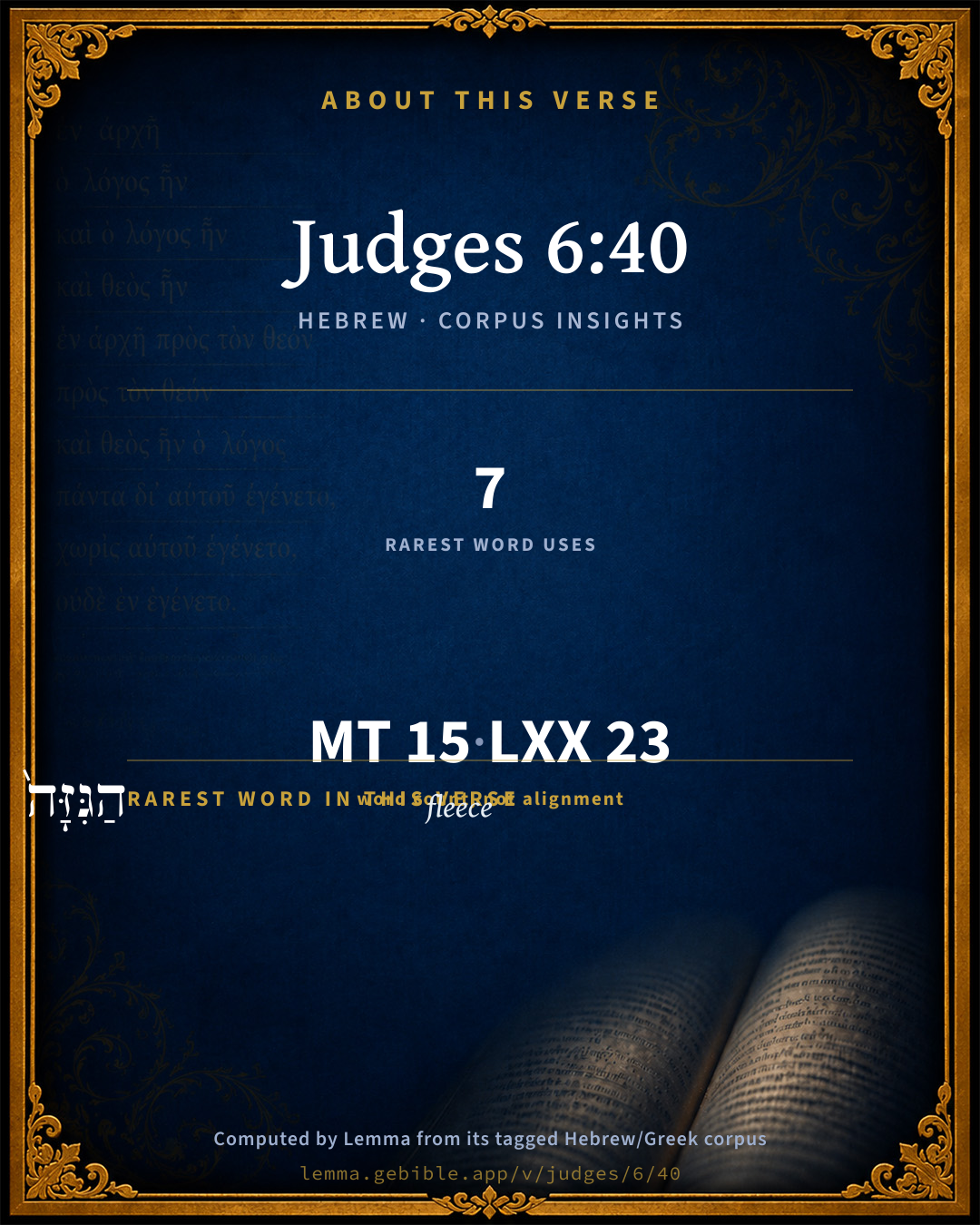
The rarest word here is הַגִּזָּה֙ fleece H1492 — appearing just 7 times in the whole Hebrew Bible.

Shared distinctive vocabulary

הַגִּזָּה֙ fleece H1492 occurs in 4 verses of the Hebrew Bible. Also found in:

Grammatical profile

  • 3 verbs
  • 8 nouns
  • 1 pronoun
  • 2 prepositions
  • 1 particle

Verb forms

  • וַיַּ֧עַשׂ Qal · Sequential Imperfect
  • וַיְהִי Qal · Sequential Imperfect
  • הָ֥יָה Qal · Perfect

Repetition

A word recurs within this verse — often emphatic in Hebrew:

  • וַיְהִי to be H1961 ×2

Hebrew & Septuagint length

In English translation the verse runs 21 words from the Hebrew and 23 from the Septuagint (LXX English) — closely comparable.

A rough comparison of the two English renderings, which tokenize alike — not a word-level alignment.

Word counts can differ between the Hebrew and the Greek without any difference in meaning — e.g. the Hebrew direct-object marker אֵת has no separate Greek word, and Greek often adds the article ὁ.

In the original languages it is 15 Hebrew tokens and 23 Greek tokens — but the two are counted differently (Hebrew bundles its prefixes and suffixes into one token; the Greek is in lemma form), so that isn’t a like-for-like length.

Hebrew and Greek witnesses Masoretic Hebrew ↔ Greek Septuagint

The same verse in the two great witnesses to the Old Testament, shown verse-for-verse.

These are two independent witnesses, not word-aligned to each other, and the Septuagint is shown in lemma (dictionary) form.

Hebrew Judges 6:40 Masoretic · Westminster Leningrad Codex

וַיַּ֧עַשׂ אֱלֹהִ֛ים כֵּ֖ן בַּלַּ֣יְלָה הַה֑וּא וַיְהִי חֹ֤רֶב אֶל הַגִּזָּה֙ לְבַדָּ֔הּ וְעַל כָּל הָאָ֖רֶץ הָ֥יָה טָֽל

God did so that night: for it was dry on the fleece only, and there was dew on all the ground.

World English Bible · Public Domain

Greek LXX Judges 6:40 Septuagint · lemma form

καί ποιέω οὕτως ὁ θεός ἐν ὁ νύξ ἐκεῖνος καί γίγνομαι ξηρασία ἐπί ὁ πόκος μόνον καί ἐπί πᾶς ὁ γῆ γίγνομαι δρόσος

And God did so in that night; and there was drought on the fleece only, and on all the ground there was dew.

LXX2012 (modern English Septuagint) · Public Domain

Hebrew: Westminster Leningrad Codex (CC BY 4.0). Greek: Septuagint (public domain); English from LXX2012 (modern English Septuagint) (Public Domain). How the Septuagint differs from the Hebrew →

Targum (Aramaic paraphrase)

1

The Targum is the ancient Jewish Aramaic paraphrase of the Hebrew Scriptures — an interpretive translation, not the Hebrew text itself. Onkelos (literal) and Pseudo-Jonathan (expansive) render the Torah, and Jonathan the Prophets. Coverage is partial: where no permissively-licensed English translation exists for a verse, only the Aramaic is shown. This is verse-level text, not a word-by-word alignment to the Hebrew.

  1. Targum Jonathan Prophets (Joshua–Malachi)
    וַעֲבַד יְיָ כֵּן בְלֵילְיָא הַהוּא וַהֲוָה יוּבְשָׁא עַל גִזְתָא בִלְחוֹדָהּ וְעַל כָּל אַרְעָא הֲוָה טַלָא:

    (no public-domain English translation for this verse)

    Targum Jonathan — Aramaic: “Mikraot Gedolot” (public domain). English: “Sefaria Community Translation” (CC0 1.0 (public-domain dedication)); “London "Chaldee Paraphrase," 1871” (public domain). Text via Sefaria.

Commentary

Notes on Judges 6:40 from classic Christian and Jewish commentators (each source and its license shown beneath its notes). The classic Christian expositions comment on the surrounding passage and are grouped to its opening verse, so a note may address several verses; the Jewish commentaries on the Tanakh (Rashi and others) are per-verse, so they appear only where the commentator wrote on this verse.

Lemma curates 59 commentaries, every one of them public domain or Creative Commons licensed, each selected and text-cleaned for this edition rather than reprinted as found. About our sources →

Joseph Benson's Commentary

Jdg 6:40. And God did so — See how tender God is even of the weak; and how ready to condescend to their infirmities! These signs were very expressive. They are going to engage the Midianites. Could God distinguish between a small fleece of Israel and the vast floor of Midian? Yes, by this token it appears that he can. Is Gideon desirous that the dew of divine grace might descend on himself in particular? He sees the fleece wet with dew, to assure him of it. Does he desire that God will be as the dew to all Israel? Behold all the ground is wet!

Joseph Benson's Commentary on the Old and New Testaments (1811–1818) — public domain. Text from a community e-Sword module.

Geneva Bible (1599)

Geneva Bible translators

Whereby he was assured that it was a miracle of God.

Geneva Bible (1599) marginal notes — public domain. Text via Bolls.life.

Ellicott's Commentary for English Readers

(40) It was dry upon the fleece only.—Such a result as this—not being in accordance with natural circumstances—could only have arisen from direct interposition. Besides the simple narrative, which tells us of these results as a sign granted to Gideon in accordance with his prayer, it is of course possible to allegorise the dew as the sign of God’s grace, and to say that the first sign represented Israel as replenished with God’s love when all was dry around (Hos_14:5, “I will be as the dew unto Israel;” Mic_5:7, “Jacob shall be as the dew”); and the second, the fact that “God manifested himself in the weakness and forsaken condition of His people, while the nations were flourishing all around.” Similarly St. Ambrose (De Sp. Sanct, Prol. in 1) sees in the fleece full of dew the Hebrew nation hiding the mystery of Christ within itself, and in the dry fleece that mystery extended to all the world, but leaving the Hebrew nation dry. It would be equally possible to give a mystic significance to the threshing-floor, as a type of the universal Church (Mat_3:12, &c.). But these allegoric applications of simple narratives are, to say the least, precarious; nor is there much value in Ewald’s comparison of the fleece to Gideon’s character, cool amid the general passion, dry amid the general damp of fear.

A Bible Commentary for English Readers, edited by Charles John Ellicott (1878–1897) — public domain. Text from a community e-Sword module.

Haydock's Catholic Bible Commentary

Ground. In these two miracles the Fathers observe, that the fleece represented the Jewish nation, favoured with so many graces, while the rest of the world was dry and barren; and that, when the latter was watered with dew from heaven, by the coming of Jesus Christ, the Synagogue was deprived of those favours. (Origen, hom. viii.; Theodoret, q. 14.; St. Jerome, ad Paulin.; St. Augustine; &c.) --- In the first miracle we may also contemplate, the incarnation of our Saviour in the womb of the most pure Virgin, Psalm lxxi. 6. (St. Bernard, serm.; St. Jerome, epist. Paul.) (Calmet)

George Leo Haydock (1774–1849), Haydock's Catholic Family Bible and Commentary, 1859 edition — public domain. Excludes Psalms (Douay-Rheims chapter numbering differs from Protestant) and Deuterocanonical books (Catholic canon only).

John Wesley's Explanatory Notes

And God did so - See how tender God is, even of the weak; and how ready to condescend to their infirmities! These signs were very expressive. They are going to engage the Midianites. Could God distinguish between a small fleece of Israel, and the vast floor of Midian? Yes, by this token it appears that he can. Is Gideon desirous, that the dew of divine grace might descend on himself in particular? He sees the fleece wet with dew, to assure him of it. Does he desire, that God will be as the dew to all Israel? Behold all the ground is wet!

John Wesley, Explanatory Notes Upon the Whole Bible (1754–1765) — public domain. Text via the GEBible commentary corpus.

Lesson kit

Teaching starters — assembled from the data on this page, not authored interpretation. Every prompt links to the verse data it draws on. Edit before teaching.

Judges, in the Historical, opens this verse with 15 words (14 distinct Hebrew lemmas). Its most distinctive word is gâzzah (“fleece”). A historical commentator’s framing appears above. Read the whole chapter for the surrounding context.

Discussion questions

  1. The word gâzzah carries the sense “fleece.” How does it shape the verse?
  2. Judges 6:37 shares the word «fleece» with this verse. How do the two illuminate each other?
  3. “to be” occurs 2× in this one verse. What is the effect of the repetition?
  4. These translations render this verse differently; the difference is in the English rendering, not the original. What questions does that raise?
  5. The verb «וַיַּ֧עַשׂ» is Qal Sequential Imperfect. How does its form color the action?
  6. Reading how Joseph Benson's Commentary and Geneva Bible (1599) read this verse, where do the two commentators agree and where do they part?

Things to notice

Reading settings

Reading text

Shown beneath each verse's original-language words.

Old Testament
Old Testament edition

Read the OT as the Masoretic Hebrew (MT) or the Greek Septuagint (LXX).

English shown for the Greek Septuagint (in the Hebrew ↔ Greek comparison).

Comparing translations? Open the Compare panel on any verse page to stack up to four side by side.