
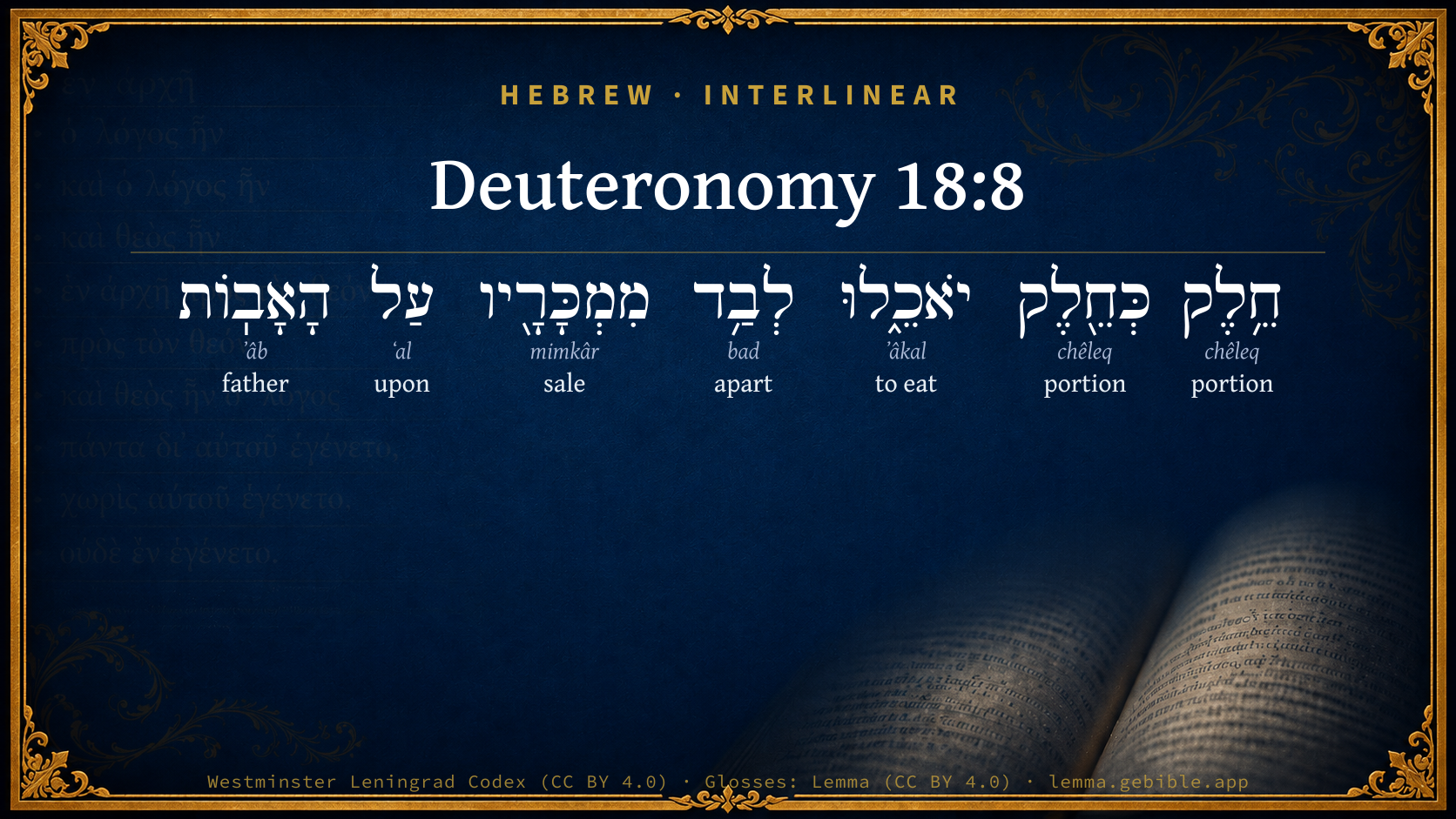
Deuteronomy 18:8

Hebrew (Westminster Leningrad Codex) Deuteronomy 18:8 appears in the Hebrew Old Testament. The text above is from the Westminster Leningrad Codex. Each word links to its Strong’s number, a concise gloss, and parsing drawn from the Open Scriptures Hebrew Bible morphology. Click any word for its full Brown-Driver-Briggs (BDB) entry.
Download image
Cite this verse

Deuteronomy 18:8 (World English Bible). Public Domain. Lemma interlinear Bible study tool, https://lemma.gebible.app/v/deuteronomy/18/8.

Show BibTeX & RIS
BibTeX
RIS
English Translation
They shall have like portions to eat, besides that which comes of the sale of his patrimony.
World English Bible · Public Domain
Download a study sheet

One document with this verse’s original text, its word-by-word gloss line, the meaning frame, cross-references with their text, attributed commentary, and full source and license credits — printable, and it pastes into notes with its structure intact.

This verse Autodidact and up

Study sheet (.html) Plain text (.txt)

A passage Seminary Student

Up to 50 verses in one chapter. A passage sheet keeps up to 6 commentary sources and 12 cross-references per verse, in the order this page ranks them, and says so on the sheet whenever that leaves anything out. Ask for a single verse and you get the Autodidact verse sheet above.

Everything on this page stays free to read, with no account — the sheet is a download of what is already on screen, not access to it.

Want to remove ads? Support Godless Engineer
Compare translations 3

The same verse in 3 English versions, stacked beneath the original-language interlinear above. Click any original word for its lexicon entry.

Each is an independent rendering of the whole verse — the interlinear is not word-aligned to these translations.

Highlighted words mark where these versions differ — a whole-verse word diff, not a word-by-word alignment.

  • World English Bible Public Domain
    They shall have like portions to eat, besides that which comes of the sale of his patrimony.
  • King James Version Public Domain
    They shall have like portions to eat, beside that which cometh of the sale of his patrimony.
  • unfoldingWord Literal Text CC BY-SA 4.0
    They shall eat portions alike portions, besides from the sale of his fathers.

unfoldingWord Literal Text — © unfoldingWord, licensed CC BY-SA 4.0. Word-aligned USFM3 via Door43 (git.door43.org/unfoldingWord/en_ult).

Versions to compare (up to 4)

3 of 4 selected

Show all 18 translations

Every available English version of this verse, each an independent rendering of the whole verse.

  • World English Bible Public Domain
    They shall have like portions to eat, besides that which comes of the sale of his patrimony.
  • Berean Standard Bible Public Domain
    They shall eat equal portions, even though he has received money from the sale of his father’s estate.
  • Majority Standard Bible Public Domain
    They shall eat equal portions, even though he has received money from the sale of his father’s estate.
  • King James Version Public Domain
    They shall have like portions to eat, beside that which cometh of the sale of his patrimony.
  • American Standard Version (1901) Public Domain
    They shall have like portions to eat, besides that which cometh of the sale of his patrimony.
  • Revised Version (1885) Public Domain
    They shall have like portions to eat, beside that which cometh of the sale of his patrimony.
  • Geneva Bible (1599) Public Domain
    They shall haue like portions to eat beside that which commeth of his sale of his patrimonie.
  • Douay-Rheims (1899) Public Domain
    He shall receive the same portion of food that the rest do: besides that which is due to him in his own city, by succession from his fathers.
  • Young's Literal Translation Public Domain
    portion as portion they do eat, apart from his sold things, with the fathers.
  • Literal Standard Version CC BY-SA 4.0
    They eat portion like portion, apart from his sold things from the fathers.
  • Unlocked Literal Bible CC BY-SA 4.0
    They must have similar portions to eat, besides of what comes of the sale of his family's inheritance.
  • unfoldingWord Literal Text CC BY-SA 4.0
    They shall eat portions alike portions, besides from the sale of his fathers.
  • Darby Bible Public Domain
    -- they shall have like portions to eat, besides that which he hath sold of his patrimony.
  • World Messianic Bible Public Domain
    They shall have like portions to eat, in addition to that which comes from the sale of his family possessions.
  • Webster's Bible Public Domain
    They shall have like portions to eat, beside that which cometh of the sale of his patrimony.
  • Free Bible Version CC BY-SA 4.0
    They will all receive the same food allowances, despite him having received money from the sale of his father's property.
  • Bible in Basic English Public Domain
    His food will be the same as theirs, in addition to what has come to him as the price of his property.
  • JPS Tanakh (1917) Public Domain
    They shall have like portions to eat, beside that which is his due according to the fathers' houses.

Literal Standard Version (2020), Covenant Press — licensed CC BY-SA 4.0. Text via the HelloAO Bible API (eBible.org). Unlocked Literal Bible (unfoldingWord) — licensed CC BY-SA 4.0. Text via the HelloAO Bible API (eBible.org). unfoldingWord Literal Text — © unfoldingWord, licensed CC BY-SA 4.0. Word-aligned USFM3 via Door43 (git.door43.org/unfoldingWord/en_ult). Free Bible Version, Dr. Jonathan Gallagher — licensed CC BY-SA 4.0. Text via the HelloAO Bible API (eBible.org).

Word by word

More ways to search: Search by grammar → Find every occurrence → Compare this word →

Practice this passage: Drill this verse → Learn its vocabulary →

About this verse

These counts appear in no published source. They are computed here, from the morphology-tagged text and Lemma’s own curated glosses. What Lemma adds →

7
words
6
distinct lemmas
Pentateuch
section

Notable vocabulary

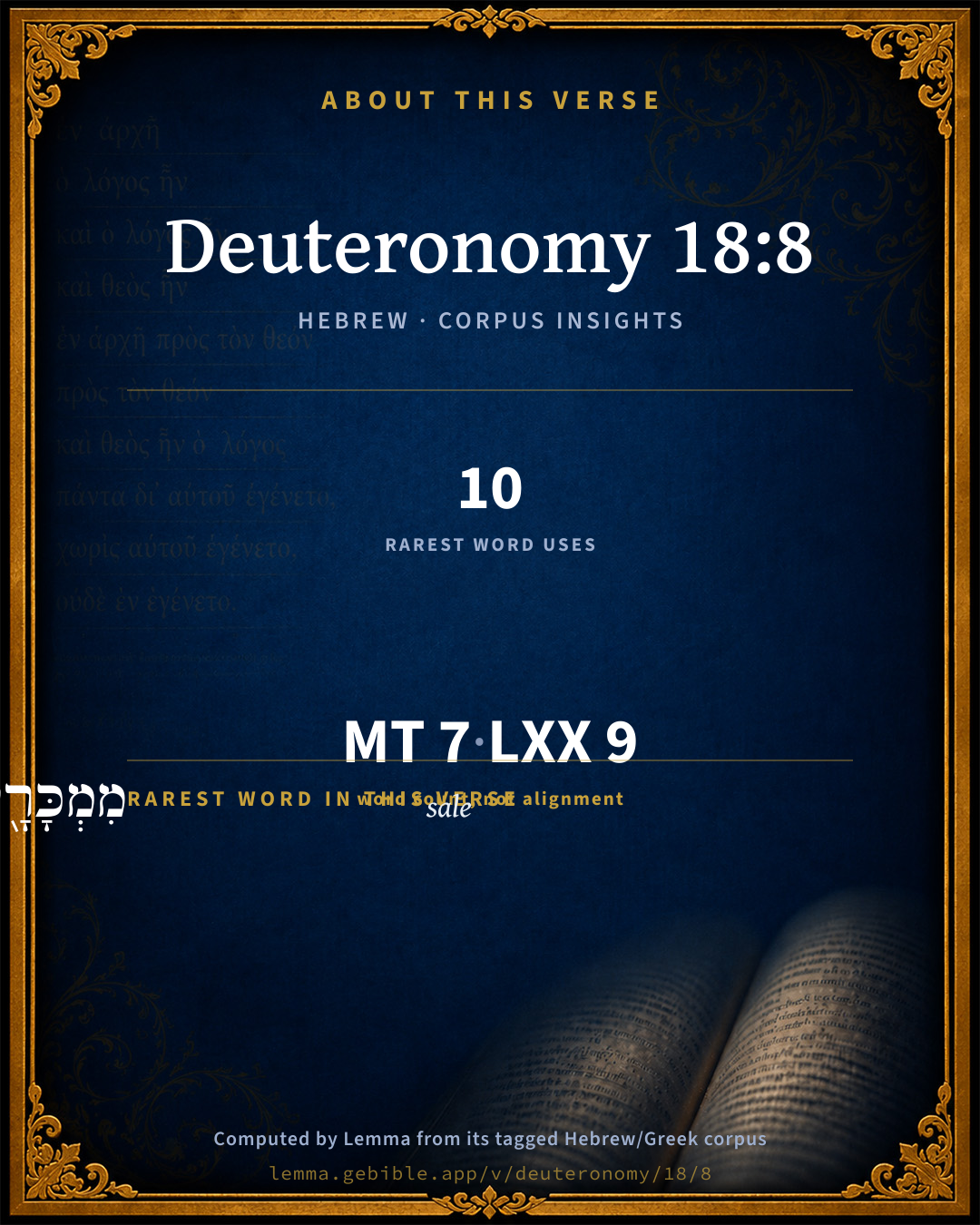
The rarest word here is מִמְכָּרָ֖יו sale H4465 — appearing just 10 times in the whole Hebrew Bible.

Shared distinctive vocabulary

מִמְכָּרָ֖יו sale H4465 occurs in 10 verses of the Hebrew Bible. Also found in:

Grammatical profile

  • 1 verb
  • 5 nouns
  • 1 preposition

Verb forms

  • יֹאכֵ֑לוּ Qal · Imperfect

Repetition

A word recurs within this verse — often emphatic in Hebrew:

  • חֵ֥לֶק portion H2506 ×2

Hebrew & Septuagint length

In English translation the verse runs 17 words from the Hebrew and 13 from the Septuagint (LXX English) — closely comparable.

A rough comparison of the two English renderings, which tokenize alike — not a word-level alignment.

Word counts can differ between the Hebrew and the Greek without any difference in meaning — e.g. the Hebrew direct-object marker אֵת has no separate Greek word, and Greek often adds the article ὁ.

In the original languages it is 7 Hebrew tokens and 9 Greek tokens — but the two are counted differently (Hebrew bundles its prefixes and suffixes into one token; the Greek is in lemma form), so that isn’t a like-for-like length.

Cross-references

8

Topical passages linked to Deuteronomy 18:8 in the Treasury of Scripture Knowledge — connected by theme and wording, ordered by reader-vote popularity; previews shown in the World English Bible.

  • Nehemiah 12:44 On that day were men appointed over the chambers for the treasures, for the heave-offerings, for the first fruits, and for the tithes, to gather into them, according to the fields of the cities, the portions appointed by the law for the priests and Levites: for Judah rejoiced for the priests and for the Levites who waited.
  • Nehemiah 12:47 All Israel in the days of Zerubbabel, and in the days of Nehemiah, gave the portions of the singers and the porters, as every day required: and they set apart [that which was] for the Levites; and the Levites set apart [that which was] for the sons of Aaron.
  • 2 Chronicles 31:4 Moreover he commanded the people who lived in Jerusalem to give the portion of the priests and the Levites, that they might give themselves to the law of Yahweh.
  • Luke 10:7 Remain in that same house, eating and drinking the things they give, for the laborer is worthy of his wages. Don't go from house to house.
  • Leviticus 7:8–9 The priest who offers any man's burnt offering, even the priest shall have for himself the skin of the burnt offering which he has offered.
  • Leviticus 7:14 Of it he shall offer one out of each offering for a heave offering to Yahweh. It shall be the priest's who sprinkles the blood of the peace offerings.
  • 1 Corinthians 9:7–14 What soldier ever serves at his own expense? Who plants a vineyard, and doesn't eat of its fruit? Or who feeds a flock, and doesn't drink from the flock's milk?
  • 1 Timothy 5:17–18 Let the elders who rule well be counted worthy of double honor, especially those who labor in the word and in teaching.

Cross-references courtesy of OpenBible.info (CC BY 4.0).

Hebrew and Greek witnesses Masoretic Hebrew ↔ Greek Septuagint

The same verse in the two great witnesses to the Old Testament, shown verse-for-verse.

These are two independent witnesses, not word-aligned to each other, and the Septuagint is shown in lemma (dictionary) form.

Hebrew Deuteronomy 18:8 Masoretic · Westminster Leningrad Codex

חֵ֥לֶק כְּחֵ֖לֶק יֹאכֵ֑לוּ לְבַ֥ד מִמְכָּרָ֖יו עַל הָאָבֽוֹת

They shall have like portions to eat, besides that which comes of the sale of his patrimony.

World English Bible · Public Domain

Greek LXX Deuteronomy 18:8 Septuagint · lemma form

μερίς μερίζω ἐσθίω πλήν ὁ πρᾶσις ὁ κατά πατριά

He shall eat an allotted portion, besides the sale of his hereditary property.

LXX2012 (modern English Septuagint) · Public Domain

On this verse, The Cambridge Bible for Schools and Colleges discusses the Septuagint’s reading. Read the note in Commentary ↓

Hebrew: Westminster Leningrad Codex (CC BY 4.0). Greek: Septuagint (public domain); English from LXX2012 (modern English Septuagint) (Public Domain). How the Septuagint differs from the Hebrew →

Targum (Aramaic paraphrase)

2

The Targum is the ancient Jewish Aramaic paraphrase of the Hebrew Scriptures — an interpretive translation, not the Hebrew text itself. Onkelos (literal) and Pseudo-Jonathan (expansive) render the Torah, and Jonathan the Prophets. Coverage is partial: where no permissively-licensed English translation exists for a verse, only the Aramaic is shown. This is verse-level text, not a word-by-word alignment to the Hebrew.

  1. Targum Onkelos Torah (Genesis–Deuteronomy)
    חֳלָק כָּחֳלָק יֵיכְלוּן בַּר מִמַטַרְתָּא דְיֵיתֵי בְּשַׁבַּתָּא דְכֵן אַתְקִינוּ אֲבָהָתָא

    (no public-domain English translation for this verse)

    Targum Onkelos — Aramaic: “Onkelos Genesis” (public domain); “Onkelos Exodus” (public domain); “Onkelos Leviticus” (public domain); “Onkelos Numbers” (public domain); “Onkelos Deuteronomy” (public domain). English: “Sefaria Community Translation” (CC0 1.0 (public-domain dedication)); “J.W. Etheridge. The Targums of Onkelos and Jonathan Ben Uzziel on the Pentateuch. London: Longmans, Green, 1862” (public domain). Text via Sefaria.

  2. Targum Pseudo-Jonathan Torah (Genesis–Deuteronomy)
    חוּלַק כָּל קֳבֵיל חוּלַק בְּשָׁוֶה יֵיכְלוּן בַּר מִמּוֹתְבֵי קוּרְבָּנַיָא דְיֵיכְלוּן כַּהֲנַיָא דְאוֹרִיתוּ לְהוֹן אֶלְעָזָר וְאִיתָמָר אֲבָהַתְכוֹן

    Portion for portion equally shall they eat, besides the gifts of the oblations which the priests do eat, which Elazar and Ithamar your fathers have given them to inherit.

    Targum Pseudo-Jonathan — Aramaic: “Targum Jonathan on Genesis” (public domain); “Targum Jonathan on Exodus” (public domain); “Targum Jonathan on Leviticus” (public domain); “Targum Jonathan on Numbers” (public domain); “Targum Jonathan on Deuteronomy” (public domain). English: “The Targum of Jonathan ben Uzziel, trans. J. W. Etheridge, London, 1862” (public domain). Text via Sefaria.

Commentary

Notes on Deuteronomy 18:8 from classic Christian and Jewish commentators (each source and its license shown beneath its notes). The classic Christian expositions comment on the surrounding passage and are grouped to its opening verse, so a note may address several verses; the Jewish commentaries on the Tanakh (Rashi and others) are per-verse, so they appear only where the commentator wrote on this verse.

Lemma curates 59 commentaries, every one of them public domain or Creative Commons licensed, each selected and text-cleaned for this edition rather than reprinted as found. About our sources →

Trapp's Complete Commentary

John Trapp

Deu 18:8 They shall have like portions to eat, beside that which cometh of the sale of his patrimony.

Ver. 8. Besides that.] He shall not maintain himself of his own private stock, but live of the holy things of the temple.

John Trapp, A Commentary or Exposition upon All the Books of the Old and New Testament (1647–1656) — public domain. Text from a community e-Sword module.

Joseph Benson's Commentary

Deu 18:8. Like portions — With their brethren, who were in actual ministration: as they share with them in the work, so shall they in the encouragements. Besides that which cometh — The reason of this law was, because he that waited on the altar, ought to live by the altar; and because it was fit he should keep his money, wherewith he might redeem what he sold, if afterward he saw occasion for it. Mr. Henry adds a remarkable note here, especially considering he wrote upward of fourscore years ago. “A hearty, pious zeal to serve God and his church, though it may a little encroach upon a settled order, and there may be somewhat in it that looks irregular, yet ought to be gratified, and not discouraged. He that loves dearly to be employed in the service of the sanctuary, in God’s name let him minister. He shall be as welcome to God as the Levites, whose course it is to minister, and should be so to them.”

Joseph Benson's Commentary on the Old and New Testaments (1811–1818) — public domain. Text from a community e-Sword module.

Tyndale Open Study Notes

Tyndale Open Resources

18:8 support from his family: Although Levites were in full-time ministry at the Tabernacle and (later) the Temple, they could still hold material assets of their own (see Num 35:1-8). The Levites were to be supported by the regular offerings designated for that purpose without having to forfeit any of their own assets.

Tyndale Open Study Notes — © Tyndale Open Resources, licensed CC BY-SA 4.0. Text via the HelloAO Bible API.

Geneva Bible (1599)

Geneva Bible translators

Not constrained to live of himself.

Geneva Bible (1599) marginal notes — public domain. Text via Bolls.life.

Adam Clarke's Commentary

Verse 8. The sale of his patrimony.] So we find that, though the Levites might have no part of the land by lot, yet they were permitted to make purchases of houses, goods, and cattle, yea, of fields also. See the case of Abiathar, 1Kg 2:26, and of Jeremiah, Jer 32:7-8.

Adam Clarke's Commentary on the Bible (1810–1826) — public domain. Text from a community e-Sword/MySword module.

Ellicott's Commentary for English Readers

(8) They shall have like portions to eat, beside that.—The Levite thus dedicated was to have the same allowance from tithes as the rest who served at the tabernacle, beside the proceeds of the patrimony which he would have had in his own Levitical city.

A Bible Commentary for English Readers, edited by Charles John Ellicott (1878–1897) — public domain. Text from a community e-Sword module.

The Cambridge Bible for Schools and Colleges

gen. ed. J. J. S. Perowne

8. They shall have] Sam. LXX: he shall have.

beside that which cometh of the sale of his patrimony] a paraphrase of the difficult Heb.: beside his sales, or realised values, or prices, on the fathers (LXX, πλὴν τῆς πράσεως τῆς κατὰ πατριάν). EVV.’s paraphrase is generally accepted; cp. Jer_32:6-15; Jer_37:12 (R.V.), which shows a priest from a rural sanctuary, who had removed to Jerusalem, possessing money of his own and by right of redemption able to buy land which a relative desired to sell. Dillm., rejecting the usual interpretation as too obvious, proposes ‘the money which he realised on such dues as had fallen to him from the families to whom he ministered at his home.’ A certain solution of the difficulty is hardly possible. Either we have an abbreviated legal formula the meaning of which is lost, or the text is corrupt. By small emendations, Steuern. ingeniously reads: ‘except those who are idolatrous priests and necromancers.’ This is agreeable to the spirit of D, guards against an easy abuse of the law and is in harmony with the next law; but it has to be forced out of even the emended syntax.

This law of D, establishing the rural Levites, who come to Jerusalem, in equal rank and privilege with their fellow-tribesmen already ministering there, was not carried out. 2Ki_23:9 states that the priests of the high places came not up to the altar of Jehovah at Jerusalem but they did eat unleavened bread among their brethren. Apparently the Jerusalem priests succeeded from the first in keeping off the rural Levites from the priestly function of sacrifice on the ground that the cults which they had served were idolatrous (high places); and exclusion from the altar involved of course exclusion from the priest’s share of the offerings. That they ate unleavened bread (the attempts to emend this text are unsatisfactory) with their brethren may imply some peculiar privilege of the priests; yet unleavened bread was not their food alone, and so the phrase more probably means that though shut out from priestly functions the rural Levites were not excommunicated from eating at the Passover, with their brother Levites and other Israelites. Ezekiel (Eze_44:10-14) excludes ‘Levites’ from the priesthood (confined by him to the sons of Zadok) and degrades them to inferior services about the Temple. We have already seen (on Deu_10:8 f.) how this inferiority was confirmed by P.

The Cambridge Bible for Schools and Colleges (gen. ed. J. J. S. Perowne; Cambridge University Press, 1878–1918) — public domain. Text from a community e-Sword module.

John Gill's Exposition

They shall have like portions to eat,.... Equal parts of the sacrifices with the priests that usually ministered there; hence we learn, says Jarchi, that they divided the skins and flesh of the sin offerings; perhaps even such as did not come by virtue of the feast, as the daily sacrifices, and the additions of the sabbath, and the vows, and the freewill offerings:

beside that which cometh by the sale of his patrimony: for though the priests and Levites had no inheritance divided to them in the land, yet they might buy houses and fields, and leave them to their children, and this may be called their patrimony; now it was not reasonable that they should wholly live upon this, or spend what their fathers left them; but, besides the income of that, were to have their part and portion with their brethren in the sacrifices of the sanctuary. But some interpret these words in a different way, as if they had respect to the gifts and oblations in the several wards in which the priests ministered, as they were ordered by their fathers, Eleazar, Ithamar, Samuel, David, and Solomon; so the Targums of Onkelos, Jonathan, and Jarchi. In the times of Eleazar and Ithamar, there were only eight wards or courses, which ministered in their turns, but in the days of David they were divided into twenty four; See Gill on Luk 1:8; now the ordering and fixing these in their turns is called a vendition or sale; and these country priests might partake of all sacrifices at the feast, excepting those which belonged to him whose course it was that week.

John Gill's Exposition of the Whole Bible (1746–1763) — public domain (CC PDM 1.0). Text via the HelloAO Bible API.

Haydock's Catholic Bible Commentary

Portion. Whence this was taken, whether from the tithes in general, or from the treasury of the temple, or from the revenue of the high priest, &c., does not appear. (Calmet) --- Fathers. The Levites might possess houses, suburbs, and cattle. (Menochius) --- Hebrew, "besides that which ariseth from the sale of his patrimony." (Haydock)

George Leo Haydock (1774–1849), Haydock's Catholic Family Bible and Commentary, 1859 edition — public domain. Excludes Psalms (Douay-Rheims chapter numbering differs from Protestant) and Deuterocanonical books (Catholic canon only).

Matthew Poole's English Annotations

Like portions, to wit, with their brethren who were in actual ministration; as they share with them in the work, so shall they also in the encouragements.

Beside that which cometh of the sale of his patrimony; though he have an estate whereby he may subsist raised by the sale of his house in his city, and his cattle, and other movables, yet you shall not upon this ground either deny or diminish their part of your maintenance. The reason of this law was, partly because he that waited on the altar ought to live by the altar; and partly because it was fit he should keep his money, wherewith he might redeem what he sold, if afterwards he saw occasion for it. Heb. besides his sales by the fathers, i.e. of that which came to him by his fathers, or, according to his fathers, or, his father’s house; and these words may be joined not with the word immediately foregoing, but with the former part of the verse, the next word coming in by a kind of parenthesis, in this manner and order,

Besides that which cometh by the sale of their goods, they shall have like portions to eat to what their brethren have, each of them eating according to his father’s house, i.e. a Gershonite shall eat with his brethren the Gershonites who are then ministering, and a Merarite with the Merarites, &c., and so there shall be no disturbance nor change in the appointed courses by their accession to the number.

Matthew Poole's English Annotations on the Holy Bible (1683–1685) — public domain. Text from a community e-Sword/MySword module.

Whedon's Commentary on the Bible

Daniel D. Whedon

8. Besides that which cometh of the sale of his patrimony — The passage is somewhat obscure, but it probably refers to the Levites who may have sold their houses in the Levitical cities and have gone to the central sanctuary to minister unto the Lord. Such were to be supported the same as the priests, reserving the money that came from the sale of their patrimony or house in case they wished to redeem it.

Daniel D. Whedon (gen. ed.), Commentary on the Old and New Testaments (1874–1909) — public domain. Text from a community e-Sword module.

John Wesley's Explanatory Notes

Like portions - With their brethren who were in actual ministration: as they share with them in the work, so shall they in the encouragements. Beside that which cometh - The reason of this law was, because he that waited on the altar, ought to live by the altar: and because it was fit he should keep his money, wherewith he might redeem what he sold, if afterwards he saw occasion for it. Mr. Henry adds a remarkable note here: especially considering he wrote threescore years ago. "A hearty, pious zeal to serve God and his church, tho' it may a little encroach upon a settled order, and there may be somewhat in it that looks irregular, yet ought to be gratified, and not discouraged. He that loves dearly to be employed in the service of the sanctuary: in God's name let him minster. He shall be as welcome to God as the Levites, whose course it was to minister, and should be so to them."

John Wesley, Explanatory Notes Upon the Whole Bible (1754–1765) — public domain. Text via the GEBible commentary corpus.

Rashi

Rabbi Shlomo Yitzchaki (Rashi)

חלק כחלק יאכלו THEY SHALL ENJOY LIKE PORTIONS — This teaches that they (the priests who come to Jerusalem on the festivals as pilgrims but are not in charge) participate in the hides (of the burnt offerings due on the festivals) and the flesh of the he goats brought as sin-offerings on account of the festivals. One might think that they participate also in sacrifices which are offered not on account of the festivals, as, for instance, the continual burnt offerings, the additional offerings due on account of Sabbath (on which a festival happens to fall) and vow- and free-will offerings! Scripture, however, states: לבד ממכריו על האבות [THEY SHALL ENJOY LIKE PORTIONS] EXCEPT THE SALE OF THE FATHERS — i.e. except those things which their ancestors sold to each other in the days of David and Samuel when the system of shifts was established and they made, as it were, an agreement of sale, saying, “Take thou the ordinary priestly perquisites during thy week and I shall take them during my week (Sifrei Devarim 169:3; Sukkah 56a).

Rashi on the Tanakh — English translations: “The Judaica Press complete Tanach with Rashi, translated by A. J. Rosenberg” (CC BY 4.0); “Pentateuch with Rashi's commentary by M. Rosenbaum and A.M. Silbermann, 1929-1934” (public domain); “The Metsudah Tanach series, Lakewood, N.J” (CC BY 4.0); and “The Book of Joshua, Metsudah Publications, 1997” (CC BY 4.0). Text via Sefaria.

Lesson kit

Teaching starters — assembled from the data on this page, not authored interpretation. Every prompt links to the verse data it draws on. Edit before teaching.

Deuteronomy, in the Pentateuch, opens this verse with 7 words (6 distinct Hebrew lemmas). Its most distinctive word is mimkâr (“sale”). A historical commentator’s framing appears above. Read the whole chapter for the surrounding context.

Discussion questions

  1. How does “sale” (mimkâr) shape what this verse is saying?
  2. Leviticus 25:14 shares the word «sale» with this verse. How do the two illuminate each other?
  3. “portion” occurs 2× in this one verse. What is the effect of the repetition?
  4. These translations render this verse differently. What is at stake in choosing one wording over another?
  5. The verb «יֹאכֵ֑לוּ» is Qal Imperfect. How does its form color the action?
  6. Reading how Trapp's Complete Commentary and Joseph Benson's Commentary read this verse, where do the two commentators agree and where do they part?

Things to notice

Reading settings

Reading text

Shown beneath each verse's original-language words.

Old Testament
Old Testament edition

Read the OT as the Masoretic Hebrew (MT) or the Greek Septuagint (LXX).

English shown for the Greek Septuagint (in the Hebrew ↔ Greek comparison).

Comparing translations? Open the Compare panel on any verse page to stack up to four side by side.