
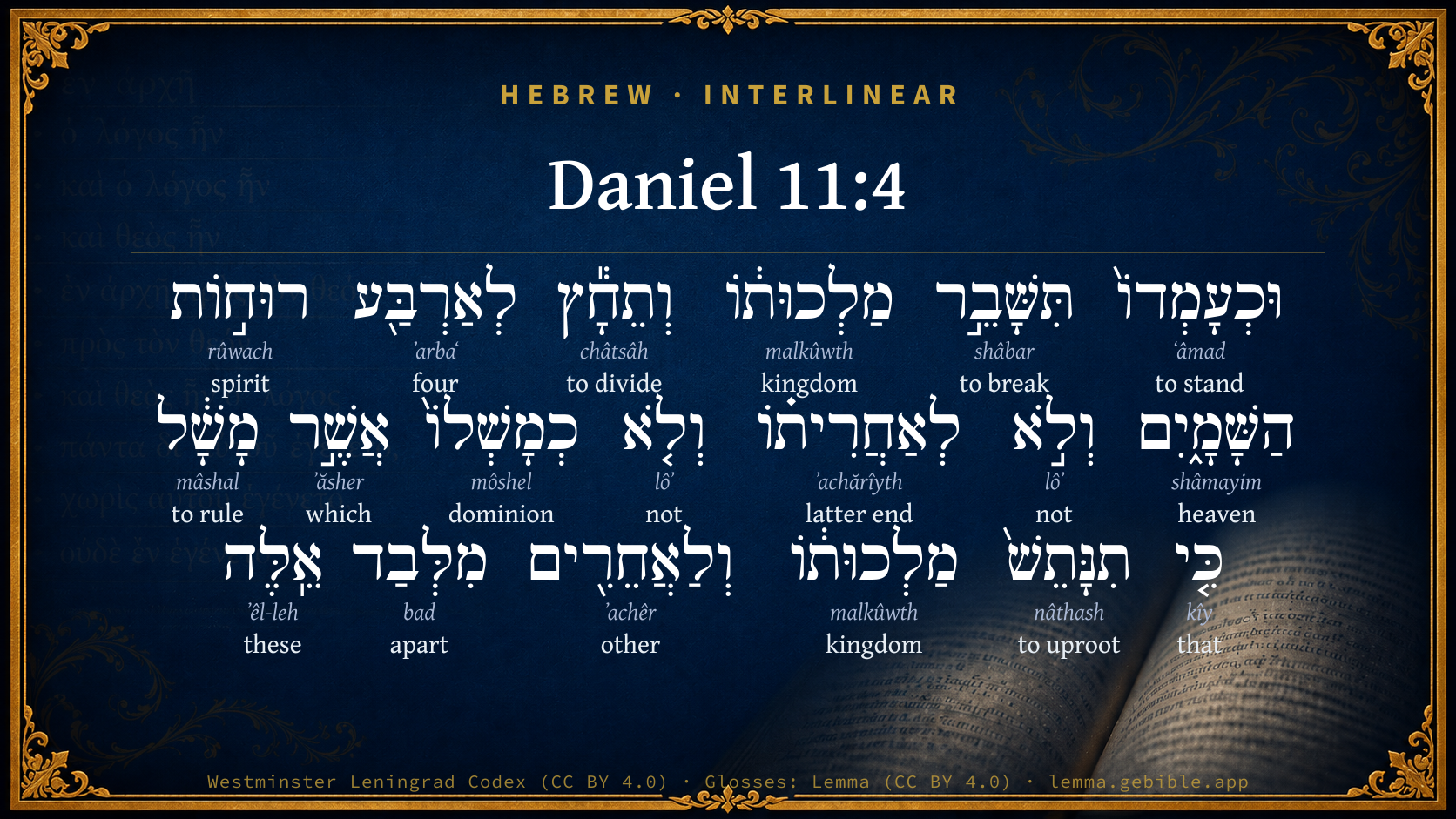
Daniel 11:4

Hebrew (Westminster Leningrad Codex) Daniel 11:4 appears in the Hebrew Old Testament. The text above is from the Westminster Leningrad Codex. Each word links to its Strong’s number, a concise gloss, and parsing drawn from the Open Scriptures Hebrew Bible morphology. Click any word for its full Brown-Driver-Briggs (BDB) entry.
Download image
Cite this verse

Daniel 11:4 (World English Bible). Public Domain. Lemma interlinear Bible study tool, https://lemma.gebible.app/v/daniel/11/4.

Show BibTeX & RIS
BibTeX
RIS
English Translation
When he shall stand up, his kingdom shall be broken, and shall be divided toward the four winds of the sky, but not to his posterity, nor according to his dominion with which he ruled; for his kingdom shall be plucked up, even for others besides these.
World English Bible · Public Domain
Download a study sheet

One document with this verse’s original text, its word-by-word gloss line, the meaning frame, cross-references with their text, attributed commentary, and full source and license credits — printable, and it pastes into notes with its structure intact.

This verse Autodidact and up

Study sheet (.html) Plain text (.txt)

A passage Seminary Student

Up to 50 verses in one chapter. A passage sheet keeps up to 6 commentary sources and 12 cross-references per verse, in the order this page ranks them, and says so on the sheet whenever that leaves anything out. Ask for a single verse and you get the Autodidact verse sheet above.

Everything on this page stays free to read, with no account — the sheet is a download of what is already on screen, not access to it.

Want to remove ads? Support Godless Engineer
Compare translations 3

The same verse in 3 English versions, stacked beneath the original-language interlinear above. Click any original word for its lexicon entry.

Each is an independent rendering of the whole verse — the interlinear is not word-aligned to these translations.

Highlighted words mark where these versions differ — a whole-verse word diff, not a word-by-word alignment.

  • World English Bible Public Domain
    When he shall stand up, his kingdom shall be broken, and shall be divided toward the four winds of the sky, but not to his posterity, nor according to his dominion with which he ruled; for his kingdom shall be plucked up, even for others besides these.
  • King James Version Public Domain
    And when he shall stand up, his kingdom shall be broken, and shall be divided toward the four winds of heaven; and not to his posterity, nor according to his dominion which he ruled: for his kingdom shall be plucked up, even for others beside those.
  • unfoldingWord Literal Text CC BY-SA 4.0
    But as soon as he has arisen, his kingdom will be broken and divided toward the four winds of heaven, but not to his posterity, and not according to his authority with which he ruled. For his kingdom will be uprooted and given to others besides these.

unfoldingWord Literal Text — © unfoldingWord, licensed CC BY-SA 4.0. Word-aligned USFM3 via Door43 (git.door43.org/unfoldingWord/en_ult).

Versions to compare (up to 4)

3 of 4 selected

Show all 18 translations

Every available English version of this verse, each an independent rendering of the whole verse.

  • World English Bible Public Domain
    When he shall stand up, his kingdom shall be broken, and shall be divided toward the four winds of the sky, but not to his posterity, nor according to his dominion with which he ruled; for his kingdom shall be plucked up, even for others besides these.
  • Berean Standard Bible Public Domain
    But as soon as he is established, his kingdom will be broken up and parceled out toward the four winds of heaven. It will not go to his descendants, nor will it have the authority with which he ruled, because his kingdom will be uprooted and given to others.
  • Majority Standard Bible Public Domain
    But as soon as he is established, his kingdom will be broken up and parceled out toward the four winds of heaven. It will not go to his descendants, nor will it have the authority with which he ruled, because his kingdom will be uprooted and given to others.
  • King James Version Public Domain
    And when he shall stand up, his kingdom shall be broken, and shall be divided toward the four winds of heaven; and not to his posterity, nor according to his dominion which he ruled: for his kingdom shall be plucked up, even for others beside those.
  • American Standard Version (1901) Public Domain
    And when he shall stand up, his kingdom shall be broken, and shall be divided toward the four winds of heaven, but not to his posterity, nor according to his dominion wherewith he ruled; for his kingdom shall be plucked up, even for others besides these.
  • Revised Version (1885) Public Domain
    And when he shall stand up, his kingdom shall be broken, and shall be divided toward the four winds of heaven; but not to his posterity, nor according to his dominion wherewith he ruled; for his kingdom shall be plucked up, even for others beside these.
  • Geneva Bible (1599) Public Domain
    And when he shall stand vp, his kingdome shall be broken, and shall be deuided towarde the foure windes of heauen: and not to his posteritie, nor according to his dominion, which he ruled: for his kingdome shall be pluckt vp, euen to be for others besides those.
  • Douay-Rheims (1899) Public Domain
    And when he shall come to his height, his kingdom shall be broken, and it shall be divided towards the four winds of the heaven: but not to his posterity, nor according to his power with which he ruled. For his kingdom shall be rent in pieces, even for strangers, beside these.
  • Young's Literal Translation Public Domain
    and according to his standing is his kingdom broken, and divided to the four winds of the heavens, and not to his posterity, nor according to his dominion that he ruled, for his kingdom is plucked up -- and for others apart from these.
  • Literal Standard Version CC BY-SA 4.0
    and according to his standing is his kingdom broken, and divided to the four winds of the heavens, and not to his posterity, nor according to his dominion that he ruled, for his kingdom is plucked up—and for others apart from these.
  • Unlocked Literal Bible CC BY-SA 4.0
    When he has risen up, his kingdom will be broken and divided to the four winds of heaven, but not to his own descendants, and not with his power when he had been ruling. For his kingdom will be uprooted for others besides his descendants.
  • unfoldingWord Literal Text CC BY-SA 4.0
    But as soon as he has arisen, his kingdom will be broken and divided toward the four winds of heaven, but not to his posterity, and not according to his authority with which he ruled. For his kingdom will be uprooted and given to others besides these.
  • Darby Bible Public Domain
    And when he shall stand up, his kingdom shall be broken, and shall be divided toward the four winds of the heavens; but not to his posterity, nor according to his dominion wherewith he ruled; for his kingdom shall be plucked up, even for others beside these.
  • World Messianic Bible Public Domain
    When he stands up, his kingdom will be broken and will be divided toward the four winds of the sky, but not to his posterity, nor according to his dominion with which he ruled; for his kingdom will be plucked up, even for others besides these.
  • Webster's Bible Public Domain
    And when he shall stand up, his kingdom shall be broken, and shall be divided towards the four winds of heaven; and not to his posterity, nor according to his dominion which he ruled: for his kingdom shall be plucked up, even for others beside those.
  • Free Bible Version CC BY-SA 4.0
    But as he extends his power his kingdom will be broken up, divided towards the four winds of heaven. It will not go to his descendants, and it will not be ruled as he ruled. It will be pulled up and given to others.
  • Bible in Basic English Public Domain
    And when he has become strong, his kingdom will be broken and parted to the four winds of heaven; but not to his offspring, for it will be uprooted; and his kingdom will be for the others and not for these: but not with the same authority as his.
  • JPS Tanakh (1917) Public Domain
    And when he shall stand up, his kingdom shall be broken, and shall be divided toward the four winds of heaven; but not to his posterity, nor according to his dominion wherewith he ruled; for his kingdom shall be plucked up, even for others beside those.

Literal Standard Version (2020), Covenant Press — licensed CC BY-SA 4.0. Text via the HelloAO Bible API (eBible.org). Unlocked Literal Bible (unfoldingWord) — licensed CC BY-SA 4.0. Text via the HelloAO Bible API (eBible.org). unfoldingWord Literal Text — © unfoldingWord, licensed CC BY-SA 4.0. Word-aligned USFM3 via Door43 (git.door43.org/unfoldingWord/en_ult). Free Bible Version, Dr. Jonathan Gallagher — licensed CC BY-SA 4.0. Text via the HelloAO Bible API (eBible.org).

Word by word

More ways to search: Search by grammar → Find every occurrence → Compare this word →

Practice this passage: Drill this verse → Learn its vocabulary →

כְמָשְׁלוֹ֙
môshel
H4915
“like/as · dominion · his”
Preposition + Noun, Common, Masculine, Singular, Construct + Suffix, Personal, 3rd Person, Masculine, Singular
Part of Speech
Preposition + Noun
Type
Common
Gender
Masculine
Number
Singular
State
Construct
Full BDB Definition

Origin: from H4910

TWOT: 1259a

dominion - likeness, one like, similitude
  1. וּכְעָמְדוֹ֙ ʻâmad H5975 “and · like/as · to stand · him” Conjunction + Preposition + Verb, Qal, Infinitive Construct + Suffix, Personal, 3rd Person, Masculine, Singular
  2. תִּשָּׁבֵ֣ר shâbar H7665 “to break” Verb, Niphal, Imperfect, 3rd Person, Feminine, Singular
  3. מַלְכוּת֔וֹ malkûwth H4438 “kingdom · his” Noun, Common, Feminine, Singular, Construct + Suffix, Personal, 3rd Person, Masculine, Singular
  4. וְתֵחָ֕ץ châtsâh H2673 “and · to divide” Conjunction + Verb, Niphal, Jussive, 3rd Person, Feminine, Singular
  5. לְאַרְבַּ֖ע ʼarbaʻ H702 “to/for · four” Preposition + Adjective, Cardinal number, Feminine, Singular, Absolute
  6. רוּח֣וֹת rûwach H7307 “spirits of” Noun, Common, Both, Plural, Construct
  7. הַשָּׁמָ֑יִם shâmayim H8064 “the · heaven(s)” Particle, Definite Article + Noun, Common, Masculine, Plural, Absolute
  8. וְלֹ֣א lôʼ H3808 “and · not” Conjunction + Particle, Negative
  9. לְאַחֲרִית֗וֹ ʼachărîyth H319 “to/for · latter end · his” Preposition + Noun, Common, Feminine, Singular, Construct + Suffix, Personal, 3rd Person, Masculine, Singular
  10. וְלֹ֤א lôʼ H3808 “and · not” Conjunction + Particle, Negative
  11. אֲשֶׁ֣ר ʼăsher H834 “which” Particle, Relative
  12. מָשָׁ֔ל mâshal H4910 “to rule” Verb, Qal, Perfect, 3rd Person, Masculine, Singular
  13. כִּ֤י kîy H3588 “that” Conjunction
  14. תִנָּתֵשׁ֙ nâthash H5428 “to uproot” Verb, Niphal, Imperfect, 3rd Person, Feminine, Singular
  15. מַלְכוּת֔וֹ malkûwth H4438 “kingdom · his” Noun, Common, Feminine, Singular, Construct + Suffix, Personal, 3rd Person, Masculine, Singular
  16. וְלַאֲחֵרִ֖ים ʼachêr H312 “and · to/for · other” Conjunction + Preposition + Adjective, Adjective, Masculine, Plural, Absolute
  17. מִלְּבַד bad H905 “from · to/for · apart of” Preposition + Preposition + Noun, Common, Masculine, Singular, Construct
  18. אֵֽלֶּה ʼêl-leh H428 “these” Pronoun, Demonstrative, Common, Plural

About this verse

These counts appear in no published source. They are computed here, from the morphology-tagged text and Lemma’s own curated glosses. What Lemma adds →

19
words
17
distinct lemmas
Prophets
section

Notable vocabulary

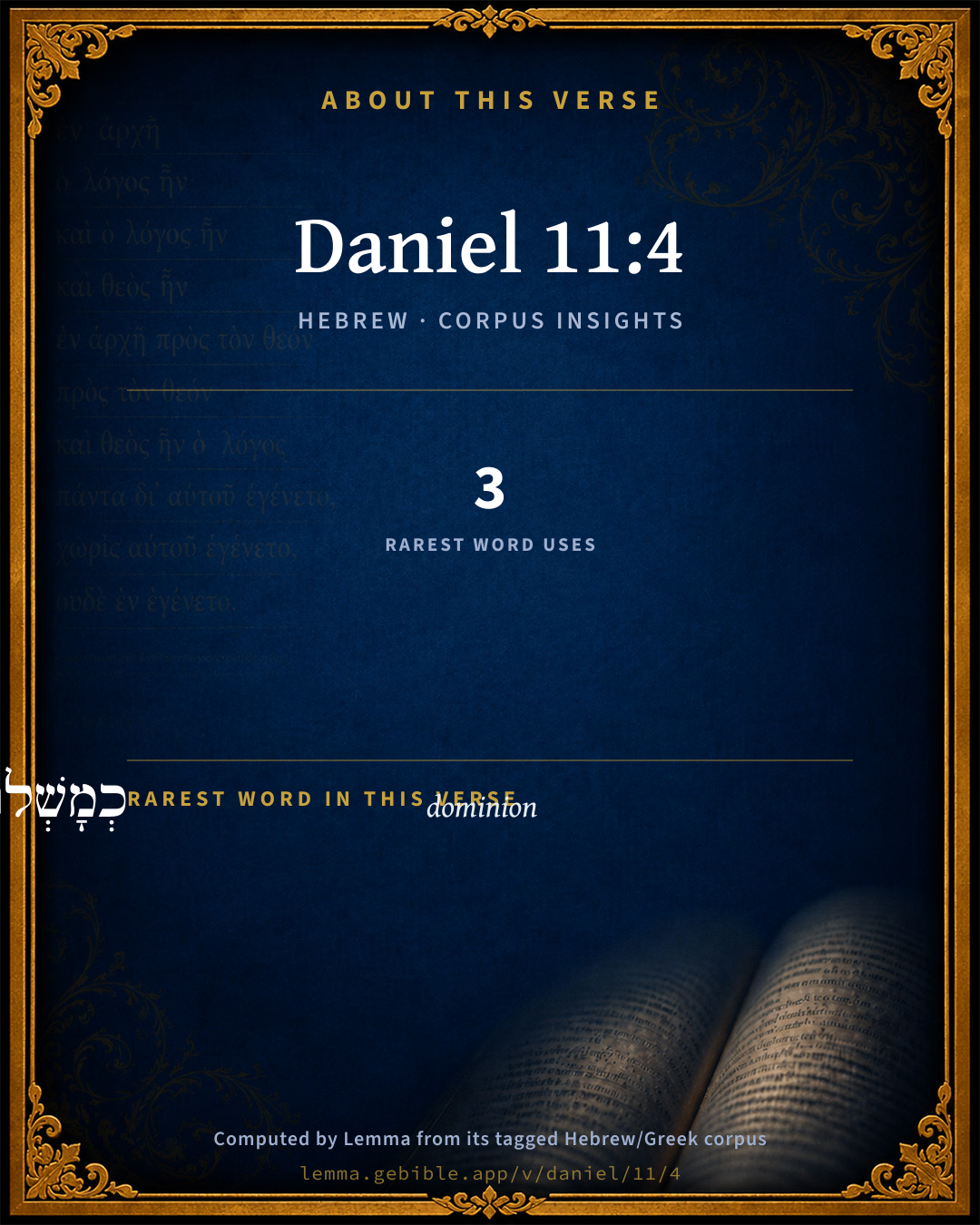
The rarest word here is כְמָשְׁלוֹ֙ dominion H4915 — appearing just 3 times in the whole Hebrew Bible.

Shared distinctive vocabulary

כְמָשְׁלוֹ֙ dominion H4915 occurs in 3 verses of the Hebrew Bible. Also found in:

Grammatical profile

  • 5 verbs
  • 7 nouns
  • 2 adjectives
  • 1 pronoun
  • 1 conjunction
  • 3 particles

Verb forms

  • וּכְעָמְדוֹ֙ Qal · Infinitive Construct
  • תִּשָּׁבֵ֣ר Niphal · Imperfect
  • וְתֵחָ֕ץ Niphal · Jussive
  • מָשָׁ֔ל Qal · Perfect
  • תִנָּתֵשׁ֙ Niphal · Imperfect

Repetition

Words recur within this verse — often emphatic in Hebrew:

  • מַלְכוּת֔וֹ kingdom H4438 ×2
  • וְלֹ֣א not H3808 ×2

Hebrew & Septuagint length

In English translation the verse runs 47 words from the Hebrew and 48 from the Septuagint (LXX English) — closely comparable.

A rough comparison of the two English renderings, which tokenize alike — not a word-level alignment.

Word counts can differ between the Hebrew and the Greek without any difference in meaning — e.g. the Hebrew direct-object marker אֵת has no separate Greek word, and Greek often adds the article ὁ.

Cross-references

19

Topical passages linked to Daniel 11:4 in the Treasury of Scripture Knowledge — connected by theme and wording, ordered by reader-vote popularity; previews shown in the World English Bible.

  • Daniel 8:8 The male goat magnified himself exceedingly: and when he was strong, the great horn was broken; and instead of it there came up four notable [horns] toward the four winds of the sky.
  • Daniel 8:22 As for that which was broken, in the place where four stood up, four kingdoms shall stand up out of the nation, but not with his power.
  • Jeremiah 12:17 But if they will not hear, then will I pluck up that nation, plucking up and destroying it, says Yahweh.
  • Jeremiah 12:15 It shall happen, after that I have plucked them up, I will return and have compassion on them; and I will bring them again, every man to his heritage, and every man to his land.
  • Jeremiah 18:7 At what instant I shall speak concerning a nation, and concerning a kingdom, to pluck up and to break down and to destroy it;
  • Daniel 7:2 Daniel spoke and said, I saw in my vision by night, and, behold, the four winds of the sky broke forth on the great sea.
  • Daniel 7:8 I considered the horns, and, behold, there came up among them another horn, a little one, before which three of the first horns were plucked up by the roots: and, behold, in this horn were eyes like the eyes of a man, and a mouth speaking great things.
  • Job 20:5–7 That the triumphing of the wicked is short, The joy of the godless but for a moment?
  • Psalms 37:35–36 I have seen the wicked in great power, Spreading himself like a green tree in its native soil.
  • Psalms 39:6 "Surely every man walks like a shadow. Surely they busy themselves in vain. He heaps up, and doesn't know who shall gather.
  • Psalms 49:6–12 Those who trust in their wealth, And boast in the multitude of their riches--
  • Psalms 73:17–20 Until I entered God's sanctuary, And considered their latter end.
  • Ecclesiastes 2:18–19 I hated all my labor in which I labored under the sun, seeing that I must leave it to the man who comes after me.
  • Ecclesiastes 4:8 There is one who is alone, and he has neither son nor brother. There is no end to all of his labor, neither are his eyes satisfied with wealth. For whom then, do I labor, and deprive my soul of enjoyment? This also is vanity, yes, it is a miserable business.
  • Jeremiah 31:40 The whole valley of the dead bodies and of the ashes, and all the fields to the brook Kidron, to the corner of the horse gate toward the east, shall be holy to Yahweh; it shall not be plucked up, nor thrown down any more forever.
  • Jeremiah 45:4 Thus shall you tell him, Thus says Yahweh: Behold, that which I have built will I break down, and that which I have planted I will pluck up; and this in the whole land.
  • Daniel 7:6 After this I saw, and, behold, another, like a leopard, which had on its back four wings of a bird; the animal had also four heads; and dominion was given to it.
  • Matthew 12:25 Knowing their thoughts, Jesus said to them, "Every kingdom divided against itself is brought to desolation, and every city or house divided against itself will not stand.
  • Luke 12:20 "But God said to him, 'You foolish one, tonight your soul is required of you. The things which you have prepared--whose will they be?'

Cross-references courtesy of OpenBible.info (CC BY 4.0).

Hebrew and Greek witnesses Masoretic Hebrew ↔ Greek Septuagint

The same verse in the two great witnesses to the Old Testament, shown verse-for-verse.

These are two independent witnesses, not word-aligned to each other, and the Septuagint is shown in lemma (dictionary) form.

Hebrew Daniel 11:4 Masoretic · Westminster Leningrad Codex

וּכְעָמְדוֹ֙ תִּשָּׁבֵ֣ר מַלְכוּת֔וֹ וְתֵחָ֕ץ לְאַרְבַּ֖ע רוּח֣וֹת הַשָּׁמָ֑יִם וְלֹ֣א לְאַחֲרִית֗וֹ וְלֹ֤א כְמָשְׁלוֹ֙ אֲשֶׁ֣ר מָשָׁ֔ל כִּ֤י תִנָּתֵשׁ֙ מַלְכוּת֔וֹ וְלַאֲחֵרִ֖ים מִלְּבַד אֵֽלֶּה

When he shall stand up, his kingdom shall be broken, and shall be divided toward the four winds of the sky, but not to his posterity, nor according to his dominion with which he ruled; for his kingdom shall be plucked up, even for others besides these.

World English Bible · Public Domain

Greek LXX Daniel 11:4 Septuagint · lemma form

καί ἐν ὁ ἀναἵστημι αὐτός συντρίβω ὁ βασιλεία αὐτός καί μερίζω εἰς ὁ τέσσαρες ἄνεμος ὁ οὐρανός οὐ κατά ὁ ἀλκή αὐτός οὐδέ κατά ὁ κυριεία αὐτός ὅς δυναστεύω ὅτι ἀποἵστημι ὁ βασιλεία αὐτός καί ἕτερος διδάσκω οὗτος

And when his kingdom shall stand up, it shall be broken, and shall be divided to the four winds of heaven; but not to his posterity, nor according to his dominion which he ruled over: for his kingdom shall be plucked up, and given to others beside these.

LXX2012 (modern English Septuagint) · Public Domain

On this verse, The Pulpit Commentary discusses the Septuagint’s reading. Read the note in Commentary ↓

Hebrew: Westminster Leningrad Codex (CC BY 4.0). Greek: Septuagint (public domain); English from LXX2012 (modern English Septuagint) (Public Domain). How the Septuagint differs from the Hebrew →

Commentary

Notes on Daniel 11:4 from classic Christian and Jewish commentators (each source and its license shown beneath its notes). The classic Christian expositions comment on the surrounding passage and are grouped to its opening verse, so a note may address several verses; the Jewish commentaries on the Tanakh (Rashi and others) are per-verse, so they appear only where the commentator wrote on this verse.

Lemma curates 59 commentaries, every one of them public domain or Creative Commons licensed, each selected and text-cleaned for this edition rather than reprinted as found. About our sources →

Trapp's Complete Commentary

John Trapp

Dan 11:4 And when he shall stand up, his kingdom shall be broken, and shall be divided toward the four winds of heaven; and not to his posterity, nor according to his dominion which he ruled: for his kingdom shall be plucked up, even for others beside those.

Ver. 4. And when he shall stand up.] And seemeth to be best underlaid, set to live, as we say, when he standeth on his best bottom, expecting ambassadors at Babylon from all the world, requiring divine honours from his Grecians, and enjoining the Jews that their dates should be taken from his reign, and that all the priests’ sons born that year should be called Alexanders.

His kingdom shall be broken.] As brittle ware is apt to be.

And shall be divided toward the four winds.] Sic transit gloria mundi. So fleeting is the fame of the world. Fitly compared to the wind, {as Dan 2:35} to a dream, to a shadow, to a dream of a shadow. Great Alexander’s kingdom was first broken into many pieces by twelve of his princes, until, eleven years after his death, it became quadripartite, &c. Here is foretold being divided among four of his chieftains, Cassander, Antigonus, Seleucus, and Ptolemy, till at length these two last got all into their hands, and yet were ever jarring and warring, as appeareth by what here followeth.

And not to his posterity.] For all his kindred were killed by Cassander, with whom it happened accordingly.

Nor according to his dominion.] For although they were all sovereign princes, yet they fell far short of Alexander in command and warlike fame. {Dan 8:22}

John Trapp, A Commentary or Exposition upon All the Books of the Old and New Testament (1647–1656) — public domain. Text from a community e-Sword module.

Tyndale Open Study Notes

Tyndale Open Resources

11:4 Alexander died on June 10, 323 BC, in Babylon at the age of thirty-three. He was at the height of his power and willing to be worshiped as a god. • Alexander’s descendants were not capable of governing, and his brother Philip was incompetent. • For his empire will be . . . given to others: Several of Alexander’s generals divided his empire; by 301 BC, their conflicts had resulted in four parts (see 7:4-7; 8:8-12 and corresponding study notes). God orchestrates history, and its end belongs to him.

Tyndale Open Study Notes — © Tyndale Open Resources, licensed CC BY-SA 4.0. Text via the HelloAO Bible API.

Geneva Bible (1599)

Geneva Bible translators

For when his estate was most flourishing, he overcame himself with drink, and so fell into a disease: or as some write, was poisoned by Cassander.

That is, his posterity having no part thereof.

None of these four shall be able to be compared to the power of Alexander.

Thus God revenged Alexander’s ambition and cruelty in causing his posterity to be murdered, partly of the father’s chief friends, and partly one of another.

After this his Monarchy was divided into four: for Seleucus had Syria, Antigonus Asia minor, Cassander the kingdom of Macedonia, and Ptolemy Egypt.

For his twelve chief Princes first divided his kingdom among themselves.

Geneva Bible (1599) marginal notes — public domain. Text via Bolls.life.

Jamieson, Fausset & Brown

Robert Jamieson, A. R. Fausset & David Brown

kingdom . . . divided toward . . . four winds--the fourfold division of Alexander's kingdom at his death (Dan 8:8, Dan 8:22), after the battle of Ipsus, 301 B.C.

not to his posterity--(See on Dan 8:8; Dan 8:22).

nor according to his dominion--None of his successors had so wide a dominion as Alexander himself.

others besides those--besides Alexander's sons, Hercules by Barsine, Darius daughter, and Alexander by Roxana, who were both slain [MAURER]. Rather, besides the four successors to the four chief divisions of the empire, there will be other lesser chiefs who shall appropriate smaller fragments of the Macedonian empire [JEROME].

Jamieson, Fausset & Brown — Commentary Critical and Explanatory on the Whole Bible (1871) — public domain (CC PDM 1.0). Text via the HelloAO Bible API.

Adam Clarke's Commentary

Verse 4. His kingdom shall be broken] Shall, after his death, be divided among his four chief generals, as we have seen before. See Da 8:22.

And not to his posterity] The family of Alexander had a most tragical end:

1. His wife Statira was murdered soon after his death by his other wife Roxana.

2. His brother Aridaeus, who succeeded him, was killed, together with his wife Euridice, by command of Olympias, Alexander's mother, after he had been king about six years and some months.

3. Olympias herself was killed by the soldiers in revenge.

4. Alexander AEgus, his son, together with his mother Roxana, was slain by order of Cassander.

5. Two years after, his other son Hercules, with his mother Barsine, was privately murdered by Polysperchon; so that in fifteen years after his death not one of his family or posterity remained alive!

"Blood calls for blood." He (Alexander) was the great butcher of men. He was either poisoned, or killed himself by immoderate drinking, when he was only thirty-two years and eight months old: and a retributive Providence destroyed all his posterity, so that neither root nor branch of them was left on the face of the earth. Thus ended Alexander, the great butcher; and thus ended his family and posterity.

Adam Clarke's Commentary on the Bible (1810–1826) — public domain. Text from a community e-Sword/MySword module.

John Calvin's Commentaries

This language is concise, but there is no ambiguity in the sense. First of all the angel says, After that brave king had stood up, his empire should be broken in pieces: for when Alexander had arrived at his height, he suddenly fell sick, and shortly afterwards died at Babylon. Ambassadors had assembled round him from every quarter. He was quite intoxicated by prosperity, and very probably poisoned himself. Historians, however, have viewed him as a remarkable example of singular valor, and so they have pretended and have related, because at least they thought so, that he was deceitfully poisoned by Cassander. But we all know how intemperately and immoderately he indulged in drinking; he almost buried himself in wine, and was seized with disease amidst his cups, and sank under it, because no remedy was found for him. This, then, was Alexander’s poison. Whichever way we understand it, he fell suddenly, almost as soon as he began to stand. After conquering nearly the whole East, he came to Babylon, and was uncertain in his plans as to the employment of his forces, after he had procured peace for the whole East. He was then anxious to transfer his armies to either Europe or Africa. The angel says, After he had stood up, meaning, after he had acquired the monarchy of the whole East, his kingdom should be broken up. He uses this simile, because the whole power of Alexander was not so much extinguished as broken into separate parts. We know how the twelve chiefs who were his generals drew the spoils to themselves; every one took a portion of his kingdom, and divided it among themselves, as we have previously stated, just as if it were torn from their master’s body. All consented in raising his brother Aridaeus to the dignity of king, and they called him Philip, that, while his sons were young, the memory of his father might commend them to the world. But four kingdoms at length issued from Alexander’s monarchy. It is unnecessary here to refer to what we may read at our leisure in the writings of historians.

The Prophet only touches shortly on those points which relate to the instruction of the Church; he does not relate in order or in detail the events narrated in history; he only says, His empire shall be broken, and shall be divided, says he, towards the four winds of heaven The angel omits that partition which assigned the treasure to one, and gave the office of counselor to Philip: Perdiccas was the guardian of his son, and he with others obtained a portion of his dominions. Seleucus obtained Syria, to whom his son Antiochus succeeded; Antigonus became prefect of Asia Minor; Cassander, the father of Antipater, seized the kingdom of Macedon for himself; Ptolemy, the son of Lagus, who had been a common soldier, possessed Egypt. These are the four kingdoms of which the angel now treats. For Egypt was situated to the south of Judea, and Syria to the north, as we shall afterwards have occasion to observe. Macedonia came afterwards, and then Asia Minor, both east and west. But the angel does not enter into any complicated details, but shortly enumerates whatever was necessary for the common instruction of the elect people. The common consent of all writers has handed down these facts, — four kingdoms were constituted at length out of many portions, after the chiefs had been so mutually slain by one another that four only survived, namely, Ptolemy, Seleucus, Antigonus, and Cassander. Afterwards the kingdom of Antiochus was extended when Antigonus was conquered; for Antiochus added Asia Minor to the kingdom of Syria. But Antiochus stood only for a time, and hence the angel truly and properly states this empire to have been divided into four parts.

He next adds, And not to his posterity No one could have guessed what the angel predicted so many years before Alexander’s birth; for he was not born till a hundred years after this period. Those who know the boldness of his warlike schemes, the rapidity of his movements, and the success of his measures, would never be persuaded of this result, — the complete destruction of all his posterity, and the utter extinction of his race.

Had Alexander lived quietly at home, he might have married, and have become the father of children who would have been his undisputed successors. He died young, soon after reaching the age of thirty; still he might have married, and have had heirs to his throne. He had a brother, Aridaeus, and other relations, among whom was his uncle Pyrrhus, king of Epirus, and a royal offspring might thus have been preserved, and a successor prepared for him. After he had subdued both upper and lower Asia, he became master of Syria, Egypt, and Judea, and extended his power to the Persians, while his fame extended over Africa and Europe. Since no one dared to raise a finger against him, as he possessed a most magnificent army, and all his generals were bound to him by most important benefits, and so many of his prefects were enriched by his extreme liberality, who would have thought that all his posterity and relations would be thus blotted out? He left; two sons, but they were slain as well as his brother Aridaeus, while his wives and his mother, aged eighty years, shared the same fate. Nor did Cassander spare her, for she intrigued against him. At length, as if God would punish so many slaughters committed by Alexander, he wished his whole posterity to be extinguished. And yet, as I have stated, no foreign enemy was the agent in inflicting such heavy punishments. He had subjugated the whole East, and his bearing was such, as if the whole monarchy of that portion of the world had descended to him from his ancestors by hereditary right. As the world contained no enemy for him, his foes sprang from his own home; they slew his mother, his wives, his children, and all his relatives, and utterly rooted out all his race. We observe, then, with what clearness and certainty the angel predicts events entirely concealed from that age, and for hundred years afterwards, and such as would never be, credited by mankind. There seems a great contrast in the language; his kingdom shall be broken, it shall be divided towards the four winds of heaven, and not to his posterity; that is, although the four kingdoms should spring up in the four quarters of the world, yet, none of Alexander’s posterity should remain in a single place, or obtain even the least portion of his dominions. This was a remarkable proof of God’s wrath against the cruelty of Alexander; not that he was savage by nature, but ambition seized upon him, and made him bloodthirsty, and indisposed him to desire any end to his warfare. God, therefore, avenged that grasping disposition of Alexander’s, by allowing the whole of his race thus to perish with disgrace and horrible cruelty. On this account that pride of his which wished to be thought a son of Jupiter, and which condemned to death all his friends and followers who would not prostrate themselves before him as a god; — that pride, I say, never could secure a single descendant to reign in his place, or even to hold a single satrapy. Not to his posterity, says the angel, and not according to his dominion.

He passes to the four kings of which he had spoken: It shall not break forth, he says, namely, from the four kings. He had already stated their foreign extraction, not in any way derived from the family of that king; for none of the four should equal his power, because his kingdom should be expired. Here the angel seems to omit intervening events, and speaks of an ultimate destruction. We know how the past king Perseus was conquered by the Romans, and how the kingdom of Antiochus was partly destroyed by war, and partly oppressed by fraud. And the angel seems to mark this. We may interpret it more to the point, by considering the cessation of Alexander’s empire, with reference to his own race, as if the angel had stated that none of his successors should acquire equal power with himself. And why so? Not one of them could accomplish it. Alexander acquired so mighty a name that all people willingly submitted to his sway, and no single successor could sustain the burden of the whole. Hence his kingdom, as far as it related to himself and His posterity, was divided, and no one succeeded to his power and his opulence. And it shall be given to others. The angel here explains his meaning. The destruction of the kingdom ought not to be explained particularly of single parts, for each seized his own portion for himself, and his successors were all strangers. And to others besides those; meaning, his kingdom shall be seized upon by officers who are not of his posterity; that is, strangers shall rush into Alexander’s place, and no successor shall arise from his own kindred. It afterwards follows, —

John Calvin's Commentaries (1540-1563) — public domain. Text from the Calvin Translation Society English edition (1840s-50s) via the Christian Classics Ethereal Library (ccel.org). Calvin's coverage is partial (roughly two-thirds of the Bible); uncommented books and verses are honest gaps, never fabricated. The 19th-century editor's footnotes and remarks are omitted so the notes are faithfully Calvin's own voice.

Ellicott's Commentary for English Readers

(4) Broken.—The shortness of the king’s reign is implied; the moment that he has arisen he will come to nothing. As in Dan_8:8, the great horn was broken, so here the kingdom is broken and dismembered. This has been explained to mean the sudden collapse of the Greek empire after the death of Alexander.

Not to his posterity.—The kingdom disappears without the members of the king’s family reaping any benefit from it. It is “plucked up for others besides these”—i.e., to the exclusion of his lawful heirs—and strangers shall possess the fragments of his empire. This is explained of the partition of Alexander’s empire among his generals, and of the murder of his two sons, Hercules and Alexander, but the language is too indefinite to make any such identification certain. The revelation directs our attention to a self-willed king, whose large empire is to come to a sudden and unexpected end; the ruins of it are not to benefit his posterity, but apparently two strangers, who are designated king of the north and king of the south respectively.

A Bible Commentary for English Readers, edited by Charles John Ellicott (1878–1897) — public domain. Text from a community e-Sword module.

The Cambridge Bible for Schools and Colleges

gen. ed. J. J. S. Perowne

4. The disruption of Alexander’s empire, after his death.

when he shall stand up] or, at the time of his standing up. The expression, if correct, will be intended to emphasize the short-lived duration of Alexander’s empire (his reign extended from 336 to 323; his conquests in Asia from 334 to 323). But in view of Dan_8:8, Grätz’s emendation, ‘when he shall become strong’ (וכעצמו for וכעמדו), is a probable one; the reference will then be to the manner in which Alexander was suddenly struck down in the midst of his successes.

be broken] The word is, no doubt, suggested by Dan_8:8, where it is used of the ‘great horn,’ which symbolizes Alexander.

toward the four winds of heaven] So also Dan_8:8. Alexander’s empire, after his death, was broken up; and in the end the four kingdoms of Cassander, Lysimachus, Seleucus, and Ptolemy arose upon its ruins (see on Dan_8:8).

but (it shall) not (belong) to his posterity] Alexander, the conqueror’s youthful son by Roxana, and Herakles, an illegitimate son, were both murdered in 310 or 309, the former by Cassander directly, the latter by Polysperchon at Cassander’s persuasion (Diod. Sic. xix. 105, xx. 28).

nor (be) according to his dominion, wherewith he ruled] The divided kingdom would not, in any of its parts, retain the power and prestige which Alexander enjoyed. Cf. Dan_8:22, ‘but not with his power.’

pluckt up] The figure is that of a tree: it is common in Jeremiah, as Jer_1:10, Jer_18:7, Jer_31:28.

and (it shall be) for others besides these] besides Alexander’s generals,—with allusion to the independent petty dynasties which arose gradually in Cappadocia, Armenia, and other countries, during the century and a half that followed upon the death of Alexander (Jerome, von Leng., Bevan).

From this point onwards the author confines himself to the kingdoms of the north and of the south, i.e. of the Seleucidae (in Syria), and of the Ptolemies (in Egypt),—these being the two dynasties which during the period that elapsed from the death of Alexander to the time of Antiochus Epiphanes, successively dominated Palestine.

The Cambridge Bible for Schools and Colleges (gen. ed. J. J. S. Perowne; Cambridge University Press, 1878–1918) — public domain. Text from a community e-Sword module.

John Gill's Exposition

And when he shall stand up, his kingdom shall be broken,.... When Alexander was risen up to his highest pitch of grandeur, was sole monarch of the world, in the height of his ambition, in the prime of his days, he was cut off by death; his kingdom remained no more one, but became many, was seized by different persons, his generals, and so broke to pieces:

and shall be divided toward the four winds of heaven; which seem to have respect to the four horns or kings, which came up in his place, Dan 8:8, and among whom his kingdom was parted; Ptolemy reigned in Egypt to the south; Antigonus in Asia to the north; Seleucus in Babylon and Syria to the east; and Cassander in Macedonia to the west:

and not to his posterity; for though he had two sons, one by Barsine, whose name was Hercules, who was living at his death; and another by Roxane, born after his death, whose name was Alexander; yet they were both destroyed by Cassander, or his means, that he might enjoy Macedonia (p):

nor according to his dominion which he ruled; their dominion was not so large and powerful as Alexander's was, being divided into several parts; see Dan 8:22, for his kingdom shall be plucked up, even for others besides those; either besides his posterity, who had no share in it, and so, with respect to his family, was like a tree plucked up by the roots, and, as to their concern in it, withered away at once; or, besides the four governors before mentioned, there were others that had, at least for a while, some lesser shares in the kingdom, as Eumenes, Philotas, Leonnatus, and others; but, at length, all were reduced to the kings of Egypt and Syria, the Lagidae and Seleucidae, which the following part of the prophecy chiefly concerns; and, besides these, for the Romans also, to whom this kingdom came.

(p) Diodor. Sicul. Bibliothec. l. 19. p. 739. & l. 20. p. 761.

John Gill's Exposition of the Whole Bible (1746–1763) — public domain (CC PDM 1.0). Text via the HelloAO Bible API.

Albert Barnes' Notes on the Bible

And when he shall stand up - In the might and power of his kingdom. When his power shall be fully established. I understand this, with Rosenmuller and Havernick, as meaning, when he shall be at the height of his authority and power, then his kingdom would be broken up. The reference is, undoubtedly, to the sudden death of Alexander; and the sense is, that his empire would not “gradually” diminish and decay, but that some event would occur, the effect of which would be to rend it into four parts.

His kingdom shall be broken - To wit, by his death. The language is such as is properly applicable to this, and indeed implies this, for it is said that it would not be “to his posterity” - an event which might be naturally expected to occur; or, in other words, the allusion to his posterity is such language as would be employed on the supposition that the reference here is to his death.

And shall be divided toward the four winds of heaven - Into four parts. For the remarkable fulfillment of this prediction, see the notes at Dan 8:8.

And not to his posterity - See also the notes at Dan 8:8.

Nor according to his dominion which he ruled - This was literally true of the division of the empire. No one of his successors ever obtained as wide a dominion as he did himself.

For his kingdom shall be plucked up - By his death. This does not naturally mean that it would be by “conquest,” for it is said that it would be “divided toward the four winds of heaven” - language which is not properly expressive of conquest. All that is implied is met by the supposition, that at his decease the kingdom which had been founded by him, and which had been sustained by his valor and political wisdom, would fall to pieces.

Even for others beside those - That is, to others beside those to whom it should be at first divided. Literally, “exclusively, or to the exclusion of” - מלבד mı̂llebad. The word “those” refers to his posterity; and the meaning is, that the process of division would not stop with them, or that the four portions of the empire, as thus divided, would not remain in their hands, or pass to their posterity. There would be other changes and other divisions; and it was not to be expected that just four, and no more, empires would grow out of the one which had been founded, or that when that one should be divided into four parts, that partition would always continue. There would be other divisions, and other princes besides those who first obtained the empire would come in, and the process of division would ultimately be carried much farther. It is unnecessary to say that this occurred in the empire founded by Alexander. It was, soon after his death, separated into four parts, but at no distant period this arrangement was broken up, and all traces of the empire, as established by him, or as divided among his four successors, wholly disappeared.

Albert Barnes' Notes on the Bible (1834–1885) — public domain. Text from a community e-Sword/MySword module.

Haydock's Catholic Bible Commentary

These four; Ptolemy, Seleucus, Antigonus, and Antipater, kings of Egypt, Syria, Asia, and Greece. (Chap. vii. 6. and viii. 22.) Besides the other generals, (Calmet) foreigners began to erect new kingdoms in what had formed the empire of Alexander. (St. Jerome; Livy xlv.; Calmet)

George Leo Haydock (1774–1849), Haydock's Catholic Family Bible and Commentary, 1859 edition — public domain. Excludes Psalms (Douay-Rheims chapter numbering differs from Protestant) and Deuterocanonical books (Catholic canon only).

Matthew Poole's English Annotations

When he shall stand up; when he is come to his highest, as monarch of the world, &c. After he had enjoyed that title a little while, his kingdom was broken, as the text saith. So it was, into four pieces, whereof we have spoken, Da 7; Da 8.

Not to his posterity, but to four of his chief commanders, who should reign in the four quarters of the world, i.e. Alexander’s conquest, though here he only mentions two of them, Egypt and Syria, i.e. the south and the north. Alexander had a brother, named Aridaeus, and two sons, Alexander and Hercules, besides others of his blood, but the nobles destroyed them all; and so the whole race of Alexander was rooted out to fulfil this prophecy; but judicially, for his great cruelty, pride, and luxury.

Nor according to his dominion; they did not reign as kings at first, but only as captains; and as to the extent of their dominion, it was far less than Alexander’s, yea, all four fell short of his.

For others beside those; some lesser commanders shared several parts of that empire, as Eumenes, Philotes, with many more, at least ten; as histories tell us.

Matthew Poole's English Annotations on the Holy Bible (1683–1685) — public domain. Text from a community e-Sword/MySword module.

Whedon's Commentary on the Bible

Daniel D. Whedon

4. This is a reference to what has been previously stated more explicitly concerning Alexander and the ending of his empire (Dan_8:5-8). This identification is made easier by the statement that the kingdom was not divided between the posterity of this king, but should be for others beside those. (See notes Dan_8:8; Dan_8:21.) No one of these successors to this “mighty king” ruled according to his dominion, but over a territory and with a power much inferior to his.

Daniel D. Whedon (gen. ed.), Commentary on the Old and New Testaments (1874–1909) — public domain. Text from a community e-Sword module.

The Pulpit Commentary

And when he shall stand up, his kingdom shall be broken, and shall be divided toward the four winds of heaven; and not to his posterity, nor according to his dominion which he ruled: for his kingdom shall be plucked up, even for others beside those. The LXX rendering is, "And when he is risen up, his kingdom shall be broken, and divided to the four winds of heaven; not according to his might, nor according to his dominion which he ruled: because his kingdom shall be taken away, and he shall teach these things to others." It is difficult to see what reading the LXX translator had when he rendered, "his might," for no word meaning "might" is at all like ahareetho, "his posterity." In the last clause he must have read, not milbad, but melamayd. Theodotion resembles the Massoretic more closely; he renders, "But when his kingdom stood (shall stand), it shall be broken, and shall be scattered to the four winds of heaven; and to his latter end (escata), nor according to his rule which he ruled: for his kingdom shall be rooted out, and (let) for others besides these." The Peshitta agrees generally with this, only that when in the English we have, "not to his posterity," it has, "not to his sword (siphoh)" The last clause is somewhat paraphrastic, "And his kingdom shall be rooted, and shall not be to others save these." The Vulgate agrees with the Massoretic. The description here given of the empire of Alexander the Great is strictly accurate; his empire did not go to his posterity, nor did any of his successors possess a dominion as extensive as his. For others beside those. This has been thought to refer to the successors of those who first divided the empire among them. It seems more natural to regard "those" as referring to the posterity of Alexander, as the nearest antecedent.

The Pulpit Commentary (1880–1919), ed. H.D.M. Spence-Jones & Joseph S. Exell — public domain. Text from a community e-Sword module.

John Wesley's Explanatory Notes

When he shall stand up - When he is come to his highest point. Nor according to his dominion - They did not reign as kings at first, but only as captains; and as to the extent of their dominion, it was far less than Alexander's, yea, all four fell short of his. Even for others - Some lesser commanders shared several parts of the empire.

John Wesley, Explanatory Notes Upon the Whole Bible (1754–1765) — public domain. Text via the GEBible commentary corpus.

Rashi

Rabbi Shlomo Yitzchaki (Rashi)

And when he arises, his kingdom will be broken When he becomes very strong and reaches the height of his strength, his kingdom will be broken, meaning that he will die.

and it will be divided to the four directions of the heavens It is written in the book of Ben Gorion (ch. 14) that he divided his kingdom between the four heads of his family; they are the four heads of the leopard that Daniel saw (above 7:6): “And behold another one, like a leopard, and it had four wings of a bird on its back, and the beast had four heads.” He gave this one dominion in the east, this one in the west, this one in the north and this one in the south, and so in the first vision (8:8): “an appearance of four sprouted in its stead,” concerning the horns of the he-goat.

but not to his posterity The dominion will not come to his sons but to his family members. [The word] אַחֲרִיתוֹ coincides only with the expression of sons, and so Scripture states (Amos 4:2): “and you shall be borne on shields and your posterity (אַחֲרִיתְכֶן) in fishing boats,” which Jonathan renders: and your sons (sic) and daughters in fishermen’s boats.

and not like the dominion that he ruled but the kingdom of these will not be as strong as that of Alexander.

for his kingdom will be uprooted to divide to these four heads and to others besides these.

Rashi on the Tanakh — English translations: “The Judaica Press complete Tanach with Rashi, translated by A. J. Rosenberg” (CC BY 4.0); “Pentateuch with Rashi's commentary by M. Rosenbaum and A.M. Silbermann, 1929-1934” (public domain); “The Metsudah Tanach series, Lakewood, N.J” (CC BY 4.0); and “The Book of Joshua, Metsudah Publications, 1997” (CC BY 4.0). Text via Sefaria.

Lesson kit

Teaching starters — assembled from the data on this page, not authored interpretation. Every prompt links to the verse data it draws on. Edit before teaching.

Daniel, in the Prophets, opens this verse with 19 words (17 distinct Hebrew lemmas). Its most distinctive word is môshel (“dominion”). A historical commentator’s framing appears above. Read the whole chapter for the surrounding context.

Discussion questions

  1. The word môshel carries the sense “dominion.” How does it shape the verse?
  2. How does Job 41:33, which shares the word «dominion», read alongside this verse?
  3. What does the repetition of “kingdom” (2× in this one verse) do in this verse?
  4. The translations on this page render this verse differently — a whole-verse word diff, not a word-by-word alignment. What might account for the different wordings?
  5. «וּכְעָמְדוֹ֙» is a Qal Infinitive Construct verb. How does that grammatical form shape the action described?
  6. Compare how Trapp's Complete Commentary and Tyndale Open Study Notes read this verse. Where do they agree or differ?

Things to notice

Reading settings

Reading text

Shown beneath each verse's original-language words.

Old Testament
Old Testament edition

Read the OT as the Masoretic Hebrew (MT) or the Greek Septuagint (LXX).

English shown for the Greek Septuagint (in the Hebrew ↔ Greek comparison).

Comparing translations? Open the Compare panel on any verse page to stack up to four side by side.