
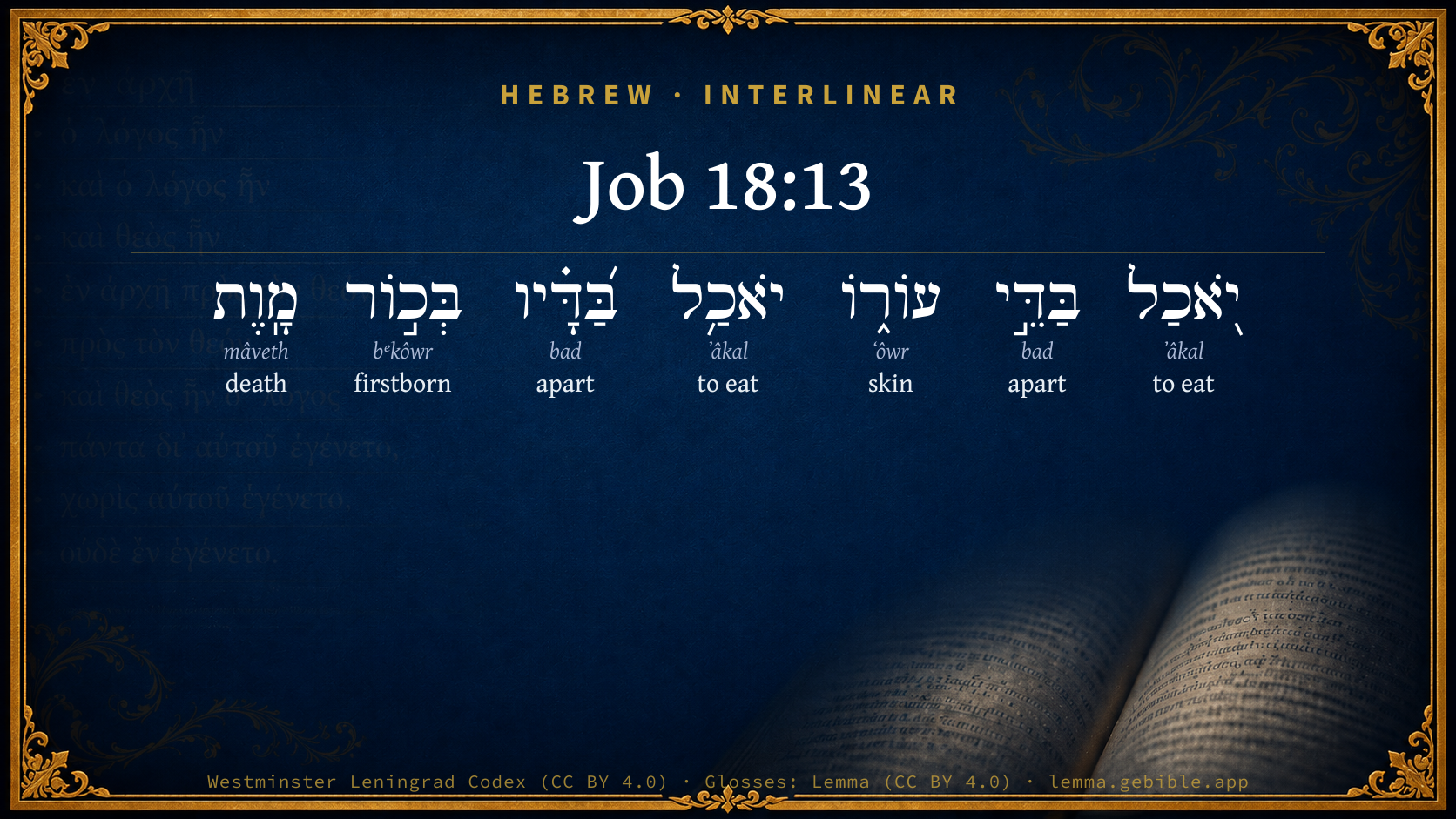
Job 18:13

Hebrew (Westminster Leningrad Codex) Job 18:13 appears in the Hebrew Old Testament. The text above is from the Westminster Leningrad Codex. Each word links to its Strong’s number, a concise gloss, and parsing drawn from the Open Scriptures Hebrew Bible morphology. Click any word for its full Brown-Driver-Briggs (BDB) entry.
Download image
Cite this verse

Job 18:13 (World English Bible). Public Domain. Lemma interlinear Bible study tool, https://lemma.gebible.app/v/job/18/13.

Show BibTeX & RIS
BibTeX
RIS
English Translation
The members of his body shall be devoured, The firstborn of death shall devour his members.
World English Bible · Public Domain
Download a study sheet

One document with this verse’s original text, its word-by-word gloss line, the meaning frame, cross-references with their text, attributed commentary, and full source and license credits — printable, and it pastes into notes with its structure intact.

This verse Autodidact and up

Study sheet (.html) Plain text (.txt)

A passage Seminary Student

Up to 50 verses in one chapter. A passage sheet keeps up to 6 commentary sources and 12 cross-references per verse, in the order this page ranks them, and says so on the sheet whenever that leaves anything out. Ask for a single verse and you get the Autodidact verse sheet above.

Everything on this page stays free to read, with no account — the sheet is a download of what is already on screen, not access to it.

Want to remove ads? Support Godless Engineer
Compare translations 3

The same verse in 3 English versions, stacked beneath the original-language interlinear above. Click any original word for its lexicon entry.

Each is an independent rendering of the whole verse — the interlinear is not word-aligned to these translations.

Highlighted words mark where these versions differ — a whole-verse word diff, not a word-by-word alignment.

  • World English Bible Public Domain
    The members of his body shall be devoured, The firstborn of death shall devour his members.
  • King James Version Public Domain
    It shall devour the strength of his skin: even the firstborn of death shall devour his strength.
  • unfoldingWord Literal Text CC BY-SA 4.0
    It devours parts of his skin; the firstborn of death devours his parts.

unfoldingWord Literal Text — © unfoldingWord, licensed CC BY-SA 4.0. Word-aligned USFM3 via Door43 (git.door43.org/unfoldingWord/en_ult).

Versions to compare (up to 4)

3 of 4 selected

Show all 18 translations

Every available English version of this verse, each an independent rendering of the whole verse.

  • World English Bible Public Domain
    The members of his body shall be devoured, The firstborn of death shall devour his members.
  • Berean Standard Bible Public Domain
    It devours patches of his skin; the firstborn of death devours his limbs.
  • Majority Standard Bible Public Domain
    It devours patches of his skin; the firstborn of death devours his limbs.
  • King James Version Public Domain
    It shall devour the strength of his skin: even the firstborn of death shall devour his strength.
  • American Standard Version (1901) Public Domain
    The members of his body shall be devoured, `Yea', the first-born of death shall devour his members.
  • Revised Version (1885) Public Domain
    It shall devour the members of his body, yea, the firstborn of death shall devour his members.
  • Geneva Bible (1599) Public Domain
    It shall deuoure the inner partes of his skinne, and the first borne of death shall deuoure his strength.
  • Douay-Rheims (1899) Public Domain
    Let it devour the beauty of his skin, let the firstborn death consume his arms.
  • Young's Literal Translation Public Domain
    It consumeth the parts of his skin, Consume his parts doth death's first-born.
  • Literal Standard Version CC BY-SA 4.0
    It consumes the parts of his skin, || Death’s firstborn consumes his parts.
  • Unlocked Literal Bible CC BY-SA 4.0
    The parts of his body will be devoured; indeed, the firstborn of death will devour his parts.
  • unfoldingWord Literal Text CC BY-SA 4.0
    It devours parts of his skin; the firstborn of death devours his parts.
  • Darby Bible Public Domain
    The firstborn of death devoureth the members of his body; it will devour his members.
  • World Messianic Bible Public Domain
    The members of his body will be devoured. The firstborn of death will devour his members.
  • Webster's Bible Public Domain
    It shall devour the strength of his skin: even the first-born of death shall devour his strength.
  • Free Bible Version CC BY-SA 4.0
    Disease devours their skin; deadly disease consumes their limbs.
  • Bible in Basic English Public Domain
    His skin is wasted by disease, and his body is food for the worst of diseases.
  • JPS Tanakh (1917) Public Domain
    It shall devour the members of his body, yea, the first-born of death shall devour his members.

Literal Standard Version (2020), Covenant Press — licensed CC BY-SA 4.0. Text via the HelloAO Bible API (eBible.org). Unlocked Literal Bible (unfoldingWord) — licensed CC BY-SA 4.0. Text via the HelloAO Bible API (eBible.org). unfoldingWord Literal Text — © unfoldingWord, licensed CC BY-SA 4.0. Word-aligned USFM3 via Door43 (git.door43.org/unfoldingWord/en_ult). Free Bible Version, Dr. Jonathan Gallagher — licensed CC BY-SA 4.0. Text via the HelloAO Bible API (eBible.org).

Word by word

More ways to search: Search by grammar → Find every occurrence → Compare this word →

Practice this passage: Drill this verse → Learn its vocabulary →

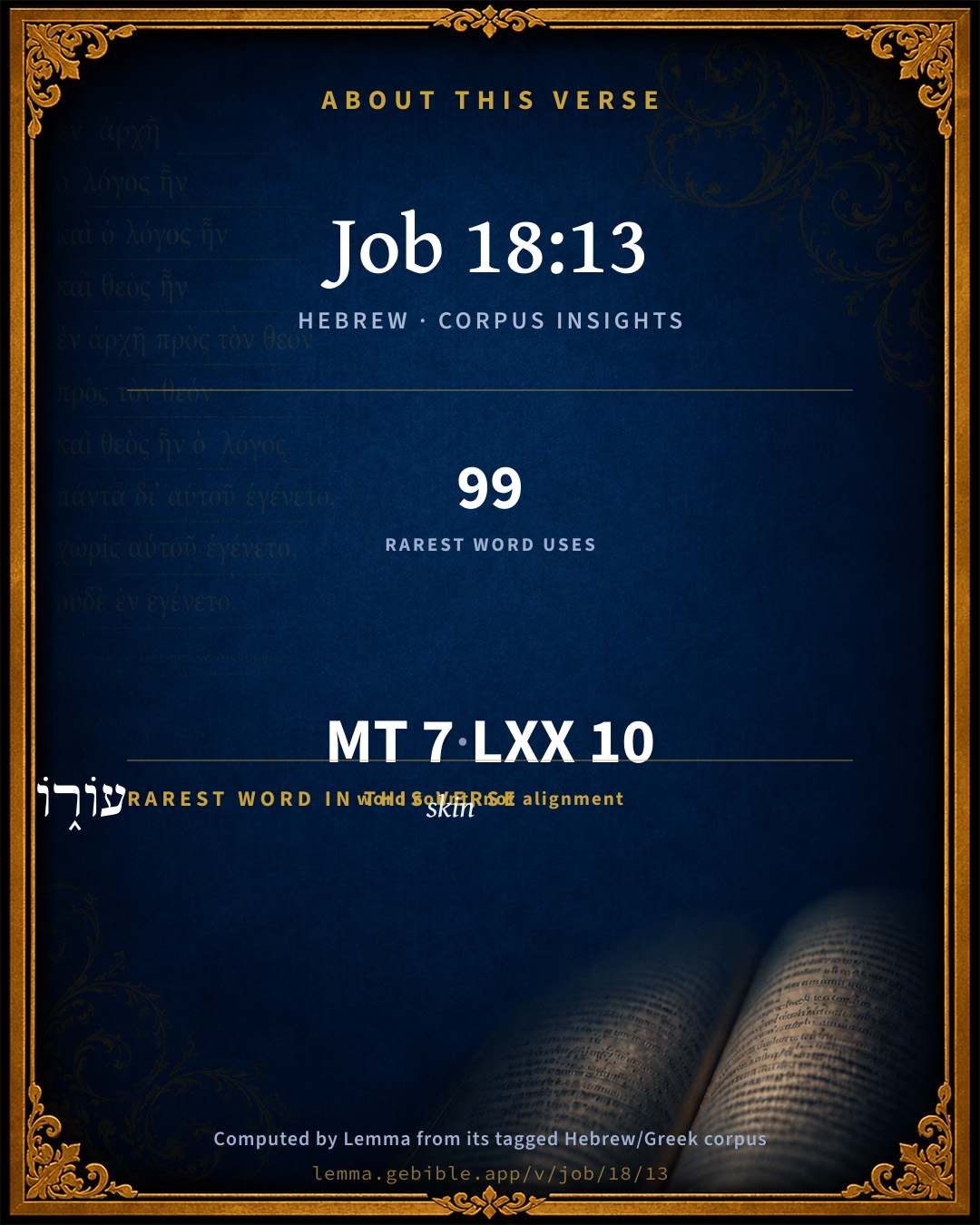
About this verse

These counts appear in no published source. They are computed here, from the morphology-tagged text and Lemma’s own curated glosses. What Lemma adds →

7
words
5
distinct lemmas
Wisdom
section

Grammatical profile

  • 2 verbs
  • 5 nouns

Verb forms

  • יֹ֭אכַל Qal · Imperfect
  • יֹאכַ֥ל Qal · Imperfect

Repetition

Words recur within this verse — often emphatic in Hebrew:

  • יֹ֭אכַל to eat H398 ×2
  • בַּדֵּ֣י apart H905 ×2

Hebrew & Septuagint length

In English translation the verse runs 16 words from the Hebrew and 14 from the Septuagint (LXX English) — closely comparable.

A rough comparison of the two English renderings, which tokenize alike — not a word-level alignment.

Word counts can differ between the Hebrew and the Greek without any difference in meaning — e.g. the Hebrew direct-object marker אֵת has no separate Greek word, and Greek often adds the article ὁ.

In the original languages it is 7 Hebrew tokens and 10 Greek tokens — but the two are counted differently (Hebrew bundles its prefixes and suffixes into one token; the Greek is in lemma form), so that isn’t a like-for-like length.

Cross-references

6

Topical passages linked to Job 18:13 in the Treasury of Scripture Knowledge — connected by theme and wording, ordered by reader-vote popularity; previews shown in the World English Bible.

  • Genesis 49:3 "Reuben, you are my firstborn, my might, and the beginning of my strength; The pre-eminence of dignity, and the pre-eminence of power.
  • Job 17:16 Shall it go down with me to the gates of Sheol, Or descend together into the dust?"
  • Isaiah 14:30 The firstborn of the poor shall feed, and the needy shall lie down in safety; and I will kill your root with famine, and your remnant shall be killed.
  • Jonah 2:6 I went down to the bottoms of the mountains. The earth barred me in forever: Yet have you brought up my life from the pit, Yahweh my God.
  • Zechariah 14:12 This will be the plague with which Yahweh will strike all the peoples who have warred against Jerusalem: their flesh will consume away while they stand on their feet, and their eyes will consume away in their sockets, and their tongue will consume away in their mouth.
  • Revelation 6:8 And behold, a pale horse, and he who sat on it, his name was Death. Hades followed with him. Authority over one fourth of the earth, to kill with the sword, with famine, with death, and by the wild animals of the earth was given to him.

Cross-references courtesy of OpenBible.info (CC BY 4.0).

Hebrew and Greek witnesses Masoretic Hebrew ↔ Greek Septuagint

The same verse in the two great witnesses to the Old Testament, shown verse-for-verse.

These are two independent witnesses, not word-aligned to each other, and the Septuagint is shown in lemma (dictionary) form.

Hebrew Job 18:13 Masoretic · Westminster Leningrad Codex

יֹ֭אכַל בַּדֵּ֣י עוֹר֑וֹ יֹאכַ֥ל בַּ֝דָּ֗יו בְּכ֣וֹר מָֽוֶת

The members of his body shall be devoured, The firstborn of death shall devour his members.

World English Bible · Public Domain

Greek LXX Job 18:13 Septuagint · lemma form

βιβρώσκω αὐτός κλών πούς καταἐσθίω δέ ὁ ὡραῖος αὐτός θάνατος

Let the soles of his feet be devoured: and death shall consume his beauty.

LXX2012 (modern English Septuagint) · Public Domain

On this verse, Haydock's Catholic Bible Commentary discusses the Septuagint’s reading. Read the note in Commentary ↓

Hebrew: Westminster Leningrad Codex (CC BY 4.0). Greek: Septuagint (public domain); English from LXX2012 (modern English Septuagint) (Public Domain). How the Septuagint differs from the Hebrew →

Commentary

Notes on Job 18:13 from classic Christian and Jewish commentators (each source and its license shown beneath its notes). The classic Christian expositions comment on the surrounding passage and are grouped to its opening verse, so a note may address several verses; the Jewish commentaries on the Tanakh (Rashi and others) are per-verse, so they appear only where the commentator wrote on this verse.

Lemma curates 59 commentaries, every one of them public domain or Creative Commons licensed, each selected and text-cleaned for this edition rather than reprinted as found. About our sources →

Trapp's Complete Commentary

John Trapp

Job 18:13 It shall devour the strength of his skin: [even] the firstborn of death shall devour his strength.

Ver. 13. It shall devour the strength of his skin] i.e. His bones, which support his skin; these destruction shall devour or swallow up at a bite, as a hungry monster.

The firstborn of death shall devour his strength] i.e. The devil, say some, that destroyer, Rev 9:11, that old manslayer, Joh 8:44, Prince of death, Heb 2:14, as Christ is called Prince of life, Act 3:15, and firstborn of death, as Christ is the firstborn of the resurrection, Col 1:18. Others understand it, De cruentissima ac funestissima morte, to be the most tragic and cruel kind of death, see Isa 14:30. Broughton readeth it, A strange death shall eat the branches of his body, judgments shall come upon thee in their perfection, saith God to Babylon, Isa 47:9.

John Trapp, A Commentary or Exposition upon All the Books of the Old and New Testament (1647–1656) — public domain. Text from a community e-Sword module.

Joseph Benson's Commentary

Job 18:13. It shall devour, &c. — “Filthy ulcers shall consume his skin; an untimely death shall destroy his children. — Heath and Houbigant. This sarcasm was peculiarly adapted to the case of Job, whose skin was thus consumed, and whose children had been destroyed in this manner. The reader must have had occasion frequently to remark, in this book, how often, amidst the sublimity of the eastern metaphors, the author drops the metaphor and treats of his subject simply; as in the present case, having spoken of the wicked man under the metaphor of a wild beast caught in a snare, in this verse he considers him no longer in that view, but speaks of him immediately in his own character.” — Dodd.

Joseph Benson's Commentary on the Old and New Testaments (1811–1818) — public domain. Text from a community e-Sword module.

Tyndale Open Study Notes

Tyndale Open Resources

18:13 death devours: Isaiah later reversed the figure and saw the Lord as swallowing up death (Isa 25:8; see 1 Cor 15:54).

Tyndale Open Study Notes — © Tyndale Open Resources, licensed CC BY-SA 4.0. Text via the HelloAO Bible API.

Geneva Bible (1599)

Geneva Bible translators

That is, some strong and violent death shall consume his strength: or as the Hebrew word signifieth, his members or parts.

Geneva Bible (1599) marginal notes — public domain. Text via Bolls.life.

Jamieson, Fausset & Brown

Robert Jamieson, A. R. Fausset & David Brown

UMBREIT has "he" for "it," that is, "in the rage of hunger he shall devour his own body"; or, "his own children" (Lam 4:10). Rather, "destruction" from Job 18:12 is nominative to "devour."

strength--rather, "members" (literally, the "branches" of a tree).

the first-born of death--a personification full of poetical horror. The first-born son held the chief place (Gen 49:3); so here the chiefest (most deadly) disease that death has ever engendered (Isa 14:30; "first-born of the poor"--the poorest). The Arabs call fever, "daughter of death."

Jamieson, Fausset & Brown — Commentary Critical and Explanatory on the Whole Bible (1871) — public domain (CC PDM 1.0). Text via the HelloAO Bible API.

Adam Clarke's Commentary

Verse 13. It shall devour the strength of his skin] This may refer to the elephant, or to the rhinoceros, whose skin scarcely any dart can pierce: but in the case referred to above, the animal is taken in a pitfall, and then the first-born of death - a sudden and overwhelming stroke - deprives him of life. See the account of hunting the elephant in the East at the end of the chapter. See Clarke on Job 18:21. The Chaldee has: "The strength of his skin shall devour his flesh; and the angel of death shall consume his children."

Adam Clarke's Commentary on the Bible (1810–1826) — public domain. Text from a community e-Sword/MySword module.

Ellicott's Commentary for English Readers

(13) The strength of his skin.—This verse should probably be rendered, “It shall devour the members of his body, even the firstborn of death shall devour his members;” and by the “firstborn of death” is probably to be understood some wasting disease such as Job’s, the phrase being so used as a euphemism.

A Bible Commentary for English Readers, edited by Charles John Ellicott (1878–1897) — public domain. Text from a community e-Sword module.

The Cambridge Bible for Schools and Colleges

gen. ed. J. J. S. Perowne

13. The verse reads,

It shall devour the members of his body,

Even the firstborn of death shall devour his members.

The subject it in clause one is the “firstborn of death” in clause two; cf. a similar construction, Jdg_5:20, “they fought from heaven, the stars in their courses fought against Sisera”. “Members of his body” is literally the pieces (“parts” ch. Job_41:12) of his skin. The firstborn of death is the strongest child of death (Gen_49:3); or else, less naturally, the “deadliest death,” cf. firstborn of the poor (= the very poorest) Isa_14:30; in any case the phrase means the most terrible and fatal disease. The Arabs call deadly diseases “daughters of destiny”—destiny, as the bacchanal fatalist sings,

Ordained for us and we ordained for it.

The Cambridge Bible for Schools and Colleges (gen. ed. J. J. S. Perowne; Cambridge University Press, 1878–1918) — public domain. Text from a community e-Sword module.

John Gill's Exposition

His confidence shall be rooted out of his tabernacle,.... That which his confidence was placed in, his wealth and riches, his family, particularly his children, in all which he placed his confidence of future prosperity and happiness; these should be all taken away from him, and his house cleared of them all; or his good, sound, and healthful constitution, on account of which he promised himself long life, this he should be deprived of, and it should be taken out of the tabernacle of his body; or his hope and confidence of eternal happiness in another world, this should perish, and be as the giving up of the ghost: or the words may be rendered, "he shall be rooted out of his tabernacle which was his confidence" (b); that is, his soul shall be taken out of his body by death, in which it dwelt as in a tabernacle, and where he hoped to have had a long continuance; death is a rooting of a man out of it, and even out of the world, see Psa 52:5;

and it shall bring him to the king of terrors; either famine, by which his strength is weakened, or destruction that is at his side, or the firstborn of death, or his vain confidence: or this may be the sense, "thou (O God) wilt bring him", or "cause him to go to the king of terrors" (c); to death; all men are brought unto it, but not all unto it as a king of terrors; as good men, such as Simeon, the Apostle Paul, and others, but wicked men. Death is a king: it reigns, it has a large empire, even the whole world; its subjects are numerous, all, high and low, rich and poor, great and small; and the duration of its reign is long, it reigned from Adam to Moses, from Moses to the coming of Christ, and from thence to this day, and will to the end of the world, and it reigns with an irresistible power: and this king is a king of terrors to wicked men; it is, as Aristotle (d) calls it, the most terrible of terribles; it is terrible to nature, being a dissolution of it; and it must be terrible to mere natural men, who have nothing to support them under it, and no views beyond the grave to comfort them, and cause them to go cheerful through it; but, on the other hand, have not only the bitterness of death to endure, but have terrible apprehensions of a future judgment that comes after it. Some render it, "the king of darkness" (e), extreme darkness, blackness of darkness, utter darkness, which wicked men at death are brought unto. Jarchi interprets it of the king of demons, the devil; and to be brought to him is to be brought to hell and eternal damnation: so some render it, "terrors shall bring him to his king" (f), the devil; or rather "terrors shall come upon him like a king" (g), in a very grand, powerful, and formidable manner.

(b) Michaelis. (c) De Dieu. (d) Ethic. l. 3. c. 9. (e) "ad regem caliginum", Cocceius. (f) Schmidt. (g) "Instar regis", Schultens; "quasi rex", V. L.

John Gill's Exposition of the Whole Bible (1746–1763) — public domain (CC PDM 1.0). Text via the HelloAO Bible API.

Albert Barnes' Notes on the Bible

It shall devour the strength of his skin - Margin, bars. The margin is a correct translation of the Hebrew. The word used (בדי badēy, construct with עורו ‛ôrô - his skin) means bars, staves, branches, and here denotes his limbs, members; or, more literally, the bones, as supports of the skin, or the human frame. The bones are regarded as the bars, or the framework, holding the other parts of the body in their place, and over which the skin is stretched. The word “it” here refers to the “first-born of death” in the other hemistich of the verse; and the meaning is, that the strength of his body shal be entirely exhausted.

The first-born of death - The “first-born” is usually spoken of as distinguished for vigor and strength; Gen 49:3, “Reuben, thou art my first-born, my might, and the beginning of my strength;” and the idea conveyed here by the “first-born of death” is the most fearful and destructive disease that death has ever engendered; compare Milton’s description of the progeny of sin, in Paradise Los. Diseases are called “the sons or children of death” by the Arabs, (see Schultens in loc.,) as being begotten by it.

Albert Barnes' Notes on the Bible (1834–1885) — public domain. Text from a community e-Sword/MySword module.

Haydock's Catholic Bible Commentary

First-born denotes the best, or the worst. (Haydock) --- Death. Hebrew, "of death," the devil, or a premature death, and most cruel enemy. (Calmet) --- Septuagint, "But death devours his most beautiful things." (Haydock)

George Leo Haydock (1774–1849), Haydock's Catholic Family Bible and Commentary, 1859 edition — public domain. Excludes Psalms (Douay-Rheims chapter numbering differs from Protestant) and Deuterocanonical books (Catholic canon only).

Matthew Poole's English Annotations

The strength of his skin, Heb. the bars, or rather, the branches of the skin, i.e. either the veins and sinews, which branch out themselves through the skin as well as elsewhere; or the fat and flesh, which like bars support the skin, and adorn and beautify it, as branches do a tree; without which the skirt is shrivelled up and deformed.

The first-born of death, i.e. a most remarkable and terrible kind of death. The first-born was the chief of his brethren, and therefore this title is given to things eminent in their kind, as Isa 14:30; Col 1:18; Heb 12:23; Rev 1:5.

Matthew Poole's English Annotations on the Holy Bible (1683–1685) — public domain. Text from a community e-Sword/MySword module.

Whedon's Commentary on the Bible

Daniel D. Whedon

13. Strength — Hebrew, Baddim. The same word is used twice in this verse, and means parts or members. Skin stands here for body, as in Exo_22:27. The discourse now becomes personal, for the disease Job had eats its way as Bildad describes. AEschylus speaks of “leprosies that assail the flesh with fierce fangs, and entirely eat away its original nature.” — Choephori, 279. Firstborn of death — Whatever is pre-eminent in its kind is called in the Scriptures “the firstborn.” If the Arab deems “fevers to be the daughters of death,” the terrible elephantiasis may well be called his firstborn. Death has his family, and at the head of the dismal brood stands, in the Semitic mind, this most dreaded disease.

Daniel D. Whedon (gen. ed.), Commentary on the Old and New Testaments (1874–1909) — public domain. Text from a community e-Sword module.

The Pulpit Commentary

It shall devour the strength of his skin; literally, the bars of his skin"by which some understand "the muscles," some "the members," of his body. The general meaning is plain, that destruction shall always be close to him, and shall ultimately make him its own. Even the firstborn of death shall devour his strength. By "the firstborn of death" is probably intended, either some wasting disease generally, or perhaps the special disease from which Job is suffering.

The Pulpit Commentary (1880–1919), ed. H.D.M. Spence-Jones & Joseph S. Exell — public domain. Text from a community e-Sword module.

John Wesley's Explanatory Notes

First-born - A terrible kind of death. The first-born was the chief of his brethren, and therefore this title is given to things eminent in their kind.

John Wesley, Explanatory Notes Upon the Whole Bible (1754–1765) — public domain. Text via the GEBible commentary corpus.

Rashi

Rabbi Shlomo Yitzchaki (Rashi)

He shall eat the branches of his body And he shall devour all the rest of his branches, viz. his sons and daughters.

the prince of death Heb. בכור מות, as in (Ps. 89:28), “Also I will make him a prince (בכור).”

Rashi on the Tanakh — English translations: “The Judaica Press complete Tanach with Rashi, translated by A. J. Rosenberg” (CC BY 4.0); “Pentateuch with Rashi's commentary by M. Rosenbaum and A.M. Silbermann, 1929-1934” (public domain); “The Metsudah Tanach series, Lakewood, N.J” (CC BY 4.0); and “The Book of Joshua, Metsudah Publications, 1997” (CC BY 4.0). Text via Sefaria.

Lesson kit

Teaching starters — assembled from the data on this page, not authored interpretation. Every prompt links to the verse data it draws on. Edit before teaching.

Job, in the Wisdom, opens this verse with 7 words (5 distinct Hebrew lemmas). Its most distinctive word is ʻôwr (“skin”). A historical commentator’s framing appears above. Read the whole chapter for the surrounding context.

Discussion questions

  1. What does “skin” (ʻôwr) contribute to the verse as a whole?
  2. Genesis 49:3 shares this passage’s theme. How do the two illuminate each other?
  3. “to eat” occurs 2× in this one verse. What is the effect of the repetition?
  4. The translations on this page render this verse differently — a whole-verse word diff, not a word-by-word alignment. What might account for the different wordings?
  5. The verb «יֹ֭אכַל» is Qal Imperfect. How does its form color the action?
  6. Reading how Trapp's Complete Commentary and Joseph Benson's Commentary read this verse, where do the two commentators agree and where do they part?

Things to notice

Reading settings

Reading text

Shown beneath each verse's original-language words.

Old Testament
Old Testament edition

Read the OT as the Masoretic Hebrew (MT) or the Greek Septuagint (LXX).

English shown for the Greek Septuagint (in the Hebrew ↔ Greek comparison).

Comparing translations? Open the Compare panel on any verse page to stack up to four side by side.