
Exodus 22:20

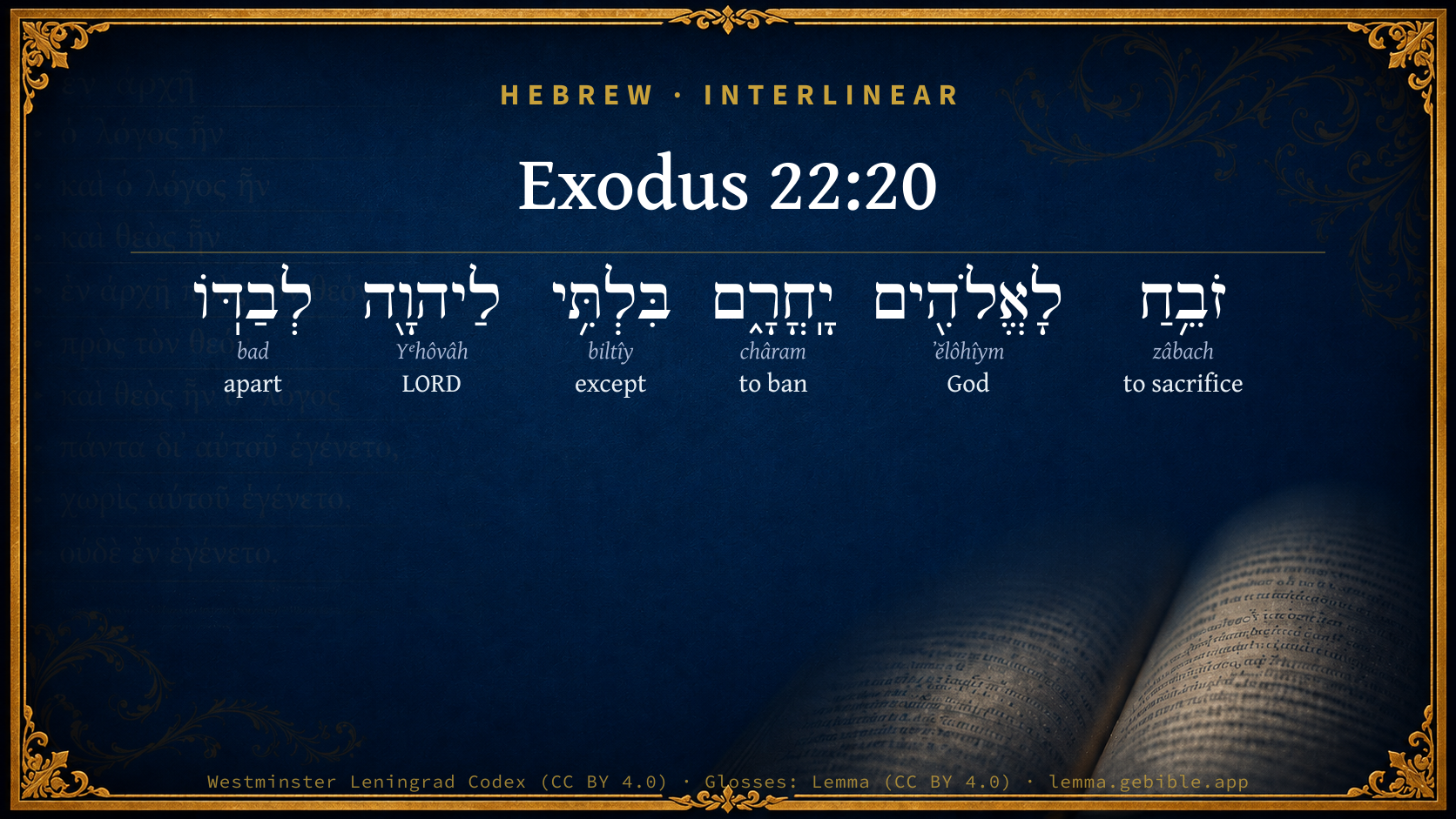
Hebrew (Westminster Leningrad Codex) Exodus 22:20 appears in the Hebrew Old Testament. The text above is from the Westminster Leningrad Codex. Each word links to its Strong’s number, a concise gloss, and parsing drawn from the Open Scriptures Hebrew Bible morphology. Click any word for its full Brown-Driver-Briggs (BDB) entry.
Download image
Cite this verse

Exodus 22:20 (World English Bible). Public Domain. Lemma interlinear Bible study tool, https://lemma.gebible.app/v/exodus/22/20.

Show BibTeX & RIS
BibTeX
RIS
English Translation
"He who sacrifices to any god, except to Yahweh only, shall be utterly destroyed.
World English Bible · Public Domain
Highlights
  • 1 first appearance in the Hebrew Bible
Full analysis ↓
Download a study sheet

One document with this verse’s original text, its word-by-word gloss line, the meaning frame, cross-references with their text, attributed commentary, and full source and license credits — printable, and it pastes into notes with its structure intact.

This verse Autodidact and up

Study sheet (.html) Plain text (.txt)

A passage Seminary Student

Up to 50 verses in one chapter. A passage sheet keeps up to 6 commentary sources and 12 cross-references per verse, in the order this page ranks them, and says so on the sheet whenever that leaves anything out. Ask for a single verse and you get the Autodidact verse sheet above.

Everything on this page stays free to read, with no account — the sheet is a download of what is already on screen, not access to it.

Want to remove ads? Support Godless Engineer
Compare translations 3

The same verse in 3 English versions, stacked beneath the original-language interlinear above. Click any original word for its lexicon entry.

Each is an independent rendering of the whole verse — the interlinear is not word-aligned to these translations.

Highlighted words mark where these versions differ — a whole-verse word diff, not a word-by-word alignment.

  • World English Bible Public Domain
    "He who sacrifices to any god, except to Yahweh only, shall be utterly destroyed.
  • King James Version Public Domain
    He that sacrificeth unto any god, save unto the LORD only, he shall be utterly destroyed.
  • unfoldingWord Literal Text CC BY-SA 4.0
    A sacrificer to the gods except to Yahweh alone shall be completely destroyed.

unfoldingWord Literal Text — © unfoldingWord, licensed CC BY-SA 4.0. Word-aligned USFM3 via Door43 (git.door43.org/unfoldingWord/en_ult).

Versions to compare (up to 4)

3 of 4 selected

Show all 18 translations

Every available English version of this verse, each an independent rendering of the whole verse.

  • World English Bible Public Domain
    "He who sacrifices to any god, except to Yahweh only, shall be utterly destroyed.
  • Berean Standard Bible Public Domain
    If anyone sacrifices to any god other than the LORD alone, he must be set apart for destruction.
  • Majority Standard Bible Public Domain
    If anyone sacrifices to any god other than the LORD alone, he must be set apart for destruction.
  • King James Version Public Domain
    He that sacrificeth unto any god, save unto the LORD only, he shall be utterly destroyed.
  • American Standard Version (1901) Public Domain
    He that sacrificeth unto any god, save unto Jehovah only, shall be utterly destroyed.
  • Revised Version (1885) Public Domain
    He that sacrificeth unto any god, save unto the LORD only, shall be utterly destroyed.
  • Geneva Bible (1599) Public Domain
    Hee that offereth vnto any gods, saue vnto the Lord onely, shalbe slaine.
  • Douay-Rheims (1899) Public Domain
    He that sacrificeth to gods, shall be put to death, save only to the Lord.
  • Young's Literal Translation Public Domain
    `He who is sacrificing to a god, save to Jehovah alone, is devoted.
  • Literal Standard Version CC BY-SA 4.0
    He who is sacrificing to a god, except to YHWH alone, is devoted.
  • Unlocked Literal Bible CC BY-SA 4.0
    Whoever sacrifices to any god except to Yahweh must be completely destroyed.
  • unfoldingWord Literal Text CC BY-SA 4.0
    A sacrificer to the gods except to Yahweh alone shall be completely destroyed.
  • Darby Bible Public Domain
    -- He that sacrificeth to [any] god, save to Jehovah only, shall be devoted to destruction.
  • World Messianic Bible Public Domain
    “He who sacrifices to any god, except to the LORD only, shall be utterly destroyed.
  • Webster's Bible Public Domain
    He that sacrificeth to any god, save to the LORD only, he shall be utterly destroyed.
  • Free Bible Version CC BY-SA 4.0
    Anyone who sacrifices to any other god than the Lord must be set apart and executed.
  • Bible in Basic English Public Domain
    Complete destruction will come on any man who makes offerings to any other god but the Lord.
  • JPS Tanakh (1917) Public Domain
    (22-19) He that sacrificeth unto the gods, save unto the LORD only, shall be utterly destroyed.

Literal Standard Version (2020), Covenant Press — licensed CC BY-SA 4.0. Text via the HelloAO Bible API (eBible.org). Unlocked Literal Bible (unfoldingWord) — licensed CC BY-SA 4.0. Text via the HelloAO Bible API (eBible.org). unfoldingWord Literal Text — © unfoldingWord, licensed CC BY-SA 4.0. Word-aligned USFM3 via Door43 (git.door43.org/unfoldingWord/en_ult). Free Bible Version, Dr. Jonathan Gallagher — licensed CC BY-SA 4.0. Text via the HelloAO Bible API (eBible.org).

Word by word

More ways to search: Search by grammar → Find every occurrence → Compare this word →

Practice this passage: Drill this verse → Learn its vocabulary →

יָֽחֳרָ֑ם
châram
H2763
“to ban”
Verb, Hophal, Imperfect, 3rd Person, Masculine, Singular
Part of Speech
Verb
Stem
Hophal
Form
Imperfect
Person
3rd Person
Gender
Masculine
Number
Singular
Full BDB Definition

Origin: a primitive root

TWOT: 744 , 745

to ban, devote, destroy utterly, completely destroy, dedicate for destruction, exterminate - (Hiphil) - to prohibit (for common use), ban - to consecrate, devote, dedicate for destruction - to exterminate, completely destroy - (Hophal) - to be put under the ban, be devoted to destruction - to be devoted, be forfeited - to be completely destroyed - to split, slit, mutilate (a part of the body) - (Qal) to mutilate - (Hiphil) to divide
  1. זֹבֵ֥חַ zâbach H2076 “sacrificing” Verb, Qal, Participle Active, Masculine, Singular, Absolute
  2. לָאֱלֹהִ֖ים ʼĕlôhîym H430 “to/for the · God(s)” Preposition, Determined + Noun, Common, Masculine, Plural, Absolute
  3. בִּלְתִּ֥י biltîy H1115 “except” Conjunction
  4. לַיהוָ֖ה Yᵉhôvâh H3068 “to/for · LORD” Preposition + Noun, Proper
  5. לְבַדּֽוֹ bad H905 “to/for · apart · his” Preposition + Noun, Common, Masculine, Singular, Construct + Suffix, Personal, 3rd Person, Masculine, Singular

About this verse

These counts appear in no published source. They are computed here, from the morphology-tagged text and Lemma’s own curated glosses. What Lemma adds →

6
words
6
distinct lemmas
Pentateuch
section

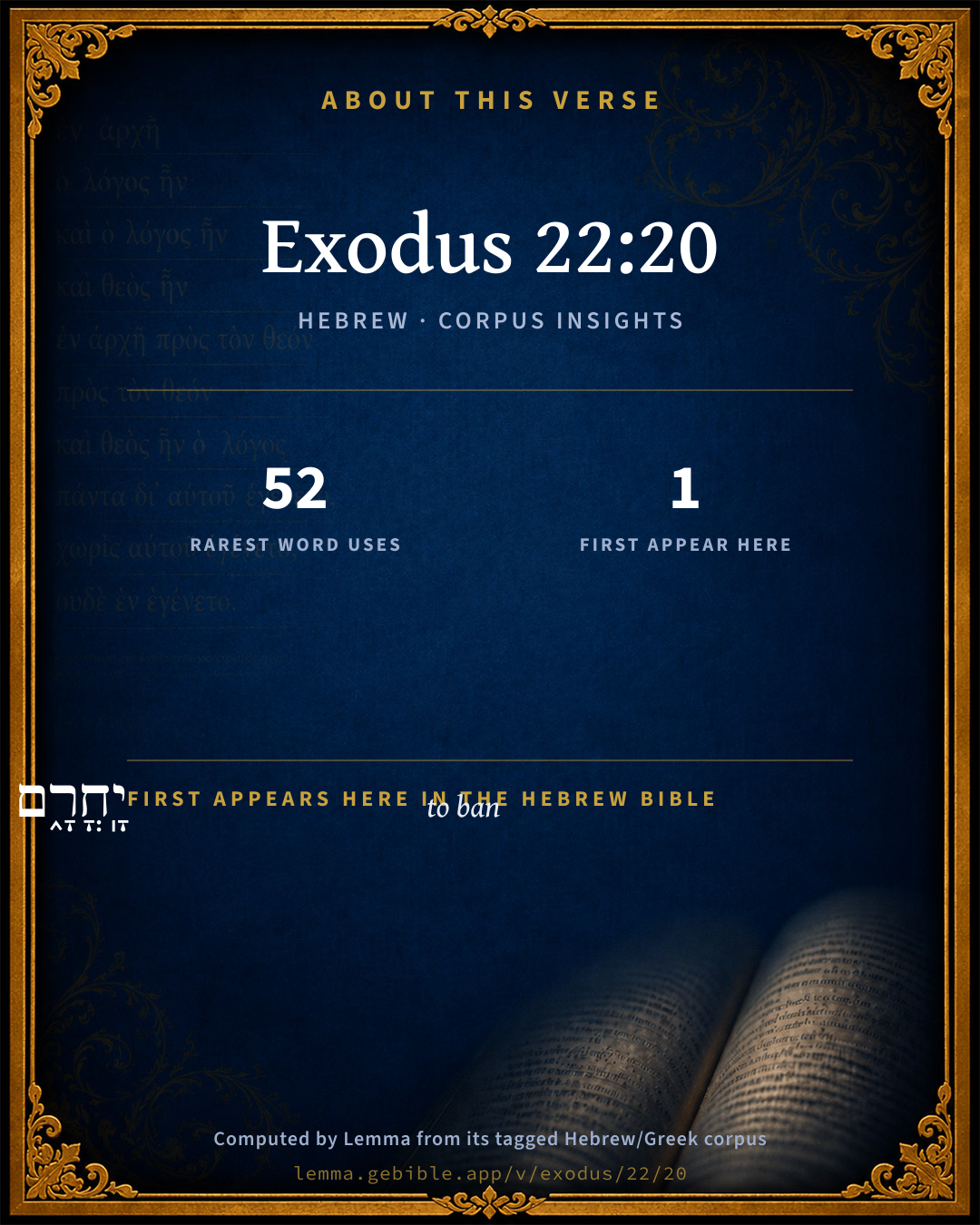
First appearance in Scripture

This word makes its first canonical appearance in the Hebrew Bible here:

  • יָֽחֳרָ֑ם to ban H2763

Shared distinctive vocabulary

יָֽחֳרָ֑ם to ban H2763 occurs in 48 verses of the Hebrew Bible. Also found in:

Grammatical profile

  • 2 verbs
  • 3 nouns
  • 1 conjunction

Verb forms

  • זֹבֵ֥חַ Qal · Participle Active
  • יָֽחֳרָ֑ם Hophal · Imperfect

Hebrew & Septuagint length

In English translation the verse runs 14 words from the Hebrew and 16 from the Septuagint (LXX English) — closely comparable.

A rough comparison of the two English renderings, which tokenize alike — not a word-level alignment.

Word counts can differ between the Hebrew and the Greek without any difference in meaning — e.g. the Hebrew direct-object marker אֵת has no separate Greek word, and Greek often adds the article ὁ.

Cross-references

7

Topical passages linked to Exodus 22:20 in the Treasury of Scripture Knowledge — connected by theme and wording, ordered by reader-vote popularity; previews shown in the World English Bible.

  • Deuteronomy 17:2–5 If there be found in the midst of you, within any of your gates which Yahweh your God gives you, man or woman, who does that which is evil in the sight of Yahweh your God, in transgressing his covenant,
  • Numbers 25:7–8 When Phinehas, the son of Eleazar, the son of Aaron the priest, saw it, he rose up from the midst of the congregation, and took a spear in his hand;
  • Deuteronomy 18:20 But the prophet, who shall speak a word presumptuously in my name, which I have not commanded him to speak, or who shall speak in the name of other gods, that same prophet shall die.
  • Deuteronomy 13:1–15 If there arise in the midst of you a prophet, or a dreamer of dreams, and he give you a sign or a wonder,
  • Numbers 25:2–4 for they called the people to the sacrifices of their gods; and the people ate, and bowed down to their gods.
  • Numbers 21:3 Yahweh listened to the voice of Israel, and delivered up the Canaanites; and they utterly destroyed them and their cities: and the name of the place was called Hormah.
  • Joshua 23:15–16 It shall happen, that as all the good things are come on you of which Yahweh your God spoke to you, so will Yahweh bring on you all the evil things, until he have destroyed you from off this good land which Yahweh your God has given you.

Cross-references courtesy of OpenBible.info (CC BY 4.0).

Hebrew and Greek witnesses Masoretic Hebrew ↔ Greek Septuagint

The same verse in the two great witnesses to the Old Testament, shown verse-for-verse.

These are two independent witnesses, not word-aligned to each other, and the Septuagint is shown in lemma (dictionary) form.

Hebrew Exodus 22:20 Masoretic · Westminster Leningrad Codex

זֹבֵ֥חַ לָאֱלֹהִ֖ים יָֽחֳרָ֑ם בִּלְתִּ֥י לַיהוָ֖ה לְבַדּֽוֹ

"He who sacrifices to any god, except to Yahweh only, shall be utterly destroyed.

World English Bible · Public Domain

Greek LXX Exodus 22:20 Septuagint · lemma form

καί προσήλυτος οὐ κακόω οὐδέ μή θλίβω αὐτός εἰμί γάρ προσήλυτος ἐν γῆ αἴγυπτος

He that sacrifices to any gods but to the Lord alone, shall be destroyed by death.

LXX2012 (modern English Septuagint) · Public Domain

Hebrew: Westminster Leningrad Codex (CC BY 4.0). Greek: Septuagint (public domain); English from LXX2012 (modern English Septuagint) (Public Domain). How the Septuagint differs from the Hebrew →

Targum (Aramaic paraphrase)

2

The Targum is the ancient Jewish Aramaic paraphrase of the Hebrew Scriptures — an interpretive translation, not the Hebrew text itself. Onkelos (literal) and Pseudo-Jonathan (expansive) render the Torah, and Jonathan the Prophets. Coverage is partial: where no permissively-licensed English translation exists for a verse, only the Aramaic is shown. This is verse-level text, not a word-by-word alignment to the Hebrew.

  1. Targum Onkelos Torah (Genesis–Deuteronomy)
    וְגִיוֹרָא לָא תוֹנוּן וְלָא תְעִיקוּן לֵהּ אֲרֵי דַיָרִין הֱוֵיתוּן בְּאַרְעָא דְמִצְרָיִם:

    (no public-domain English translation for this verse)

    Targum Onkelos — Aramaic: “Onkelos Genesis” (public domain); “Onkelos Exodus” (public domain); “Onkelos Leviticus” (public domain); “Onkelos Numbers” (public domain); “Onkelos Deuteronomy” (public domain). English: “Sefaria Community Translation” (CC0 1.0 (public-domain dedication)); “J.W. Etheridge. The Targums of Onkelos and Jonathan Ben Uzziel on the Pentateuch. London: Longmans, Green, 1862” (public domain). Text via Sefaria.

  2. Targum Pseudo-Jonathan Torah (Genesis–Deuteronomy)
    וְגִיּוֹרָא לָא תְקַנְטוּן בְּמִילִין וְלָא תְעִיקוּן לְמִיסַב לֵיהּ נִכְסוֹי עַמִּי בְנֵי יִשְרָאֵל הֲווֹ דְכִירִין אֲרוּם דַּיְירִין הֲוֵיתוּן בְּאַרְעָא דְמִצְרָיִם

    And the stranger you shall not vex with words, nor distress him by taking his goods: Remember, sons of Israel, My people, that you were strangers in the land of Mizraim.

    Targum Pseudo-Jonathan — Aramaic: “Targum Jonathan on Genesis” (public domain); “Targum Jonathan on Exodus” (public domain); “Targum Jonathan on Leviticus” (public domain); “Targum Jonathan on Numbers” (public domain); “Targum Jonathan on Deuteronomy” (public domain). English: “The Targum of Jonathan ben Uzziel, trans. J. W. Etheridge, London, 1862” (public domain). Text via Sefaria.

Commentary

Notes on Exodus 22:20 from classic Christian and Jewish commentators (each source and its license shown beneath its notes). The classic Christian expositions comment on the surrounding passage and are grouped to its opening verse, so a note may address several verses; the Jewish commentaries on the Tanakh (Rashi and others) are per-verse, so they appear only where the commentator wrote on this verse.

Lemma curates 59 commentaries, every one of them public domain or Creative Commons licensed, each selected and text-cleaned for this edition rather than reprinted as found. About our sources →

Trapp's Complete Commentary

John Trapp

Exo 22:20 He that sacrificeth unto [any] god, save unto the LORD only, he shall be utterly destroyed.

Ver. 20. He shall be utterly destroyed.] As an execrable and accursed creature.

John Trapp, A Commentary or Exposition upon All the Books of the Old and New Testament (1647–1656) — public domain. Text from a community e-Sword module.

Tyndale Open Study Notes

Tyndale Open Resources

22:20 must be destroyed: See “Complete Dedication” Theme Note.

Tyndale Open Study Notes — © Tyndale Open Resources, licensed CC BY-SA 4.0. Text via the HelloAO Bible API.

Adam Clarke's Commentary

Verse 20. Utterly destroyed.] The word חרם cherem denotes a thing utterly and finally separated from God and devoted to destruction, without the possibility of redemption.

Adam Clarke's Commentary on the Bible (1810–1826) — public domain. Text from a community e-Sword/MySword module.

Ellicott's Commentary for English Readers

(20) He that sacrificeth.—Sacrifice in this place represents worship generally, being its most essential act. Elsewhere the death-penalty is affixed to any acknowledgment of false gods (Deu_13:1-16).

Shall be utterly destroyed.—Heb., Shall be devoted, i.e., devoted to destruction.

A Bible Commentary for English Readers, edited by Charles John Ellicott (1878–1897) — public domain. Text from a community e-Sword module.

The Cambridge Bible for Schools and Colleges

gen. ed. J. J. S. Perowne

20. Sacrifice by an Israelite to any god save Jehovah to be punished with the ban. Jehovah is a ‘jealous God’ (Exo_20:5), who does not tolerated the worship of any other god beside Himself.

utterly destroyed] banned or devoted. The ‘ban’ (ḥérem) was an archaic institution, often alluded to in the OT. A city or nation that was hostile to Jehovah was ‘banned,’ or ‘devoted’ (etymologically, as Arabic shews, separated or set apart1[189]), i.e. given over to Him as a form of offering, human beings being destroyed, with or without the cattle and spoil as well, according to the gravity of the occasion. For examples, see Deu_2:34 f., Exo_3:6 f., Exo_7:2, Exo_13:12-18 (an idolatrous Isr. city to be ‘devoted’), Jos_6:17-19; Jos_6:21, Jdg_1:17; Jdg_21:11, 1Sa_15:3; 1Sa_15:9. Here the ‘ban’ is to be put in force against the Israelite who is disloyal to Jehovah. The ban was also a Moabite institution. Mesha in his inscription (see DB. s.v. Moab, or EB. s.v. Mesha), ll. 16–18 tells us how, after he had carried off the ‘vessels of Yahweh’ from the town of Nebo (Num_32:38), and dragged them before Chemosh, he slew 7000 Israelite prisoners, for he had ‘devoted’ the city to Ashtor-Chemosh (cf. Num_21:2 f.). See further DB. v. 619b, EB. Ban.

[189] The root is the Arabic ḥarama, to shut off, set apart, whence ḥarâm, the sacred enclosure round the Mosque of Omar at Jerusalem, and ḥarîm, the secluded part of a Mohammedan establishment, in which the women live, applied also to its occupants, i.e. the ‘harem.’

In AV. heḥìrîm was usually rendered ‘utterly destroy,’ and the corresponding subst. ḥérem ‘cursed thing’ (Deu_7:26), or (in Joshua 6, Joshua 7.) ‘accursed thing’: but these renderings both express secondary ideas, besides being to all appearance entirely unrelated to each other: in RV. the verb, when applied to things, is rendered ‘devote’ (as Lev_27:29 AV.); when applied to human beings it is still rendered ‘utterly destroy,’ but ‘Heb. devote’ has been added on the margin; and ‘devoted thing’ has been substituted for ‘cursed’ and ‘accursed thing’ (e.g. Jos_6:18; Jos_7:1 ff.): the connexion between the two cognate terms has thus been preserved throughout.

The Cambridge Bible for Schools and Colleges (gen. ed. J. J. S. Perowne; Cambridge University Press, 1878–1918) — public domain. Text from a community e-Sword module.

John Gill's Exposition

Thou shall not vex a stranger,.... One that is not born in the same country, but comes into another country to sojourn, as Jarchi; not a native of the place, but of another kingdom or country; a stranger to the commonwealth of Israel, that is only in it for a time on trade and business, or through one providence or another; or else a proselyte is meant, not a proselyte of righteousness, who has embraced the true religion; but a proselyte of the gate, that takes upon him the commands of the sons of Noah; or, as Aben Ezra here expresses it, who takes upon him not to serve idols; such were allowed to dwell among the Israelites, and they were to carry it friendly and kindly to them, and "not vex" them, nor irritate them with words, as the Targum of Jonathan, and so Jarchi; by calling them names, Gentiles, uncircumcised persons, and the like; upbraiding them with their country, ignorance, and manner of life; they were not to say to a proselyte, as Ben Melech observes, remember thy former works; or, if the son of a proselyte, remember thy father's works:

nor oppress him; by taking his goods, as the above Targum, and so Jarchi; by refusing to assist him with advice or otherwise, to trade with him, or to give him lodging, and furnish him with the necessaries of life:

for ye were strangers in the land of Egypt: out of which they were but just come, and therefore such a reason must be very striking and moving upon them: the Targum of Jonathan prefaces it,"and my people, the house of Israel, remember that ye were strangers, &c.''this they could not have forgot in so short a time, and the remembrance of this should move their compassion to strangers hereafter, when they came to settle in their own land; and therefore, as they would that men should have done to them when in such circumstances, the same they should do to others; and besides, the remembrance of this would serve to abate their pride and vanity, and their overbearing disposition.

John Gill's Exposition of the Whole Bible (1746–1763) — public domain (CC PDM 1.0). Text via the HelloAO Bible API.

Albert Barnes' Notes on the Bible

This was probably an old formula, the sense of which, on its ethical side, is comprised in the first and second commandments.

Shall be utterly destroyed - The Hebrew word here used is חרם châram (i. e. devoted). See Lev 27:28.

Albert Barnes' Notes on the Bible (1834–1885) — public domain. Text from a community e-Sword/MySword module.

Haydock's Catholic Bible Commentary

Death. Hebrew, "shall be anathema," (erom) which denotes utter destruction both of the person and of his goods. (Jonathan) (1 Kings xv. 3.)

George Leo Haydock (1774–1849), Haydock's Catholic Family Bible and Commentary, 1859 edition — public domain. Excludes Psalms (Douay-Rheims chapter numbering differs from Protestant) and Deuterocanonical books (Catholic canon only).

Matthew Poole's English Annotations

Sacrificeth, or otherwise worshippeth, as appears from Deu 17:2-5, and many other places. One act of worship put for all by a very familiar synecdoche.

Destroyed, Heb. anathematized, i.e. esteemed execrable, and as such destroyed without mercy. See Deu 13:15; 18:20.

Matthew Poole's English Annotations on the Holy Bible (1683–1685) — public domain. Text from a community e-Sword/MySword module.

The Pulpit Commentary

Law against sacrificing to false gods. Sacrifice was the chief act of worship; and to sacrifice to a false god was to renounce the true God. Under a theocracy this was rebellion, and rightly punished with temporal death. In ordinary states it would be no civil offence, and would be left to the final judgment of the Almighty. Utterly destroyed. Literally, "devoted;" but with the meaning of "devoted to destruction."

The Pulpit Commentary (1880–1919), ed. H.D.M. Spence-Jones & Joseph S. Exell — public domain. Text from a community e-Sword module.

Keil & Delitzsch

C. F. Keil & F. Delitzsch

Whoever offered sacrifice to strange gods instead of to Jehovah alone, was liable to death. יחרם he shall be banned, put under the ban (cherem), i.e., put to death, and by death devoted to the Lord, to whom he would not devote himself in life (cf. Lev 27:29, and my Archologie, 70).

Keil & Delitzsch — Biblical Commentary on the Old Testament (1861–1891) — public domain (CC PDM 1.0). Text via the HelloAO Bible API. (Old Testament only.)

unfoldingWord translationNotes

Door43 World Missions Community

Yahweh must be completely destroyed

This can be stated in active form. AT: "Yahweh, you must completely destroy" (See: Active or Passive)

wrong a foreigner

"mistreat a foreigner" or "cheat a foreigner"

translationWords

sacrifice

God

Yahweh

wrong

alien

oppress

Egypt

unfoldingWord translationNotes — © Distant Shores Media and the Door43 World Missions Community, licensed CC BY-SA 4.0. Source: git.door43.org/Door43/en_tn.

Rashi

Rabbi Shlomo Yitzchaki (Rashi)

וגר לא תונה — means, do not vex him with words (referring to the fact that he is a stranger); contrarier in old French Similar is, (Isaiah 49:26) “And I will feed them that vex thee (מוניך) with their own flesh”.

ולא תלחצנו NOR OPPRESS HIM — by robbing him of money (Mekhilta).

כי גרים הייתם FOR YE WERE STRANGERS — If you vex him he can vex you also by saying to you: “You also descend from strangers”. Do not reproach thy fellow-man for a fault which is also thine (Mekhilta). Wherever גר occurs in Scriptures it signifies a person who has not been born in that land (where he is living) but has come from another country to sojourn there.

Rashi on the Tanakh — English translations: “The Judaica Press complete Tanach with Rashi, translated by A. J. Rosenberg” (CC BY 4.0); “Pentateuch with Rashi's commentary by M. Rosenbaum and A.M. Silbermann, 1929-1934” (public domain); “The Metsudah Tanach series, Lakewood, N.J” (CC BY 4.0); and “The Book of Joshua, Metsudah Publications, 1997” (CC BY 4.0). Text via Sefaria.

Ramban (Nachmanides)

Rabbi Moshe ben Nachman (Ramban / Nachmanides)

AND A STRANGER SHALT THOU NOT WRONG, NEITHER SHALT THOU OPPRESS HIM; FOR YE WERE STRANGERS IN THE LAND OF EGYPT. There is no reason why all strangers [from countries outside the land of Egypt] should be included here because of our having been strangers in the land of Egypt! And there is no reason why they be assured for ever against being wronged or oppressed because we were once strangers there! Now Rashi explained that this is a reason for the prohibition against annoying a stranger. G-d warned against vexing him with words, for “if you vex him he can also vex you, by saying to you, “You also descend from strangers.’ Do not reproach your fellow man with a fault which is also in you.” Rabbi Abraham ibn Ezra explained the verses: “Remember that ye were strangers as he is now.” But there is in all these comments no real reason for the law.The correct interpretation appears to me to be that He is saying: “Do not wrong a stranger or oppress him, thinking as you might that none can deliver him out of your hand; for you know that you were strangers in the land of Egypt and I saw the oppression wherewith the Egyptians oppressed you, and I avenged your cause on them, because I behold the tears of such who are oppressed and have no comforter, and on the side of their oppressors there is power, and I deliver each one from him that is too strong for him. Likewise you shall not afflict the widow and the fatherless child, for I will hear their cry, for all these people do not rely upon themselves but trust in Me.” And in another verse He added this reason: for ye know the soul of a stranger, seeing ye were strangers in the land of Egypt. That is to say, you know that every stranger feels depressed, and is always sighing and crying, and his eyes are always directed towards G-d, therefore He will have mercy upon him even as He showed mercy to you, just as it is written, and the children of Israel sighed by reason of the bondage, and they cried, and their cry came up unto G-d by reason of the bondage, meaning that He had mercy on them not because of their merits, but only an account of the bondage [and likewise He has mercy on all who are oppressed].

Ramban (Nachmanides) on the Tanakh — English translation: “Commentary on the Torah by Ramban (Nachmanides). Translated and annotated by Charles B. Chavel. New York, Shilo Pub. House, 1971-1976” (CC BY 4.0). Text via Sefaria.

Ibn Ezra

Rabbi Abraham ibn Ezra

You must not abuse … a stranger. In their own land B’nei Yisrael have an advantage over the strangers living among them—i.e. those gentiles who renounce idolatry. Therefore they are commanded not to abuse them but to recall that they were in a similar position in Egypt.

Ibn Ezra on the Tanakh — English translations: “Sefaria Community Translation” (CC0 1.0 (public-domain dedication)); “Yalkut, Sifsei Chachomim Chumash, Metsudah Publications, 2009” (CC BY 4.0); and “Commentary of Ibn Ezra on Isaiah - trans. by M. Friedlander, 1873” (public domain). Text via Sefaria.

Lesson kit

Teaching starters — assembled from the data on this page, not authored interpretation. Every prompt links to the verse data it draws on. Edit before teaching.

Exodus, in the Pentateuch, opens this verse with 6 words (6 distinct Hebrew lemmas). Its most distinctive word is châram (“to ban”). A historical commentator’s framing appears above. Read the whole chapter for the surrounding context.

Discussion questions

  1. The word châram carries the sense “to ban.” How does it shape the verse?
  2. The word “to ban” first appears here in Scripture. What is being introduced at this debut?
  3. Leviticus 21:18 shares the word «to ban» with this verse. How do the two illuminate each other?
  4. The translations on this page render this verse differently — a whole-verse word diff, not a word-by-word alignment. What might account for the different wordings?
  5. The verb «זֹבֵ֥חַ» is Qal Participle Active. How does its form color the action?
  6. Reading how Trapp's Complete Commentary and Tyndale Open Study Notes read this verse, where do the two commentators agree and where do they part?

Things to notice

Reading settings

Reading text

Shown beneath each verse's original-language words.

Old Testament
Old Testament edition

Read the OT as the Masoretic Hebrew (MT) or the Greek Septuagint (LXX).

English shown for the Greek Septuagint (in the Hebrew ↔ Greek comparison).

Comparing translations? Open the Compare panel on any verse page to stack up to four side by side.