1 Kings 18:6

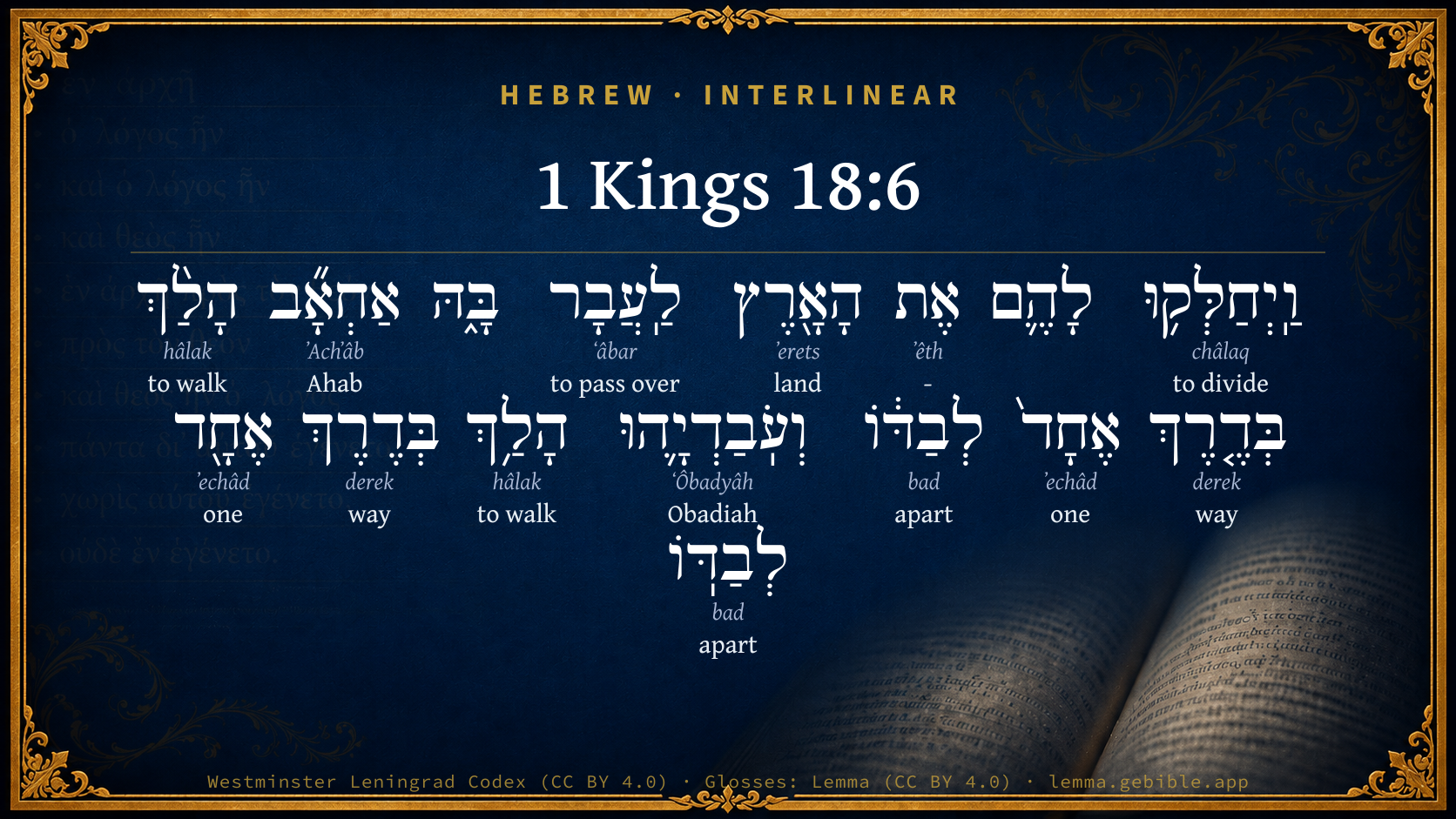
Hebrew (Westminster Leningrad Codex) 1 Kings 18:6 appears in the Hebrew Old Testament. The text above is from the Westminster Leningrad Codex. Each word links to its Strong’s number, a concise gloss, and parsing drawn from the Open Scriptures Hebrew Bible morphology. Click any word for its full Brown-Driver-Briggs (BDB) entry.
Download image
Cite this verse

1 Kings 18:6 (World English Bible). Public Domain. Lemma interlinear Bible study tool, https://lemma.gebible.app/v/1-kings/18/6.

Show BibTeX & RIS
BibTeX
RIS
English Translation
So they divided the land between them to pass throughout it: Ahab went one way by himself, and Obadiah went another way by himself.
World English Bible · Public Domain
Download a study sheet

One document with this verse’s original text, its word-by-word gloss line, the meaning frame, cross-references with their text, attributed commentary, and full source and license credits — printable, and it pastes into notes with its structure intact.

This verse Autodidact and up

Study sheet (.html) Plain text (.txt)

A passage Seminary Student

Up to 50 verses in one chapter. A passage sheet keeps up to 6 commentary sources and 12 cross-references per verse, in the order this page ranks them, and says so on the sheet whenever that leaves anything out. Ask for a single verse and you get the Autodidact verse sheet above.

Everything on this page stays free to read, with no account — the sheet is a download of what is already on screen, not access to it.

Want to remove ads? Support Godless Engineer
Compare translations 3

The same verse in 3 English versions, stacked beneath the original-language interlinear above. Click any original word for its lexicon entry.

Each is an independent rendering of the whole verse — the interlinear is not word-aligned to these translations.

Highlighted words mark where these versions differ — a whole-verse word diff, not a word-by-word alignment.

  • World English Bible Public Domain
    So they divided the land between them to pass throughout it: Ahab went one way by himself, and Obadiah went another way by himself.
  • King James Version Public Domain
    So they divided the land between them to pass throughout it: Ahab went one way by himself, and Obadiah went another way by himself.
  • unfoldingWord Literal Text CC BY-SA 4.0
    And they divided the land between them to pass through it. Ahab went in one way by himself, and Obadiah went in one way by himself.

unfoldingWord Literal Text — © unfoldingWord, licensed CC BY-SA 4.0. Word-aligned USFM3 via Door43 (git.door43.org/unfoldingWord/en_ult).

Versions to compare (up to 4)

3 of 4 selected

Show all 18 translations

Every available English version of this verse, each an independent rendering of the whole verse.

  • World English Bible Public Domain
    So they divided the land between them to pass throughout it: Ahab went one way by himself, and Obadiah went another way by himself.
  • Berean Standard Bible Public Domain
    So they divided the land to explore. Ahab went one way by himself, and Obadiah went the other way by himself.
  • Majority Standard Bible Public Domain
    So they divided the land to explore. Ahab went one way by himself, and Obadiah went the other way by himself.
  • King James Version Public Domain
    So they divided the land between them to pass throughout it: Ahab went one way by himself, and Obadiah went another way by himself.
  • American Standard Version (1901) Public Domain
    So they divided the land between them to pass throughout it: Ahab went one way by himself, and Obadiah went another way by himself.
  • Revised Version (1885) Public Domain
    So they divided the land between them to pass throughout it: Ahab went one way by himself, and Obadiah went another way by himself.
  • Geneva Bible (1599) Public Domain
    And so they deuided the lande betweene them to walke thorowe it. Ahab went one way by him selfe, and Obadiah went another way by him selfe.
  • Douay-Rheims (1899) Public Domain
    And they divided the countries between them, that they might go round about them: Achab went one way, and Abdias another way by himself.
  • Young's Literal Translation Public Domain
    And they apportion to themselves the land, to pass over into it; Ahab hath gone in one way by himself, and Obadiah hath gone in another way by himself;
  • Literal Standard Version CC BY-SA 4.0
    And they apportion the land to themselves, to pass over into it; Ahab has gone in one way by himself, and Obadiah has gone in another way by himself;
  • Unlocked Literal Bible CC BY-SA 4.0
    So they divided the land between them to pass through it and look for water. Ahab went one way by himself and Obadiah went another way.
  • unfoldingWord Literal Text CC BY-SA 4.0
    And they divided the land between them to pass through it. Ahab went in one way by himself, and Obadiah went in one way by himself.
  • Darby Bible Public Domain
    And they divided the land between them to pass through it: Ahab went one way by himself, and Obadiah went another way by himself.
  • World Messianic Bible Public Domain
    So they divided the land between them to pass throughout it. Ahab went one way by himself, and Obadiah went another way by himself.
  • Webster's Bible Public Domain
    So they divided the land between them to pass throughout it: Ahab went one way by himself, and Obadiah went another way by himself.
  • Free Bible Version CC BY-SA 4.0
    So they divided the land between them. Ahab went in one direction, and Obadiah the other.
  • Bible in Basic English Public Domain
    So they went through all the country, covering it between them; Ahab went in one direction by himself, and Obadiah went in another by himself.
  • JPS Tanakh (1917) Public Domain
    So they divided the land between them to pass throughout it: Ahab went one way by himself, and Obadiah went another way by himself.

Literal Standard Version (2020), Covenant Press — licensed CC BY-SA 4.0. Text via the HelloAO Bible API (eBible.org). Unlocked Literal Bible (unfoldingWord) — licensed CC BY-SA 4.0. Text via the HelloAO Bible API (eBible.org). unfoldingWord Literal Text — © unfoldingWord, licensed CC BY-SA 4.0. Word-aligned USFM3 via Door43 (git.door43.org/unfoldingWord/en_ult). Free Bible Version, Dr. Jonathan Gallagher — licensed CC BY-SA 4.0. Text via the HelloAO Bible API (eBible.org).

Word by word

More ways to search: Search by grammar → Find every occurrence → Compare this word →

Practice this passage: Drill this verse → Learn its vocabulary →

וְעֹֽבַדְיָ֛הוּ
ʻÔbadyâh
H5662
“and · Obadiah”
Conjunction + Noun, Proper
Part of Speech
Conjunction + Noun
Type
Proper
Full BDB Definition

Origin: act part of H5647 and H3050

TWOT: None

Obadiah = "servant of Jehovah" - the 4th of the 12 minor prophets; nothing personal is known of him but it is probable that he was contemporary with Jeremiah, Ezekiel, and Daniel - the prophetic book by him; prophesies against Edom - father of Ishmaiah, one of the chiefs of Zebulun in the time of David - a Merarite Levite overseer of the work of restoring the temple in the time of king Josiah of Judah - chief of the household of king Ahab of Israel; an devout worshipper of Jehovah who at risk to his own life hid over 100 prophets during the persecution of Jezebel - a descendant of David - a chief of the tribe of Issachar - a Benjamite, one of the 6 sons of Azel and a descendant of king Saul - a Levite, son of Shemaiah and a descendant of Jeduthun - a Gadite chief, the 2nd of the lion-faced Gadites who joined David at Ziklag - a prince of Judah in the time of king Jehoshaphat of Judah - a priest, son of Jehiel of the sons of Joab who returned from exile with Ezra - a gatekeeper in the time of Nehemiah - one of the men who sealed the covenant with Nehemiah - perhaps the same as 12
  1. וַֽיְחַלְּק֥וּ châlaq H2505 “and · to divide” Conjunction + Verb, Piel, Sequential Imperfect, 3rd Person, Masculine, Plural
  2. אֶת ʼêth H853 “-” Particle, Direct Object
  3. הָאָ֖רֶץ ʼerets H776 “the · land” Particle, Definite Article + Noun, Common, Both, Singular, Absolute
  4. לַֽעֲבָר ʻâbar H5674 “to pass over” Preposition + Verb, Qal, Infinitive Construct
  5. אַחְאָ֞ב ʼAchʼâb H256 “Ahab” Noun, Proper
  6. הָלַ֨ךְ hâlak H1980 “to walk” Verb, Qal, Perfect, 3rd Person, Masculine, Singular
  7. בְּדֶ֤רֶךְ derek H1870 “in/at · way” Preposition + Noun, Common, Both, Singular, Absolute
  8. אֶחָד֙ ʼechâd H259 “one” Adjective, Cardinal number, Masculine, Singular, Absolute
  9. לְבַדּ֔וֹ bad H905 “to/for · apart · his” Preposition + Noun, Common, Masculine, Singular, Construct + Suffix, Personal, 3rd Person, Masculine, Singular
  10. הָלַ֥ךְ hâlak H1980 “to walk” Verb, Qal, Perfect, 3rd Person, Masculine, Singular
  11. בְּדֶרֶךְ derek H1870 “in/at · way” Preposition + Noun, Common, Both, Singular, Absolute
  12. אֶחָ֖ד ʼechâd H259 “one” Adjective, Cardinal number, Masculine, Singular, Absolute
  13. לְבַדּֽוֹ bad H905 “to/for · apart · his” Preposition + Noun, Common, Masculine, Singular, Construct + Suffix, Personal, 3rd Person, Masculine, Singular

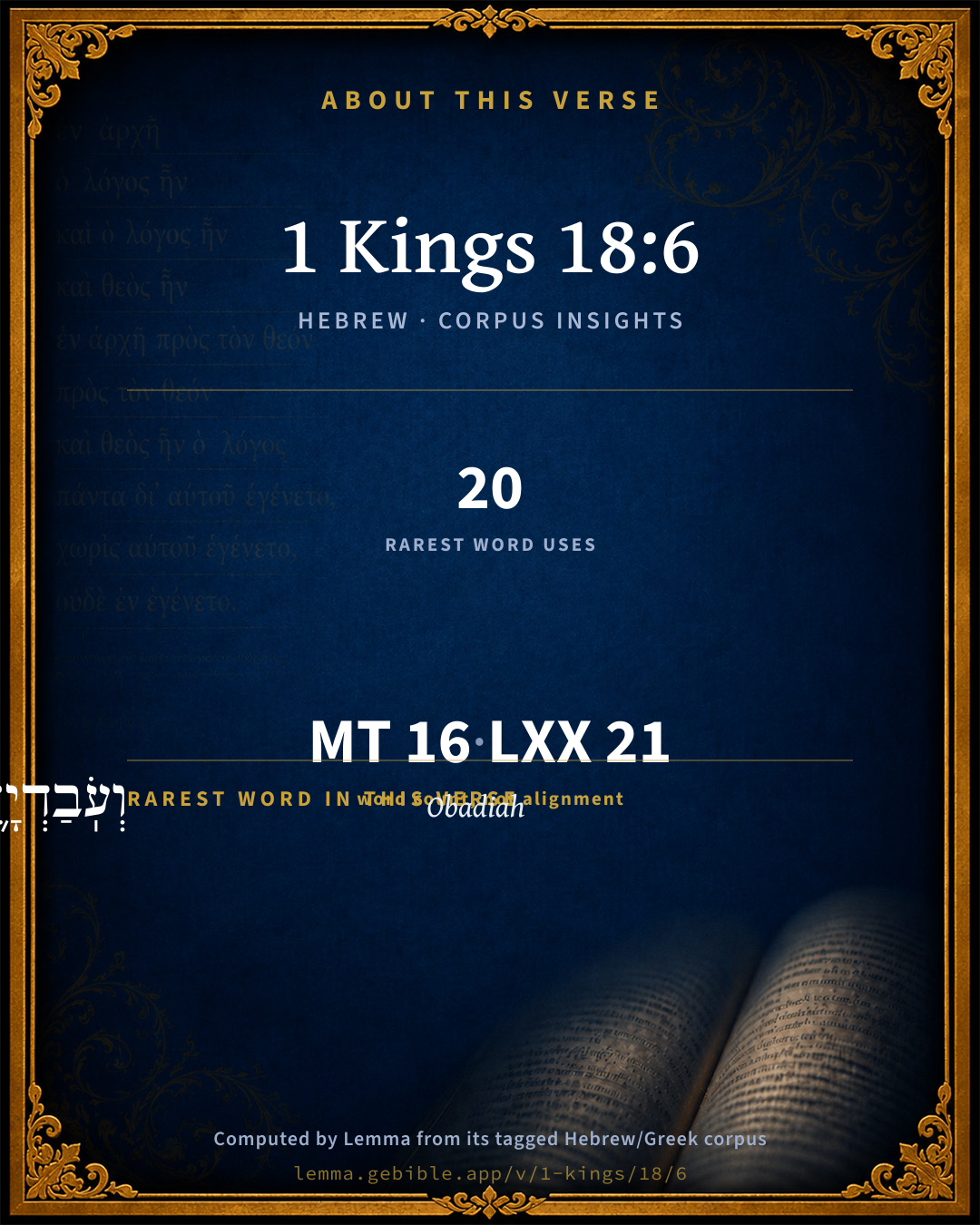
About this verse

These counts appear in no published source. They are computed here, from the morphology-tagged text and Lemma’s own curated glosses. What Lemma adds →

16
words
10
distinct lemmas
Historical
section

Notable vocabulary

The rarest word here is וְעֹֽבַדְיָ֛הוּ Obadiah H5662 — appearing just 20 times in the whole Hebrew Bible.

Shared distinctive vocabulary

וְעֹֽבַדְיָ֛הוּ Obadiah H5662 occurs in 19 verses of the Hebrew Bible. Also found in:

Grammatical profile

  • 4 verbs
  • 7 nouns
  • 2 adjectives
  • 2 prepositions
  • 1 particle

Verb forms

  • וַֽיְחַלְּק֥וּ Piel · Sequential Imperfect
  • לַֽעֲבָר Qal · Infinitive Construct
  • הָלַ֨ךְ Qal · Perfect
  • הָלַ֥ךְ Qal · Perfect

Repetition

Words recur within this verse — often emphatic in Hebrew:

  • הָלַ֨ךְ to walk H1980 ×2
  • בְּדֶ֤רֶךְ way H1870 ×2
  • אֶחָד֙ one H259 ×2
  • לְבַדּ֔וֹ apart H905 ×2

Hebrew & Septuagint length

In English translation the verse runs 24 words from the Hebrew and 25 from the Septuagint (LXX English) — closely comparable.

A rough comparison of the two English renderings, which tokenize alike — not a word-level alignment.

Word counts can differ between the Hebrew and the Greek without any difference in meaning — e.g. the Hebrew direct-object marker אֵת has no separate Greek word, and Greek often adds the article ὁ.

In the original languages it is 16 Hebrew tokens and 21 Greek tokens — but the two are counted differently (Hebrew bundles its prefixes and suffixes into one token; the Greek is in lemma form), so that isn’t a like-for-like length.

Cross-references

1

Topical passages linked to 1 Kings 18:6 in the Treasury of Scripture Knowledge — connected by theme and wording, ordered by reader-vote popularity; previews shown in the World English Bible.

  • Jeremiah 14:3 Their nobles send their little ones to the waters: they come to the cisterns, and find no water; they return with their vessels empty; they are disappointed and confounded, and cover their heads.

Cross-references courtesy of OpenBible.info (CC BY 4.0).

Hebrew and Greek witnesses Masoretic Hebrew ↔ Greek Septuagint

The same verse in the two great witnesses to the Old Testament, shown verse-for-verse.

These are two independent witnesses, not word-aligned to each other, and the Septuagint is shown in lemma (dictionary) form.

Hebrew 1 Kings 18:6 Masoretic · Westminster Leningrad Codex

וַֽיְחַלְּק֥וּ לָהֶ֛ם אֶת הָאָ֖רֶץ לַֽעֲבָר בָּ֑הּ אַחְאָ֞ב הָלַ֨ךְ בְּדֶ֤רֶךְ אֶחָד֙ לְבַדּ֔וֹ וְעֹֽבַדְיָ֛הוּ הָלַ֥ךְ בְּדֶרֶךְ אֶחָ֖ד לְבַדּֽוֹ

So they divided the land between them to pass throughout it: Ahab went one way by himself, and Obadiah went another way by himself.

World English Bible · Public Domain

Greek LXX 1 Kings 18:6 Septuagint · lemma form

καί μερίζω ἑαυτοῦ ὁ ὁδός ὁ διαἔρχομαι αὐτός αχααβ πορεύομαι ἐν ὁδός εἷς μόνος καί αβδιου πορεύομαι ἐν ὁδός ἄλλος μόνος

And they made a division of the way between them to pass through it: Achaab went one way, and Abdiu went by another way alone.

LXX2012 (modern English Septuagint) · Public Domain

On this verse, The Cambridge Bible for Schools and Colleges discusses the Septuagint’s reading. Read the note in Commentary ↓

Hebrew: Westminster Leningrad Codex (CC BY 4.0). Greek: Septuagint (public domain); English from LXX2012 (modern English Septuagint) (Public Domain). How the Septuagint differs from the Hebrew →

Targum (Aramaic paraphrase)

1

The Targum is the ancient Jewish Aramaic paraphrase of the Hebrew Scriptures — an interpretive translation, not the Hebrew text itself. Onkelos (literal) and Pseudo-Jonathan (expansive) render the Torah, and Jonathan the Prophets. Coverage is partial: where no permissively-licensed English translation exists for a verse, only the Aramaic is shown. This is verse-level text, not a word-by-word alignment to the Hebrew.

  1. Targum Jonathan Prophets (Joshua–Malachi)
    וּפְּלִיגוּ לְהוֹן יַת אַרְעָא לְמֶעְבַּר בָּהּ אַחְאָב אֲזַל בְּאוֹרְחָא חֲדָא בִּלְחוֹדוֹהִי וְעוֹבַדְיָהוּ אֲזַל בְּאוֹרְחָא חֲדָא בִּלְחוֹדוֹהִי:

    (no public-domain English translation for this verse)

    Targum Jonathan — Aramaic: “Mikraot Gedolot” (public domain). English: “Sefaria Community Translation” (CC0 1.0 (public-domain dedication)); “London "Chaldee Paraphrase," 1871” (public domain). Text via Sefaria.

Commentary

Notes on 1 Kings 18:6 from classic Christian and Jewish commentators (each source and its license shown beneath its notes). The classic Christian expositions comment on the surrounding passage and are grouped to its opening verse, so a note may address several verses; the Jewish commentaries on the Tanakh (Rashi and others) are per-verse, so they appear only where the commentator wrote on this verse.

Lemma curates 59 commentaries, every one of them public domain or Creative Commons licensed, each selected and text-cleaned for this edition rather than reprinted as found. About our sources →

Trapp's Complete Commentary

John Trapp

1Ki 18:6 So they divided the land between them to pass throughout it: Ahab went one way by himself, and Obadiah went another way by himself.

Ver. 6. And Obadiah went another way by himself.] Ahab had found him faithful; and therefore trusteth him in this weighty business, rather than any other. Of a man that truly feareth God it may better be said, than of Cato, that he never did well that he might appear to do so, but because he could not do otherwise.

John Trapp, A Commentary or Exposition upon All the Books of the Old and New Testament (1647–1656) — public domain. Text from a community e-Sword module.

The Biblical Illustrator

Joseph S. Exell

1Ki_18:6

Ahab went one way by himself, and Obadiah went another way by himself.

Separated: and no tears at the parting

They separated; and I am sure there were no tears shed on either side at the parting. Never were two men more utterly unlike. Never were associates more ill-matched. How they managed for some time to pull together, I cannot imagine. The text has sufficient allegorical suggestiveness to awaken many a solemn thought within you.

1. There are, after all, but two ways; you must choose the one or the other. You must follow Ahab, or you must go with Obadiah. The snare into which large numbers of young men fall is the attempt at compromise. They shrink from the unblushing wickedness of the one, but do not care to commit themselves to the earnest piety of the other. The words which Fowell Buxton wrote near the close of his life are well worthy of being pondered by each of you:--The longer I live, the more I am certain that the great difference between men is energy, invincible determination--a purpose once fixed, and then death or victory! This quality, added he, will do anything that can be done in this world; and no talent, no circumstances, no opportunities, will make a two-legged creature a man without it.

2. Choose for your associates those with whom you would wish to company all through life. Try to look below the surface and read the character; and do not give your friendship to any one whom, in your deepest soul, you do not respect. It was a good maxim of Lord Collingwood, Better be alone, than in mean company.

3. Should your most intimate associate prove to be of evil principles, part company with him at once. Better offend your acquaintance than lose your soul. Pull up the instant you find you are off the road, and take the shortest way back you can find. When the shoe of conscience begins to pinch, it is about time we turn our stops into another path. Ahabs and Obadiahs cannot remain long in partnership, and the sooner that partnership be dissolved the better. (J. T. Davidson, D. D.)

The Biblical Illustrator, edited by Joseph S. Exell (c. 1880s–1900s) — public domain. Text from a community e-Sword module.

The Cambridge Bible for Schools and Colleges

gen. ed. J. J. S. Perowne

6. Ahab went one way by himself] We can see the grievous necessity the land was in when the king himself goes forth on such a quest. No one save the two chief persons in the realm could be trusted to make this all-important search. The LXX. does not specify that Ahab went alone, but makes further mention of Obadiah’s solitary journey, by saying ‘And Obadiah was in the way alone, and Elijah by himself came to meet him.’ There is a reason for Obadiah’s being alone when such a meeting was to take place; why Ahab should go alone is not so clear.

The Cambridge Bible for Schools and Colleges (gen. ed. J. J. S. Perowne; Cambridge University Press, 1878–1918) — public domain. Text from a community e-Sword module.

John Gill's Exposition

So they divided the land between them, to pass through it,.... And one took one part, and the other the other part:

Ahab went one way by himself, and Obadiah went another way by himself; Ahab not caring to trust any but Obadiah, who he knew was a faithful man, lest they should be bribed by those that had grass not to discover it.

John Gill's Exposition of the Whole Bible (1746–1763) — public domain (CC PDM 1.0). Text via the HelloAO Bible API.

Haydock's Catholic Bible Commentary

Himself. So Providence ordered it, that the prophet might declare his sentiments to him freely. (Haydock) --- Achab would go in person, another way, that he might not be imposed upon. He was more solicitous for his cattle than for his subjects. (Menochius)

George Leo Haydock (1774–1849), Haydock's Catholic Family Bible and Commentary, 1859 edition — public domain. Excludes Psalms (Douay-Rheims chapter numbering differs from Protestant) and Deuterocanonical books (Catholic canon only).

Matthew Poole's English Annotations

Ahab went one way by himself; not daring to trust any other, Obadiah excepted, lest being bribed by such as had grass for their own use, they should not give him a true account.

Matthew Poole's English Annotations on the Holy Bible (1683–1685) — public domain. Text from a community e-Sword/MySword module.

Whedon's Commentary on the Bible

Daniel D. Whedon

6. They divided the land between them — This shows further how high was the position of Obadiah in the service and confidence of the king. It is said to be a custom in the East, when a public calamity reaches its highest point, for the king himself and his chief minister to go forth and seek relief.

Daniel D. Whedon (gen. ed.), Commentary on the Old and New Testaments (1874–1909) — public domain. Text from a community e-Sword module.

The Pulpit Commentary

So they divided the land between them to pass throughout it "This personal inspection by the king and one of his chief officers marks the extreme straits to which the Israelites were now reduced" (Rawlinson). The difference, however, between an Eastern and a European monarch must not be overlooked. "None (of the emirs of Arabia or the chiefs of central Asia) think it beneath them to lead an expedition in search of grass or water" (Kitto): Ahab went one way by himself Heb. alone. Rawlinson says, "This does not mean that either Ahab or Obadiah was unaccompanied by a retinue," but it may very well mean that (dbl solus; LXX. monov; Bahr allein. Cf. ver. 22), if, indeed, it must not necessarily mean it; and ver. 14 certainly implies that Obadiah at least was unattended, and Obadiah went another way by himself.

The Pulpit Commentary (1880–1919), ed. H.D.M. Spence-Jones & Joseph S. Exell — public domain. Text from a community e-Sword module.

Lesson kit

Teaching starters — assembled from the data on this page, not authored interpretation. Every prompt links to the verse data it draws on. Edit before teaching.

1 Kings, in the Historical, opens this verse with 16 words (10 distinct Hebrew lemmas). Its most distinctive word is ʻÔbadyâh (“Obadiah”). A historical commentator’s framing appears above. Read the whole chapter for the surrounding context.

Discussion questions

  1. What does “Obadiah” (ʻÔbadyâh) contribute to the verse as a whole?
  2. 1 Kings 18:3 shares the word «Obadiah» with this verse. How do the two illuminate each other?
  3. “to walk” occurs 2× in this one verse. What is the effect of the repetition?
  4. These translations render this verse differently. What is at stake in choosing one wording over another?
  5. The verb «וַֽיְחַלְּק֥וּ» is Piel Sequential Imperfect. How does its form color the action?
  6. Reading how Trapp's Complete Commentary and The Biblical Illustrator read this verse, where do the two commentators agree and where do they part?

Things to notice

Reading settings

Reading text

Shown beneath each verse's original-language words.

Old Testament
Old Testament edition

Read the OT as the Masoretic Hebrew (MT) or the Greek Septuagint (LXX).

English shown for the Greek Septuagint (in the Hebrew ↔ Greek comparison).

Comparing translations? Open the Compare panel on any verse page to stack up to four side by side.