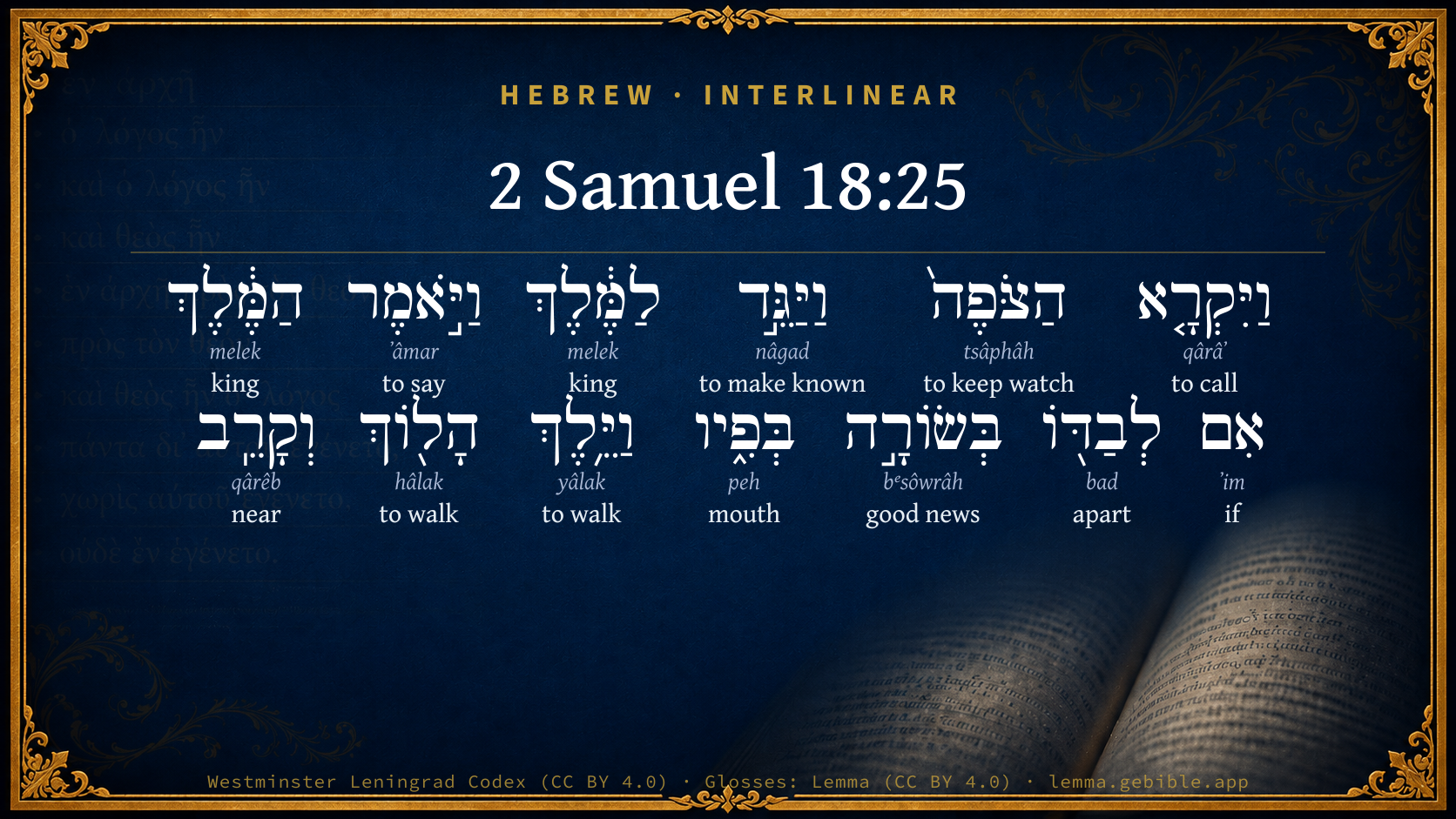
2 Samuel 18:25

Hebrew (Westminster Leningrad Codex) 2 Samuel 18:25 appears in the Hebrew Old Testament. The text above is from the Westminster Leningrad Codex. Each word links to its Strong’s number, a concise gloss, and parsing drawn from the Open Scriptures Hebrew Bible morphology. Click any word for its full Brown-Driver-Briggs (BDB) entry.
Download image
Cite this verse

2 Samuel 18:25 (World English Bible). Public Domain. Lemma interlinear Bible study tool, https://lemma.gebible.app/v/2-samuel/18/25.

Show BibTeX & RIS
BibTeX
RIS
English Translation
The watchman cried, and told the king. The king said, If he be alone, there is news in his mouth. He came apace, and drew near.
World English Bible · Public Domain
Download a study sheet

One document with this verse’s original text, its word-by-word gloss line, the meaning frame, cross-references with their text, attributed commentary, and full source and license credits — printable, and it pastes into notes with its structure intact.

This verse Autodidact and up

Study sheet (.html) Plain text (.txt)

A passage Seminary Student

Up to 50 verses in one chapter. A passage sheet keeps up to 6 commentary sources and 12 cross-references per verse, in the order this page ranks them, and says so on the sheet whenever that leaves anything out. Ask for a single verse and you get the Autodidact verse sheet above.

Everything on this page stays free to read, with no account — the sheet is a download of what is already on screen, not access to it.

Want to remove ads? Support Godless Engineer
Compare translations 3

The same verse in 3 English versions, stacked beneath the original-language interlinear above. Click any original word for its lexicon entry.

Each is an independent rendering of the whole verse — the interlinear is not word-aligned to these translations.

Highlighted words mark where these versions differ — a whole-verse word diff, not a word-by-word alignment.

  • World English Bible Public Domain
    The watchman cried, and told the king. The king said, If he be alone, there is news in his mouth. He came apace, and drew near.
  • King James Version Public Domain
    And the watchman cried, and told the king. And the king said, If he be alone, there is tidings in his mouth. And he came apace, and drew near.
  • unfoldingWord Literal Text CC BY-SA 4.0
    And the watcher called and declared to the king. And the king said, “If by himself, news in his mouth.” And he came, coming and near.

unfoldingWord Literal Text — © unfoldingWord, licensed CC BY-SA 4.0. Word-aligned USFM3 via Door43 (git.door43.org/unfoldingWord/en_ult).

Versions to compare (up to 4)

3 of 4 selected

Show all 18 translations

Every available English version of this verse, each an independent rendering of the whole verse.

  • World English Bible Public Domain
    The watchman cried, and told the king. The king said, If he be alone, there is news in his mouth. He came apace, and drew near.
  • Berean Standard Bible Public Domain
    So he called out and told the king. “If he is alone,” the king replied, “he bears good news.” As the first runner drew near,
  • Majority Standard Bible Public Domain
    So he called out and told the king. “If he is alone,” the king replied, “he bears good news.” As the first runner drew near,
  • King James Version Public Domain
    And the watchman cried, and told the king. And the king said, If he be alone, there is tidings in his mouth. And he came apace, and drew near.
  • American Standard Version (1901) Public Domain
    And the watchman cried, and told the king. And the king said, If he be alone, there is tidings in his mouth. And he came apace, and drew near.
  • Revised Version (1885) Public Domain
    And the watchman cried, and told the king. And the king said, If he be alone, there is tidings in his mouth. And he came apace, and drew near.
  • Geneva Bible (1599) Public Domain
    And the watchman cryed, and tolde ye king. And the King said, If he be alone, he bringeth tidings. And he came apace, and drew neere.
  • Douay-Rheims (1899) Public Domain
    And crying out he told the king: and the king said: If he be alone, there are good tidings in his mouth. And as he was coming apace, and drawing nearer,
  • Young's Literal Translation Public Domain
    And the watchman calleth, and declareth to the king, and the king saith, `If by himself, tidings `are' in his mouth;' and he cometh, coming on and drawing near.
  • Literal Standard Version CC BY-SA 4.0
    And the watchman calls, and declares [it] to the king, and the king says, “If [he is] by himself, tidings [are] in his mouth”; and he comes, coming on and drawing near.
  • Unlocked Literal Bible CC BY-SA 4.0
    The watchman shouted out and told the king. Then the king said, “If he is alone, there is news in his mouth.” The runner came closer and neared the city.
  • unfoldingWord Literal Text CC BY-SA 4.0
    And the watcher called and declared to the king. And the king said, “If by himself, news in his mouth.” And he came, coming and near.
  • Darby Bible Public Domain
    And the watchman cried, and told the king. And the king said, If he be alone, there is news in his mouth. And he came on and drew near.
  • World Messianic Bible Public Domain
    The watchman shouted and told the king. The king said, “If he is alone, there is news in his mouth.” He came closer and closer.
  • Webster's Bible Public Domain
    And the watchman called, and told the king. And the king said, If he is alone there is tidings in his mouth. And he came apace, and drew near.
  • Free Bible Version CC BY-SA 4.0
    So he shouted down to tell the king. “If he's by himself then he's bringing good news,” the king replied. As the first runner got closer,
  • Bible in Basic English Public Domain
    And the watchman gave news of it to the king. And the king said, If he is coming by himself, then he has news. And the man was travelling quickly, and came near.
  • JPS Tanakh (1917) Public Domain
    And the watchman cried, and told the king. And the king said: 'If he be alone, there is tidings in his mouth.' And he came apace, and drew near.

Literal Standard Version (2020), Covenant Press — licensed CC BY-SA 4.0. Text via the HelloAO Bible API (eBible.org). Unlocked Literal Bible (unfoldingWord) — licensed CC BY-SA 4.0. Text via the HelloAO Bible API (eBible.org). unfoldingWord Literal Text — © unfoldingWord, licensed CC BY-SA 4.0. Word-aligned USFM3 via Door43 (git.door43.org/unfoldingWord/en_ult). Free Bible Version, Dr. Jonathan Gallagher — licensed CC BY-SA 4.0. Text via the HelloAO Bible API (eBible.org).

Word by word

More ways to search: Search by grammar → Find every occurrence → Compare this word →

Practice this passage: Drill this verse → Learn its vocabulary →

בְּשׂוֹרָ֣ה
bᵉsôwrâh
H1309
“good news”
Noun, Common, Feminine, Singular, Absolute
Part of Speech
Noun
Type
Common
Gender
Feminine
Number
Singular
State
Absolute
Full BDB Definition

Origin: from H1319

TWOT: 291b

news, good news, tidings, reward for good news - good tidings - tidings, news - reward for good tidings
  1. וַיִּקְרָ֤א qârâʼ H7121 “and · to call” Conjunction + Verb, Qal, Sequential Imperfect, 3rd Person, Masculine, Singular
  2. הַצֹּפֶה֙ tsâphâh H6822 “the · keeping watch” Particle, Definite Article + Verb, Qal, Participle Active, Masculine, Singular, Absolute
  3. וַיַּגֵּ֣ד nâgad H5046 “and · to make known” Conjunction + Verb, Hiphil, Sequential Imperfect, 3rd Person, Masculine, Singular
  4. לַמֶּ֔לֶךְ melek H4428 “to/for the · king” Preposition, Determined + Noun, Common, Masculine, Singular, Absolute
  5. וַיֹּ֣אמֶר ʼâmar H559 “and · to say” Conjunction + Verb, Qal, Sequential Imperfect, 3rd Person, Masculine, Singular
  6. הַמֶּ֔לֶךְ melek H4428 “the · king” Particle, Definite Article + Noun, Common, Masculine, Singular, Absolute
  7. אִם ʼim H518 “if” Conjunction
  8. לְבַדּ֖וֹ bad H905 “to/for · apart · his” Preposition + Noun, Common, Masculine, Singular, Construct + Suffix, Personal, 3rd Person, Masculine, Singular
  9. בְּפִ֑יו peh H6310 “in/at · mouth · his” Preposition + Noun, Common, Masculine, Singular, Construct + Suffix, Personal, 3rd Person, Masculine, Singular
  10. וַיֵּ֥לֶךְ yâlak H3212 “and · to walk” Conjunction + Verb, Qal, Sequential Imperfect, 3rd Person, Masculine, Singular
  11. הָל֖וֹךְ hâlak H1980 “to walk” Verb, Qal, Infinitive Absolute
  12. וְקָרֵֽב qârêb H7131 “and · near” Conjunction + Adjective, Adjective, Masculine, Singular, Absolute

About this verse

These counts appear in no published source. They are computed here, from the morphology-tagged text and Lemma’s own curated glosses. What Lemma adds →

13
words
12
distinct lemmas
Historical
section

Notable vocabulary

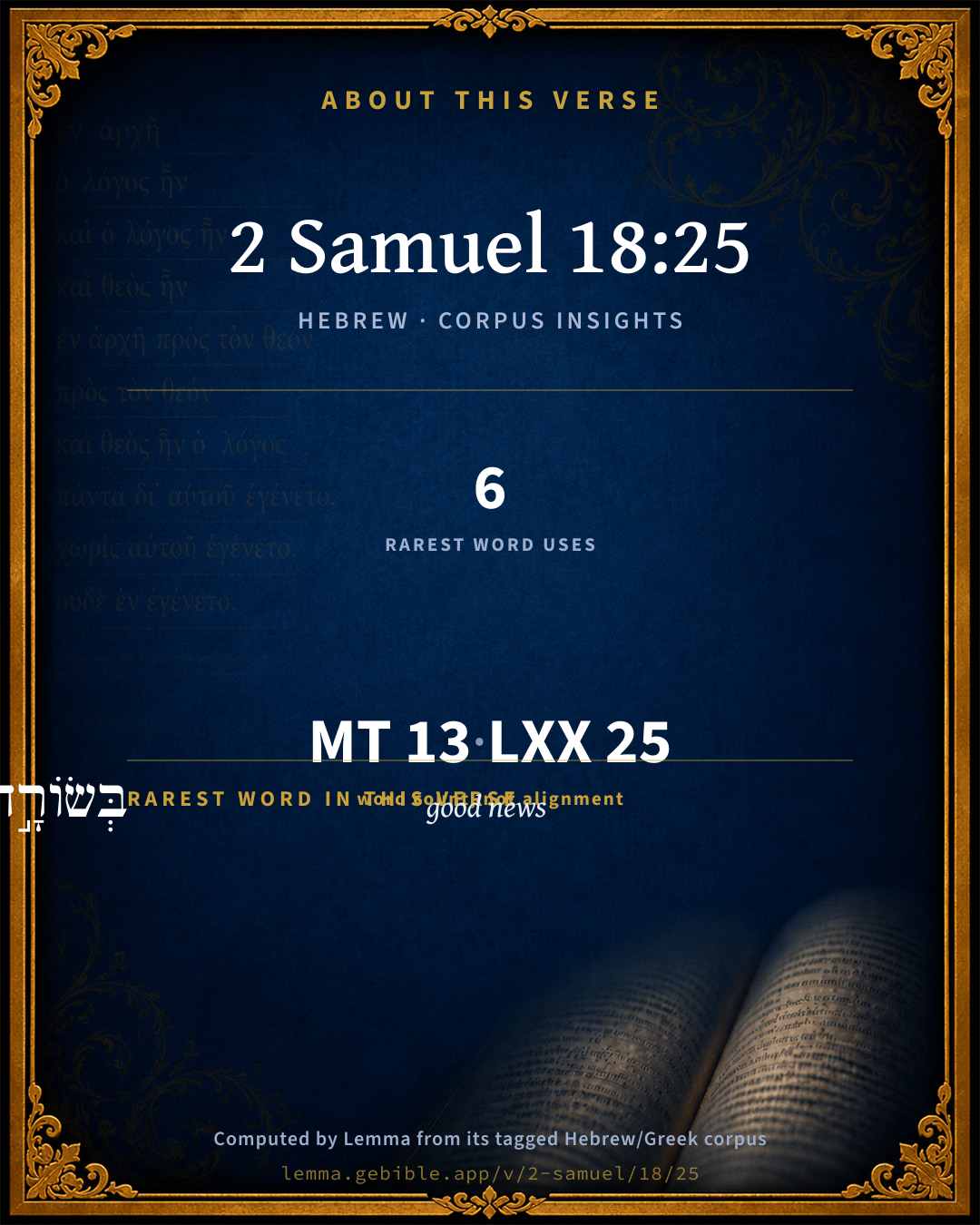
The rarest word here is בְּשׂוֹרָ֣ה good news H1309 — appearing just 6 times in the whole Hebrew Bible.

Shared distinctive vocabulary

בְּשׂוֹרָ֣ה good news H1309 occurs in 6 verses of the Hebrew Bible. Also found in:

Grammatical profile

  • 6 verbs
  • 5 nouns
  • 1 adjective
  • 1 conjunction

Verb forms

  • וַיִּקְרָ֤א Qal · Sequential Imperfect
  • הַצֹּפֶה֙ Qal · Participle Active
  • וַיַּגֵּ֣ד Hiphil · Sequential Imperfect
  • וַיֹּ֣אמֶר Qal · Sequential Imperfect
  • וַיֵּ֥לֶךְ Qal · Sequential Imperfect
  • הָל֖וֹךְ Qal · Infinitive Absolute

Repetition

A word recurs within this verse — often emphatic in Hebrew:

  • לַמֶּ֔לֶךְ king H4428 ×2

Hebrew & Septuagint length

In English translation the verse runs 26 words from the Hebrew and 32 from the Septuagint (LXX English) — closely comparable.

A rough comparison of the two English renderings, which tokenize alike — not a word-level alignment.

Word counts can differ between the Hebrew and the Greek without any difference in meaning — e.g. the Hebrew direct-object marker אֵת has no separate Greek word, and Greek often adds the article ὁ.

In the original languages it is 13 Hebrew tokens and 25 Greek tokens — but the two are counted differently (Hebrew bundles its prefixes and suffixes into one token; the Greek is in lemma form), so that isn’t a like-for-like length.

Hebrew and Greek witnesses Masoretic Hebrew ↔ Greek Septuagint

The same verse in the two great witnesses to the Old Testament, shown verse-for-verse.

These are two independent witnesses, not word-aligned to each other, and the Septuagint is shown in lemma (dictionary) form.

Hebrew 2 Samuel 18:25 Masoretic · Westminster Leningrad Codex

וַיִּקְרָ֤א הַצֹּפֶה֙ וַיַּגֵּ֣ד לַמֶּ֔לֶךְ וַיֹּ֣אמֶר הַמֶּ֔לֶךְ אִם לְבַדּ֖וֹ בְּשׂוֹרָ֣ה בְּפִ֑יו וַיֵּ֥לֶךְ הָל֖וֹךְ וְקָרֵֽב

The watchman cried, and told the king. The king said, If he be alone, there is news in his mouth. He came apace, and drew near.

World English Bible · Public Domain

Greek LXX 2 Samuel 18:25 Septuagint · lemma form

καί ἀναβοάω ὁ σκοπός καί ἀποἀγγέλλω ὁ βασιλεύς καί εἶπον ὁ βασιλεύς εἰ μόνος εἰμί εὐαγγελία ἐν ὁ στόμα αὐτός καί πορεύομαι πορεύομαι καί ἐγγίζω

And the watchman cried out, and reported to the king. And the king said, If he be alone, there are good tidings in his mouth. And the man came and drew near.

LXX2012 (modern English Septuagint) · Public Domain

On this verse, Keil & Delitzsch discusses the Septuagint’s reading. Read the note in Commentary ↓

Hebrew: Westminster Leningrad Codex (CC BY 4.0). Greek: Septuagint (public domain); English from LXX2012 (modern English Septuagint) (Public Domain). How the Septuagint differs from the Hebrew →

Targum (Aramaic paraphrase)

1

The Targum is the ancient Jewish Aramaic paraphrase of the Hebrew Scriptures — an interpretive translation, not the Hebrew text itself. Onkelos (literal) and Pseudo-Jonathan (expansive) render the Torah, and Jonathan the Prophets. Coverage is partial: where no permissively-licensed English translation exists for a verse, only the Aramaic is shown. This is verse-level text, not a word-by-word alignment to the Hebrew.

  1. Targum Jonathan Prophets (Joshua–Malachi)
    וּקְרָא סַכְוָאָה וְחַוֵי לְמַלְכָּא וַאֲמַר מַלְכָּא אִם בִּלְחוֹדוֹהִי הוּא בְּסוֹרְתָא בְּפוּמֵיהּ וַאֲזַל מֵיזַל וְקָרֵיב:

    (no public-domain English translation for this verse)

    Targum Jonathan — Aramaic: “Mikraot Gedolot” (public domain). English: “Sefaria Community Translation” (CC0 1.0 (public-domain dedication)); “London "Chaldee Paraphrase," 1871” (public domain). Text via Sefaria.

Commentary

Notes on 2 Samuel 18:25 from classic Christian and Jewish commentators (each source and its license shown beneath its notes). The classic Christian expositions comment on the surrounding passage and are grouped to its opening verse, so a note may address several verses; the Jewish commentaries on the Tanakh (Rashi and others) are per-verse, so they appear only where the commentator wrote on this verse.

Lemma curates 59 commentaries, every one of them public domain or Creative Commons licensed, each selected and text-cleaned for this edition rather than reprinted as found. About our sources →

Trapp's Complete Commentary

John Trapp

2Sa 18:25 And the watchman cried, and told the king. And the king said, If he [be] alone, [there is] tidings in his mouth. And he came apace, and drew near.

Ver. 25. If he be alone, there is tidings in his mouth.] Tidings of victory likely; for if an army be beaten they flee by troops; and it is seldom seen that the newsbearer hath cause to say, "I only am escaped alone to tell thee," as Job 1:15-16.

John Trapp, A Commentary or Exposition upon All the Books of the Old and New Testament (1647–1656) — public domain. Text from a community e-Sword module.

Joseph Benson's Commentary

2Sa 18:25. If he be alone, there are tidings in his mouth — He is sent with some special message, which was a very probable conjecture, and that he brought good news; for if he had run, or fled from the enemy, many others would have followed him.

Joseph Benson's Commentary on the Old and New Testaments (1811–1818) — public domain. Text from a community e-Sword module.

Tyndale Open Study Notes

Tyndale Open Resources

18:25 If he is alone, he has news: A solitary runner was usually a courier.

Tyndale Open Study Notes — © Tyndale Open Resources, licensed CC BY-SA 4.0. Text via the HelloAO Bible API.

Geneva Bible (1599)

Geneva Bible translators

Hebrew, tidings are in his mouth.

Geneva Bible (1599) marginal notes — public domain. Text via Bolls.life.

Adam Clarke's Commentary

Verse 25. If he be alone, there is tidings] That is, good tidings. For if the battle had been lost men would have been running in different directions through the country.

Adam Clarke's Commentary on the Bible (1810–1826) — public domain. Text from a community e-Sword/MySword module.

The Cambridge Bible for Schools and Colleges

gen. ed. J. J. S. Perowne

25. If he be alone, &c.] If the army had been routed, a number of fugitives would have been seen coming together.

The Cambridge Bible for Schools and Colleges (gen. ed. J. J. S. Perowne; Cambridge University Press, 1878–1918) — public domain. Text from a community e-Sword module.

John Gill's Exposition

And the watchman cried and told the king,.... Called with a loud voice from the roof of the watchtower to the king, sitting between the gates, and informed him what he saw:

and the king said, if he be alone there is tidings in his mouth; for if the army was routed and fled, and were pursued, there would be more in company, or several running one after another; but being but one, it was highly improbable that he was sent express:

and he came apace, and drew near; which was another sign of his being a messenger, the haste he made towards the city.

John Gill's Exposition of the Whole Bible (1746–1763) — public domain (CC PDM 1.0). Text via the HelloAO Bible API.

Haydock's Catholic Bible Commentary

Mouth. If the army had been routed, all would have been in confusion. (Calmet) --- Now they are employed in plundering the vanquished. (Menochius)

George Leo Haydock (1774–1849), Haydock's Catholic Family Bible and Commentary, 1859 edition — public domain. Excludes Psalms (Douay-Rheims chapter numbering differs from Protestant) and Deuterocanonical books (Catholic canon only).

Matthew Poole's English Annotations

There is tidings in his mouth; he is sent with some special message; which was a very probable conjecture; for if he had run or fled from the enemy, many others would have followed him.

Matthew Poole's English Annotations on the Holy Bible (1683–1685) — public domain. Text from a community e-Sword/MySword module.

Whedon's Commentary on the Bible

Daniel D. Whedon

25. Amasa — A nephew of David and cousin of Joab, but of foreign paternity, which fact, perhaps, had led David to honour the sons of Zeruiah more than him.

An Israelite — Rather, an Ishmaelite, as the text of 1Ch_2:17, has it; for there was no reason to state his nationality if he were an Israelite.

Nahash — Supposed by some to be the name of Jesse’s wife, but by Stanley to be the king of the Ammonites, and father of Abigail and Zeruiah by a woman who afterwards became the wife of Jesse and mother of David. But the more common and satisfactory opinion is the unbroken tradition of the Jews, that Nahash and Jesse were different names of the same person.

25. If he be alone, there is tidings — For if many had been running together it would have indicated a flight.

Daniel D. Whedon (gen. ed.), Commentary on the Old and New Testaments (1874–1909) — public domain. Text from a community e-Sword module.

The Pulpit Commentary

If he be alone. In case of defeat there would have been a crowd of runaways in eager flight. And when soon afterwards a second courier is seen, as he also is alone, and comes by a different route, his appearance only suggests the idea of completer tidings. And quickly the foremost is recognized by his running as the son of the high priest, and David is then assured that all has gone well, because Joab would not have sent a man of such rank to be the bearer of bad news. The word good may also mean that Ahimaaz was too brave a man to have fled from the battle, and must, therefore, have come on an errand from Joab.

The Pulpit Commentary (1880–1919), ed. H.D.M. Spence-Jones & Joseph S. Exell — public domain. Text from a community e-Sword module.

Keil & Delitzsch

C. F. Keil & F. Delitzsch

When he announced this to the king, he said, "If he (is or comes) alone, there is good news in his mouth," namely, because several runners would have shown themselves if it had been a flight. As the first messenger came nearer and nearer, the watchman saw another man running, and shouted this into the gate (השּׁער is wrongly pointed for השּׁער, according to the lxx, Syr., and Vulgate); whereupon the king replied, "This is also a good messenger."

Keil & Delitzsch — Biblical Commentary on the Old Testament (1861–1891) — public domain (CC PDM 1.0). Text via the HelloAO Bible API. (Old Testament only.)

Lesson kit

Teaching starters — assembled from the data on this page, not authored interpretation. Every prompt links to the verse data it draws on. Edit before teaching.

2 Samuel, in the Historical, opens this verse with 13 words (12 distinct Hebrew lemmas). Its most distinctive word is bᵉsôwrâh (“good news”). A historical commentator’s framing appears above. Read the whole chapter for the surrounding context.

Discussion questions

  1. What does “good news” (bᵉsôwrâh) contribute to the verse as a whole?
  2. How does 2 Samuel 4:10, which shares the word «good news», read alongside this verse?
  3. What does the repetition of “king” (2× in this one verse) do in this verse?
  4. These translations render this verse differently. What is at stake in choosing one wording over another?
  5. «וַיִּקְרָ֤א» is a Qal Sequential Imperfect verb. How does that grammatical form shape the action described?
  6. Compare how Trapp's Complete Commentary and Joseph Benson's Commentary read this verse. Where do they agree or differ?

Things to notice

Reading settings

Reading text

Shown beneath each verse's original-language words.

Old Testament
Old Testament edition

Read the OT as the Masoretic Hebrew (MT) or the Greek Septuagint (LXX).

English shown for the Greek Septuagint (in the Hebrew ↔ Greek comparison).

Comparing translations? Open the Compare panel on any verse page to stack up to four side by side.