
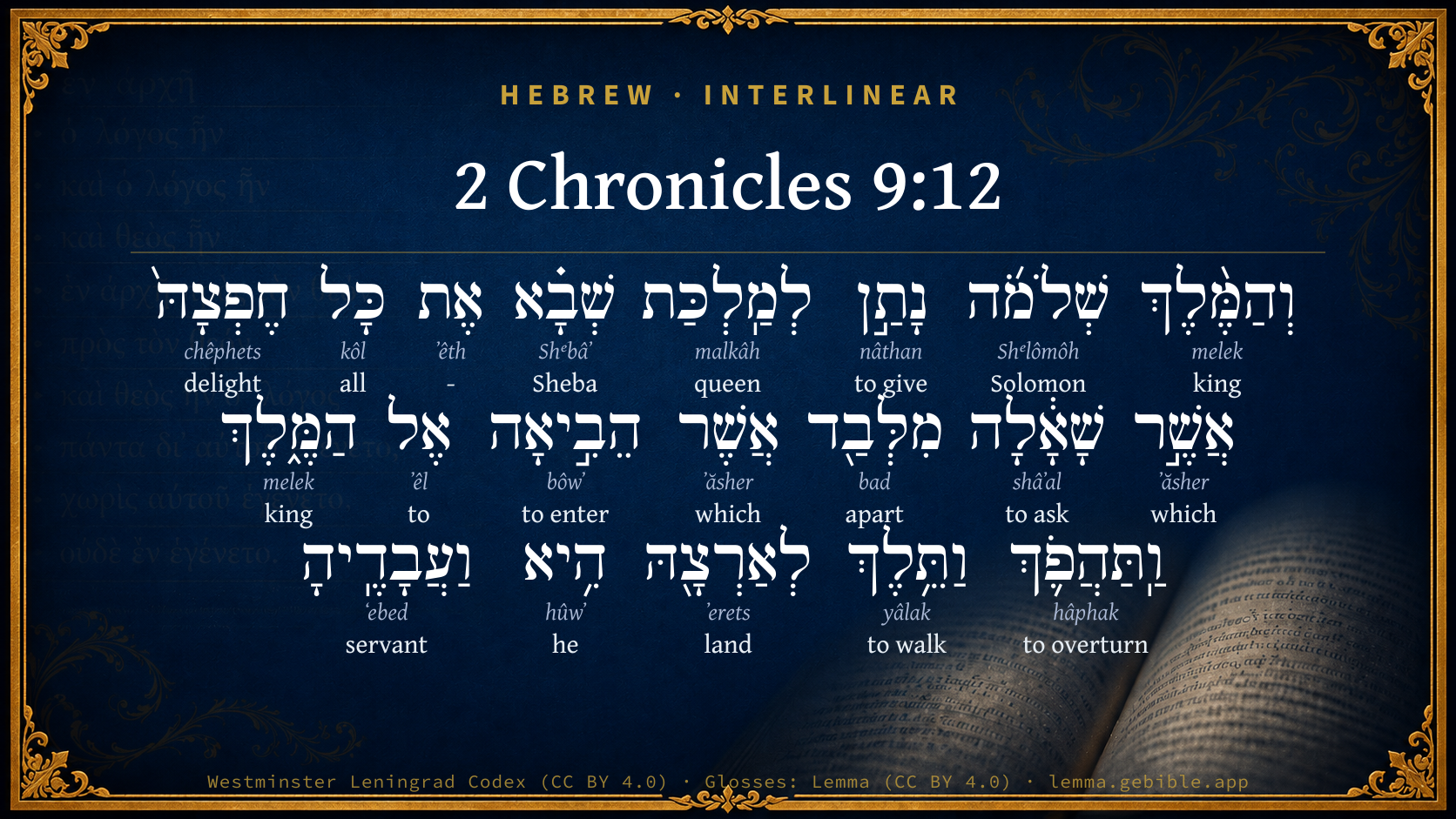
2 Chronicles 9:12

Hebrew (Westminster Leningrad Codex) 2 Chronicles 9:12 appears in the Hebrew Old Testament. The text above is from the Westminster Leningrad Codex. Each word links to its Strong’s number, a concise gloss, and parsing drawn from the Open Scriptures Hebrew Bible morphology. Click any word for its full Brown-Driver-Briggs (BDB) entry.
Download image
Cite this verse

2 Chronicles 9:12 (World English Bible). Public Domain. Lemma interlinear Bible study tool, https://lemma.gebible.app/v/2-chronicles/9/12.

Show BibTeX & RIS
BibTeX
RIS
English Translation
King Solomon gave to the queen of Sheba all her desire, whatever she asked, besides that which she had brought to the king. So she turned, and went to her own land, she and her servants.
World English Bible · Public Domain
Download a study sheet

One document with this verse’s original text, its word-by-word gloss line, the meaning frame, cross-references with their text, attributed commentary, and full source and license credits — printable, and it pastes into notes with its structure intact.

This verse Autodidact and up

Study sheet (.html) Plain text (.txt)

A passage Seminary Student

Up to 50 verses in one chapter. A passage sheet keeps up to 6 commentary sources and 12 cross-references per verse, in the order this page ranks them, and says so on the sheet whenever that leaves anything out. Ask for a single verse and you get the Autodidact verse sheet above.

Everything on this page stays free to read, with no account — the sheet is a download of what is already on screen, not access to it.

Want to remove ads? Support Godless Engineer
Compare translations 3

The same verse in 3 English versions, stacked beneath the original-language interlinear above. Click any original word for its lexicon entry.

Each is an independent rendering of the whole verse — the interlinear is not word-aligned to these translations.

Highlighted words mark where these versions differ — a whole-verse word diff, not a word-by-word alignment.

  • World English Bible Public Domain
    King Solomon gave to the queen of Sheba all her desire, whatever she asked, besides that which she had brought to the king. So she turned, and went to her own land, she and her servants.
  • King James Version Public Domain
    And king Solomon gave to the queen of Sheba all her desire, whatsoever she asked, beside that which she had brought unto the king. So she turned, and went away to her own land, she and her servants.
  • unfoldingWord Literal Text CC BY-SA 4.0
    And King Solomon gave to the queen of Sheba all her desire which she asked besides that which she brought to the king. And she turned and went to her land, she and her servants.

unfoldingWord Literal Text — © unfoldingWord, licensed CC BY-SA 4.0. Word-aligned USFM3 via Door43 (git.door43.org/unfoldingWord/en_ult).

Versions to compare (up to 4)

3 of 4 selected

Show all 18 translations

Every available English version of this verse, each an independent rendering of the whole verse.

  • World English Bible Public Domain
    King Solomon gave to the queen of Sheba all her desire, whatever she asked, besides that which she had brought to the king. So she turned, and went to her own land, she and her servants.
  • Berean Standard Bible Public Domain
    King Solomon gave the queen of Sheba all she desired—whatever she asked—far more than she had brought the king. Then she left and returned to her own country, along with her servants.
  • Majority Standard Bible Public Domain
    King Solomon gave the queen of Sheba all she desired—whatever she asked—far more than she had brought the king. Then she left and returned to her own country, along with her servants.
  • King James Version Public Domain
    And king Solomon gave to the queen of Sheba all her desire, whatsoever she asked, beside that which she had brought unto the king. So she turned, and went away to her own land, she and her servants.
  • American Standard Version (1901) Public Domain
    And king Solomon gave to the queen of Sheba all her desire, whatsoever she asked, besides that which she had brought unto the king. So she turned, and went to her own land, she and her servants.
  • Revised Version (1885) Public Domain
    And king Solomon gave to the queen of Sheba all her desire, whatsoever she asked, beside that which she had brought unto the king. So she turned, and went to her own land, she and her servants.
  • Geneva Bible (1599) Public Domain
    And King Salomon gaue to the Queene of Sheba euery pleasant thing that she asked, besides for that which she had brought vnto the King: so she returned and went to her owne countrey, both she, and her seruants.
  • Douay-Rheims (1899) Public Domain
    And king Solomon gave to the queen of Saba all that she desired, and that she asked, and many more things than she brought to him: so she returned, and went to her own country with her servants.
  • Young's Literal Translation Public Domain
    And king Solomon hath given to the queen of Sheba all her desire that she asked, apart from that which she had brought unto the king, and she turneth and goeth to her land, she and her servants.
  • Literal Standard Version CC BY-SA 4.0
    And King Solomon has given to the queen of Sheba all her desire that she asked, apart from that which she had brought to the king, and she turns and goes to her land, she and her servants.
  • Unlocked Literal Bible CC BY-SA 4.0
    King Solomon gave to the queen of Sheba everything she desired and whatever she asked for; he gave her more than what she had brought to the king. So she left and went back to her own land, she and her servants.
  • unfoldingWord Literal Text CC BY-SA 4.0
    And King Solomon gave to the queen of Sheba all her desire which she asked besides that which she brought to the king. And she turned and went to her land, she and her servants.
  • Darby Bible Public Domain
    And king Solomon gave to the queen of Sheba all her desire, whatever she asked, besides what she had brought to the king. And she turned and went to her own land, she and her servants.
  • World Messianic Bible Public Domain
    King Solomon gave to the queen of Sheba all her desire, whatever she asked, more than that which she had brought to the king. So she turned and went to her own land, she and her servants.
  • Webster's Bible Public Domain
    And king Solomon gave to the queen of Sheba all her desire, whatever she asked, besides that which she had brought to the king. So she turned, and went away to her own land, she and her servants.
  • Free Bible Version CC BY-SA 4.0
    King Solomon gave the queen of Sheba all she wanted, whatever she asked for. This was far more than she had brought the king. Then she and her attendants returned home to her own country.
  • Bible in Basic English Public Domain
    And King Solomon gave the queen of Sheba all her desire, whatever she made request for, in addition to what she had taken to the king. So she went back to her country with her servants.
  • JPS Tanakh (1917) Public Domain
    And king Solomon gave to the queen of Sheba all her desire, whatsoever she asked, beside that which she had brought unto the king. So she turned, and went to her own land, she and her servants.

Literal Standard Version (2020), Covenant Press — licensed CC BY-SA 4.0. Text via the HelloAO Bible API (eBible.org). Unlocked Literal Bible (unfoldingWord) — licensed CC BY-SA 4.0. Text via the HelloAO Bible API (eBible.org). unfoldingWord Literal Text — © unfoldingWord, licensed CC BY-SA 4.0. Word-aligned USFM3 via Door43 (git.door43.org/unfoldingWord/en_ult). Free Bible Version, Dr. Jonathan Gallagher — licensed CC BY-SA 4.0. Text via the HelloAO Bible API (eBible.org).

Word by word

More ways to search: Search by grammar → Find every occurrence → Compare this word →

Practice this passage: Drill this verse → Learn its vocabulary →

שְׁבָ֗א
Shᵉbâʼ
H7614
“Sheba”
Noun, Proper
Part of Speech
Noun
Type
Proper
Full BDB Definition

Origin: of foreign origin

TWOT: None

Sheba = "seven" or " an oath" - son of Joktan and a descendant of Seth (noun proper masculine) - son of Raamah, grandson of Cush, and a descendant of Ham (noun proper masculine) - son of Jokshan, the son of Abraham by Keturah (noun proper masculine) - a nation in southern Arabia (noun proper locative)
  1. וְהַמֶּ֨לֶךְ melek H4428 “and · the · king” Conjunction + Particle, Definite Article + Noun, Common, Masculine, Singular, Absolute
  2. שְׁלֹמֹ֜ה Shᵉlômôh H8010 “Solomon” Noun, Proper
  3. נָתַ֣ן nâthan H5414 “to give” Verb, Qal, Perfect, 3rd Person, Masculine, Singular
  4. לְמַֽלְכַּת malkâh H4436 “to/for · queen of” Preposition + Noun, Common, Feminine, Singular, Construct
  5. אֶת ʼêth H853 “-” Particle, Direct Object
  6. כָּל kôl H3605 “all of” Noun, Common, Masculine, Singular, Construct
  7. חֶפְצָהּ֙ chêphets H2656 “delight · her” Noun, Common, Masculine, Singular, Construct + Suffix, Personal, 3rd Person, Feminine, Singular
  8. אֲשֶׁ֣ר ʼăsher H834 “which” Particle, Relative
  9. שָׁאָ֔לָה shâʼal H7592 “to ask” Verb, Qal, Perfect, 3rd Person, Feminine, Singular
  10. מִלְּבַ֖ד bad H905 “from · to/for · apart of” Preposition + Preposition + Noun, Common, Masculine, Singular, Construct
  11. אֲשֶׁר ʼăsher H834 “which” Particle, Relative
  12. הֵבִ֣יאָה bôwʼ H935 “to enter” Verb, Hiphil, Perfect, 3rd Person, Feminine, Singular
  13. אֶל ʼêl H413 “to” Preposition
  14. הַמֶּ֑לֶךְ melek H4428 “the · king” Particle, Definite Article + Noun, Common, Masculine, Singular, Absolute
  15. וַֽתַּהֲפֹ֛ךְ hâphak H2015 “and · to overturn” Conjunction + Verb, Qal, Sequential Imperfect, 3rd Person, Feminine, Singular
  16. וַתֵּ֥לֶךְ yâlak H3212 “and · to walk” Conjunction + Verb, Qal, Sequential Imperfect, 3rd Person, Feminine, Singular
  17. לְאַרְצָ֖הּ ʼerets H776 “to/for · land · her” Preposition + Noun, Common, Both, Singular, Construct + Suffix, Personal, 3rd Person, Feminine, Singular
  18. הִ֥יא hûwʼ H1931 “he” Pronoun, Personal, 3rd Person, Feminine, Singular
  19. וַעֲבָדֶֽיהָ ʻebed H5650 “and · servants · her” Conjunction + Noun, Common, Masculine, Plural, Construct + Suffix, Personal, 3rd Person, Feminine, Singular

About this verse

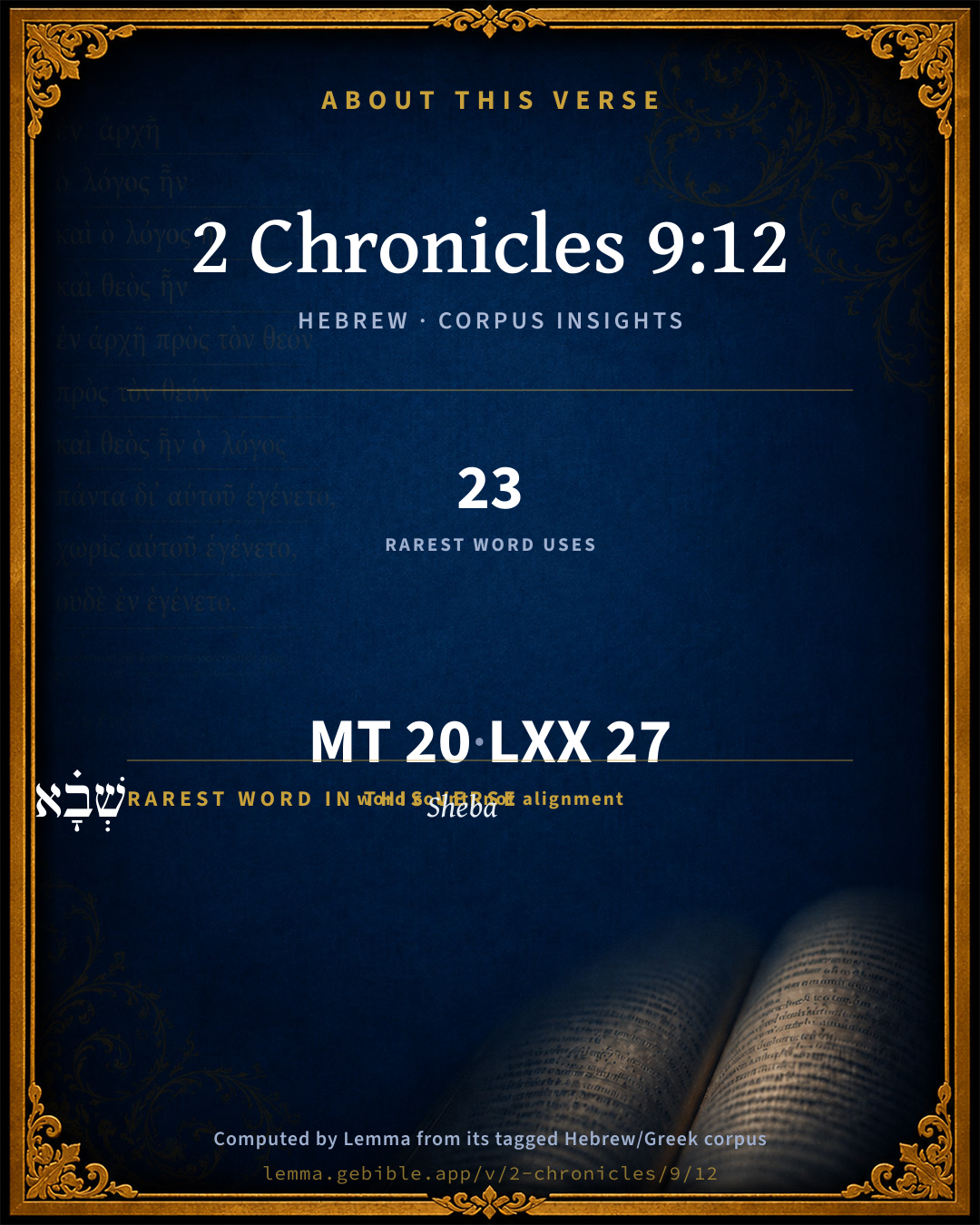
These counts appear in no published source. They are computed here, from the morphology-tagged text and Lemma’s own curated glosses. What Lemma adds →

20
words
18
distinct lemmas
Historical
section

Notable vocabulary

The rarest word here is שְׁבָ֗א Sheba H7614 — appearing just 23 times in the whole Hebrew Bible.

Shared distinctive vocabulary

שְׁבָ֗א Sheba H7614 occurs in 23 verses of the Hebrew Bible. Also found in:

Grammatical profile

  • 5 verbs
  • 10 nouns
  • 1 pronoun
  • 1 preposition
  • 3 particles

Verb forms

  • נָתַ֣ן Qal · Perfect
  • שָׁאָ֔לָה Qal · Perfect
  • הֵבִ֣יאָה Hiphil · Perfect
  • וַֽתַּהֲפֹ֛ךְ Qal · Sequential Imperfect
  • וַתֵּ֥לֶךְ Qal · Sequential Imperfect

Repetition

Words recur within this verse — often emphatic in Hebrew:

  • וְהַמֶּ֨לֶךְ king H4428 ×2
  • אֲשֶׁ֣ר which H834 ×2

Hebrew & Septuagint length

In English translation the verse runs 36 words from the Hebrew and 28 from the Septuagint (LXX English) — closely comparable.

A rough comparison of the two English renderings, which tokenize alike — not a word-level alignment.

Word counts can differ between the Hebrew and the Greek without any difference in meaning — e.g. the Hebrew direct-object marker אֵת has no separate Greek word, and Greek often adds the article ὁ.

In the original languages it is 20 Hebrew tokens and 27 Greek tokens — but the two are counted differently (Hebrew bundles its prefixes and suffixes into one token; the Greek is in lemma form), so that isn’t a like-for-like length.

Cross-references

3

Topical passages linked to 2 Chronicles 9:12 in the Treasury of Scripture Knowledge — connected by theme and wording, ordered by reader-vote popularity; previews shown in the World English Bible.

  • 1 Kings 10:13 King Solomon gave to the queen of Sheba all her desire, whatever she asked, besides that which Solomon gave her of his royal bounty. So she turned, and went to her own land, she and her servants.
  • Psalms 20:4 May He grant you your heart's desire, And fulfill all your counsel.
  • Ephesians 3:20 Now to him who is able to do exceedingly abundantly above all that we ask or think, according to the power that works in us,

Cross-references courtesy of OpenBible.info (CC BY 4.0).

Hebrew and Greek witnesses Masoretic Hebrew ↔ Greek Septuagint

The same verse in the two great witnesses to the Old Testament, shown verse-for-verse.

These are two independent witnesses, not word-aligned to each other, and the Septuagint is shown in lemma (dictionary) form.

Hebrew 2 Chronicles 9:12 Masoretic · Westminster Leningrad Codex

וְהַמֶּ֨לֶךְ שְׁלֹמֹ֜ה נָתַ֣ן לְמַֽלְכַּת שְׁבָ֗א אֶת כָּל חֶפְצָהּ֙ אֲשֶׁ֣ר שָׁאָ֔לָה מִלְּבַ֖ד אֲשֶׁר הֵבִ֣יאָה אֶל הַמֶּ֑לֶךְ וַֽתַּהֲפֹ֛ךְ וַתֵּ֥לֶךְ לְאַרְצָ֖הּ הִ֥יא וַעֲבָדֶֽיהָ

King Solomon gave to the queen of Sheba all her desire, whatever she asked, besides that which she had brought to the king. So she turned, and went to her own land, she and her servants.

World English Bible · Public Domain

Greek LXX 2 Chronicles 9:12 Septuagint · lemma form

καί ὁ βασιλεύς σαλωμών δίδωμι ὁ βασίλισσα σαβα πᾶς ὁ θέλημα αὐτός ὅς αἰτέω ἐκτός πᾶς ὅς φέρω ὁ βασιλεύς σαλωμών καί ἀποστρέφω εἰς ὁ γῆ αὐτός

And king Solomon gave to the queen of Saba all that she requested, besides all that she brought to king Solomon: and she returned to her own land.

LXX2012 (modern English Septuagint) · Public Domain

On this verse, Ellicott's Commentary for English Readers discusses the Septuagint’s reading. Read the note in Commentary ↓

Hebrew: Westminster Leningrad Codex (CC BY 4.0). Greek: Septuagint (public domain); English from LXX2012 (modern English Septuagint) (Public Domain). How the Septuagint differs from the Hebrew →

Commentary

Notes on 2 Chronicles 9:12 from classic Christian and Jewish commentators (each source and its license shown beneath its notes). The classic Christian expositions comment on the surrounding passage and are grouped to its opening verse, so a note may address several verses; the Jewish commentaries on the Tanakh (Rashi and others) are per-verse, so they appear only where the commentator wrote on this verse.

Lemma curates 59 commentaries, every one of them public domain or Creative Commons licensed, each selected and text-cleaned for this edition rather than reprinted as found. About our sources →

Trapp's Complete Commentary

John Trapp

2Ch 9:12 And king Solomon gave to the queen of Sheba all her desire, whatsoever she asked, beside [that] which she had brought unto the king. So she turned, and went away to her own land, she and her servants.

Ver. 12. And king Solomon gave to the queen.] 1Ki 10:13.

Besides that which she had brought unto the king,] i.e., Besides that which he gave her in exchange or requital of her presents, he added many more thereunto, out of his own mere bounty and liberality; even the greatest rarities of his country. Munster’s translation therefore is not to be admitted, Sed non tantum quantum illa attulit regi. Ingenuous spirits love not to lie behind in their courteous retributions.

John Trapp, A Commentary or Exposition upon All the Books of the Old and New Testament (1647–1656) — public domain. Text from a community e-Sword module.

Joseph Benson's Commentary

2Ch 9:12. Besides that which she had brought unto the king — Over and above that which was an equivalent for the presents she had made him. See note on 1Ki 10:13.

Joseph Benson's Commentary on the Old and New Testaments (1811–1818) — public domain. Text from a community e-Sword module.

Geneva Bible (1599)

Geneva Bible translators

That is, which the King gave her for recompense of the treasure which she brought.

Geneva Bible (1599) marginal notes — public domain. Text via Bolls.life.

Adam Clarke's Commentary

Verse 12. Beside that which she had brought unto the king] In 1Kg 10:13 it is stated that Solomon gave her all she asked, besides that which he gave her of his royal bounty. It is not at all likely that he gave her back the presents which she brought to him, and which he had accepted. She had, no doubt, asked for several things which were peculiar to the land of Judea, and would be curiosities in her own kingdom; and besides these, he gave her other valuable presents.

Adam Clarke's Commentary on the Bible (1810–1826) — public domain. Text from a community e-Sword/MySword module.

Ellicott's Commentary for English Readers

(12) Beside that which she had brought unto the king.—It can hardly be meant that Solomon returned her own presents. If the reading be sound, we may understand return presents, i.e., gifts equal in value to those which she had bestowed. Or better, we may regard the clause as a parenthetic note of the chronicler’s, to the effect that the giving of presents was not all on one side. Solomon showed himself as royally generous as his visitor. Putting the clause first would make this meaning clearer: “And quite apart from what she brought the king, Solomon gave the queen of Sheba all her desire.” Bertheau, however, proposes a slight change in the Hebrew text, so as to get the sense, “beside what the king had brought for her.” 1Ki_10:13 is much clearer: “besides what he had given her, according to the hand of king Solomon.” LXX. translates, “besides all that she brought to king Solomon;” the Vulg., “and far more than she had brought him,” which may be a trace of the original reading; the Syriac, “besides what he had given her.” Syriac and Arabic add, “and he revealed to her all that was in her heart.”

She turned.—Hâphak, for pânâh of Kings, which is more usual in this sense.

A Bible Commentary for English Readers, edited by Charles John Ellicott (1878–1897) — public domain. Text from a community e-Sword module.

The Cambridge Bible for Schools and Colleges

gen. ed. J. J. S. Perowne

12. besides that which she had brought unto the king] This means that the king beside returning the queen the value of her presents to him, also gave her additional gifts; cp. 1Ki_10:13.

The Cambridge Bible for Schools and Colleges (gen. ed. J. J. S. Perowne; Cambridge University Press, 1878–1918) — public domain. Text from a community e-Sword module.

Haydock's Catholic Bible Commentary

And many. Hebrew, "besides that which she had brought unto the king." (Protestants) It is however certain that Solomon made use of many of her presents, and therefore he returned her others in greater profusion, or, as it is expressed, 3 Kings, besides what he offered her of himself of his royal bounty. (Haydock)

George Leo Haydock (1774–1849), Haydock's Catholic Family Bible and Commentary, 1859 edition — public domain. Excludes Psalms (Douay-Rheims chapter numbering differs from Protestant) and Deuterocanonical books (Catholic canon only).

Matthew Poole's English Annotations

Besides that which she had brought; besides what he gave her of his royal bounty, as it is expressed, 1Ki 10:13, which was in compensation for her presents, as is here noted.

Matthew Poole's English Annotations on the Holy Bible (1683–1685) — public domain. Text from a community e-Sword/MySword module.

The Pulpit Commentary

Beside that which she had brought unto the king. The parallel has not this obscure clause, but has, "beside that which Solomon gave her of his royal Bounty." Professor Dr. Murphy explains our clause as purporting to say this: Solomon gave all the queen"s desire in the way of bounty, "beside" all that belonged as an equivalent for "what she had brought." She got so much sheer gift, beside all that, according to the then Eastern custom, was her due.

The Pulpit Commentary (1880–1919), ed. H.D.M. Spence-Jones & Joseph S. Exell — public domain. Text from a community e-Sword module.

John Wesley's Explanatory Notes

Besides - Besides what he gave her of his royal bounty, as is expressed, 1 Kings x, 13, which was in compensation for her presents.

John Wesley, Explanatory Notes Upon the Whole Bible (1754–1765) — public domain. Text via the GEBible commentary corpus.

Rashi

Rabbi Shlomo Yitzchaki (Rashi)

aside from that which she brought This is written here in deference to the honor of the kings of Judah; it means that she gave him more than he gave her, and in I Kings (10:13) it is written: “aside from that which he gave her according to King [Solomon’s] ability.” [He gave her] things that were common in the land of Israel, but were not common in her country.

Rashi on the Tanakh — English translations: “The Judaica Press complete Tanach with Rashi, translated by A. J. Rosenberg” (CC BY 4.0); “Pentateuch with Rashi's commentary by M. Rosenbaum and A.M. Silbermann, 1929-1934” (public domain); “The Metsudah Tanach series, Lakewood, N.J” (CC BY 4.0); and “The Book of Joshua, Metsudah Publications, 1997” (CC BY 4.0). Text via Sefaria.

Lesson kit

Teaching starters — assembled from the data on this page, not authored interpretation. Every prompt links to the verse data it draws on. Edit before teaching.

2 Chronicles, in the Historical, opens this verse with 20 words (18 distinct Hebrew lemmas). Its most distinctive word is Shᵉbâʼ (“Sheba”). A historical commentator’s framing appears above. Read the whole chapter for the surrounding context.

Discussion questions

  1. The word Shᵉbâʼ carries the sense “Sheba.” How does it shape the verse?
  2. Genesis 10:7 shares the word «Sheba» with this verse. How do the two illuminate each other?
  3. “king” occurs 2× in this one verse. What is the effect of the repetition?
  4. The translations on this page render this verse differently — a whole-verse word diff, not a word-by-word alignment. What might account for the different wordings?
  5. The verb «נָתַ֣ן» is Qal Perfect. How does its form color the action?
  6. Reading how Trapp's Complete Commentary and Joseph Benson's Commentary read this verse, where do the two commentators agree and where do they part?

Things to notice

Reading settings

Reading text

Shown beneath each verse's original-language words.

Old Testament
Old Testament edition

Read the OT as the Masoretic Hebrew (MT) or the Greek Septuagint (LXX).

English shown for the Greek Septuagint (in the Hebrew ↔ Greek comparison).

Comparing translations? Open the Compare panel on any verse page to stack up to four side by side.