2 Chronicles 9:14

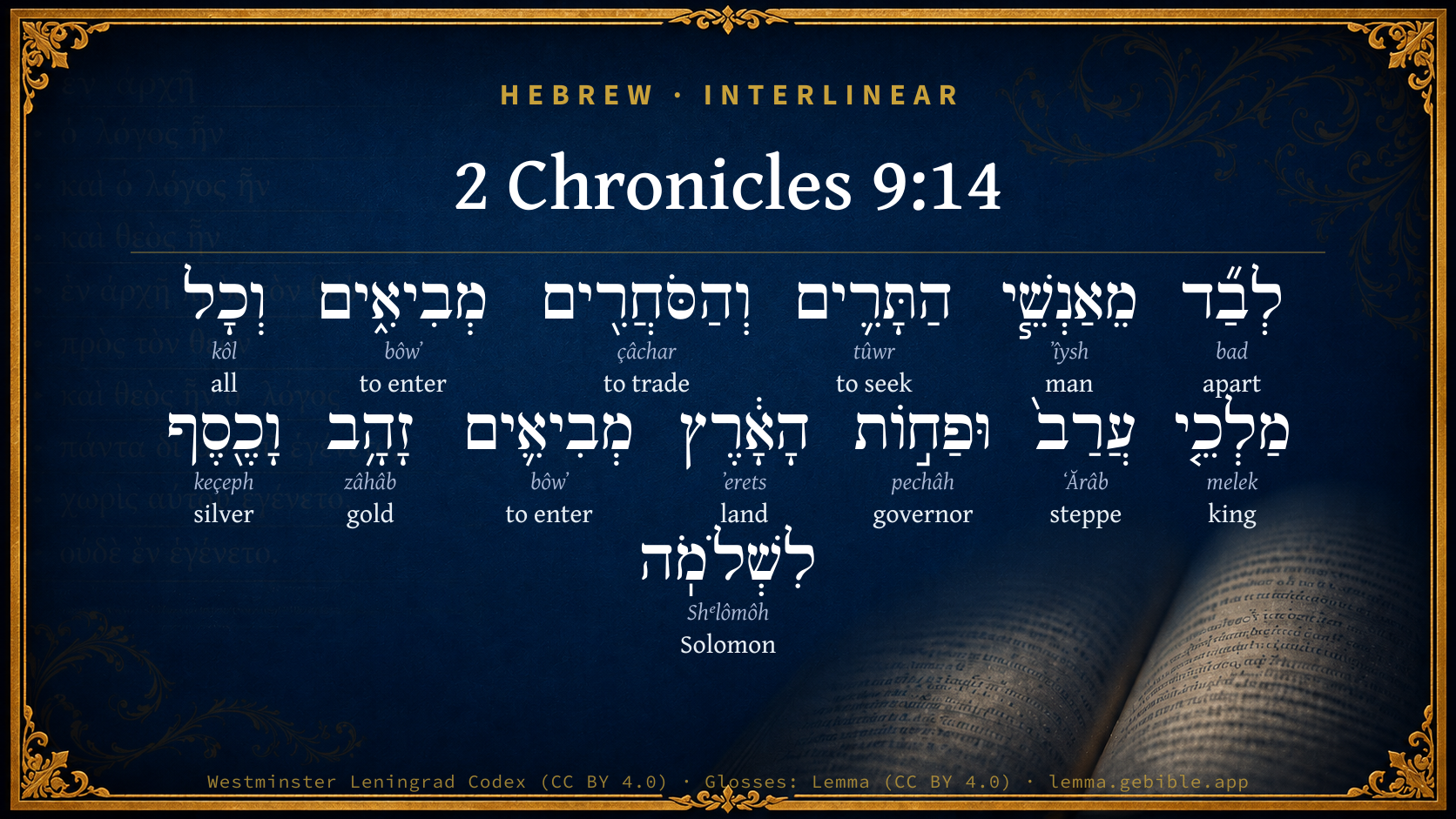
Hebrew (Westminster Leningrad Codex) 2 Chronicles 9:14 appears in the Hebrew Old Testament. The text above is from the Westminster Leningrad Codex. Each word links to its Strong’s number, a concise gloss, and parsing drawn from the Open Scriptures Hebrew Bible morphology. Click any word for its full Brown-Driver-Briggs (BDB) entry.
Download image
Cite this verse

2 Chronicles 9:14 (World English Bible). Public Domain. Lemma interlinear Bible study tool, https://lemma.gebible.app/v/2-chronicles/9/14.

Show BibTeX & RIS
BibTeX
RIS
English Translation
besides that which the traders and merchants brought: and all the kings of Arabia and the governors of the country brought gold and silver to Solomon.
World English Bible · Public Domain
Download a study sheet

One document with this verse’s original text, its word-by-word gloss line, the meaning frame, cross-references with their text, attributed commentary, and full source and license credits — printable, and it pastes into notes with its structure intact.

This verse Autodidact and up

Study sheet (.html) Plain text (.txt)

A passage Seminary Student

Up to 50 verses in one chapter. A passage sheet keeps up to 6 commentary sources and 12 cross-references per verse, in the order this page ranks them, and says so on the sheet whenever that leaves anything out. Ask for a single verse and you get the Autodidact verse sheet above.

Everything on this page stays free to read, with no account — the sheet is a download of what is already on screen, not access to it.

Want to remove ads? Support Godless Engineer
Compare translations 3

The same verse in 3 English versions, stacked beneath the original-language interlinear above. Click any original word for its lexicon entry.

Each is an independent rendering of the whole verse — the interlinear is not word-aligned to these translations.

Highlighted words mark where these versions differ — a whole-verse word diff, not a word-by-word alignment.

  • World English Bible Public Domain
    besides that which the traders and merchants brought: and all the kings of Arabia and the governors of the country brought gold and silver to Solomon.
  • King James Version Public Domain
    Beside that which chapmen and merchants brought. And all the kings of Arabia and governors of the country brought gold and silver to Solomon.
  • unfoldingWord Literal Text CC BY-SA 4.0
    besides from the traveling men and the traders who brought in; and all the kings of Arabia and the governors of the land were bringing gold and silver to Solomon.

unfoldingWord Literal Text — © unfoldingWord, licensed CC BY-SA 4.0. Word-aligned USFM3 via Door43 (git.door43.org/unfoldingWord/en_ult).

Versions to compare (up to 4)

3 of 4 selected

Show all 18 translations

Every available English version of this verse, each an independent rendering of the whole verse.

  • World English Bible Public Domain
    besides that which the traders and merchants brought: and all the kings of Arabia and the governors of the country brought gold and silver to Solomon.
  • Berean Standard Bible Public Domain
    not including the revenue from the merchants and traders. And all the Arabian kings and governors of the land also brought gold and silver to Solomon.
  • Majority Standard Bible Public Domain
    not including the revenue from the merchants and traders. And all the Arabian kings and governors of the land also brought gold and silver to Solomon.
  • King James Version Public Domain
    Beside that which chapmen and merchants brought. And all the kings of Arabia and governors of the country brought gold and silver to Solomon.
  • American Standard Version (1901) Public Domain
    besides that which the traders and merchants brought: and all the kings of Arabia and the governors of the country brought gold and silver to Solomon.
  • Revised Version (1885) Public Domain
    beside that which the chapmen and merchants brought: and all the kings of Arabia and the governors of the country brought gold and silver to Solomon.
  • Geneva Bible (1599) Public Domain
    Besides that which chapmen and marchants brought: and all the Kings of Arabia, and the princes of the countrey brought golde and siluer to Salomon.
  • Douay-Rheims (1899) Public Domain
    Beside the sum which the deputies of divers nations, and the merchants were accustomed to bring, and all the kings of Arabia, and the lords of the lands, who I brought gold and silver to Solomon.
  • Young's Literal Translation Public Domain
    apart from `what' the tourists, and the merchants, are bringing in; and all the kings of Arabia, and the governors of the land, are bringing in gold and silver to Solomon.
  • Literal Standard Version CC BY-SA 4.0
    apart from [what] the tourists and the merchants are bringing in; and all the kings of Arabia, and the governors of the land, are bringing in gold and silver to Solomon.
  • Unlocked Literal Bible CC BY-SA 4.0
    besides the gold that the traders and merchants brought. All the kings of Arabia and the governors in the country also brought gold and silver to Solomon.
  • unfoldingWord Literal Text CC BY-SA 4.0
    besides from the traveling men and the traders who brought in; and all the kings of Arabia and the governors of the land were bringing gold and silver to Solomon.
  • Darby Bible Public Domain
    besides [what] dealers and merchants brought, and [what] all the kings of Arabia and the governors of the country brought of gold and silver to Solomon.
  • World Messianic Bible Public Domain
    in addition to that which the traders and merchants brought. All the kings of Arabia and the governors of the country brought gold and silver to Solomon.
  • Webster's Bible Public Domain
    Besides that which chapmen and merchants brought. And all the kings of Arabia and governors of the country brought gold and silver to Solomon.
  • Free Bible Version CC BY-SA 4.0
    not including that received from traders and merchants. All the kings of Arabia and governors of the land also brought gold and silver to Solomon.
  • Bible in Basic English Public Domain
    And in addition to what he got from traders of different sorts, all the kings of Arabia and the rulers of the country gave gold and silver to Solomon.
  • JPS Tanakh (1917) Public Domain
    beside that which the traffickers and merchants brought; and all the kings of Arabia and the governors of the country brought gold and silver to Solomon.

Literal Standard Version (2020), Covenant Press — licensed CC BY-SA 4.0. Text via the HelloAO Bible API (eBible.org). Unlocked Literal Bible (unfoldingWord) — licensed CC BY-SA 4.0. Text via the HelloAO Bible API (eBible.org). unfoldingWord Literal Text — © unfoldingWord, licensed CC BY-SA 4.0. Word-aligned USFM3 via Door43 (git.door43.org/unfoldingWord/en_ult). Free Bible Version, Dr. Jonathan Gallagher — licensed CC BY-SA 4.0. Text via the HelloAO Bible API (eBible.org).

Word by word

More ways to search: Search by grammar → Find every occurrence → Compare this word →

Practice this passage: Drill this verse → Learn its vocabulary →

עֲרַב֙
ʻĂrâb
H6152
“steppe”
Noun, Proper
Part of Speech
Noun
Type
Proper
Full BDB Definition

Origin: from H6150 in the fig. sense of sterility

TWOT: 1688a , 1688c

steppe-dwellers - the people inhabiting the country east and south of Canaan, the nomadic desert Bedouins - Arabians, Arabs
  1. לְבַ֞ד bad H905 “to/for · apart” Preposition + Noun, Common, Masculine, Singular, Absolute
  2. מֵאַנְשֵׁ֧י ʼîysh H376 “from · men of” Preposition + Noun, Common, Masculine, Plural, Construct
  3. הַתָּרִ֛ים tûwr H8446 “the · seeking” Particle, Definite Article + Verb, Qal, Participle Active, Masculine, Plural, Absolute
  4. וְהַסֹּחֲרִ֖ים çâchar H5503 “and · the · trading” Conjunction + Particle, Definite Article + Verb, Qal, Participle Active, Masculine, Plural, Absolute
  5. מְבִיאִ֑ים bôwʼ H935 “entering” Verb, Hiphil, Participle Active, Masculine, Plural, Absolute
  6. וְכָל kôl H3605 “and · all of” Conjunction + Noun, Common, Masculine, Singular, Construct
  7. מַלְכֵ֤י melek H4428 “kings of” Noun, Common, Masculine, Plural, Construct
  8. וּפַח֣וֹת pechâh H6346 “and · governors of” Conjunction + Noun, Common, Masculine, Plural, Construct
  9. הָאָ֔רֶץ ʼerets H776 “the · land” Particle, Definite Article + Noun, Common, Both, Singular, Absolute
  10. מְבִיאִ֛ים bôwʼ H935 “entering” Verb, Hiphil, Participle Active, Masculine, Plural, Absolute
  11. זָהָ֥ב zâhâb H2091 “gold” Noun, Common, Masculine, Singular, Absolute
  12. וָכֶ֖סֶף keçeph H3701 “and · silver” Conjunction + Noun, Common, Masculine, Singular, Absolute
  13. לִשְׁלֹמֹֽה Shᵉlômôh H8010 “to/for · Solomon” Preposition + Noun, Proper

About this verse

These counts appear in no published source. They are computed here, from the morphology-tagged text and Lemma’s own curated glosses. What Lemma adds →

14
words
13
distinct lemmas
Historical
section

Notable vocabulary

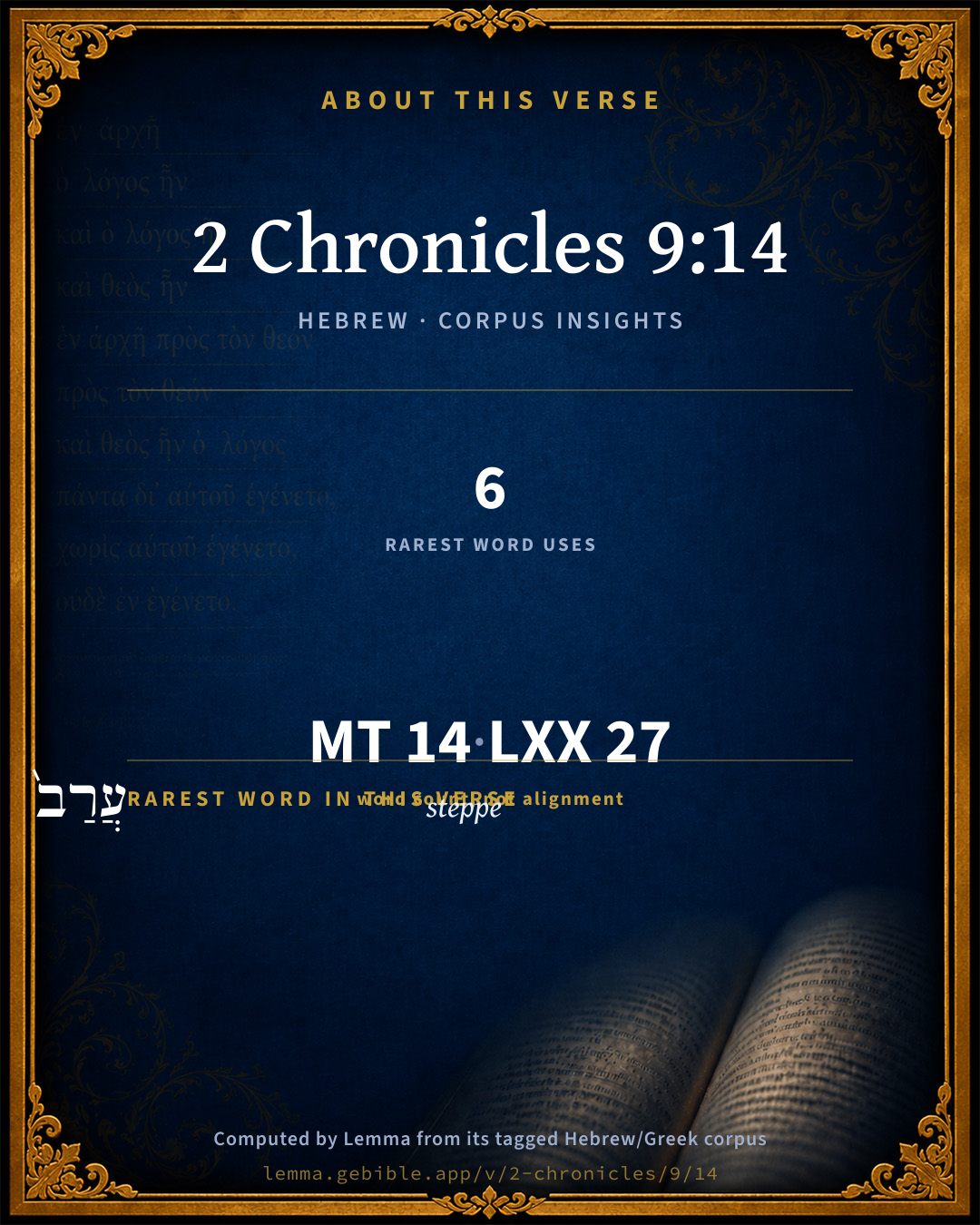
The rarest word here is עֲרַב֙ steppe H6152 — appearing just 6 times in the whole Hebrew Bible.

Shared distinctive vocabulary

עֲרַב֙ steppe H6152 occurs in 5 verses of the Hebrew Bible. Also found in:

Grammatical profile

  • 4 verbs
  • 10 nouns

Verb forms

  • הַתָּרִ֛ים Qal · Participle Active
  • וְהַסֹּחֲרִ֖ים Qal · Participle Active
  • מְבִיאִ֑ים Hiphil · Participle Active
  • מְבִיאִ֛ים Hiphil · Participle Active

Repetition

A word recurs within this verse — often emphatic in Hebrew:

  • מְבִיאִ֑ים to enter H935 ×2

Hebrew & Septuagint length

In English translation the verse runs 26 words from the Hebrew and 31 from the Septuagint (LXX English) — closely comparable.

A rough comparison of the two English renderings, which tokenize alike — not a word-level alignment.

Word counts can differ between the Hebrew and the Greek without any difference in meaning — e.g. the Hebrew direct-object marker אֵת has no separate Greek word, and Greek often adds the article ὁ.

In the original languages it is 14 Hebrew tokens and 27 Greek tokens — but the two are counted differently (Hebrew bundles its prefixes and suffixes into one token; the Greek is in lemma form), so that isn’t a like-for-like length.

Cross-references

2

Topical passages linked to 2 Chronicles 9:14 in the Treasury of Scripture Knowledge — connected by theme and wording, ordered by reader-vote popularity; previews shown in the World English Bible.

  • Psalms 68:29 Because of your temple at Jerusalem, Kings shall bring presents to you.
  • Psalms 72:10 The kings of Tarshish and of the isles will bring tribute. The kings of Sheba and Seba shall offer gifts.

Cross-references courtesy of OpenBible.info (CC BY 4.0).

Hebrew and Greek witnesses Masoretic Hebrew ↔ Greek Septuagint

The same verse in the two great witnesses to the Old Testament, shown verse-for-verse.

These are two independent witnesses, not word-aligned to each other, and the Septuagint is shown in lemma (dictionary) form.

Hebrew 2 Chronicles 9:14 Masoretic · Westminster Leningrad Codex

לְבַ֞ד מֵאַנְשֵׁ֧י הַתָּרִ֛ים וְהַסֹּחֲרִ֖ים מְבִיאִ֑ים וְכָל מַלְכֵ֤י עֲרַב֙ וּפַח֣וֹת הָאָ֔רֶץ מְבִיאִ֛ים זָהָ֥ב וָכֶ֖סֶף לִשְׁלֹמֹֽה

besides that which the traders and merchants brought: and all the kings of Arabia and the governors of the country brought gold and silver to Solomon.

World English Bible · Public Domain

Greek LXX 2 Chronicles 9:14 Septuagint · lemma form

πλήν ὁ ἀνήρ ὁ ὑποτάσσω καί ὁ ἐνπορεύομαι ὅς φέρω καί πᾶς ὁ βασιλεύς ὁ ἀραβία καί σατράπης ὁ γῆ φέρω χρυσίον καί ἀργύριον ὁ βασιλεύς σαλωμών

besides what the men who were regularly appointed and the merchants brought, and all the kings of Arabia and princes of the land: all brought gold and silver to king Solomon.

LXX2012 (modern English Septuagint) · Public Domain

On this verse, Ellicott's Commentary for English Readers discusses the Septuagint’s reading. Read the note in Commentary ↓

Hebrew: Westminster Leningrad Codex (CC BY 4.0). Greek: Septuagint (public domain); English from LXX2012 (modern English Septuagint) (Public Domain). How the Septuagint differs from the Hebrew →

Commentary

Notes on 2 Chronicles 9:14 from classic Christian and Jewish commentators (each source and its license shown beneath its notes). The classic Christian expositions comment on the surrounding passage and are grouped to its opening verse, so a note may address several verses; the Jewish commentaries on the Tanakh (Rashi and others) are per-verse, so they appear only where the commentator wrote on this verse.

Lemma curates 59 commentaries, every one of them public domain or Creative Commons licensed, each selected and text-cleaned for this edition rather than reprinted as found. About our sources →

Trapp's Complete Commentary

John Trapp

2Ch 9:14 Beside [that which] chapmen and merchants brought. And all the kings of Arabia and governors of the country brought gold and silver to Solomon.

Ver. 14. See 1Ki 10:15-17, &c.

John Trapp, A Commentary or Exposition upon All the Books of the Old and New Testament (1647–1656) — public domain. Text from a community e-Sword module.

Adam Clarke's Commentary

Verse 14. The kings of Arabia] "The kings of Sistevantha." - Targum.

Adam Clarke's Commentary on the Bible (1810–1826) — public domain. Text from a community e-Sword/MySword module.

Ellicott's Commentary for English Readers

(14) Besides that which chapmen and merchants brought.—The Hebrew is difficult, and probably corrupt. Literally it seems to run, besides the men of the itinerants (a strange phrase), and that which the merchants were bringing; or, perhaps, apart from the men of the itinerants and the merchants bringing. The last word may be a clerical error, as it occurs again directly. The conjecture of Thenius on 1Ki_10:15 seems to be borne out by the ancient Versions. He would read instead of ’anshê ha-târîm, “men of the travellers,” ‘onshê ha-r’dûyîm, “fines or tributes of the subjects.” The Syriac of Chronicles has “tributes of the cities.” Perhaps, therefore, the true original reading was ‘onshê he‘arîm. The Vulg. renders “envoys of divers peoples;” but the LXX., “men of the subjected (states).”

For the second half of the phrase Kings has, “and the merchandise of the pedlars.”

The kings of Arabia.—Kings, “the kings of the mixed tribes;” that is, the Bêdâwîs, bordering on and mingling with Israel. (Comp. Exo_12:38.) The difference depends on the vowel pointing only. (Comp. Jer_25:24, where both words occur; and Eze_30:5.)

Governors.—Pachôth, i.e., pashas. Thenius is wrong in supposing this word to be a token of the “later composition of the section.” (See Note on 2Ki_18:24.)

Brought.—Were bringing = used to bring. (Comp. 2Ch_9:23-24.)

A Bible Commentary for English Readers, edited by Charles John Ellicott (1878–1897) — public domain. Text from a community e-Sword module.

The Cambridge Bible for Schools and Colleges

gen. ed. J. J. S. Perowne

14. chapmen] R.V. the chapmen. The English word means “merchant”; cp. the verb, “to chaffer” and the German “Kaufmann.” The Heb. word means “those who go about” as merchants.

governors] Heb. Paḥoth, a word applied specially to governors of provinces of the Assyrian, Babylonian, and Persian empires. Probably here governors outside the land of Israel are meant.

The Cambridge Bible for Schools and Colleges (gen. ed. J. J. S. Perowne; Cambridge University Press, 1878–1918) — public domain. Text from a community e-Sword module.

Haydock's Catholic Bible Commentary

Beside. Hebrew, "besides that which chapmen and merchants brought." (Protestants) The deputies appear to be the tax-gatherers, 3 Kings x. 15. (Haydock)

George Leo Haydock (1774–1849), Haydock's Catholic Family Bible and Commentary, 1859 edition — public domain. Excludes Psalms (Douay-Rheims chapter numbering differs from Protestant) and Deuterocanonical books (Catholic canon only).

The Pulpit Commentary

Beside, etc. The preposition (In.) left both here and in the parallel, before the words "men of," etc., in the compound English word chapmen (Authorized Version), shows clearly the construction of this and the following sentence; from the previous verse needs to come the words, after our "beside," "the weight of gold which came," etc. This gold probably came by way of tax payments from the merchant travellers, and as tribute money from the kings of the part of Arabia where the blood was mingled, Jewish and Arabian, and not exclusively and independently Arabian (see the word used in place of our Arabian in the parallel, and, (Jer_25:24) and from those governors (perhaps in some cases superseding older kings) of adjacent countries, that had become in some part tributary to Solomon. Governors. For this unusual and un-Hebrew word (twOjp) see Ezr_5:6; Hag_1:1; Neh_5:14.

Gesenius mentions Turkish, Persian, and Sanscrit derivations that would well suit it. It is very noticeable that it is employed also by the writer of Kings. It is used of a ruler in the Assyrian empire (2Ki_18:24; Isa_36:9) in the Chaldean (Eze_23:6, Eze_23:23; Jer_51:23) in the Persian, (Est_8:9 Est_9:3) specially of the Persian governor of Judaea (Hag_1:1, 14 2:2, 21; Neh_5:14, 18 12:26; Mal_1:8) while Gesenius reads this passage in our present text and its parallel, to speak of governors of Judaea (the country). See also 1Ki_20:24, where the word is translated (Authorized Version) "captains," and is in the Syrian king"s mouth. The word is not used before Kings. It is used by the writer of Kings three times; of Chronicles, once; by Ezra, six times; in Nehemiah, eight times; in Esther, three times; in Daniel, four times; and in the remaining prophets, Isaiah, Jeremiah, Ezekiel, Haggai, Malachi, ten times in all. The Authorized Version, out of the whole number of these occurrences of the word, has rendered it "captains" thirteen times; "deputies," twice; and "governors," twenty times.

The Pulpit Commentary (1880–1919), ed. H.D.M. Spence-Jones & Joseph S. Exell — public domain. Text from a community e-Sword module.

Rashi

Rabbi Shlomo Yitzchaki (Rashi)

Aside from that which the guides - Heb. הַתָּרִים. They were afraid to pass from province to province or from kingdom to kingdom without a guide, and they would give him the guide’s fee.

and the merchants would bring They would bring him [gold] on a pretext in order to see his wisdom.

Rashi on the Tanakh — English translations: “The Judaica Press complete Tanach with Rashi, translated by A. J. Rosenberg” (CC BY 4.0); “Pentateuch with Rashi's commentary by M. Rosenbaum and A.M. Silbermann, 1929-1934” (public domain); “The Metsudah Tanach series, Lakewood, N.J” (CC BY 4.0); and “The Book of Joshua, Metsudah Publications, 1997” (CC BY 4.0). Text via Sefaria.

Lesson kit

Teaching starters — assembled from the data on this page, not authored interpretation. Every prompt links to the verse data it draws on. Edit before teaching.

2 Chronicles, in the Historical, opens this verse with 14 words (13 distinct Hebrew lemmas). Its most distinctive word is ʻĂrâb (“steppe”). A historical commentator’s framing appears above. Read the whole chapter for the surrounding context.

Discussion questions

  1. The word ʻĂrâb carries the sense “steppe.” How does it shape the verse?
  2. 1 Kings 10:15 shares the word «steppe» with this verse. How do the two illuminate each other?
  3. “to enter” occurs 2× in this one verse. What is the effect of the repetition?
  4. These translations render this verse differently; the difference is in the English rendering, not the original. What questions does that raise?
  5. The verb «הַתָּרִ֛ים» is Qal Participle Active. How does its form color the action?
  6. Reading how Trapp's Complete Commentary and Adam Clarke's Commentary read this verse, where do the two commentators agree and where do they part?

Things to notice

Reading settings

Reading text

Shown beneath each verse's original-language words.

Old Testament
Old Testament edition

Read the OT as the Masoretic Hebrew (MT) or the Greek Septuagint (LXX).

English shown for the Greek Septuagint (in the Hebrew ↔ Greek comparison).

Comparing translations? Open the Compare panel on any verse page to stack up to four side by side.