
Psalms 83:18

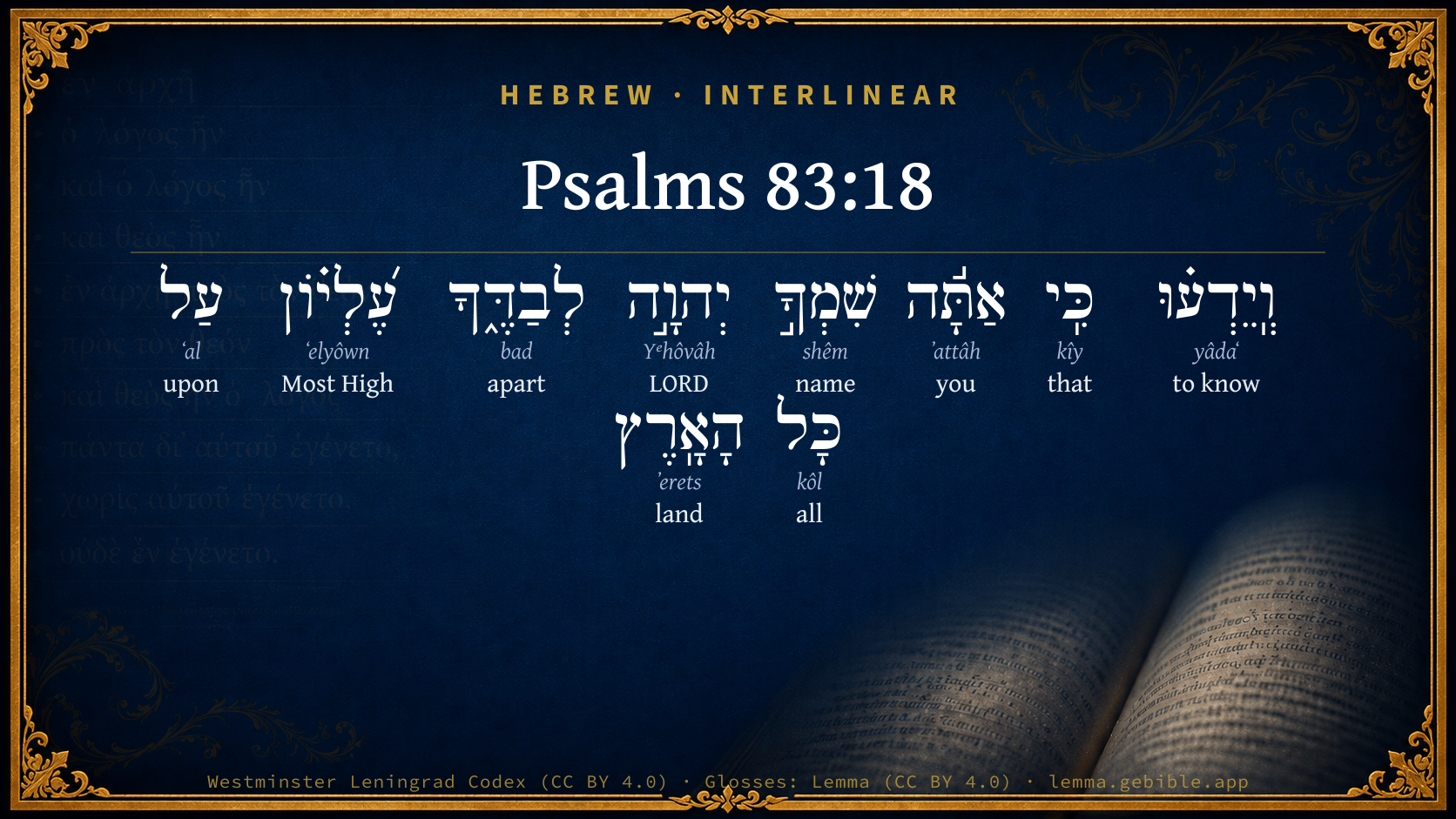
Hebrew (Westminster Leningrad Codex) Psalms 83:18 appears in the Hebrew Old Testament. The text above is from the Westminster Leningrad Codex. Each word links to its Strong’s number, a concise gloss, and parsing drawn from the Open Scriptures Hebrew Bible morphology. Click any word for its full Brown-Driver-Briggs (BDB) entry.
Download image
Cite this verse

Psalms 83:18 (World English Bible). Public Domain. Lemma interlinear Bible study tool, https://lemma.gebible.app/v/psalms/83/18.

Show BibTeX & RIS
BibTeX
RIS
English Translation
That they may know that you alone, whose name is Yahweh, Are the Most High over all the earth.
World English Bible · Public Domain
Download a study sheet

One document with this verse’s original text, its word-by-word gloss line, the meaning frame, cross-references with their text, attributed commentary, and full source and license credits — printable, and it pastes into notes with its structure intact.

This verse Autodidact and up

Study sheet (.html) Plain text (.txt)

A passage Seminary Student

Up to 50 verses in one chapter. A passage sheet keeps up to 6 commentary sources and 12 cross-references per verse, in the order this page ranks them, and says so on the sheet whenever that leaves anything out. Ask for a single verse and you get the Autodidact verse sheet above.

Everything on this page stays free to read, with no account — the sheet is a download of what is already on screen, not access to it.

Want to remove ads? Support Godless Engineer
Compare translations 3

The same verse in 3 English versions, stacked beneath the original-language interlinear above. Click any original word for its lexicon entry.

Each is an independent rendering of the whole verse — the interlinear is not word-aligned to these translations.

Highlighted words mark where these versions differ — a whole-verse word diff, not a word-by-word alignment.

  • World English Bible Public Domain
    That they may know that you alone, whose name is Yahweh, Are the Most High over all the earth.
  • King James Version Public Domain
    That men may know that thou, whose name alone is JEHOVAH, art the most high over all the earth.
  • unfoldingWord Literal Text CC BY-SA 4.0
    And may they know that you, your name Yahweh, you alone the Most High over all of the earth.

unfoldingWord Literal Text — © unfoldingWord, licensed CC BY-SA 4.0. Word-aligned USFM3 via Door43 (git.door43.org/unfoldingWord/en_ult).

Versions to compare (up to 4)

3 of 4 selected

Show all 18 translations

Every available English version of this verse, each an independent rendering of the whole verse.

  • World English Bible Public Domain
    That they may know that you alone, whose name is Yahweh, Are the Most High over all the earth.
  • Berean Standard Bible Public Domain
    May they know that You alone, whose name is the LORD, are Most High over all the earth.
  • Majority Standard Bible Public Domain
    May they know that You alone, whose name is the LORD, are Most High over all the earth.
  • King James Version Public Domain
    That men may know that thou, whose name alone is JEHOVAH, art the most high over all the earth.
  • American Standard Version (1901) Public Domain
    That they may know that thou alone, whose name is Jehovah, Art the Most High over all the earth. Psalm 84 For the Chief Musician; set to the Gittith. A Psalm of the sons of Korah.
  • Revised Version (1885) Public Domain
    That they may know that thou alone, whose name is JEHOVAH, art the Most High over all the earth.
  • Geneva Bible (1599) Public Domain
    That they may knowe that thou, which art called Iehouah, art alone, euen the most High ouer all the earth.
  • Douay-Rheims (1899) Public Domain
    Let them be ashamed and troubled for ever and ever: and let them be confounded and perish.
  • Young's Literal Translation Public Domain
    And they know that Thou -- (Thy name `is' Jehovah -- by Thyself,) `Art' the Most High over all the earth!
  • Literal Standard Version CC BY-SA 4.0
    And they know that You—Your Name [is] YHWH—By Yourself [are] the Most High over all the earth!
  • Unlocked Literal Bible CC BY-SA 4.0
    Then they will know that you alone, Yahweh, are the Most High over all the earth.
  • unfoldingWord Literal Text CC BY-SA 4.0
    And may they know that you, your name Yahweh, you alone the Most High over all of the earth.
  • Darby Bible Public Domain
    That they may know that thou alone, whose name is Jehovah, art the Most High over all the earth.
  • World Messianic Bible Public Domain
    that they may know that you alone, whose name is the LORD, are the Most High over all the earth.
  • Webster's Bible Public Domain
    \\83:17\\Let them be confounded and troubled for ever; yes, let them be put to shame, and perish:
  • Free Bible Version CC BY-SA 4.0
    Let them understand that you alone, called the Lord, are the Most High who rules over all the earth.
  • Bible in Basic English Public Domain
    So that men may see that you only, whose name is Yahweh, are Most High over all the earth.
  • JPS Tanakh (1917) Public Domain
    (83-19) That they may know that it is Thou alone whose name is the LORD, the Most High over all the earth.

Literal Standard Version (2020), Covenant Press — licensed CC BY-SA 4.0. Text via the HelloAO Bible API (eBible.org). Unlocked Literal Bible (unfoldingWord) — licensed CC BY-SA 4.0. Text via the HelloAO Bible API (eBible.org). unfoldingWord Literal Text — © unfoldingWord, licensed CC BY-SA 4.0. Word-aligned USFM3 via Door43 (git.door43.org/unfoldingWord/en_ult). Free Bible Version, Dr. Jonathan Gallagher — licensed CC BY-SA 4.0. Text via the HelloAO Bible API (eBible.org).

Word by word

More ways to search: Search by grammar → Find every occurrence → Compare this word →

Practice this passage: Drill this verse → Learn its vocabulary →

עֶ֝לְי֗וֹן
ʻelyôwn
H5945
“Most High”
Adjective, Adjective, Masculine, Singular, Absolute
Part of Speech
Adjective
Type
Adjective
Gender
Masculine
Number
Singular
State
Absolute
Full BDB Definition

Origin: from H5927

TWOT: 1624g , 1624h

high, upper (adjective) - of Davidic king exalted above monarchs - Highest, Most High (noun masculine) - name of God - of rulers, either monarchs or angel-princes
  1. וְֽיֵדְע֗וּ yâdaʻ H3045 “and · to know” Conjunction + Verb, Qal, Imperfect, 3rd Person, Masculine, Plural
  2. כִּֽי kîy H3588 “that” Conjunction
  3. אַתָּ֬ה ʼattâh H859 “you” Pronoun, Personal, 2nd Person, Masculine, Singular
  4. שִׁמְךָ֣ shêm H8034 “name · your” Noun, Common, Masculine, Singular, Construct + Suffix, Personal, 2nd Person, Masculine, Singular
  5. יְהוָ֣ה Yᵉhôvâh H3068 “LORD” Noun, Proper
  6. לְבַדֶּ֑ךָ bad H905 “to/for · apart · your” Preposition + Noun, Common, Masculine, Singular, Construct + Suffix, Personal, 2nd Person, Masculine, Singular
  7. עַל ʻal H5921 “upon” Preposition
  8. כָּל kôl H3605 “all of” Noun, Common, Masculine, Singular, Construct
  9. הָאָֽרֶץ ʼerets H776 “the · land” Particle, Definite Article + Noun, Common, Both, Singular, Absolute

About this verse

These counts appear in no published source. They are computed here, from the morphology-tagged text and Lemma’s own curated glosses. What Lemma adds →

10
words
10
distinct lemmas
Wisdom
section

Shared distinctive vocabulary

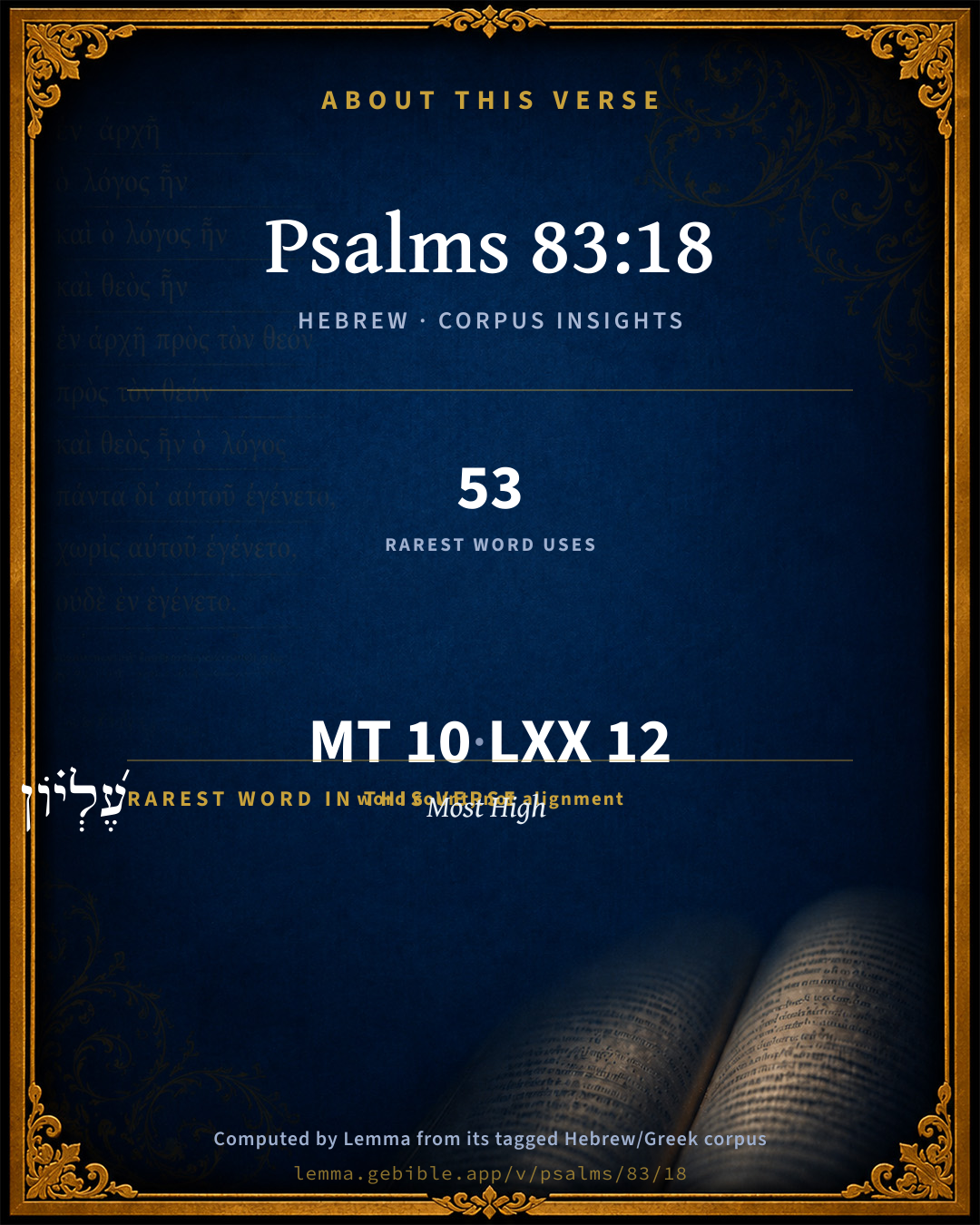
עֶ֝לְי֗וֹן Most High H5945 occurs in 53 verses of the Hebrew Bible. Also found in:

Grammatical profile

  • 1 verb
  • 5 nouns
  • 1 adjective
  • 1 pronoun
  • 1 preposition
  • 1 conjunction

Verb forms

  • וְֽיֵדְע֗וּ Qal · Imperfect

Hebrew & Septuagint length

In English translation the verse runs 19 words from the Hebrew and 19 from the Septuagint (LXX English) — the same length.

A rough comparison of the two English renderings, which tokenize alike — not a word-level alignment.

Word counts can differ between the Hebrew and the Greek without any difference in meaning — e.g. the Hebrew direct-object marker אֵת has no separate Greek word, and Greek often adds the article ὁ.

In the original languages it is 10 Hebrew tokens and 12 Greek tokens — but the two are counted differently (Hebrew bundles its prefixes and suffixes into one token; the Greek is in lemma form), so that isn’t a like-for-like length.

Cross-references

16

Topical passages linked to Psalms 83:18 in the Treasury of Scripture Knowledge — connected by theme and wording, ordered by reader-vote popularity; previews shown in the World English Bible.

  • Exodus 6:3 and I appeared to Abraham, to Isaac, and to Jacob, as God Almighty; but by my name Yahweh I was not known to them.
  • Psalms 59:13 Consume them in wrath. Consume them, and they will be no more. Let them know that God rules in Jacob, To the ends of the earth. Selah.
  • 2 Kings 19:19 Now therefore, Yahweh our God, save you us, I beg you, out of his hand, that all the kingdoms of the earth may know that you Yahweh are God alone.
  • Psalms 97:9 For you, Yahweh, are most high above all the earth. You are exalted far above all gods.
  • Jeremiah 16:21 Therefore, behold, I will cause them to know, this once will I cause them to know my hand and my might; and they shall know that my name is Yahweh.
  • Ezekiel 38:23 I will magnify myself, and sanctify myself, and I will make myself known in the eyes of many nations; and they shall know that I am Yahweh.
  • Isaiah 42:8 I am Yahweh, that is my name; and my glory will I not give to another, neither my praise to engraved images.
  • Ezekiel 30:19 Thus will I execute judgments on Egypt; and they shall know that I am Yahweh.
  • Daniel 4:32 and you shall be driven from men; and they dwelling shall be with the animals of the field; you shall be made to eat grass as oxen; and seven times shall pass over you; until you know that the Most High rules in the kingdom of men, and gives it to whoever he will.
  • 1 Kings 18:37 Hear me, Yahweh, hear me, that this people may know that you, Yahweh, are God, and [that] you have turned their heart back again.
  • Psalms 92:8 But you, Yahweh, are on high forevermore.
  • Isaiah 54:5 For your Maker is your husband; Yahweh of Hosts is his name: and the Holy One of Israel is your Redeemer; the God of the whole earth shall he be called.
  • Micah 4:13 Arise and thresh, daughter of Zion; For I will make your horn iron, And I will make your hoofs brass; And you will beat in pieces many peoples: And I will devote their gain to Yahweh, And their substance to the Lord of the whole earth.
  • Genesis 22:14 Abraham called the name of that place Yahweh-Jireh. As it is said to this day, "In Yahweh's mountain it will be provided.
  • Psalms 9:2 I will be glad and rejoice in you. I will sing praise to your name, O Most High.
  • Psalms 9:16 Yahweh has made himself known. He has executed judgment. The wicked is snared by the work of his own hands. Meditation. Selah.

Cross-references courtesy of OpenBible.info (CC BY 4.0).

Hebrew and Greek witnesses Masoretic Hebrew ↔ Greek Septuagint

The same verse in the two great witnesses to the Old Testament, shown verse-for-verse.

You’re reading Greek Psalm 82 (Hebrew Psalm 83). The Septuagint counts the superscription, so verse numbers can differ from the Hebrew — chapter-level alignment, not verse-by-verse. Numbering follows Rahlfs.

These are two independent witnesses, not word-aligned to each other, and the Septuagint is shown in lemma (dictionary) form.

Hebrew Psalms 83:18 Masoretic · Westminster Leningrad Codex

וְֽיֵדְע֗וּ כִּֽי אַתָּ֬ה שִׁמְךָ֣ יְהוָ֣ה לְבַדֶּ֑ךָ עֶ֝לְי֗וֹן עַל כָּל הָאָֽרֶץ

That they may know that you alone, whose name is Yahweh, Are the Most High over all the earth.

World English Bible · Public Domain

Greek LXX Greek Psalm 82:18 Septuagint · lemma form

αἰσχύνω καί ταράσσω εἰς ὁ αἰών ὁ αἰών καί ἐντρέπω καί ἀποὀλλύω

And let them know that your name is Lord; that you alone are Most High over all the earth.

LXX2012 (modern English Septuagint) · Public Domain

Hebrew: Westminster Leningrad Codex (CC BY 4.0). Greek: Septuagint (public domain); English from LXX2012 (modern English Septuagint) (Public Domain). How the Septuagint differs from the Hebrew →

Commentary

Notes on Psalms 83:18 from classic Christian and Jewish commentators (each source and its license shown beneath its notes). The classic Christian expositions comment on the surrounding passage and are grouped to its opening verse, so a note may address several verses; the Jewish commentaries on the Tanakh (Rashi and others) are per-verse, so they appear only where the commentator wrote on this verse.

Lemma curates 59 commentaries, every one of them public domain or Creative Commons licensed, each selected and text-cleaned for this edition rather than reprinted as found. About our sources →

Adam Clarke's Commentary

Verse 18. That men may know] That they may acknowledge, and be converted to thee. Here is no malice; all is self-defence.

ANALYSIS OF THE EIGHTY-THIRD PSALM

This Psalm divides itself into four parts: -

I. A short ejaculation, Ps 83:1.

II. A complaint against God's enemies, which is the reason of this prayer, Ps 83:2-10.

III. A fearful imprecation against them, Ps 83:12-17.

IV. The charitable ends proposed, Ps 83:18.

I. The ejaculation or prayer: "Keep not thou silence - be not still." Thy enemies are loud in their threatenings, and active in their endeavours, to destroy thy people and thy worship: "Hold not thy peace!"

II. He complains - These are enemies, 1. To thy people, Ps 83:2. 2. To God himself, Ps 83:5. Then he describes them, Ps 83:6-8.

1. They were banditti - spoilers: They "make a tumult," Ps 83:2.

2. Proud and arrogant: "They have lifted up the head," Ps 83:2.

3. They were subtle and crafty: "They have taken crafty counsel," Ps 83:3.

4. They carried their cunning counsel into acts of aggression: "Come, and let us cut them off," c., Ps 83:4.

5. They were conspirators, - 1. Against God. 2. Against his people. All the world against God and his Church! Not an uncommon case.

6. He gives us a catalogue of these conspirators, Ps 83:6-8: Edom, &c.

III. He prays to God against them. In which there are four particulars: 1. Their fall and ruin. 2. Their persecution. 3. Their terror. 4. Their disgrace.

These he illustrates by five similitudes: 1. Of a wheel that, running on, crushes all under it successively. 2. Of stubble or chaff, easily driven away by the wind, Ps 83:13. 3. Of a wood or forest in a state of general conflagration, Ps 83:14. 4. Of a flame that even consumes the mountains, Ps 83:14.

Their fall and ruin he wished to be -

1. Speedy and perpetual: "Do unto them as unto the Midianites," &c., Ps 83:9-13.

2. Sudden and violent: "As fire," Ps 83:13.

3. Terrible and shameful: "Fill their faces with shame," Ps 83:15-16.

There are here three particulars of their punishment: 1. Flight. 2. Terror. 3. Shame and ignominy.

IV. The charitable ends proposed. These were two: -

1. That they might seek after God, be converted to him, Ps 83:16.

2. That they might know him to be Jehovah, the only true God, that they might be saved from all idolatry, Ps 83:18.

The spirit of this prayer is, 1. If they will not seek thee, and be converted, let them be confounded in their attempts against thy people. 2. If they will not acknowledge thee, let them be utterly routed and overthrown: "Let them be put to shame, and perish!"

Adam Clarke's Commentary on the Bible (1810–1826) — public domain. Text from a community e-Sword/MySword module.

Trapp's Complete Commentary

John Trapp

Psa 83:18 That [men] may know that thou, whose name alone [is] JEHOVAH, [art] the most high over all the earth.

Ver. 18. That men may know that thou, whose name alone is Jehovah] The essentiator, Isa 44:6, with Act 17:25 Rev 1:4; Rev 1:8. The Jews pronounce not this name at all, but use Adonai or Elohim for it. The first among the Christians that pronounced it was Petrus Galatinus, following the pronunciation of the Syriacs and Greeks. Genebrard will have it pronounced Jahue, and bitterly inveigheth against Beza and ethers as profaners of God’s name, who call God Jova, or Jehova; vocabulo novo , saith he, barbaro, fictitio, irreligioso et Iovem Gentilium redolente. It is very likely that of this holy and reverend name of God, the Gentiles called their greatest god Jove and Jupiter, that is, Jah-pater (Aug. do Consens. Evang. l. 1, c. 22). Pausanias also telleth us that the poets thus sang unto him, Zευν ην, Zευς εστι, Zευς εσσεται, ω μεγαλε Zευ. And Varro, the most learned of the Romans, thought Jove to be the God of the Jews. But he and all men should have known, as here, that Jehovah is God alone; and so have sought to the Jews (of whom alone was salvation, Joh 4:22) for better understanding in the things of God’s kingdom, acknowledging him to be the most High above all the earth, and contemning minutulos istos deos modo Iovem sibi propitium haberet , as another heathen said.

John Trapp, A Commentary or Exposition upon All the Books of the Old and New Testament (1647–1656) — public domain. Text from a community e-Sword module.

The Biblical Illustrator

Joseph S. Exell

Psa_83:18

That men may know that Thou, whose name alone is Jehovah, art the most high over all the earth.

The inner proofs of God

The age in which we live is frequently characterized as an age of unbelief. Certainly it is an age in which much unbelief comes to the front, aggressively; and hence it is an age of conflict in regard to fundamental verities. The question raised, then, is whether the possible God is unknowable. Is the Absolute unthinkable? From one quarter the response is affirmative. An innumerable host out of all kindreds, tongues, and nations confess that the thought of God is the strongest force in life, the purest comfort in sorrow, the one rock-idea which no storm shakes, as true, as real, as natural, as fruitful as any thought, and more. To them history without that word is a riddle, being a mystery, life a torment, and death a horror. The concurrent testimony of millions affirms the central fact that God is, and the affirmation rests upon the experimental knowledge that He is. The fact is the reality; the knowledge is mans recognition of the reality. Only the unreal is unknowable. It is not, however, a question of majorities. The real point involved is, why does the great mass of mankind think that they can and do cognize God as the focal reality, the spiritual sun in the firmament of being? The data of the theistic argument are all to be found in man. Mr. Morell, adverting to this fact in his History of Philosophy, asks, Do we wish the argument from being? Man in his own conscious dependence has the deepest conviction of that Independent and Absolute One on Whom his own being reposes. Do we wish the argument from design? Man has the most wonderful and perfect of all known organizations. Do we wish the argument from reason and morals? The mind or soul of man is the only accessible repository of both, Man is a microcosm, a world in himself; and contains in himself all the essential proof which the world furnishes of Him who made it. And to those who with Schleiermacher accept the doctrine of immediateness, that is, the consciousness of God as an original and primary act of the soul antecedent to reflection or reasoning, man stands forth as the mirror of God, for it is in the depths of his nature that the two meet face to face. Man looks at himself, into himself, and by studied processes of thought or by sudden leaps of unconscious induction, he arrives at a knowledge of himself. He is not looking to see God in any mystic sense, but he is looking to see proofs of God. We come to the knowledge of God in much the same way as we come to the knowledge of our fellow-men. You could never know me if you did not first know yourself. The proof that I exist is in your existence. The evidence that I think is in your thought. That is to say, from the ascertained premise that you think you draw the conclusion that I think. The Father in heaven, says Dr. Flint, is known just as a father on earth is known. The latter is as unseen as the former. No human being has really ever seen another. No sense has will, or wisdom, or goodness for its object. Man must infer the existence of his fellow-men, for he can have no immediate perception of it; he must become acquainted with their character through the use of his intelligence, because character cannot be heard with the ear, or looked upon with the eye, or touched with the finger. Yet a child is not long in knowing that a spirit is near it. As soon as it knows itself it easily detects a spirit like its own, yet other than itself, when the signs of a spirits activity are presented to it. The process of inference by which it ascends from the works of man to the spirit which origin-ares them is not more legitimate, more simple, and more natural than that by which it rises from nature to natures God. The argument for God is many-sided, but the one determining force in us is that which seems like an instinct, which is original, primary, universal. No formal demonstration of God by trains of syllogistic reasoning could maintain theism through the ages but for the help of this implanted aptitude of the soul to respond to the thought of God. Anselms a priori, beautiful as it is, belongs to trained thinkers, while the millions assert their knowledge of God with the same spontaneous confidence with which a child trusts the proof of parental love. Nature is clearer-headed than philosophy. And is so because Nature looks with all her faculties at the broad landscape of truth, and believes that she sees it, every cliff and scar, every bend of the river and flowery meadow, every forest and nestling cottage. Philosophy, meanwhile, is busy with the mechanism of the eye, and announces that the landscape is a miniature picture painted on the retina--a scientific truth, no doubt! But we are not fashioned to contemplate objects under the lead of a single faculty. We could not appreciate beauty if we should always keep the structure of the organ of vision in mind. We look--we see--we rejoice; we believe that we see what we see, we know that we see, and we know that all men excepting those who have lost the organ of vision see; and if at any time the thought comes to us that what we see is a picture on the retina, we accept the reflection as demonstrating the reality of the landscape, which, however, we did not doubt existed in all its beauty. It was not necessary to corroborate the fact. From the data before us we naturally inferred the reality of the scene by the same law of thought as that by which we rise from the phenomena of our consciousness to the reality of God. Now let us examine some of these phenomena.

1. The great mass of mankind think that they can and do know that there is a God, because they find themselves reaching out into the realm of spirit after a power that is above them in the oft-recurring exigencies of their life, temporal and spiritual, in which they realize their own limitations in respect of strength, wisdom and foresight. This is not a mere impulse of unintelligent despair; it is quite as often the calm instinct of deliberation as the last resort of one who has no other source of help left. It is the refuge alike of childhood and age.

2. Another fact in our self-consciousness presents itself. When we walk out into a public park, the eye falls upon a splendid green sward, smooth as velvet, swelling into graceful curves, with head lands of noble forests jutting out, and islands of rarest flowers dotting its surface. The picture charms us and we seat ourselves in some shady spot to enjoy the Elysian scene. But we resume our stroll, and enter a densely populated slum of the city where the atmosphere is laden with poison, and where crime and vice eat like gangrenes into the souls and bodies of the miserable host. We hasten away with horror from the spot. The impression made upon us by either is distinct and influential, because there is in us an inherent capacity of admiring the beautiful and disliking the hideous. The same capacity exists in regard to the moral quality of things. Some things we plainly perceive to be right and some to be wrong. Being wrong as an idea wears a storm-cloud on its brow, and when it passes into a concrete shape and becomes in us doing wrong, then the storm bursts upon the soul, and it trembles to think that it will be called to account. Deeply implanted in the solid rock of mans nature, these two granite columns ought and ought not rise and form the gateway, through which we pass up to the cognition of an Infinite Judge.

3. How unlike is man to the brutes beneath him! They have their planes, fixed and uniform as a floor of rock, and thereon, through all the circuit of their tame existence, they fulfil their simple destiny. They do not hunger for that which is beyond their reach, but are content to live and die just as they live and die. No dream of happier climes or kindlier destinies ever disturbs them. The fledgling is satisfied with the bough where he was hatched. The lion seeks no other lair than that where he was born. But the soul of man soon gives token of a strange discontent, and when he thinks to settle down, a dream of other things stirs his blood and disturbs his repose. It is as true in the spiritual as in the secular life. Men aspire to higher planes of moral attainment, and even sainthood forgets its grace as it presses on to sublimer achievements in the imitation of God. Does it impair this majestic argument of God drawn from the depths of human consciousness that it does not formulate its postulates in the language of metaphysics? Heine tells us that it was while he was climbing the dizzy heights of dialectics, that the divine homesickness came over him, and led him down to the levels of his kind, where he found God. There is a meadow-land of common-sense realism from which God has chosen to be more distinctly seen, and it is to that familiar spot we have led you to-day. It is there that our analysis of consciousness has revealed the indubitable phenomena that enables us to know that there is a God. The sense of dependence has led us up to a Power above us; the sense of obligation has pointed to an Authority above us; the sense of imperfection has ushered us into the presence of the Perfect Ideal, and the sublime inference of the race--the inference which has controlled history, created civilization, brightened the world with every virtue and grace of true nobility, thrown itself like a rainbow upon the storm of human sorrow, spanned the gulf of eternity with the bridge of hope, that inference is Jehovah. (Bp. W. E. McLaren.)

.

Psa_84:1-12

The Biblical Illustrator, edited by Joseph S. Exell (c. 1880s–1900s) — public domain. Text from a community e-Sword module.

J. A. Alexander on Psalms

Joseph Addison Alexander

19. (Psa 83:18). And (men) shall know that thou, whose name (is) Jehovah, (art) alone Most High over all the earth. The reference here, as in Psa 83:16, is not to the impression made upon the minds of those destroyed, but upon men in general considered as spectators of their fate. See above, on Psa 59:13, and compare 1Sa 17:46, 2Ki 19:19, Isa 37:16; Isa 37:20. The original construction is peculiar: "they shall know that thou—thy name Jehovah—thou alone—art Most High over all the earth." The simple pronoun thou is explained and amplified by the addition of the words, thy name Jehovah, i.e. thou who hast revealed thyself already as the self- existent and eternal God, and as the covenant God of Israel.

Joseph Addison Alexander, The Psalms Translated and Explained (1850) — public domain. Text from a community e-Sword module.

Geneva Bible (1599)

Geneva Bible translators

Though they believe not, yet they may prove by experience, that it is in vain to resist against thy counsel in establishing thy Church.

Geneva Bible (1599) marginal notes — public domain. Text via Bolls.life.

John Calvin's Commentaries

18. And let them know that thou art, thy name Jehovah. It is not the saving knowledge of God which is here spoken of, but that acknowledgement of him which his irresistible power extorts from the wicked. It is not simply said that they will know that there is a God; but a special kind of knowledge is laid down, it being intimated that the heathen who before held the true religion in contempt, would at length perceive that the God who made himself known in the Law, and who was worshipped in Judea, was the only true God. Still, however, it must be remembered, that the knowledge spoken of is only that which is of an evanescent character, having neither root nor the living juice to nourish it; for the wicked will not submit to God willingly and cordially, but are drawn by compulsion to yield a counterfeit obedience, or, being restrained by him, dare not break forth into open outrage. This, then, is an experimental recognition of God which penetrates not to the heart, but is extorted from them by force and necessity. The pronoun אתה, atah, thou, is emphatic, implying a tacit contrast between the God of Israel and all the false gods which were the product of men’s invention. The prayer amounts to this: Lord, make them to know that the idols which they have fabricated for themselves are no gods, and in fact are nothing. The despisers of God may indeed shun the light, and at one time may overcast themselves with clouds, while at another their may plunge into the deep and thick shades of darkness; but He pursues them, and draws them forth to the knowledge of himself, which they would fain bury in ignorance. And as the world indiscriminately and disgracefully applies his sacred name to its own trifling inventions, this profanation is corrected when it is added, thy name Jehovah. This implies that being, or really to be, is in the strict sense applicable to God alone; for although unbelievers may attempt to tear his glory to pieces, he continues perfect and unchanged. The contrast of which I have spoken, must be kept in mind by the reader. A nation has never existed so barbarous as not to have worshipped some deity; but every country forged particular gods for itself. And although the Moabites, the Edomites, and the rest of these nations, admitted that some power and authority belonged to the God of Israel, yet they conceived that this power and authority did not extend beyond the boundaries of Judea. Thus the king of Syria called him, “the God of the hills,” (1 Kings 20:23.) This preposterous and absurd division of God’s glory, which men make, is disproved by one word, and all the superstitions which at that time prevailed in the world are overthrown, when the Prophet attributes to the God of Israel, as well the essence of Deity as the name; for unless all the idols of the heathen are completely abolished, he will not obtain, alone and unshared, the name of Jehovah. Accordingly, it is added, Thou alone art the Most High over all the earth; a statement which is worthy of our most careful attention. The superstitious commonly think it enough to leave God his name, that is to say, two or three syllables; and in the meantime they fritter away his power, as if his majesty were contained in an empty title. Let us then remember that God does not receive that honor among men to which he is entitled, if he is not allowed to possess his own inherent sovereignty, and if his glory is obscured by setting up other objects against him with antagonist claims.

John Calvin's Commentaries (1540-1563) — public domain. Text from the Calvin Translation Society English edition (1840s-50s) via the Christian Classics Ethereal Library (ccel.org). Calvin's coverage is partial (roughly two-thirds of the Bible); uncommented books and verses are honest gaps, never fabricated. The 19th-century editor's footnotes and remarks are omitted so the notes are faithfully Calvin's own voice.

The Cambridge Bible for Schools and Colleges

gen. ed. J. J. S. Perowne

18. That they may know that thou, whose name is JEHOVAH, even thou alone,

Art the Most High over all the earth.

The primary object of chastisement is conversion (Psa_83:16); but if they will not acknowledge Israel’s God as the God of revelation, let them be compelled by reiterated judgements to recognise Him as the Almighty Ruler. Cp. Isa_37:20; 2Ch_20:29. The ruin with which they threaten God’s people will recoil upon themselves (Psa_6:10; Psa_35:4; Psa_35:26). For ‘know’ see Psa_59:13 : and generally, cp. Psa_97:8-9; Isa_26:9-11.

The Cambridge Bible for Schools and Colleges (gen. ed. J. J. S. Perowne; Cambridge University Press, 1878–1918) — public domain. Text from a community e-Sword module.

John Gill's Exposition

That men may know that thou, whose name alone is Jehovah,.... Or, "that thou, thy name alone is Jehovah" (p), a self-existent Being, the Being of beings, the everlasting I AM, the immutable God; for this name is expressive of the being, eternity, and unchangeableness of God, who is, and was, and is to come, invariably the same, Rev 1:4 which is to be understood not to the exclusion of the Son or Spirit, who are with the Father the one Jehovah, Deu 6:4, and to whom this name is given; see Exo 17:6, compared with Co1 10:9, Isa 6:8 compared with Act 28:25, but to the exclusion of all nominal and fictitious deities, the gods of the Heathens; and the being and perfections of God are known by the judgments he executes, Psa 9:16,

art the most High over all the earth; or,

and that thou art, &c. (q), being the Maker and the Possessor of it, and the sovereign Lord of its inhabitants, doing in it what seems good in his sight; see Gen 14:22, for the accents require two propositions in the text: the Heathens (r) give the title of most high to their supreme deity: the Targum is,

"over all the inhabitants of the earth.''

(p) "quod nomen tuum", Pagninus, Montanus, Musculus. (q) "Quod tu, inquam, sis altissimus", Michaelis. (r) Pansan. Boeotica sive, l. 9. p. 555.

Next: Psalms Chapter 84

John Gill's Exposition of the Whole Bible (1746–1763) — public domain (CC PDM 1.0). Text via the HelloAO Bible API.

Albert Barnes' Notes on the Bible

That men may know - That all people may be impressed with the belief that thou art the true and only God. This was the design and aim of the prayer in the psalm. It was that there might be such a manifestation of the power of God; that it might be so evident that the events which had occurred could be traced to no other source than God himself, that all people might be led to honor him.

That thou whose name alone is Jehovah - To whom alone this name belongs; to whom alone it can be properly ascribed. This was the special name by which God chose to be known. Exo 6:3. Compare the notes at Isa 42:8. On the word Jehovah - יהוה Yahweh - see the notes at Psa 68:4. It is found in combination, in Gen 22:14; Exo 17:15; Jdg 6:24; Eze 48:35; Jer 23:6; Jer 33:16.

Art the Most High over all the earth - Thou art the Supreme God, ruling over all people. Thy dominion is so absolute over nations, even when combined together, and thy power is so complete in foiling their plans, and disconcerting their purposes, that it is clear that thou dost reign over them. He that could break up such a combination - he that could rescue his people from such an allied force - must have all power over the nations - must be the true God.

Albert Barnes' Notes on the Bible (1834–1885) — public domain. Text from a community e-Sword/MySword module.

Matthew Poole's English Annotations

That men may know, or that they may know, to wit, by costly experience, even by their own ruin, what they would not know by information for their own good, that thou art the Most High, the most high God, and the God not only of his people Israel, as the heathen fancied, and as their gods were confined to their particular and several territories, but the God and Governor of all the nations and parts of the earth.

Matthew Poole's English Annotations on the Holy Bible (1683–1685) — public domain. Text from a community e-Sword/MySword module.

The Treasury of David

Charles H. Spurgeon

Ver. 18. That men may know that thou, whose name alone is JEHOVAH, art the most high over all the earth. Hearing of the Lord's marvellous deeds in defeating such a numerous confederacy, the very heathen would be compelled to acknowledge the greatness of Jehovah. We read in 2Ch 20:30, that the fear of God was on all the neighbouring kingdoms when they heard that Jehovah fought against the enemies of Israel. Jehovah is essentially the Most High. He who is self existent is infinitely above all creatures, all the earth is but his footstool. The godless race of man disregards this, and yet at times the wonderful works of the Lord compel the most unwilling to adore his majesty. Thus has this soul stirring lyric risen from the words of complaint to those of adoration; let us in our worship always seek to do the same. National trouble called out the nation's poet laureate, and well did he discourse at once of her sorrows, and prayers, and hopes. Sacred literature thus owes much to sorrow and distress. How enriching is the hand of adversity! The following attempt to verify the Psalm, and tune it to gospel purposes, is submitted with great diffidence.

O God, be thou no longer still,

Thy foes are leagued against thy law;

Make bare thine arm on Zion's hill,

Great Captain of our Holy War.

As Amalek and Ishmael

Had war for ever with thy seed,

So all the hosts of Rome and hell

Against the Son their armies led.

Though they are agreed in nought beside,

Against thy truth they all unite;

They rave against the Crucified,

And hate the gospel's growing might.

By Kishon's brook all Jabin's band

At thy rebuke were swept away;

O Lord, display thy mighty hand,

A single stroke shall win the day.

Come, rushing wind, the stubble chase!

Come, sacred fire, the forests burn!

Come, Lord, with all thy conquering grace,

Rebellious hearts to Jesus turn!

That men may know at once that thou,

Jehovah, lovest truth right well;

And that thy church shall never bow

Before the boastful gates of hell.

Ver. 18. That men may know that thou, whose name alone is JEHOVAH, etc. Early English History informs us, that some bloodthirsty persecutors were marching on a band of Christians. The Christians, seeing them approaching, marched out towards them, and at the top of their voices, shouted, "Hallelujah, hallelujah!" (Praise Jehovah). The name of the Lord being presented, the rage of the persecutors abated. Josephus says, that the Great Alexander, when on his triumphal march, being met near Jerusalem by the Jewish high priest, on whose mitre was engraved the name of Jehovah, "approached by himself and adored that name, "and was disarmed of his hostile intent. There was significance and power in the glorious old name as written by the Jews. But the name of Jesus is now far more mighty in the world than was the name Jehovah in these earlier ages. "The Dictionary of Illustrations, " 1872.

Ver. 18. JEHOVAH is one of the incommunicable names of God, which signifies his eternal essence. The Jews observe that in God's name Jehovah the Trinity is implied. Je signifies the present tense, ho the preterperfect tense, vah, the future. The Jews also observe that in his name Jehovah all the Hebrew letters are literae quiescentes, that denotes rest, implying that in God and from God is all our rest. Every gracious soul is like Noah's dove, he can find no rest nor satisfaction but in God. God alone is the godly man's ark of rest and safety. Jehovah is the incommunicable name of God, and is never attributed to any but God: Thou, whose name alone is JEHOVAH.

Ver. 18. The most high. His being the High and lofty One, notes forth the transcendancy and super excellency of his divine being in himself, and that it is utterly of another kind from creatures, and indeed that it only is truly being. When the Psalmist says, That men may know that thou, whose name alone in JEHOVAH art the MOST HIGH over all the earth, he thereby argues his height from his name, that his name is alone Jehovah, and therefore he is most high, and in that very respect. Now Jehovah is the name of his essence, "I AM, " and he is MOST HIGH in respect of such a glorious being as is proper alone unto him. Thomas Goodwin.

Ver. 18. The Golden Lesson: how taught, to whom, by whom, through whom?

Charles H. Spurgeon's The Treasury of David (1869–1885) — public domain. Psalms only. Text from a community e-Sword/MySword module.

Whedon's Commentary on the Bible

Daniel D. Whedon

18. That men may know—The knowing God which is here intended, is a true perception and discovery of his supremacy over all gods and all nations of the earth. This, as in Psa_83:16, might possibly lead to repentance and true submission. The ultimate idea of knowledge unto salvation must not be excluded, but first of all their armament must be crushed, their plans defeated, their faces filled with shame, and they terrified and swept away in a tempest of wrath, that they may see their gods are nothing, and that they may know that “the Most High ruleth in the kingdom of men.” See Dan_4:17; Dan_4:34-37; Psa_59:13; 1Sa_17:46.

Daniel D. Whedon (gen. ed.), Commentary on the Old and New Testaments (1874–1909) — public domain. Text from a community e-Sword module.

The Pulpit Commentary

That men may know; rather, that they may know. There is no "men" in the original. That thou, whose name alone is Jehovah, art the Most High over all the earth (see the comment on ver. 16).

The Pulpit Commentary (1880–1919), ed. H.D.M. Spence-Jones & Joseph S. Exell — public domain. Text from a community e-Sword module.

unfoldingWord translationNotes

Door43 World Missions Community

Then they will know

This can also be stated as the writer making a request to God. AT: "Cause them to know"

are the Most High over all the earth

God ruling over everything in the earth is spoken of as if he were elevated higher than everything else. AT: "are supreme, and you rule all things on the earth" (See: Metaphor)

translationWords

Yahweh

Most High

unfoldingWord translationNotes — © Distant Shores Media and the Door43 World Missions Community, licensed CC BY-SA 4.0. Source: git.door43.org/Door43/en_tn.

Lesson kit

Teaching starters — assembled from the data on this page, not authored interpretation. Every prompt links to the verse data it draws on. Edit before teaching.

Psalms, in the Wisdom, opens this verse with 10 words (10 distinct Hebrew lemmas). Its most distinctive word is ʻelyôwn (“Most High”). A historical commentator’s framing appears above. Read the whole chapter for the surrounding context.

Discussion questions

  1. What does “Most High” (ʻelyôwn) contribute to the verse as a whole?
  2. Genesis 14:18 shares the word «Most High» with this verse. How do the two illuminate each other?
  3. The translations on this page render this verse differently — a whole-verse word diff, not a word-by-word alignment. What might account for the different wordings?
  4. The verb «וְֽיֵדְע֗וּ» is Qal Imperfect. How does its form color the action?
  5. Reading how Adam Clarke's Commentary and Trapp's Complete Commentary read this verse, where do the two commentators agree and where do they part?

Things to notice

Reading settings

Reading text

Shown beneath each verse's original-language words.

Old Testament
Old Testament edition

Read the OT as the Masoretic Hebrew (MT) or the Greek Septuagint (LXX).

English shown for the Greek Septuagint (in the Hebrew ↔ Greek comparison).

Comparing translations? Open the Compare panel on any verse page to stack up to four side by side.