Isaiah 44:25

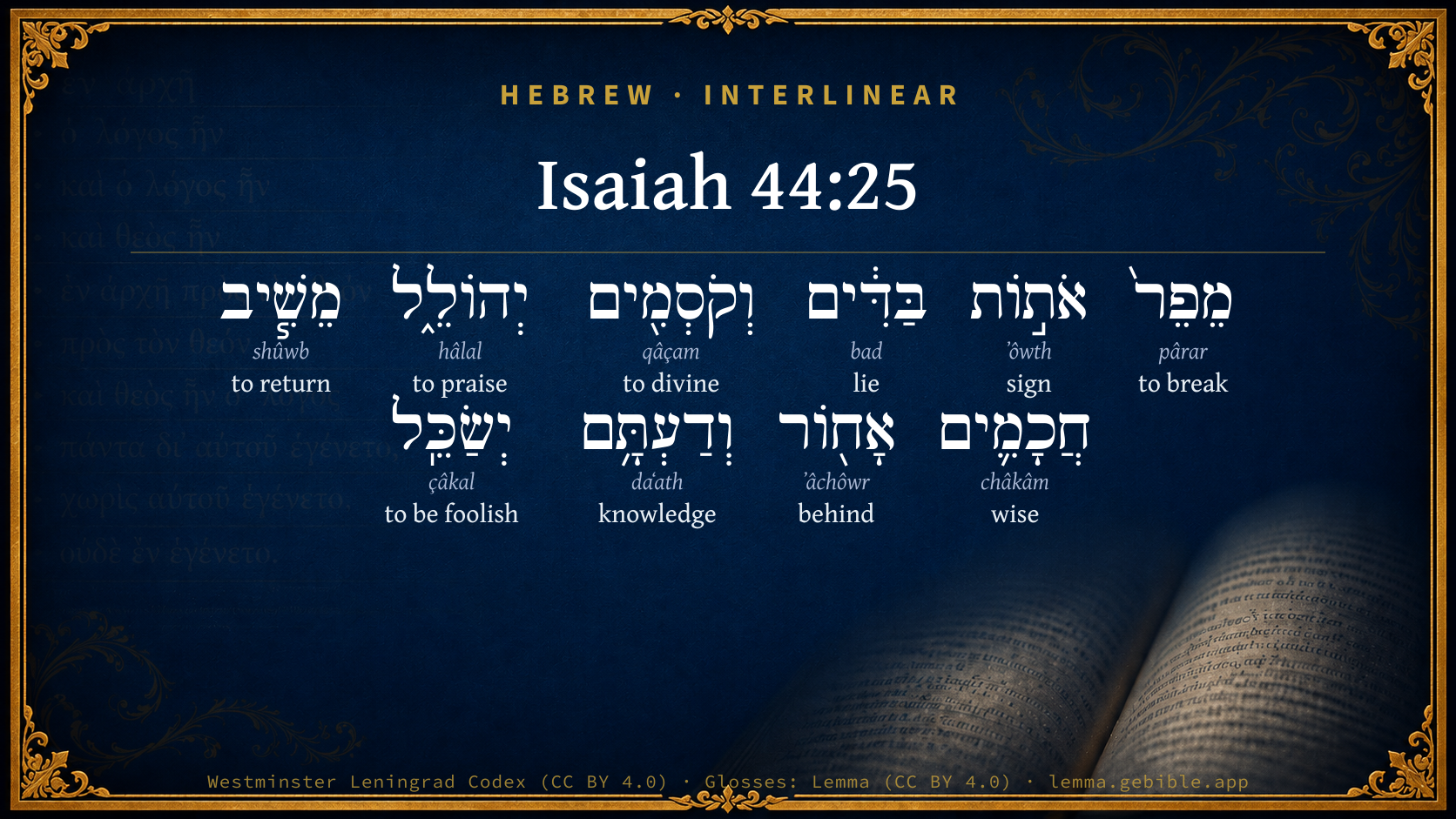
Hebrew (Westminster Leningrad Codex) Isaiah 44:25 appears in the Hebrew Old Testament. The text above is from the Westminster Leningrad Codex. Each word links to its Strong’s number, a concise gloss, and parsing drawn from the Open Scriptures Hebrew Bible morphology. Click any word for its full Brown-Driver-Briggs (BDB) entry.
Download image
Cite this verse

Isaiah 44:25 (World English Bible). Public Domain. Lemma interlinear Bible study tool, https://lemma.gebible.app/v/isaiah/44/25.

Show BibTeX & RIS
BibTeX
RIS
English Translation
who frustrates the signs of the liars, and makes diviners mad; who turns wise men backward, and makes their knowledge foolish;
World English Bible · Public Domain
Download a study sheet

One document with this verse’s original text, its word-by-word gloss line, the meaning frame, cross-references with their text, attributed commentary, and full source and license credits — printable, and it pastes into notes with its structure intact.

This verse Autodidact and up

Study sheet (.html) Plain text (.txt)

A passage Seminary Student

Up to 50 verses in one chapter. A passage sheet keeps up to 6 commentary sources and 12 cross-references per verse, in the order this page ranks them, and says so on the sheet whenever that leaves anything out. Ask for a single verse and you get the Autodidact verse sheet above.

Everything on this page stays free to read, with no account — the sheet is a download of what is already on screen, not access to it.

Want to remove ads? Support Godless Engineer
Compare translations 3

The same verse in 3 English versions, stacked beneath the original-language interlinear above. Click any original word for its lexicon entry.

Each is an independent rendering of the whole verse — the interlinear is not word-aligned to these translations.

Highlighted words mark where these versions differ — a whole-verse word diff, not a word-by-word alignment.

  • World English Bible Public Domain
    who frustrates the signs of the liars, and makes diviners mad; who turns wise men backward, and makes their knowledge foolish;
  • King James Version Public Domain
    That frustrateth the tokens of the liars, and maketh diviners mad; that turneth wise men backward, and maketh their knowledge foolish;
  • unfoldingWord Literal Text CC BY-SA 4.0
    the one thwarting the signs of liars, and he discredits diviners; the one turning back the wise, and he makes their knowledge foolish,

unfoldingWord Literal Text — © unfoldingWord, licensed CC BY-SA 4.0. Word-aligned USFM3 via Door43 (git.door43.org/unfoldingWord/en_ult).

Versions to compare (up to 4)

3 of 4 selected

Show all 18 translations

Every available English version of this verse, each an independent rendering of the whole verse.

  • World English Bible Public Domain
    who frustrates the signs of the liars, and makes diviners mad; who turns wise men backward, and makes their knowledge foolish;
  • Berean Standard Bible Public Domain
    who foils the signs of false prophets and makes fools of diviners, who confounds the wise and turns their knowledge into nonsense,
  • Majority Standard Bible Public Domain
    who foils the signs of false prophets and makes fools of diviners, who confounds the wise and turns their knowledge into nonsense,
  • King James Version Public Domain
    That frustrateth the tokens of the liars, and maketh diviners mad; that turneth wise men backward, and maketh their knowledge foolish;
  • American Standard Version (1901) Public Domain
    that frustrateth the signs of the liars, and maketh diviners mad; that turneth wise men backward, and maketh their knowledge foolish;
  • Revised Version (1885) Public Domain
    that frustrateth the tokens of the liars, and maketh diviners mad; that turneth wise men backward, and maketh their knowledge foolish:
  • Geneva Bible (1599) Public Domain
    I destroy the tokens of ye southsayers, and make them that coniecture, fooles, and turne the wise men backwarde, and make their knowledge foolishnesse.
  • Douay-Rheims (1899) Public Domain
    That make void the tokens of diviners, and make the soothsayers mad. That turn the wise backward, and that, make their knowledge foolish.
  • Young's Literal Translation Public Domain
    Making void the tokens of devisers, And diviners it maketh mad, Turning the wise backward, And their knowledge it maketh foolish.
  • Literal Standard Version CC BY-SA 4.0
    Making void the tokens of devisers, || And makes diviners mad, || Turning the wise backward, || And makes their knowledge foolish.
  • Unlocked Literal Bible CC BY-SA 4.0
    I who frustrate the omens of the empty talkers and who disgrace those who read omens; I who overturn the wisdom of the wise and make their advice foolish.
  • unfoldingWord Literal Text CC BY-SA 4.0
    the one thwarting the signs of liars, and he discredits diviners; the one turning back the wise, and he makes their knowledge foolish,
  • Darby Bible Public Domain
    -- he that frustrateth the tokens of the liars, and maketh diviners mad; that turneth wise men backward, and maketh their knowledge foolish;
  • World Messianic Bible Public Domain
    who frustrates the signs of the liars, and makes diviners mad; who turns wise men backward, and makes their knowledge foolish;
  • Webster's Bible Public Domain
    That frustrateth the tokens of the liars, and maketh diviners mad; that turneth wise men backward, and maketh their knowledge foolish;
  • Free Bible Version CC BY-SA 4.0
    I am the one who proves the signs of false prophets are wrong. I am the one who makes fools of fortune-tellers. I turn the wisdom of the wise upside down, and make their knowledge ridiculous.
  • Bible in Basic English Public Domain
    Who makes the signs of those who give word of the future come to nothing, so that those who have knowledge of secret arts go off their heads; turning the wise men back, and making their knowledge foolish:
  • JPS Tanakh (1917) Public Domain
    That frustrateth the tokens of the imposters, and maketh diviners mad; that turneth wise men backward, and maketh their knowledge foolish;

Literal Standard Version (2020), Covenant Press — licensed CC BY-SA 4.0. Text via the HelloAO Bible API (eBible.org). Unlocked Literal Bible (unfoldingWord) — licensed CC BY-SA 4.0. Text via the HelloAO Bible API (eBible.org). unfoldingWord Literal Text — © unfoldingWord, licensed CC BY-SA 4.0. Word-aligned USFM3 via Door43 (git.door43.org/unfoldingWord/en_ult). Free Bible Version, Dr. Jonathan Gallagher — licensed CC BY-SA 4.0. Text via the HelloAO Bible API (eBible.org).

Word by word

More ways to search: Search by grammar → Find every occurrence → Compare this word →

Practice this passage: Drill this verse → Learn its vocabulary →

בַּדִּ֔ים
bad
H907
“lies”
Noun, Common, Masculine, Plural, Absolute
Part of Speech
Noun
Type
Common
Gender
Masculine
Number
Plural
State
Absolute
Full BDB Definition

Origin: from H908

TWOT: 202a

empty talk, idle talk, liar, lie
  1. מֵפֵר֙ pârar H6565 “breaking” Verb, Hiphil, Participle Active, Masculine, Singular, Absolute
  2. אֹת֣וֹת ʼôwth H226 “signs of” Noun, Common, Both, Plural, Construct
  3. וְקֹסְמִ֖ים qâçam H7080 “and · divining” Conjunction + Verb, Qal, Participle Active, Masculine, Plural, Absolute
  4. יְהוֹלֵ֑ל hâlal H1984 “to praise” Verb, Piel, Imperfect, 3rd Person, Masculine, Singular
  5. מֵשִׁ֧יב shûwb H7725 “returning” Verb, Hiphil, Participle Active, Masculine, Singular, Absolute
  6. חֲכָמִ֛ים châkâm H2450 “wise” Adjective, Adjective, Masculine, Plural, Absolute
  7. אָח֖וֹר ʼâchôwr H268 “behind” Noun, Common, Masculine, Singular, Absolute
  8. וְדַעְתָּ֥ם daʻath H1847 “and · knowledge · their” Conjunction + Noun, Common, Feminine, Singular, Construct + Suffix, Personal, 3rd Person, Masculine, Plural
  9. יְשַׂכֵּֽל çâkal H5528 “to be foolish” Verb, Piel, Imperfect, 3rd Person, Masculine, Singular

About this verse

These counts appear in no published source. They are computed here, from the morphology-tagged text and Lemma’s own curated glosses. What Lemma adds →

10
words
10
distinct lemmas
Prophets
section

Notable vocabulary

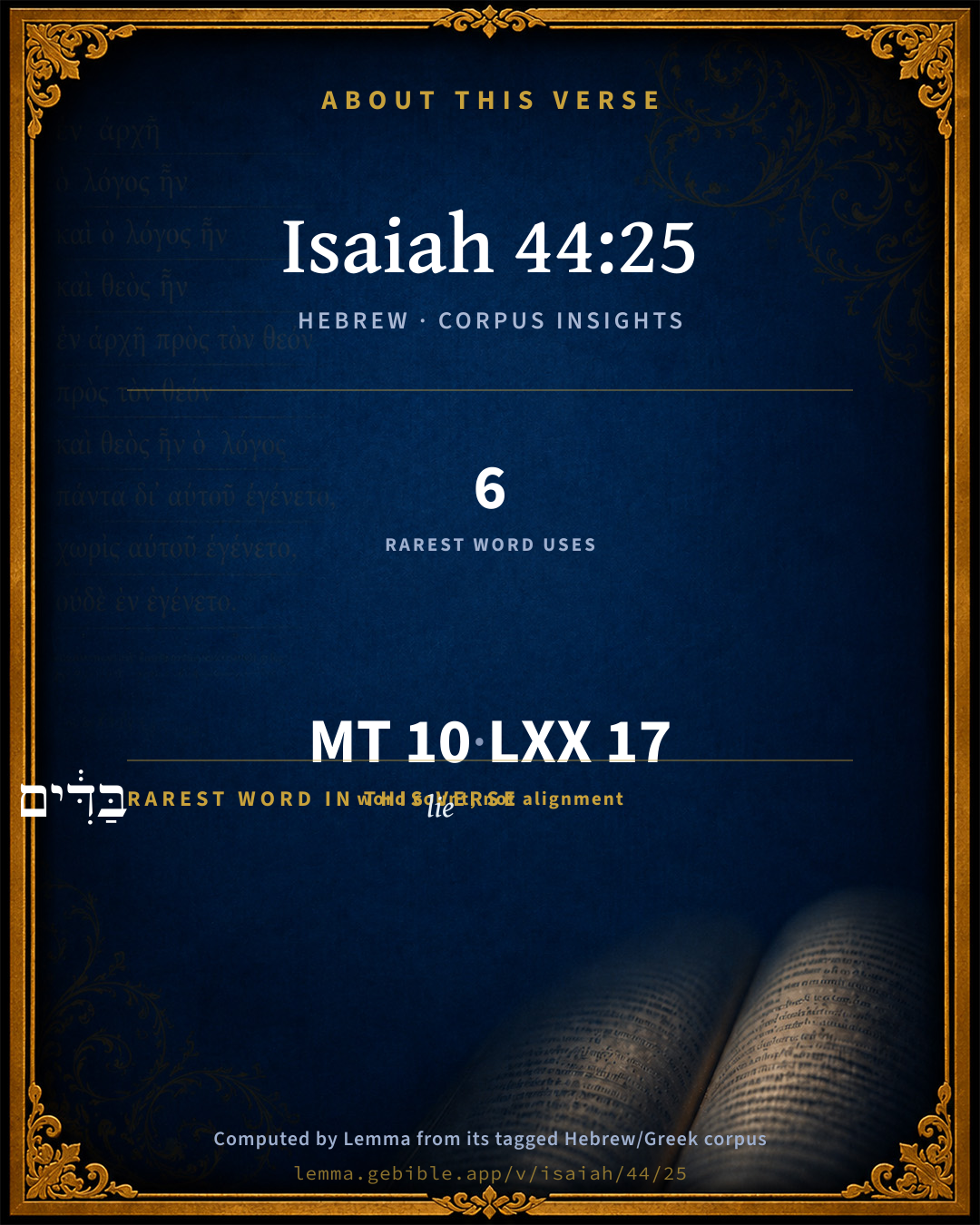
The rarest word here is בַּדִּ֔ים lie H907 — appearing just 6 times in the whole Hebrew Bible.

Shared distinctive vocabulary

בַּדִּ֔ים lie H907 occurs in 6 verses of the Hebrew Bible. Also found in:

Grammatical profile

  • 5 verbs
  • 4 nouns
  • 1 adjective

Verb forms

  • מֵפֵר֙ Hiphil · Participle Active
  • וְקֹסְמִ֖ים Qal · Participle Active
  • יְהוֹלֵ֑ל Piel · Imperfect
  • מֵשִׁ֧יב Hiphil · Participle Active
  • יְשַׂכֵּֽל Piel · Imperfect

Hebrew & Septuagint length

In English translation the verse runs 21 words from the Hebrew and 28 from the Septuagint (LXX English) — closely comparable.

A rough comparison of the two English renderings, which tokenize alike — not a word-level alignment.

Word counts can differ between the Hebrew and the Greek without any difference in meaning — e.g. the Hebrew direct-object marker אֵת has no separate Greek word, and Greek often adds the article ὁ.

In the original languages it is 10 Hebrew tokens and 17 Greek tokens — but the two are counted differently (Hebrew bundles its prefixes and suffixes into one token; the Greek is in lemma form), so that isn’t a like-for-like length.

Cross-references

25

Topical passages linked to Isaiah 44:25 in the Treasury of Scripture Knowledge — connected by theme and wording, ordered by reader-vote popularity; previews shown in the World English Bible.

  • Psalms 33:10 Yahweh brings the counsel of the nations to nothing. He makes the thoughts of the peoples to be of no effect.
  • Job 5:12–14 He frustrates the devices of the crafty, So that their hands can't perform their enterprise.
  • 2 Samuel 15:31 One told David, saying, Ahithophel is among the conspirators with Absalom. David said, Yahweh, please turn the counsel of Ahithophel into foolishness.
  • Jeremiah 50:36 A sword is on the boasters, and they shall become fools; a sword is on her mighty men, and they shall be dismayed.
  • Isaiah 47:12–14 Stand now with your enchantments, and with the multitude of your sorceries, in which you have labored from your youth; if so be you shall be able to profit, if so be you may prevail.
  • Jeremiah 51:57 I will make drunk her princes and her wise men, her governors and her deputies, and her mighty men; and they shall sleep a perpetual sleep, and not wake up, says the King, whose name is Yahweh of Hosts.
  • 1 Corinthians 1:20–27 Where is the wise? Where is the scribe? Where is the lawyer of this world? Hasn't God made foolish the wisdom of this world?
  • Isaiah 29:14 therefore, behold, I will proceed to do a marvelous work among this people, even a marvelous work and a wonder; and the wisdom of their wise men shall perish, and the understanding of their prudent men shall be hid.
  • Isaiah 19:11–14 The princes of Zoan are utterly foolish; the counsel of the wisest counselors of Pharaoh is become brutish: how do you say to Pharaoh, I am the son of the wise, the son of ancient kings?
  • Jeremiah 27:9–10 But as for you, don't you listen to your prophets, nor to your diviners, nor to your dreams, nor to your soothsayers, nor to your sorcerers, who speak to you, saying, You shall not serve the king of Babylon:
  • Daniel 5:6–8 Then the king's face was changed in him, and his thoughts troubled him; and the joints of his loins were loosened, and his knees struck one against another.
  • 1 Corinthians 3:19–20 For the wisdom of this world is foolishness with God. For it is written, "He has taken the wise in their craftiness."
  • Exodus 9:11 The magicians couldn't stand before Moses because of the boils; for the boils were on the magicians, and on all the Egyptians.
  • 2 Samuel 16:23 The counsel of Ahithophel, which he gave in those days, was as if a man inquired at the oracle of God: so was all the counsel of Ahithophel both with David and with Absalom.
  • 2 Samuel 17:23 When Ahithophel saw that his counsel was not followed, he saddled his donkey, and arose, and got him home, to his city, and set his house in order, and hanged himself; and he died, and was buried in the tomb of his father.
  • 1 Kings 22:11–12 Zedekiah the son of Chenaanah made him horns of iron, and said, Thus says Yahweh, With these shall you push the Syrians, until they be consumed.
  • 1 Kings 22:22–25 Yahweh said to him, 'How?' He said, 'I will go forth, and will be a lying spirit in the mouth of all his prophets.' He said, 'You shall entice him, and shall prevail also: go forth, and do so.'
  • 2 Chronicles 18:11 All the prophets prophesied so, saying, Go up to Ramoth-gilead, and prosper; for Yahweh will deliver it into the hand of the king.
  • 2 Chronicles 18:34 The battle increased that day: however the king of Israel stayed himself up in his chariot against the Syrians until the even; and about the time of the going down of the sun he died.
  • Jeremiah 28:9–17 The prophet who prophesies of peace, when the word of the prophet shall happen, then shall the prophet be known, that Yahweh has truly sent him.
  • Jeremiah 49:7 Of Edom. Thus says Yahweh of Hosts: Is wisdom no more in Teman? is counsel perished from the prudent? is their wisdom vanished?
  • Daniel 1:20 In every matter of wisdom and understanding, concerning which the king inquired of them, he found them ten times better than all the magicians and enchanters who were in all his realm.
  • Daniel 2:10–12 The Chaldeans answered before the king, and said, There is not a man on the earth who can show the king's matter, because no king, lord, or ruler, has asked such a thing of any magician, or enchanter, or Chaldean.
  • Daniel 4:7 Then came in the magicians, the enchanters, the Chaldeans, and the soothsayers; and I told the dream before them; but they did not make known to me the interpretation of it.
  • 1 Kings 22:37 So the king died, and was brought to Samaria; and they buried the king in Samaria.

Cross-references courtesy of OpenBible.info (CC BY 4.0).

Hebrew and Greek witnesses Masoretic Hebrew ↔ Greek Septuagint

The same verse in the two great witnesses to the Old Testament, shown verse-for-verse.

These are two independent witnesses, not word-aligned to each other, and the Septuagint is shown in lemma (dictionary) form.

Hebrew Isaiah 44:25 Masoretic · Westminster Leningrad Codex

מֵפֵר֙ אֹת֣וֹת בַּדִּ֔ים וְקֹסְמִ֖ים יְהוֹלֵ֑ל מֵשִׁ֧יב חֲכָמִ֛ים אָח֖וֹר וְדַעְתָּ֥ם יְשַׂכֵּֽל

who frustrates the signs of the liars, and makes diviners mad; who turns wise men backward, and makes their knowledge foolish;

World English Bible · Public Domain

Greek LXX Isaiah 44:25 Septuagint · lemma form

διασκεδάζω σημεῖον ἐγγαστρίμυθος καί μαντεία ἀπό καρδία ἀποστρέφω φρόνιμος εἰς ὁ ὀπίσω καί ὁ βουλή αὐτός μωρεύω

Who else will frustrate the tokens of those that have divining spirits, and prophecies from the heart of man? turning the wise back, and making their counsel foolishness;

LXX2012 (modern English Septuagint) · Public Domain

Hebrew: Westminster Leningrad Codex (CC BY 4.0). Greek: Septuagint (public domain); English from LXX2012 (modern English Septuagint) (Public Domain). How the Septuagint differs from the Hebrew →

Targum (Aramaic paraphrase)

1

The Targum is the ancient Jewish Aramaic paraphrase of the Hebrew Scriptures — an interpretive translation, not the Hebrew text itself. Onkelos (literal) and Pseudo-Jonathan (expansive) render the Torah, and Jonathan the Prophets. Coverage is partial: where no permissively-licensed English translation exists for a verse, only the Aramaic is shown. This is verse-level text, not a word-by-word alignment to the Hebrew.

  1. Targum Jonathan Prophets (Joshua–Malachi)
    מְבַטֵל אֶתְוָת בַּדִין וְקִסוּמִין מְשַׁגֵשׁ מַתִיב חַכִּימָא לַאֲחוֹרָא וְדַעְתְּהוֹן מְקַלְקֵל:

    That frustrateth the tokens of the liars, and maketh diviners mad; that turneth wise men backward, and bringeth their knowledge into contempt.

    Targum Jonathan — Aramaic: “Mikraot Gedolot” (public domain). English: “Sefaria Community Translation” (CC0 1.0 (public-domain dedication)); “London "Chaldee Paraphrase," 1871” (public domain). Text via Sefaria.

Commentary

Notes on Isaiah 44:25 from classic Christian and Jewish commentators (each source and its license shown beneath its notes). The classic Christian expositions comment on the surrounding passage and are grouped to its opening verse, so a note may address several verses; the Jewish commentaries on the Tanakh (Rashi and others) are per-verse, so they appear only where the commentator wrote on this verse.

Lemma curates 59 commentaries, every one of them public domain or Creative Commons licensed, each selected and text-cleaned for this edition rather than reprinted as found. About our sources →

Trapp's Complete Commentary

John Trapp

Isa 44:25 That frustrateth the tokens of the liars, and maketh diviners mad; that turneth wise [men] backward, and maketh their knowledge foolish;

Ver. 25. That frustrateth the tokens of the liars.] Their false prognostics of the long lastingness of the Babylonian empire, and therefore no likelihood of the Jews’ enlargement.

And maketh diviners mad.] Diviners, the Latins call soothsayers and such fellows, by a term that is altogether too good for them. Quum sint potius diabolici, saith Piscator, since they are rather devils incarnate than divines. By a like form of speech Alsted {a} said of his Germans, that if the Sabbath day should be named according to their observing of it, Daemoniacus potius quam Dominicus diceretur.

That turneth wise men backward.] The world’s wizards, who approved of that which the diviners affirmed, judging according to outward appearance, &c.

{a} In Encyclop.

John Trapp, A Commentary or Exposition upon All the Books of the Old and New Testament (1647–1656) — public domain. Text from a community e-Sword module.

Tyndale Open Study Notes

Tyndale Open Resources

44:25 False prophets and fortune-tellers used forbidden forms of divination to try to predict the future. Eventually God would expose them as deluded liars (see 3:2; 9:15; 47:13; Deut 18:10-11).

Tyndale Open Study Notes — © Tyndale Open Resources, licensed CC BY-SA 4.0. Text via the HelloAO Bible API.

Geneva Bible (1599)

Geneva Bible translators

He armeth them against the soothsayers of Babylon, which would have borne them in hand, that they knew by the stars, that God would not deliver them, and that Babylon should stand.

Geneva Bible (1599) marginal notes — public domain. Text via Bolls.life.

Jamieson, Fausset & Brown

Robert Jamieson, A. R. Fausset & David Brown

tokens--prognostics; the pretended miracles whiten they gave as proofs of their supernatural powers.

liars-- (Jer 50:36). Conjurers; or, astrologers; men leading a retired contemplative life in order to study divination by the signs of the stars [VITRINGA].

backward--with shame at their predictions not being verified. "To turn away the face" is to frustrate defeat (Isa 36:9; Kg1 2:15). The "wise men" are the diviners who, when Babylon was attacked by Cyrus, predicted his overthrow.

Jamieson, Fausset & Brown — Commentary Critical and Explanatory on the Whole Bible (1871) — public domain (CC PDM 1.0). Text via the HelloAO Bible API.

Ellicott's Commentary for English Readers

(25) That frustrateth the tokens of the liars.—Better, of the praters—i.e., the false prophets of Babylon. It is implied that they, after the manner of the false seers of Judah (Jer_23:16-17), predicted for the kings of Babylon a time of prosperity and peace.

A Bible Commentary for English Readers, edited by Charles John Ellicott (1878–1897) — public domain. Text from a community e-Sword module.

The Cambridge Bible for Schools and Colleges

gen. ed. J. J. S. Perowne

25, 26. The overthrow of heathen soothsaying and the establishment of true prophecy as it existed in Israel.

the tokens of the liars] Or, the signs of the praters (cf. Jer_50:36, and See on ch. Isa_16:6 where the word means “pratings”). The “signs” (see Deu_13:1 f.) referred to are the omens on which the diviners based their forecasts of the future. How much reliance was placed on these prognostications by the Babylonians will be seen from ch. 47.

diviners] See on ch. Isa_3:2.

The Cambridge Bible for Schools and Colleges (gen. ed. J. J. S. Perowne; Cambridge University Press, 1878–1918) — public domain. Text from a community e-Sword module.

John Gill's Exposition

That frustrateth the tokens of the liars,.... Struck dumb the oracles of the Heathens, disappointed their lying priests, and made void all the signs and tokens they gave the people, that such and such things would come to pass, which did not, and which proved them to be liars:

and maketh diviners mad; soothsayers, astrologers, and such sort of persons, who pretended to foretell future events; but these not answering to their predictions, they became mad, because their credit was ruined, and they lost their reward:

that turneth wise men backward, and maketh their knowledge foolishness; the wise philosophers among the Gentiles, and their schemes of philosophy, which were confounded and destroyed, and proved foolish, through the ministration of the Gospel, Co1 1:20.

John Gill's Exposition of the Whole Bible (1746–1763) — public domain (CC PDM 1.0). Text via the HelloAO Bible API.

Albert Barnes' Notes on the Bible

That frustrateth - Hebrew, ‘Breaking:’ that is, destroying, rendering vain. The idea is, that that which necromancers and diviners relied on as certain demonstration that what they predicted would be fulfilled, God makes vain and inefficacious. The event which they predicted did not follow, and all their alleged proofs that they were endowed with divine or miraculous power he rendered vain.

The tokens - Hebrew, אתות 'othôth - ‘Signs.’ This word is usually applied to miracles, or to signs of the divine interposition and presence. Here it means the things on which diviners and soothsayers relied; the tricks of cunning and sleight-of-hand which they adduced as miracles, or as demonstrations that they were under a divine influence. See the word more fully explained in the notes at Isa 7:2.

The liars - Deceivers, boasters - meaning conjurers, or false prophets (compare Jer 50:36; see also the note at Isa 16:6).

And maketh diviners mad - That is, makes them foolish, or deprives them of wisdom. They pretend to foretell future events, but the event does not correspond with the prediction. God orders it otherwise, and thus they are shown to be foolish, or unwise.

That turneth wise men backward - Lowth renders this, ‘Who reverseth the devices of the sages.’ The sense is, he puts them to shame. The idea seems to be derived from the fact that when one is ashamed, or disappointed, or fails of performing what he promised, he turns away his face (see 1Ki 2:16, margin) The ‘wise men,’ here denote the sages; the diviners, the soothsayers; and the sense is, that they were not able to predict future events, and that when their prediction failed, they would be suffused with shame.

And maketh their knowledge foolish - He makes them appear to be fools. It is well known that soothsayers and diviners abounded in the East; and it is not improbable that the prophet here means that when Babylon was attacked by Cyrus, the diviners and soothsayers would predict his defeat, and the overthrow of his army, but that the result would show that they were utterly incapable of predicting a future event. The whole passage here has reference to the taking of Babylon by Cyrus, and should be interpreted accordingly.

Albert Barnes' Notes on the Bible (1834–1885) — public domain. Text from a community e-Sword/MySword module.

Haydock's Catholic Bible Commentary

Mad. That people may be no longer deluded.

George Leo Haydock (1774–1849), Haydock's Catholic Family Bible and Commentary, 1859 edition — public domain. Excludes Psalms (Douay-Rheims chapter numbering differs from Protestant) and Deuterocanonical books (Catholic canon only).

Matthew Poole's English Annotations

That frustrateth the tokens of the liars; of the magicians, and astrologers, and sorcerers, who were numerous, and greatly employed and esteemed in Babylon, Isa 47:12,13; Da 2:2,48, and who had foretold the long continuance and prosperity of the Chaldean empire. But, saith God, I will confute their tokens or predictions, and prove them to be liars.

And maketh diviners mad with grief for the disappointment of their hopes and predictions, and their disgrace and loss which followed it.

That turneth wise men backward; stopping their way, thwarting and blasting their designs, so as they can proceed no further, but are forced to retreat and take new counsels, and giving them up to such counsels and courses as are foolish and pernicious to themselves.

Matthew Poole's English Annotations on the Holy Bible (1683–1685) — public domain. Text from a community e-Sword/MySword module.

The Pulpit Commentary

That frustrateth the tokens of the liars; i.e. "who brings to nought the prognostications of the astrologers and soothsayers, that pretend falsely to a knowledge of future events"; (see Isa_49:13; and Jer_29:8, Jer_29:9) and maketh diviners mad; i.e. "shows them to be thole or madmen". (see Job_12:17) That turneth wise men backward; i.e. "repulses them puts them to flight." Pretenders to wisdom, rather than truly wise men, are meant.

The Pulpit Commentary (1880–1919), ed. H.D.M. Spence-Jones & Joseph S. Exell — public domain. Text from a community e-Sword module.

John Wesley's Explanatory Notes

Liars - Of the magicians, and astrologers, who were numerous, and greatly esteemed in Babylon, and who had foretold the long continuance and prosperity of the Chaldean empire. Mad - With grief for the disappointment of their predictions, and their disgrace which followed it. Turneth - Stopping their way, and blasting their designs.

John Wesley, Explanatory Notes Upon the Whole Bible (1754–1765) — public domain. Text via the GEBible commentary corpus.

J. A. Alexander on Isaiah

Joseph Addison Alexander

“Breaking the signs of babblers, and diviners He will madden; turning sages back, and their knowledge He will stultify.” The whole verse is descriptive of Jehovah as convicting all prophets except His own, of folly and imposture, by falsifying their prognostications. The second noun is commonly translated either lies or liars; but it is rather an expression of contempt, denoting prayers, vain or idle talkers, and by implication utterers of falsehood. Signs are properly the pledges and accompaniments of predictions, but may here be regarded as equivalent to prophecy itself. These are said to be broken in the same sense that breaking may be predicated of a promise or a covenant. The effect of course would be to make such prophets seem like fools or madmen. (See 2Sa 15:31; Hos 9:7). The restriction of these terms to the false prophets of the Babylonish exile is not only arbitrary, but at variance with the context, which repeatedly contrasts the omnipotence and omniscience of Jehovah with the impotence of idols and the ignorance of heathen prophets. The alternation of the future and participle seems to have a rhythmical design. The distinction may however be, that while the latter signifies habitual or customary action, the former expresses certain futurity and fixed determination.

Joseph Addison Alexander, The Prophecies of Isaiah (1846–1847; New York: Scribner, 1870–1878) — public domain. Text from a community e-Sword module.

Rashi

Rabbi Shlomo Yitzchaki (Rashi)

Who stretched forth the heavens alone...Who frustrates the signs of imposters Since I stretched forth the heavens, I can, therefore, frustrate their signs.

imposters Heb. בַּדִּים. They are stargazers, who predict the future through signs of the heavens, and since many times they lie, they are called בַּדִּים, imposters, for I change the heavenly princes, and these who ask of them err, and since the astrologers of Babylon were stargazers, as Scripture states (infra 47:13), “Let them stand now, and let the gazers into the heavens save you.” He, therefore, states that He will frustrate the signs of their imposters, for I am He Who frustrated the signs of the imposters of Egypt.

Rashi on the Tanakh — English translations: “The Judaica Press complete Tanach with Rashi, translated by A. J. Rosenberg” (CC BY 4.0); “Pentateuch with Rashi's commentary by M. Rosenbaum and A.M. Silbermann, 1929-1934” (public domain); “The Metsudah Tanach series, Lakewood, N.J” (CC BY 4.0); and “The Book of Joshua, Metsudah Publications, 1997” (CC BY 4.0). Text via Sefaria.

Ibn Ezra

Rabbi Abraham ibn Ezra

בדים Liars. Comp. בדיך thy lies (Job 11:3). More probably בדים is connected with בדד alone, and signifies such, persons as pretend to be able to emancipate their souls from, the influence of the body, which some in reality can do.

וקוסמים And astrologers. Lit., men that decide by reason, and say that and that will happen; while בדים foretell the future not by reasonable means.

Wise men. Persons, who divine from the liver or shoulder, and soothsayers.

Ibn Ezra on the Tanakh — English translations: “Sefaria Community Translation” (CC0 1.0 (public-domain dedication)); “Yalkut, Sifsei Chachomim Chumash, Metsudah Publications, 2009” (CC BY 4.0); and “Commentary of Ibn Ezra on Isaiah - trans. by M. Friedlander, 1873” (public domain). Text via Sefaria.

Lesson kit

Teaching starters — assembled from the data on this page, not authored interpretation. Every prompt links to the verse data it draws on. Edit before teaching.

Isaiah, in the Prophets, opens this verse with 10 words (10 distinct Hebrew lemmas). Its most distinctive word is bad (“lie”). A historical commentator’s framing appears above. Read the whole chapter for the surrounding context.

Discussion questions

  1. What does “lie” (bad) contribute to the verse as a whole?
  2. Job 11:3 shares the word «lie» with this verse. How do the two illuminate each other?
  3. These translations render this verse differently; the difference is in the English rendering, not the original. What questions does that raise?
  4. The verb «מֵפֵר֙» is Hiphil Participle Active. How does its form color the action?
  5. Reading how Trapp's Complete Commentary and Tyndale Open Study Notes read this verse, where do the two commentators agree and where do they part?

Things to notice

Reading settings

Reading text

Shown beneath each verse's original-language words.

Old Testament
Old Testament edition

Read the OT as the Masoretic Hebrew (MT) or the Greek Septuagint (LXX).

English shown for the Greek Septuagint (in the Hebrew ↔ Greek comparison).

Comparing translations? Open the Compare panel on any verse page to stack up to four side by side.